
Industrial microbiology explores the safe and useful application of microorganisms in manufacturing, from familiar fermented foods to enzymes and regulated biological products. It distinguishes microbial growth from useful product formation and follows material through production, recovery, quality testing and responsible oversight.
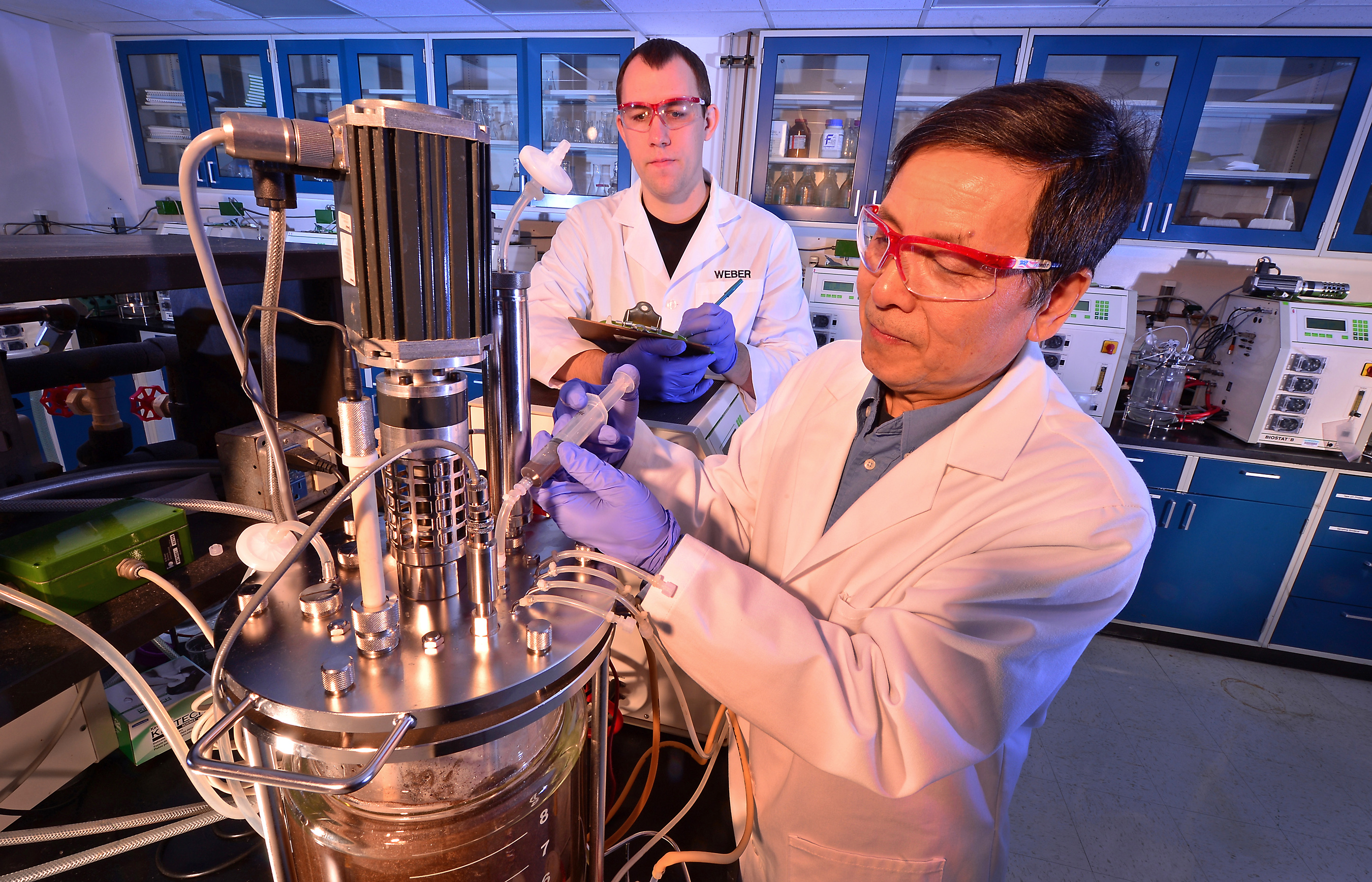
This Gold Standard guide uses a genuine USDA bioreactor photograph, authoritative WHO and FDA references, and original fictional mass-balance examples. Its aim is to teach evidence, quality and bioprocess reasoning—not to provide instructions for operating cultures or producing regulated substances.
THE GOLD STANDARD · INDUSTRIAL MICROBIOLOGY
Understand the organism, the product and the manufacturing evidence
Chapter index
Microorganisms, manufacturing stages and measurements · Chapters 1–13
- What industrial microbiology actually investigates
- Microbes are varied biological producers
- Fermentation has several meanings in science and industry
- Product goals determine the questions that matter
- Upstream and downstream processes have separate jobs
- The bioreactor is a controlled measurement environment
- Batch and continuous operation have different definitions
- Microbial growth is not identical to product formation
- Cell identity and stability are quality concerns
- Contamination changes both safety and interpretation
- Metabolism links inputs to outputs
- A mass balance must name what is included
- Worked example: concentration and batch amount
Scale, process controls, purity and quality · Chapters 14–27
- Worked example: recovery changes the usable amount
- Yield and productivity require separate denominators
- Scale changes more than the size of a vessel
- Sensors report physical quantities, not intentions
- pH is logarithmic and reflects only part of the system
- Oxygen availability and oxygen use are different concepts
- Mixing and heat transfer matter at large scales
- Samples provide limited views of a changing process
- Contamination control protects quality and safety
- Biological identity is not a label that never changes
- Recovery and purification do not create new product mass
- Product purity and potency are distinct attributes
- Release decisions are governed by specifications
- Validation evaluates the process against defined expectations
Products, responsible industry and worked cases · Chapters 28–38
- Good documentation permits investigation and correction
- Food fermentation serves several purposes
- Industrial enzymes have measured functions
- Biological medicines demand specialized quality systems
- Biofuels involve chemistry and economics as well as microbes
- Waste treatment is a different microbial task
- Circular bioeconomy claims need a complete accounting boundary
- A productivity dashboard can hide product failure
- Worked quality case: accepted yield differs from recovery
- Practice: change the reporting period
- Frequently asked questions and learning transfer
1. What industrial microbiology actually investigates
Industrial microbiology studies the roles of microorganisms and their biological processes in producing materials, foods, enzymes, medicines and other useful outputs. It links microbial physiology and metabolism with engineering, product quality, economics and safety. The field is broader than familiar food fermentation, and not every microbial production system uses the same organism, vessel or operating environment.
The WHO guidance on biotherapeutic products describes biological medicinal products made with suitably characterised bacteria, yeasts, fungi or other cells. The gold standard is to explain which organism and product relationship is being investigated, what outcome is measured and which safety and quality requirements apply. Educational understanding does not authorise unsupervised industrial cultivation.
2. Microbes are varied biological producers
Bacteria, yeasts and filamentous fungi differ in cellular structure, metabolism, nutritional needs and the products they may generate. A strain used for a food process is not automatically suitable for medicine production, and a laboratory organism can behave differently under manufacturing conditions.
An investigator needs the correct biological identity and knowledge of the product specification before interpreting results. Broad names such as yeast or bacteria do not identify every property of a production strain. The Microbiology and Biochemistry roots provide underlying cellular and molecular concepts.
3. Fermentation has several meanings in science and industry
In metabolic biochemistry, fermentation refers to particular energy-generating pathways. In industrial usage, fermentation may describe the controlled cultivation of microorganisms for products, including processes where oxygen is deliberately present. These meanings overlap but should not be confused as universal synonyms.
A bioprocess producing an enzyme may use a different metabolic and operational design from one producing an acid or fermented food. An educational report should state which definition is being used. The Fermentation root examines the wider history and biology of these processes.
4. Product goals determine the questions that matter
An industrial process may aim to produce living cells, an enzyme, a small molecule, a recombinant protein or a changed food product. These outcomes require different measurements and quality criteria. A high biomass reading cannot be substituted for a high concentration of the desired product, and a product’s mass does not alone establish its purity.
Begin with a product identity, legitimate application and specification. Then ask which physical and biological measurements could support an assessment of progress. A process that produces a large amount of unwanted material is not successful because a fermenter operated for a long period.
5. Upstream and downstream processes have separate jobs
Upstream processing concerns preparation and operation of the biological production stage under appropriate controls. Downstream processing involves recovering, separating, purifying or formulating the desired material as required. The exact steps and their hazards depend on the product and regulated environment.
The FDA ICH Q7 manufacturing guidance describes how process controls, monitoring, recovery and purification support active pharmaceutical ingredient quality. A classroom flow diagram can show these stages without providing operational instructions for cultivating microorganisms or making medicines. The important learning question is where material and uncertainty move along the process.
6. The bioreactor is a controlled measurement environment
A bioreactor provides a managed environment for a biological process and may contain systems for mixing, monitoring or delivering relevant materials. It is not a magical container that guarantees the desired organism will behave predictably. The quality of any process depends on its organism, vessel, controls, measurement and appropriate qualified oversight.
The featured photograph shows USDA researchers working with a research bioreactor. It is evidence of a type of equipment, not a specific instruction for how to operate one. The NIST Bioprocessing Laboratory describes controlled biological research and the measurements needed to characterise cellular production and impurities.
7. Batch and continuous operation have different definitions
In batch operation, a defined production cycle is started and later completed. In continuous operation, materials may flow into and out of a system during ongoing use. Some processes use intermediate strategies, but the basic distinction helps explain how residence time, material balance and product collection are described.
No mode is universally superior. Different product risks, contamination controls, process reliability and quality-assurance needs can change which arrangement is appropriate. A student should compare conceptual process boundaries and observed outcomes, not infer an industrial operating plan from the word continuous alone.
8. Microbial growth is not identical to product formation
An increase in cell population may be useful for some outputs, while other processes seek molecules produced by cells. The desired product can depend on cell state and other conditions in ways not captured by total biomass alone. A growth curve and a product assay therefore answer distinct questions.
A process study should show which measurement describes biomass, viable cells, product identity or usable recovered material. A large optical signal is not automatically proof that the intended product accumulated. The Measurement root clarifies why the instrument’s quantity needs a defined meaning.
9. Cell identity and stability are quality concerns
Manufacturing depends on appropriate confidence in the identity and relevant properties of the biological system being used. Characteristics may change over repeated handling or process stages, and contamination or misidentification can undermine a product claim. Qualified organisations maintain suitable records and controls based on product risks.
The FDA ICH Q7 manufacturing guidance discusses cell-bank maintenance and traceability in regulated biomanufacturing. These controls are not a public recipe for operating cultures. Their importance is conceptual: a finished label cannot repair an unknown or poorly documented biological source.
10. Contamination changes both safety and interpretation
Unintended microorganisms or other impurities can affect yield, composition and safety. Their importance depends on the product, process and applicable standards. The absence of visible cloudiness or odour is not reliable proof that a batch is free of contaminants, nor is every abnormal reading evidence of a particular species.
Quality assessment relies on suitable methods, environmental controls and trained personnel. The FDA ICH Q7 manufacturing guidance discusses process and microbiological monitoring in relevant manufacturing stages. A good scientific article separates observation from identification and avoids advising readers to diagnose contamination by appearance alone.
11. Metabolism links inputs to outputs
Microorganisms transform substrates through metabolic networks that allocate carbon, energy and other resources to maintenance, growth and products. A simplified diagram can show carbon entering a cell and products leaving, but real metabolism includes multiple pathways, by-products and environmental interactions.
An observed reduction in a substrate does not imply every lost unit became the desired product. Some material may support cell growth or leave in other forms, and sampling uncertainty matters. Mass balance and suitable assays help investigate the process without inventing a perfect conversion.
12. A mass balance must name what is included
Mass balance follows the principle that material is accounted for through relevant inputs, outputs and accumulation. A bioprocess can contain biomass, gases, dissolved products, residues and waste. Reporting only one measured product while ignoring other routes can make conversion look greater than physically plausible.
An educational model should identify the system boundary and use compatible mass units. If a hypothetical batch begins with a measured amount of one component, it cannot create unlimited mass of that same component without relevant inputs or a changed definition. The Chemistry root develops conservation and reaction reasoning.
13. Worked example: concentration and batch amount
Suppose a fictional vessel contains 1,000 litres of material and a validated assay finds 4 grams of a specified product per litre. Under the assumption that the mixture is uniform and the volume is correctly measured, total product present is 1,000 × 4 = 4,000 grams, or 4 kilograms.
That figure describes an estimated amount before recovery. It does not indicate purity, biological activity, product safety or permission to manufacture a regulated material. Sample representativeness and analytical uncertainty can alter the estimate. The exercise teaches the importance of units rather than a method for producing the material.
14. Worked example: recovery changes the usable amount
Continue the fictional 4-kilogram batch. Suppose a documented recovery process obtains 70% of the specified product while retaining its identity under the model. Then recovered amount is 4 × 0.70 = 2.8 kilograms, with 1.2 kilograms not recovered in the defined product stream.
This is a simplified accounting example, not a process recipe. Loss may reflect several pathways and measurement uncertainties; it is not proof that the missing product was destroyed or became safe waste. A manufacturing result should distinguish material present, material recovered and material meeting final quality requirements.
15. Yield and productivity require separate denominators
Yield can compare product to a defined input or theoretical potential, while productivity may compare product production with volume and time. A percentage of recovered product is not automatically the same as yield on substrate, and a concentration is not a rate. These concepts become misleading when labels omit the denominator.
Suppose a fictional batch recovers 2.8 kilograms over a 20-hour reporting period from the one-thousand-litre example. Average recovered output over that period is 2.8 ÷ 20 = 0.14 kilograms per hour, under the stated whole-batch accounting. It is not an intrinsic biological reaction rate or an industrial benchmark.
16. Scale changes more than the size of a vessel
A small experimental bioreactor and an industrial vessel can differ in mixing, heat transfer, measurement, physical geometry and biological behaviour. Simply multiplying every laboratory quantity by a common scale factor cannot guarantee identical output or quality. Engineering decisions depend on the product and the processes being controlled.
Scaling requires trained personnel, qualified design, suitable validation and the applicable safety system. This guide does not specify operating settings or cultivation procedures. The Engineering and Manufacturing roots connect scientific assumptions with real industrial systems.
17. Sensors report physical quantities, not intentions
Bioprocess equipment can collect measurements of temperature, acidity, pressure and other physical conditions. A sensor tells the operator something about the quantity it actually measures under its calibrated method, not directly whether a final product will meet every specification. A stable reading can coexist with a biological change elsewhere.
The NIST Bioprocessing Laboratory illustrates the role of cell identity, viability, morphology and impurity measurements. Researchers must connect signals to their intended interpretation and record uncertainty, not convert the presence of a dashboard into a declaration of process quality.
18. pH is logarithmic and reflects only part of the system
pH concerns hydrogen-ion activity and provides information about acid–base conditions, rather than directly measuring the quantity of desired product. A difference of one pH unit corresponds to an approximately tenfold difference in hydrogen-ion activity under the standard definition. Buffering and other chemical species can influence how conditions change.
Two solutions can have the same pH and quite different buffering capacities. A simple reading therefore cannot prove that microorganisms are thriving or that a finished food or pharmaceutical product is safe. Measurements must be interpreted within the specific authorised manufacturing process and analytical system.
19. Oxygen availability and oxygen use are different concepts
Microorganisms vary in whether and how they use oxygen, and industrial processes vary in their designs. An oxygen-related sensor can indicate a local physical condition, while the biological rate of oxygen consumption involves additional measurements and a model. The words aerobic and anaerobic identify broad physiological contexts, not interchangeable recipes.
Scale can change the distribution of dissolved gases and the degree to which a sample represents a whole vessel. The Biochemistry and Engineering roots explain why physiology and transport processes must be considered together when interpreting data.
20. Mixing and heat transfer matter at large scales
A production vessel can contain regions with different temperature, dissolved substances or flow patterns. Larger equipment does not automatically reproduce the physical behaviour of a small experimental container. Geometry, material properties and energy movement affect how measurements and biological conditions are distributed.
Scale-up research evaluates these effects using qualified engineering models and appropriately controlled tests. It is misleading to say that multiplying the container volume by ten will multiply every useful outcome by ten. A successful design must meet product, safety and quality requirements at the intended scale.
21. Samples provide limited views of a changing process
A sample can differ from the process as a whole because of timing, location, separation or handling. Laboratory values also have measurement uncertainty. A single test result should not be interpreted as a complete continuous record of the biological system, particularly when the measured quantity changes rapidly.
Sampling plans require appropriate technical expertise, biological containment and product-specific controls. This guide does not describe how to obtain or culture samples. The scientific habit is to document what the analysis represents and which parts of the process remain unobserved.
22. Contamination control protects quality and safety
Unwanted microorganisms or extraneous materials can change product identity, purity or performance. Some contaminants cannot be recognised reliably by visual inspection. Controls therefore depend on trained personnel, suitable facility design, validated procedures and relevant testing rather than guesses based on colour or smell.
The FDA ICH Q7 manufacturing guidance addresses microbiological control in applicable pharmaceutical manufacturing. The principles help readers understand quality systems, but operational actions require competent facilities and the regulatory rules applying to the material.
23. Biological identity is not a label that never changes
Manufacturing may rely on characterised biological sources whose identity and relevant properties need maintained records. Errors in labels, unintended changes or contaminants can undermine a result even when the output quantity looks plausible. A process team should distinguish traceable biological material from an assumed identity.
Qualified controls and documentation provide evidence of what material was used and what tests support its description. The lesson is one of provenance: a large batch cannot be considered trustworthy without an adequately documented starting system and appropriate verification.
24. Recovery and purification do not create new product mass
Downstream operations can separate the intended material from other constituents, but a recovery percentage is not the same as new biological production. The mass of target product recovered cannot logically be treated as larger than the product initially present without additional accounting for measurement, conversion or changed definitions.
In a fictional batch with 4 kilograms initially present and 70% recovered, the reported 2.8 kilograms describes target material in one defined output stream. Purity and activity remain separate tests. See Chemistry and Measurement for mass-balance and analytical reasoning.
25. Product purity and potency are distinct attributes
Purity concerns the extent to which a material contains the specified product relative to impurities under an appropriate test. Potency or biological activity concerns its functional effect under a defined assay. A product can be present at substantial mass while failing a functional requirement, or show activity while containing unacceptable impurities.
Quality assessment therefore needs methods matched to each attribute. The WHO biotherapeutic standards overview explains why complex biological medicines require characterisation and quality assurance beyond simple production totals.
26. Release decisions are governed by specifications
A product is not necessarily ready for distribution just because a production process has completed. Its identity, impurity profile, relevant biological characteristics and other attributes may need verification against predefined specifications. Which tests apply depends on the product and jurisdiction.
A quality system distinguishes material produced, material recovered, material tested and material authorised for release. Each stage answers a different question. A manager should not redefine acceptance criteria after an inconvenient result merely to declare a batch successful.
27. Validation evaluates the process against defined expectations
Process validation is not a decorative statement that equipment once worked. It involves appropriate evidence that a process can perform as intended under defined conditions and quality expectations. The applicable controls depend on whether the system concerns food, chemicals, biological medicines or another regulated product.
The FDA manufacturing guidance discusses quality systems and critical manufacturing controls. Evidence from a small classroom model is not validation of an industrial production process, and a general article cannot certify a particular facility.
28. Good documentation permits investigation and correction
Production records can help reconstruct what happened, which measured values were collected and when a deviation arose. Without reliable timestamps, identifiers and versioned procedures, investigators may struggle to distinguish a material fault from a data-entry or calibration problem. The quality of records is part of the trustworthiness of the output.
Documentation must also protect confidential information and respect legitimate access controls. A clear public explanation can describe the method without exposing trade secrets or sensitive personnel data. The Information Ethics root adds that governance dimension.
29. Food fermentation serves several purposes
Microorganisms contribute to the flavour, texture, processing and sometimes preservation of foods through established manufacturing techniques. The resulting foods are diverse, and their microbial or chemical characteristics cannot be inferred from the word fermented alone. A safe commercially produced product depends on suitable product-specific controls.
The FDA process-contaminant overview notes that unwanted substances can form during food processing, including fermentation. No general article can declare every homemade fermented food safe or provide safe fermentation thresholds for all products.
30. Industrial enzymes have measured functions
Microorganisms can be used to manufacture enzymes that support food processing, industrial chemistry and other applications. An enzyme’s useful role depends on its activity, substrate specificity and suitability for the product. The presence of an enzyme molecule does not automatically establish that it performs the needed transformation.
An activity assay and a mass assay may therefore yield different information. A process could produce more protein but less measured activity after handling, depending on the material and conditions. The Biochemistry root explains enzymes as catalysts rather than universal ingredients.
31. Biological medicines demand specialized quality systems
Some biotherapeutic products are made using microbial or other cellular platforms. Their manufacturing and testing involve complex standards intended to protect identity, safety, efficacy and consistency. This differs from production of ordinary research materials or consumer food products.
The WHO biotherapeutic overview explains why advanced biological products created new quality challenges. This guide offers education only; medicines are developed and produced within professional and regulatory frameworks, not as general laboratory exercises.
32. Biofuels involve chemistry and economics as well as microbes
Some industrial microbial processes produce chemicals that can serve as fuels or feedstocks. Their commercial suitability depends not just on the concentration achieved but also on material inputs, recovery, energy demand, environmental consequences and market conditions.
An increased laboratory titer does not establish a positive lifecycle benefit or profitable production. A 2026 ASM study on fermentation metabolic imbalance illustrates how high-titer targets can meet physiological limits in particular engineered strains. Research findings must not be converted into universal operating prescriptions.
33. Waste treatment is a different microbial task
Microbial processes can contribute to the transformation or removal of selected constituents in wastewater and other managed environmental systems. The desired outcome may be reducing a contaminant rather than collecting a saleable microbial product. That changes the relevant measurements and regulatory requirements.
A reduction in one dissolved concentration does not automatically mean all material was destroyed or that the treated water is safe for any particular use. Verify the specific chemical forms, mass pathways and applicable discharge criteria with qualified environmental professionals. The Environmental Science root provides broader context.
34. Circular bioeconomy claims need a complete accounting boundary
Using residues as feedstocks may reduce some waste or create useful products, but the environmental result depends on collection, transport, energy, processing and the uses displaced. A circular process should be evaluated with clear boundaries rather than assumed sustainable because its input once had low market value.
State which environmental or economic quantity is being compared and what was excluded. A project might valorise an industrial by-product while requiring significant energy and quality controls. The Economics and Industrial Safety roots inform the wider trade-offs.
35. A productivity dashboard can hide product failure
Imagine a fictional facility measures kilograms produced per hour but does not initially count batches rejected for failing quality. Output volume may rise while the amount of usable compliant product falls. The key question is which material actually meets the acceptance requirements.
Track gross material, recovered product, accepted product, costs and incidents as separate indicators. A single composite score can hide critical failures. The same principle applies in laboratory research: an attractive plot of microbial growth is not a substitute for validated identity, purity and activity measurements.
36. Worked quality case: accepted yield differs from recovery
Suppose a fictional batch contains 4 kilograms of target material, of which 70% is recovered: 2.8 kilograms. A subsequent quality assessment accepts 75% of that recovered mass under the invented acceptance model. Accepted output is 2.8 × 0.75 = 2.1 kilograms, or 52.5% of the original 4 kilograms.
Recovery and acceptance are distinct proportions with distinct denominators. Multiplying 70% by 75% is appropriate here only because the second percentage applies to the recovered stream. The result is a teaching calculation, not a claim that actual manufacturing quality is judged solely by mass.
37. Practice: change the reporting period
Using the fictional batch, 2.8 kilograms recovered over a 20-hour reporting period gives 0.14 kilograms of recovered output per hour. If the time interval instead includes additional preparation and maintenance hours, the measured average changes. A rate without a clearly defined time window is difficult to compare.
Likewise, production per litre can refer to initial vessel volume, actual working volume or another defined basis. State the unit and denominator before comparing two sites. The calculation supports clear reporting but does not establish that changing one parameter will improve a real biological process.
38. Frequently asked questions and learning transfer
Does fermentation always mean oxygen is absent? The biochemical and industrial uses of the term need distinction. Is more biomass always more product? No. Does a high titer prove purity or safety? No. Is a recovered mass the same as a quality-accepted mass? No. Does scaling a vessel preserve laboratory performance automatically? No.
Continue with Microbiology, Fermentation, Biochemistry, Chemistry, Engineering, Industrial Safety and Measurement. Key sources are WHO, FDA ICH Q7 and NIST. All calculations are fictional. The wider method is The Gold Standard of Education: Learning Transfers into Life.
| Quantity | Value |
|---|---|
| Assumed batch volume | 1,000 litres |
| Assayed product concentration | 4 g/L |
| Product initially present | 4 kg |
| 70% recovered | 2.8 kg |
| 75% of recovered accepted | 2.1 kg |