
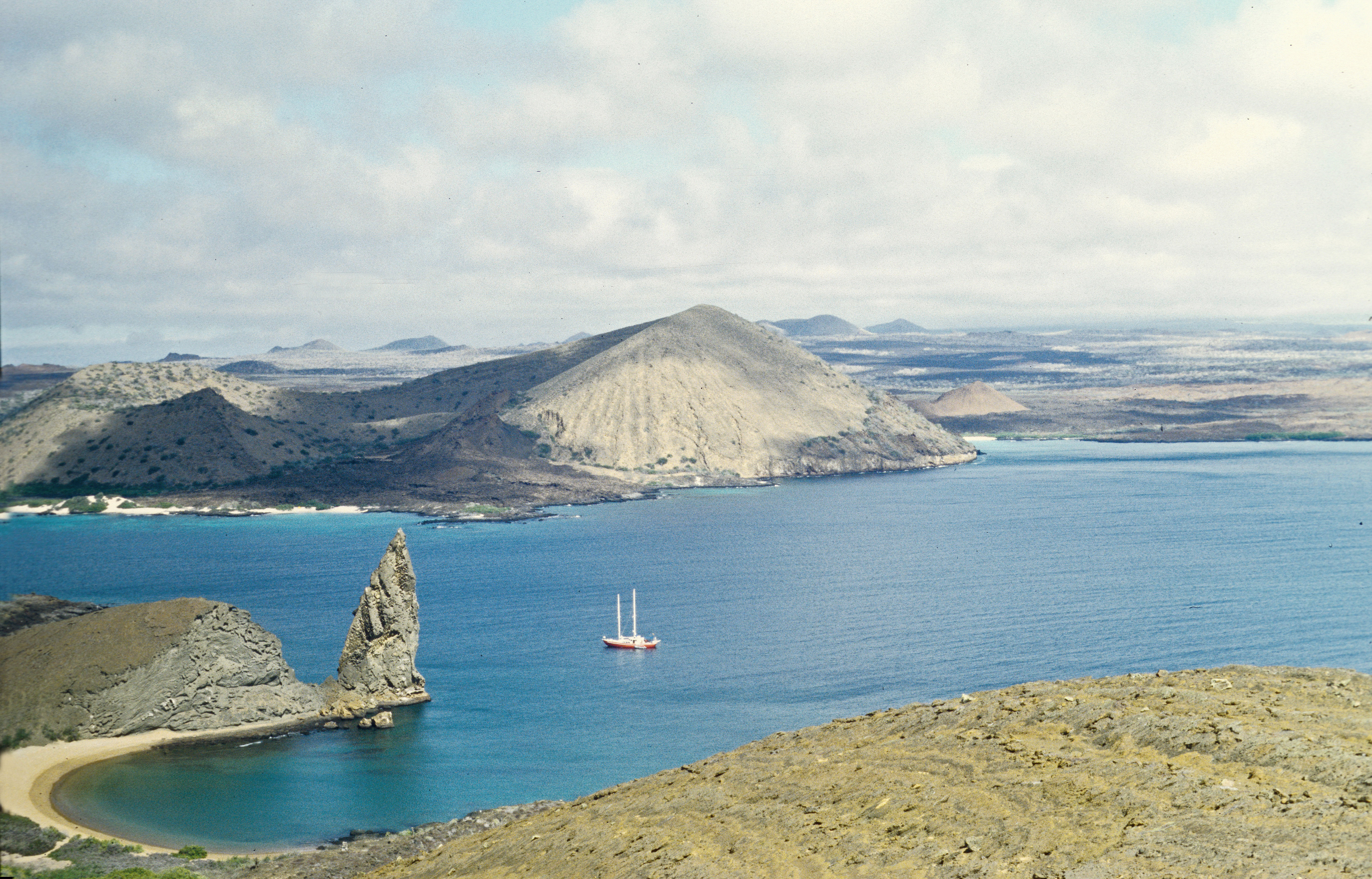
Islands show how life arrives, changes and sometimes disappears in places bounded by distance and habitat. Island biogeography studies colonisation, local extinction, species richness and evolution, connecting ecology with geology, conservation and the influence of human movement.
This guide walks from the classical immigration–extinction framework to species–area relationships, sampling, endemic biodiversity and conservation choices. Its two worked examples distinguish model predictions from observed communities and show why species counts need ecological context.
THE GOLD STANDARD · ISLAND BIOGEOGRAPHY
Understand the arrival, persistence and evolution of island life
Chapter index
Explore ten connected chapters
- Understand islands as connected but bounded ecological systems
- Follow immigration, extinction and species turnover
- Explain area, isolation and dispersal together
- Treat evolution and endemism as historical processes
- Recognise changing islands, coastlines and source pools
- Worked example: apply the species–area model without overclaiming
- Survey richness without confusing non-detection and extinction
- Protect endemics while avoiding simplistic reserve design
- Practise with a dynamic equilibrium and a second area comparison
- Connect island biogeography to conservation and wider ecology
CHAPTER 1 OF 10 · Define the island system
1. Understand islands as connected but bounded ecological systems
Back to contentsIsland biogeography studies the distribution, arrival, persistence, extinction and evolutionary diversification of life on islands and other suitably defined isolated habitats. Oceanic islands are especially useful for observing how area, distance, habitat and geological history shape biological communities. Yet they are not interchangeable experiments. A volcanic island, coral atoll, continental fragment and urban habitat patch differ in origin and ecological opportunity.
Classical research associated with Robert MacArthur and Edward O. Wilson explains species richness through the balance of immigration and local extinction. Modern island biogeography also considers evolution, geological dynamics, species traits, environmental change and people. Research published in Current Biology in 2021 describes islands as important settings for understanding how ecology and evolution interact. A single species count is therefore a starting point rather than a complete ecological explanation.
The gold standard is a claim that states the island, taxonomic group, area, degree of isolation, sampling method and period under study. Researchers should distinguish observed richness from modelled expectations and identify which environmental and evolutionary processes could produce the pattern. Islands are valuable because their boundaries help frame questions, not because every causal influence has been removed.
Investigation: Choose an island system and name its geological origin, potential colonists, relevant habitat and the evidence needed to determine how a species arrived.
CHAPTER 2 OF 10 · Define the island system
2. Follow immigration, extinction and species turnover
Back to contentsIn the classic equilibrium model, new species arrive from a source pool while established island populations can disappear locally. Immigration generally becomes harder as a greater fraction of the available source pool is already represented, while local extinction can increase as more species share limited habitat and population sizes remain vulnerable. An equilibrium richness describes a balance in rates under the model’s assumptions.
Equilibrium does not mean the identity of species remains fixed. One bird species might arrive while another disappears, leaving the same total richness but a changed community. This turnover matters for ecosystem functions, endemism and conservation. A stable species count could conceal the disappearance of a rare native species and its replacement by a widespread introduced species. Counts should be paired with identification and turnover data.
Model rates also depend on changing conditions. Habitat loss, climatic variation, invasions, dispersal traits and changing source populations can shift the balance. The model does not guarantee that real islands settle into a timeless fixed number. A strong study asks whether observations support the proposed processes and whether survey effort might make an apparent arrival or extinction a detection artefact.
Investigation: Describe a sequence where two species replace each other but total richness remains constant. Explain why a constant richness value would miss the ecological change.
CHAPTER 3 OF 10 · Study area and evolution
3. Explain area, isolation and dispersal together
Back to contentsLarger islands often have greater species richness because they contain more habitats, intercept more arrivals and can support larger populations. More isolated islands may receive fewer colonists from relevant source populations. The strength of these effects varies among taxa, landscapes and time periods. An insect capable of long-distance dispersal may experience distance differently from a flightless animal or a plant with poorly transported seeds.
An island’s mapped land area is not the same as the amount of suitable habitat for one species. A large island with only a small patch of required forest can provide less usable area for a specialist than a smaller island dominated by that habitat. Measure structural diversity, elevation, freshwater availability, disturbance and habitat quality where relevant. Distances should be defined from biologically plausible sources, not an arbitrary point on a map.
The ecological meaning of isolation also changes when people build transport links or bring organisms deliberately and accidentally. New arrivals can overwhelm simple distance effects. Scientists should therefore distinguish natural colonisation potential from anthropogenic introductions and explain whether the analysis concerns native taxa, all observed taxa or a specified subset.
Investigation: Compare two imaginary islands with equal area but different distance and habitat quality. State why the model would not justify a precise species-count prediction without parameters.
CHAPTER 4 OF 10 · Study area and evolution
4. Treat evolution and endemism as historical processes
Back to contentsIsolated populations may diverge as mutations, natural selection, genetic drift and other processes act over generations. Some become endemic species, restricted naturally to one island or island group. Endemism can make islands particularly important for biodiversity, but it is not synonymous with every species found there. A widespread migrant may use an island seasonally without being an endemic member of the local biota.
Evolutionary histories depend on geological time, dispersal and habitat change. Islands may emerge, erode, subside, connect temporarily or experience major volcanic and climatic disturbances. A 2017 Science review, Island biogeography: Taking the long view of nature’s laboratories, explains why geological and evolutionary processes must be integrated with ecological models. Species lists by themselves cannot reconstruct diversification histories.
Field observations can be combined with phylogenetic analysis, fossil evidence, geological chronology and ecological traits. Each has its own uncertainty. A phylogenetic relationship can suggest a colonisation history without proving an exact arrival year. Careful research presents competing explanations rather than declaring every similarity an evolutionary adaptation caused by island conditions.
Investigation: Distinguish native, endemic and introduced taxa in one hypothetical checklist, and explain the evidence needed to establish endemism.
CHAPTER 5 OF 10 · Model biodiversity
5. Recognise changing islands, coastlines and source pools
Back to contentsMarine islands are not static rectangles of habitat. Sea-level changes can expose land bridges or isolate previously connected populations. Volcanic activity may create new terrain; erosion and subsidence reduce area; storms and extreme temperatures modify habitat. Freshwater availability and local productivity can affect survival independently of distance from the nearest continent. Geological history changes both colonisation opportunities and extinction risks.
Source pools also change. A migratory species may use multiple islands, while propagules from one archipelago can colonise another. Human trade and transport increase the movement of organisms and may alter the roles of islands within dispersal networks. A model that assumes one permanent mainland source can be informative for a teaching exercise but inadequate for a complex real archipelago.
Reconstructing the system requires geological maps, survey history and a clearly dated area estimate. The current shoreline is not proof of the habitat available thousands of years ago. If researchers combine records from different eras, they should report whether the species and area measurements correspond to comparable historical conditions. This protects against confident but misleading explanations of observed richness differences.
Investigation: Write a timeline with one geological event, one ecological consequence and one way the event could affect modern biodiversity records.
CHAPTER 6 OF 10 · Model biodiversity
6. Worked example: apply the species–area model without overclaiming
Back to contentsA commonly used empirical representation is S = cA^z, where S denotes species richness, A area, and c and z are fitted parameters with units and interpretation determined by the sampling and region. The equation is not a universal law for every taxon. Consider a fictional comparison in which an island of 10 square kilometres has an expected richness of 20 species for a defined study group and the fitted exponent is z = 0.25.
Suppose a second island has area 160 square kilometres and other model conditions are held comparable. The area ratio is 160 ÷ 10 = 16. The model predicts S2/S1 = 16^0.25 = 2, so S2 = 40 species. This is a doubled prediction for a sixteenfold area difference under the chosen fitted exponent. It does not mean real surveys must find exactly forty species or that area caused every difference.
The study would need independent observations, comparable detection methods and attention to isolation, habitat and evolution. The coefficient may change across taxonomic groups or regions, while species count uncertainty grows when organisms are difficult to detect. A sound article labels the numerical prediction as conditional and explains which evidence would test it.
Investigation: Confirm 16^0.25 = 2 and the prediction of 40 species; identify two factors other than area that may explain a real difference.
| Fictional species–area illustration | Island 1 | Island 2 |
|---|---|---|
| Area | 10 km² | 160 km² |
| Area ratio | 1 | 16 |
| Fitted exponent | z = 0.25 | z = 0.25 |
| Modelled richness | 20 species | 40 species |
CHAPTER 7 OF 10 · Test and conserve
7. Survey richness without confusing non-detection and extinction
Back to contentsIsland inventories are affected by sampling effort, season, observer expertise and detectability. Rare nocturnal animals, cryptic insects and short-lived plants may be missed in a single visit. A species absent from a contemporary list may be genuinely lost or merely unrecorded; historical sightings may also contain taxonomic errors. Repeat surveys, expert identification and carefully documented occurrence records improve inference.
Sampling should define the spatial boundary and the focal group. A checklist of breeding birds differs from a list of all occasional bird visitors, and an inventory of native vascular plants differs from one including garden cultivars. Compare like with like before interpreting species–area relationships. A larger island may appear richer partly because more locations and habitats were searched.
Evidence of local extinction typically requires much more than one unsuccessful search. Researchers evaluate previous records, suitable habitats, population biology and detection probability. Ethical and legal obligations apply when entering protected habitats or handling organisms. Many important questions can be investigated with authorised records and non-invasive observation, rather than disturbing vulnerable island populations.
Investigation: Construct a survey report template with effort, season, habitat, species identification confidence and a warning about non-detection.
CHAPTER 8 OF 10 · Test and conserve
8. Protect endemics while avoiding simplistic reserve design
Back to contentsEndemic island species can be especially vulnerable to habitat changes, introduced predators, competition, disease and climate-related impacts. Conservation often involves controlling harmful introductions, protecting remaining habitat, supporting recovery of native species and maintaining ecological functions. But interventions must consider non-target effects, local people and the likelihood of genuine long-term success.
Island biogeography influenced the debate over a single large reserve versus several smaller reserves. There is no universal answer based only on total protected area. Species distributions, habitat diversity, connectivity, disturbance, genetic exchange and feasible management determine what different designs can protect. A set of smaller reserves may represent more habitats while a larger contiguous reserve may support populations needing extensive area; neither can be selected from one simple species–area calculation alone.
Management claims need before-and-after monitoring and appropriate comparisons. Removing an introduced organism is not automatically proof that the intended endemic populations have recovered. Human livelihoods, cultural places and traditional ecological knowledge also belong in responsible planning. The gold standard keeps conservation outcomes and their social consequences visible.
Investigation: Compare one large and three smaller protected areas with equal total area, naming ecological conditions that could favour each arrangement.
CHAPTER 9 OF 10 · Practise and connect
9. Practise with a dynamic equilibrium and a second area comparison
Back to contentsConsider a fictional island model in which annual arrival of previously unrepresented species is I(S) = 12 − 0.5S, and annual local species loss is E(S) = 0.25S, within the model’s meaningful range. Balance occurs when 12 − 0.5S = 0.25S, giving 12 = 0.75S and equilibrium richness S = 16. At that value the model predicts four arrivals and four losses per year—not an absence of turnover.
Now consider another hypothetical species–area comparison: an island of 5 square kilometres has expected richness of 12, while a comparable second island has area 80 square kilometres. With fitted z = 0.25, the area ratio is again sixteen and predicted richness doubles to 24. The two exercises answer different questions: one describes rate balance under defined functions, and the other a conditional empirical area relationship.
Neither result should be reported as an observed island population. Real rates can vary over time, and immigration–extinction functions may not be linear. The objective is to reveal the assumptions behind an apparently precise number, then design observations capable of testing whether those assumptions are reasonable.
Investigation: Reproduce S = 16 with four arrivals and four local losses under the fictional rate model; separately verify 24 species from the area relationship.
Practical answer: I(S) = 12 − 0.5S and E(S) = 0.25S balance at S = 16, when each rate equals 4 species/year. Another fictional area ratio of 16 predicts a twofold richness difference with z = 0.25.
CHAPTER 10 OF 10 · Practise and connect
10. Connect island biogeography to conservation and wider ecology
Back to contentsBegin with Ecology for species interactions and populations, Conservation Biology for protecting vulnerable taxa, and Biodiversity for the range of biological variation. Geography helps describe area and spatial separation, while Hydrology adds water and habitat context where relevant.
The related Invasive Species Ecology guide examines introduced organisms, pathways, impacts and proportionate management. Statistics supports species–area fitting, uncertainty and detection; Environmental Science links ecological findings with landscape change. Education supports rigorous learning through cross-disciplinary comparisons.
The transferable habit is to ask what a species count measures, which populations can arrive, how habitat and history shape survival, and whether a conservation proposal would protect the intended values. Islands make ecological patterns visible, but never eliminate uncertainty. A gold-standard explanation can be revised when the next survey or genetic study reveals better evidence.
Investigation: Choose one island research question, state the hypothesis and a testable comparison, and identify which findings would change the conclusion.
Questions learners often ask
Does a larger island always contain more species? No. Area is one important factor, with isolation, habitat, time and sampling also affecting observations.
Does equilibrium mean species stop arriving or going extinct? No. Immigration and extinction rates can balance while identities turn over.
Is endemic the same as native? No. Endemic describes a taxon naturally restricted to a particular geographic area.
Does one species–area exponent determine the best reserve design? No. Species, habitat, connectivity and conservation objectives must also be considered.
Authoritative sources and research limitations
The research primer Island biogeography (Current Biology, 2021) reviews ecology, evolution and conservation. Island biogeography: Taking the long view of nature’s laboratories (Science, 2017) explains geological and evolutionary processes. The peer-reviewed niche-based theory of island biogeography (2024) examines classical assumptions and species–area relationships, while A roadmap to plant functional island biogeography highlights dispersal, establishment, interactions, extinction and evolution.
All island areas, model rates and richness values in the examples are invented. These calculations do not estimate biodiversity for an actual island or establish an appropriate conservation intervention without field evidence.