
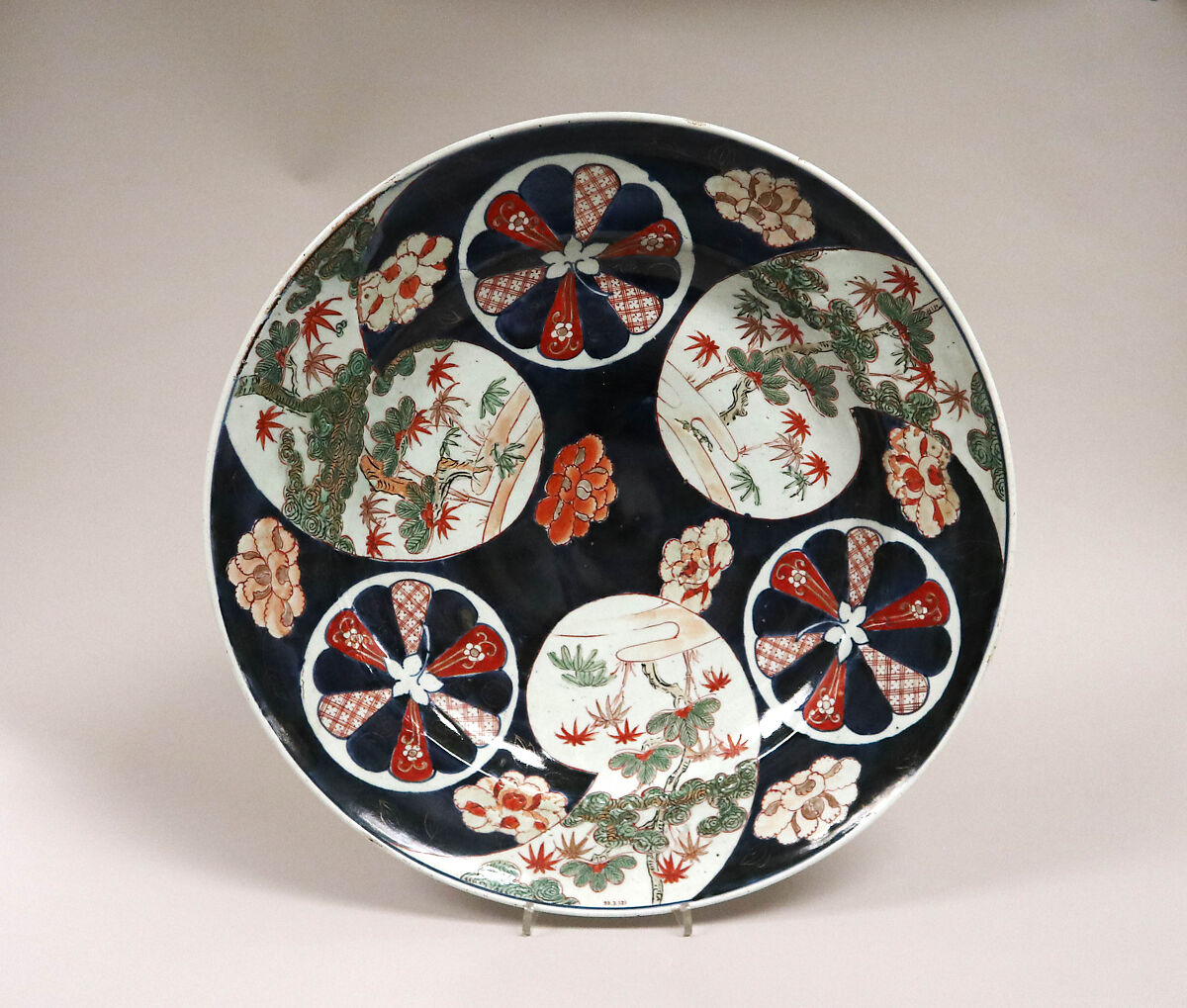
A rough storage jar and a brilliantly painted Arita porcelain dish may both be Japanese ceramics, but they answer different questions about material, technique, social life and trade. The distinction matters when we try to identify where an object came from or why it was made.
The Gold Standard of Japanese Ceramics follows clay, kiln, form, historical regional production, tea practices, international exchange, conservation and technical evidence. I use actual museum records as anchors, then distinguish visible features from the process or purpose a photograph alone cannot reveal.
This 47-chapter guide includes three fictional production and resource calculations, official Japanese heritage reading and a documented 1720 Arita Ko-Imari dish from The Metropolitan Museum of Art. The featured photograph is the museum’s public-domain record, not a rendering or a claim about any unidentified antique.
Chapter index
Clay, firing history and the major kiln traditions · Chapters 1–16
- Japanese ceramics cannot be reduced to one rustic tea bowl
- Learn the material categories before naming a style
- The clay body is a mixture of minerals and processing choices
- From forming to firing, every stage changes the work
- Recognise the six ancient kiln traditions accurately
- Echizen shows continuity through changing demand
- Seto illustrates an important glazed tradition
- Tokoname connects clay and practical objects
- Shigaraki demonstrates clay and natural surface character
- Bizen ware is not defined by a glaze recipe alone
- Tanba vessels reflect use, kiln and later appreciation
- Kiln technology shaped what regional potters could make
- Arita porcelain was a transformative early-modern industry
- Imari often describes a trade association, not only a kiln
- The seventeenth-century porcelain trade was international
- Ko-Imari and overglaze colour need correct terminology
Arita porcelain, tea culture and ceramic processes · Chapters 17–31
- Museum documentation is stronger than visual guesswork
- Kakiemon is more specific than a colourful floral plate
- Nabeshima wares illustrate patronage and workshop context
- Tea practice changed how some older utilitarian forms were valued
- Raku is a specific history, not a synonym for imperfect
- Hagi, Karatsu and other regional wares add diversity
- Shino and Oribe belong to changing Mino-related histories
- Folk craft thinking reframed how everyday pottery was admired
- Look at the form before the colour
- Clay body preparation affects later deformation
- A wheel-thrown piece and a coil-built piece may both be excellent
- Drying shrinkage is a measurement problem
- Worked example: sequential shrinkage is multiplicative
- Glazes interact chemically and visually with the body
- Under- and overglaze decoration belong to distinct stages
Evidence, safety, conservation and continued study · Chapters 32–47
- Kiln atmosphere can change colour and surface
- Kiln loading is an important source of variation
- Defects must be identified before deciding whether they matter
- Worked example: separate firing yield from production yield
- Batch energy should be allocated to usable output
- Workshop health hazards deserve explicit prevention
- Food-contact safety depends on testing and use
- Objects must be attributed with appropriate caution
- Condition reports preserve repair history
- Kintsugi should not be used as a universal historical claim
- Collecting involves provenance and cultural respect
- Conservation and new making require different decisions
- Education benefits from direct observation and clear limits
- A real research note should be reproducible
- Frequently asked questions about Japanese ceramics
- Continue through the Gold Standard Japanese and scientific roots
Quick information: compare context and evidence
| Tradition | First evidence to examine |
|---|---|
| Bizen or Shigaraki stoneware | Clay, surface, kiln and regional attribution |
| Tanba storage jars | Form, practical use, firing effects |
| Arita or Ko-Imari porcelain | Body, painted decoration, trade context |
| Tea bowls | Maker, date, function and ritual history |
1. Japanese ceramics cannot be reduced to one rustic tea bowl
Japanese ceramic history includes utilitarian storage jars, architectural tiles, everyday tableware, tea utensils, sculptural experiments and highly decorated porcelain traded internationally. Regions developed distinctive practices in response to clay deposits, kilns, markets and social customs. The visual diversity is evidence of many local industries rather than one timeless national style.
The gold standard is an object whose provenance, material, manufacturing evidence, function, condition and interpretation can be explained responsibly. A beautifully photographed dish may be historically important, but its appearance does not independently reveal every firing step or original user’s intention.
2. Learn the material categories before naming a style
Earthenware, stoneware and porcelain describe broad ceramic categories linked to material composition, firing behaviour and resulting properties. Terminology may vary with historical and technical contexts, so boundaries should be used carefully. Some Japanese ceramic traditions favour earthy stoneware while others use carefully refined porcelain bodies and complex painted decoration.
Do not call all white ceramics porcelain or all textured dark vessels raku ware. Inspect reliable collection records and, where appropriate, technical analyses. A ceramic’s colour alone cannot establish its firing temperature, composition or authenticity.
3. The clay body is a mixture of minerals and processing choices
Clay sources differ in mineral content, particle size, plasticity, fluxes and impurities. Those properties affect how a body forms, dries, shrinks, vitrifies and responds to glaze. Geological origin matters, but processing and intentional mixtures can alter performance.
A museum description may provide evidence about the body without disclosing a maker’s exact recipe. Avoid inventing the composition of a named historic pot from its photograph. Modern manufacturing decisions require tested materials and qualified studio safety practices.
4. From forming to firing, every stage changes the work
Shaping, drying, any decoration, glaze application, firing and cooling form a process chain. Objects may also undergo multiple firings or repairs. Each stage can alter dimensions, colour, surface, strength and the likelihood of defects.
Document which steps are evidenced for the actual object. A spectacular kiln effect does not prove it resulted from deliberate placement unless reliable records support that claim. Interpretation should distinguish material mechanism from attribution to an artist’s intent.
5. Recognise the six ancient kiln traditions accurately
Japan’s recognised Six Ancient Kilns are Echizen, Seto, Tokoname, Shigaraki, Tanba and Bizen. These production centres have long ceramic histories but do not represent every important Japanese ceramic tradition. Seto is associated with glazed wares, while traditions such as Bizen are widely associated with unglazed stoneware.
The Japan Heritage account of the Six Ancient Kilns provides a useful historical route. Avoid assuming their products have stayed identical for a millennium or that one kiln name proves the provenance of an unmarked pot.
6. Echizen shows continuity through changing demand
Echizen in present-day Fukui Prefecture is one of the historic kiln areas known for producing robust ceramic vessels. Its products and markets changed with local needs and technological developments. A broad identity such as ‘Echizen ware’ can cover different periods and forms.
When evaluating a piece, ask whether provenance is supported by excavated kiln evidence, historical documentation, a maker’s records or an expert attribution. Regional association is more defensible when it is linked to specific technical and historical evidence.
7. Seto illustrates an important glazed tradition
Seto in Aichi Prefecture developed glazed ceramic traditions with varied forms and influences over time. Its role among the ancient kiln centres reminds us that ‘Six Ancient Kilns’ does not mean six centres making only unglazed rural storage jars.
Check body, surface treatment, shape and date before calling something Seto ware. A glossy appearance without documentary or technical context is not sufficient attribution. Use established museum or cultural authority records for a named object.
8. Tokoname connects clay and practical objects
Tokoname, also in Aichi Prefecture, has a long ceramic production history associated with vessels and other practical forms. Changes in fuel, kiln construction and markets altered what workshops produced. Today the regional identity covers more than a single historic shape.
Understand how intended use affects form, wall thickness and finish. An object made to contain water or grain may face different requirements from a display piece. Judge the actual function rather than assuming that all handmade ceramics are primarily decorative.
9. Shigaraki demonstrates clay and natural surface character
Shigaraki in Shiga Prefecture is known for stoneware with characteristic effects linked to material and firing. The Met’s Japanese tea ceremony essay describes Shigaraki surfaces influenced by feldspar-rich clay and kiln conditions.
The rough texture that attracts some collectors is not automatically an engineering defect or proof of an object’s age. Identify the period, maker and intended use before interpreting surface irregularity. A modern intentionally textured pot may look historic without being an old specimen.
10. Bizen ware is not defined by a glaze recipe alone
Bizen in Okayama Prefecture is widely known for stoneware in which firing atmosphere and natural surface effects play important roles. Red, brown, dark or variegated appearances can arise, but no one photograph establishes the exact firing history of every vessel.
The Met’s ceramic discussion places Bizen alongside other kiln traditions important to tea culture. Learn to distinguish museum-documented Bizen objects from modern pieces merely inspired by that aesthetic.
11. Tanba vessels reflect use, kiln and later appreciation
Tanba (also spelled Tamba) in Hyōgo Prefecture has a long tradition of useful earthen and stoneware vessels. The Met’s historical Tanba jar describes the vessel’s coil construction and natural ash-glaze effects, with surfaces shaped by kiln exposure.
The account also explains later appreciation by folk-craft thinkers. That change in taste matters: a jar originally valued for storage can later become a collected artistic object. Do not assign its modern museum role to every historical owner.
12. Kiln technology shaped what regional potters could make
Wood-fired anagama and climbing kiln traditions use particular configurations to distribute heat and atmosphere. Fuel, kiln size, loading and local material supply influence production. Historical developments also reflect technical exchange between regions and countries.
The Japan National Tourism Organization’s ceramics guide introduces these broad kiln forms. It is an orientation, not an operating manual; real kiln work involves serious fire, heat, ventilation and emissions hazards.
13. Arita porcelain was a transformative early-modern industry
Porcelain production in the Arita area of Hizen emerged in the early seventeenth century, with a crucial contribution from Korean potters brought to Japan in the context of late-sixteenth-century conflict. Ceramic technology reflects human exchange under unequal and sometimes coercive historical circumstances.
The Met’s Edo-period porcelain essay describes Korean potters and the development of Arita production. A responsible history recognises their contribution rather than presenting porcelain as an isolated national invention.
14. Imari often describes a trade association, not only a kiln
Early Arita porcelains were often distributed through the port of Imari, and the term Imari acquired important trading and stylistic uses. A modern label ‘Imari’ may refer to historical export categories and visual characteristics rather than one maker’s exact kiln location.
Specify whether a record says Arita ware, Hizen ware, Ko-Imari or another recognised attribution. The words overlap, but they are not interchangeable in every context. Trade history should accompany object history.
15. The seventeenth-century porcelain trade was international
Japanese porcelain circulated within Japan and abroad, including through Dutch trading networks during the Edo period. Overseas consumers, merchants and institutions influenced forms, motifs and demand. The objects therefore record commercial exchange as well as technical and artistic practice.
Trace export claims to documented provenance or collection records. A blue-and-white dish does not automatically prove European ownership, and a European-inspired motif does not establish which individual commissioned it.
16. Ko-Imari and overglaze colour need correct terminology
Early and later Imari-associated wares differ in time and decorative practice. Blue under a transparent glaze and polychrome decoration over the glaze are different technical processes. Gold can be part of a documented decorative scheme.
The featured Metropolitan Museum Large Dish is dated 1720 and identified as Arita ware, Ko-Imari style, with blue underglaze, coloured enamels and gold. It is one verifiable object, not a universal recipe for all Ko-Imari products.
17. Museum documentation is stronger than visual guesswork
The Met’s catalogue gives the featured dish a date, medium, culture and object number 93.3.131. That permits a reader to inspect a named artefact and its museum attribution rather than relying on an anonymous online picture.
A catalogue still has scope and may be updated through research. Record the retrieval date and refrain from claiming unseen marks or firing details not listed. An object photograph is excellent visual evidence of appearance but limited evidence of hidden manufacturing stages.
18. Kakiemon is more specific than a colourful floral plate
Kakiemon-associated porcelain includes technical and decorative traditions linked to production in the Hizen region. Certain pieces use refined enamel colours, spacing and characteristic motifs, but styles and markets changed over time.
The Met’s Kakiemon-related object description distinguishes underglaze and overglaze approaches. Assess a particular object by period, attribution and materials rather than naming every multicoloured Japanese plate Kakiemon.
19. Nabeshima wares illustrate patronage and workshop context
Porcelain linked to the Nabeshima domain and its workshops is associated with particular forms of elite patronage and refined production. Understanding those wares requires institutional and regional history as well as the surface decoration.
Do not treat a fashionable blue-and-white image as proof of Nabeshima attribution. Makers, production centres, chronological styles and later copies require specialist evidence. A responsible guide marks uncertain identification clearly.
20. Tea practice changed how some older utilitarian forms were valued
Tea culture made ceramics significant through touch, handling, scale and relationship to a particular gathering. Some unglazed vessels originally designed for everyday uses were later appreciated for the qualities of their material and form.
The Met’s tea ceremony essay traces links between rustic wares and tea aesthetics. It would be inaccurate to assume every earlier storage jar was designed for tea, or that one aesthetic principle explains every Japanese pot.
21. Raku is a specific history, not a synonym for imperfect
Raku-related tea bowls have particular historical associations with the tea tradition and specialised ceramic processes. In contemporary studios outside Japan, the word may be used for different methods; those should not be conflated with Japanese historical examples.
Specify the maker, period and process evidence where available. A crackled, dark or low-fired appearance alone does not establish a genuine historic Raku attribution. Museum provenance is stronger than informal resale labelling.
22. Hagi, Karatsu and other regional wares add diversity
Japanese ceramic production includes many important traditions beyond the Six Ancient Kilns and Arita porcelain. Hagi, Karatsu, Mino and Kyoto-related wares can be studied through their particular historical markets and technical choices.
Avoid inventing a single hierarchy of prestige. Different workshops responded to domestic life, religious practice, taste, trade and available resources. Learning starts with distinguishing context rather than memorising decorative labels as if they were universal diagnostic tests.
23. Shino and Oribe belong to changing Mino-related histories
Shino and Oribe are associated with traditions that developed in the Mino region and changing tea and dining aesthetics. Their surface forms can be quite different from Arita porcelain or unglazed Bizen pieces.
A description such as ‘Oribe-style’ should be supported by a recognised object or collection record, especially when precise maker and date remain uncertain. Contemporary interpretations are legitimate work, but they should be named as contemporary rather than misrepresented as old.
24. Folk craft thinking reframed how everyday pottery was admired
The mingei movement encouraged appreciation of ordinary handmade objects and their relationship to daily life. It influenced collecting and design discourse, including the later reception of ceramics that were not originally produced as prestigious artworks.
The Met’s Tanba jar account refers to Yanagi Sōetsu and mingei appreciation. Readers should distinguish historical use, later aesthetic reinterpretation and the voices of craftspeople who made and maintained the ware.
25. Look at the form before the colour
Profile, rim, base, wall thickness, balance and intended grip determine much of a vessel’s usefulness. Two bowls with similar glaze may hold liquid differently, stack differently and feel different in the hand.
A useful study records measured dimensions and compares a vessel’s geometry with its proposed function. An overhead photograph alone cannot show the foot, wall thickness or weight distribution needed to judge a real object.
26. Clay body preparation affects later deformation
Clay consistency, trapped air, particle distribution and forming method can influence cracks or warping. Drying stresses also matter: edges and thick sections can respond differently as moisture leaves the body.
Controlled workshops use material-specific processes and testing. This guide does not prescribe mixing, drying or firing settings, which require qualified instruction and safe equipment. Surface defects in a historical object should not be assigned one cause without evidence.
27. A wheel-thrown piece and a coil-built piece may both be excellent
Forming techniques include hand-building, coiling, modelling and wheel throwing, among others. The method affects shape and surface evidence but does not by itself establish artistic or technical superiority.
The Met’s Tanba jar documentation explicitly describes coil construction. A later industrially produced vessel may be consistent and useful for different reasons. Judge the declared intent, process and result rather than claiming one forming method is inherently authentic.
28. Drying shrinkage is a measurement problem
Clay bodies often change dimensions between shaping, drying and firing. The degree can vary with body, geometry and process. Shrinkage needs to be measured through a defined specimen and method; it should not be copied from one clay to every ceramic tradition.
Compare dimensions at stated stages and include warping or local differences. A simple linear shrinkage percentage is a teaching aid, not a replacement for studio testing or a guarantee of finished size.
29. Worked example: sequential shrinkage is multiplicative
Suppose a fictional test ring measures 300 mm in diameter initially, shrinks 5% during drying and then a further 7% relative to its dried diameter in firing. The dried diameter is 300 × 0.95 = 285 mm. Final diameter under this simplified model is 285 × 0.93 = 265.05 mm.
The total reduction from the original size is 34.95 mm, or 11.65%, not exactly 5% + 7% = 12%. These are invented rates, not a safe firing programme or a prediction for a real clay body. Actual outcomes need measured tests and controls.
30. Glazes interact chemically and visually with the body
Glazes can create colour, gloss, texture and functional surface properties. Their result depends on material chemistry, application, firing atmosphere and the underlying clay body. Natural ash can also contribute to surface effects under some conditions.
Do not infer a glaze’s food safety from its appearance. Colour and shine cannot reveal chemical leaching or the suitability of a particular vessel for food use. Production requires relevant material safety and product testing.
31. Under- and overglaze decoration belong to distinct stages
Underglaze decoration is applied beneath a covering glaze; overglaze enamels are associated with decoration on a previously glazed surface, often requiring further processing. Many Arita porcelain objects use one or more of these approaches.
Read the catalogue’s material terminology before describing a piece. The Met’s 1720 dish identifies blue under the glaze as well as polychrome enamels and gold. That permits a disciplined description without claiming to know an undocumented firing schedule.
32. Kiln atmosphere can change colour and surface
Oxygen availability, fuel and thermal conditions can influence certain ceramic materials and glaze reactions. A surface exposed to ash or flame may develop distinctive variation. Temperature readings alone do not capture every interaction across a loaded kiln.
Historic kiln methods require specialist reconstruction and evidence. Kiln operation involves serious heat, fire, fumes and potential injury, so readers must not use an explanatory essay as an operational firing guide.
33. Kiln loading is an important source of variation
Where an object sits relative to heat, flame or other ware can influence its outcome. Production records and surviving kiln evidence can sometimes help reconstruct how a workshop achieved particular effects.
Do not claim every unexpected mark was intentionally created. A meaningful investigation compares multiple objects, archaeological context and documented process rather than projecting modern studio practice backward as certain history.
34. Defects must be identified before deciding whether they matter
Cracks, warping, pinholes, blistering, uneven glaze and surface contamination can reduce structural or functional performance. Yet a textured mark in a deliberate artistic object may be part of its intended appearance.
Decide the acceptance requirement before production or purchase. An attractive imperfection is not automatically safe for food contact, and a flawless glaze is not automatically correctly attributed. Quality decisions follow function and evidence.
35. Worked example: separate firing yield from production yield
Imagine a fictional studio begins with 120 shaped pieces. Ten fail during drying, eight more become unusable during firing, and twelve additional fired pieces fail final glaze or functional checks, with the categories assumed disjoint. Final accepted count is 120 − 10 − 8 − 12 = 90.
Overall accepted yield is 90 ÷ 120 = 75%. If 110 pieces entered firing and 102 survived firing without the defined firing failure, that stage’s survival is 102 ÷ 110 ≈ 92.7%, a different denominator. Neither rate alone explains which process change would improve the result.
36. Batch energy should be allocated to usable output
Energy inputs from kilns, ventilation and other equipment contribute to a production’s environmental and operating costs. Dividing consumption only by the number loaded can understate resources per accepted item when many pieces are rejected.
Suppose a fictional batch consumes 180 kWh of measured kiln electricity and yields 82 accepted vessels. Kiln energy per accepted vessel is 180 ÷ 82 ≈ 2.20 kWh under that narrow boundary. This omits drying, materials, heating infrastructure and transport; it is not a full lifecycle footprint.
37. Workshop health hazards deserve explicit prevention
Ceramic work can expose people to respirable crystalline silica dust during inappropriate dry handling, heat, chemicals and other hazards. Glaze chemicals and kiln atmospheres need competent assessment and control.
Use applicable safety guidance, dust prevention, suitable ventilation, safe material handling and professional training. Do not assume that handmade art materials are harmless because they are traditional. A museum example is not a recipe for an unsupervised classroom.
38. Food-contact safety depends on testing and use
Whether pottery is appropriate for hot food, acidic liquid, microwaves or daily washing depends on actual material and product behaviour, including possible leaching from glaze or decoration. A seller’s description as natural or lead-free does not by itself establish every relevant performance requirement.
Buyers should follow reliable product information and relevant testing requirements. Antique museum pieces are not automatically suitable as modern tableware. A historic ceramic’s cultural value need not depend on using it to serve food.
39. Objects must be attributed with appropriate caution
Attribution can draw on excavated kiln context, body and glaze analysis, shape, maker’s marks, provenance and comparison to securely dated examples. Reproductions and later imitations complicate the task.
Do not declare an object from Bizen, Arita or Kakiemon production solely because a marketplace photograph resembles a museum piece. The strength of an attribution should match the evidence, with qualifications visible to buyers and readers.
40. Condition reports preserve repair history
Historic ceramics may have cracks, fills, overpainting or reconstructed sections. Museum collection and conservation records can help distinguish original material from later treatment. Repairs may preserve a piece’s interpretive value without erasing its history.
Document current condition, earlier interventions and uncertain areas. A glossy photograph can conceal damage or restoration. For valuable objects, seek a qualified conservator rather than using household adhesives or abrasive cleaning methods.
41. Kintsugi should not be used as a universal historical claim
Kintsugi or related repair aesthetics involve approaches to repairing broken ceramics, often associated with lacquer and decorative treatment. Contemporary interpretations vary and can be highly visible, but not every gold-coloured crack represents an authentic historical restoration.
Such repairs raise conservation and food-contact questions that require their own assessment. A metaphor about beauty in imperfection does not prove the provenance or safety of a particular repaired bowl.
42. Collecting involves provenance and cultural respect
An object may move among maker, household, merchant and museum over centuries. Ethical collecting asks about legal transfer, excavation, export, ownership history and accurate documentation. A famous kiln name does not resolve provenance gaps.
Record evidence and explain uncertainty. Museums and collectors should recognise whose labour and cultural context gave the object meaning, including cross-border exchanges and histories of unequal power.
43. Conservation and new making require different decisions
A modern studio can test and revise designs using new material and equipment, while conservation of a protected historical object may require minimal intervention, reversibility where feasible and specialist documentation.
The correct response to a damaged teabowl depends on its cultural status, stability, intended future use and owners’ obligations. Treating every valuable object as something to be restored to an imagined ‘like new’ condition can destroy important evidence.
44. Education benefits from direct observation and clear limits
A student can compare a collection image of unglazed Tanba stoneware with an Arita porcelain dish and describe visible differences in form, texture, decoration and recorded provenance. That exercise teaches careful seeing and trustworthy attribution.
It should not involve unapproved kiln operation or chemical handling. A good educational exercise separates visual observation, museum-record facts, material hypotheses and questions needing specialist tests.
45. A real research note should be reproducible
Record object identifier, collection, attributed place, date, material description, dimensions, known provenance, visible observations, photo date and source URL. Distinguish facts from an institutional catalogue from the student’s own interpretation.
The featured Met Arita dish, object 93.3.131 offers an excellent exercise because its catalogue specifies medium, era and decoration. A reader can check the same evidence rather than trusting an anonymous image repost.
46. Frequently asked questions about Japanese ceramics
Are all Japanese ceramics stoneware? No; porcelain, earthenware and other bodies also have long histories. Are the Six Ancient Kilns all unglazed? No; Seto is known for glazed wares. Does Imari always name the kiln that made a dish? No; trade and stylistic use complicate the term.
Does a handmade vessel automatically qualify as food-safe? No. Does a crackled glaze prove an ancient origin? No. Are historic tea bowls always safe for daily modern use? Not necessarily. Can a new artist reinterpret a regional tradition? Yes, provided the work is described honestly.
47. Continue through the Gold Standard Japanese and scientific roots
Continue through Japanese Woodworking, Japanese Architecture, Japanese Gardens, Japanese Folklore, Cultural Heritage and Imaging Science for linked study.
Primary references: JNTO Six Ancient Kilns, JNTO Ceramics, The Met’s Arita history, The Met’s tea-culture account and the featured public-domain Arita dish. Worked numbers are fictional educational calculations, not kiln or product specifications.