
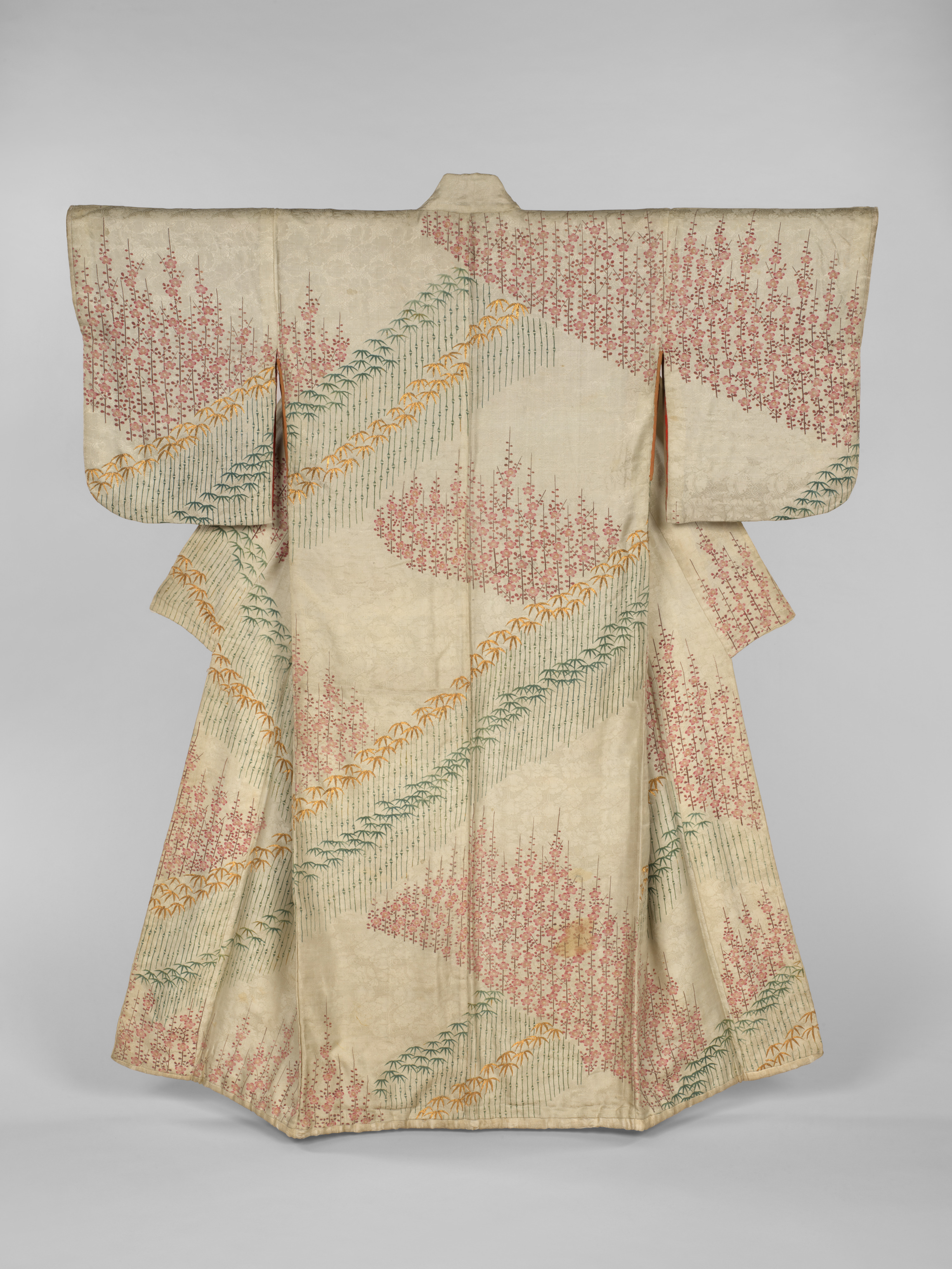
The pictured silk robe is a documented eighteenth-century object—not a generic illustration of every Japanese garment. Its woven satin foundation, paste-resist dyeing and gold-thread details reveal several crafts working together. Understanding those layers is the beginning of reading textiles responsibly.
The Gold Standard of Japanese Textile Arts explores woven and dyed traditions, fibre choices, regional histories and the people keeping knowledge alive. It connects a verifiable museum object to UNESCO’s living silk and ramie techniques and separates observed facts from cultural assumptions.
This 36-chapter guide includes hypothetical thread-density, shrinkage and weaving-yield calculations, and a practical museum-documentation checklist. The featured public-domain photograph is the Met’s eighteenth-century Kosode with Bamboo and Plum, accession 2025.326.
Chapter index
Fibre, fabric, garment and silk traditions · Chapters 1–14
- Textiles are the craft, and garments are one possible result
- Distinguish thread, fabric, finish and finished object
- Silk is important, but Japanese textiles are not only silk
- Weaving is an interaction of warp and weft
- Kimonos are garments, not a universal name for fabric
- The kosode connects garment design to Edo history
- Read the featured robe as a documented material object
- Rinzu figured satin adds pattern through weaving
- Kaga yūzen is a regionally grounded dyeing practice
- Paste-resist and stitched resist are different techniques
- Shibori describes families of controlled resist effects
- Kasuri and ikat patterns involve yarn-level preparation
- Yuki-tsumugi is a living UNESCO-inscribed silk technique
- Ramie traditions show another material and climate story
Ramie, regional work, motif and measurement · Chapters 15–26
- Snow-related finishing requires historical specificity
- Nishijin weaving belongs to Kyoto’s production culture
- Embroidery and couching add another layer of skill
- Indigo and other dyes carry technical and social histories
- Patterns can carry social meaning without fixed universality
- The garment shape interacts with a continuous design
- Dimensions are evidence, not a universal clothing size
- Worked example: warp count needs an actual design width
- Width shrinkage and length shrinkage are distinct
- Worked example: two-stage dimensional change
- Fabric defects need context before being labelled flaws
- Textile handling can affect the historical surface
Conservation, contemporary production and study · Chapters 27–36
- Museum photography changes how fabric appears
- Ethical collecting requires provenance and title
- Contemporary workshops preserve knowledge through practice
- Mechanisation and hand production answer different markets
- Sustainability needs a whole-lifecycle boundary
- Worked example: weaving yield and unexplained loss
- The price of handmade cloth includes skilled labour
- Learning from a historical garment requires source discipline
- Frequently asked questions about Japanese textile arts
- Continue through connected Gold Standard subjects
Quick information: identify the level of the claim
| Claim | Check |
|---|---|
| Fibre | Catalogue or material identification |
| Woven pattern | Weave structure and visible fabric |
| Dyed motif | Resist or colour evidence |
| Maker and period | Provenance and historical documentation |
| Living heritage | Community transmission and recognised technique |
1. Textiles are the craft, and garments are one possible result
Japanese textile arts include silk and bast-fibre weaving, patterned cloth, dyeing, embroidery, decorative stitching and the making or conservation of garments. A kosode, a bolt of woven silk and a festival banner have different purposes and histories, even when they share technical skills.
The gold standard begins with evidence of fibre, process, maker, place, function and preservation. An elegant pattern is not proof that an object was made in one famous region. Historical cloth also records labour, trade and relationships between people, not simply aesthetics.
2. Distinguish thread, fabric, finish and finished object
Textile production may involve fibre preparation, spinning, dyeing, weaving or knitting, finishing, cutting and sewing. A garment’s appearance reflects several stages, sometimes performed by different specialists. A museum collection can identify fibre and technique without knowing the maker of every component.
Describe what the object record actually establishes. Avoid attributing a garment’s entire visual effect to its weaver when dyeing or embroidery supplied major parts. If the source is an artwork photograph, explain what cannot be inferred from pixels.
3. Silk is important, but Japanese textiles are not only silk
Silk figured in prestigious Japanese garments and weaving traditions, but cotton, hemp, ramie and other fibres played roles across regions and periods. Their properties and supply chains affected comfort, cost, care and social access.
Fibres are not interchangeable merely because they look similar in a photograph. Identify whether a historical catalogue says silk, ramie, cotton or a mixture. Material attribution can sometimes be strengthened by appropriate analytical testing.
4. Weaving is an interaction of warp and weft
Warp yarns run lengthwise on a loom while weft yarns pass across them. The sequence of interlacing creates different woven structures with properties that affect surface, drape, strength and appearance. Pattern can be woven into the structure or added after weaving.
Study a close-up or verified technical description rather than calling every decorative surface embroidery. The thread count and structure must be measured through an appropriate method, and historical cloth may not fit an assumed modern industrial standard.
5. Kimonos are garments, not a universal name for fabric
Kimono describes a garment form and its historical variants; cloth may be woven in lengths suited to garment making. A named regional textile can be used for a kimono without the terms being identical.
A displayed robe’s current mounting may not show how it was originally worn or by whom. Look for provenance, garment construction, season and social context before treating it as representative of every Japanese person’s historic clothing.
6. The kosode connects garment design to Edo history
The kosode was a robe form with small sleeve openings and became an important predecessor to modern kimono dress. A documented Edo-period kosode may integrate carefully engineered fabric, dyeing and embroidery into one composition.
The Met’s Robe (Kosode) with Bamboo and Plum, second half of the eighteenth century, uses rinzu silk, yūzen paste-resist dyeing and couched gold thread. This named object anchors the featured image rather than an anonymous fashion reconstruction.
7. Read the featured robe as a documented material object
The Metropolitan Museum records the robe as Japan, Edo period, late eighteenth century, with dimensions about 158.8 by 123.2 centimetres. Its bamboo, plum and other motifs carry a documented artistic composition and seasonal associations.
The accession number 2025.326 identifies a specific object. The photograph cannot reveal every unseen seam or original use; rely on the catalogue’s material and dating statements without inventing its owner or exact weaving workshop.
8. Rinzu figured satin adds pattern through weaving
Rinzu is a figured satin-weave silk with a woven surface pattern that interacts with light. Decoration applied through dye or embroidery can sit over this woven foundation and create additional complexity.
A white ground in a photograph can therefore be technically elaborate before coloured imagery is added. Distinguish woven pattern from resist-dyed motif and couched metallic thread. The combination is central to interpreting the Met’s kosode accurately.
9. Kaga yūzen is a regionally grounded dyeing practice
Paste-resist dyeing can protect selected areas of cloth while colour is applied. Kaga yūzen developed in the Kanazawa context and is associated with controlled linework and pictorial motifs, though particular workshop methods and periods differ.
The Met identifies Kaga yūzen traditions in its kosode discussion. One object cannot prove all Kaga work was produced identically. Record source and maker where known, and do not infer manufacturing steps that the museum has not established.
10. Paste-resist and stitched resist are different techniques
Resist methods prevent dye from reaching chosen portions of the material. Some employ pastes, while others rely on tying, binding or stitching yarn or cloth. These methods create different design possibilities and evidence in finished textiles.
The umbrella term resist dyeing should not erase craft distinctions. Document whether the resist was applied before or after weaving and what the source actually says. A similar-looking design can be created by more than one method.
11. Shibori describes families of controlled resist effects
Shibori is commonly associated with shaped, tied, bound, stitched or compressed-resist dyeing methods. Examples vary by region and artistic purpose. A modern commercial tie-dye shirt may borrow from the aesthetic without reproducing one particular historic practice.
Describe the object and process at the level evidence permits. Resist marks can depend on binding and fabric behaviour, but a photograph alone may not establish the exact placement or number of steps taken by a maker.
12. Kasuri and ikat patterns involve yarn-level preparation
Kasuri design can be created by tying sections of yarn before dyeing and weaving the threads into patterns, related to broader ikat principles. Alignment requires planning across warp and weft as applicable; some visual softness can result from this process.
Yarn-resist design is not the same as painting patterns onto a finished cloth. Inspect reliable production descriptions and recognise that variations in alignment can be expressive or technical depending on the intended work.
13. Yuki-tsumugi is a living UNESCO-inscribed silk technique
UNESCO describes Yuki-tsumugi as a hand-production tradition centred on Yuki and Oyama along the Kinu River, inscribed in 2010. It includes hand-spinning silk floss, pattern-making through tied yarn before dyeing, and weaving on a back-tension loom.
The method uses silk floss recovered from certain cocoons not suited to conventional reeling. Its safeguarding relies on craftspeople and transmission, not only finished cloth. Do not present a UNESCO inscription as proof that every garment sold with the regional name followed the nominated technique.
14. Ramie traditions show another material and climate story
UNESCO’s 2009 Ojiya-chijimi and Echigo-jōfu entry concerns fine ramie textiles in Niigata’s Uonuma region. It describes fibre splitting, spinning, resist-pattern preparation, weaving and snowy-field finishing within community practice.
Lightweight ramie fabric differs substantially from silk and responds to a different agricultural and climatic context. The connection between technique, season and local skills matters more than romantic claims that snow alone creates textile quality.
15. Snow-related finishing requires historical specificity
UNESCO’s description connects wet fabric and snow-covered fields to a traditional finishing practice for the named Uonuma textiles. Such techniques must be understood within their actual environmental and cultural context.
Do not recommend replicating a historical process in an arbitrary climate or treating every textile from Japan as snow-finished. The particular nomination describes the technique’s transmission, not a universal fabric-care instruction.
16. Nishijin weaving belongs to Kyoto’s production culture
Kyoto’s Nishijin district is associated with elaborate textile production, including woven patterns used in garments and furnishings. The area’s craft history involves specialist looms, skills and commercial networks rather than one single type of silk.
Research a particular maker, textile and period before calling any brocade Nishijin. An artfully patterned cloth may share visual features with the tradition while belonging to a different workshop or later industrial process.
17. Embroidery and couching add another layer of skill
Embroidery can introduce colour and relief through stitched thread, while couching holds decorative threads or metallic elements along the surface using securing stitches. These techniques differ from woven or dyed pattern.
The Met’s featured kosode includes couched gold thread, which the collection associates with particular bamboo details. The presence of metallic thread in one image does not establish pure gold composition throughout a textile or a particular market price.
18. Indigo and other dyes carry technical and social histories
Dye sources and processes affect colour, durability, available tones and production costs. Indigo has appeared in many Japanese textiles, but not every dark blue fabric is indigo-dyed or old.
Use collection evidence or suitable analytical work when a chemical identification matters. Cultural interpretation should distinguish a maker’s intended colour from fading and later reproduction changes.
19. Patterns can carry social meaning without fixed universality
Plants, seasonal imagery, geometry and family crests can appear in textiles and garments. Motifs can reference poetry, celebration, social identity or design fashion, sometimes with overlapping interpretations.
Do not use a universal symbolism chart to assert what every wearer meant. The Met’s documented bamboo and plum motifs support a particular early-spring interpretation for its kosode; another object’s circumstances may differ.
20. The garment shape interacts with a continuous design
Japanese robes can distribute motifs across sleeves, body panels and hems in ways that become visible when worn, folded or displayed. Cutting and sewing affect which portions of a patterned textile are seen together.
Study the garment’s actual construction and museum presentation. A photograph showing only the front of a robe may conceal important design on the back. A flattened diagram can clarify pattern placement but is not a substitute for verifying a real piece.
21. Dimensions are evidence, not a universal clothing size
The Met’s 18th-century kosode has catalogued dimensions, but its size does not define one timeless body measurement or a modern ready-to-wear category. Mounting, textile stretch and historical alterations can complicate comparisons.
For educational analysis, record the measurement method and the part of the object measured. Never assume every robe with comparable width was worn by the same type of person.
22. Worked example: warp count needs an actual design width
A fictional woven panel has 640 warp ends arranged across a width of 32 centimetres. Average nominal warp density is 640 ÷ 32 = 20 ends per centimetre. If the panel shrinks to 30 centimetres after finishing while retaining the same ends, final nominal density becomes 640 ÷ 30 ≈ 21.3 ends per centimetre.
This is a simple arithmetic illustration, not a density standard for Yuki-tsumugi, Nishijin or any historical loom. The result depends on whether selvage and measurement conditions are included.
23. Width shrinkage and length shrinkage are distinct
Fibres, weave structure, finishing and environmental conditions can change textile dimensions. Movement along warp and weft may differ. A cloth labelled stable in one laboratory environment may behave differently during laundering or extended display.
Measure conditioned specimens according to a suitable method and specify the reference length. An overall percentage cannot describe local distortion in patterned fabric or damage caused by inappropriate conservation work.
24. Worked example: two-stage dimensional change
Suppose an educational textile test starts at 100 centimetres length, contracts 4% during one process and a further 3% relative to its new length during finishing. Modelled final length is 100 × 0.96 × 0.97 = 93.12 centimetres.
Total contraction is 6.88%, not 7%, because percentages apply to different reference lengths. This is fictional and cannot predict a historic silk garment’s response or justify cleaning a museum object.
25. Fabric defects need context before being labelled flaws
Slubs, uneven dye, irregular pattern alignment and small differences in thread thickness may be intentional, process-related or undesired depending on the tradition and the maker’s declared quality requirements. A flaw in a technical textile may be part of the valued character of another cloth.
Specify function and acceptance method rather than declaring every handmade irregularity superior or inferior. Distinguish artistic variation from damage that compromises safety, durability or promised performance.
26. Textile handling can affect the historical surface
Light, moisture, insects, pollutants, abrasion and unsuitable storage can change a textile’s appearance and structural condition. Dyes may fade at different rates and past repairs may cover original material.
Conservation professionals document condition, support and treatment, balancing access and preservation. Do not recommend washing, ironing or using domestic stain removers on a historic museum garment.
27. Museum photography changes how fabric appears
Silk sheen, metallic threads and layered texture can look different under lighting, camera angle and screen colour calibration. An online image may help identify composition without accurately representing every hue or tactile quality.
Use catalogue medium descriptions and known dimensions alongside the image. A digital crop is not a full material record, and a brightened reproduction can distort assumptions about an object in its original state.
28. Ethical collecting requires provenance and title
Textiles may have moved through family use, trade, inheritance, sale and museum acquisition. Provenance supports historical understanding and responsible collection practice. A culturally important piece can be misrepresented when its earlier context is erased.
Record known origin, maker where established, former ownership and research uncertainty. Avoid inventing ceremonial use or elite ownership to raise perceived value. Ethical interpretation should credit the people whose skills created the work.
29. Contemporary workshops preserve knowledge through practice
Traditional textile techniques continue through master-apprentice learning, associations, exhibitions, commercial orders and experimentation. UNESCO inscription recognises specific safeguarding needs and the role of communities rather than freezing every future design.
Support transmission through fair compensation, accurate attribution and practical training opportunities. A modern textile can be culturally meaningful without imitating an antique; honest labelling helps both makers and buyers.
30. Mechanisation and hand production answer different markets
Industrial textiles can deliver consistent fabric at scale, while labour-intensive handmade work may prioritise craft identity, custom design and specialised technique. Neither model is universally superior across price, labour conditions and environmental impact.
Assess production claims against actual process descriptions. An embroidered garment made from machine-woven base cloth should not be marketed as wholly hand-woven unless evidence supports that claim.
31. Sustainability needs a whole-lifecycle boundary
Fibre production, dyeing, water, energy, durability, repairs and disposal all contribute to textile environmental impact. Natural fibres are not automatically impact-free; modern synthetics or industrial processes also need balanced analysis.
Compare like-for-like service and lifetime. Claims such as ethical, natural or zero waste should identify their evidence and scope. Traditional craft can provide valuable repair and longevity lessons without removing the need for ecological assessment.
32. Worked example: weaving yield and unexplained loss
A fictional weaving project starts with 18 metres of available warp length. Two metres are used in setup and loom-related allowances, while one metre becomes unusable through defined defects. Under disjoint assumptions, accepted usable cloth is 18 − 2 − 1 = 15 metres.
The simple accepted-length yield is 15 ÷ 18 ≈ 83.3%. It does not measure artistic quality or labour value. A real cost model also needs materials, labour, processing, defects by cause and any additional finishing loss.
33. The price of handmade cloth includes skilled labour
Hand-spinning, tie-dye preparation, weaving and finishing require time and expertise. A price that compares only raw fibre cost with factory fabric can erase the maker’s labour and business overhead.
Calculate cost with declared hours, wages or earnings assumptions, equipment, maintenance, materials, distribution and taxes where relevant. Do not imply that a complex garment has a guaranteed investment resale price because its technique is UNESCO-listed.
34. Learning from a historical garment requires source discipline
Choose an official museum object, record title, date, maker if known, materials, dimensions, accession number and collection link. Write separate notes for direct visual observation, curatorial facts and open questions.
Compare a second object with a different material or period. A robust report states which differences may result from photography or preservation. The exercise trains readers to see textile arts as documented human work.
35. Frequently asked questions about Japanese textile arts
Is every Japanese kimono made from silk? No. Is Yuki-tsumugi the same as all Japanese hand-weaving? No. Are Ojiya-chijimi and Echigo-jōfu silk techniques? The UNESCO element concerns ramie. Does a museum photograph identify every fibre and dye? No.
Does an irregular handmade surface automatically count as a defect? No, context matters. Does UNESCO listing certify every product sold under a regional name? No. Can a modern artist adapt traditional motifs? Yes, while respecting attribution and cultural context.
36. Continue through connected Gold Standard subjects
Connect to Japanese Architecture, Japanese Woodworking, Japanese Ceramics, Japanese Printmaking, Japanese Calligraphy and Cultural Heritage.
Primary sources: The Met’s bamboo-and-plum kosode, UNESCO Yuki-tsumugi and UNESCO Ojiya-chijimi/Echigo-jōfu. The calculations are fictional educational exercises, and the featured image is a real public-domain museum photograph.