
Japanese theatre is a family of living performance traditions, not a single masked or elaborately costumed style. Noh and Kyogen, Kabuki, Bunraku and other forms have different histories and ways of creating meaning through voice, movement, music and space.
This Gold Standard guide teaches readers how to observe particular performances and distinguish historical traditions. It includes original close-viewing and audience-measurement exercises, UNESCO sources and useful routes into the broader eduKate literature, theatre and Japanese Studies roots.
THE GOLD STANDARD · JAPANESE THEATRE
Understand the stage, the craft and the specific tradition
Chapter index
The stage and Noh/Kyogen traditions · Chapters 1–8
- Japanese theatre is several evolving traditions
- Performance is more than a dramatic script
- Historical periods matter without defining every artist
- Nôgaku joins Noh and Kyogen without flattening them
- Noh masks alter how an expression is read
- Music and rhythm help organise theatrical attention
- Kyogen comedy depends on timing and social relations
- Noh stage architecture is part of the performance
Kabuki performance and Bunraku storytelling · Chapters 9–17
- Kabuki developed in an urban theatrical world
- Kabuki role types are historically situated conventions
- The hanamichi changes the relationship with spectators
- A dramatic pose can punctuate a scene
- Costume and visual design have their own dramatic grammar
- Ningyo Johruri Bunraku combines distinct performance roles
- Narration in Bunraku does more than read dialogue
- Puppet-making and operation are distinct crafts
- Modern Japanese theatre contains further forms
Living heritage, evidence and practical learning · Chapters 18–26
- Kumiodori has a distinct Okinawan history
- Theatre performances change through transmission
- A performance needs its audience to make meaning
- Worked close-viewing case: a pause before an entrance
- Worked audience comparison: more tickets is not a stronger rate
- Primary sources, programmes and archival photographs
- Safe cultural participation and respectful interpretation
- Questions, independent practice and changed-context transfer
- Continue into the Japanese arts and education ecosystem
1. Japanese theatre is several evolving traditions
Japanese theatre is not one fixed style or a single form of masked performance. It encompasses many performance histories, including Noh, Kyogen, Kabuki and Ningyo Johruri Bunraku, together with regional forms, modern spoken drama and contemporary experiments. These traditions differ in performers, texts, music, costume, stage space and ways of engaging audiences.
A reader should ask which work, historical period and performance tradition is being studied before attributing an artistic feature to ‘Japanese theatre’ in general. Some are strongly stylised, some comic, others experimental or realist. A programme that combines multiple forms need not make them the same genre.
The UNESCO’s Japan intangible cultural heritage listings gives an authoritative record of several internationally recognised performance traditions. The gold standard is to observe performance in its own conventions while remaining willing to compare different forms without erasing their particular histories.
2. Performance is more than a dramatic script
A play’s words are only part of its theatrical meaning. Timing, movement, stage architecture, costumes, vocal quality, music and the relationship between performer and audience can all influence how a scene is understood. A text read silently and the same text performed may create different experiences without the wording changing.
An analysis should distinguish the scripted content from choices made in a particular production. When a spectator describes a character as frightened, the evidence might be a gesture, pause or musical cue rather than a line explicitly naming fear. Different productions can provide different evidence for the same interpretation.
The Theatre root develops these general analytical habits. Japanese Theatre examines how particular historical forms organise performance signals rather than treating every stage as a blank surface on which a modern script is simply recited.
3. Historical periods matter without defining every artist
Performance traditions developed through long exchanges among ritual, entertainment, literature and professional communities. A period label can help locate relevant institutions and audiences, but it should not imply that every part of Japan heard the same plays or followed a single artistic fashion.
UNESCO dates the flourishing of Nôgaku particularly to the fourteenth and fifteenth centuries and associates Kabuki’s origins with the early seventeenth-century Edo period. Ningyo Johruri Bunraku developed from puppetry and narrative traditions during the early Edo period. These are useful broad guides, not exact birthdays for every element of the arts.
The History and Japanese Studies roots support further context. A responsible study identifies the actual source behind a historical statement and distinguishes a form’s origins from later transformations.
4. Nôgaku joins Noh and Kyogen without flattening them
Nôgaku encompasses Noh and Kyogen, commonly presented within a shared theatrical framework. Noh frequently employs highly stylised singing, dance, narrative and masks, while Kyogen makes extensive use of comic dialogue and different performance conventions. Their relationship is important, but saying that Kyogen is simply ‘funny Noh’ overlooks its own dramatic techniques.
The UNESCO’s Nôgaku theatre entry describes the integration of acting, music, dance, costumes, masks and distinctive stage features. Performance knowledge is transmitted through long training rather than improvised from the audience’s expectations. The art is living and continues to be taught and performed.
A viewer should observe how time and movement are organised, not judge speed by the conventions of a television comedy. The audience may need to learn which apparent pauses or repetitions carry dramatic meaning within the form.
5. Noh masks alter how an expression is read
Some Noh roles use masks, particularly for characters such as spirits, women and certain other figures, while not every performer or role uses one. A mask’s apparent expression may change as stage angle and lighting change. That effect belongs to performance technique; it is not the same as an actor simply exaggerating facial movements.
Study a mask alongside movement, costume, voice and the dramatic situation. A viewer can observe a slight tilt or changed orientation while remaining uncertain whether one gesture has a fixed symbolic meaning. The appropriate interpretation depends on the work and school of performance.
The UNESCO’s Nôgaku theatre entry is a useful primary cultural source. Avoid claiming that a single photographed mask represents every tradition or provides a literal diagnosis of the character’s feelings. The image is part of a carefully structured stage language.
6. Music and rhythm help organise theatrical attention
Music in Noh can help shape pace, atmosphere and the relationship among performer, chorus and instrumentalists. It is not merely background sound added to an otherwise complete spoken scene. Vocal form, instrumental timbre and a sequence of movements may organise the audience’s attention over time.
Students can practise listening for a change in rhythmic density or the timing of a gesture without pretending that a particular sound always means exactly the same emotion. The observed fact may be a pause, an entrance or a change in sound; the claim that it expresses grief requires contextual interpretation.
The Music root provides a general route into musical structure. A culturally careful analysis remains aware that local conventions influence how those structures are understood.
7. Kyogen comedy depends on timing and social relations
Kyogen frequently uses spoken dialogue, recognisable human foibles and comic situations, often with different masks and performance practices from Noh. Humour may arise through language, character relations, repetition or a change in expectation. The fact that an audience laughs does not by itself explain which theatrical device produced the effect.
Read a scene through who knows what, who speaks and what information the audience possesses. A servant and master may interpret the same action differently, creating irony or tension. Those forms of social comedy have specific historical contexts and should not be reduced to a timeless claim about one national sense of humour.
An observer should describe actual staging and narrative effects, not invent a universal ‘Japanese comedy rule’. The UNESCO’s Nôgaku theatre entry describes Kyogen’s relationship to Nôgaku, with its own dialogue-centred character.
8. Noh stage architecture is part of the performance
The classic Noh stage has a distinct spatial arrangement, including a performance area and a bridgeway linking it to a backstage preparation zone. The location and movement of performers can carry meaning because the stage is not merely a neutral platform. The architecture shapes entrances, relationships and the visible passage from one space to another.
The UNESCO’s Nôgaku theatre entry describes the walkway connecting the stage to a hall of mirrors. A student observing an entrance should ask how its duration and direction change the audience’s expectation before a character speaks. That question links physical space to the way narrative unfolds.
Do not treat a diagram of one standard form as proof that every historical and modern venue is identical. Touring and contemporary performances may adapt the setting, requiring analysis of the production actually seen.
9. Kabuki developed in an urban theatrical world
Kabuki developed in the Edo period and reached audiences whose circumstances, interests and patronage shaped its history. Dramatic movement, costume, music, stage effects and performance skill play major roles. A Kabuki production cannot be explained adequately by a short plot summary or an image of dramatic makeup.
The UNESCO’s Kabuki theatre entry discusses historical development, role types, stage apparatus and performance conventions. Theatre history also involves changes in institutions and audience expectations over time, so one feature from an eighteenth-century performance should not be described as a universal rule for all present productions.
Compare the role of a performer’s gesture with the timing of an instrumental cue. Both can contribute to a character’s public presence, but interpreting them requires knowledge of the specific form and scene.
10. Kabuki role types are historically situated conventions
Traditional Kabuki theatre includes role styles such as aragoto and wagoto, and the performance of women’s roles by specialist male actors called onnagata. These are theatrical practices with distinct historical contexts, not simple equivalents of present-day social identities or claims about how contemporary Japanese people should behave.
The UNESCO’s Kabuki theatre entry describes the development of these traditions and the participation of women in earlier phases before the later male-only performance practice became established. A reader who ignores history may wrongly assume one arrangement existed from the first moment.
Study the specific role and actor’s performance choices. Clothing, movement, voice and dramatic relation may convey character information beyond the literal text. Context should shape interpretation instead of forcing historical theatre into modern shorthand.
11. The hanamichi changes the relationship with spectators
Kabuki stages may use a hanamichi, a runway extending through the audience area. It can make entrances and exits theatrical events by altering distance and the direction of attention. Stage machinery such as revolving sections and trapdoors can also support effects within particular productions.
These features are not equivalent to ordinary furniture. The audience’s awareness of a character may change before the performer reaches the main stage. An analysis could compare the meaning of an entrance on the hanamichi with the same arrival shown through a conventional doorway in an alternative production.
The UNESCO’s Kabuki theatre entry provides a grounded account of the stage arrangements. Not every performance requires every apparatus, so describe what is present in the particular production.
12. A dramatic pose can punctuate a scene
A Kabuki performer may hold a characteristic pose known as a mie, drawing attention to a moment of heightened dramatic importance. Its role must be understood through the surrounding scene, music, audience expectation and acting convention. Treating the pose as an ordinary freeze-frame misses how the performance builds toward it.
Choose an observed moment and describe the sequence: approach, movement, vocal change, held pose and subsequent action. Then propose which element changes the spectator’s understanding. A careful student distinguishes these observations from a claim about precisely what every spectator felt.
This method can be practised through official recordings and institutionally provided educational material where access is legitimate. Do not reproduce protected recordings or assume a public thumbnail gives permission to distribute a full performance.
13. Costume and visual design have their own dramatic grammar
Costume, wigs and makeup can help audiences identify characters or artistic styles in particular Kabuki productions. Colour and design often contribute to recognition, but a single colour does not automatically carry the same meaning in every role or century. Visual interpretation requires the actual context and tradition.
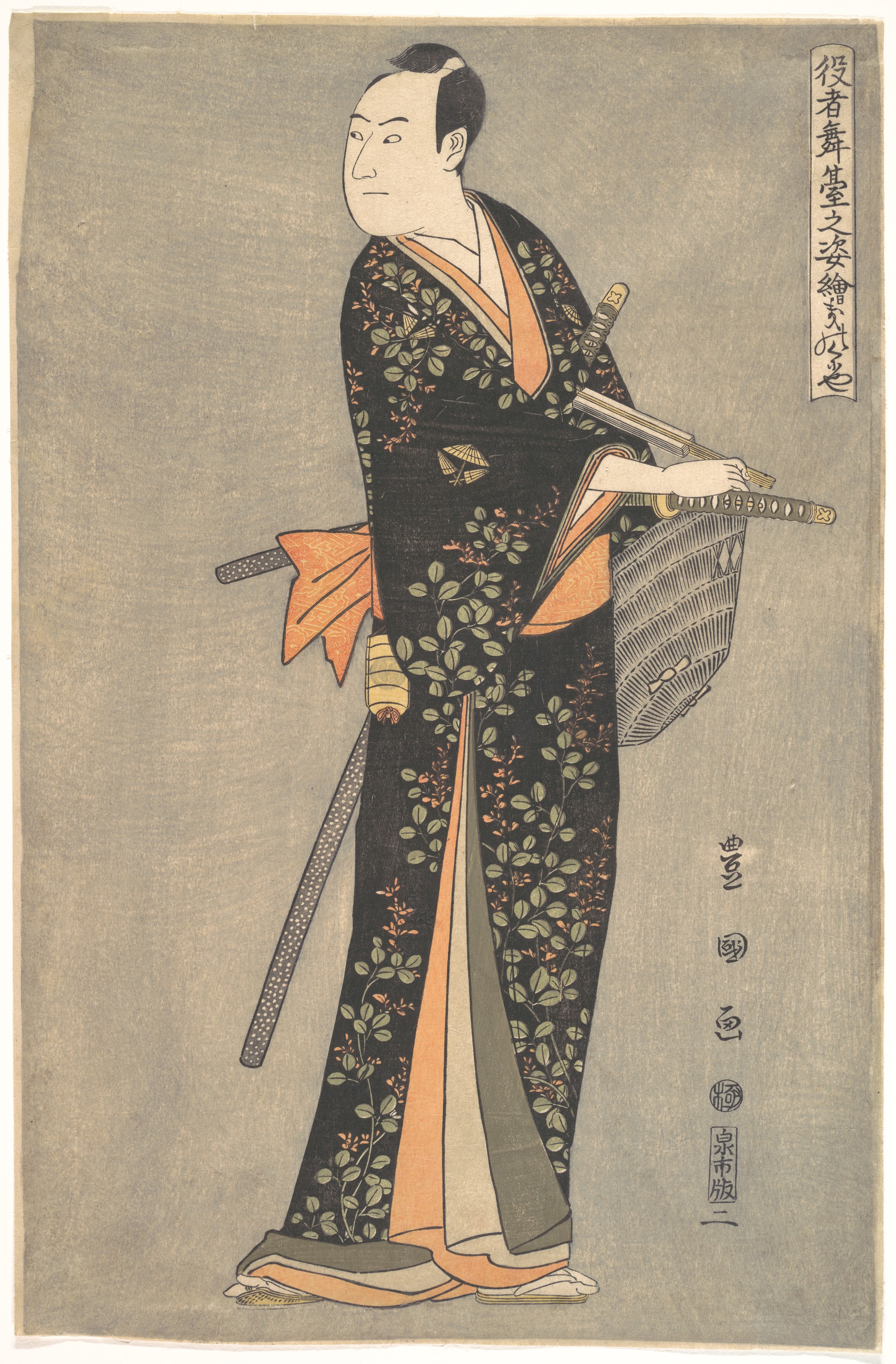
A student can compare two stage photographs by listing observable differences before attaching symbolic explanations. The pictures may belong to different productions, lighting conditions or theatrical schools, which can affect how they look. A historical woodblock print also reflects its artist’s medium and composition rather than recording the performance like a modern photograph.
The chosen featured image for this article is a public-domain Edo-period Kabuki actor print. It illustrates one historical tradition, not all Japanese theatre or a contemporary stage performance.
14. Ningyo Johruri Bunraku combines distinct performance roles
Ningyo Johruri Bunraku joins puppet movement, narrated drama and shamisen musical accompaniment. The UNESCO’s Ningyo Johruri Bunraku entry describes large articulated puppets operated by coordinated puppeteers, with a narrator who voices roles and a musician whose performance contributes to dramatic pacing.
A common arrangement uses three puppeteers for one large puppet, illustrating how visible human coordination can produce a unified character’s movement. The narrator and shamisen player add different kinds of dramatic evidence. A student who judges the puppet solely by its facial appearance misses how timing and shared attention establish the illusion of life.
These observations belong to the described traditional form and do not make every puppet stage or performance worldwide identical. Studying Bunraku is a way to understand the craft of coordinated action, not a reason to rank live actors and puppets on one arbitrary scale.
15. Narration in Bunraku does more than read dialogue
The tayu narrator may voice multiple characters and shape the delivery of the story with varied vocal techniques, while the shamisen contributes rhythm and expressive texture. A listener experiences character distinctions through this combination even though the puppet’s face may remain relatively fixed.
The UNESCO’s Ningyo Johruri Bunraku entry explains the integration of sung or narrated storytelling, music and puppetry. A meaningful analysis could compare a narrator’s sustained delivery before and after a puppet movement, rather than treating the musical part as background decoration.
An educational exercise can follow a short authorised excerpt and list which meaning seems carried by text, vocal variation, instrument or puppet gesture. Mark uncertainties when lacking the relevant language or performance training.
16. Puppet-making and operation are distinct crafts
A Bunraku puppet involves material design, articulated movement and a performance convention that audiences learn to read. The puppet-maker and puppeteers contribute different skills, while narrators and musicians shape a production’s timing. A finished puppet placed in a museum is therefore not the same experience as a living performance.
UNESCO’s UNESCO’s Ningyo Johruri Bunraku entry describes hand-crafted puppets and complex cooperation among performers. The form’s continued life depends on training and transmission as well as preserved objects and scripts. Research on performance should pay attention to the people maintaining these skills, not merely catalogue historic costumes.
A useful comparison asks what is recorded in a surviving object and what disappears when the object is separated from movement, sound and audience. Both material evidence and living practice matter.
17. Modern Japanese theatre contains further forms
Noh, Kabuki and Bunraku are major historical traditions, but Japanese theatre also includes modern spoken drama, experimental productions, musicals and regional performance practices. A current production may borrow from international staging methods or reinterpret older texts, without ceasing to belong to Japanese theatrical life.
Artists and spectators differ, and institutions can experiment with new audiences and venues. The mere use of a Japanese language script does not make a modern play a Noh work. Conversely, adaptations of classical material can involve genuine creative change that deserves its own analysis.
The Creative Industries root offers a wider context for production and distribution. A gold-standard cultural guide should not define the living field only through officially listed heritage forms.
18. Kumiodori has a distinct Okinawan history
Kumiodori is a traditional Okinawan musical theatre tradition and should not be treated simply as a local name for Kabuki or Noh. Its history and performance conventions belong to the cultural context of the Ryukyu Islands. The UNESCO Japan listing records Kumiodori’s inscription in 2010.
Comparative study can consider performance, costume, music and narrative, while respecting differences in language, historical institutions and local identity. A similarity in stagecraft does not establish that one tradition is merely a derivative copy of another.
The UNESCO’s Japan intangible cultural heritage listings is a useful starting point for identifying the formal listed tradition. Further understanding requires attention to Okinawan sources and practitioners, not assumptions drawn solely from mainland examples.
19. Theatre performances change through transmission
Learning a performance tradition involves embodied practice, observation and instruction, not merely possession of a script. Performers transmit timing, sound, gesture and interpretation through generations, while each production occurs in a present-day environment with actual spectators and institutional constraints.
Heritage inscription may support recognition and safeguarding but should not be mistaken for a promise that every local performer has adequate resources or that an art will never change. Living transmission may involve adaptation, new teaching methods and debates about what should remain consistent.
Analyse a production by asking both what it maintains and what it changes. A serious cultural history should allow variation and disagreement instead of presenting traditional theatre as a fossil preserved unchanged for centuries.
20. A performance needs its audience to make meaning
Spectators bring different experience, language access and expectations. A trained viewer may recognise a conventional movement that a first-time visitor notices only as a pause. Both have observed something real, but their interpretations can differ. A good educational guide makes the convention available without telling every reader exactly what they must feel.
Translation, surtitles and introductory talks can change access to works performed in older or specialised language. They may assist understanding while also shaping the way a spectator follows voice and timing. The choice of mediation is an artistic and educational decision, not proof that the source form is defective.
The Translation and Education roots help explore how knowledge enters a new language or audience. Accessibility should enable informed engagement without hiding what the original performance actually contains.
21. Worked close-viewing case: a pause before an entrance
Consider this invented teaching scenario, not a historical play. A performer crosses an empty stage, pauses by a doorway and turns toward a sound before speaking. A viewer might interpret hesitation, recognition or caution. The observable evidence includes the crossing, pause, turn and sound; none of these automatically proves one emotion.
Now imagine the same words are staged with immediate movement and no pause. The script has not changed, but the performed relationship among space, sound and expectation has. A responsible analysis identifies which observation supports which interpretation and acknowledges other readings.
This exercise teaches theatre as a live construction of meaning. It should not be passed off as a Noh, Kyogen or Kabuki convention without evidence from a specific production. General dramatic reasoning is transferable, but historically named traditions have their own rules.
22. Worked audience comparison: more tickets is not a stronger rate
Take fictional two-season data for a theatre education programme. Season A offers 200 seats across its performances and sells 120; Season B offers 300 seats and sells 165. Attendance count rises by 45, but the sold-seat shares are 120 ÷ 200 = 60% and 165 ÷ 300 = 55%. One measure increased while the other decreased.
Neither figure establishes public appreciation, cultural vitality or the quality of performers. Seat availability, price, scheduling, audience composition and outreach may differ. A performance with a smaller audience can also be artistically important or serve a specialised community.
The appropriate report states what was counted and why the denominator changed. Public cultural policy requires more than a catchy headline declaring a tradition ‘thriving’ or ‘declining’ from one capacity measure.
23. Primary sources, programmes and archival photographs
An old print, costume or manuscript may illuminate theatre history, but it is a particular kind of source. A woodblock print is an artwork shaped by printing techniques and artistic intentions; it is not a photographic recording of exactly how an actor moved. A surviving script may not reveal every vocal and gestural choice used in performance.
Compare catalogued objects with accounts by practitioners, reliable recordings and programme notes where available. Record dates, creators and editorial interpretation rather than adding precise historical claims unsupported by the collection. The Research and History roots support provenance checking.
Use legitimate institutional collections and respect rights information. Public-domain status for an image does not automatically grant unrestricted use of every modern recorded performance inspired by its subject.
| Season | Available seats | Tickets sold | Share |
|---|---|---|---|
| A | 200 | 120 | 60% |
| B | 300 | 165 | 55% |
24. Safe cultural participation and respectful interpretation
Watching or attending theatre can be an excellent learning activity, but students should follow venue rules about photography, recording and audience conduct. Traditional performers and local communities deserve respect as living participants rather than as props for a visitor’s exotic story.
An observer can prepare by reading a synopsis from the venue, learning the names of roles and practising attentive listening. Afterwards, describe what was actually seen before making wider claims about Japanese culture. Avoid inventing an artist’s motivation from a costume colour or facial expression.
A useful discussion identifies what remained unclear and which authoritative explanation could resolve it. Curiosity becomes more rigorous when it is combined with humility about language and training.
25. Questions, independent practice and changed-context transfer
Is Kabuki identical to Nôgaku? No. They differ in histories, roles and conventions; Nôgaku includes Noh and Kyogen. Does every Noh performer wear a mask? No. Does Bunraku consist only of puppets? No; narration, music and coordinated puppeteers are integral.
Try the fictional audience calculation: 120 of 200 seats is 60%; 165 of 300 is 55%. Why can’t the second raw count establish increased attendance share? Its denominator is larger. Now change the task from a theatre performance to an archival print exhibition. What information about live movement and sound is lost, and what evidence about costume or historical representation becomes available?
A capable learner changes the interpretation method when the source changes. The same item can be culturally meaningful without being interchangeable with an entire performed tradition.
26. Continue into the Japanese arts and education ecosystem
Read Japanese Literature, Japanese Studies, Theatre, Music and History for related questions. The UNESCO’s Nôgaku theatre entry, UNESCO’s Kabuki theatre entry and UNESCO’s Ningyo Johruri Bunraku entry are direct primary heritage sources for the major traditions discussed, including their distinct performance components.
The figures used in the theatre attendance example and the invented scene are original teaching scenarios, not actual attendance reports or historical descriptions. Readers should follow authorised recordings, venue material and documented collections when evaluating a real production.
Return to The Gold Standard of Education: Learning Transfers into Life for the general habit: start with observation, examine context, test a second explanation and adapt when the evidence medium changes. Japanese theatre becomes more understandable when one learns to see the performance rather than merely collect its names.