
A Singapore carpark owner purchases a type-approved 7 kW EV charger and assumes the supplier’s approval label means it is already registered for use. Another owner installs an older unlabelled charger and pays an electrician, but never submits the Government registration. A third believes every 7 kW charger costs S$150 to register, even when installed at a qualifying landed home. The distinctions can affect both legal use and ongoing safety.
The Gold Standard of LTA EV Charger Registration Services is an accountable public journey from model type approval and competent installation to a correctly registered unit, visible registration mark, a responsible owner and continuing periodic inspections. It also includes safe ownership transfers, relocation and decommissioning so that official charger records reflect the physical network.
The Land Transport Authority requires all EV chargers to be registered before use, including replacement units, and the registration mark to be affixed within sixty days. Current Government registration fees are fixed through 31 March 2027, starting from S$150 for a below-23 kW charger in non-restricted premises and S$375 for the same power at a qualifying landed-property restricted-access location.
EV charger authorisation from approved model to maintained unit
Model type approval, competent installation and certification, unit registration, physical mark and continuing fitness records are separate legal and technical milestones. Use the chapters to track the actual owner and device.
1. Start with the actual EV charger unit
A property owner may say the condominium already has an EV charging system, but the installation could contain several separately identifiable chargers. Registering an operator company or a parking area does not automatically register each physical charger unit.
LTA’s registration rules require all relevant EV chargers, including replacements, to be individually registered before they can be used. A Gold Standard front door captures the actual equipment model, serial or type approval identity, power rating, owner and installed location.
Back to charger registration index · Next chapter
2. Separate model type approval from unit registration
A manufacturer can obtain LTA approval for an EV charger design while a property owner still needs to register a specific installed unit. The former assesses the model’s technical conformity; the latter connects a real charger to a person responsible for its safe use.
Under the Electric Vehicles Charging Act, suppliers must ensure the charger model is type approved and carries a valid approval label before supply. Owners subsequently register the actual unit with LTA. An approved model sticker and an owner registration mark are different identifiers.
Back to charger registration index · Next chapter
3. Check the national TR25 safety standard
A device may be sold overseas with compliance marks accepted in another country. Those marks do not alone establish that it meets Singapore’s national EV charging safety standard and local technical approval rules.
LTA’s EV charger safety framework refers to Technical Reference 25. Local type approval assesses the model against applicable parts of the standard. A purchaser should verify the real LTA approval and match it to the equipment rather than assume every imported plug or adaptor is lawful.
Back to charger registration index · Next chapter
4. Inspect the supplier’s type approval label
A charger supplier may provide a brochure containing a model approval number without the correct label affixed to the unit delivered. A buyer needs evidence that the actual device corresponds to the approved model.
LTA requires type-approved equipment to bear the prescribed approval label before supply. The label contains a type approval ID that can be checked through OneMotoring. The service should identify a mismatch in model or serial particulars before a customer pays to register the unit.
Back to charger registration index · Next chapter
5. Keep charger owners responsible despite installer assistance
An electrician or EV equipment supplier can handle substantial technical work, but registration law places continuing duties on the responsible charger owner. A seller’s promise that everything is done is not the authoritative register.
LTA says the charger owner or registered responsible person must ensure registration, subsequent inspections and lawful use. A Gold Standard application identifies the individual or business with charge and control, with an appropriate delegated filer if used.
Back to charger registration index · Next chapter
6. Use a Licensed Electrical Worker for fixed installation
A device can be type approved yet badly connected to a building’s electrical installation. Registration of a model cannot replace competent electrical work at the site.
LTA states fixed EV chargers must be installed by an Energy Market Authority Licensed Electrical Worker and certified as fit for charging by the prescribed charger equipment specialist. The service should verify the actual installation and competent personnel, not rely on a generic receipt from a home renovation contractor.
Back to charger registration index · Next chapter
7. Keep the Certificate of Fitness distinct from a sales invoice
A property manager might pay for a new charger and assume its packaging or delivery document proves lawful installation. The actual completed installation needs technical examination and certification.
The LTA requirements describe a Certificate of Fitness after charger installation and certification. This should correspond to the actual installed equipment. An authorised owner filing should not represent the supplier’s factory acceptance sheet as a complete local site fitness certificate.
Back to charger registration index · Next chapter
8. Use the correct permitted charging location
An ordinary socket inside a home, shared basement carpark and public charging station have different approval and access characteristics. The fact that a charger can physically connect to a wall is not sufficient.
LTA specifies which EV charging classes may be installed or used at particular locations, including residential car parking. The registration service should record whether the site is a restricted-access location and confirm actual electrical and premises arrangements, not assume all private apartment buildings qualify as landed home use.
Back to charger registration index · Next chapter
9. Distinguish restricted and non-restricted access correctly
A charger in an HDB carpark and a charger next to a landed house may both be used mainly by residents. Yet the statutory restricted-access classification is narrower than ordinary everyday speech.
LTA defines restricted access for fee and inspection purposes principally as parking within or contiguous to a landed dwelling and forming part of the same property ownership. Other locations, including ordinary condominiums, are generally non-restricted for that classification. A Gold Standard fee calculator should use the statutory location, not merely a gate or membership restriction.
Back to charger registration index · Next chapter
10. Register before first use
A newly installed charger might work perfectly during commissioning, but ordinary customers cannot begin charging solely because the electrical system energises without error.
The Electric Vehicles Charging Act requires the unit to be registered with LTA before it is used for EV charging. LTA permits use immediately after successful registration under its process, with the registration mark to follow within sixty days. The service should distinguish controlled commissioning from ordinary public or private use.
Back to charger registration index · Next chapter
11. Use the official self-registration service
A charger owner may receive a private link from the installer promising immediate registration in return for bank login details. A secure route should remain accessible directly to the owner.
OneMotoring provides LTA’s charger registration service through authenticated Singpass for individuals or Corppass for authorised corporate users. The applicant enters the actual type approval ID, equipment details and location, and pays the relevant Government fee. Registration should not require sharing personal passwords with the installer.
Back to charger registration index · Next chapter
12. Allow safe third-party registration
An installer may know the device’s technical and serial details better than the customer and can prepare a form on the customer’s behalf. Delegation is useful only if the owner retains the final legal decision.
LTA allows an authorised third party to submit the initial particulars. The owner receives an SMS and must log into OneMotoring to confirm the submission and pay. A third party’s draft and a complete registered owner declaration are different milestones, with a deadline for owner action.
Back to charger registration index · Next chapter
13. Keep the fourteen-day third-party confirmation window
A supplier might submit a registration and assume approval lasts indefinitely while the owner is travelling. The law’s operating record needs timely verified responsibility.
Under LTA’s third-party procedure, the owner has fourteen days to confirm the submitted registration application or it lapses. The service should remind the rightful owner and offer a lawful resubmission route rather than accept an installer pretending to confirm ownership.
Back to charger registration index · Next chapter
14. Reject inaccurate third-party technical details
An installer might enter the wrong equipment serial number or type approval ID. The owner should not be pushed to approve a document that misidentifies the charger.
LTA explains the owner can directly amend location and mailing address within the pending process, but technical fields provided by the representative generally need the owner to reject the submission and request a corrected new application. A Gold Standard interface should make that limitation clear before payment.
Back to charger registration index · Next chapter
15. Differentiate prior installations from new chargers
An EV charger installed before the current registration regime began might lack a modern type approval label. A blanket rule that every such device is automatically illegal ignores the lawful verification route established for earlier installations.
For chargers installed or in use before 8 December 2023, LTA can consider evidence of a prior Letter of No Objection. Following appropriate verification it may issue a provisional ID for registration. If the old unit fails the relevant checks, replacement may be required for safety rather than a fictitious type approval label.
Back to charger registration index · Next chapter
16. Apply the currently frozen 2026 fee schedule
A consumer may read that an earlier Government fee subsidy ended in December 2025 and expect the charger registration cost to increase immediately in January 2026.
LTA’s current schedule keeps the published registration fees unchanged through 31 March 2027. The service should label that future end date and warn that the Government may review fees thereafter. It should not advertise the 2026 amounts as permanent statutory prices.
Back to charger registration index · Next chapter
17. Calculate below-23-kilowatt fees accurately
A normal 7 kW home charger is below 23 kW, but the location determines which of two registration fees applies. A customer who expects S$150 at a landed property may receive the higher Government bill.
Under current LTA rates, a charger below 23 kW costs S$150 to register at non-restricted locations and S$375 at qualifying restricted-access landed premises. A Gold Standard quote separates this statutory fee from the charger’s purchase, wiring and specialist certification costs.
Back to charger registration index · Next chapter
18. Use the middle and high power tiers
A commercial site may deploy 60 kW or 180 kW chargers. Those equipment classes have different published rates from ordinary low-power units.
LTA lists S$375 non-restricted and S$750 restricted for chargers from 23 kW through 150 kW, and S$600 non-restricted or S$750 restricted above 150 kW. The cutoff at 23 kW belongs to the middle band, not the below-23-kW band. The actual rated output power should come from approved charger details.
Back to charger registration index · Next chapter
19. Show that GST is not charged on registration
A supplier might add a percentage for GST to the Government registration fee in a combined commercial quotation, leaving the owner unable to distinguish a real statutory charge from a private service price.
LTA’s registration fee table states that GST does not apply to the charger registration fee. Private installer services or equipment purchases may have their own applicable tax treatment. A Gold Standard payment summary keeps these amounts separate without inventing GST on the LTA fee.
Back to charger registration index · Next chapter
20. Make the owner registration mark a separate stage
A charger can be successfully registered in OneMotoring before the physical registration mark arrives in the post. The owner still has to attach it within the legal deadline.
LTA says the registration mark is sent within around fourteen working days and must be affixed within sixty days from registration on the charger. The service should display registered, mark dispatched, mark received and mark affixed as distinct states, with a lawful replacement-mark route if necessary.
Back to charger registration index · Next chapter
21. Keep the approval label and registration mark visually distinct
The model approval label and individual charger registration mark serve different public purposes. A building owner might see one label and assume all identification requirements are met.
The first label proves LTA type approval for the model; the later registration mark identifies the legally registered individual unit. A good inspection guide shows where each should be located and how to verify the corresponding record without requiring a user to open sealed electrical enclosures.
Back to charger registration index · Next chapter
22. Do not confuse charger registration with an EV charging operator licence
A homeowner who registers one charger does not automatically become a licensed commercial EV charging network operator. Conversely, an EV Charging Operator licence does not register every new unit it deploys.
LTA administers separate EV charger type approval, unit registration, and EV Charging Operator licensing. A public service should classify whether the business is charging privately, providing charging services to the public or managing public stations and display each relevant permission separately.
Back to charger registration index · Next chapter
23. Protect ordinary charger users from unsafe adaptors
A person might use a multi-socket extension cord or improvised connector to reach a parked vehicle. Registration of the underlying device does not render every unusual charging method lawful.
LTA warns against improper use such as non-approved adaptors between charger and vehicle inlet or inappropriate extension cords with non-fixed chargers. Users should follow the actual approved equipment instructions and seek qualified assistance rather than rely on a seller’s assurance that an improvised setup is safe.
Back to charger registration index · Next chapter
24. Distinguish restricted site inspection frequency
A landed home charger typically serves a smaller group in a controlled location. Its inspection interval differs from public or shared facilities.
LTA requires an appropriately certified equipment specialist inspection every twenty-four months for chargers in restricted-access premises. A Gold Standard owner dashboard should record the last fitness certificate, next due date and responsible specialist. The interval does not remove the need to respond to an actual fault immediately.
Back to charger registration index · Next chapter
25. Use both inspection disciplines at non-restricted sites
A charger in an ordinary multi-storey carpark can be used by many different drivers and may have higher operational wear. Periodic inspection needs both equipment and electrical installation checks under the prescribed timetable.
LTA requires qualified equipment specialist inspection every six months and a Licensed Electrical Worker assessment every twelve months at non-restricted sites. The service should track both calendars separately rather than declare the unit current simply because one of the two inspections took place.
Back to charger registration index · Next chapter
26. Retain Certificates of Fitness for the prescribed period
An owner might throw away the original certification after the registration mark is affixed, assuming the sticker replaces all technical records. That undermines later maintenance and regulator checks.
LTA requires owners to retain the initial Certificate of Fitness and subsequent Certificates of Continued Fitness for at least two years from the respective certificate dates and to provide them upon request. A Gold Standard digital record links each certificate to the correct unit and inspector.
Back to charger registration index · Next chapter
27. Repair faults through qualified personnel
A charger may fail intermittently, overheat or show a persistent electrical fault. The right response is to stop unsafe use and engage the appropriate competent people rather than ask drivers to bypass safeguards.
LTA’s EVCA framework expects maintenance and fitness of registered chargers throughout their life. A service should report a fault, identify necessary safe isolation, record repair and obtain the relevant follow-up inspection as required. Ordinary users should never be given improvised live electrical troubleshooting steps.
Back to charger registration index · Next chapter
28. Transfer registration when a charger changes ownership
A commercial property or charger can be sold while the equipment itself remains at the same location. The responsible person on LTA’s record must still change.
LTA permits an official registration transfer with a S$35 application fee payable by the transferor. The new owner must accept within fourteen days or the transfer lapses. A private sales agreement alone is not a substitute for the Government’s change of responsible person.
Back to charger registration index · Next chapter
29. Report relocation as a separate event
An owner might remove a charger from one HDB carpark and install it at another location. The old record and periodic inspection status may no longer describe the actual environment or electrical installation.
LTA requires notification of relocation on installation at the new place, with a current S$35 fee. The service should record the old and new addresses, technical readiness and any required updated certification; it must not treat a postal address edit as proof the fixed charger was reinstalled safely.
Back to charger registration index · Next chapter
30. Deregister when the charger is permanently withdrawn
A unit left in the register after decommissioning may continue generating inspection obligations and misleading counts of operational charging points.
LTA offers free deregistration of a charger no longer used. The owner should confirm that the unit has actually been decommissioned under appropriate technical controls and retain the Government’s final record. Deregistration is not permission to continue operating the unit without its prior registration.
Back to charger registration index · Next chapter
31. Check ordinary condominium and landed home categories separately
A strata-titled townhouse or cluster house can produce ambiguity about restricted access. An owner should not choose the cheaper fee classification merely because the estate has a gate.
LTA provides specific guidance for strata-titled landed dwellings and can classify the charger location based on property particulars. A Gold Standard form should request actual title and parking arrangement details and wait for the proper decision, rather than present all MCST residences as identical.
Back to charger registration index · Next chapter
32. Worked example: a 7 kW HDB carpark charger
Fictional operator Orchard Mobility installs a type-approved 7 kW fixed charger in a publicly accessible Singapore carpark. An EMA Licensed Electrical Worker installs it, the specialist issues the required Certificate of Fitness, and the owner uses the actual type approval ID for registration.
Because the location is non-restricted and the rating is below 23 kW, the published Government registration fee is S$150. After successful registration the charger may be used and its physical mark must be attached within sixty days. The owner schedules equipment specialist inspection every six months and LEW assessment every twelve months.
Back to charger registration index · Next chapter
33. Worked example: charger at a landed home
Fictional owner Priya buys a type-approved 7 kW home charger for a garage within her landed property. The electrician and specialist complete the prescribed installation and certificate process before registration.
Although the charger’s power matches a 7 kW shared-carpark unit, the premises are a qualifying restricted-access location. The LTA registration fee is S$375 under the current table. The ongoing equipment specialist inspection interval is twenty-four months, subject to actual charger classification and safety needs.
Back to charger registration index · Next chapter
34. Worked example: charger sold with an apartment
Fictional company GreenLine Holdings sells a charger installed in a condominium garage to a new responsible owner. The charger remains in place but the statutory responsible person changes, and its existing certification and maintenance history must be reviewed.
The current owner initiates the S$35 registration transfer; the buyer accepts the official request within fourteen days. If the buyer lets the request lapse, ownership in a private contract is not a completed LTA transfer. The service should flag the pending state and prevent misleading public information about who is accountable.
Back to charger registration index · Next chapter
35. Worked example: older charger with no approval label
A property manager discovers a charging unit installed in 2022 that has no modern LTA type approval label. The manager should not invent a new model number or attach a label from a different approved charger.
The legitimate approach is to use LTA’s pre-December-2023 verification process, submitting actual charger details and any Letter of No Objection for evaluation. LTA may issue a provisional registration ID if satisfied; otherwise replacement may be required. The existing unit should not be described as safely registered until that decision and subsequent registration are completed.
Back to charger registration index · Next chapter
36. Measure safe charging rather than registrations counted
A regulator can record thousands of registered EV chargers while some lose labels, miss six-month checks or transfer ownership without updating the responsible person. That would undermine public safety despite a high adoption number.
The Gold Standard is a type-approved model, competent installation, accurate individual registration, visible labels, prescribed ongoing specialist and LEW inspections, traceable faults and correct transfer or deregistration. Drivers should be able to trust actual working equipment and find the legally responsible party when something goes wrong.
Back to charger registration index
Current EV charger registration fees until 31 March 2027
| Output power | Non-restricted locations | Restricted landed-home locations |
|---|---|---|
| Below 23 kW | S$150 | S$375 |
| 23 kW to 150 kW inclusive | S$375 | S$750 |
| Above 150 kW | S$600 | S$750 |
GST does not apply to the above LTA registration fees. They do not include equipment purchase, installation, private agent fees or specialist inspection.
Inspection intervals depend on charger location
| Site category | Equipment specialist | Licensed Electrical Worker |
|---|---|---|
| Non-restricted access | Every 6 months | Every 12 months |
| Restricted access landed dwelling | Every 24 months | Follow actual applicable site and certification rules |
Actual registration and ownership states
| Milestone | Confirmed | Still required |
|---|---|---|
| Model type approved | Charger design approved by LTA | Specific unit installed, certified and registered |
| Installation certified fit | Qualified personnel examined actual installation | LTA registration and owner payment |
| OneMotoring registration completed | Unit registered and may lawfully begin use | Mark affixed within 60 days and periodic inspections |
| Transfer request lodged | Pending ownership change | New owner acceptance within 14 days |
| Deregistration confirmed | Charger removed from active register | Must not continue ordinary use while unregistered |
Common questions about the Government charger record
- Does an approval label mean my charger is registered? No. It proves model type approval; register the individual unit separately.
- Can I use a newly installed charger before registration? No. LTA requires registration before use.
- Does a condominium charger always qualify for the landed-home rate? No. Ordinary condominiums are generally non-restricted for this fee classification.
- Do fees attract GST? No, the current charger registration charges exclude GST.
- Must I affix a physical mark? Yes, within 60 days of registration.
- Can an installer complete the application without my approval? The owner must confirm the third-party submission in OneMotoring.
- Do all chargers need inspections every 24 months? No. Non-restricted sites have more frequent specialist and LEW checks.
Public EV charger registration service audit
- Can the owner match the approval label ID to the actual LTA type-approved model?
- Are the installed unit, power rating, actual charger owner and site recorded correctly?
- Is competent LEW installation and equipment-specialist fitness certification established?
- Do registered fees use the true restricted-access location definition and power tier?
- Can the owner reject inaccurate third-party applications before paying?
- Is the physical registration mark posted within 60 days?
- Are the six-month, twelve-month and twenty-four-month inspection obligations calculated by site?
- Are Certificates of Fitness retained for the required two years?
- Can registration transfer, relocation and free deregistration be traced through to completion?
- Does the service monitor safe operating equipment rather than counting model approval labels?
LTA and EMA official sources with connected Gold Standards
- LTA: Registration, fees, transfer, relocation and inspection schedules
- LTA: OneMotoring EV charger registration service
- LTA: Charger model type approval and approval labels
- LTA: Electric Vehicles Charging Act safety and TR25 requirements
- LTA: EV charging categories including EVCO licence
- LTA: Official EV charger registration eService
- LTA: Minimum EV charging provisions are separate development requirements
- EMA: Licensed electrical workers directory
- Singapore Statutes: Electric Vehicles Charging Act 2022
- eduKate: Vehicle Registration Services
- eduKate: Public Utilities Account Opening Services
- eduKate: EV Charging Companies
- eduKate: HDB Season Parking Services
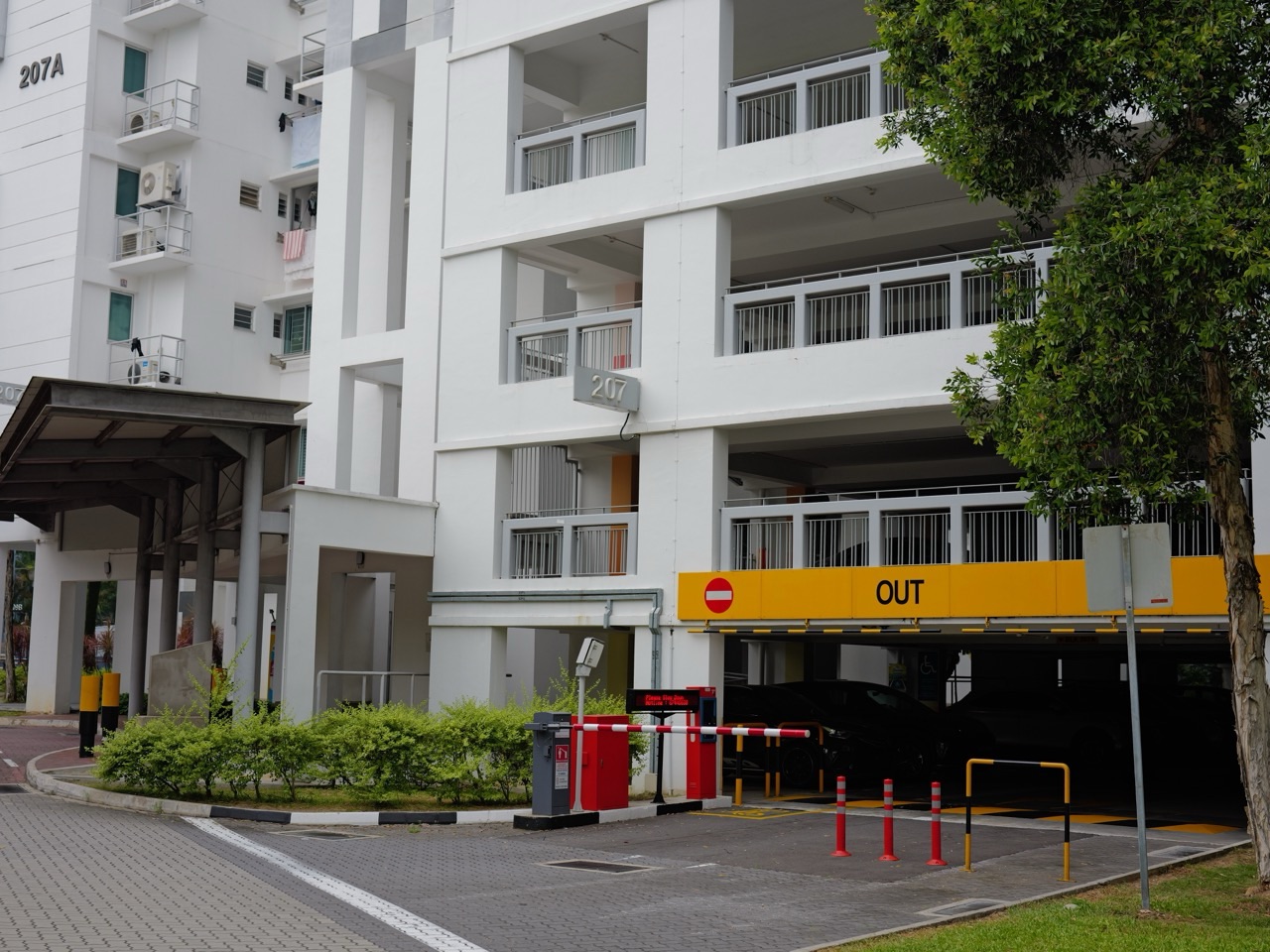
Featured photograph: Punggol HDB multi-storey car park, showing the kind of parking environment where EV charging could be provided. The image does not show a registered EV charger, a specific registered responsible person or an LTA certification. Part of The Gold Standard | eduKate Singapore and the Sectors and Services Directory. Current LTA rules, issued registration and qualified electrical professionals govern actual installation and use.