
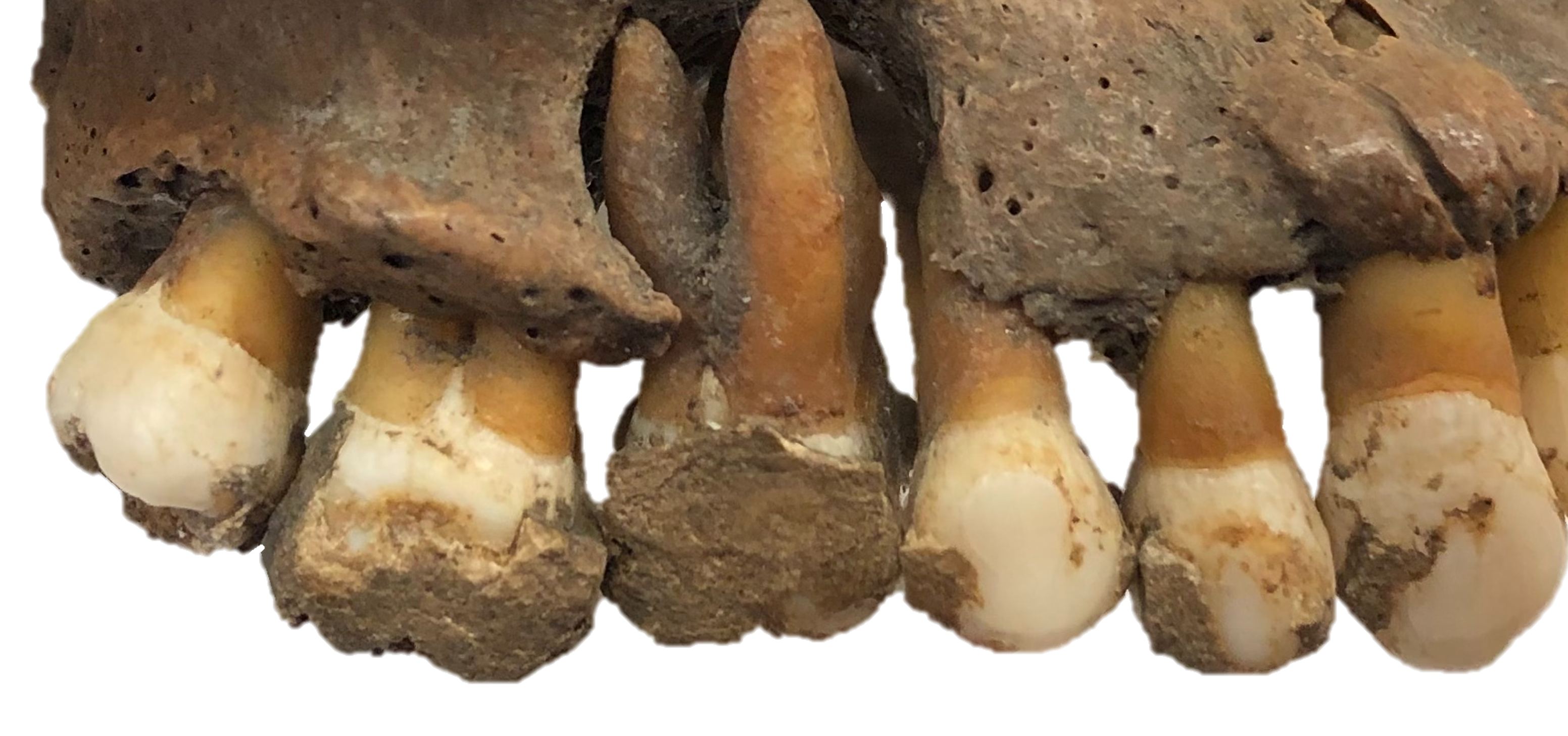
Archaeological Dental Calculus Analysis studies mineralised dental plaque as a potential archive of oral microbes, dietary particles, proteins and other traces. A preserved grain or microbial sequence does not reveal a complete personal menu, diagnosis or ancestry. The Gold Standard is to explain source formation, preservation, identification and contamination before making historical claims.
Our fictional Orchard Cemetery individual OC-01 has a small assemblage of microscopic particles and an invented classified-sequence profile. All laboratory numbers are teaching examples. The featured genuine archaeological maxilla from Tlatelolco, Mexico City, photographed by Kelly Blevins, shows calculus but is not the source of our invented data.
Research foundations include ancient oral microbiome and proteomic work, a calculus-versus-dentin preservation comparison, and methodological warnings about dietary DNA authentication. The eduKate Gold Standard provides the practical teaching quality floor.


Find the oral-archive research question
Read from plaque formation through biomolecular source verification, or follow one of the five teaching routes.
Chapter index
Calculus formation and context · Chapters 1–4
Human remains and dietary microfossils · Chapters 5–7
Oral DNA and authentication · Chapters 8–10
Preservation, mobility and health · Chapters 11–14
Integrated reporting and transfer · Chapters 15–16
1. Dental calculus is not a diary of every meal
At a fictional excavation called Orchard Cemetery, one archaeological tooth carries a hard deposit of mineralised dental plaque. An enthusiastic student finds a few plant-like particles in the deposit and declares that the individual ate a named cereal every day. Dental calculus can preserve microbial material, proteins and particles from oral exposure, but it is not a complete or unbiased record of meals. A trace may have entered the mouth from food, dust, craft activity or another source; even diet-associated residues do not establish frequency or portion size.
Warinner and colleagues’ 2014 ancient oral-cavity research demonstrated the potential of dental calculus to preserve biomolecular evidence from microbial communities and diet-associated material. The tooth and counts in our teaching case are invented. The featured photograph is a real archaeological maxilla from Tlatelolco, Mexico City, with visible calculus, credited to Kelly Blevins; no laboratory diet or infection result is inferred from the photograph. That separation is the article’s first teaching standard.
Back to chapter index · Next chapter
2. Understand how a mineralised plaque deposit forms
Dental calculus is calcified plaque, containing microbial biofilm components and materials that become trapped as plaque mineralises. Some of those components may preserve for long periods on archaeological teeth, depending on deposition and later environmental history. It can be more stable for certain kinds of oral biomolecules than unmineralised plaque, but survival and contamination vary among sites and sample conditions.
Pupils compare a diagram of a tooth, adherent calculus and surrounding burial sediment. They identify the original oral deposit separately from post-burial soil. A mineralised surface does not mean every substance on its exterior came from the living individual’s mouth. The answer must be based on extraction context and independent evidence, not an assumption that hard deposits exclude contamination.
Back to chapter index · Next chapter
3. Record the tooth and archaeological context first
An archaeological tooth belongs to a particular skeleton, burial, layer and collection history. Calculus may sit on one tooth surface and be absent from another; deposits can be damaged by excavation, handling, conservation or museum storage. A specimen ID, tooth type, deposit position, preservation and custody record must accompany any microremains or biomolecular measurement.
Students make a fictitious record for specimen OC-01: archaeological context, identified molar, visible calculus location and recovery history. Then a second field sheet intentionally omits which tooth was sampled. Ask whether laboratory results can still be linked to one person or surface reliably. A convincing biomolecular dataset does not recover provenance that was never documented.
Back to chapter index · Next chapter
4. Distinguish calculus from nearby soil and conservation residues
A scraped deposit may include external sediment or material introduced during earlier cleaning or storage. Modern handling can contribute human DNA, microorganisms or particles. Ancient microbes and post-depositional organisms can overlap in broad classification unless authenticity and context are assessed carefully. Some laboratory techniques can target interior deposits, but no method makes contamination impossible.
A comparative study of dental calculus and dentin reported different DNA preservation and contamination profiles across archaeological samples. Pupils should identify what a surface soil control, preservation record and independent laboratory blank could each reveal. A negative control supports confidence in a process but does not automatically verify every result.
Back to chapter index · Next chapter
5. Respect human remains and the limits of destructive sampling
Dental calculus occurs on human remains with cultural, familial and institutional significance. Removing calculus or extracting biomolecules can irreversibly change a specimen, so professional research requires appropriate permissions, ethical consultation, conservation assessment and a scientifically justified question. A child’s curiosity about a historic tooth does not authorise collection or scraping.
Use the licensed Tlatelolco image with precise credit and collection context, rather than inviting pupils to handle archaeological teeth. Students design a research-permission checklist: who holds the material, what cultural authority may be relevant, what sample size is proposed and how the record will be archived. The class should understand that scientific promise does not override care for people and heritage.
Back to chapter index · Next chapter
6. Microfossils record encounters, not complete food inventories
Starch granules, phytoliths, fibres, pollen or other particles can be trapped in calculus. Identification depends on preservation, morphology, reference specimens and controls; similar forms may occur in multiple botanical taxa. Some particles can enter the mouth through preparation, inhalation or work, not necessarily through eating. One grain is not one meal.
Give fictitious OC-01 with five starch-like grains, three phytoliths and four other particles. Pupils describe the categories and explain why the set does not establish twelve meals or the person’s lifelong menu. The source of each particle and its taxonomic confidence remain separate questions. This complements the eduKate Phytolith Analysis guide without replacing its morphology-specific owner.
Back to chapter index · Next chapter
7. Proteins may preserve different biological sources
Proteins in mineralised calculus can include human host proteins, oral microbial proteins and sometimes food-related proteins. Their identification depends on sequence coverage, reference quality, degradation, laboratory processing and contamination checks. Detecting a protein consistent with a food source can support past exposure, but not always how often, how much or in which dish it was consumed.
The 2018 medieval dental calculus metaproteomics study examined thousands of protein groups and oral microbial associations. Pupils should distinguish identification of protein groups from a direct measurement of disease or diet. The existing Gold Standard Palaeoproteomics article owns general protein authentication; this guide concentrates on the specific calculus matrix and its mixture of oral sources.
Back to chapter index · Next chapter
8. Oral microbial DNA represents a community, not a diagnosis
Ancient dental calculus can preserve sequences from bacteria and other oral organisms. The detected community reflects microbiome ecology, preservation and laboratory analysis. A bacterial species associated with a modern disease can occur in people without proving that the archaeological individual had a particular clinical diagnosis. A microbial sequence count is not automatically a count of living cells.
Warinner’s oral microbiome investigation offers a real research example. Students compare a fictional 1000-read dataset with a list of actual microbial taxa in a reference publication, asking what read counts, authentication and sample quality permit. The correct first output is a source-aware microbial profile, not a patient’s medical chart.
Back to chapter index · Next chapter
9. Ancient authentication and modern contamination are distinct
For molecular evidence, researchers can investigate short fragments, characteristic ancient damage patterns, blanks, reproducibility and the source ecological signature. Those checks vary by method and taxon; a sample’s age does not guarantee every recovered molecule is ancient. A modern contaminant can even appear abundant because it amplifies or maps more efficiently than degraded ancient molecules.
Ask pupils whether a short read matching a familiar food plant must be ancient and dietary. Not without controls, taxonomic specificity, damage and provenance. A methodological critique of dietary DNA claims from archaeological dental calculus discusses common authentication and taxonomic errors. The lesson is verification, not learning to make a dramatic ancestry announcement from one DNA result.
Back to chapter index · Next chapter
10. Define the read-count denominator before percentages
A library with 1000 reads classified as 600 oral-associated, 250 environmental-associated and 150 other/uncertain has three numbers that sum to 1000. Their shares are 60%, 25% and 15% under this invented pipeline. They do not represent the original percentage of living bacteria in the mouth, because preservation, DNA extraction, library preparation and mapping can bias representation.
Students calculate these shares and identify why a second specimen processed by a different pipeline may not be directly comparable. Absolute molecule numbers, organism abundance and relative read counts are different. If a laboratory reclassifies one ambiguous genus, the percentages change even if the sequenced data do not. The archive needs raw reads and method information.
Back to chapter index · Next chapter
11. Differential preservation makes comparisons difficult
DNA, proteins, starch and mineral particles do not preserve equally, and burial chemistry, humidity, dental disease, calculus thickness and handling histories can influence recovery. A thinner archaeological deposit may contain fewer molecules despite similar original oral exposure. A site with warm, moist conditions may differ from a cold, dry site without the difference meaning people had fundamentally different diets.
Research comparing calculus and dentin found distinct host and microbial DNA preservation profiles across a broad sample set. Give pupils fictional OC-01 and OC-02 with different library yields and blank results. The responsible comparison reports preservation and method effects before proposing historical differences.
Back to chapter index · Next chapter
12. Microbiome patterns and human mobility are not identity certificates
Oral microbial communities vary among people, time, environment and lifestyle. Population-level patterns may be informative in appropriately designed studies, but one ancient calculus profile does not establish ethnicity, nationality, migration route or descent from a named modern family. Such assertions require separate research design and ethical review.
A 2024 study of Oceania archaeological calculus evaluated ancient oral microbiome preservation and possible biogeographic questions. Students should explain how population-level sampling differs from diagnosing the biography of one individual. Personal identity is not encoded as a tidy label in an oral taxon chart.
Back to chapter index · Next chapter
13. Oral health interpretation needs clinical and skeletal context
Calculus, caries, abscesses and periodontal bone changes can provide related but different evidence of oral conditions. Molecular profiles might be consistent with certain disease-associated communities, but a clinical diagnosis of infection in a living person cannot be recreated automatically from one archived biomolecular measurement. Historical oral health research needs tooth condition, anatomical evidence, source sampling and relevant comparisons.
The real Tlatelolco photograph also documents a periapical lesion, but it has no attached microbial laboratory result in our guide. Pupils identify what the image alone shows and which findings would require osteological or molecular investigation. This prevents the careless use of modern disease names to describe every ancient oral deposit.
Back to chapter index · Next chapter
14. Multiple proxies strengthen some claims but can also disagree
Dental calculus can contain microscopic food-related particles, proteins and microbial DNA, each with different recovery and contamination histories. Agreement may strengthen evidence for particular exposure when the source is secure. Disagreement may reflect method sensitivity, source identity, preservation or chance sampling; one apparently missing food molecule does not prove its absence from diet.
Students compare invented microscopy and molecular records from OC-01. If a starch-like grain is present but no plant DNA is detected, should the grain be dismissed? Not automatically. Likewise, a low-confidence plant DNA hit may not validate a poorly identified starch grain. The right approach is to assess each line independently before combining them in a qualified interpretation.
Back to chapter index · Next chapter
15. Use chronological control and collection histories honestly
A calculus deposit was formed during an individual’s lifetime, but its archaeological burial has a separate dating history. Calculus itself is not a self-contained date label; human remains might be dated by suitable scientific methods or archaeological context. A modern museum acquisition or sequencing year is not the age of the original oral deposit.
Pupils build four fields: life exposure, formation of calcified plaque, burial or deposition, and modern sampling. They cite the source supporting each when available. A richly sequenced medieval sample does not mean every detectable molecule formed on one exactly documented day, or that all four events should be assigned the same calendar date.
Back to chapter index · Next chapter
16. Archive evidence and transfer to a different burial
A credible calculus report needs provenance, tooth and deposit position, permissions, imaging, amount sampled, microscope identifications, DNA/protein methods, contamination controls, reference databases, taxonomic uncertainties and interpretation scope. Publishing only an exciting food or disease claim hides the work needed to verify it.
The final fictitious case provides two skeletal contexts, one high-preservation calculus sample and one poorly preserved tooth with a suspect modern contaminant. Students identify which sources can be compared, what can be said about oral exposure and what remains ethically or statistically unresolved. The gold standard is a careful archaeological archive, not an invented life story.
Worked archaeological calculus sample: counts are not meals or patients
The two tables are invented to illustrate source-aware arithmetic. They contain no real human genetic data, no reported medical diagnoses and no facts about the photographed archaeological person.
| Invented microremains from OC-01 | Count | What can be claimed |
|---|---|---|
| Starch-like grains | 5 | Morphological candidates, not five meals |
| Silica phytolith-like bodies | 3 | Plant-related forms, not definite crops |
| Unresolved particles | 4 | Remain unidentified |
| Total recorded particles | 12 | Not twelve discrete consumption events |
| Fictional sequence classification | Reads / 1000 | Interpretive limit |
|---|---|---|
| Oral-associated classification | 600 = 60% | Not 60% of living bacteria |
| Environmental-associated classification | 250 = 25% | Possible source and contamination questions |
| Uncertain / other | 150 = 15% | Not a defined disease group |
Correct interpretation: the first count documents a few classified particles. The second shows how a fictional sequence-analysis pipeline classified reads. Neither table provides direct meal frequency, clinical infection prevalence or a personal ancestry category. Identification references, laboratory and source controls are essential before stronger claims.
Four lessons that respect both science and the archaeological person
- Lesson 1: describe calculus, tooth position, site records and ethically appropriate sampling.
- Lesson 2: distinguish food-like microremains, proteins and oral microbial sequences with their separate authentication requirements.
- Lesson 3: calculate fictional counts and evaluate contamination, preservation, disease inference and misleading diet claims.
- Lesson 4: interpret an unfamiliar burial archive and write a cautious summary that protects both evidence and human dignity.
Advanced evidence audit: a documented tooth and a convincing biomolecular result are different accomplishments
An imaginary archive contains one labelled calculus sample from tooth OC-01 and a second sample labelled only ‘Old Cemetery, molar’. Both produce high-quality laboratory reads. A student may combine them as if they belonged to the same person because the excavation name sounds related. That would merge uncertain provenance with molecular evidence. A laboratory can authenticate certain molecules without independently establishing which archaeological individual supplied an ambiguously labelled sample. The two questions require different source information.
Ask learners to build a custody chain: field context, skeleton identifier, tooth and surface, sample collection, storage, laboratory batch and computational file. If a stage is unknown, it should stay unknown rather than be reconstructed from the eventual readout. This lesson reinforces ethical treatment of human remains: no molecular curiosity justifies erasing who had authority over the specimen or overstating a personal attribution. The final report can preserve a useful general finding while declining an unsupported individual biography.
Advanced contamination case: a successful negative control is necessary but not a magical guarantee
A fictional calculus extraction produces abundant oral-associated sequences, while one batch blank contains a low number of environmental-looking reads. Another blank is negative. Pupils should consider background contamination, reagent sources, differences between batches and identification uncertainty. They should not automatically exclude the entire excavation or silently delete the inconvenient blank. Equally, a clean blank does not prove that every taxon identified in the main sample is ancient; contamination may enter during earlier excavation or later handling.
Students draw the two possible routes by which a modern microbe could reach the sample: before laboratory extraction and during laboratory processing. Which records test each? Storage and handling logs matter for the first; extraction blanks and batch history for the second. Ancient fragment damage and authentic ecological patterns may contribute, but neither independently settles every microbe’s source. A strong report documents the issue, distinguishes material from inference and recommends appropriate specialist review before asserting a historical pathogen or food identification.
Advanced dietary inference: one starch-like grain is not an ancient recipe
The fictional OC-01 calculus contains five starch-like particles. A learner searches for a shape match online and announces that its owner ate a particular grain porridge every morning. The reasoning is over-specific at several stages: taxonomic morphology may overlap, some starch-like bodies can be damaged or misidentified, exposure might be dietary or occupational, and the observed grain count does not measure meal frequency. A trace’s meaning depends on reference comparisons, contamination controls and source context.
Offer two alternative routes: food chewing and environmental introduction through processing raw plant fibres. Pupils specify what microscopy, starch extinction pattern, reference tissue and associated archaeological evidence might help discriminate explanations. They should also acknowledge where the calculus preservation history limits confidence. The correct conclusion may be ‘a particle consistent with a plant starch form occurs in the sampled deposit’ rather than ‘this person ate exactly five meals of a named dish’. This is how oral microfossils contribute to history without being inflated into a complete menu.
Advanced microbial comparison: a read profile does not identify an ill person
Imagine two invented calculus samples, one with a higher proportion of reads assigned to a bacterium associated with periodontal disease in some modern research. A beginner writes that one ancient person suffered worse illness. But sequencing reads depend on preservation, relative abundance, taxonomic assignment, mapping and many laboratory stages. Presence of a species associated with disease does not establish the person’s symptoms, clinical condition or severity at life, and the relationship between ancient and modern oral communities may vary.
Give pupils fictional archaeological tooth descriptions showing calculus, caries and bone lesions alongside their read-classification results. They should distinguish direct visible dental evidence from a microbial hypothesis and from a fully supported health conclusion. The medieval calculus metaproteomics study illustrates how host and microbial protein information may add insight, but does not license one-to-one diagnoses for every specimen. A good student writes about patterns and evidence limitations rather than turn the sample into an imagined modern clinic report.
Advanced taxonomy and reference bias: a diet hit may be wrong even when the software looks certain
An imaginary DNA read aligns to a known food plant in a database. A second related species has not been included in the reference, and a broader taxonomic group shares the read’s short sequence. A high software match score does not eliminate the missing-reference problem. Short ancient DNA fragments, damaged bases and contamination can make exact dietary species identification difficult, particularly when closely related plants share sequences.
Students are given two mock reference databases, one limited and one with additional related plant sequences. The classification changes when the more complete set becomes available. The original read has not changed; the analysis and its confidence have. Published criticism of dietary DNA inference from dental calculus provides real reasons for authentication caution. The strongest teaching outcome is to preserve raw sequence evidence, reference version, alternative plausible taxa and an appropriately broad label rather than publish a definitive dish from a weak alignment.
Advanced preservation case: an absent food signal is not evidence that the food was never eaten
An archaeological calculus specimen contains few identifiable biomolecules but the surrounding site’s plant remains show evidence of several foods. A student may conclude that the person avoided those foods because none of their DNA or proteins was detected in calculus. Absence of detection has many possible explanations: the person might have eaten the item without residue becoming entrapped, particular molecules may have degraded, or the detection method may have insufficient sensitivity. Negative evidence must be interpreted under the source’s preservation and analytical limits.
Compare a second fictional calculus sample with better molecular preservation from the same context. Pupils should not equate its higher sequence yield with greater consumption or worse hygiene without controlling for material and analysis. The calculus-versus-dentin study shows that different materials preserve microbial and host DNA differently. Classroom assessment should reward a clear statement of what was not detected, how it was searched for, and why the missing signal does not automatically prove behavioural absence.
A respectful museum account of an archaeological person
Give students a seventy-word caption assignment for the real Tlatelolco calculus photograph. The image documents an archaeological maxilla with mineralised plaque, not a genome, diet reconstruction or diagnosis. Students should include the source and relevant collection record and avoid presenting the individual as a set of sensational medical symptoms. If describing dental lesions visible in the photograph, distinguish that appearance from interpretations requiring clinical or osteological expertise.
Now ask them to write a separate caption for the fictional OC-01 microremains dataset, clearly labelling it invented. Mixing the two images and data would fabricate evidence about a real person. This exercise tests whether pupils can communicate archaeological science to the public with both accuracy and dignity. A powerful educational image should deepen curiosity about documented research rather than tempt the author into borrowing a stranger’s biographical identity.
Assessment rubric: five distinct claims, five kinds of evidence
| Question | What strong work requires | What not to infer |
|---|---|---|
| Whose sample? | Archaeological context, tooth and custody record | Identity from matching excavation names alone |
| What survives? | Visual calculus, preservation and source metadata | Every biomolecule is ancient by default |
| What was identified? | Reference quality and authentication controls | A database hit proves an exact food species |
| What was experienced? | Careful separation of exposure, diet and disease | Read share measures meals or clinical illness |
| What can be published? | Consent/permissions, traceable methods and honest limits | One person’s complete life from one tooth sample |
For final transfer, pupils receive an unfamiliar sample with a damaged calculus patch, a molecular result from a different batch and incomplete tooth metadata. They should identify which analyses are possible, which claims remain provisional and what additional field or laboratory documentation could improve confidence. The best answer is informative without making the sample speak beyond its evidence.
Frequently asked questions
Can a starch grain tell us someone’s last meal?
No. Source, preservation, contamination and exposure route remain uncertain.
Does dental calculus preserve ancient DNA?
It can, subject to preservation and authentication; recovered sequences also reflect the analytical method.
Does a disease-associated bacterium prove ancient disease?
Not without additional clinical, skeletal or source-specific evidence.
Can the microbiome establish a named ancestry or nationality?
No. Individual identity claims require different methods and evidence.
Should students remove calculus from archaeological teeth?
No. Such sampling must be justified and authorised by qualified heritage and research institutions.
Research references and related eduKate studies
- Warinner et al.: Ancient Oral Microbiome and Host Immunity
- Calclulus and Dentin DNA Preservation Comparison
- Dietary DNA Identification and Contamination Cautions
- Medieval Dental Calculus Metaproteomics
- Neanderthal Dental Calculus Research
- Oceania Archaeological Calculus and Preservation
- Tlatelolco Archaeological Calculus Photograph (CC0)
- Teaching Ancient DNA Analysis
- Teaching Palaeoproteomics
- Teaching Phytolith Analysis
- The Gold Standard master hub
The Gold Standard of Teaching Archaeological Dental Calculus Analysis is a learner who can recognise the mineralised oral archive, distinguish its contents and source histories, verify relevant molecular and microfossil evidence and decline unwarranted claims about diet, diagnosis or identity.