
Archaeological Starch Grain Analysis studies microscopic plant starch preserved on tools, in sediments and other archaeological deposits. A starch-like grain on a stone is not automatically proof of an ancient crop or food-processing technique. Identification requires microscopy, credible plant references, source context and rigorous contamination control.
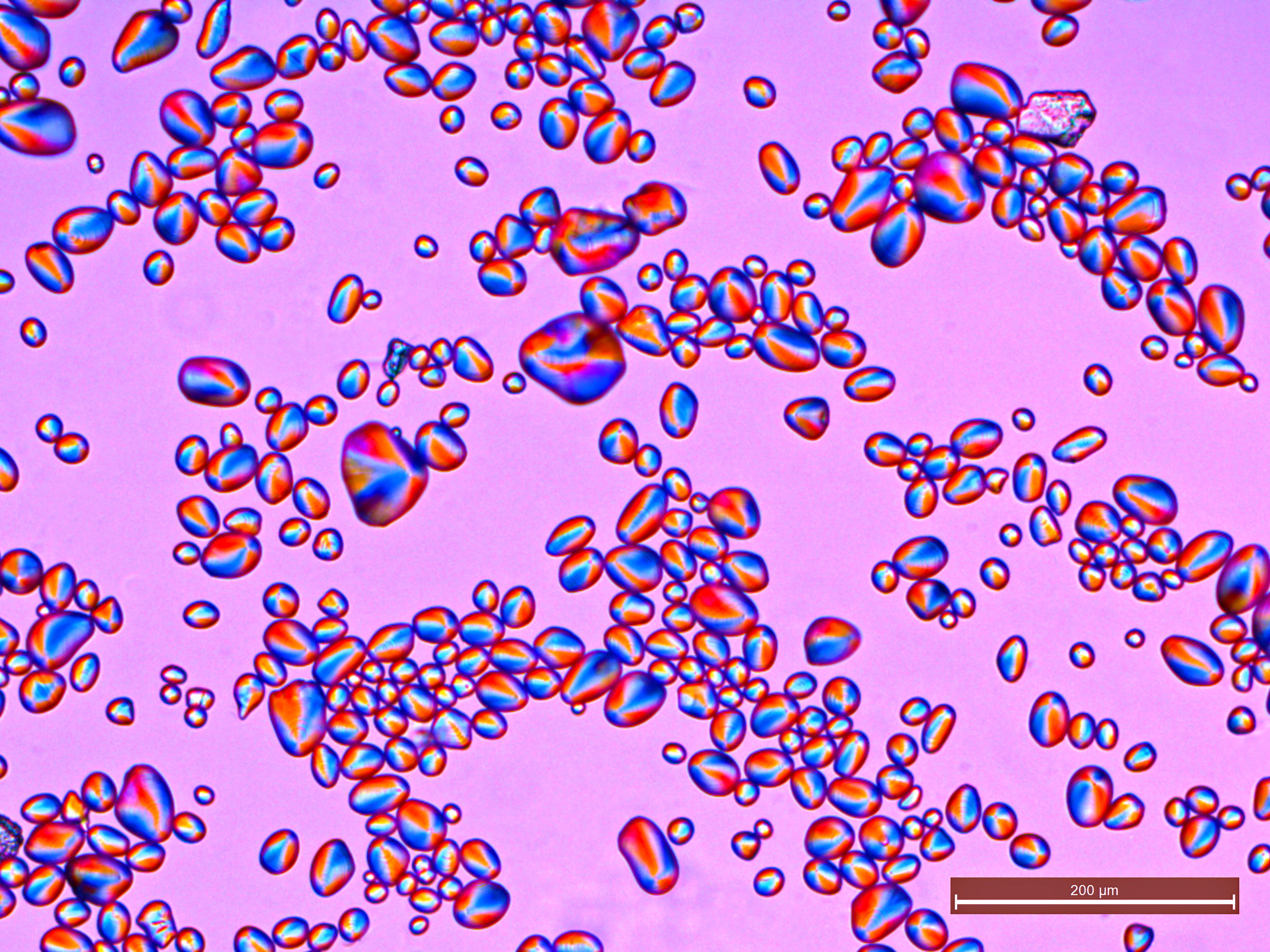
Our original Stone H1 case is entirely fictional, comparing candidate grains from a tool surface and adjacent sediment. The featured modern potato starch micrograph by Photon 400 750 is genuine reference material, not archaeological material from H1.
The ancient starch laboratory contamination study, multi-analytical archaeological starch research and eduKate Gold Standard master hub provide the research and teaching principles.


1. The difference between a starch grain and a crop history
Archaeological starch analysis uses microscopic starch granules from tools, sediments, residues or other archaeological materials to investigate past plant use. A grain may be compatible with a plant group but does not automatically identify a specific crop, a recipe or who prepared the food. Modern contamination, preservation and overlapping grain morphologies are major limits. The right starting point is to describe the observed particle, its sample context and authenticity.
Our invented Stone H1 is a grinding-stone-like object with a fictional residue count, not a real excavation. The featured high-quality modern potato starch photograph by Photon 400 750 is a teaching reference, not archaeological material from H1. The Crowther and colleagues’ contamination study shows why field and laboratory contamination must be documented before plant-use stories are written.
Back to chapter index · Next chapter
2. What starch granules are biologically
Starch is a carbohydrate reserve made within plant cells; granules can vary in size, shape, internal structure and growth patterns by tissue and taxon. Starch grains are not pollen grains or silica phytoliths. Each source proxy has different production, dispersal, destruction and recovery pathways. A tool residue may contain grains from direct contact with plant tissue, but also particles from soil, curation or modern airborne sources.
Students compare a starch micrograph with a pollen and phytolith reference image and identify which observed structures distinguish them. The aim is accurate source classification before assigning a species. They should not assume that every shiny round object under a microscope is carbohydrate or that every visible particle represents one ancient meal.
Back to chapter index · Next chapter
3. Use ordinary and polarised illumination together
Starch granules can show characteristic birefringence under crossed-polarised light, sometimes appearing as a dark cross whose arms intersect near a hilum. This feature is useful, but it does not by itself identify a plant species or prove a grain is archaeological. Modern starch, contaminants and ancient-looking particles may display comparable optical behaviour.
The featured potato starch photograph specifically documents modern material under polarised light at reported 100× magnification. Students identify the illuminated form and a visible cross, then ask what else is needed: scale, multiple views, reference sources and the grain’s archaeological context. A birefringent cross is a microscopy observation, not a historic cultivation date.
Back to chapter index · Next chapter
4. Describe hila, lamellae, fissures and shape cautiously
Starch granules may exhibit a hilum, growth lamellae, fissures, compound structures and differing outlines. Those characters can assist identification, but some features are subtle, altered or shared among plants. A smooth oval grain with one visible internal point is not necessarily diagnostic of potato, wheat, rice or another crop. Image orientation and preservation influence what a researcher can observe.
Provide pupils drawings of an oval, angular and compound-looking fictional grain. They describe measurable width and length, the apparent hilum and any damage before consulting references. Then show two source taxa whose grain dimensions overlap. A broad ‘starch-like granule, plant taxon unresolved’ may be the most defensible annotation when characters are missing.
Back to chapter index · Next chapter
5. Use identified modern reference material rather than visual familiarity
Species identification requires documented modern reference specimens, relevant plant organs, microscopy and criteria for comparing natural within-species variation. A photograph found online can help teaching but cannot always distinguish all closely related taxa. Ancient cooking, fermentation or grinding may further alter grain shape compared with a modern reference. Good research keeps taxonomic hypotheses provisional where those effects remain unknown.
Students prepare an imaginary modern reference card specifying source plant, organ, location, preparation, image scale and diagnostic grain range. They then test a fictional unknown against at least two references rather than choose the first visually similar photograph. The question is how reliably a set of observations identifies the candidate, not how quickly students can name a familiar food.
Back to chapter index · Next chapter
6. Tool surfaces and sediment controls answer different questions
A grain adhering to a grinding surface might derive from plant processing, but its presence could also reflect archaeological soil adhering to the object, post-excavation handling or conservation. Adjacent sediment controls may help assess background starch, yet differences in sampling area and processed mass complicate numerical comparison. A tool residue should never be interpreted without its use-wear, condition and archaeological context.
Our invented Stone H1 contains 18 candidate starch grains from a defined surface area while a nearby sediment control yields 12 from a measured mass. These quantities are not directly comparable rates, because cm² and grams are different denominators. Pupils should state what each observation represents and propose suitable further controls instead of announcing that the tool certainly processed plants.
Back to chapter index · Next chapter
7. Field handling can introduce modern starch
Gloves, packaging, brushes, field meals, airborne dust and curation practices can introduce starch onto archaeological objects. Some apparently clean consumables carry starch residues. This matters especially when ancient grains are scarce: one modern particle may dominate a small microscopic finding. A convincing identification of starch chemistry or morphology does not establish that the grain predates excavation.
Crowther and colleagues’ 2014 laboratory study documented contaminants associated with consumables and showed that some intuitive decontamination procedures were ineffective. Students evaluate a fictional excavation log that records uncovered objects beside food handling. They should ask what contamination pathway could be tested rather than assign all grains ancient status because they were found on stone.
Back to chapter index · Next chapter
8. Controls must be chosen for the contamination pathway
A laboratory blank, clean container control, adjacent soil sample and unworked stone control address different sources of potential contamination. A negative slide in one room does not prove that no starch entered during excavation or storage. Conversely, one positive control is a serious prompt to investigate, not an automatic proof that every particle in the site sample is modern.
Give pupils fictional controls with different outcomes and ask which stage each can evaluate. If a processing blank contains three grains, the class should document the issue and identify alternative sources before accepting an ancient-use interpretation. The aim is quality-control reasoning, not a do-it-yourself chemical decontamination procedure for heritage objects.
Back to chapter index · Next chapter
9. Ancient grain survival is a taphonomic question
Starch granules may be affected by moisture, microbes, soil chemistry, heat, grinding and time. Some may be altered or destroyed while others persist. Preservation can depend on protected microenvironments such as crevices, mineral matrices or dental calculus, though each context has different source biases. A scarce grain count can reflect limited preservation rather than a lack of ancient plant use.
Ask students what happens to an interpretive claim if the supposed tool has been exposed to decades of humid curation without documentation. Some material may survive, but the preservation history needs investigation. An absence of identifiable starch is not evidence that an ancient population never consumed starchy plants. The strongest conclusion identifies the particular examined source and analytical limits.
Back to chapter index · Next chapter
10. Grinding, heating and processing alter the grain
Starch structure can change through mechanical damage and thermal processing. Some heated or processed granules lose diagnostic features, potentially complicating plant identification. An unusual outline on a used grinding stone might reflect manufacture of a particular food, but equally a different plant or post-depositional alteration. Assigning one ancient cooking method from one damaged grain is not justified.
The Pontic steppe starch study used more than simple morphology to evaluate possible ancient starch on ground-stone tools. Students compare an undamaged reference with a deliberately labelled fictional altered grain and propose which complementary methods might help a specialist. The lesson distinguishes trace appearance from the sequence of actions that produced it.
Back to chapter index · Next chapter
11. Use-wear and starch evidence need corroboration
Microscopic edge or surface wear may provide evidence about contact materials or tool function, while starch residues potentially add botanical information. But these are partly independent interpretations with their own contamination and taphonomy limits. A tool that looks like a grinding stone does not make every grain ancient, and an authentic grain does not establish exactly what activity the tool performed.
In the fictional H1 case, a polished surface and starch-like bodies are reported together. Students should list a plant-processing hypothesis and alternatives involving soil, post-excavation contact and non-food activities. They can identify what a suitable experimental reference or independent plant macroremain would contribute. Multiple proxies strengthen an account only when their source histories are related and independently credible.
Back to chapter index · Next chapter
12. Count granules using appropriate observation units
A source may be reported as grains per examined surface area, grains per processed soil mass or occurrence across sampled subsurfaces. These are not equivalent measures of ancient food quantity. Grain fragments, compound clusters and uncertain particles can also affect tally definitions. A table should state which structures were counted, how duplicates were excluded and which observations remained unidentified.
Give a fictional source table with 18 candidate granules from ten cm² of tool surface and 12 from five grams of sediment. Although arithmetic can yield 1.8/cm² and 2.4/g, pupils must not subtract these figures as though the units matched. Nor may they convert a grain count into kilograms of ancient flour. Quantitative clarity begins by preserving what the instrument and sampling actually observed.
Back to chapter index · Next chapter
13. Authentication may need chemistry as well as microscopy
Morphological similarity and polarisation behaviour do not always establish ancient starch authenticity. Complementary spectroscopic or microscopic methods can sometimes test chemical characteristics or deterioration, while controls and source context remain crucial. A laboratory method is useful only when it tests a particular uncertainty and when reference materials permit its results to be interpreted.
The Palaeolithic ground-stone study describes multi-analytical characterisation using imaging and chemical approaches. Students identify the research question each method addresses: particle morphology, chemical identity or archaeological authenticity. No single image or spectra can automatically recover a missing chain of custody. The teacher should discourage treating instrument complexity as a substitute for source reliability.
Back to chapter index · Next chapter
14. Do not confuse the residue date with a tool’s age
A stone tool may have been used, deposited, exposed, excavated and handled at different times. Its sediment context could have a radiocarbon or luminescence age, while grains found in a crevice might have entered during a separate event. A tool’s manufacture date cannot be obtained simply from an undated starch particle. Ancient starch interpretation therefore depends on archaeology as well as analytical chemistry.
Pupils draw a fictional sequence of H1 manufacture, use, burial, disturbance and discovery. Which stage is supported by a stratigraphic date, and which by microresidue evidence? If a modern grain entered during curation, it would record none of the ancient processing events. A defensible conclusion can state possible plant-residue presence without making the tool precisely contemporary with every particle.
Back to chapter index · Next chapter
15. Protect archaeological objects and distinguish disciplines
Sampling residues from heritage objects may remove material or alter surfaces important to future examination. Permissions, conservation, prior treatments and appropriate controls matter. School pupils can analyse licensed images and prepared data without scraping actual archaeological artefacts or handling potentially hazardous laboratory reagents. The specialised owner of this guide is tool- and sediment-associated starch evidence rather than all dental calculus research.
The existing Dental Calculus guide treats oral mineral deposits as a distinct source. Here pupils draft a safe research request for H1, identifying which surface may be sampled, the possible damage and what conservation documentation is essential before intervention. The preservation of an object is part of the trustworthiness of its science.
Back to chapter index · Next chapter
16. Transfer to a new grinding surface with conflicting controls
An unfamiliar fictitious stone has thirty candidate granules on a worn surface, eight in adjacent sediment and two in a field-handling control. The taxonomic identification is unresolved and a storage photograph suggests earlier contact with modern flour. Students must separate morphological observation, grain authentication, plant-source hypothesis and ancient activity interpretation.
A strong answer calculates only compatible measures, describes which controls address which contamination routes, and proposes a specialist corroboration plan. It may conclude that ancient plant processing remains possible but unproven. The gold standard of teaching Archaeological Starch Grain Analysis is a repeatable route from microscope observations to appropriately limited archaeological claims, not simply the identification of a familiar food from one particle.
Worked H1 study: a tool surface and sediment have different denominators
Every figure below is invented. The samples have different bases and the control is not archaeological source material. Candidate grains have not been independently authenticated as ancient.
| Fictional source | Sample basis | Candidate grains | Supported description |
|---|---|---|---|
| Stone H1 surface | 10 cm² examined | 18 | 1.8/cm² under this surface-counting protocol |
| Adjacent sediment S1 | 5 g processed | 12 | 2.4/g under this sediment protocol |
| Processing control | Laboratory blank | 3 | Potential processing contamination requiring review |
| Modern potato image | Reference photograph | Not counted here | Reference shape, not ancient sample |
The 1.8/cm² and 2.4/g values cannot be subtracted as though their denominators were the same. A positive blank is an additional reason not to equate the H1 microscope observation with confirmed ancient use. Both results are descriptions of what the invented samples contained under their stated protocols.
Contamination audit: a clean-looking glove is still a source question
A fictitious field worker wears non-powdered gloves while handling Stone H1. A student concludes that modern starch cannot be present because the gloves were not visibly dusty. Crowther and colleagues documented that laboratory consumables can carry starch and that some commonplace cleaning approaches were unreliable. Appearance is not a validated contamination test.
Students should list field, packaging, storage and laboratory stages and identify what control evidence would address each. A clean blank does not prove the earlier excavation was uncontaminated. The method needs reliable provenance and risk management rather than one reassuring detail.
Microscopy audit: two grains look alike but identify no unique species
An imaginary grain resembles potato in size and oval outline, but some diagnostic internal details are missing. Other plant starches may occupy overlapping morphological ranges, while grinding and heating can distort the original form. Assigning potato from the modern photograph alone would give an unjustified taxonomic precision.
Students record the features actually observed under visible and polarised light, consult multiple authenticated modern references and choose a provisional identification. Where the evidence does not discriminate, the plant source remains uncertain. A responsible method prefers revisable classification to a dramatic food claim.
Tool-use audit: residues and wear must have related histories
Stone H1 has a worn surface and starch-like particles in several crevices. Perhaps plants were processed there; alternatively, some wear might derive from unrelated activities while the particles entered during burial or modern curation. The mere coexistence of evidence does not establish that the two share one ancient event.
Pupils draw separate histories for tool use, residue introduction, burial and conservation. Then they identify which spatial, microscopic or contextual observations would link them. A good conclusion says why plant processing is plausible and exactly what evidence prevents it from being considered proven.
Negative evidence audit: no starch is not no plant food
A second fictitious grinding stone contains no identifiable starch. Its surface was weathered, and the ancient sediment was acidic or microbially active under an unspecified history. Students should not conclude that the people used no starchy food or that the tool never contacted plants. Preservation, source surface and sample recovery can all explain absence.
Ask what independent charred seeds, phytoliths, tool wear or associated residue chemistry could add. Each proxy has its own biases; agreement is meaningful only when contexts are related. The teacher should value a correctly limited negative result rather than a confident but unsupported cultural contrast.
Research audit: a larger number is not necessarily a stronger study
One analyst reports fifty unidentified starch-like particles on a poorly documented stone, while another reports six well-documented grains with proper controls and context. The first number sounds impressive but may include contaminants, double counting or unrelated particles. Laboratory quality and independent source history matter more than raw totals.
Students compare what can actually be concluded from the two records and design missing metadata fields. Strong work retains images, scale bars, identification criteria, artefact and sediment provenance, controls, analytical method and taxonomic confidence. A second researcher should be able to audit rather than simply trust the original report.
Four lessons to move from grain to defensible ancient plant evidence
- Lesson 1: identify starch structures using reliable microscopy and modern plant references, without over-specific taxonomic labels.
- Lesson 2: analyse artefact and soil contexts, contamination pathways, blanks and preservation limits.
- Lesson 3: calculate compatible source counts and evaluate wear, microscopy and chemistry as different evidence types.
- Lesson 4: interpret a fresh fictional grinding-stone packet and write a source-aware historical conclusion.
Advanced comparison: starch, phytolith and mineral particles can coexist
A fictional residue sample contains several birefringent starch-like granules, two elongated silica bodies and a clear mineral fragment. One student names all of them ‘plant starch’ because they occur on a stone tool. A more accurate investigation classifies the observed particles by their actual morphology and chemistry. A phytolith is formed through silica deposition in plant tissue, whereas starch is a carbohydrate reserve with distinctive optical properties. A geological grain may resemble parts of either under one illumination mode. Counting all three under one starch denominator would fabricate a biological signal that the evidence does not contain.
Give pupils three credited modern reference images and one invented mixed field of view. They record what is observed, which classification is supported, and which particle cannot yet be resolved. Then change the illumination or supply another image and ask whether the judgement should be revised. The point is not that one method is universally superior; it is that different microremains provide different kinds of information and preservation histories. An archaeological claim about one plant source should follow the appropriate identified structure, not the researcher’s desired crop.
Advanced contamination chain: the residue may enter before excavation
Imagine Stone H1 was excavated with apparently clean tools but spent decades in a museum drawer close to modern plant specimens and occasionally handled during school demonstrations. The current microscope finds potato-like starch. Those grains could relate to genuine ancient plant use, but a modern source may also have contacted the artefact long after burial. A modern starch granule is biologically genuine starch; that does not establish its archaeological authenticity. Students should keep the question ‘what material is it?’ separate from ‘when and how did it arrive?’
A careful provenance audit lists the excavation record, handling logs, past conservation treatments, contact with food or plant collections, modern control slides and the location of sampled residue. If the records are incomplete, the age of the starch association may remain unresolved even when microscopy is very clear. The analysis should not assume that an object is uncontaminated simply because it came from a museum. Source custody can be as important as a photograph with a scale bar.
Worked scientific rubric for starch-grain identification
| Question | Required evidence | Unsupported shortcut |
|---|---|---|
| Is this starch? | Recognisable grain morphology and appropriate optical or chemical support | Every rounded particle is starch |
| Which plant? | Diagnostic features and suitable multiple modern references | One photograph proves one crop |
| Is it ancient? | Archaeological source control, handling history and contamination assessment | Grain on a stone must be prehistoric |
| Was the plant processed? | Tool context, wear, residue distribution and alternative histories | Presence proves grinding |
| What can be published? | Source ID, raw observations, count denominator and warranted uncertainty | A named recipe from one grain |
Finally, assign each student a fictitious artefact report that omits two essential source fields. The task is to find the gaps, request the right evidence and write a conclusion that may deliberately remain provisional. This trains scientific judgement across microscopic archaeology. The best student need not claim a named cereal or recipe if the only secure finding is that starch-like particles were observed on one historical object after uncertain handling.
Frequently asked questions
Does a polarised-light cross prove ancient starch?
No. It helps recognise starch structure, but authenticity and age require source-specific controls and context.
Can one starch grain identify a specific crop?
Not necessarily. Grain forms overlap and may be changed by processing or preservation.
Are counts per surface area comparable with counts per soil mass?
Not directly. The denominators and processing pathways differ.
Can ancient tool starch be contaminated after excavation?
Yes. Field handling, curatorial history and laboratory consumables can introduce modern material.
Does a negative grain result prove ancient people ate no starch?
No. Preservation, sampling and method limitations can cause negative results.
Research sources and connected eduKate disciplines
- Documenting Contamination in Ancient Starch Laboratories (2014)
- Multi-Analytical Ancient Starch Research on Palaeolithic Tools
- Modern Potato Starch Under Polarised Light, CC BY-SA 4.0
- Teaching Lithic Analysis
- Teaching Phytolith Analysis
- Teaching Archaeobotany
- Teaching Archaeological Dental Calculus
- Gold Standard master hub
The gold standard of teaching Archaeological Starch Grain Analysis is a student who can distinguish microscopic carbohydrate evidence from modern contamination, source condition and crop-specific inference, and identify exactly what additional research would support a historical plant-use claim.