
Archaeological microvertebrate analysis studies small animal bones and teeth to reconstruct site formation, predator activity and past habitats. A pile of rodent jawbones in an ancient cave may have come from owl pellets rather than people hunting or eating rodents. The central scientific task is to identify what was found, trace the routes by which it arrived and keep human-history claims separate from the direct bone observations.
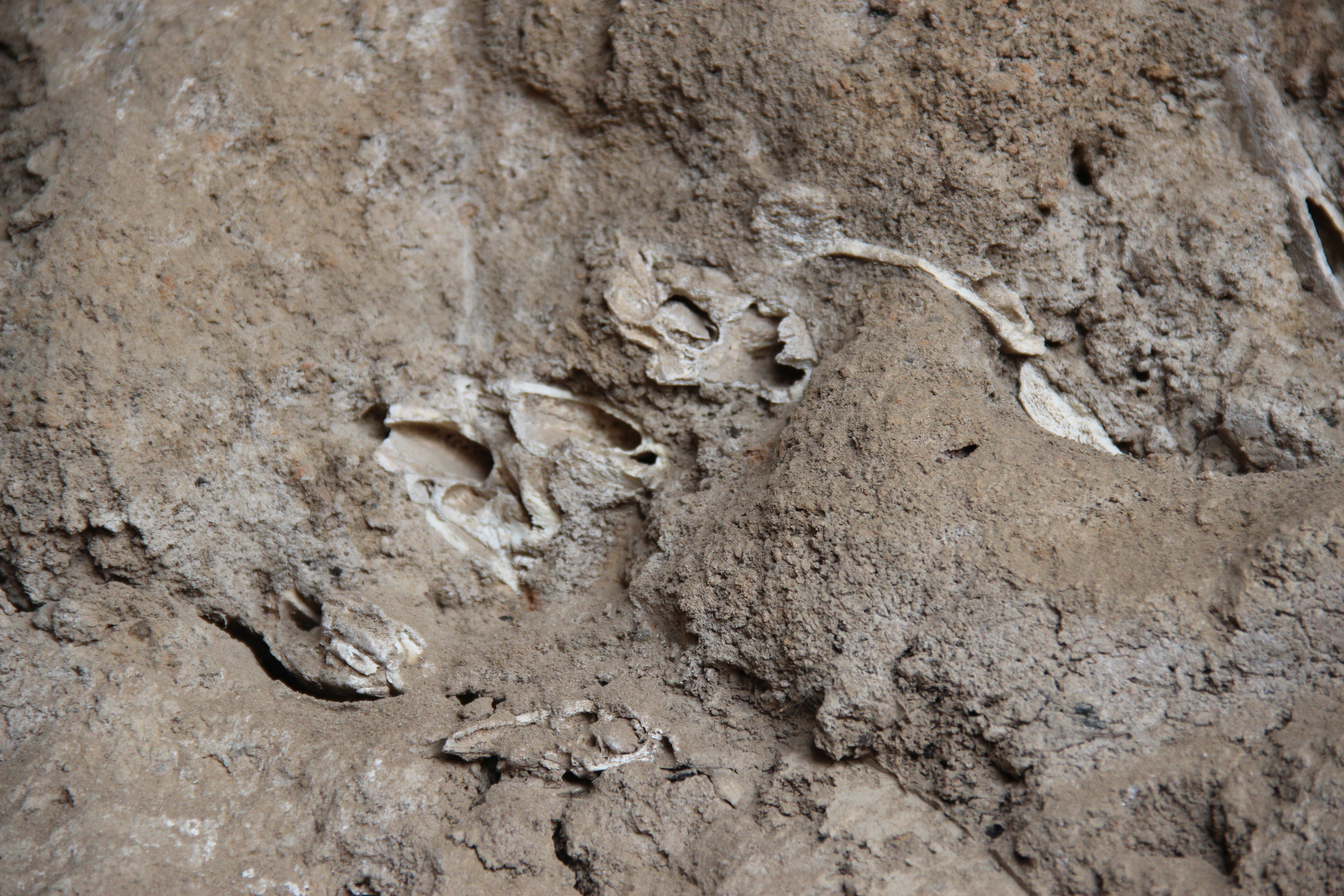
This detailed teaching reference covers tooth identification, fine-sieve recovery, owl-pellet formation, predator digestion, skeletal representation, NISP, environmental bias, age control and a fully invented Meadow Cave dataset. The featured photograph is a real museum display of archaeological animal bones, but it does not depict Meadow Cave and should not be mistaken for a diagnosed small-mammal owl-pellet concentration.
Method studies from Wonderwerk Cave and the Ongamira Valley show how modern pellet comparisons and archaeological context together support careful inference.


1. The miniature bones may belong to a different history
Small mammal and other microvertebrate bones can tell researchers about past environments, animal predators and the layered formation of human sites. But the bones do not necessarily belong to people’s meals. An owl can roost above an archaeological occupation, deposit pellets for years, and leave hundreds of small remains in sediment later associated with human artefacts. Other deposits may result from carnivores, natural mortality or intrusive burrowing. The first teaching question should therefore be who or what deposited the evidence, before anyone reconstructs human behaviour.
Show learners three statements: tiny rodent teeth are present; owls contributed to their accumulation; residents trapped and ate rodents. Ask which is directly observed and what would support each further inference. Teeth may be diagnostic of taxon, while skeletal representation, digestion marks and stratigraphy bear on the second claim. The third requires its own contextual evidence. A rigorous learner becomes comfortable leaving a fascinating behavioural story unclaimed until the formation process is demonstrated.
2. Decide what microvertebrate means in this study
Microvertebrate is a practical size-based research category. Some studies focus on mammals such as rodents and shrews, while others include bats, birds, amphibians, reptiles or fish. The scope depends on the site and research question, and analysts must state it explicitly. A catalogue of small-mammal molars cannot be compared uncritically with a study combining every tiny vertebrate fragment. Even if their table headings look similar, their included specimens may represent different sampling frames.
Begin with a mixed tray of reference drawings. Students classify each entry by taxonomic group, anatomical element and identification confidence. They must state what they have excluded and why. A better record might include ‘small mammal tooth, family uncertain’ alongside species-level identifications justified by diagnostic anatomy. An explicit scope prevents research questions from silently changing halfway through the lesson.
3. Recognise diagnostic teeth and jaws
Teeth and jaw fragments often have useful anatomical characters, including cusp arrangements, enamel patterns, tooth-row proportions and root morphology. The precise features used vary with taxon and geography. A missing cusp, heavy tooth wear or damaged jaw may prevent species identification. Students should be trained with suitable comparative collections and published keys rather than recognising a familiar silhouette and guessing a modern species. Photographs should include scale, viewpoint and the anatomical features used for each decision.
An exercise pairs a complete modern comparative jaw with a fragmentary archaeological example. Learners first annotate what is visible, then record plausible alternatives. They should discover that a broad family-level assignment may be fully justified when species-level diagnosis is not. Confidence is something to calibrate, not something to perform. The correct description remains useful for faunal and taphonomic analysis even if the most specific label is unavailable.
4. Keep anatomical side and element counts separate
One mandible may be split into several fragments; isolated teeth may derive from that same jaw. Counting every fragment as an animal creates a fictitious population. NISP records numbers of identified specimens, whereas other measures attempt to describe anatomical elements or minimum numbers of individuals. Those concepts are related but not interchangeable. Left and right sidedness, tooth positions, refits, maturity and recovery conditions can all influence the inferred counts.
Ask learners to reconcile a toy catalogue listing three fragments of one jaw and two loose teeth recovered in the same bag. They must give an honest identified-specimen count and explain why the number of animals is not simply five. Refit evidence and anatomical redundancy should be documented. This basic discipline protects later ecological percentages from an error introduced at the very first spreadsheet column.
5. Understand the role of sieving and sediment volume
Small remains may vanish from the record if excavation uses coarse screens or opportunistic hand collection. Fine and consistent recovery can recover teeth and bones invisible during ordinary excavation, but the chosen methods still determine what enters the observed collection. Different mesh sizes, sediment volumes, wet processing and sorting intensity affect the relative representation of skeletal elements and tiny species. The excavation method must therefore appear beside taxonomic counts in any meaningful comparison.
Give teams two fictional units, one processed by measured fine sieving and one collected by eye. The team with more specimens must resist claiming greater ancient animal abundance until recovery differences are assessed. Students propose a common protocol and record volume or mass processed, sorted fractions and missing material. A sound sampling frame is part of archaeological evidence, not a technical footnote beneath the ecological interpretation.
6. List all plausible routes into a deposit
Owls, diurnal raptors, mammalian carnivores, water movement, natural deaths, burrowing and human actions can place small vertebrate bones in archaeological settings. Multiple contributors may share the same layer or use the same shelter at different times. Some of their outcomes overlap. A high concentration of skull parts might favour one process in a particular comparative setting, but does not establish it universally. A strong analyst reconstructs a range of formation histories before selecting one.
In a class debate, assign teams owl roosting, fox-like carnivory, accidental death and human food discard. Each must identify the observation most useful for discriminating its model from the others. For instance, digestive modification and element survival could support a pellet interpretation, while direct processing marks may bear on human handling. The groups should critique what each model fails to explain instead of scoring points for confidence.
7. Understand what an owl pellet is
Owls often swallow prey and regurgitate compressed pellets containing indigestible remains, including bones, teeth and fur. Pellets can break apart and contribute dense accumulations under roosts. Their bone preservation depends on owl species, prey, digestive processes and subsequent conditions. An assemblage with skulls and long-bone fragments can be consistent with owl input, but its entire history does not follow from one pellet-like cluster. Research compares modern known processes against ancient material.
Draw the chain from prey capture to ingestion, regurgitation, pellet dispersal, breakdown and burial. At each stage ask what could be lost or changed. Then compare a modern pellet reference with an archaeological layer where pellets are no longer intact. Students should see that interpreting an ancient concentration requires studying the traces left by multiple processes rather than looking for an exact copy of a modern pellet.
8. Describe digestion marks without naming an owl prematurely
Predator digestion may chemically modify bone, rounding edges, etching surfaces or damaging enamel. Severity differs with predator, prey anatomy and local conditions. Burial chemistry can also modify surfaces. Scientific references therefore compare combinations of traits across many specimens, not one tooth described as ‘corroded’. Recent actualistic studies remind researchers that predator-specific patterns can overlap and that expectations built in one region may be incomplete elsewhere.
Use three labelled reference images showing light, moderate and severe surface alteration, alongside an altered bone whose cause is unknown. Students record what is observed, how it is classified and why the interpretation remains provisional. They should identify when sedimentary alteration or a different predator could produce a similar effect. The aim is repeatable diagnosis, not a theatrical demonstration of certainty.
9. Compare cranial and postcranial representation
Skulls, jaws, teeth and postcranial bones may survive and be transported at different rates. Some predator-derived accumulations contain a recognisable imbalance. Yet fragile bones break, excavation affects recovery and diagnostic teeth are easier to identify than nondescript shafts. A ratio of cranial to postcranial remains is therefore an informative description only when anatomical definitions, denominators, selection and preservation are recorded. It is not a predator-identification password.
Students calculate percentages for two invented samples with equal total counts but different cranial shares. They then investigate whether the contrast could be created by different screening methods or anatomical classification decisions. This teaches denominator literacy and why an archaeological assemblage must be assessed as a whole, including the indeterminate fraction and recovery method.
10. Record breakage and refitting
Bone fractures can occur during predation, trampling, burial, excavation or modern handling. Fresh-looking and ancient-looking breaks may sometimes be differentiated through surfaces and context, but classification needs care. Refitting pieces can reveal whether an apparently large assemblage is actually dominated by a few fragmented bones. Every broken edge deserves a note about condition and location before it is turned into a behavioural indicator.
Create a fictitious bag of twelve fragments that join to reconstruct five bones. Students compare the original fragment count with the number of reconstructed elements and explain which is appropriate for different questions. If the purpose is documenting damage, the fragments remain relevant; if the purpose is inferring prey abundance, naive fragment totals are misleading. A useful catalogue stores both kinds of information instead of discarding either.
11. Distinguish digestive from environmental corrosion
Acidic sediment, groundwater flow, roots and other chemical processes can alter bone after deposition. Superficial pitting may resemble predator digestion even when no animal swallowed the bone. Microscopic context, characteristic patterns, mineral alteration and preservation of associated material can help distinguish explanations. Analysts should not treat corrosion as a self-authenticating predator label. A taphonomic diagnosis is an inference supported by a suite of observations.
Provide two fictional bones with similar pitting, one found within a coherent pellet-rich concentration and one from disturbed acidic soil. Ask students what independent context or laboratory observations would discriminate digestive alteration from later environmental damage. They should report ambiguity where the evidence cannot. The aim is to produce a more testable hypothesis, not to force a label onto a poor specimen.
12. Test skeletal articulation and natural death
A near-complete articulated skeleton may suggest a different formation history from a dispersed collection of prey fragments. Natural death, burial inside a nest, intrusive burrowing and rapid sediment cover are all possible. Articulation alone is not decisive; later excavation may disturb it, and predators can also deposit clustered body parts. Contextual relationships and sediment fabrics are essential to understanding the deposit.
Have students sketch two hypothetical finds, one articulated within a burrow cut and one scattered beneath a roost ledge. They identify the dates and relationships that need verification before either is assigned to the main human occupation. A rodent that died in a later burrow can crosscut a much older archaeological floor. Recognising intrusion is as much archaeology as identifying a mammal tooth.
13. Treat predator prey choice as a sampling filter
Owls and other predators catch a selective sample of local small animals. Hunting time, prey size, habitat, movement and visibility affect which species end up in pellets. An abundant prey species in a pellet sample need not have been the most abundant living species. These ecological selection processes intervene before digestion, sediment preservation and laboratory recovery. Using the recovered fauna as a direct census skips several powerful filters.
Ask learners to draw three bars for one imaginary site: actual small-animal community, predator-selected prey and archaeologically recovered bones. They specify a plausible change at each step. This introduces ecological sampling bias without requiring advanced mathematics. Students can see why a change in predator or prey behaviour may mimic a change in vegetation or climate.
14. Use habitat information as a range, not a label
Identified small mammals can inform past environments because taxa differ in ecological tolerances and preferred habitats. Yet their habitats overlap, ranges change and predator hunting territories cover diverse landscapes. A species associated with open country today does not prove a cave’s entire surroundings were open grassland. Good interpretations combine regional ecology, multiple taxa, dating and independent vegetation or sediment evidence.
Build a habitat matrix with woodland, scrub, grassland and wetland affinities, allowing a taxon to occupy more than one class. If a fictional assemblage contains a mixture, ask whether a habitat mosaic, a broad predator catchment or a mixed deposit best explains it. No one needs to claim a complete landscape from a single tooth. The lesson is about constrained alternatives.
15. Separate layers before constructing a climate trend
A large taxonomic shift between layers is interesting only if the layers are chronologically and methodologically comparable. Burrowing, trampling, erosion and reworking can mix material. Sample size also matters: two teeth of one species in a six-tooth layer appear dramatically important as a percentage. Without sufficient specimens and age control, the apparent trend may be sampling noise rather than ecological transformation.
Have learners plot both raw taxon counts and percentages for three fictitious layers. Add the layers’ age ranges to expose chronological overlap. Students write a conservative statement about observed composition before proposing a palaeoclimate scenario. The sequence trains them to distinguish measurement changes, depositional changes and real environmental change.
16. Use modern actualistic analogues without copying conclusions
Actualistic taphonomy studies modern known processes to understand their characteristic effects on bones. Studies of owls and mammalian carnivores can reveal useful patterns of fragmentation, digestion and anatomical survival. However, the reference predators, prey and local ecological conditions may differ from an archaeological setting. A paper can be rigorous for one valley and still be an imperfect direct model for another.
Invite students to compare an actualistic study from Argentina with a hypothetical cave elsewhere. They list the method components that can be adapted and the assumptions that require local validation. The correct response is neither rejecting modern references nor copying a predator name from a published table. Strong comparative archaeology preserves local context.
17. Use genuine Wonderwerk Cave research as a method model
Wonderwerk Cave in South Africa offers published work examining deep-time small mammal assemblages, modern pellet comparisons and site-formation questions. The value for teaching lies in how researchers test accumulation processes, not in pretending their specific results apply everywhere. It is a case study of multi-method reasoning in a complex archaeological archive. Students can examine how taxonomic observations, bone modification and spatial evidence interact to support a carefully bounded conclusion.
Assign a reading worksheet asking which information came from modern reference pellets, which came from archaeological layers and which came from interpretive comparisons. Require learners to identify uncertainties and the scale of the final claims. The lesson teaches scientific reading: extracting a method from a paper is more transferable than memorising its headline.
18. Learn from research in the Ongamira Valley
Published research from the Ongamira Valley in Argentina has compared modern and archaeological owl pellets to assess small vertebrate deposits and site history. This demonstrates why modern comparative collections help interpret taphonomy and why past habitats require multiple lines of evidence. It also shows that predators and humans may use the same places differently through time, complicating simple occupation stories.
Students compare what is directly documented about modern pellet accumulation with what is inferred about prehistoric shelter use. They should identify which findings depend on the region’s modern ecology and which methodological procedures can be adapted elsewhere. An archaeological paper becomes a model for research design rather than a catalogue of facts to paste into a new regional story.
19. Count the fictional Meadow Cave lenses correctly
Imagine West Lens contains thirty-six identified cranial elements and twenty-four postcranial elements, while East Lens contains twenty cranial and forty postcranial elements. Each total is sixty. In this purely fictional exercise, cranial shares are sixty percent in West and one-third in East. These are anatomical counts from an invented worksheet, not sixty animals in either deposit. That distinction must remain visible even after the numbers are placed on a polished diagram.
Students must record how fragments are assigned and whether some elements could derive from the same individual. Ask whether different skeletal survival or sorting could produce the contrast. A descriptive difference is real within the invented counts; its causal meaning is still open. The gold-standard report prints totals, denominators and the unknowns together.
Meadow Cave anatomy table: invented evidence
| Lens | Cranial | Postcranial | Cranial share |
|---|---|---|---|
| West | 36 | 24 | 60% of 60 |
| East | 20 | 40 | 33.3% of 60 |
20. Add a fictional digestion tally carefully
Suppose eighteen of sixty identified West Lens fragments show modifications classified as digestion-compatible, compared with five of sixty in East. The simple observed rates are thirty percent and about eight percent. This can motivate a deposit-history hypothesis. But the data do not specify which predator was present, whether both layers were exposed to the same burial chemistry or how many separate pellets and prey are represented.
Use the tally to introduce alternative explanations and sensitivity. What if several borderline fragments were reclassified? What if one lens contained many pieces of the same jaw? What if sample volumes differed? Students should see how quantitative descriptions can remain useful without pretending that every percentage is a causal proof. They must state how the damage classification was performed.
Meadow Cave damage table: invented evidence
| Lens | Digestion-compatible fragments | Observed NISP | Toy proportion |
|---|---|---|---|
| West | 18 | 60 | 30% |
| East | 5 | 60 | 8.3% |
21. Avoid overreading apparent numerical precision
An observation reported to a decimal point may look authoritative without adding independent information. A rate such as 8.3 percent comes from five of sixty and does not imply that the whole ancient deposit has a known rate to the nearest tenth of a percent. Field sampling, preservation and identification uncertainty can dwarf arithmetic rounding. The number of truly independent animals or pellets may be smaller than the number of fragments.
Ask the class to write an informal plain-language description and a formal numerical one for the same fictional tally. Both should express the same limited finding. Students should practise saying ‘among recorded fragments’ rather than ‘among all prey caught by prehistoric owls’ unless the design supports a broader estimate. Scientific accuracy is an agreement between language and evidence.
22. Separate owl use from human occupation timing
A cave can alternate between human occupation and owl roosting, or host both at different locations. Pellets and hearths may be contemporaneous, separated by decades or later mixed. A pellet-rich layer does not by itself prove people were absent from the surrounding landscape, and a hearth does not prove every animal remain in the cave was human waste. Reading site use requires microstratigraphy, dating and spatial relationships.
Provide a fictional sequence with a hearth floor, an intervening pellet-like accumulation and a later disturbed surface. Have learners propose the observations needed to discriminate sequential occupation from simultaneous use or secondary deposition. They should keep the chronology of animal accumulation distinct from the chronology of human activity.
23. Integrate the ecological record with other proxies
Small-animal taxa can be compared with pollen, charcoal, sediment and other palaeoenvironmental evidence. Such cross-checks are valuable when they are independent and comparably dated. A circular argument occurs when one taxon is used to infer grassland and the same inferred grassland is then cited as independent proof that the taxon was identified correctly. Shared age models and overlapping sampling locations can also limit independence.
Give students an evidence diagram linking rodents, vegetation remains and sediment. They mark observations in one colour and inferred environmental categories in another. The exercise reveals whether the final explanation rests on several measurements or one repeated assumption. The best reports explain both agreement and contradictory indicators.
24. Plan conservation and minimally destructive study
Small archaeological bones can be fragile, and some collections are protected by cultural, legal or institutional responsibilities. The preferred teaching approach uses well-documented photographs, comparative models, replicas and responsibly acquired modern material. Archaeological specimens should not be destroyed merely because a technique is available. Any proposed destructive analysis needs authorisation, a defined question and consideration of non-destructive alternatives.
Require a specimen handling plan: unique catalogue number, field context, storage conditions, imaging, label checks and access restrictions. Students should be able to explain what information will survive if the sample is later reanalysed. Good science protects the archival record as well as the immediate research result.
25. Create a reproducible observation database
A report should preserve taxonomic decisions with their basis, anatomical side, element, breakage, surface modification, fragment refits, size, context and preparation information. Classification uncertainty belongs in the dataset. Calculated ratios should be reproducible from saved raw counts. If later reference work changes a species identification, the earlier determination should remain documented rather than erased as if it never existed.
Design a sample spreadsheet with separate columns for observed characters and inferential labels. Add specimen photographs and field identifiers. Then ask another student to reconstruct the published table without verbal help. If the second person cannot, the first report needs better documentation. This is a practical, student-friendly test of scientific reproducibility.
26. End by comparing rival formation histories
Present the Meadow Cave evidence without naming the correct depositional agent. Students must consider owl input, other predators, natural deaths, intrusion, human activity and mixed histories. Each proposal should identify the evidence it explains, the evidence it leaves unexplained and the next observations that could distinguish competing accounts. Avoid rewarding elaborate certainty or unnecessary technical vocabulary.
A strong final answer might say that the two lenses differ in recorded anatomical representation and surface alteration, and that a predatory contribution is a plausible research hypothesis. The current fictional counts do not identify one owl species, measure ancient population size or establish a regional climate shift. Knowing where to stop is a central research skill.
Twenty-two independent teaching drills
These compact lab challenges are hypothetical and require explicit interpretation limits. They are not published measurements from actual excavations.
1. Unknown tooth at the microscope
A learner finds one worn tooth with a missing diagnostic cusp. Instead of guessing a rodent species, they record the visible enamel features and compare them with several reference taxa. They must decide which identification rank remains defensible. The exercise is successful when an appropriately broad taxon and a clear uncertainty statement replace a fragile species claim.
2. A false animal census
Three fragments of one mandible and four loose teeth are entered as seven mammals. Students reconstruct which fragments may belong together and separate fragment count from minimum individuals. Their revised result preserves the original seven observations while explaining why the number of animals cannot be inferred from that tally alone.
3. Two different mesh sizes
Layer A was fine-sieved and Layer B hand-collected. Students are told one ancient small-mammal population collapsed. They identify recovery protocol as a confounding explanation, seek processed sediment volumes and describe a fairer comparison. The exercise illustrates how archaeological methods can create a false biological trend.
4. A suspicious surface pit
An etched bone comes from acidic soil beside a disturbed cave entrance. Students compare digestive alteration and environmental corrosion and propose additional observations. They cannot label a predator from one mark without contextual support. A high-quality report states both possible pathways and what would distinguish them.
5. The crowded pellet lens
One concentrated lens contains many teeth, but excavation notes suggest a few disintegrated pellet masses. Learners must ask whether fragments are independent samples or repeated portions of one deposit. They design a sampling strategy that records pellet context and element duplication before attempting ecological proportions.
6. The intrusive skeleton
A small rodent skeleton lies within a later burrow through an older settlement floor. Students draw a stratigraphic relationship and determine why the animal cannot simply be dated by the old layer it penetrated. The exercise connects microfaunal evidence to site formation and archaeological chronology.
7. Predator preference changes
A hypothetical owl begins hunting more edge-habitat rodents as vegetation and hunting opportunities change. Students consider how the pellet fauna might shift without an equally large change in regional populations. Their report must distinguish predator selectivity from direct habitat census and propose a modern ecological comparison.
8. The wrong continent analogy
A published predator reference study is applied to a very different archaeological ecosystem. Learners identify which damage mechanisms might be comparable and which prey or predator-specific assumptions need local testing. They should respect the research while refusing to import its exact interpretation blindly.
9. The hearth shortcut
A cluster of tiny bones is found near an ancient hearth. A student concludes they are cooked food. Others note the absence of human processing traces and the possibility of an overhead owl roost. The group designs field and microscopic tests, keeping cultural behaviour separate from spatial coincidence.
10. Percentages with tiny samples
A species rises from one in five identifiable teeth to three in seven. Students draw percentage bars and then label the raw numerators and denominators. The lesson is to show how visually dramatic shifts can be unstable when samples are small and identifications are uncertain.
11. Two readers disagree
One analyst classifies a tooth as a named species; another recognises only its genus. Students compare reference criteria, sample preservation and microscopic images. The outcome need not be forced consensus. It can be a documented taxonomic rank reflecting what the surviving anatomy securely supports.
12. Missing field labels
Two bags of bones are mixed in storage and their original context notes are uncertain. Learners decide which analyses remain possible and which chronological or spatial claims must be withheld. They propose archive safeguards and label verification. The lesson shows why chain of custody is a scientific requirement.
13. Chemistry versus digestion
Two specimens have surface etching from different causes, one hypothetical digestive and one sedimentary. Students evaluate microcontext, mineral preservation and associated bones. They explain why a surface feature must be interpreted in the history of a deposit, not in isolation.
14. The same owl different year
Pellet remains collected from a modern roost differ between seasons because available prey changes. Students must decide whether an archaeological shift necessarily means regional climate change. They specify how repeated modern samples, predator behaviour and dating might constrain the explanation.
15. Mixed prey sizes
One assemblage contains surprisingly large prey relative to a student’s chosen owl reference. Learners consider whether other owl taxa, mammalian carnivores or humans could be involved and seek digestion and skeletal evidence. No one may eliminate owls merely because the prey-size pattern differs from one familiar study.
16. A negative recovery report
A fine-sieved deposit contains no identified microvertebrate bones. Students state the processed volume, preservation conditions and identification threshold before inferring absence. They learn that non-detection is a conditional observation and does not prove no small vertebrates ever entered the place.
17. The date mismatch
One bone is found in a layer associated with a dated hearth but may be intrusive. Students distinguish the date of the hearth from the date of bone deposition and list ways to examine stratigraphy. The correct inference stays limited until association is established.
18. A habitat contradiction
Pollen suggests woodland, while several small-mammal taxa appear associated with open terrain. Learners propose mosaic habitats, predator catchment differences and temporal mixing rather than erasing one proxy. They must choose a follow-up observation that could discriminate among those alternatives.
19. A preservation reversal
Highly fragmented postcranial bones are missing from one unit, leaving a cranial-heavy record. Students ask whether the pattern reflects a predator or differential survival and recovery. Their audit focuses on context, element robustness and screening, not on a universal ratio threshold.
20. The blind taphonomy review
Two teams independently classify forty fictional fragments as corrosion, breakage and uncertain. They compare confusion patterns, revise coding rules and document disagreements. Scientific precision improves when observers can see the source of variation, not when they hide inconvenient readings.
21. Ethical sampling decision
A specialist proposes destroying the only diagnostic jaw for a measurement unrelated to the main question. Students must write a justification, assess alternatives and identify necessary permissions. Declining the test is a valid scientifically disciplined decision when expected evidence does not outweigh irreversible loss.
22. The final published claim
Learners edit an exaggerated conclusion that names a precise owl, a regional drought and a food habit from one bone table. They preserve verified observations and label the stronger claims as hypotheses requiring independent research. The finished paragraph must remain useful, not simply pessimistic.
Advanced evidence clinics
1. Counting unit clinic
Prepare a small table containing individual tooth fragments, refitted jaws, archaeological bags and inferred prey animals. Have students map which units are nested inside others and which can be independent observations. A proportion based on identified bones may be appropriate for studying preservation, while a prey community estimate requires different inferential care. Ask learners to write the unit beside every denominator rather than relying on a generic column headed ‘count’.
2. Spatial concentration audit
Plot a fictional cave plan showing the distribution of microvertebrate bones, pellet-like clusters, hearths and later burrows. Students must decide whether apparent overlap is meaningful given excavation coordinates and sampling density. They should preserve alternative hypotheses of roosting and human occupation rather than assigning the entire floor to one depositional process. The lesson trains field archaeologists to connect a microscopic identification back to the physical geography of a trench.
3. Age control workshop
Give three dated contexts and a bone deposit whose association is uncertain. Students draw the stratigraphic sequence, identify which dated samples directly constrain the bone concentration and mark possible later intrusion. They should distinguish a plausible age range from a date borrowed from the nearest feature. A useful outcome is a statement of chronological uncertainty attached to each taxon and damage observation.
4. Reference collection check
Offer a beautiful modern jaw photograph missing a scale bar and an apparently dull but well-documented comparative collection. Students decide which is more informative for species identification and why. The exercise introduces anatomical orientation, measurement calibration, access to comparable taxa and preservation. Attractive images are useful only when they provide reproducible information rather than a false feeling of certainty.
5. Mixed agent reconstruction
A fictional deposit includes lightly digested teeth, some articulated skeletons, and isolated burned fragments. Students build a model with more than one contributor and explain how each process could enter the same layer. They should resist the temptation to select one total explanation when the observations suggest mixed formation histories. The proposed next study targets spatial associations and timing rather than a generic request for more specimens.
6. The sample-size audit
Give learners a taxon frequency table with one rare species, several common taxa and an extensive indeterminate fraction. They must report all three, not publish only named taxa. Compare the apparent habitat conclusion when indeterminate remains are excluded and when its size is acknowledged. The lesson illustrates that unresolved specimens affect the strength of inferences even when they contribute no new species names.
7. The modern-ancient comparison
Two predator pellet datasets use different preparation, anatomical categories and recovery intensities. Students design a harmonisation table and identify what comparisons cannot fairly be made. A published reference is not automatically appropriate because it includes the same animal names. They must document method compatibility before interpreting numerical differences as predator behaviour.
8. Lab book handover
One student delivers a table of ninety fragments to another but omits the fragment photographs and source context. The recipient cannot reconstruct taxonomic or taphonomic decisions. The class writes a required handover checklist with raw observations, labels, uncertainty, reference citations and revisions. This exercise converts the general concept of reproducibility into a concrete professional practice.
Three-stage course pathway
- Stage One: classify anatomy, build comparative reference notes, check recovery meshes and complete a context-linked catalogue.
- Stage Two: study pellet formation, digestive alteration, anatomical ratios and fictional Meadow Cave calculations.
- Stage Three: compare alternative formation histories, habitat evidence, chronological controls, study ethics and reproducible reporting.
- Final assessment: submit scale-labelled drawings, specimen and context tables, rival hypotheses, a replicable counting rule and a follow-up field plan.
Assessment rubric
| Dimension | Meets the standard | Common unsupported shortcut |
|---|---|---|
| Taxonomy | Specific characters and justified identification level | Guessing species from shape alone |
| Sampling | Mesh, sediment volume and sorting effort stated | Hand collection compared directly with fine sieving |
| Formation | Several accumulating agents evaluated | Every bone near a hearth called food |
| Quantification | NISP and individuals distinguished | Fragment total called population size |
| Ecology | Predator filter and habitat overlap considered | One rodent proves a whole landscape |
| Reproducibility | Images, rules, context and uncertainty preserved | Only the favoured conclusion saved |
Frequently asked questions
Does a rodent bone in an archaeological house mean people ate rodents?
No. Owls, other predators, natural deaths and intrusive burrowing can all produce remains. A human-food interpretation needs separate evidence.
Can owl pellets reveal a past ecosystem?
They can contribute, but predator prey selection, recovery, dating and preservation affect the assemblage; independent ecological proxies help.
Can digestion marks identify one owl species?
Not on their own. Patterns can overlap among predators and with sedimentary alteration.
Is NISP the number of animals?
No. It is the Number of Identified Specimens, which may include several fragments or elements from one animal.
Why is fine sieving important?
Many small jaws and teeth are missed through coarse or inconsistent recovery, creating comparisons biased by excavation method.
Are Meadow Cave data real?
No. Every number in Meadow Cave examples is fictional and provided solely for teaching arithmetic and archaeological reasoning.
Sources and connected eduKate chapters
- Wonderwerk Cave small mammal and owl taphonomy (2022)
- Ongamira Valley modern and archaeological owl pellet study (2018)
- Comparative owl-pellet research in Armenia (2026)
- Taphonomy of owl pellet deposition (Journal of Paleontology)
- Mammal Society: identifying small mammal bones in pellets
- Teaching Zooarchaeology
- Teaching Zooarchaeological Age-at-Death Analysis
- Teaching Archaeological Entomology
- The Gold Standard of Archaeology
- The Gold Standard hub
The gold standard of teaching archaeological microvertebrate analysis is a student who can identify a specimen, reconstruct multiple plausible sources, understand how recovery and predator behaviour shape the collection, and make a measured environmental or historical claim that remains within the evidence.