
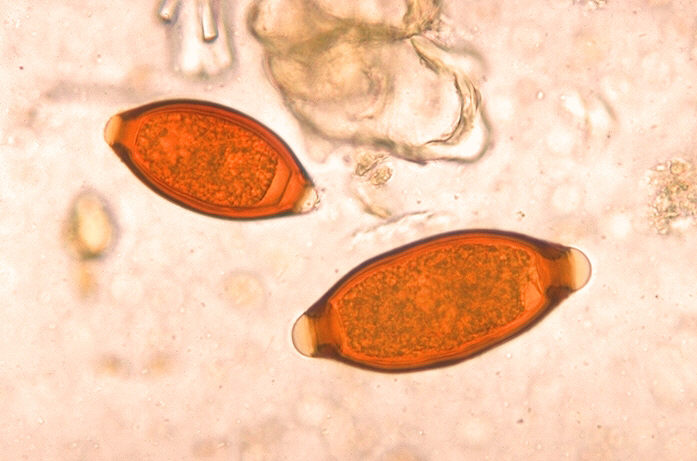
Archaeoparasitology studies ancient parasite evidence from coprolites, latrines, burials and sediments. An egg recovered in one sample does not establish that an entire settlement was infected. Good teaching explains microscopic identification, the source’s burial history, sampling limitations and why health and sanitation conclusions need additional evidence.
The original worked example is a fictional Reed Wharf latrine with three separately sampled deposits. Its counts are invented, not clinical diagnoses. The featured CDC microscope photograph is a modern Trichuris reference, not a real egg recovered at Reed Wharf.
The archaeological parasitology rigour review, taphonomic research and eduKate Gold Standard master hub provide the scientific and teaching framework.


1. Begin with a source, not a diagnosis
Archaeoparasitology studies evidence for ancient parasites from coprolites, latrines, mummies, burials and archaeological sediment. A preserved egg may support identification of a parasite taxon in the sampled material; it does not mean everyone at a settlement was infected, symptomatic or exposed through one identified source. Each step from microscopic observation to health history needs separate support. Archaeological context and biological evidence must be read together.
Our invented Reed Wharf latrine has three sampled units with different conditions and supposed egg counts. The CDC photograph is a modern reference showing Trichuris egg morphology, not archaeological Reed Wharf material. Reinhard’s review on maintaining rigour explains why parasitology should not be isolated from sampling, cultural setting, environment and related sciences. Ask learners which claim can be made immediately from the egg image and what context is still missing.
Back to chapter index · Next chapter
2. Differentiate coprolites, latrines and mixed deposits
A coprolite is preserved faecal material; a latrine fill may contain many excreta events, soil, household debris and later sediment. Some coprolites may have a plausible human or animal host, while others cannot be attributed confidently. A mixed latrine is not a single patient’s medical record. Sampling a composite layer as if it represented one bowel movement loses both human and temporal context.
Students receive fictitious cards for an isolated coprolite, a latrine fill collected across several centimetres and a drain sediment sample. They list the source identity, likely processes, sampling mass and potential mixing for each. A strong answer recognises that identical egg counts do not mean identical numbers of hosts or parasites. The taphonomy review describes the different preservation histories of coprolites and mummified remains.
Back to chapter index · Next chapter
3. Read egg morphology without inventing species
Parasite identification can rely on features including egg outline, shell surface, thickness, size and anatomical structures such as polar plugs. Preservation can erase these diagnostic details, and related host parasites may overlap morphologically. A barrel-shaped structure compatible with whipworm does not always identify a specific human parasite without appropriate reference measurements and specialised interpretation.
Use a scale-labelled reference image to describe the two compared modern Trichuris egg types. Then obscure a diagnostic feature in a fictional copy and ask whether the species assignment survives. Students should distinguish ‘possible egg’, ‘genus-like form’ and supported species identification; unknown is a valid category. Do not teach identification as matching one attractive picture from the internet. A scientifically useful record must preserve the actual features seen and taxonomic confidence.
Back to chapter index · Next chapter
4. Understand transmission cycles without diagnosing behaviours
Different parasite groups have distinct life cycles and environmental requirements. Ingestion of eggs, host contact, food-borne transmission, soil exposure and intermediate hosts can all matter, depending on the organism. Identifying a parasite-like egg in refuse does not specify a person’s route of infection or prove that all residents shared one behaviour. General biological possibilities need to be distinguished from a local historical explanation.
Create a safe schematic of egg shedding, possible environmental persistence and a hypothetical host. Learners annotate which stages are biologically plausible and which have archaeological evidence. Then introduce a settlement well and animal pen: their presence generates research questions but does not uniquely explain a positive latrine sample. The strongest student asks what water, animal or waste-management records could discriminate alternative transmission histories.
Back to chapter index · Next chapter
5. Design a stratified sampling programme
Latrines can accumulate layers during use, clearance, abandonment and later flooding. Selecting the darkest or most egg-rich pocket alone can exaggerate a pattern, and combining multiple contexts can destroy useful chronological differences. The sample should carry its site grid, depth, context, sediment character, collection method and mass. Replication matters when the deposit is heterogeneous.
The fictional Reed Wharf series R1, R2 and R3 represents separate sources, not patients. Give pupils an excavation section and ask which strata and appropriate controls they would sample to test a pattern through time. Reinhard’s interdisciplinary review calls for diverse contextual sampling rather than repeated study of one isolated source. Teachers should reward the research design as much as the ultimate microscopic tally.
Back to chapter index · Next chapter
6. Explain taphonomy and differential survival
Helminth eggs differ in how they tolerate water movement, drying, microbial degradation, soil conditions and subsequent disturbance. Some can be displaced through a deposit, while others lose identifiable structures. Therefore a layer with no observed eggs does not prove absence of ancient parasitism. The measured assemblage is the product of original deposition followed by a history of preservation and recovery.
A published taphonomic investigation describes how water percolation and other conditions changed egg survival in archaeological contexts. Pupils compare invented dry R1 with a water-disturbed R2 and generate three explanations for different counts. They must identify what sedimentological or microscopic evidence could differentiate removal, destruction and genuine depositional change. Absence of recovered eggs is a source observation, not a population-health verdict.
Back to chapter index · Next chapter
7. Count eggs with an appropriate unit
A tally may record candidate eggs in a microscope slide or processed sediment aliquot. Without the sampled mass, volume, recovery procedure and inclusion rules, counts from different strata may not be directly comparable. Even well-normalised ‘eggs per gram of sediment’ describes the archaeological subsample, not eggs per gram of fresh clinical stool, the number of worms in an ancient body or the fraction of town residents affected.
R1 hypothetically contains 18 possible eggs in 30 g of processed sediment and R2 contains 9 in 15 g. Both calculate to 0.6 candidate eggs per gram of processed archaeological sediment under the toy model. Ask why this equal rate does not establish equal infections or equivalent deposits. The samples may represent different durations, processing efficiency and preservation. Students should print the denominator beside every result and never equate fragment concentration with prevalence.
Back to chapter index · Next chapter
8. Keep infection prevalence separate from source concentration
Prevalence requires a defined number of hosts and independent evidence for whether each meets the relevant diagnostic criteria. An archaeological latrine often aggregates waste from an unknown number of contributors over time, and one person may shed many eggs. A 60% share of candidate eggs among observed objects is not a statement that 60% of people had an infection. Count-based archaeological proxies and epidemiological rates answer fundamentally different questions.
Provide a fictional latrine with 100 recognised biological particles, including ten candidate eggs. Ask whether 10% is parasite prevalence. It is not; it is a share under the particular object-counting convention. Then give each pupil a hypothetical report caption and ask them to repair overclaiming language. The highest mark goes to the student who explicitly identifies the absent population denominator and recommends what different kind of evidence would be required.
Back to chapter index · Next chapter
9. Control contamination and maintain laboratory traceability
Potential carryover can occur during collection, curation, processing or imaging, while misidentified soil particles can create false positives. Appropriate negative controls, separate material records and laboratory procedures help identify problems; their suitability depends on method and specimen. A clean blank is useful but does not prove every earlier stage uncontaminated. A contaminated blank should be investigated, not silently ignored.
Invent a batch where sample R2 and a laboratory blank share an egg-like particle after the same work period. Students list possible sources—lab carryover, processing materials, an unrecognised biological structure or field contamination—without making a final diagnosis. They write a professional follow-up plan rather than a chemical extraction protocol. Genuine historic faecal material and parasite specimens require qualified biosafety controls. Classroom practice can safely rely on documentary photos and fictitious datasets.
Back to chapter index · Next chapter
10. Avoid forcing human versus animal host identities
A parasite-like egg in a settlement layer may derive from human faeces, livestock, scavengers or environmental transport. Certain parasites have relatively specific host ranges, whereas others can be harder to separate from morphology alone. A deposit’s architectural association with a latrine is evidence about probable waste use, but it does not guarantee that all contained eggs came directly from humans.
Add a fictional stable drain adjacent to Reed Wharf. Students are told that a similarly shaped egg appears there too. Can they say the human and animal deposits contained the same parasite species or that one infected the other? Not from that alone. They should check taxonomic specificity, sample provenance, animals represented at the site and separate archaeological periods. The lesson connects archaeology and parasitology without confusing host attribution with one compelling contamination story.
Back to chapter index · Next chapter
11. Reconstruct sanitation through alternatives, not stereotypes
Ancient parasite evidence can contribute to histories of waste disposal, crowding, livestock proximity, food systems and water access. The presence of eggs does not prove that an entire community was unhygienic, while their absence may reflect poor preservation. Practices should be interpreted using independent architecture, texts, water systems and environmental records, not modern assumptions about how past societies ought to have lived.
Ask students to compare fictitious settlements with different climate, water movement and sampling coverage. One has many identifiable eggs; another has none in a small sample. Does that establish which was healthier? No. Pupils should build a matrix of alternative explanations and propose corroboration. A respectful public article treats parasite findings as evidence about conditions and possible exposures, not as a moral judgement on historic people or living descendants.
Back to chapter index · Next chapter
12. Date the context rather than the egg directly
Microscopic eggs generally lack their own easily obtained calendar age. Chronology comes from site stratigraphy and suitable associated dating evidence, which may be imprecise or disrupted. A burrow can carry later particles downward, while a coprolite may have an independent archaeological context. A radiocarbon determination on nearby charcoal does not date each parasite egg’s original shedding event automatically.
Provide fictional R1 beneath an intact floor and R3 within a younger cut that crosses it. Learners distinguish which specimen is likely associated with which archaeological event and what source relationship remains to be demonstrated. The right answer may place one sample in a broad stratigraphic phase rather than an exact year. The point is to combine Chronology and Geoarchaeology without pretending that eggs act as a direct dating clock.
Back to chapter index · Next chapter
13. Use ancient parasite DNA only with authentication
Ancient DNA can sometimes support parasite identification or reveal molecular diversity, but ancient fragments may be scarce, chemically damaged and mixed with modern organisms. A positive sequence match does not automatically demonstrate an authentic ancient infection. Laboratory controls, appropriate damage and contamination assessment, and archaeological provenance are needed before molecular findings strengthen morphological evidence.
A Hallstatt salt-mine study demonstrates combined morphological and molecular investigation of ancient helminths. In a fictional R2 case, an analyst obtains a short DNA match to a parasite group; pupils must ask whether blanks, fragment condition and source context support authenticity. The molecular evidence might refine a taxonomic attribution without revealing exactly when one person became sick or how the town responded.
Back to chapter index · Next chapter
14. Interpret health history and treatment without presentism
Knowing that parasites circulated in a historic environment is not the same as knowing how severe infection was, how individuals described symptoms or what they believed caused illness. Archaeological evidence may support questions about treatment if connected medicinal plants, medical texts or other contextual records survive; the eggs alone do not identify a treatment, symptom or diagnosis. Modern biomedical terms should not erase the culturally specific ways people understood wellbeing.
Give learners a fictional herbal residue found near the latrine and ask whether that proves parasite treatment. It does not: the plant may have had many uses and no demonstrated connection to a particular patient. They should design a source comparison including plant identification, deposit association, historically documented medicinal uses and alternative explanations. This new challenge distinguishes parasite biology, symptom interpretation and histories of care. It prevents a visually dramatic microscope picture from becoming an unsupported medical biography.
Back to chapter index · Next chapter
15. Explain findings publicly without stigma
Exaggerated descriptions such as ‘every resident was ill’, ‘primitive sanitation’ or ‘a plague of worms’ often go beyond the evidence of a handful of microscopic eggs. Archaeoparasitology can be engaging without sensationalising people. Public interpretations should describe the sampled context, biological confidence and implications that are reasonable given the source, including alternatives related to animals and preservation.
Write two museum captions for Reed Wharf. The first claims a city-wide epidemic; the second reports possible parasite eggs in sampled latrine sediment, with limitations in identification, host attribution and prevalence. Students explain why the second is better, even though the first sounds more dramatic. Historical communication is strongest when it gives readers the mechanism of discovery and exactly what remains unknown. An honest limit is not a weakness; it is part of the result.
Back to chapter index · Next chapter
16. Transfer to a new deposit and archive the evidence
A reusable dataset preserves site, layer, sample material and processed mass, preservation assessment, microscope dimensions, taxon confidence, controls, raw counts, possible age bounds and laboratory method. Without this record, another specialist may not be able to review a disputed egg identification or compare samples fairly. A result that cannot be revisited loses much of its archaeological value.
The final fictional packet includes a coprolite, mixed latrine sediment, stable waste and a sample with zero recognised eggs. Pupils calculate only comparable quantities, explain which host claims remain unsupported, and propose safe specialist checks. They should not handle authentic parasite material at school. The gold standard is a learner who can reconstruct a source-respecting history of possible parasite ecology without inflating fragment counts into medical diagnoses or population statistics.
Worked Reed Wharf sediment count: samples are not patients
Every count below is fictional. The material quantities describe processed archaeological sediment, and morphological ‘candidate’ eggs require specialist confirmation. Sample units are not assumed to represent one person.
| Teaching sample | Processed mass | Candidate eggs | Valid source observation |
|---|---|---|---|
| R1: sealed latrine fill | 30 g | 18 | 0.6 candidate eggs/g sediment |
| R2: wetter deposit | 15 g | 9 | 0.6 candidate eggs/g, under different preservation |
| R3: disturbed late layer | 20 g | 0 | Zero recognised in this examined material only |
| Control | Not an archaeological sample | 0 | Useful processing check, not proof of ancient infection status |
Both R1 and R2 give the same elementary count-per-mass ratio, but their preservation, deposition and host histories may differ. These are not clinical eggs-per-gram measurements, parasite burdens or infection prevalence statistics. Neither a high egg count nor zero recovered eggs provides a reliable percentage of ancient residents who were ill.
Case A: a damaged egg can still support a broad conclusion
A fictional broken structure retains a barrel outline but has lost the polar features needed for a confident whipworm classification. A student might fill in missing anatomy from a preferred CDC reference. That would convert an inference into a false observation. Ask pupils to report which dimensions and shell parts genuinely survive, then make a provisional identification no narrower than evidence allows.
If a better source photograph later reveals a polar plug, the determination can be revised. A careful dataset retains both the previous uncertainty and the new evidence. This is a practical lesson in why taxonomic diagnoses are revisable, not a competition to produce the longest Latin species name.
Case B: the same count may conceal unequal recovery
R1 and R2 yield identical nominal candidate eggs-per-gram ratios. One source has been heavily water-disturbed, however, and recovery efficiency is not established. Students must explain why a matched ratio is not automatically evidence of matched ancient shedding, infection prevalence or diet.
The right next question is about laboratory recovery, preservation and source duration. A researcher could investigate processed sediment control material or replicate samples under professionally appropriate methods. Even if the ratio remains equal, the social interpretation depends on host identity and source history.
Case C: older eggs enter a younger deposit
An imagined flood cuts an old latrine deposit and redeposits some egg-bearing sediment into a later ditch. The ditch contains authentic old parasite remains but was formed later than those eggs were first shed. Ask pupils which event a contextual date on the ditch might constrain and whether the eggs directly date the ditch’s original use.
A correct answer distinguishes the depositional phase from the biological source. A parasite’s presence can inform past exposure possibilities while the stratigraphic relationship remains uncertain. This case links microremains to Geoarchaeology and Chronology.
Case D: animal housing complicates human infection stories
A stable drain and a household latrine contain superficially similar structures. The class is tempted to describe animal-to-human transmission, but egg morphology and site adjacency alone do not demonstrate it. Some host parasites can be distinguished while others overlap, and deposits can mix through water.
Pupils draw separate host, transport and archaeological sampling hypotheses. They identify which specialist comparisons and contextual records could improve the assessment. A conclusion that remains ‘host not established’ may be correct despite the appeal of a dramatic disease narrative.
Four lessons from observed egg to justified conclusion
- Lesson 1: describe eggs and comparison images without prematurely assigning species or patients.
- Lesson 2: distinguish coprolites, stratified latrine fills, preservation and sample denominators.
- Lesson 3: calculate source concentrations and assess contamination, animal hosts and sanitation hypotheses.
- Lesson 4: analyse a different fictional source packet and write a museum caption with explicit limits.
Advanced case: three microscope photographs are not three independent ancient hosts
Suppose Reed Wharf’s laboratory makes three photographs of the same mounted preparation, each showing a similar-looking egg. Those images might be overlapping fields of view of one structure, separate eggs from one ancient deposition, or finds from completely different sources. The photographs themselves do not tell us which. Students must follow field sample, processed aliquot, slide, field of view and counted structure as separate levels of observation. If the same egg is counted twice, even a laboratory count is wrong; if three different eggs came from one ancient host, the number of hosts still cannot be derived. Independence has to be demonstrated rather than inferred from file names or image totals.
Create three imaginary image cards labelled R1-A, R1-B and R2-A. The first two derive from one aliquot and R2-A from a separate sediment context with a later depositional history. Pupils should describe what each source permits: morphology and a possible egg occurrence in an identifiable sample. They should not pool all three as a ‘number of infected residents’. The stronger report documents each observation and the archaeological context, then marks the host count unknown. This is a transferable statistical distinction: specimen count, source count and number of people are different research variables.
Advanced case: a latrine positive and an animal drain positive
An excavated animal drain and a household latrine contain similar egg-shaped particles. It may be tempting to write a story about infection travelling from animals to people, but matching appearance and geographic proximity do not establish species identity, shared host range, environmental transfer or direction of transmission. Students should name each link and the evidence it would require: diagnostic morphology, reference material, sample dates, drainage connections, possible animal husbandry and, where justified, independently authenticated molecular findings.
A fictional flood channel crosses the two deposits. The proposed connection now has another alternative: some particles may have been redeposited after their original shedding. The teacher should ask whether the data support occurrence of similar structures in both sediments, a common source organism or a specific public-health chain. These progressively stronger claims should not be merged. The result can make ancient waste management intelligible without inventing a named disease outbreak.
Assessment rubric: from the sample to a cautious museum caption
| Evidence stage | Expected student demonstration |
|---|---|
| Provenance | Identifies context, material, sampling mass and stratigraphic limits |
| Morphology | Distinguishes observed structures, candidate taxon and unresolved alternatives |
| Quantification | States raw egg count, appropriate denominator and observation independence |
| Quality | Discusses controls, preservation and modern contamination |
| Historical explanation | Considers host, depositional and sanitation interpretations without inventing infection prevalence |
| Ethics | Produces a clear, non-stigmatising public explanation |
The final transfer packet includes a positive coprolite, a mixed latrine and a negative water-disturbed burial. Pupils can describe which structures were found, compare truly compatible observations and identify why neither a missing egg nor an abundant sample equals a town-wide diagnosis. The teacher should accept a conclusion of uncertain host or parasite species where diagnostic evidence is incomplete. A strong educational guide leaves the source available for future reanalysis; it does not convert unresolved laboratory or archaeological conditions into confidence merely to satisfy a narrative.
Frequently asked questions
Does finding an egg diagnose a whole town?
No. It concerns sampled material, not independent patients or population prevalence.
Can negative samples establish that no infection existed?
No. Poor preservation, sampling and recovery may explain absence.
Is every whipworm-shaped egg definitely a human parasite?
No. Morphological overlap and preservation can limit host and species attribution.
Is it safe for pupils to work with real parasite-bearing archaeological material?
Not as an ordinary school activity. Use credited images and invented datasets; actual material requires appropriate biosafety controls.
Published science and connected eduKate reading
- Reinhard, 2017: Archaeological Parasitology Rigour
- Taphonomy of Ancient Parasites
- Paleoparasitology Research in the Old World
- Ancient Helminth Eggs and DNA, Hallstatt
- CDC Modern Trichuris Egg Image
- Teaching Ancient DNA
- Teaching Archaeological Entomology
- Teaching Historical Demography
- The Gold Standard master hub
The gold standard is a learner who can report what a microscopic parasite trace actually reveals, preserve archaeological context and uncertainty, and resist converting individual observations into invented diagnoses or stories about an entire community.