
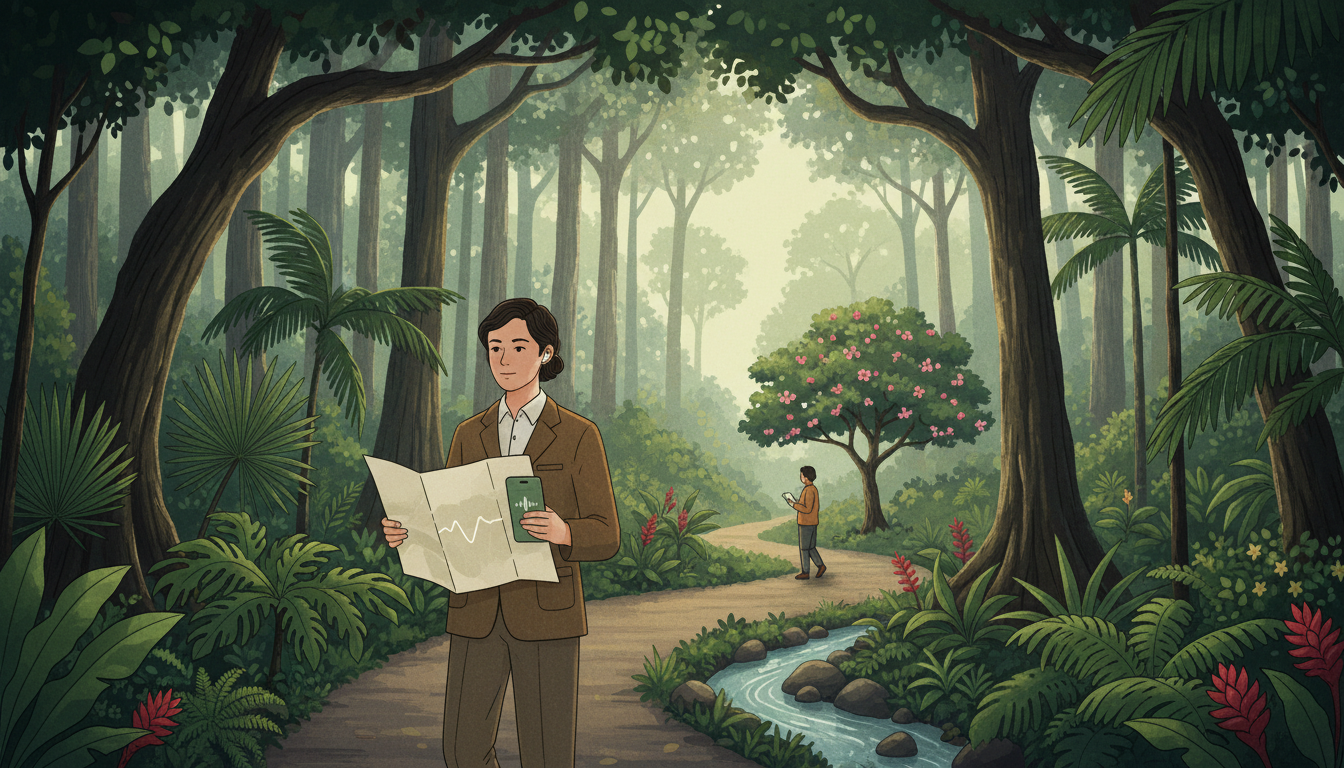
Is there a free self-guided audio tour at Singapore Botanic Gardens? Yes. The official Learning Forest Audio Tour is a 1km, 60–90-minute walk through freshwater swamp and lowland dipterocarp forest habitats. It has nine audio listening points and an official Spotify playlist plus downloadable audio-tour map, with no admission fee. The Learning Forest opens 7am–7pm daily and offers a barrier-free alternative route for visitors with mobility needs. This is a self-led walk, so you can pause, replay an explanation and choose a pace appropriate for children or older companions.
Looking for Singapore Botanic Gardens audio tour, free self-guided Bukit Timah walking tour, Learning Forest Spotify audio, NParks family nature walk, Rain Forest Trail map, nature immersion at Saraca Stream, forest therapy trail Singapore, barrier-free audio walk and Botanic Gardens nature learning? Three official experiences are worth distinguishing. The Learning Forest has the actual audio programme (1km, nine points); the Rain Forest Self-Guided Trail is a 600m, 30–40-minute mapped walk through a six-hectare rainforest, but its official page does not promise an audio recording; and the Nature Immersion Trail at Saraca Stream is a separate 150m sensory-prompt route open during the Gardens’ broader 5am–midnight hours. Do not describe all three as downloadable narrated audio tours.
Our recommended choice: use the Learning Forest for a family that enjoys listening and making observations, the Rain Forest for a shorter botanical walk with a printed or phone map, or Saraca Stream for gentle, deliberate attention to natural sounds and movement. All can be enjoyed without booking a paid guide when their paths are open. The NParks Nature Immersion page updated 22 October 2026 says its organised two-hour guide-led sessions have no announced upcoming places and advises readers to check again in January 2027; the free self-led route is different and remains an option. Check rain, lighting, trail restrictions and official notices before visiting.
Quick answer: compare the three official free walks
| Experience | Length / typical duration | Audio, map or prompt / visitor hours |
| Learning Forest Audio Tour | 1km; 60–90 minutes | Nine Spotify audio points and official tour map; 7am–7pm |
| Rain Forest Self-Guided Trail | 600m; 30–40 minutes | Map-based nature walk; no official audio claimed; 7am–7pm |
| Nature Immersion Trail, Saraca Stream | 150m; take your own gentle pace | Self-led sensory invitations; 5am–midnight |
| Guided Nature Immersion Walk | About two hours on select Saturdays | Separate instructor-led sessions; new dates expected from January 2027 |
| Wider Singapore Botanic Gardens | Many routes, general grounds 5am–midnight | Some named nature zones and indoor venues close earlier |
Contents: listen, walk and notice
- How to open the Learning Forest audio playlist and map
- What the nine audio points teach
- Swamp, forest canopy and native plants
- Barrier-free route and family planning
- The separate 600m rainforest walk
- The 150m Saraca Stream sensory walk
- How self-led differs from paid or booked guided walks
- Walking times, entrances, weather and safety
- Personal observation prompts and FAQs
1. The Learning Forest is the one with an official audio playlist
Singapore Botanic Gardens’ Self-Guided Walks page explicitly names the Learning Forest Audio Tour and links to both Spotify and a route map. That makes it a genuine downloadable or streamable listening experience rather than a generic nature walk.
The first step is to open the official webpage and follow its audio link. Avoid relying on an unrelated podcast with a similar title or assuming every park has its own narrated track.
2. The audio walk is about one kilometre
NParks gives 1km as the estimated Learning Forest audio-tour distance and 60–90 minutes as the expected duration. The time includes listening and appreciating the features, not just walking quickly over a kilometre.
A fitness watch may show a longer total because of the walk from the entrance, detours, toilet visits and return journey. The tour distance should not be treated as the total trip from any MRT station.
3. Nine audio points structure the experience
The trail has nine audio points introducing the Learning Forest’s habitats, native species and the work required to create and maintain them. A visitor can use numbered listening locations to make the walk manageable.
Do not promise that every point will be directly next to one another or that every recording has the same duration. Let the official map organise the sequence.
4. Spotify is a practical playback option
NParks links its tour through a Spotify podcast playlist. Listening on a compatible device lets a visitor pause and repeat an explanation as needed.
Spotify features and offline downloading may depend on the user’s app settings and account access. Do not promise that every visitor can download audio for offline use without checking the platform.
5. The official map matters as much as the soundtrack
An audio file alone cannot tell you which side path is open today or where to stand safely. The Gardens provides a separate audio-tour map alongside the Spotify link.
Open the map before setting out, confirm the nearest entrance and follow signs. A recording is a guide to learning, not a licence to enter a closed habitat.
6. The Learning Forest normally opens 7am–7pm
NParks lists 7am–7pm daily for the Learning Forest, including the SPH Walk of Giants, Keppel Discovery Wetlands and Botanist Boardwalk. The wider Gardens normally open 5am–midnight, but these named Learning Forest attractions do not.
A person planning to listen to an episode after dinner may find the area closed even though the park gate is still open. Choose a daylight tour.
7. Admission to the audio walk is free
The official Self-Guided Walks page labels the Learning Forest Audio Tour free admission. It does not require purchasing a National Orchid Garden ticket for this particular forest walk.
Transport, mobile data, food and parking can create separate costs. Those expenses should not be presented as an attraction-entry fee.
8. Who is it designed for?
NParks calls the Learning Forest audio experience family-friendly, suitable for ages from young children to seniors. That is a broad invitation to learn, not an assurance that every path or every visitor’s mobility need is the same.
Choose listening speed, rests and route according to the least comfortable companion. Some families will prefer only part of the tour.
9. A barrier-free route is available
The official Learning Forest audio description says a barrier-free route is available for visitors with mobility needs. This is useful for people who prefer step-free access or travel with certain mobility aids.
Do not generalise to every raised boardwalk, wetland side path or forest trail in the wider Gardens. Check the current accessible map and any temporary diversions.
10. Hearing nature still matters while listening to narration
The forest is a living soundscape. You may hear birds, insects, rustling leaves or footsteps, depending on time and conditions. Headphones should not prevent awareness of people approaching on a shared path.
Use a comfortable volume, and consider listening with only one earbud or through a quiet speaker only where it does not disturb other visitors. Safety and nature etiquette come before uninterrupted podcast playback.
11. Freshwater swamp is a distinctive habitat
The Learning Forest introduces freshwater swamp habitat: a forest ecosystem influenced by waterlogging, low-lying conditions and specialised plants.
It is not the same thing as a public pond. The wetland’s soils, microhabitats and ecological interactions deserve protection; visitors should observe from designated trails.
12. Lowland dipterocarp forest is another focus
Dipterocarps are important tropical rainforest trees, many of which contribute to tall canopy structure in Southeast Asian forests. The tour explores the Learning Forest’s lowland dipterocarp habitat alongside the wetland.
An audio guide can make the difference between a swampy habitat and a drier lowland slope easier to notice, even when a child cannot identify every species.
13. The layers of the canopy are worth observing
Look up at how trees organise space: emergent crowns above a canopy, climbing plants attached to trunks and smaller shrubs beneath. Different heights experience different levels of light and wind.
Avoid entering planted beds to inspect a leaf. Use the map’s legal route and let narration suggest what you can observe safely.
14. Why the forest looks designed and natural at once
The Learning Forest is carefully managed and restored to represent important native habitats. Paths, signs, plantings and wetland controls support public access while protecting ecology.
An especially useful audio topic is the behind-the-scenes work required to sustain a living collection. A nature area can look wild yet still need skilled horticultural planning.
15. The role of a botanist
A botanist studies plants and can help identify species, understand ecology, record changes and support conservation. Work in the Learning Forest may also involve horticulture, arboriculture, environmental management and visitor safety.
The walk can prompt children to think about the many people responsible for a public landscape, not only the gardeners they might see pruning plants.
16. The Keppel Discovery Wetlands are a named Learning Forest feature
The visitor directory identifies the Keppel Discovery Wetlands as a Learning Forest attraction with 7am–7pm access. It provides a setting for understanding water-dependent plants and habitats.
Stay on boardwalks and authorised viewing points. The wetland is not a waterplay area where children may wade into the vegetation.
17. The Botanist Boardwalk is a different forest perspective
Boardwalks help people approach sensitive areas while distributing pedestrian movement onto designed surfaces. The Learning Forest’s Botanist Boardwalk is one of its named public features.
The timber or built surface may be wet after rain. Walk slowly and avoid leaning far out over any handrails for a photograph.
18. The Walk of Giants draws attention to canopy height
The SPH Walk of Giants is a named Learning Forest attraction that helps visitors appreciate the scale of tall trees from a different perspective.
Use it as an observation stop rather than an obstacle course. If the area has a temporary maintenance closure, follow signs and the alternate route.
19. Why the one-kilometre distance may take over an hour
The official duration of 60–90 minutes incorporates interpretation and a relaxed pace. A walker who simply strides one kilometre will miss much of what the audio points are designed to teach.
Pause after listening and look for the described form, habitat or interaction. The benefit comes from connecting words to the living landscape.
20. Children can each choose an audio question
One child might listen for information about a tree, another might ask why a plant grows close to water. The adult can invite them to choose one thing to observe after each listening point.
Avoid quizzing children on every sentence. A brief conversation about an actual observation can be more memorable than repeating the recording word for word.
21. A child can practise describing evidence
Ask what the child saw directly and what the recording explained. ‘The ground looked wet’ is an observation; ‘all swamp plants need permanent flooding’ would be a broad claim requiring evidence.
Separating observation and inference is a valuable scientific habit. The audio guide creates a relaxed setting to practise it.
22. Older visitors may enjoy a more flexible pace
An audio walk allows someone to stop, sit where seating is available and replay a recording without keeping up with a fast tour group. However, outdoor heat and walking still matter.
Plan rest and water, and use the barrier-free alternative if appropriate. A free self-guided tour does not guarantee that all listeners need the same route.
23. A group may listen together or separately
Friends may prefer individual earphones or a single shared device, depending on volume, hearing needs and park etiquette. Keep the path free for others.
If listening separately, agree on meeting points and stop before moving between unfamiliar trail junctions. Looking at a screen while walking can reduce awareness of uneven surfaces.
24. A phone needs enough battery
Streaming, mapping, photography and cellular access can drain a phone over a long outing. Charge before leaving and consider downloading an allowed map for reference.
Do not rely solely on the phone to guide you in an emergency. Observe actual route signs and keep a clear plan to reach a visitor entrance.
25. Some audio can be replayed at home
Because the official Learning Forest recordings are linked on a public Spotify page, visitors may be able to revisit them after the outing using the service.
Do not claim the park supplies a private MP3 library or gives unrestricted redistribution rights. Use the official link and comply with the platform’s terms.
26. The Rain Forest Trail is a separate 600m walk
NParks’ Self-Guided Walks page lists a 600m Rain Forest Trail, typically 30–40 minutes, through the Gardens’ six-hectare primary rainforest.
The official resource provides a trail map rather than the nine-episode Learning Forest audio sequence. Distinguish the two when recommending the right experience.
27. The Rain Forest opens 7am–7pm
Like the Learning Forest, the Rain Forest nature attraction operates under a named 7am–7pm opening window. The surrounding public lawns can have a longer schedule.
Do not begin the forest walk at 6.50pm expecting forty minutes of legal access. Leave enough time to finish and exit safely.
28. A primary rainforest is a conservation treasure
The Rain Forest preserves part of Singapore’s historically widespread lowland tropical forest. Its complexity can be appreciated by observing leaves, roots, trunks, climbers and changing light.
Stay on designated paths and do not collect seeds. Even familiar-looking green spaces can support sensitive ecological processes.
29. The Rain Forest mapped route can suit a shorter visit
At 600m with an indicative 30–40-minute duration, the mapped Rain Forest route may suit visitors who prefer less time than the full Learning Forest audio programme.
That does not mean every part of the path is universally flat or accessible. The best choice depends on visitor mobility and current closures.
30. A map is not a promise of a perfectly straight trail
Path junctions, plants and temporary diversions can change navigation. Download the official map and orient yourself before entering rather than assuming the shortest line on a screen is an authorised route.
If a side area is closed or flooded, turn back. Do not cross planted borders to reconnect with a trail marker.
31. The Nature Immersion Trail is only 150m
NParks lists the self-led Nature Immersion Trail at Saraca Stream as 150m. Its central experience is slowing down, engaging the senses and following invitations along the stream.
It is deliberately different from walking quickly to a summit or visiting every sculpture in the Gardens. A short path can take as much time as you choose to spend observing.
32. The Nature Immersion route uses the general Gardens hours
The official Self-Guided Walks page lists the Nature Immersion Trail as 5am–midnight, matching the general Gardens opening hours, rather than the 7am–7pm Learning Forest rules.
Even when a route is open, outdoor areas can be dark or uncomfortable after sunset. Choose daylight if unfamiliar with the path and never enter a dangerous area during bad weather.
33. Saraca Stream is closer to Tanglin
NParks’ trail descriptions place Saraca Stream in the Tanglin-side Gardens context. The official page provides a specific trailhead map link.
A visitor travelling from the Bukit Timah MRT end should allow for a longer walk than someone entering from the Tanglin side. Choose the starting gate accordingly.
34. ‘Nature immersion’ is not the same as a paid therapy appointment
The self-led route offers prompts for noticing sensory experiences. It is a free public garden activity, not a clinical treatment or a claim that walking cures medical conditions.
Many people enjoy the sense of calm, but the experience and any benefits vary. Avoid presenting it as a substitute for health care.
35. The certified status applies to the specific trail
NParks identifies the Saraca Stream route as Asia’s first Nature Immersion Trail certified by the Association of Nature and Forest Therapy. That certification belongs to the trail description, not every pedestrian path throughout the Gardens.
A visitor should follow the actual official Saraca Stream route instead of claiming any walk through Bukit Timah has the same certification.
36. Guided and self-led immersion are separate products
The official Nature Immersion page describes guided walks led by a certified forest-therapy guide on selected Saturdays, approximately two hours, with group size and minimum-participant conditions.
The no-cost sensory trail does not require joining one of those guided sessions. A visitor should not confuse a private guided programme with a publicly accessible path.
37. The next guided sessions had not been announced
The 22 October 2026 Gardens page says the guided Nature Immersion Walk’s next lineup is being planned and asks people to check back in January 2027 for dates.
Do not invent an October or November bookable time. People wanting a walk now can use the self-guided trail or look for another clearly scheduled park programme.
38. A mindful pause can be completely simple
At a permitted pause point, look for something moving gently in the breeze, notice a natural sound and describe a scent without handling plants. You do not need equipment or a special breathing technique.
Stay aware of other visitors and your surroundings. Personal reflection should never involve sitting in a restricted habitat or blocking a narrow boardwalk.
39. Touch should never involve taking specimens
A sensory invitation can draw attention to textures, but park rules prohibit removing plants or damaging bark and living collections. The safest approach is to observe permitted surfaces and use sight and hearing generously.
Do not crush leaves to smell them or peel bark. The ecosystem belongs to everyone, including wildlife that depends on those plant parts.
40. A family can enjoy all three experiences over different days
The Learning Forest, the Rain Forest and Saraca Stream occupy distinct parts of the Gardens and have separate purposes. A single morning need not include every route.
One day might focus on listening, another on forest structure, and a third on slow observation. Repetition often reveals details you missed the first time.
41. What about combining a nature walk with the Orchid Garden?
The National Orchid Garden is a separate ticketed attraction with its own admission and hours. A family can combine visits if it has enough time and budget, but the free audio walk itself does not require buying an orchid ticket.
Plan the walking distance between entrances and rest stops rather than pretending the two attractions share one small gate.
42. Food should not be used to attract wildlife
Do not feed birds, macaques or other animals in order to improve a recording or photograph. Keep snacks packed away and use designated places to eat.
The best nature sounds are those made by animals acting naturally. Visitors who attempt to lure wildlife can change its behaviour and create problems for others.
43. Keep the audio at a respectful volume
Portable speakers can disturb a quiet nature area and competing visitors’ experiences. Earphones at a safe volume are usually more considerate, provided you remain aware of the trail.
If you are guiding a family verbally, speak quietly and allow pauses without narration. The forest itself deserves to be heard.
44. A poor-weather plan may need to end early
The Gardens’ Self-Guided Walks page warns that areas including the Rain Forest and Mingxin Rambler’s Ridge may close during bad weather, reopening only after inspection confirms safety.
Lightning, fallen branches and slippery surfaces take priority over an audio playlist. Stop and choose a safe substantial building or another day.
45. Parking is separate from free admission
The wider Gardens provides multiple paid parking zones, including an area associated with Tyersall Entrance for Learning Forest. A free trail does not guarantee free parking or a vacant car lot.
Public transport may be easier for some visitors, but choose the exit and return direction based on the exact trail. Never improvise roadside parking.
46. The trail does not have a universal MRT-to-MRT duration
NParks specifically asks visitors to factor in walks from the MRT and notes that an additional 15–25 minutes may be needed for some exit routes. That varies greatly across the large Gardens.
Do not promise that a 1km tour is a 60-minute total outing from any train station. Include access, bathrooms and return travel separately.
47. Visiting with a class or large group needs preparation
A school or organised group should review the route, audio equipment, supervision and permitted group arrangements. Several children listening independently may become separated without a clear meeting process.
A free self-guided tour is not proof that all group sizes can arrive without organisational conditions. Ask NParks about permits and programmes where required.
48. Make a useful observation notebook
Write a question heard in one audio stop and note what you actually saw. Distinguish sound, sight and inference. You might record the shape of a root, a bird’s movement or a habitat’s moisture.
This is an engaging activity for adults as well as children. A handful of precise observations is better than a huge list copied from a recording without looking around.
49. Why an official self-guided trail is valuable
Self-guided formats allow freedom to pause, repeat explanations, choose a comfortable pace and return on another day. Official maps also help prevent misunderstandings about where a trail begins or which areas are closed.
The meaningful experience is not about ticking off every audio point. It is about discovering how much can be learned by paying attention to a familiar green space.
50. A sensible decision for your next visit
If your family likes listening and learning, choose the free 1km Learning Forest audio route. If you want a shorter but botanically rich walk, use the 600m Rain Forest map. If you want a calm sensory experience, use the 150m Saraca Stream trail.
Check the opening window and entrances for the actual route you choose. Three distinct options make it possible to find a walk that fits the people joining you without misrepresenting what the Gardens offers.
Frequently asked questions: free Botanic Gardens audio and nature walks
Does Singapore Botanic Gardens have a free audio tour?
Yes. Its Learning Forest Audio Tour is free, with nine listening points, a Spotify podcast playlist and official audio-tour map.
How long is the Learning Forest audio route?
1km, with an official recommended duration of 60–90 minutes.
What are the Learning Forest hours?
7am–7pm daily, different from the wider Gardens’ general 5am–midnight hours.
Is the audio tour suitable for children?
NParks describes it as family-friendly and suitable across ages from young children to seniors.
Is there a wheelchair-friendly audio route?
The official page says a barrier-free route is available, but confirm exact accessible paths and temporary diversions.
How do I listen to the tour?
Follow the Spotify audio playlist link on the official Singapore Botanic Gardens Self-Guided Walks page.
Do I need Spotify Premium?
The Gardens links a public Spotify show, but listening and offline features depend on Spotify’s current app and account policies.
Can I download the audio map?
The Gardens provides a separate audio-tour map link from the official Self-Guided Walks page.
How many audio points are there?
Nine points on the Learning Forest Audio Tour.
What does the audio teach?
Freshwater swamp, lowland dipterocarp forest, native species and the work of creating and maintaining the Learning Forest.
Is the audio route free even for foreigners?
The official Learning Forest Audio Tour is listed as free admission; ordinary use is not dependent on local concession rates.
Is the Rain Forest Trail another audio tour?
Its official page presents a 600m mapped self-guided walk, not a second nine-point audio tour. Do not assume narration is provided.
How long is the Rain Forest Trail?
600m, estimated at 30–40 minutes.
When does the Rain Forest open?
7am–7pm daily, subject to weather and closure notices.
Is the Rain Forest worth a short visit?
It preserves a six-hectare primary rainforest area and offers an interpretive walking route.
What is the Nature Immersion Trail?
A 150m self-led sensory-prompt trail at Saraca Stream in Singapore Botanic Gardens.
What are Saraca Stream trail hours?
The official Self-Guided Walks page lists 5am–midnight, subject to safety conditions.
Is the Saraca Stream trail an audio tour?
No official nine-point audio playlist is described for it. It uses sensory invitations and prompts instead.
Does the Nature Immersion Trail cost money?
The official self-guided route is listed with free admission.
Does it count as forest therapy?
The Gardens says the Saraca Stream Nature Immersion Trail was certified by the Association of Nature and Forest Therapy, but it is not a medical treatment.
Can I join a guided forest immersion walk tomorrow?
No unconfirmed date should be invented. The Gardens’ 22 October 2026 page says its next guided-session lineup is being planned for announcement in January 2027.
How long does a guided Nature Immersion Walk last?
The operator describes selected guided sessions lasting about two hours, separate from the free self-led route.
Are all three trails at Bukit Timah Gate?
No. They lie in different Gardens zones. Use the official map and choose the appropriate entrance; Saraca Stream is in the Tanglin-side context.
Can I visit Learning Forest after 7pm?
No. Its named features close at 7pm, although the main Gardens remain open longer.
What if there is lightning?
Stop the exposed walk, seek substantial shelter and follow NParks weather closures. Audio playback does not make forest trails safe.
Can I feed a bird to get a good recording?
No. Keep wildlife wild and do not feed or disturb animals.
Can I pick leaves to show my child?
No. Gardens rules require leaving plants and natural materials in place.
Can I use a speaker for the whole group?
Avoid disturbing other visitors or wildlife. Keep playback quiet or use suitable personal listening arrangements.
How do I plan walking for a wheelchair user?
Start with the Learning Forest’s documented barrier-free route and confirm the current path, entrance and any lift or ramp conditions.
Does the National Orchid Garden ticket include the tour?
The Learning Forest tour is a separate free public activity; the Orchid Garden is a ticketed attraction elsewhere in the park.
Can I do everything in one morning?
Possibly for some fit visitors, but the zones are separate and each walk has a different pace. Choosing one or two is often more comfortable.
Is the route safe in ordinary rain?
Conditions can become slippery, and forest areas may close during bad weather; follow official notices and take a safer alternative if needed.
What should I bring?
Charged phone, headphones at safe volume, official map, water, suitable footwear and weather protection.
What can I learn without knowing plant names?
Notice different habitats, describe roots and leaf shapes, and separate direct observations from ideas suggested by the recording.
Where can I confirm current details?
The official Singapore Botanic Gardens Self-Guided Walks, Nature Immersion and General Visitor Information pages.
Related free Bukit Timah and Gardens guides
- National Orchid Garden and other garden attractions
- Self-guided sculpture and public art walks
- Free botanical galleries and Seed Bank
- Guided nature walks and volunteering
- Senior-friendly walks and accessible outings
- Gallop Extension, playground and free galleries
Official audio playlist, trail maps and visitor sources
Editorial verification: 23 October 2026. NParks lists one explicitly narrated Learning Forest route with nine audio stops, plus separate mapped rainforest and prompted nature-immersion experiences. A self-guided trail should not be presented as a bookable guided session without a live official offering.
- Singapore Botanic Gardens — 2026 official audio tour, maps, opening hours and free self-guided walks
- Spotify — Singapore Botanic Gardens Learning Forest Audio Tour playlist
- Singapore Botanic Gardens — Nature Immersion Trail and future guided-session updates
- Singapore Botanic Gardens — entrances, Learning Forest hours, accessibility, parking and named-area closures
- Singapore Botanic Gardens — temporary rainforest and path closures
- NParks — general self-guided nature-walk resources
- NParks — separate virtual guided visits and alternative home experiences
- Meteorological Service Singapore — current conditions and lightning advisories