
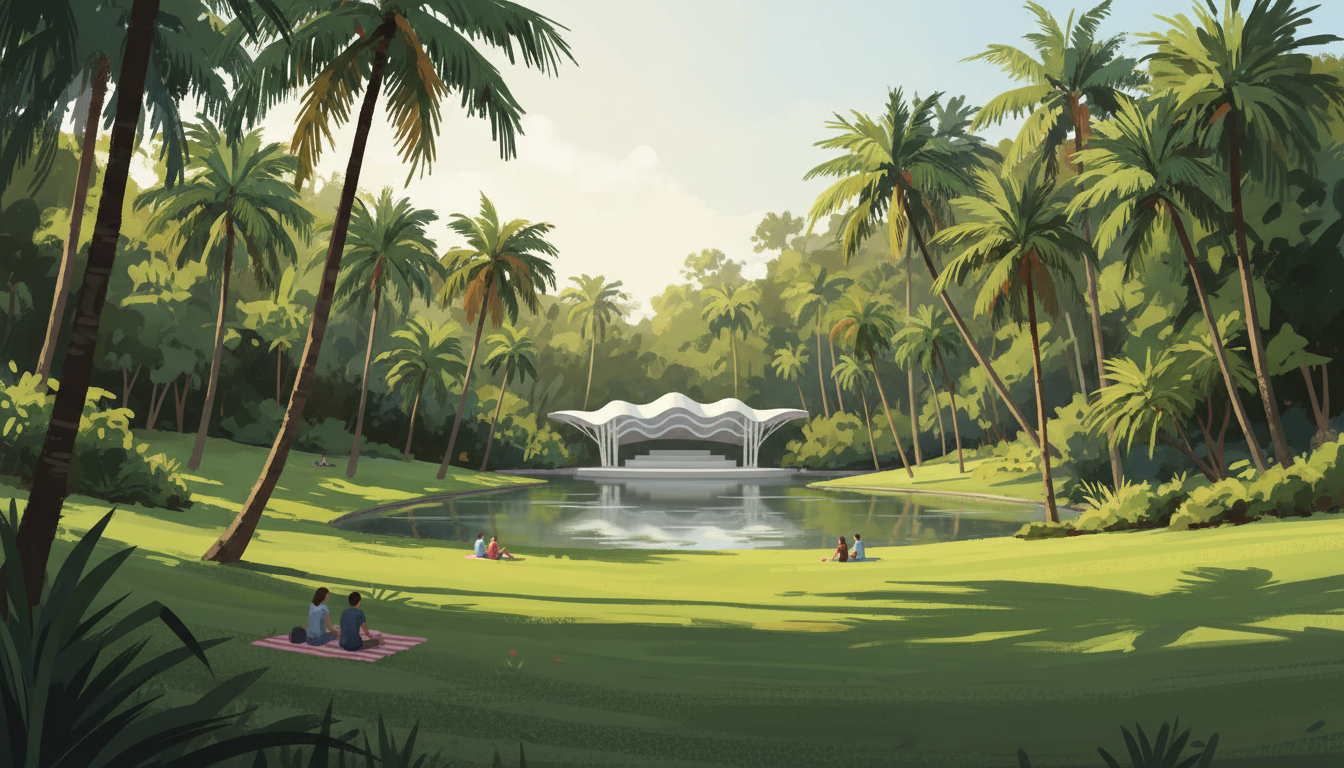
Where is Palm Valley in Singapore Botanic Gardens, and can you watch free concerts at Symphony Lake? Palm Valley and Symphony Lake are in the Gardens’ Central Core, served most conveniently for many visitors by Nassim Gate and paths from Botanic Gardens MRT or the Tanglin side, depending on where you begin. Palm Valley was established in 1879 and today showcases more than 350 palm species in nine themed plots. The lawn slopes towards the Shaw Foundation Symphony Stage beside Symphony Lake, where performances such as Singapore Symphony Orchestra’s Symphony in the Gardens are sometimes presented free of admission. Those concerts have specific published dates and may be cancelled or delayed by weather; the stage is not running an orchestra at all hours.
For searches such as Palm Valley Singapore Botanic Gardens, Symphony Lake picnic, Shaw Foundation Symphony Stage, free outdoor orchestra Singapore, Singapore Symphony Orchestra gardens, large lawn near Nassim Gate, palm species, double coconut palm, Heliconia Walk, family outdoor concerts, picnic rules and weekend things to do around Bukit Timah, there are two reasons to visit. On an ordinary day, enjoy the landscape, palms and relaxing views. On a properly announced event date, the same lawn becomes a place to listen to public music. A current SSO programme page advertises a free Symphony in the Gardens concert on Saturday 20 February 2027 at 6pm, subject to changes; do not describe that as a concert taking place today, 23 October 2026.
A good first-time plan: consult the official Gardens map, choose the central entrance that minimises walking for your group, enjoy a gentle Palm Valley plant stroll and a view of Symphony Lake, and check whether a concert is actually scheduled. The Singapore Botanic Gardens are free to enter and generally open 5am–midnight, while performance schedules and temporary venue closures vary. Before laying out a picnic or organising a large gathering, read the current Gardens visitor rules: no tents or furniture, no ball games or frisbees, no flying drones or kites, no blocking paths and no feeding wildlife. For a special group event or hired photographer, ask NParks about permission.
Quick answer: Palm Valley and Symphony Lake
| Place or activity | Verified information | Important distinction |
| Palm Valley | Established 1879; over 350 palm species in nine plots | Botanical collection, not a paid theme park |
| Heliwalk | More than 90 species and cultivars of Heliconia | Botanical display within Palm Valley |
| Double coconut palm | Lodoicea maldivica, world’s largest seed | A distinctive palm, not an ordinary coconut |
| Symphony Lake | Lake landscape by Shaw Foundation Symphony Stage | Viewing and outdoor event setting, not a swimming venue |
| Shaw Foundation Symphony Stage | Hosts scheduled public performances | No automatic concert every weekend |
| SSO Symphony in the Gardens | Selected events have free admission | 20 February 2027 at 6pm currently advertised |
| General Gardens hours | 5am–midnight daily | Individual event and area rules apply |
| Picnic setup | No tents or brought furniture | Follow NParks outdoor-space rules |
| Pets | Leashed in generally permitted areas | Restricted from listed protected and indoor areas |
| Weather | Concerts may be delayed/cancelled | Check SSO and Gardens updates |
Contents: palm collections, lake and occasional music
- Find the correct Central Core entrance
- 350-plus palm species and their diversity
- Heliconias and the double coconut
- Shaw Foundation Symphony Stage and actual events
- Choosing a free outdoor concert responsibly
- Picnic rules, pets and family preparation
- Noisy or commercial activities and permits
- Photography, weather, mobility and safe routes
- FAQs and verified event information
1. Palm Valley is a botanical landscape, not simply a lawn
The sweeping grass area is framed by botanical palm collections that have been maintained for generations. It combines public recreation with the scientific and horticultural work of Singapore Botanic Gardens.
Visitors can enjoy sitting quietly without attending an event, but the plant diversity makes the valley distinctive when compared with an ordinary neighbourhood field.
2. It was established in 1879
The Gardens’ current plant-collection page identifies 1879 as the origin of Palm Valley. This is earlier than the creation of several modern attractions such as Evolution Garden and Learning Forest.
The exact trees visible today are not necessarily 147 years old. A botanical collection can persist across centuries even as individual specimens are planted, replaced and documented.
3. More than 350 palm species are showcased
NParks describes 350-plus palm species across nine plots, presenting different palm forms and families. This figure gives a sense of the breadth of the collection.
Do not assume every named species will have a plant in full view from your chosen picnic blanket. A collection is larger than one photograph or one easy footpath.
4. Where should you enter?
The Palm Valley and Symphony Lake area belongs to the Central Core. NParks’ Coast-to-Coast Gardens mapping places Nassim Gate as a useful access point for Symphony Lake and Palm Valley.
Visitors arriving at Bukit Timah Gate can walk through the Gardens, but the trip is longer than the lawn itself. Choose the entrance based on mobility, timing and location.
5. The nearest MRT depends on approach
Botanic Gardens MRT serves Bukit Timah Gate, while Napier MRT serves the Tanglin end. Either can be used for a larger Gardens visit, but neither station exit opens directly onto Symphony Stage.
A traveller going only to an outdoor concert should check the event’s recommended entrance and allow time to cross the Gardens safely.
6. Parking may have same-day restrictions
The Gardens has paid carparks at several entrances. The live visitor page says Nassim Car Park A is closed on 23 October 2026, reopening 24 October at 7am, with Car Parks B and C remaining available.
That is a dated notice for visitors driving today, not a permanent condition. Always check carpark signs and event-specific transport notices.
7. The valley gives a view across an open lawn
Tall palms, mature surrounding trees and open grass create a broad visual scene. The Shaw Foundation Symphony Stage provides a focal point towards the lake.
A wide photograph shows why audiences can gather here without sitting in a conventional enclosed concert hall. It also makes the central botanical landscape visible.
8. Palms are not all coconut palms
People often recognise palms from coconut trees or oil palms, but the family Arecaceae includes a huge variety of leaf shapes, trunk structures and reproductive forms.
Palm Valley makes that diversity visible. Compare fan-shaped leaves with long feather-like fronds and ask why two related plants might appear so different.
9. The feather-like palm form
Many palms have pinnate leaves made up of narrow leaflets along a central axis. Such forms can create graceful movement and filtered shade.
Look at how the fronds respond to wind while staying clear of fallen leaves or maintenance work. Do not pull down or collect living fronds.
10. Fan palms look different
Other palms have leaves with segments radiating from a common point, producing a fan-like silhouette. NParks mentions the fan-shaped Coryphoideae among the valley’s botanical highlights.
A good observation exercise is to compare two crowns from the same safe viewpoint and note differences in leaf structure, not simply tree height.
11. A palm can have a trunk unlike a typical tree
Many palms do not form wood through the same secondary growth process as broad-leaved trees. Some remain slender, while other palms develop large stems and distinctive leaf scars.
The trunks are not interchangeable with timber trees in their anatomy or development. A visit can reveal botanical distinctions in familiar landscaping plants.
12. The double coconut is an unusual palm
NParks highlights Lodoicea maldivica, the double coconut, in Palm Valley. It is famous for the world’s largest seed and an extraordinary reproductive form.
It is not the ordinary coconut sold as a drink at a hawker stall. Its seed is part of a living botanical collection, not a public souvenir to collect.
13. The largest seed raises useful science questions
Large seeds can allocate substantial resources to early plant growth, but dispersal and reproduction involve different ecological trade-offs from small wind-carried seeds.
Ask older students why bigger is not universally better. Seed size, environmental conditions, dispersal distance and viability are connected but not identical.
14. Do not confuse double coconut with the Seed Bank display
The Gardens also discusses the double coconut in its Seed Bank and Seed Dispersal Garden materials. More than one institution or garden area may interpret the same species.
If you want the conservation-science exhibit, choose the Seed Bank. If you want to see diverse palms in the landscape, Palm Valley is the right theme.
15. Heliwalk adds a different plant collection
NParks says Palm Valley’s Heliwalk includes over 90 Heliconia species and cultivars. These plants are often recognised for vibrant, unusual bracts and broad tropical foliage.
Heliconias are not palms; they belong to a different botanical group. The combination expands the visual and educational interest of the landscape.
16. Heliconia bracts can look like flowers
Many Heliconias have brightly coloured bracts that surround smaller true flowers. Their shapes make them popular in tropical landscape design and floral arrangements.
Ask children to spot the difference without plucking plants. The attractive coloured structure does not mean the whole plant is safe to touch or taste.
17. Plant introductions tell a horticultural history
A collection of hundreds of species develops through decades of cultivation, documentation and international scientific exchange. Singapore Botanic Gardens has a long role in studying and exchanging tropical plants.
It is useful to appreciate that a public lawn reflects ongoing expertise, not simply spontaneous forest growth.
18. The Shaw Foundation Symphony Stage is the performance focus
The distinctive outdoor stage beside Symphony Lake provides a venue for music among the Gardens’ tropical landscape. Its creation was part of the Gardens’ late twentieth-century masterplan improvements.
The structure is not a ticketed indoor auditorium and has no fixed daily orchestra. A stage may remain empty for much of the week.
19. What does Symphony Lake contribute?
The water feature and surrounding planted slopes create a landscaped setting beside the performance area. It is a place for views and public events rather than an authorised swimming or boating lake.
Families should keep children out of the water and not attempt fishing or aquatic games simply because no performance is happening.
20. Free orchestra concerts happen on published dates
The Singapore Symphony Orchestra presents occasional Symphony in the Gardens programmes at the Shaw Foundation Symphony Stage, often with free admission.
These are individual scheduled events. A guide should not promise a weekly Sunday concert merely because the venue is well known for classical music.
21. One future concert currently on the calendar
The SSO’s official 2026/27 programme currently lists Saturday, 20 February 2027 at 6pm for a free Symphony in the Gardens concert. It is scheduled for roughly an hour with no intermission.
This is a future dated event, not a claim that it is happening on 23 October 2026. Check the live page and social channels before travel, especially if weather changes.
22. The 1 August 2026 concert is a past event
The SSO also held a free Symphony in the Gardens concert on 1 August 2026. That programme’s details remain online as a record of a past performance.
Do not mistake an archived booking page for an upcoming show. Calendar dates and publication dates are not interchangeable.
23. Music programmes differ each time
The 2027 programme advertises a festive selection around the Lunar New Year, while other concerts have included classical, film music and local compositions.
Choose a date based on the confirmed programme and your own interests. The stage itself does not guarantee a particular musical style.
24. Free admission does not guarantee ideal seating
Open-air concerts may attract large audiences, and prime lawn positions can fill. The actual layout, barriers and available spaces depend on that performance’s arrangements.
Arrive with reasonable flexibility, respect designated aisles and avoid claiming a reserved patch of public grass without permission.
25. Weather can postpone or cancel an event
The SSO explicitly states that free outdoor concerts may be delayed or cancelled in inclement weather and directs audiences to its current Facebook or Instagram for updates.
A planned 6pm start is conditional, not a safety override. Never remain exposed during lightning or encourage children to sit in unsafe wet conditions.
26. A concert is a different outing from an ordinary palm walk
On a normal day, Palm Valley offers plant observation, open views and leisure. On an event day, audiences, sound equipment and entry arrangements may occupy sections of the lawn.
Check the event calendar if you specifically want a quiet nature visit; conversely, check a real event listing if you want music.
27. Free public music can introduce children to orchestras
An outdoor concert may feel less formal than a conventional indoor hall. Young listeners can hear different instrument groups while seeing musicians perform together.
Prepare children for listening respectfully and keep noise moderate. A family can step away if a child becomes restless without disrupting other listeners.
28. Palm Valley itself can be a botanical lesson
Even without a concert, choose three visibly different palms and describe their leaves. Ask why a giant palm seed and a small garden seed might require different methods of dispersal.
The valley’s living collection can teach plant diversity without admission fees, a guidebook purchase or a scheduled workshop.
29. Picnics need compliance with NParks rules
The Gardens’ Use Our Space guidance prohibits setting up tents or furniture, obstructing paths, ball or racquet games, frisbees, drones and kites.
A casual meal on an appropriate open lawn is different from installing a private party structure. Ask NParks if uncertain about a specific picnic setup or group activity.
30. Do not assume all picnic equipment is allowed
Commercial picnic companies sometimes advertise chairs, tables, canopies and decorations as part of package setups. The Gardens’ current rules prohibit tents and furniture and have separate permit requirements for larger organised activities.
Use a modest setup appropriate to the public space and obtain written approval for arrangements that require it. A social-media photograph is not a permit.
31. Avoid loud portable speakers
A public Gardens concert has professional arrangements; private amplified music can disturb other park visitors, wildlife and nearby residents. Check the applicable rules before using speakers.
A picnic does not entitle one group to control the lawn’s entire soundscape. Keep noise low and be considerate even when no formal performance is taking place.
32. Pets can join only within applicable rules
The Gardens permit leashed pets in some general public areas, and SSO concert advice references pet owners following venue guidelines. However, indoor attractions and named protected gardens are No Pets Zones.
Keep animals controlled and verify event-specific restrictions. A pet allowed on an ordinary lawn does not thereby gain access to National Orchid Garden or Learning Forest.
33. Pet etiquette during a concert
Large audiences, loud music and unfamiliar people may be stressful for some animals. A responsible owner should keep sufficient distance from other groups and be prepared to leave if their pet is uncomfortable.
Observe leash, muzzle and waste rules. The organiser’s event restrictions may change what is appropriate compared with a normal afternoon stroll.
34. Food for humans is not wildlife food
Do not feed birds, fish, turtles or squirrels with picnic scraps. The Gardens explicitly prohibit wildlife feeding.
Pack away food and dispose of waste properly. Feeding can change animals’ behaviour and degrade water quality.
35. Avoid balls and frisbees on the lawn
NParks prohibits ball and racquet games and frisbees in the Gardens. The openness of Palm Valley does not make it a designated ball-sports field.
A gentle stroll, picnic and observation are more appropriate. Choose a sports facility elsewhere for badminton, football or other games.
36. Do not fly drones or kites
The Gardens’ visitor rules prohibit model aircraft and drones and kite flying. This protects visitors and the landscaped collections.
Aerial footage or a spectacular skyline video is not permission to bypass official restrictions. Obtain any applicable approvals before specialist filming.
37. A group birthday has different requirements
Large gatherings, commercial services or organised events can need official permission. The Gardens ask people planning extended public-space use to submit applications in advance.
A few relatives quietly sharing snacks is different from hiring vendors, erecting furniture or organising games for a crowd. Check the applicable conditions rather than guessing a numerical exemption.
38. What to pack for a free concert
Bring water, appropriate weather protection, a compact ground covering if permitted, and enough comfort items for children without creating a large obstruction.
Do not bring tents, chairs or tables contrary to the current Gardens rules. Check the concert’s official admission and weather advice for any special restrictions.
39. A blanket is not automatic approval for a large setup
Ordinary picnic blankets may be seen in publicity for free outdoor performances, but the Gardens’ written rules should guide what you install and where.
Avoid blocking paths, occupying landscaped beds or claiming space for people who have not arrived. Ask the operator for anything beyond a modest normal visit.
40. Don’t forget sun and rain protection
Palm Valley is an outdoor lawn with a mix of trees and open space. Sun exposure and thunderstorms can affect comfort and safety even on a day when the Gardens are generally open.
Bring water and choose sensible arrival times. A rain umbrella is no substitute for lightning-safe shelter.
41. A two-hour ordinary visit
On a day without an event, enjoy Palm Valley’s palms, choose some Heliconia displays and pause near Symphony Lake. The outing can be calm and informal.
Two hours is a suggested leisure duration, not an official guided-tour schedule. Travel through the Gardens from your arrival gate takes additional time.
42. A concert-day itinerary
First confirm the date on the SSO site, choose the event’s current recommended entrance, arrive with enough margin, and set up only what the venue permits. Listen to the programme and leave politely afterwards.
Do not rely on an article published months earlier for real-time rain cancellations or the exact queue at the lawn.
43. Access for wheelchairs and strollers
The Gardens offer public accessible facilities, but lawn conditions, slopes, event crowds and individual viewing arrangements can vary.
Ask Visitor Services or the event organiser about the actual accessible route and seating area rather than promising all parts of a sloping grass valley are barrier-free.
44. Elderly visitors can enjoy the landscape without a full descent
A visitor with limited walking endurance may choose a path or viewpoint that avoids crossing the steepest part of a grassy slope. The entrance and route should match actual needs.
Do not treat a broad green lawn as proof that every slope is easy. Comfortable access and rest can make the visit more rewarding than getting near the stage.
45. What makes a useful photograph?
A wide angle can show the lawn flowing toward the stage, with palm crowns framing the lake. A closer image can focus on a particular palm leaf shape or Heliconia bract.
Respect other visitors and do not block walking paths with tripods. Commercial or organised shoots may require permission.
46. The stage is not an invitation to climb
Even when unoccupied, performance structures can have working equipment, electrical connections and restricted areas.
Stay on authorised public paths and lawns. Enter a backstage or equipment zone only when explicitly invited by event staff.
47. The palm collection and the concert setting are linked
A major cultural event can draw people to a botanical collection they might otherwise overlook. At the same time, a garden encourages audiences to hear music in a distinctive landscape.
That coexistence is part of the Gardens’ public mission: scientific study, conservation, education and shared community life.
48. Palm Valley differs from the Ginger Garden
Ginger Garden is a separate one-hectare collection with waterfalls, a mossy cave and lily pond. Palm Valley is an open lawn and palm-diversity landscape.
A visitor seeking a shaded intimate floral display may prefer ginger, while someone seeking a broad stage-side view may prefer Palm Valley. Both can fit a longer Gardens walk.
49. Symphony Lake differs from Swan Lake
Swan Lake is the older 1866 ornamental lake in the Tanglin Core with the Victorian gazebo and Flight of Swans sculpture. Symphony Lake is associated with the Shaw Foundation Symphony Stage in the Central Core.
This distinction prevents visitors from following a gazebo photograph to the wrong lake when their intention is to watch a scheduled orchestra.
50. The best memory may be an ordinary afternoon
Not every visit needs a big musical event. A quiet view of palm crowns, a breeze moving Heliconia leaves and a short pause beside Symphony Lake can be enough.
The venue’s accessibility, natural setting and free ordinary entry make it valuable throughout the year rather than only when a concert is scheduled.
Frequently asked questions: Palm Valley and Symphony Lake
Is Palm Valley free?
Yes. Palm Valley is in Singapore Botanic Gardens, which has free general public admission.
Where is Palm Valley?
In the Central Core of Singapore Botanic Gardens, near Symphony Lake and the Shaw Foundation Symphony Stage.
Where is Symphony Lake?
Beside the outdoor symphony stage in the Gardens’ Central Core, not the historic Swan Lake in Tanglin Core.
Which MRT station is best?
Botanic Gardens MRT and Napier MRT serve different entrances; choose the approach based on the current Gardens and concert map.
What is a convenient entrance?
Nassim Gate is a useful reference for Symphony Lake and Palm Valley on NParks’ Coast-to-Coast Gardens map.
When was Palm Valley established?
1879, according to the Gardens’ current plant collections page.
How many palm species are there?
NParks lists more than 350 species across nine Palm Valley plots.
Is a double coconut a regular coconut?
No. Lodoicea maldivica is a distinctive palm renowned for producing the largest seed in the world.
What is Heliwalk?
A Palm Valley collection displaying more than 90 Heliconia species and cultivars.
Are Heliconias the same as palm trees?
No. Heliconias belong to a different plant group; they are an additional collection within Palm Valley.
Does Symphony Stage host concerts every weekend?
No. Performances have particular published dates. Check the live Gardens or SSO event schedule.
Are some concerts free?
Yes. The Singapore Symphony Orchestra advertises Symphony in the Gardens performances with free admission.
Is there a concert today, 23 October 2026?
The sources reviewed here do not establish a free concert on that date. Use the live event calendar for a confirmed event.
Is a future Symphony in the Gardens event scheduled?
SSO currently lists a free programme on Saturday 20 February 2027 at 6pm, subject to weather and schedule updates.
What is the duration of that 2027 event?
The official SSO page lists approximately one hour without intermission.
Can concerts be cancelled for rain?
Yes. SSO explicitly says outdoor programmes may be delayed or cancelled due to inclement weather.
Is the Shaw Foundation Symphony Stage indoors?
No. It is an outdoor garden performance setting with a lawn audience area.
Can I enter the stage when empty?
No general public stage access is established. Stay in designated visitor zones.
Are picnic tents permitted?
No. NParks’ current Gardens rules prohibit setting up tents or furniture.
Can we bring chairs and tables?
The Gardens prohibit setting up furniture on public grounds without applicable permission.
Can we play frisbee while waiting for a concert?
No. Ball/racquet games and frisbees are prohibited in the Gardens.
Can we fly drones or kites?
No. The Gardens prohibit these activities under their visitor rules.
Can I bring my dog to a concert?
Pets can be allowed in some outdoor public areas, but must be leashed and follow event and Gardens No Pets Zone rules.
Can dogs enter National Orchid Garden too?
No. National Orchid Garden is a No Pets Zone, regardless of rules for ordinary public lawns.
Can I feed the birds near the lake?
No. The Gardens prohibit feeding wildlife.
Can we swim in Symphony Lake?
No. It is an ornamental and event landscape lake, not a swimming venue.
What are the opening hours of the public Gardens?
Generally 5am–midnight daily, with specific attractions and event operations having separate rules.
Is parking free?
No. The Gardens’ parking zones are charged; check the visitor page and any closure notices.
Is Nassim Car Park A open on 23 October 2026?
NParks says it closes that day, reopening on 24 October at 7am. Car Parks B and C remain alternative zones.
How early should I arrive for a free concert?
There is no universal guaranteed queue time. Check the event’s actual access advice and allow flexibility for crowds.
Is a concert lawn seat reserved?
Free admission does not establish an allocated individual seat. Follow event signage and accessibility arrangements.
How much time should I allow for a non-concert walk?
About one to two hours is a flexible suggestion for Palm Valley and Symphony Lake, excluding transit.
Can grandparents enjoy the valley?
Yes with an appropriate walking route and rest, but a sloping grass lawn may not suit every mobility need.
Does a hired photographer need permission?
Check Gardens permit rules for commercial or organised photography; do not infer approval from a public photo.
Where can I see official concert dates?
The NParks Concerts in the Gardens page and Singapore Symphony Orchestra events listings.
Is Symphony Lake where the Flight of Swans sculpture stands?
No. Flight of Swans is at historic Swan Lake, in the Tanglin Core.
What’s the best thing to do without a concert?
Enjoy the palm collection, Heliwalk and views across the broad valley and stage-side lake.
Related Bukit Timah activities
- Free concerts and music opportunities
- Historic Swan Lake and its gazebo
- Outdoor picnic spots and lunch planning
- National Orchid Garden ticketed displays
- Heritage trees and walking routes
- Free things to do in Bukit Timah
Official botanical, concert and outdoor-space sources
Editorial verified on 23 October 2026. Palm Valley plant figures and dates are from NParks’ current collection page. The future SSO programme is identified with its exact February 2027 date and is subject to weather changes. Picnic and group-use guidance comes from NParks’ October 2026 rules.
- Singapore Botanic Gardens — Palm Valley 1879, 350+ palm species, nine plots, double coconut and 90+ heliconias
- NParks — current free Concerts in the Gardens and event-calendar links
- SSO — scheduled free Saturday 20 February 2027 concert, weather and pet notes
- SSO — previous 1 August 2026 concert for historical comparison
- NParks — public-space, no furniture/tents, no games, pets and organised-events rules
- NParks — free public Gardens access, MRT, parking and grounds hours
- NParks — parking and Gardens closure notices
- Singapore Botanic Gardens — Masterplan and Shaw Foundation Symphony Stage
- Meteorological Service Singapore — lightning and rainfall alerts