
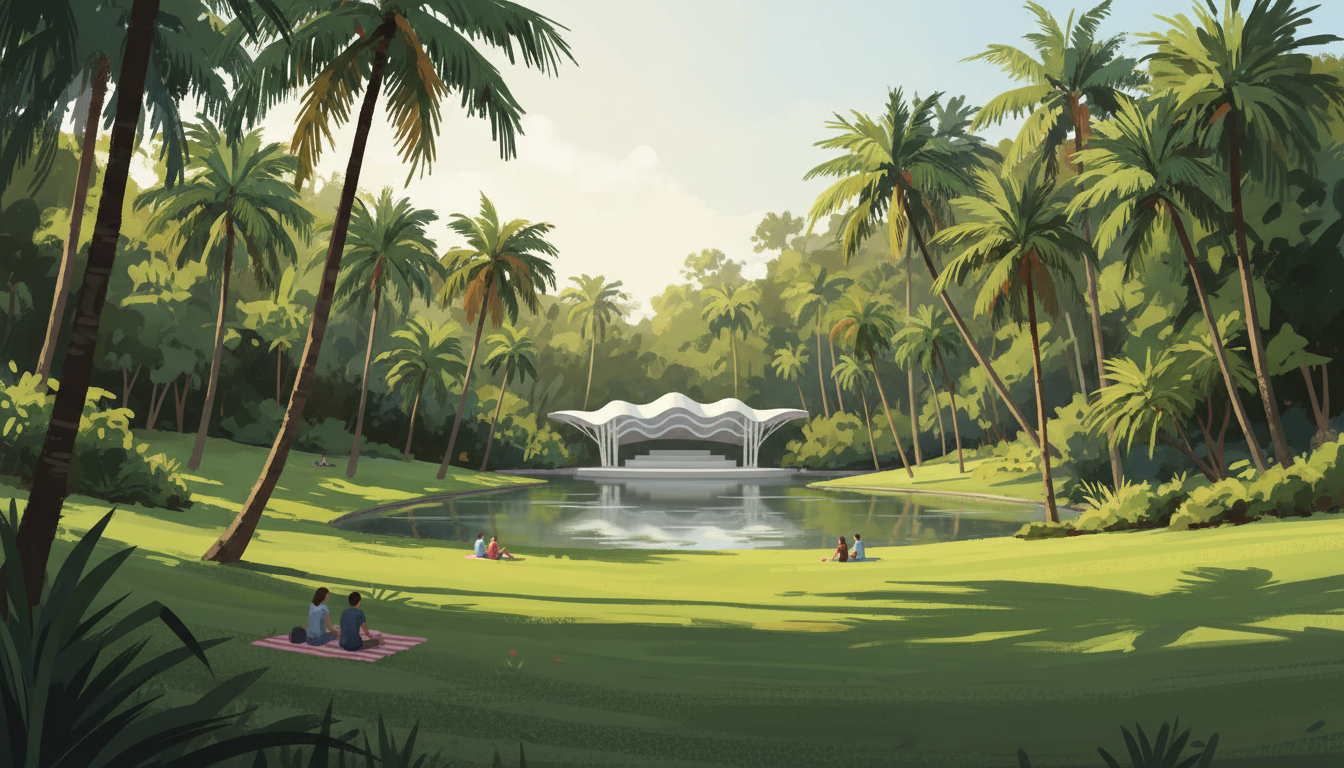
Where is Palm Valley at Singapore Botanic Gardens, and are Symphony Lake concerts free? Palm Valley is a historic, sloping lawn and palm collection in the central part of Singapore Botanic Gardens, leading towards Symphony Lake and the Shaw Foundation Symphony Stage. The palms have been cultivated here since 1879, and the current NParks collections page describes more than 350 palm species arranged across nine plots. On certain published dates, the lawn becomes the audience area for outdoor concerts, including free Singapore Symphony Orchestra performances. A concert is not guaranteed on any particular evening: always check the organiser’s live event calendar.
For searches such as Palm Valley Botanic Gardens, Symphony Lake Singapore, Shaw Foundation Symphony Stage, free outdoor concerts Singapore 2026, Botanic Gardens picnic concerts, Heliconia walk, Heliwalk, palm species collection, double coconut palm, Symphony Lake MRT entrance, Nassim Gate drop-off, accessible concert lawns and family sunset walks, the right distinction is that Palm Valley and Symphony Lake form one visitor area, not Swan Lake or Eco Lake. Swan Lake is in the historic Tanglin Core, while Eco Lake is near Bukit Timah Gate. Symphony Stage was constructed in 1995 and substantially rebuilt in 2005; the current visitor experience combines living palm collections, a lakeside performance venue and relaxing lawns.
The easiest visitor plan: enter through a suitable Gardens entrance, with Nassim Gate and its Visitor Centre a practical route for the central Gardens, check the official map to locate Palm Valley and Symphony Lake, and take a gentle palm-focused walk. If a free concert is scheduled, arrive according to the actual event notice, bring sensible weather protection and respect organisers’ entry and lawn rules. NParks’ general Gardens admission is free, normally 5am–midnight, but a concert may set different access, crowd-control or event conditions. The nearest MRT or taxi route depends on the gate you choose; the event venue is not inside an MRT station.
Quick answer: Palm Valley and Symphony Lake
| Question | Verified answer | Useful qualification |
| Palm Valley | Historic palm collection established 1879 | Central Gardens near Symphony Lake |
| Palm diversity | 350+ species across nine plots | Current NParks collection description |
| Heliwalk | 90+ Heliconia species and cultivars | Part of the Palm Valley collection setting |
| Double Coconut | Lodoicea maldivica highlighted by NParks | World’s largest seed; observe without touching |
| Symphony Lake | Lake adjoining the Shaw Foundation Symphony Stage | Not Swan Lake or Eco Lake |
| Original modern stage | Built in 1995 | Rebuilt in 2005 |
| Free concerts | Some SSO and other scheduled performances are free | Check individual published events |
| General Gardens entry | Free; grounds normally 5am–midnight | No blanket guarantee of concerts nightly |
| Practical drop-off | Nassim Gate / Visitor Centre useful | Choose actual mapped route |
| Visitor duration | 45–90 minutes without a concert | Event days need additional time |
| Concert booking | Varies by programme | Do not invent dates or seat reservations |
Contents: palms, lake and music
- Palm Valley’s 1879 botanical history
- The nine plots and more than 350 palm species
- Fan palms, feather palms and Double Coconut
- Heliwalk and Heliconia displays
- Symphony Lake and 1995/2005 music stage
- Finding genuine free concerts on the live calendar
- Picnic, arrival, rain and crowd planning
- Children, seniors, mobility and plant etiquette
- Self-guided visits, FAQs and official sources
1. Palm Valley is a botanical collection, not just a concert lawn
The open green slope is an attractive place to rest, but its name reflects one of the Gardens’ important plant collections. Different palm shapes and sizes occupy a landscape that has developed over many decades.
A visitor can have a rewarding experience even when no musician is on the stage. Compare several palm types and consider how landscaping gives the valley its character.
2. Palms have been planted here since 1879
NParks dates the establishment of Palm Valley to 1879. That long history makes the palms part of the Gardens’ botanical mission rather than merely decorative plants planted for modern concerts.
The living collection is not static; individual plants grow, die, are maintained and are replaced. The historical date marks a beginning, not a guarantee that every tree has stood for 147 years.
3. Current collection figures exceed many old accounts
The 2026 official plant collections page describes 350+ species of palms across nine plots. UNESCO’s earlier nomination materials referenced around 220 species represented in the landscape at the time.
These are dated measurements of an evolving collection. For current travel writing, use the NParks figure and avoid claiming all 350+ species can be identified by a casual visitor in one short walk.
4. Why nine plots help organisation
Dividing the collection into plots helps visitors and horticulturists understand botanical groupings, landscape relationships and maintenance requirements.
Not every plot must be visited in a rigid order. Select a few contrasting palms and use the official map and labels rather than walking into landscaped areas to inspect a rare specimen.
5. Palms belong to one plant family
Palms are flowering plants in the family Arecaceae, with enormous variation in height, leaf type, habitat and use.
A palm may have feather-like or fan-like leaves and may grow as a single tall trunk or as a cluster. Seeing them together reveals a wider family relationship behind different silhouettes.
6. Fan-shaped versus feather-shaped leaves
Some palms have broad fan-like leaf segments, while others have pinnate, feather-like leaf arrangements. The Gardens uses groups such as Arecoideae and Coryphoideae to introduce that diversity.
Ask a child to describe leaf shape before attempting a species name. Morphology is an approachable way to begin plant identification.
7. A silhouette changes the whole landscape
The height of a palm, shape of its crown and spacing of its trunk can influence shade, wind movement and the way a visitor frames a photograph.
At Palm Valley, look at a short clustered specimen against a tall slender one. The contrast is part of how the collection produces visual interest without heavy ornamentation.
8. Palm leaves are still living structures
A leaf may change colour, droop or fold as it matures. Different palms have different natural patterns of leaf shedding and trunk formation.
Do not pull off dried fronds or collect seeds. The Gardens’ professional staff decide when maintenance is needed for safety and horticultural health.
9. Double Coconut is a notable botanical curiosity
NParks highlights Lodoicea maldivica, known as the Double Coconut, as a palm associated with the world’s largest seed. A visitor may see a specimen as part of the Palm Valley collection.
The species is different from the ordinary coconut palm. A huge seed does not mean the public can handle, lift or remove one from the Gardens.
10. Why the biggest seed is interesting
Seed size reflects biological trade-offs, including the resources a seedling carries and how the plant reproduces. A large seed can support early development differently from very small wind-dispersed seeds.
A visitor can compare this idea with tiny gliding seeds described at the nearby Seed Dispersal Garden without claiming every seed follows the same survival strategy.
11. Double Coconut is a different subject from coconut water
The well-known fruit sold as coconut water comes from Cocos nucifera, while the Double Coconut belongs to Lodoicea. Similar English names do not make two species interchangeable.
Do not assume a rare botanical specimen is edible or sold as a public food product. Appreciating its morphology is enough.
12. Palms have shaped many human societies
Different palm species provide food, fibres, oils, building materials and ornamental foliage. The diversity is one reason scientific institutions maintain broad collections.
Those uses vary by species and plant part. A visitor should not treat every palm leaf or fruit as suitable for food or craftmaking.
13. Heliwalk adds a colourful secondary collection
NParks also identifies more than 90 Heliconia species and cultivars within the Palm Valley setting. Their foliage and striking colourful bracts complement the palms.
Heliconias are not palms. Their presence is a useful reminder that a garden valley can host multiple botanical groups serving different display purposes.
14. What is a Heliconia?
Heliconias are tropical flowering plants often known for vivid bracts and distinctive inflorescences. Their form can be dramatic even when the true flowers are less visually prominent.
If you see a bright red or yellow hanging structure, read the label before deciding it is a palm flower or a bird-of-paradise relative.
15. Heliwalk makes a useful plant comparison
The long leaves of Heliconia can be compared with a feather palm and a broad fan palm. One walk can introduce different growth forms without a classroom.
Encourage children to draw or photograph shapes from the path rather than pulling apart flowers to inspect their interiors.
16. Heliconias are not bird-of-paradise plants
The vivid shape of some heliconias can resemble other tropical ornamental groups, but resemblance in the garden does not establish identical genus or ecology.
Botanical names help distinguish them. Ask which features are common and which are different rather than assuming the plants are all one type.
17. Palm Valley slopes towards Symphony Lake
The collection occupies a broad shallow valley with sloping lawns and a lake at one end. The landscape creates a natural amphitheatre-like setting for audiences looking towards the stage.
Sloping grass may be fine for some visitors and difficult for others. A scenic lawn is not necessarily a level wheelchair-accessible platform.
18. Symphony Lake is the lake by the music stage
The Shaw Foundation Symphony Stage sits by Symphony Lake and acts as the focal point of outdoor performances. It is a different waterbody from Swan Lake and Eco Lake.
Keep the names separate when using maps or meeting friends. A visitor going to Swan Lake will not find the main Symphony Stage beside the Victorian gazebo.
19. The first Symphony Stage opened in 1995
National Heritage Board sources trace the stage’s development to a Gardens masterplan, with a performance stage constructed in 1995.
The addition helped formalise the Gardens’ role as a public cultural venue alongside research and horticultural education.
20. The stage was rebuilt in 2005
The iconic Shaw Foundation stage was rebuilt in 2005 with upgraded stage, lighting and backstage facilities. The project was supported by the Shaw Foundation.
The date difference explains why one archive may mention 1995 and another 2005. The later date refers to the substantially rebuilt stage.
21. The stage has a recognisable canopy
Its canopy and waterside setting make the stage easy to recognise in broad Palm Valley views. The lawn in front of it can accommodate a large outdoor audience on suitable event days.
The canopy is part of performance infrastructure, not a visitor shelter for anyone to climb or a stage on which the public may perform without booking.
22. Music does not play there every day
The Gardens and the Singapore Symphony Orchestra run specific programmed concerts. A lawn is not a continuously operating music attraction.
Check the actual What’s On pages rather than promising an orchestra on any random weekend. A free public site and a free scheduled concert are distinct concepts.
23. The SSO has held genuine free 2026 concerts
The Singapore Symphony Orchestra advertised a free Symphony in the Gardens performance on 1 August 2026 at 6pm at Shaw Foundation Symphony Stage.
That dated event is evidence of the type of concert held, not a future booking or promise that the same programme occurs every month. Check current listings for the next event.
24. SSO free events can attract large audiences
Historical concerts in the Gardens have attracted thousands of visitors, especially around popular programmes. Crowd conditions therefore differ substantially between a quiet weekday and a headline concert.
Build in extra time, respect organiser instructions and do not assume there will always be an unobstructed place to spread a mat near the front.
25. Check the event organiser as well as the venue
NParks’ What’s On calendar lists Gardens programmes, while the SSO maintains its own upcoming concert pages. Both can help confirm the date, starting time and admission rules.
Use a published event page for exact performance details. The general Palm Valley visitor page alone cannot confirm who will play this Saturday.
26. A free concert may still have capacity rules
Some public performances are entirely open on a first-come basis, while others have registration, designated access or event-specific restrictions. The particular organiser defines those conditions.
Do not invent a booking link or ‘available ticket’ without confirmation. If a registration is required, it belongs on that individual event page.
27. Make a lawn-picnic plan, not an elaborate campsite
A small picnic mat and modest snacks may suit an outdoor performance where permitted. Large furniture, tents, generators or event fixtures are separate matters.
Follow Gardens and event-specific space-use rules. A public lawn remains shared space, not an unlimited private reservation.
28. Bring the essentials for an outdoor concert
Water, light rain protection, an appropriate picnic mat and a small personal bag may help. Keep equipment easy to carry over the lawn.
Do not bring huge lighting rigs or amplified speakers that interfere with the official performance. Respect the event team’s safety and crowd directions.
29. Check the forecast on the concert day
Outdoor events depend on weather, and organisers may announce changes for lightning or heavy rain. The stage’s canopy does not make the audience lawn safe during a thunderstorm.
Use official weather warnings and wait for event-organiser instructions. Do not shelter beneath isolated trees during lightning.
30. Quiet days are just as worthwhile
On days without a concert, Palm Valley offers space to observe palms, heliconias and the lake in a calmer atmosphere.
Treat the lack of music as an opportunity rather than a failed visit. A quiet botanical walk is an attraction in its own right.
31. Why the venue suits free community music
A central green lawn with a dedicated stage provides a setting where many people can experience a performance without the architecture of an enclosed concert hall.
Outdoor acoustics, sightlines and crowd conditions differ from a paid indoor seat. Visitors should expect a park atmosphere, not identical theatre conditions.
32. How young children can enjoy the area
Children may enjoy the wide valley, varied palms and simple observations around the lake. For a concert, prepare them for the possibility of crowds and longer waiting.
Keep a child within sight, choose a safe listening location and be ready to leave if the child becomes tired or overwhelmed.
33. A family botany game between concert pieces
Choose a fan palm, a feather palm and a Heliconia and describe the visible differences. A few minutes of nature learning can help children connect the concert setting with the living collection.
Do not walk among protected plant beds or disturb other listeners while a performance is underway.
34. Older adults may prefer the gentle botanical visit
A person who dislikes large crowds may enjoy Palm Valley on an ordinary morning or afternoon. A concert can involve long periods sitting on the grass and later walking uphill.
Choose a plan that matches mobility and comfort, using current accessible approach maps and rest areas rather than assuming every concert is suitable for everyone.
35. Accessibility is route-specific
The Gardens publishes accessible visitor paths and has loan wheelchairs at certain service points, but not every part of a sloping lawn can be described as barrier-free.
For an accessible concert viewing area or route, consult the organiser’s actual event information. Do not promise a particular reserved spot without official evidence.
36. A useful approach from Nassim Gate
Nassim Gate and the Visitor Centre are practical visitor references for the central Gardens and Symphony Lake area. NParks’ visitor page lists a parking zone served by Nassim Entrance.
The best entry point depends on where a guest starts. Read the current Gardens map and transport options rather than inventing a universal five-minute walk from every gate.
37. Getting there from Botanic Gardens MRT
The Downtown and Circle Line station serves the Bukit Timah Gate. You can continue through the Gardens towards Palm Valley and Symphony Lake using the official paths.
A longer internal walk may be required. Leave more time for a concert because late arrival can make it harder to find companions or a suitable spot.
38. Getting there from Napier MRT
Napier MRT serves the Tanglin end. The route through the Gardens to Palm Valley takes time and depends on the chosen paths.
Plan for the actual distance and mobility needs. Singapore Botanic Gardens is not one compact square in which all attractions are directly beside both MRT stations.
39. Car parking costs extra
The Gardens currently lists paid parking at S$0.02 per minute across its visitor zones. The Nassim Entrance carpark is among the options identified.
Parking spaces are limited and may be crowded during events. Public transport can simplify arrival and exit, especially after a popular concert.
40. Why concert days change the walk back
Thousands of people may leave the performance area after a scheduled event, creating slower walking conditions near gates and public transport.
Agree on a meeting point in advance and follow the flow arranged by organisers. Do not cut through planted beds to get around a crowd.
41. Dogs and pets require current event checks
The Singapore Botanic Gardens permit pets in some areas but restrict them in several named attractions. One SSO 2026 concert explicitly welcomed pets, but that invitation is event-specific.
Check the latest pet rules for the lawn and the actual concert before bringing an animal, and keep it safely controlled among crowds.
42. Palm Valley is not a designated off-leash playground
Even if animals are permitted in a particular ordinary lawn area, that does not make the collection a dog run. Children and wildlife are sharing the space.
Follow leash, waste and access restrictions. No animal should be allowed to enter protected plantings or disturb nesting birds.
43. The lake is not a boating or swimming venue
Symphony Lake is an ornamental landscape feature alongside the performance stage, not a public recreational pool.
Stay away from unprotected water edges and avoid retrieving objects by entering the water. Parents should supervise children near the lake.
44. A lake photograph can include art and botany
A wider frame can show the stage canopy, water, palms and lawn in one composition. A closer image may highlight the structure of an unusual palm leaf.
Use permitted routes and do not enter planted collections or climb stage infrastructure for a more dramatic picture.
45. Palm Valley is a useful part of Gardens history
Palm Valley’s establishment in 1879 connects to the Gardens’ late nineteenth-century evolution as a botanical institution, while the stage represents its modern community culture.
The same landscape can therefore illustrate both scientific collecting and public arts programming. That combination is what makes it distinctive.
46. The Gardens’ UNESCO status gives added context
Singapore Botanic Gardens is a UNESCO World Heritage site valued for its horticultural, research and cultural landscape history. Palm Valley forms part of that wider story.
The designation does not guarantee performances or make every individual plant a protected heritage tree. It recognises the significance of the overall living institution.
47. A 45–60-minute palm-focused walk
For a short visit, observe a few different palms, enjoy the view towards Symphony Lake and turn around using the mapped public path.
The time is a suggested pace rather than a certified route length. Add MRT approach and rest stops separately.
48. A ninety-minute botanical outing
Spend longer comparing the nine-plot collection, a Double Coconut if accessible on the current route and the Heliwalk. Allow an unhurried pause near the lake.
This can be enjoyable without a concert. Flowers and palms vary in appearance, so treat current displays as living collections rather than fixed exhibitions.
49. A concert afternoon requires a separate clock
If you have a genuine published concert at 6pm, reverse-plan arrival, walking, weather preparation and food accordingly. A popular lawn can fill early.
Do not adopt 6pm as the default for all concerts merely because one 2026 SSO programme began at that hour. Each event has its own actual schedule.
50. The most helpful final distinction
Palm Valley is the botanical collection and sloping grass landscape; Symphony Lake is the waterside setting; Shaw Foundation Symphony Stage is the performance facility. They are closely related but not synonyms.
Knowing these names helps visitors choose the right event, entrance and point to meet friends rather than navigating to Swan Lake or a separate garden pavilion by mistake.
Frequently asked questions: Palm Valley and Symphony Lake
Is Palm Valley free to visit?
Yes. It is part of the general free-entry Singapore Botanic Gardens.
Where is Palm Valley?
In the central part of Singapore Botanic Gardens, sloping towards Symphony Lake and the Shaw Foundation Symphony Stage.
Is Palm Valley the same as Swan Lake?
No. Swan Lake is a separate historic ornamental lake in the Tanglin Core.
Is Symphony Lake the same as Eco Lake?
No. Eco Lake is near Bukit Timah Gate, while Symphony Lake is beside the music stage at Palm Valley.
How many palm species are there?
NParks’ 2026 collection page reports more than 350 palm species spread across nine plots.
Why do older sources say about 220 species?
UNESCO nomination materials reflected a smaller historical collection count. The current NParks page gives 350+ species.
When did Palm Valley start?
NParks says palm cultivation in the valley began in 1879.
What is Heliwalk?
Part of Palm Valley’s displays, showcasing more than 90 Heliconia species and cultivars.
Are Heliconias palms?
No. They are a separate tropical flowering plant group known for brightly coloured bracts.
What is the Double Coconut?
Lodoicea maldivica, a palm renowned for producing the world’s largest seed.
Can visitors collect palm fruits?
No. Do not remove or damage living botanical collections.
Is the Shaw Foundation Symphony Stage free to enter?
The stage is performance infrastructure within public Gardens grounds. Some scheduled concerts are free, but access and registration depend on the event.
Are Symphony concerts held every weekend?
No fixed weekly performance can be assumed. Check the live Gardens and Singapore Symphony Orchestra event calendars.
Is there a 2026 free SSO concert example?
Yes. The Singapore Symphony Orchestra advertised free admission to its 1 August 2026 Symphony in the Gardens concert at the stage.
Does the 1 August 2026 event prove a concert is on tonight?
No. That is a past dated event, not a current schedule. Check the next confirmed listing.
When was the original modern stage built?
1995, according to National Heritage Board history.
When was the stage rebuilt?
2005, with expanded modern performance facilities.
What is the Shaw Foundation Symphony Stage?
A dedicated performance stage beside Symphony Lake used for programmed outdoor concerts.
Can I perform on the stage myself?
Do not assume free public stage access. Organised events require operator approval.
Can I have a picnic on the lawn?
Where the Gardens and event permit, modest picnics can be part of the experience. Follow lawn and crowd-management rules.
Should I arrive early for a free concert?
For a popular scheduled event, extra arrival time is sensible, but check the official organiser’s instructions and actual capacity.
Can I reserve a picnic spot?
Not automatically. Event organisers may have specific crowd or accessible viewing arrangements; check the actual programme.
Is the lawn wheelchair accessible?
The grounds include slopes and varied surfaces. Ask the organiser or Visitor Services about a suitable accessible route and concert viewing area.
What is the best Gardens entrance?
Nassim Gate / Visitor Centre is one practical access reference. Choose the route based on your starting point and the official Gardens map.
Can I reach it from Botanic Gardens MRT?
Yes, by walking through the Gardens from Bukit Timah Gate. Allow additional time.
Can I reach it from Napier MRT?
Yes, via the Tanglin side, with a walk through the Gardens. Check the current route.
Is parking free?
No. The Gardens charges visitor parking at S$0.02 per minute, subject to onsite conditions.
Do concerts continue during thunderstorms?
Weather can affect outdoor concerts. Follow organisers’ latest announcements and official lightning guidance.
Are dogs allowed during concerts?
Rules vary. One 2026 SSO free event welcomed pets, but other events and Gardens zones have separate requirements.
Can I swim in Symphony Lake?
No. It is an ornamental park lake, not a swimming venue.
Is there food nearby?
Singapore Botanic Gardens lists dining operators around its visitor centres; check specific menus, location and hours.
How long does a non-concert visit take?
A relaxed 45–90-minute Palm Valley and lake outing is possible depending on entrance and pace.
Can small children visit?
Yes with supervision near slopes, planting beds, crowds and lake edges.
Can I take photographs?
Ordinary photography from public paths is possible subject to event and equipment rules; avoid blocking performance viewing areas.
What is the best way to find a free event?
Check the official Singapore Symphony Orchestra What’s On and Singapore Botanic Gardens What’s On listings.
Where can I find the official visitor map?
Singapore Botanic Gardens Visitor Information includes downloadable maps with Palm Valley and Symphony Lake.
Related Bukit Timah and Gardens guides
- Free concerts, live performances and music
- Historic Swan Lake and Victorian gazebo
- Eco Lake and Eco Garden
- Garden picnic spots and outdoor lunch
- Heritage tree walks
- Free local activities and family itineraries
Official palm collection, stage history and concerts
Verified on 23 October 2026. Palm species counts and Heliwalk details follow NParks’ current collection description; 1995/2005 stage dates follow National Heritage Board records. The August 2026 free concert is a dated example, not an upcoming availability claim. Confirm actual future event dates with organisers.
- NParks — Palm Valley 1879, 350+ species, nine plots, Heliconias and Double Coconut
- NParks — modern Gardens masterplan and Symphony Stage creation
- National Heritage Board — 1995 stage construction and 2005 rebuild
- Singapore Symphony Orchestra — dated free Symphony in the Gardens event on 1 August 2026
- Singapore Symphony Orchestra — upcoming concerts and admission
- NParks — general Gardens opening, entrances, accessibility and parking
- NParks — self-guided visitor itineraries
- NParks — use of lawns, events, photography and pets
- NParks — current visitor notices and closures
- Meteorological Service Singapore — outdoor event and lightning safety