
Things to do in Singapore | Raffles Place. Stand in the middle of Singapore’s financial district, relax at Raffles Place Park, climb into CapitaSpring’s public greenery when available, walk to Lau Pa Sat and Boat Quay, cross toward the Singapore River and use the CBD to understand how a swampy colonial commercial square became one of Asia’s densest financial centres.
Raffles Place is easiest to misunderstand when everyone is rushing.
Slow down.
The district contains one of Singapore’s clearest urban transformations: reclaimed land, nineteenth-century commerce, banks, skyscrapers, underground rail, public parks, hawker food and increasingly mixed-use towers all compressed into a few blocks.
- Sit in Raffles Place Park and watch the office district at different times of day.
- Walk the historic line toward Boat Quay and the Singapore River.
- Eat at Lau Pa Sat.
- Visit CapitaSpring’s public Green Oasis or Sky Garden when current access allows.
- Compare older street blocks with new mixed-use towers.
- Walk toward Fullerton, Marina Bay or Telok Ayer.
- Return on a weekend and compare the quieter CBD with the weekday rush.
Read: Things to do in Singapore | Downtown Core
Read: Things to do in Singapore | Singapore River
Read: Things to do in Singapore | Tanjong Pagar
Start With the Big Idea: Raffles Place Is the Birthplace of Singapore’s Commercial Core
URA describes Raffles Place as historically rich and strategically important — the birthplace of Singapore’s commercial development and today the country’s premier business district.
The district still carries both identities.
Nineteenth-century commercial geography survives underneath twenty-first-century finance.
The most useful visit is therefore a comparison between layers rather than a search for one attraction.
Official precinct reference: URA | Raffles Place Alliance
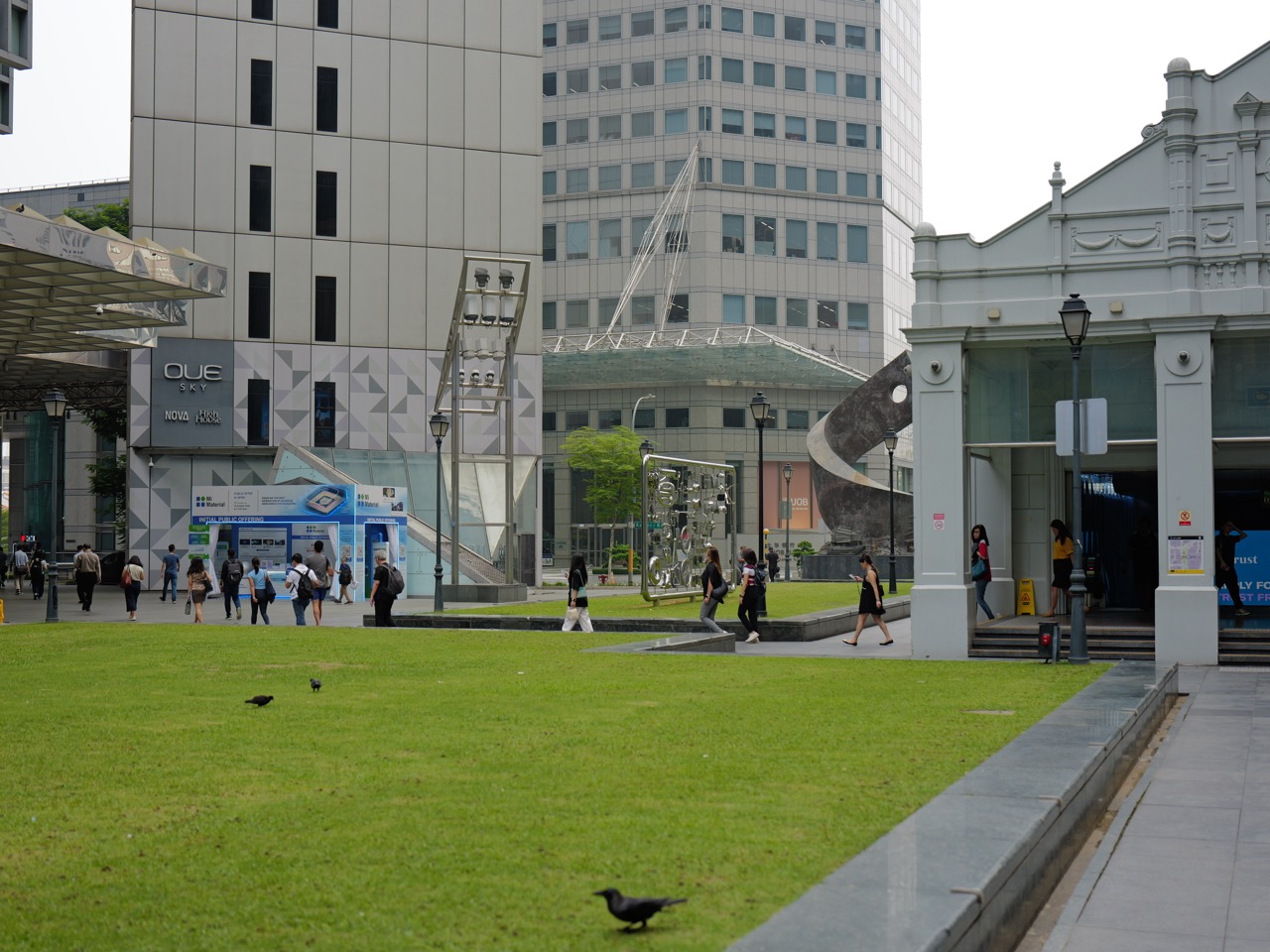
Stand in Raffles Place Park
NParks lists Raffles Place Park at 0.6 hectares and open 24 hours.
The small lawn sits directly above and beside the MRT station, surrounded by some of Singapore’s tallest commercial buildings.
Its value comes from contrast.
The park occupies exceptionally valuable land yet remains a public place to sit, meet and pause.
That makes it a strong lesson in why city centres need breathing room.
Official visitor information: NParks | Raffles Place Park
Visit Twice: Lunch and Weekend
Raffles Place behaves differently depending on time.
At lunch, office workers flood food courts, hawker centres and public spaces.
After work, bars and restaurants take over some of the social demand.
On weekends, the same streets can feel dramatically quieter.
This is a perfect example of the Time Layer.
The buildings do not move.
The user population changes.
Walk Toward Boat Quay
Boat Quay sits at the historic commercial edge of the Singapore River.
URA notes that in the 1820s a hillock near Battery Road was levelled to create Commercial Square — later renamed Raffles Place — and the earth was used to fill swampy land along the south bank, helping create Boat Quay.
That means Raffles Place and Boat Quay were physically built together.
One supplied commercial land.
The other became the riverfront logistics edge.
Official heritage reference: URA | Boat Quay Conservation Area
Use the River to Understand Why Raffles Place Grew Here
The financial district did not appear randomly.
Commerce concentrated near the river because goods, merchants, warehouses and shipping activity were already there.
Banks and trading houses followed flows of money and goods.
Over time, finance became increasingly separated from physical cargo, but the district remained.
The modern skyscraper is therefore part of a much older commercial geography.
Eat at Lau Pa Sat
Lau Pa Sat, the former Telok Ayer Market, is one of the CBD’s strongest everyday heritage anchors.
URA lists the building as a National Monument at 18 Raffles Quay.
Its distinctive octagonal cast-iron structure preserves the memory of a nineteenth-century market inside the modern financial district.
Eating there is useful because the building still performs a food function rather than existing only as a museum.
Official heritage reference: URA | Former Telok Ayer Market / Lau Pa Sat
Use Lau Pa Sat to Teach Continuity of Function
Buildings often survive by changing use.
Lau Pa Sat is interesting because its broad function remained remarkably consistent.
It was a market.
It remains a food place.
The customers, vendors, urban context and operating systems changed enormously, but the building’s social role stayed recognisable.
That is a different kind of heritage continuity from converting a warehouse into a restaurant or gallery.
Visit CapitaSpring’s Green Oasis and Sky Garden When Available
CapitaSpring represents the newer mixed-use direction of Raffles Place.
The development includes offices, serviced residences, food, public greenery and rooftop urban farming.
CapitaLand provides public access to the Green Oasis and 1-Arden Sky Garden during designated times, subject to booking, private events and blackout dates.
Check the live CapitaSpring page before going because access arrangements can change.
Current access information: CapitaLand | CapitaSpring
Use CapitaSpring to Understand Mixed-Use CBD Renewal
URA’s Master Plan 2025 points to the former Golden Shoe Carpark redevelopment as an example of how Raffles Place is evolving.
The site now combines Grade A offices, serviced residences, a hawker centre, sky terraces and rooftop farming.
That is important because the future CBD is not intended to remain purely office-based.
More mixed use creates activity outside traditional work hours and reduces the risk of a district emptying every evening.
Official planning reference: URA | Rejuvenating our Downtown
Walk the Art and Public-Space Layer
Raffles Place Alliance runs programmes designed to make the district more than a workplace.
Current initiatives include public seating, fitness activities, heritage audio tours and periodic UNWIND events with markets, performances, lawn games and movie screenings.
In June 2026, i Light Singapore also extended to Raffles Place Park as a satellite site.
The lesson is placemaking.
A business district can be physically complete but socially underused.
Programming changes how long people stay and why they return.
Use the MRT to Understand Vertical Density
Raffles Place MRT serves the North–South and East–West lines beneath one of Singapore’s densest employment zones.
The station is central to why the district can support such a large daytime population without requiring everyone to arrive by car.
High-rise density and high-capacity public transport reinforce one another.
Take away the rail system and the same concentration of workers becomes much harder to sustain.
Walk Toward Fullerton and Marina Bay
Eastward, Raffles Place flows toward Fullerton, the river mouth and Marina Bay.
The skyline opens.
Public waterfront space becomes more prominent.
This transition shows how the old commercial centre extended into the newer Marina Bay financial district rather than being replaced by it.
The CBD grew outward while Raffles Place remained a core node.
Walk Toward Telok Ayer and Tanjong Pagar
Southwest, the district connects to Telok Ayer, Cecil Street, Shenton Way and Tanjong Pagar.
This route reveals the CBD as a long commercial spine rather than one plaza.
Older religious and shophouse streets near Telok Ayer sit surprisingly close to global banks and towers.
Singapore’s business district is historically layered rather than uniformly modern.
A Simple Raffles Place Half-Day Plan
- Morning: arrive at Raffles Place MRT and begin in Raffles Place Park.
- History walk: continue to Boat Quay and the Singapore River.
- Lunch: eat at Lau Pa Sat or a nearby CBD food centre.
- Viewpoint: visit CapitaSpring’s public greenery if current access is available.
- Waterfront: continue toward Fullerton and Marina Bay.
- Finish: leave from Raffles Place, Downtown or Telok Ayer MRT.
Raffles Place Through the eduKate Ecosystem
Things to do in Singapore | Downtown Core
Things to do in Singapore | Singapore River
Things to do in Singapore | Tanjong Pagar
Things to do in Singapore | Marina Bay
Frequently Asked Questions
What is Raffles Place best known for?
It is Singapore’s historic and modern financial core, home to major banks, offices, Raffles Place Park and excellent connections to the Singapore River and Marina Bay.
Is Raffles Place Park open to the public?
Yes. NParks currently lists the 0.6-hectare park as open 24 hours.
Can the public visit CapitaSpring’s Sky Garden?
CapitaLand currently offers public access during designated periods, subject to booking and closures. Check the current building page before travelling.
Is Lau Pa Sat near Raffles Place?
Yes. It is a short walk south toward Raffles Quay and is one of the CBD’s strongest food-and-heritage stops.
Is Raffles Place interesting on weekends?
Yes, precisely because it is quieter. The lower crowd levels make the architecture and public spaces easier to observe, although some office-oriented food and retail may operate shorter hours.
What is the main learning idea?
Commercial continuity. Raffles Place shows how a nineteenth-century trading square became a modern financial district while keeping the same strategic centrality within Singapore’s economy.
Official References and Current Sources
URA | Rejuvenating our Downtown
URA | Former Telok Ayer Market / Lau Pa Sat
Things to do in Singapore | Raffles Place
Raffles Place is where Singapore’s commercial history learned to climb vertically.
The swamp became a square.
The square became a financial district.
The financial district is now becoming more mixed, greener and more active beyond office hours.
Stand in the park long enough and the entire evolution is visible around you.