
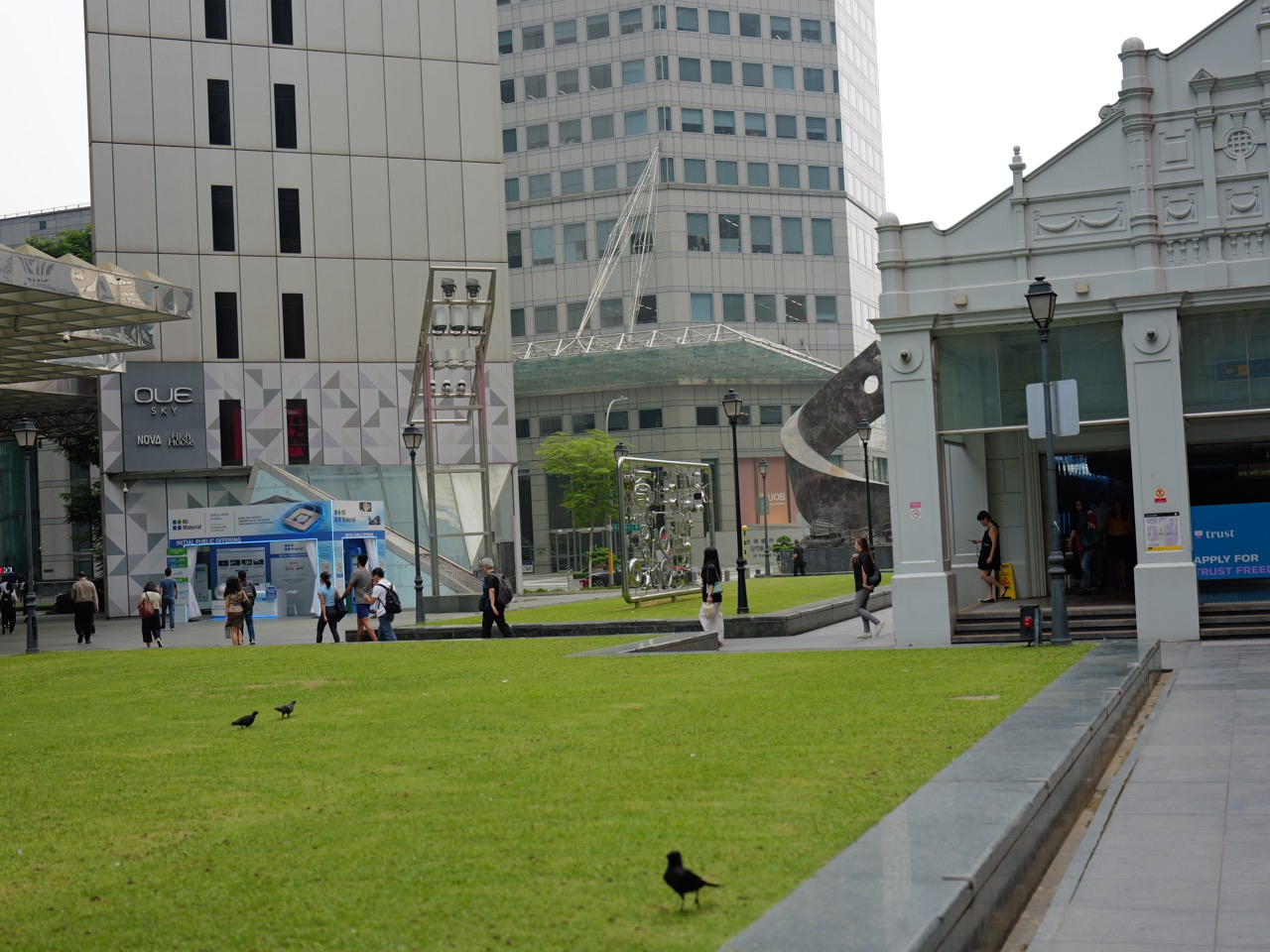
Raffles Place MRT Station (NS26/EW14) is the most practical rail entrance for Singapore’s financial district and a surprisingly good starting point for a free central-city walk. Step out to Raffles Place Park for a small green space among office towers, visit One Raffles Place for food and shops, or walk towards The Fullerton Hotel, Asian Civilisations Museum, the Singapore River and Merlion Park. A first-time visitor can combine urban architecture and waterfront scenery without purchasing a tourist attraction ticket.
The station-exit decision is important: Exit H is the Asian Civilisations Museum’s recommended approach, with an approximately five-minute walk to its entrance at 1 Empress Place. It is also a useful public approach to the Fullerton waterfront. Exits A and B open close to Raffles Place Park, and One Raffles Place is directly connected at Basement 1. The park is only 0.6 hectares, free to enter and generally open 24 hours, rather than a large nature reserve with a long hiking trail.
The most useful current caution is that Market Street Hawker Centre is scheduled for cleaning on 26–27 December 2026 according to NEA’s published programme. Do not plan a special meal there on those dates without confirming the updated notice. This Raffles Place MRT guide covers one-hour, two-hour and half-day routes, what is open to the public, food and museum choices, accessibility and the difference between the free bay promenade and paid riverboat services. Reviewed 1 November 2026.
- Station: Raffles Place NS26 / EW14, North–South and East–West Line interchange
- Exit H: useful for Asian Civilisations Museum, 1 Empress Place, and Fullerton waterfront
- Exits A/B: around Raffles Place Park, a 0.6-hectare 24-hour public space
- Direct indoor option: One Raffles Place shopping centre, Basement 1 station connection
- Free waterfront highlight: Merlion Park at 1 Fullerton Road, generally open 24 hours
- Museum: Asian Civilisations Museum, 10am–7pm daily, Fridays until 9pm; gallery admission closes 30 minutes earlier
- Food closure: Market Street Hawker Centre’s 26–27 December 2026 scheduled cleaning

Raffles Place is a financial centre and a worthwhile walking destination
Raffles Place is best known as a place where people work in Singapore’s central business district. That does not make it only an office destination. The area contains historic sites, commercial arcades, accessible public spaces, outdoor art and important connections to the river and Marina Bay.
A short city walk can be worthwhile because different stages of Singapore’s development are visible within a modest area. Skyscrapers stand beside streets with older names; former civic and postal buildings have different present uses; the river has changed from a cargo-handling route into a public-facing cultural landscape.
Unlike a ticketed theme park, this trip is not organised by admission to a single enclosed venue. You choose which public paths, park areas, galleries and commercial places to visit. The most successful plan allows one interesting observation to lead to another without demanding that the entire waterfront be completed.
For a visitor arriving at NS26/EW14, the question is simple: do you want a short green break, a meal, a lesson in Singapore’s history, or the iconic Marina Bay skyline? Choose the purpose before heading to the exit.
Which station exit should you use for your destination?
The station has many entrances because it connects different buildings in a dense district. A visitor standing on the platform should follow the overhead wayfinding rather than treating Raffles Place as one surface entrance. The two MRT lines meet underground, and the exits can lead to different tower basements and sidewalks.
Exit H is a reliable choice for the Asian Civilisations Museum because the museum itself names that exit and estimates a five-minute walk. One Raffles Place provides a Basement 1 connection from the MRT. The Raffles Place Business Association identifies Exits A and B beside the park and its public-art stops.
An important accessibility detail is that some street-level lifts serve particular commercial buildings and have operating-hour restrictions. Do not assume a building lift can always be used around the clock merely because the station itself is open. If step-free access is essential, use the current station and business-association guidance and ask staff for the suitable route.
People using wheelchairs, strollers or heavy luggage should choose the complete route rather than a letter on a map. A lift to a basement may be available while another connecting door is closed after office hours. The best exit is one you can actually use at your intended time.
Stop 1: Raffles Place Park, an outdoor pocket in the city
Raffles Place Park occupies approximately 0.6 hectares between Battery Road and Collyer Quay and is listed by NParks as open 24 hours and wheelchair-accessible. It is a small park directly associated with the MRT station, not a place where you should expect a long forested hike.
Because the park is surrounded by commercial towers, its atmosphere changes throughout the day. Office workers use the space between appointments or during lunch, while visitors stop for photographs and rest. It is a good place to begin because it shows how even a busy business district can preserve greenery and public seating.
An ordinary visit may take only fifteen or twenty minutes, depending on interest. Look at how the surrounding buildings create shade or alter the view, and notice how people move between different exits. Do not assume an empty lawn is always available for private sport or a commercial event; NParks explicitly restricts certain uses, including skateboarding and commercial events.
Take a photograph from a lawful public position rather than stepping into planted areas. A central park is shared by people eating, resting, walking and working, so do not obstruct a bench or pedestrian route to stage a long photoshoot.
If you want a larger nature outing, choose another park in Singapore. Raffles Place Park is valuable precisely because it is compact and accessible, which makes it well suited to a short urban break.
Stop 2: public art and the Raffles Place Business Association route
Raffles Place has several outdoor sculptures and public artworks. The business association offers an art audio tour that leads visitors from the park into the surrounding commercial district, explaining selected installations and the histories behind them.
According to the association’s guide, sculptures near the park include work by Singapore artists Aw Tee Hong and Tan Wee Lit, while other installations around commercial buildings are connected with international artists. Art can therefore become a reason to explore the district without entering a ticketed gallery.
Look at one piece carefully before consulting an explanation. What is it made of? Is it abstract or representational? How does it respond to the surrounding towers? The goal is not to guess the artist’s biography, but to learn how public art changes the way a street feels.
An artwork displayed outdoors is not automatically available for touching, climbing or commercial filming. Check signs and remain clear of office entrances, security areas and accessible paths. Some works sit on private developments where visitor photography may be managed by building owners.
A good public-art outing can last an hour by itself. You do not need to combine it with a full museum visit if your main interest is architecture and sculpture.
Stop 3: One Raffles Place, food and shopping above the station
One Raffles Place is directly connected to Raffles Place MRT from Basement 1. Its shopping centre includes food outlets, retail services and a place for workers and visitors to complete everyday errands. The developer’s directory is useful when you need a particular shop or food venue.
The shopping centre is not the entire office tower. Retail floors, offices and building services have different access and operation. A person who can enter the mall does not automatically have permission to go to a rooftop office or a private tower floor.
Check current business hours, particularly on weekends or public holidays. An area designed around a business district can have a different rhythm from a suburban shopping mall. An outlet busy during weekday lunch may trade differently in the evening.
For a short visit, this is a good place to find food before heading towards the river. Choose a business that suits your budget, dietary needs and available time rather than trusting an undated recommendation naming a particular stall.
The mall’s Basement 1 link is especially useful in rain, but a museum or waterfront outing will still require some outdoor walking. Do not assume every part of the route to Merlion Park is connected by underground retail corridors.
How financial-district food differs from a weekend food tour
Raffles Place contains cafés, casual takeaway outlets, restaurants and hawker-centre dining. Because many customers work in the area, some businesses focus on weekday breakfast and lunch. An itinerary built around a popular office-lunch outlet may fail if you visit at a different time.
Check the actual business rather than assuming a generic mall schedule covers everything. For a family visiting on Sunday, a restaurant that caters to office workers may have reduced hours, even though the park and public waterfront remain available.
Set a limit on waiting time. A thirty-minute queue for a famous lunch item can use much of a short trip. If the goal is to see the waterfront, choose a convenient open meal option and leave enough time for the walk.
Food pricing varies from modest takeaway meals to expensive fine dining in the Fullerton precinct. Choosing what to spend should be deliberate; no travel guide can honestly promise one universal cost for a Raffles Place outing.
Stop 4: Market Street Hawker Centre in CapitaSpring
Market Street Hawker Centre is located in the CapitaSpring development at 86 Market Street, Singapore 048947. It provides a public hawker-food option in an area often associated with high-rise offices and commercial restaurants.
It is important not to confuse the hawker centre with a rooftop sky garden or office-floor access in the same high-rise development. Those may have booking conditions, access times or separate rules, and a meal at the hawker centre does not automatically grant free unlimited entry to the whole building.
The market offers multiple food stalls, but individual vendors can close, change menus or sell out. Check the actual stall rather than promising a permanent dish or price based on an old article.
NEA currently lists a scheduled cleaning closure on 26–27 December 2026. This is a useful correction for visitors planning an end-of-year day in the CBD. A scheduled two-day closure should not be exaggerated into permanent closure, nor ignored because the broader building remains in use.
If the centre is unavailable on your chosen day, a nearby open restaurant or another verified hawker centre may be suitable. Do not make readers walk from one closed location to another without checking the specific date.
Stop 5: the Fullerton Building and its history
The Fullerton Hotel Singapore occupies the former Fullerton Building, a large neoclassical landmark beside the Singapore River mouth. The building was completed in 1928 as the General Post Office and also housed other government and commercial functions over time.
The National Heritage Board’s historical account explains how the building’s monumental columns and river-facing presence reflected Singapore’s role in regional trade and communications. That is a more useful reason to observe the façade than simply calling it a beautiful luxury hotel.
Look at the building from a lawful public position and identify the relationship between the road, the river and its prominent frontage. Ask how the functions of the building have changed. A post office serving a busy port and a modern hotel are different uses of the same historic structure.
Do not assume that a hotel lobby, guest floor or private dining room is freely accessible to any sightseeing group. The exterior and adjacent public paths provide meaningful views without intruding into guest areas.
The Fullerton Heritage operator names Raffles Place NS26/EW14 as a recommended MRT station for its precinct. Use the public route and the specific destination entrance rather than trying to cut through private hotel spaces.
Stop 6: Merlion Park, free access beside Marina Bay
Merlion Park is at 1 Fullerton Road, Singapore 049213 and is listed by Singapore Tourism Board as free and open 24 hours, with Raffles Place MRT as its nearest train station. It is one of the easiest iconic outdoor destinations to reach from the financial district.
The lion-headed, fish-bodied Merlion refers to different strands of Singapore’s name and early maritime story: Singapura as the Lion City and Temasek as a place connected with the sea. The present statue is not where it was originally placed when unveiled in 1972; it was moved to the present location in 2002.
Visit with realistic expectations. The viewing area can be crowded during evenings and school holidays. A photograph may take a few minutes, but enjoying the bay view and surrounding architecture can easily fill much longer.
Do not treat the waterfront edge as a place to climb for a more dramatic photo. Keep children close, follow railings and avoid blocking the pathways. The public park being open 24 hours does not make an exposed waterfront walk advisable during lightning or a severe storm.
You do not need to pay for a boat or skydeck to enjoy the Merlion and much of the Marina Bay skyline. A simple public-promenade visit is a genuine low-spend option.
What should you look at from Merlion Park?
Across the water are Marina Bay Sands and other modern landmarks; nearby are the Fullerton building, bridges, civic institutions and the financial district. This view brings together several periods of Singapore’s development in one frame.
A family can ask which structures were built for public government, which for trade, which for tourism and which for modern business. The buildings are not all the same kind of landmark, even if they appear together in an attractive photograph.
Choose one building to learn about and compare its purpose with another. A skyline becomes educational when visitors connect architecture with the way people live and work.
At night, be mindful of crowds and wet surfaces. Take photographs from places where people are allowed to stand and do not ask others to cross barriers for a better angle.
Stop 7: Asian Civilisations Museum, about five minutes from Exit H
Asian Civilisations Museum (ACM) is at 1 Empress Place, Singapore 179555. The museum’s official visitor page identifies Raffles Place MRT Exit H and an indicative five-minute walk. It sits in the former Empress Place Building beside the Singapore River and presents art and objects connected with Asian cultures and trade.
The published opening is 10am–7pm daily, with extended Friday opening until 9pm; gallery admission ends thirty minutes before closing. Ticket prices and concessions depend on visitor eligibility and whether a special exhibition is being visited.
The museum is especially relevant to a riverfront walk because trade and cultural exchange are central themes. Some objects reveal links between people across regions, faiths and historical periods. It can add depth to the visible urban landscape outside.
A useful visit focuses on one exhibition or collection theme. A child may choose a ceramic object, textile or artwork and ask where it came from and how people used it. An older student can compare evidence for trade with the history of the port city.
Do not treat the museum as a free space simply because the river outside is public. The operator has its own admissions, gallery rules and event schedules. Check if the chosen exhibition is open before making the trip.
Museum visit with children: keep one question in mind
Ask a child to find one object that travelled or was influenced by cultural exchange. Then ask what the object’s design might reveal about the people who made or used it. This connects the museum’s objects with the history of Singapore’s port and trade routes.
Explain the difference between a museum label and a personal guess. A label may give a date and place supported by research, while a viewer might interpret the object’s possible meaning. Both can be interesting, but they are not the same level of evidence.
Allow a break when the child becomes tired. A museum with many rooms is not a challenge to finish every exhibition in one visit.
Photography and touching rules vary by gallery. Do not assume all works can be handled or photographed with flash.
Stop 8: Empress Place and Victoria Theatre—an extension into civic history
Empress Place and the surrounding Singapore River area bring visitors towards landmarks such as Victoria Theatre and Concert Hall, Parliament House and former civic institutions. They provide a different perspective from Raffles Place’s office towers.
The National Heritage Board’s civic heritage material can help explain how public institutions developed around the mouth of the Singapore River. Some buildings remain in official use, while others host cultural performances or exhibitions.
Do not assume a concert hall is running a performance throughout the day. A building can be admired from outside without purchasing a show ticket, but an indoor event follows its own programme and admission rules.
For a longer walk, choose one or two buildings and read their interpretation. A public walking path around the area can be rewarding without entering any restricted office or government space.
Stop 9: Boat Quay, a historical riverfront continuation
Boat Quay is a riverside zone of conserved shophouses and modern restaurants. It can be included as a longer extension from Raffles Place and ACM, but it is not a compulsory part of a one-hour outing.
The area’s history is connected with Singapore’s early trading economy and river traffic. Looking at the shophouses from a public path can help visitors imagine a waterfront that once handled goods rather than primarily serving dining and leisure.
Individual restaurant menus and hours vary; a river-facing view does not guarantee a modest price or open seating. Read the current menu, ask about dietary needs and keep a budget in mind.
Choose a turnaround point or a different rail departure station if you walk farther upriver. An unplanned river walk can become tiring when a group has not considered the return.
Raffles Place public-art walks and an optional longer loop
The Raffles Place Business Association maintains audio guides and walking suggestions, including an art trail and a longer running route linking the district with the river and Marina Bay. These resources are useful for someone who wants a self-directed urban outing rather than a ticketed guided tour.
Start by looking for a sign or QR code near Raffles Place Park and confirm that the material is still available. A guide published in an earlier year may be informative, but you should verify the current pedestrian route before relying on a historic path description.
An art trail can be enjoyed at a slow pace. Stopping to compare two different works may be more worthwhile than attempting the entire circuit in a hurry.
Do not advertise a multi-kilometre waterfront loop as a five-minute activity simply because it begins near the MRT. If fitness is the goal, plan the full route, weather and return separately.
A simple one-hour Raffles Place MRT plan
From the station, step into Raffles Place Park and look at the skyscrapers and public art. Then choose one small extension: a meal in One Raffles Place, a walk towards the Fullerton exterior or a brief riverside viewpoint. Reserve time to return to the MRT.
An hour can be enough for a comfortable park-and-skyline outing but not for a full ACM museum visit, a boat ride and a long river walk. Choose one purpose and avoid constantly adding destinations.
During weekday lunch, food queues may be longer than expected. If a meal is the main activity, select the restaurant first and reduce the walking portion if necessary.
A two-hour free city-and-river walk
Begin at Raffles Place Park, follow the public route towards the Fullerton building and continue to Merlion Park. Spend time enjoying the view before returning. This can be a rewarding low-cost visit when weather and crowds are comfortable.
The route combines historic architecture with modern skyscrapers. A useful family activity is to identify which building belongs to which period and how each is used now.
If you want to add ACM, check its entry and closing time. A museum may deserve its own two-hour block rather than a rushed twenty-minute detour.
A half-day art and history outing
Start with a preselected exhibition or collection at Asian Civilisations Museum, allowing time to read and ask questions. Continue to the Singapore River and Fullerton waterfront, then finish with an appropriate meal. You can choose to return through Raffles Place MRT or another convenient station depending on the completed route.
This version works well for students or adults interested in history because the museum gives context to the river outside. A riverbank walk alone shows buildings; a museum can explain some of the exchange and trade that made those places important.
Do not overfill the schedule with National Gallery Singapore or multiple distant waterfront attractions. Those belong to a longer city itinerary or a separate station guide.
A family evening with the Merlion
For an evening visit, choose an appropriate meal first and then walk to Merlion Park when conditions are safe. The skyline and illuminated buildings can be memorable without a paid attraction ticket.
Keep children close near water and busy crossings. A free outdoor space is not a playground with protective barriers around every edge. Do not encourage climbing or risky posing.
After the walk, use current signs to return to Raffles Place MRT. If you have moved far around Marina Bay, another station may be closer; check the complete journey rather than automatically retracing the original route.
What is free and what costs money?
Raffles Place Park and Merlion Park are publicly accessible without a normal attraction entry fee. Looking at the historic Fullerton exterior, public art and permitted riverfront views is also free.
Asian Civilisations Museum has admission conditions and special exhibitions. Restaurants, shopping, paid river cruises and guided activities cost money according to their operators. The difference matters when a family is choosing a low-budget outing.
Your MRT trip uses the appropriate public-transport fare, and a long route may need additional transport. The cost of a day is determined by the actual itinerary, not the entire neighbourhood.
A budget plan can be simple: fare, one meal, optional museum admission. If the museum is not essential, the outdoor city walk can be the main experience.
A realistic accessibility plan
The park is described by NParks as wheelchair-accessible, and ACM provides accessible visitor facilities. However, the journey between them still includes the station lift, the chosen street-level exit, crossings and the museum entrance.
Business association material describes accessible routes through selected exits and tower buildings but notes that some street-level lifts operate only during specific hours. Use current signage and, when necessary, ask MRT staff for the best lift route at the time of travel.
A person using a wheelchair or stroller may prefer a shorter loop rather than a full bay walk. Choose the accessible route that fits the group’s comfort and available rest stops.
Public promenades can become crowded during festivals and evening light shows. Be patient and keep accessible pathways clear.
Weather and safety: the CBD can be exposed too
The office towers create shade in some places, but an urban walk can still be hot, humid or exposed. Carry water and consider a shorter route during strong afternoon sun. A shopping centre or museum can be a suitable indoor stop when open.
During lightning or heavy rain, avoid exposed waterfront paths and seek proper shelter. The Merlion Park’s twenty-four-hour opening does not guarantee that it is safe to stand by the water during a storm.
In haze, consult the Singapore government’s current health advice and shorten outdoor activity as appropriate.
Respect working offices, security restrictions and construction areas. A public plaza is not permission to enter the private floors of an adjacent tower.
Common errors that waste time at Raffles Place
Choosing a random station exit. ACM recommends Exit H; One Raffles Place offers a Basement 1 connection; park-side exits are another option.
Expecting a large nature reserve at Raffles Place Park. It is a 0.6-hectare central urban park.
Assuming an office tower’s street lifts operate at all hours. Some building-specific lifts have restricted schedules.
Going to Market Street Hawker Centre during its 26–27 December cleaning closure. Check NEA updates before a food-centred trip.
Assuming the museum is free to all visitors or open late every night. ACM has admission categories and extended Friday hours.
Expecting every riverboat cruise to be included in a free walk. Boat trips are separate ticketed services.
Frequently asked questions about Raffles Place MRT
Which lines serve Raffles Place MRT? North–South Line NS26 and East–West Line EW14.
Which exit serves the Asian Civilisations Museum? The museum recommends Exit H, with an indicative five-minute walk.
Can I visit Raffles Place Park for free? Yes. NParks lists it as a 0.6-hectare park generally open 24 hours.
Where is One Raffles Place? Directly above the MRT, connected at Basement 1.
Can I walk to Merlion Park? Yes. Singapore Tourism Board identifies Raffles Place as its nearest MRT station.
Is Merlion Park free? Yes, the park is open to public visitors without normal admission, subject to temporary restrictions.
Is the Fullerton Hotel itself a public museum? No. Its exterior is a significant heritage landmark, but hotel spaces have their own access rules.
Is Asian Civilisations Museum open on Fridays? Yes, the museum lists 10am–9pm on Fridays, with last gallery admission thirty minutes before closing.
When does Market Street Hawker Centre close for cleaning? NEA lists 26–27 December 2026, subject to updates.
Is Raffles Place good for families? Yes for a selective park, museum or waterfront walk, with supervision near roads and water.
How much time is needed? About an hour for a compact park-and-food visit, two hours for a waterfront walk, or a half-day for a museum-plus-river itinerary.
What this guide does not duplicate
The existing eduKateSG guide to Raffles Place discusses the broader neighbourhood. The Clarke Quay and City Hall MRT guides explain different river and civic approaches. This article focuses on arriving at NS26/EW14, selecting a usable exit and making a comfortable route from the financial district towards one or two real destinations.
It is useful because it separates the park, shopping, museum, landmark and hawker-centre schedules. It does not promise that every attraction is open, or invent live food and tour availability.
Official sources and related reading
- NParks: Raffles Place Park opening and accessibility
- One Raffles Place: Basement 1 MRT connection and shopping location
- Asian Civilisations Museum: Exit H, five-minute approach, gallery hours
- Singapore Tourism Board: Merlion Park location and free entry
- The Fullerton Heritage: recommended MRT and public access
- National Heritage Board: Former Fullerton Building history
- NEA: Market Street Hawker Centre cleaning schedule
- Raffles Place Business Association: public art and audio tour
- eduKateSG: Raffles Place neighbourhood companion
- eduKateSG: Clarke Quay MRT for a separate river promenade route
Independent visitor guide. Official opening and closure notices reviewed 1 November 2026; this is not a live shop, event or cruise booking confirmation.