
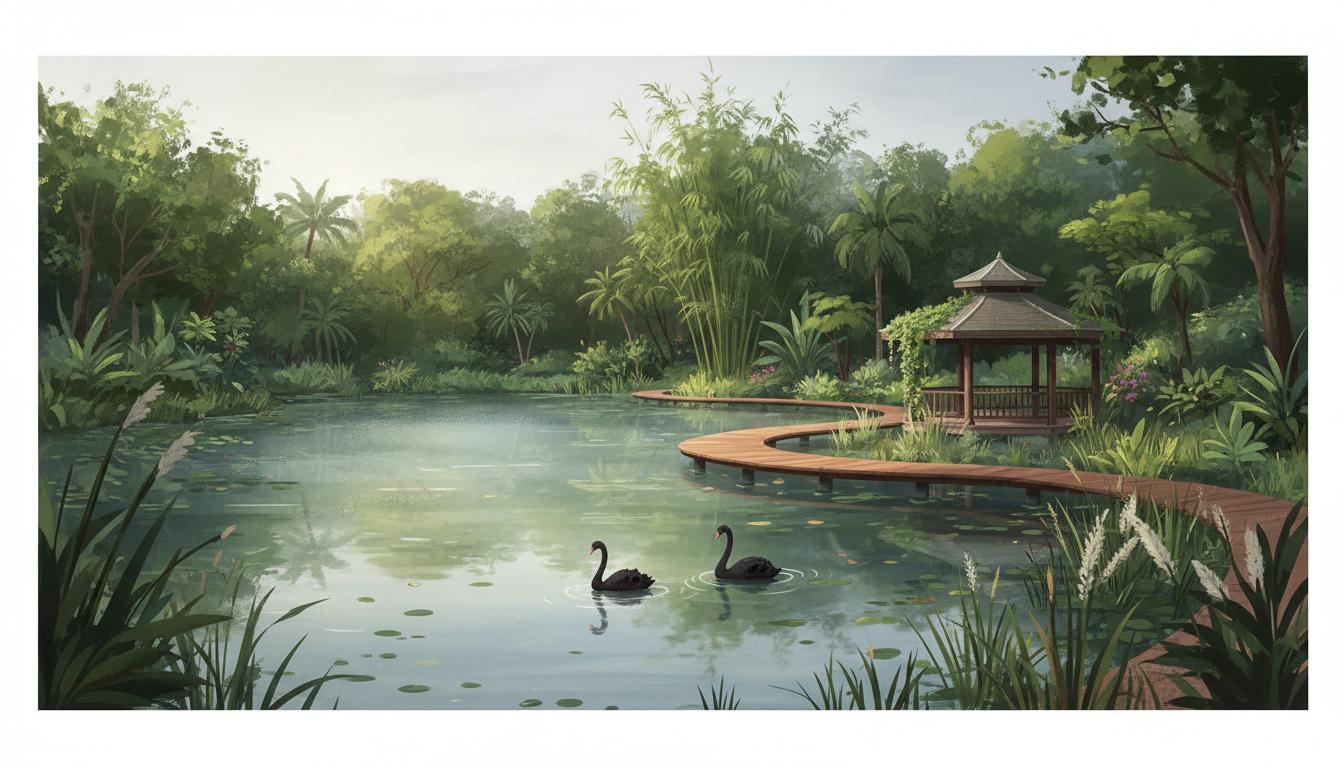
Things to do near Botanic Gardens MRT for free: walk into the Bukit Timah Gate of the Singapore Botanic Gardens, enjoy the Eco Lake landscape, explore the Seed Bank’s plant-conservation story, visit the Centre for Ethnobotany and take children to Jacob Ballas Children’s Garden. Botanic Gardens MRT (CC19/DT9) is an interchange on the Circle and Downtown Lines; Exit A leads directly to the Bukit Timah entrance. The main garden grounds are free and generally open from 5am to midnight.
The best family choice is not to cover the entire UNESCO World Heritage Site. For a simple outing, choose Eco Lake and one nearby learning stop, or make Jacob Ballas Children’s Garden your main activity. NParks estimates roughly ten minutes from MRT Exit A to the children’s garden, which opens 8am–7pm, generally closes on Mondays except designated public holidays, and offers free supervised nature play and waterplay for suitable ages. Important 2026 update: its popular Tree House is closed following termite damage, with a replacement targeted around the end of 2027. The rest of the children’s garden remains available under its normal access rules, subject to weather and maintenance.
Quick answers for families and visitors:
- Station: Botanic Gardens CC19/DT9, Exit A for Bukit Timah Gate.
- Best free short walk: Eco Lake and nearby Bukit Timah garden paths.
- Best children’s play: Jacob Ballas Children’s Garden, ten minutes’ walk from the MRT exit according to NParks.
- Children’s garden hours: 8am–7pm, last entry 6.30pm; generally closed Mondays unless a designated public holiday.
- Waterplay: suitable for ages 2–12 with adult supervision, subject to weather and facility closures.
- Important closure: Jacob Ballas Tree House closed for safety; replacement expected around end 2027.
- Free learning: Seed Bank Interpretive Gallery and Centre for Ethnobotany near Bukit Timah Gate, subject to their hours.
- Paid exception: National Orchid Garden has separate admission and is farther inside the landscape.
- Alternative rail entrance: Napier MRT is more convenient for the Tanglin side; the two entrances are not the same.
A garden visit works best when it starts with one clear purpose
The Singapore Botanic Gardens covers a substantial and varied landscape. People arrive for quiet walking, family recreation, exercise, botanical research, photographs or a specific museum or programme. A guide that lists every attraction without explaining the distances creates an unnecessary problem: visitors may spend more time moving between sites than appreciating what they came to see.
Start by choosing one main activity. With preschool children, the Children’s Garden may be enough for a whole morning once you include rest and food. For an adult who enjoys plants, Eco Lake and the Seed Bank make a satisfying short circuit. For someone interested in history and culture, the Centre for Ethnobotany offers an opportunity to understand how people use plants. A visitor aiming for the National Orchid Garden should plan a longer journey or a more convenient entrance.
| Main reason to visit | Choose first | Leave for another day |
|---|---|---|
| Free calming walk | Eco Lake and Bukit Timah grounds | Far southern garden circuit |
| Play and water | Jacob Ballas Children’s Garden | Ticketed orchid collection |
| Plant science | Seed Bank | Multiple distant galleries |
| Culture and plants | Centre for Ethnobotany | Full multi-kilometre trail |
| Premium orchid displays | National Orchid Garden | Short-station-only assumptions |
The point is not to do less because you lack ambition. It is to give one activity enough time to become memorable. A child who understands seed dispersal after seeing a real plant has gained more than someone rushed through ten areas while looking at the clock.
Botanic Gardens MRT Exit A: which entrance do you reach?
Botanic Gardens MRT (CC19/DT9) serves the Circle Line and Downtown Line. NParks identifies Exit A as the route directly to the Bukit Timah Gate. That makes this station especially useful for Eco Lake, the Seed Bank, the Centre for Ethnobotany and Jacob Ballas Children’s Garden. The station name is correct for the whole garden, but the exit is at one end of a large property.
Do not confuse the Bukit Timah Gate with the Tanglin Entrance. The Thomson–East Coast Line’s Napier MRT is more useful for destinations near the Tanglin end, while different gardens and landmarks lie between those entrances. A tourist map may make the whole park look like a single green shape. In reality, choosing the wrong entrance can create a long walk before you reach the planned attraction.
Meet a group at a specific landmark near Exit A rather than agreeing only to “meet at the Botanic Gardens”. Friends arriving from Napier could be far away. Check current station signage for lifts and barrier-free routes if your group includes a wheelchair user or stroller. An accessible station exit is the first step; the walking surface and the final attraction entrance also matter.
The official NParks visitor page provides maps of the gardens and lists different entrances, access options and opening hours. Download or open the map before entering, especially if you plan to visit an indoor facility with a last-entry time.
For a detailed station-by-station comparison, eduKate’s Botanic Gardens MRT guide already covers the rail and entrance information. This page focuses on choosing activities and helping families enjoy them.
Free walk 1: Eco Lake and the slower way to enjoy nature
Eco Lake is a good starting point for visitors who want a gentle outdoor experience near the Bukit Timah section. The water, surrounding planting and open views change the feeling of the day as soon as you leave the busy road and station. There is no requirement to complete a fixed circuit to appreciate the landscape.
Start with a short out-and-back route. Look at the lake from an approved path, notice the shapes of different plants and listen for birds without disturbing them. Children may be fascinated by movement on the water or by the contrast between large trees and low-growing plants. Encourage them to describe what they see rather than identify every species immediately. Accurate identification often needs more information than a single quick glance.
A lake in a managed garden is a living environment and a public recreation space. Visitors should stay clear of water edges unless specifically permitted, never feed wildlife or leave litter, and respect the pace of other walkers. A family photographing an animal should not surround or pursue it. The goal is to observe calmly and allow wildlife to behave naturally.
When travelling with grandparents, a shorter lake section may be preferable to a long route across the entire Gardens. Choose seating and shade where available, drink water and stop before the walk becomes tiring. A simple outing can be satisfying even when it contains no indoor programme and no shopping.
For older children, ask a more interesting question: What is the difference between a natural lake and a lake managed within a botanic garden? The answer may involve design, maintenance, drainage and ecosystem management. Do not turn the question into a fake certainty. Treat it as an invitation to learn more from signs and reliable sources.
Free learning 1: the Seed Bank and how plants survive for the future
The Seed Bank is one of the best learning destinations near the Bukit Timah Gate. NParks explains that it was established in 2019 to conserve seeds from plants in Singapore and Southeast Asia. The facility includes an interpretive gallery and an outdoor Seed Dispersal Garden, providing a public introduction to the science of plant conservation.
The Seed Bank’s main purpose is not merely storing a cupboard full of dry seeds. Plant species differ in how their seeds respond to drying, cold storage and other conditions. NParks notes that many native tropical seeds cannot tolerate ordinary drying and freezing, which makes research into alternative methods important. This is a much more useful scientific insight than telling a child that “all seeds can be frozen until needed”.
The public gallery contains displays and interpretation of the conservation process, while laboratory windows help visitors see the setting for research without granting access to working facilities. The outdoor garden illustrates different seed-dispersal strategies: wind, water, animals and mechanical movement. Ask a child to compare the shape of two seeds and suggest how each might travel. Then check the interpretation. A guess is useful as a hypothesis, not as proof.
NParks lists the Seed Bank as open 9am–6pm daily, subject to notices. Use the official Seed Bank page for current information. It includes the facility’s conservation context and guidance about the public gallery and outdoor garden.
If the family is short on time, choose either the gallery or the outdoor dispersal plants, not every display. Ask each person to explain how one seed might move away from its parent plant. This small exercise connects science vocabulary to a real object and can last long after the outing.
Free learning 2: Centre for Ethnobotany and plants in everyday life
The Centre for Ethnobotany explores the relationships between people and plants. NParks describes displays involving plant materials, artefacts and traditional practices from Singapore and the region. This is a useful choice for families who want to connect a garden trip with food, culture, household materials and the ways communities make use of plant resources.
A child may already know that plants provide fruit and vegetables. The centre offers a chance to see that plants also influence medicine, building materials, traditions and livelihoods. Explain that knowing a plant has been used traditionally is different from claiming a medical treatment is proven safe or effective. Cultural history and modern clinical evidence answer different questions; responsible learning keeps those distinctions clear.
Use one familiar example, such as a fruit or household plant product, to ask where it comes from, what part of the plant is used and why the product matters to people. An older student might compare a display’s account of a plant’s cultural importance with the biological explanation of how it grows. Neither dimension cancels the other. A well-rounded understanding connects natural science with human experience.
The operator lists general hours as 9am–6pm, with closure on the last Wednesday of each month. Check the official Centre for Ethnobotany page before building an outing around it. Special exhibitions may change, and it would be misleading to promise a specific temporary display without checking what is currently installed.
When museum spaces are unavailable, the surrounding garden remains useful for observation. A short discussion of a tree, fruit or flower can be educational without entering a gallery. The key is choosing a concrete example and speaking about it precisely.
Jacob Ballas Children’s Garden: the most important family rules
Jacob Ballas Children’s Garden is a major family attraction near Botanic Gardens MRT. NParks describes it as a four-hectare nature-learning environment with eight zones for children up to 14 years old. The operator’s directions identify Exit A at Botanic Gardens MRT and estimate a ten-minute walk to the children’s garden. That is a useful estimate for planning, but a family with young children or a stroller may need more time.
General opening is 8am–7pm, with last entry at 6.30pm. It is ordinarily closed on Mondays unless that Monday falls on a designated public holiday. Admission is free. The adult-entry rule is important: adults are admitted when accompanying a child, and adults without children generally need to consult the service desk and follow the staff’s access policy. This is a children’s environment, not a general adult public park where every visitor has the same admission arrangement.
Children under 12 must be accompanied by an adult, and the broader children’s garden is intended for children up to 14. Follow onsite supervision and age rules for particular facilities. The operator also restricts items such as bicycles, scooters, pets, glass objects and camping furniture. A family should check the prohibited-item list before arriving with picnic equipment or wheeled devices.
There are play areas and nature-themed sections designed for exploration, so a child can enjoy the garden without completing a prescribed educational course. Let them investigate one zone that interests them, then rest. A preschooler may be overwhelmed if adults insist on visiting every feature in the park.
The official Jacob Ballas Children’s Garden page gives the current access rules, activities, age guidance and facility details. Check it on the date of the visit.
Jacob Ballas Waterplay: useful fun with non-negotiable supervision
The Children’s Garden includes a waterplay area that NParks describes as approximately 500 square metres, with mist features, wading zones, spray jets and an umbrella-fountain experience. The operator says the waterplay is suitable for children aged 2–12 years, with an adult supervising at all times. Those ages and supervision requirements are more important than whether a travel blog calls the area “fun for everyone”.
Bring clothing suitable for wet play, a towel, dry clothes and any child-specific essentials. Check the rules about nappies, footwear and changing arrangements on arrival rather than assuming a general public waterpark’s rules apply. This is play in a botanic learning environment, not permission to enter every water feature in the larger Gardens.
Waterplay may be closed during inclement weather. NParks’ current notices specifically mention temporary closure of Water Play as well as several forest and walking attractions when weather conditions are unsuitable. A parent should not promise an entire outing around one weather-sensitive feature without a backup plan.
One sensible backup is to enjoy the Children’s Garden’s other permitted areas or make a shorter Seed Bank or Eco Lake visit if the group is still comfortable. If the child is disappointed, explain calmly that weather decisions protect people. Avoid compensating by rushing into another costly attraction that was never part of the plan.
Use waterplay as a chance for simple science observations: Which jets reach higher? Where does water collect? What is the difference between a mist and a stream? Children can notice cause and effect without requiring a formal experiment or entering unsafe areas. The purpose remains safe enjoyment.
Important 2026 closure: the Jacob Ballas Tree House
Some older family guides feature the Tree House at Jacob Ballas Children’s Garden as a main attraction. That advice needs correction. The Singapore Botanic Gardens notices, updated 5 November 2026, say the Tree House is temporarily closed because termite damage has made its wooden structure unsafe. The operator is working on a replacement and hopes to open it around the end of 2027.
The fact that an old photograph shows children climbing it does not make it available today. Do not try to enter a cordoned-off play structure, and do not tell children that a past attraction will definitely be open by a precise date. The published replacement timeframe is a target rather than a confirmed reopening appointment.
The rest of Jacob Ballas Children’s Garden contains other activities and nature sections, subject to their individual operating conditions. Make those available facilities the focus of the day. A clear explanation before leaving home can prevent disappointment: “We are going to the garden and may use the waterplay if it is open; the Tree House is not available.”
There is also a wider lesson about how public places are maintained. Wooden structures can deteriorate or be damaged. When staff close a facility because it is unsafe, the closure is a safety measure, not a minor inconvenience to bypass. Children can understand that the best playground is one designed and maintained to protect its users.
Check current notices before each new visit. A general guide cannot be updated minute by minute when rain, maintenance or replacement work changes the status of a particular feature.
Is the National Orchid Garden near this MRT exit?
The National Orchid Garden is part of the Singapore Botanic Gardens but is a distinct ticketed attraction farther through the grounds. It should not be treated as a two-minute activity directly outside Botanic Gardens MRT Exit A. The better entrance for a particular itinerary depends on whether the visit begins from Bukit Timah, Tanglin or another access point.
NParks lists paid National Orchid Garden admission with different rates for local residents, standard visitors, students, seniors and young children. As of its 2026 visitor information, ordinary local adult admission is S$5 and standard adult admission S$15, with other concession categories. The operator’s rules define which travellers qualify as local residents. Check current pricing before committing to a ticketed family excursion.
The main Botanic Gardens remain free to enter, and the Orchid Garden is the specific paid exception highlighted on the official visitor page. A person who wants a free nature outing does not have to enter the Orchid Garden to enjoy plants, trees and public paths. A visitor passionate about orchids may find the separate ticket worthwhile and should give it enough time.
The National Orchid Garden’s public operating hours are listed as 8.30am–7pm, with last ticket sale and entry at 6pm, but maintenance can affect specific houses. Before travelling for a precise installation, read the official visiting information and notices. A temporary closure of one plant display should not be described as the entire orchid collection being closed.
When planning with children, do not combine an extended orchid visit, waterplay and every northern educational exhibit without considering fatigue. The most rewarding outcome is time to appreciate one main experience.
Why the Gardens is a UNESCO World Heritage Site
The Singapore Botanic Gardens was inscribed on the UNESCO World Heritage List in 2015. UNESCO describes its importance not only as a beautiful public garden but as a place that demonstrates the development of tropical botany, science, conservation and horticultural research from the nineteenth century to the present. The site’s history includes its establishment in 1859 and its role in the study and distribution of plants associated with plantation agriculture.
That helps explain why a simple family walk can be more than recreational. A historic tree, research building or designed landscape is connected to how people have studied tropical plants for generations. The gardens preserve both living collections and evidence of the systems used to understand them. A child does not need to memorise UNESCO criteria to recognise that this is a cultural and scientific landscape.
Ask what makes a place worth protecting. Is it merely that it is pretty in photographs? Or does it support research, biodiversity, history, education and public life? This is a useful discussion for older children. It introduces the idea that important places can have several purposes at once, with different communities placing value on different aspects.
UNESCO’s official Singapore Botanic Gardens listing provides the historical and conservation context. It is a more reliable source for a factual claim about World Heritage inscription than an unsupported social post.
One of the Gardens’ strengths is that public visitors can experience parts of this landscape without paying for entry. That does not mean every building or research facility is publicly accessible. Respect conservation areas and visitor signs, and enjoy the permitted paths instead of assuming that heritage status creates universal access.
Plan a 45-minute visit, a family morning or a plant-science half-day
45 minutes: easy free garden break
Arrive at Botanic Gardens MRT Exit A and enter the Bukit Timah Gate. Choose one path near Eco Lake, notice the landscape and return when the group is ready. This is a good option for a visitor between appointments, an elderly companion or a child not in the mood for a longer walk. You do not need to reach the opposite end of the Gardens.
90 minutes: Seed Bank and one outdoor observation
Begin at the Seed Bank’s public gallery during opening hours, then see an example of seed dispersal outdoors. Add a short lakeside walk if weather permits. Ask one question about plant survival and find an answer in the interpretive material. This is ideal for upper-primary and secondary students interested in biology.
Two to three hours: Jacob Ballas family morning
Leave the MRT, walk to the children’s garden and allow time for play, rest, a drink and changing if waterplay is available. The Tree House is closed, so do not plan around it. Keep a weather backup and finish while the children still have energy. This day does not need an extra paid orchid visit.
Half a day: plants and culture
Choose the Centre for Ethnobotany and the Seed Bank, then use surrounding paths for a gentle nature walk. Read the monthly gallery closures carefully, particularly the Centre’s last-Wednesday closure. This route suits older students or adults who like exhibitions, observation and conversations about science and everyday life.
Longer botanical visit
If your main aim is the National Orchid Garden or more distant southern attractions, consult the full garden map and consider the most appropriate entry point. Do not try to cover the entire property merely because all sections appear in the same official brochure.
Budget: how much is truly free?
General admission to the Singapore Botanic Gardens is free for everyone under NParks’ current visitor information. Jacob Ballas Children’s Garden is also a free-entry destination with age and supervision conditions. Eco Lake and many outdoor areas can be enjoyed without an attraction ticket. Public galleries such as the Seed Bank offer educational experiences subject to their operating arrangements.
However, a free entry does not make transport, food, drinks or paid programmes free. The National Orchid Garden charges admission according to visitor category. Some events, workshops or tours may have separate registration and costs. Parking is not free simply because the garden is open to all; visitors who drive need to check charges and available zones.
The most practical budget is not a fabricated total of “a day for S$10”. Instead, decide whether the day is a free-first walk, a low-spend visit including a meal or a deliberately ticketed experience. Let the rest of the schedule support that main choice. Parents can bring suitable water and a snack, but must follow the garden’s rules and keep shared spaces clean.
When children want souvenirs, make the decision before entering a gift shop. A photograph of a leaf shape, an observation about a seed or a conversation about a tree may have more lasting value than a purchase made simply because the family reached the end of an attraction.
If saving money is essential, choose the nearest free experiences around Exit A and postpone ticketed activities for another visit. A calm, well-planned public-garden outing is a complete experience in itself.
Accessibility, rain and wildlife safety
The public gardens have varied routes, surfaces and slopes. Some attractions provide wheelchair-friendly access, but not every narrow nature path or forest section is suitable for all mobility needs. Jacob Ballas Children’s Garden’s official page specifically describes wheelchair accessibility, while the precise route to a particular play feature may require additional planning. Check the current garden map and access guidance for your intended destination.
Start with the shortest path that fits the group. If someone is tired, return to the Bukit Timah Gate rather than attempting a large loop that passes distant entrances. Carry water and consider the heat. Children should know where they can play and which plant displays, research areas and water edges must not be entered.
In inclement weather, NParks may close Water Play, Rain Forest, Learning Forest and Rambler’s Ridge to protect visitors. Treat these closures as essential safety information. Do not cross barriers, and do not insist that a facility is open because a travel article listed its normal hours. Lightning makes open grassy and tree-lined areas particularly unsuitable for lingering; seek appropriate shelter and wait for safe conditions.
Respect wildlife. Do not feed birds or other animals, chase them for photographs or remove plants from the garden. A child who wants to learn about an unfamiliar plant can photograph it without damaging it and later use a trusted reference to attempt identification. The difference between observing and collecting is an important part of responsible nature study.
For visitors with allergies, medical needs or particular accessibility requirements, check the official NParks guidance and plan a route that avoids unnecessary barriers. There is no requirement to complete a strenuous trail simply to claim you visited a World Heritage Site.
How to make the outing educational without making it stressful
The Gardens offers plenty of opportunities for learning, but parents can ruin a pleasant morning by turning every tree into a quiz. Choose a single broad theme—seeds, habitats, shapes, water or the relationship between plants and people—and let the child’s observations lead the conversation. Asking a good question is more useful than demanding ten scientific terms on demand.
Ages 3–6: discover with senses
Look at different leaf shapes and colours without touching restricted plants. Ask which leaves are large, small, smooth-looking or pointed. Invite the child to describe one thing that moves in the breeze. Speak in simple words and offer a more precise term when it helps. A short observation followed by play is enough.
Primary 1–3: describe change
Compare two ways seeds travel, using the Seed Dispersal Garden’s interpretation. Ask why a wing-shaped seed might move differently from one with fleshy fruit. The child should explain the idea in their own language before learning the formal label. This builds reasoning rather than rote recitation.
Primary 4–6: ask what makes scientific evidence
Look at the Seed Bank displays and consider why storing seeds requires special conditions. A student might initially say that freezing always protects a seed. NParks explains that some tropical seeds do not tolerate ordinary drying and freezing. This is a good lesson: scientific statements often have conditions and exceptions.
Secondary students: see science and society together
Use the Centre for Ethnobotany to explore how plants are important in cultural practice and the Seed Bank to consider conservation research. Ask what each source can tell you and what it cannot. An exhibition on historical plant uses does not necessarily demonstrate the present clinical effectiveness of a traditional remedy. Understanding that difference is a mark of careful reasoning.
Two-minute reflection
At home, ask each person to explain one surprising fact and one unanswered question. No marks, no worksheet, no pressure. The outing succeeds when people can connect what they saw with a clearer idea of how the world works.
Common mistakes to avoid on a Botanic Gardens MRT day
Mistake 1: treating the Gardens as a small park just outside one gate. It is a substantial landscape with distinct zones and entrances. Starting near Bukit Timah does not put every southern attraction within a short walk.
Mistake 2: promising Jacob Ballas Tree House as open. NParks’ November 2026 notice confirms a safety closure due to termite damage, with a replacement expected around end 2027. Do not rely on old attraction photographs.
Mistake 3: assuming Children’s Garden has the same hours as the main grounds. The main Gardens are generally open 5am–midnight, but Jacob Ballas usually opens 8am–7pm, with a Monday closure and last entry at 6.30pm.
Mistake 4: taking adults into a children’s facility without children. Jacob Ballas’ visitor policy primarily allows adults when accompanying children. Adults without children must follow the service desk’s special access guidance.
Mistake 5: treating a waterplay closure as a minor inconvenience to bypass. Waterplay is weather-sensitive. Maintenance or lightning can make the facility unsafe; choose another appropriate activity rather than crossing a barrier.
Mistake 6: saying every orchid attraction is free. The main Gardens are free but National Orchid Garden has ticketing and hours of its own. Check prices and concessions for the actual visitor category.
Mistake 7: planning a visit to the Public Reference Library in 2026 without checking. NParks currently lists that reference facility as closed through 2027 to support collection digitisation. Public interpretation at the Seed Bank is a different activity and should not be confused with general library access.
Did you know? Five scientific and historical details
A botanic garden can also be a scientific institution. UNESCO recognises the Singapore Botanic Gardens for its long history of tropical research, conservation and garden design. It was inscribed on the World Heritage List in 2015.
Not all seeds can be conserved the same way. The Seed Bank explains that some tropical seeds are sensitive to drying and freezing, creating a scientific challenge for conservation.
Plants can tell cultural stories. The Centre for Ethnobotany connects botany with food, materials, traditional practices and how communities interact with plants.
A short distance is not the same as a short visit. Jacob Ballas may be around ten minutes from the station exit for an unhurried walker, yet waterplay, changing, rest and other activities can make it a satisfying half-day destination.
Conservation includes maintenance and safety. The Tree House closure is an example of how public play structures must be assessed and replaced when they are no longer safe, even if visitors loved them.
Frequently asked questions about Botanic Gardens MRT activities
Is Singapore Botanic Gardens free to enter?
Yes. NParks lists general garden entry as free for everyone. National Orchid Garden is a separately ticketed attraction.
Which MRT exit leads to the Gardens?
Botanic Gardens MRT Exit A leads directly to the Bukit Timah Gate. Napier MRT is nearer the Tanglin entrance.
How far is Jacob Ballas Children’s Garden from the station?
NParks estimates about ten minutes on foot from Botanic Gardens MRT Exit A. Allow more time with small children or mobility needs.
What time is Jacob Ballas open?
Generally 8am–7pm, last admission at 6.30pm, closed Mondays except designated public holidays.
Can adults enter without children?
Adults without accompanying children normally need to consult the Visitor Services Desk and follow the specific policy; the site is intended for children up to 14 with appropriate adult accompaniment.
Is waterplay free at Jacob Ballas?
General entry is free and the waterplay is part of the children’s garden when available. It is suitable for ages 2–12 under adult supervision, subject to weather and operating rules.
Is the Tree House open in November 2026?
No. It is closed due to structural safety concerns following termite damage. NParks hopes for a replacement around the end of 2027, not a guaranteed earlier opening.
What can primary-school children learn at the Seed Bank?
Seed dispersal, plant survival, storage limitations and why conservation research matters. The interpretive gallery and outdoor displays provide good starting points.
When is the Centre for Ethnobotany open?
NParks lists 9am–6pm with a closure on the last Wednesday of each month. Recheck for special notices.
Can we visit in heavy rain?
Some indoor galleries may remain available, but NParks closes certain nature and waterplay areas during inclement weather. Avoid outdoor travel in nearby lightning.
Is the National Orchid Garden free for residents?
No. Local visitor rates are discounted but still require admission for many categories; check the official current fare table.
Do I have to walk all the way to Swan Lake?
No. The Gardens are large and Swan Lake is in a different section. A northern garden walk, the Seed Bank or Jacob Ballas can be a complete outing.
Official sources, site updates and related eduKate guides
Reviewed 6 November 2026. This guide distinguishes the main gardens from individual indoor and children’s facilities. Weather and maintenance can cause unscheduled closures; read the official live notices before a date-specific trip.
- Singapore Botanic Gardens — official map, entrances, fees and hours
- Singapore Botanic Gardens — updated closures and notices
- Jacob Ballas Children’s Garden — waterplay, ages, opening and rules
- Seed Bank — gallery and seed conservation
- Centre for Ethnobotany — plants and culture
- UNESCO — Singapore Botanic Gardens World Heritage listing
- eduKate — Botanic Gardens MRT station guide
- eduKate — another free family nature outing near Punggol MRT
The most useful part of a Botanic Gardens visit is often the unhurried conversation. Choose one gate, one main activity and one thing to observe carefully. The park will still be there when you are ready for another route.