
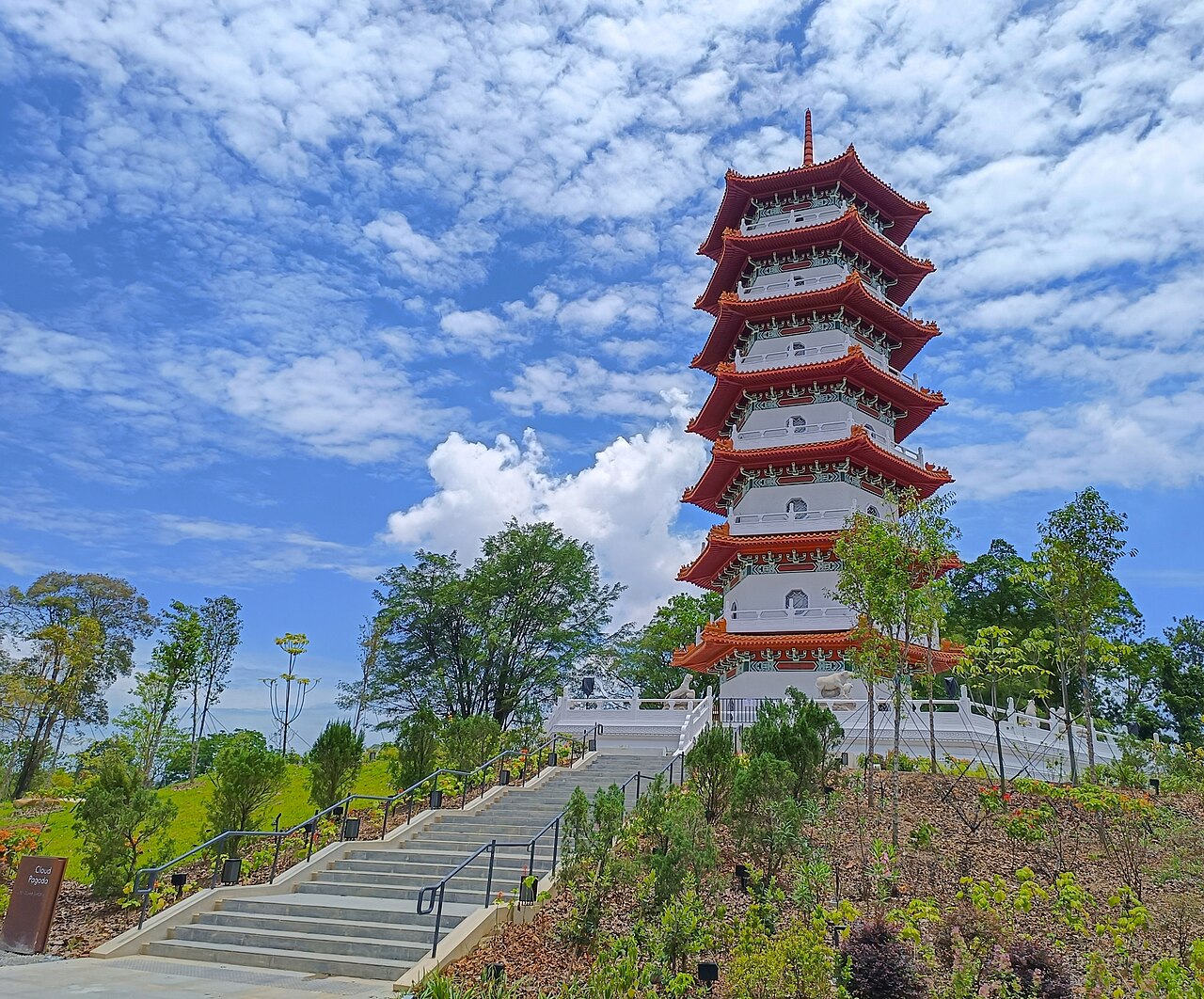
Things to do near Chinese Garden MRT: walk about five minutes from Chinese Garden station (EW25) to the free public Chinese Garden entrance, photograph the Grand Arch and Cloud Pagoda, explore the Bonsai Gallery, Twin Pagoda, Bamboo Grove and Edible Garden, then continue to Japanese Garden if you want a longer nature-and-culture outing. Chinese Garden and Japanese Garden are part of Jurong Lake Gardens, and their general public grounds are open from 5.30am to midnight. Entrance to the garden grounds is free, but individual attractions operate on shorter schedules.
The best first-time route is Chinese Garden MRT → Chinese Garden Bridge → Grand Arch and Pagoda Plaza → Cloud Pagoda from permitted public paths → one chosen garden attraction → return to the MRT. For 90 minutes to two hours, add the Bonsai Gallery or Twin Pagoda; for a half-day, extend towards Japanese Garden’s Water Lily Garden and Breathing Gallery. The most important November 2026 caution is that Waterwall Court at Chinese Garden remains closed for maintenance until further notice, and the Sunken Garden toilet in Japanese Garden is also listed closed. Do not use an old photograph or event leaflet as proof that those facilities are operating.
Visitor quick information:
- Nearest station: Chinese Garden MRT EW25 on the East–West Line; roughly five minutes’ walk to Chinese Garden Bridge, eight minutes to Pagoda Plaza.
- Admission: free to the public gardens under normal access rules; some programmes, rentals or services may cost extra.
- Garden grounds: Chinese and Japanese Gardens 5.30am–12 midnight, subject to closures and events.
- Best free photo attractions: Grand Arch, Cloud Pagoda exterior, Twin Pagoda, lakeside planting and garden bridges.
- Bonsai Gallery: Tuesday–Sunday and public holidays, normally 9am–7pm; regular Monday maintenance closure, with exceptions.
- Jurong Lake Gardens Gallery: normally 9am–9pm Tuesday–Sunday and public holidays, with Monday maintenance closure.
- Twin Pagoda: normally 7am–10pm, subject to conditions.
- Cascading Creek: normally 7am–7pm.
- Important closure: Chinese Garden Waterwall Court closed until further notice; follow live NParks signs.
- Free garden shuttle trial: generally every 30 minutes, 9am–12pm and 4pm–7pm; check service-day suspensions.


Start with the correct garden, not just a destination name
Jurong Lake Gardens is a network of connected landscapes rather than a single small park. It includes Chinese Garden, Japanese Garden and Lakeside Garden, with separate features and public-transport entrances. Chinese Garden MRT is particularly good for the Chinese Garden side. Lakeside MRT is nearer Lakeside Garden, while some routes to Japanese Garden may be shorter from a different entrance. The best plan begins with the exact place you want to see.
A family interested in the Cloud Pagoda and bonsai should not feel obligated to cross the entire lake landscape. A child who wants a playground may be happier on a separate day in Lakeside Garden, where the larger Forest Ramble playgarden and Clusia Cove have their own maintenance schedules. The word Jurong in the attraction name does not make every feature adjacent to EW25.
| Visitor goal | First choice | Do not confuse with |
|---|---|---|
| Pagoda photography | Chinese Garden from EW25 | Ticketed sightseeing towers |
| Quiet plant study | Bonsai Gallery, Bamboo Grove | All-day gallery access |
| Learning about the rejuvenated gardens | Jurong Lake Gardens Gallery | Open museum on Monday maintenance day |
| Water lilies and Japanese design | Japanese Garden extension | Immediate station-exit view |
| Young children’s playground | Separate Lakeside Garden plan | Chinese Garden’s main pagoda circuit |
| Short green break | Grand Arch and nearby public path | Full three-garden route |
The best day is not the day you walk the most kilometres. It is the day you understand what you have seen and have enough energy to enjoy the journey home. A focused 60-minute walk can be complete in its own right.
Chinese Garden MRT EW25: bridge and station directions
Chinese Garden MRT is EW25 on the East–West Line, between Jurong East and Lakeside. NParks lists the walk from the station to Chinese Garden Bridge at around five minutes and to the information counter at Pagoda Plaza at around eight minutes. These are useful official estimates for ordinary walking, but a group with strollers, wheelchairs or children pausing for photographs may take longer.
Follow current station and street signs towards the garden entrance. You may see the lake and distinctive structures from a distance, but do not attempt to reach them by crossing planted areas or using an informal shortcut. The proper bridge and signed paths keep visitors away from unsuitable banks and landscaping.
Decide on the meeting place before leaving the MRT. “Meet at Chinese Garden” is too vague for a large site, particularly when one friend arrives by car at a different entrance. Name Chinese Garden Bridge, Pagoda Plaza information counter or another clearly identified public location, and confirm the route from each person’s transport method.
For people with reduced mobility, the official NParks map and counter staff are more useful than a screenshot from a visitor’s phone. The park offers complimentary wheelchair rental subject to availability during information-counter hours. However, access to an upper pagoda staircase can differ from accessibility along a garden path. Plan the particular activities, not merely a general claim that the gardens are accessible.
Official directions: NParks Getting Here. Related reading: eduKate Chinese Garden MRT Guide.
A free garden day and the admission that does not exist
One common online search is “Chinese Garden Singapore ticket price”. The straightforward answer is that general admission to Jurong Lake Gardens is free. You can appreciate garden architecture, open public paths and permitted landscaping without buying an attraction entry ticket. Some privately organised activities, booked venues, classes, special services or food outlets may charge separately; do not assume every paid service becomes free because the grounds are free.
The garden’s opening window is not identical to every feature’s opening window. Chinese and Japanese Garden grounds are listed 5.30am–midnight, but the Bonsai Gallery and Jurong Lake Gardens Gallery have shorter hours and regular maintenance days. A person arriving at 7pm might still enjoy exterior pathways while being too late for the Bonsai Gallery’s usual admission period.
For a budget day, carry suitable water, take the MRT and plan a comfortable walk. If you want a drink or meal, check actual available facilities or arrange a stop in the town centre; do not invent a café at every landmark. A family does not have to buy souvenirs to make a garden visit meaningful.
If a public area is reserved for an event, follow the signs. Free public entry does not create permission to occupy a private function, enter a maintenance enclosure or climb an access-restricted tower. Separate the general garden from individual facilities before promising children what they will see.
For current hours and service details, the operator maintains one central operating-hours and services page. Read the date of its most recent update and check it again before travelling for a specific gallery.
Stop 1: Chinese Garden Bridge and Grand Arch
The Chinese Garden Bridge is a natural arrival point from EW25. Crossing it helps visitors move from the surrounding estate into a deliberately designed garden landscape. The sequence of approach, bridge, formal entrance and visual landmarks is part of the experience. Do not rush immediately to the tallest tower and miss the way the entrance frames the whole space.
The Grand Arch is a strong photography stop and a useful introduction to Chinese-inspired garden design. A formal gateway announces a shift in purpose: behind you are ordinary roads and transport infrastructure; ahead is a space arranged around greenery, paths, water and architectural landmarks. Children can identify symmetry, colour, repeated roof details and the use of an arch to frame a view.
When photographing the bridge or arch, use the pedestrian path without obstructing people moving in either direction. A group portrait is less important than leaving enough room for someone using a wheelchair or stroller. Be considerate of other visitors who may be using the same location for a quiet walk rather than a photo shoot.
A simple question for Primary children is, “What makes the entrance look different from an MRT entrance?” They might notice roof shapes or decorative details. Older students can ask why gardens often use deliberate transition spaces and whether an entry landmark helps people orient themselves. The point is not to guess at every symbolic meaning, but to observe a design choice carefully.
For a first-time visit, stop here for a few minutes, then decide whether to continue towards Pagoda Plaza, the Cloud Pagoda or a plant-focused area. A comfortable route is more useful than a rigid one.
Stop 2: Cloud Pagoda and the problem of treating photographs as access guarantees
The Cloud Pagoda is among the Chinese Garden’s defining architectural landmarks. Its layered roofline and elevated position make it easy to recognise, and photographs often place it against a broad sky with surrounding greenery. The structure is a helpful visual example of how architectural repetition and vertical scale can shape the identity of a landscape.
The best reliable experience is to appreciate the pagoda exterior from permitted public paths. A guide should not promise that every level or staircase is open for climbing at all times. Specific access may change for weather, crowd control, restoration or other operating needs. Read current signs rather than basing your visit on a social-media picture taken from an upper level in a different year.
For families, avoid making access to the top the sole definition of a successful trip. Children can observe the repeating floors and roof edges from below and compare them with the much lower, wider Grand Arch. Ask how height changes the way a building is visible across a large garden. A secondary student can discuss why a landmark may be designed to orient people even when the visitor never enters it.
Photographs show a view but not necessarily the effort required to reach the camera’s position. Garden paths can have gradients and some features include stairs. If a companion cannot safely manage a particular path, choose a lower viewpoint. The garden provides enough public spaces to enjoy without pushing anyone beyond their ability.
For current access and park features, use NParks Chinese Garden and the latest onsite signs.
Stop 3: Twin Pagoda, lake reflections and the best short photo theme
The Twin Pagoda offers another Chinese-inspired architectural viewpoint in a garden of bridges, water and planting. NParks lists its normal operating period as 7am–10pm daily, which is shorter than the general grounds’ 5.30am–midnight window. That difference matters when visitors plan sunset or night photographs.
A good photography theme is repetition and reflection. Look for two matching structures, repeated roof details or the way the lake changes their appearance. A photo can be improved by waiting for a safe, clear viewpoint rather than stepping into a planted bed or moving beyond a railing. Respect any signs controlling access to the tower, paths or stairs.
Children can learn the word reflection by observing a real surface, then distinguishing a water reflection from a mirrored decorative feature. Older students can ask why water, architecture and plant forms are deliberately placed together. A garden is not an accidental collection of attractive objects; its composition can influence how a visitor moves and what they notice.
If you are travelling with a senior or very young child, this may be the final major stop before turning back. It is better to return comfortably than to add a distant Japanese Garden circuit when everybody is already tired. The presence of an attraction on a map does not obligate you to visit it.
At night, follow lit paths and consider the return route. Avoid assuming the lake edge is suitable for every person after dark. The Twin Pagoda’s published hours are an operating rule, not a guarantee that every surrounding path will be equally bright or comfortable.
Stop 4: Bonsai Gallery and the art of patient cultivation
The Bonsai Gallery is a useful destination for visitors interested in plants, horticulture and design. Bonsai demonstrates how careful cultivation can influence the form and scale of a living tree over time. It is neither a collection of plastic miniatures nor proof that a normal species naturally remains the size of a table ornament.
NParks lists the gallery’s ordinary hours as 9am–7pm Tuesday–Sunday and public holidays, with a regular Monday maintenance closure except for relevant public-holiday rules. Check the exact date of a visit, particularly if Monday follows a public holiday, because the operator may modify maintenance arrangements. The surrounding public garden can be open even when the gallery itself is closed.
Take time to observe differences in trunk shape, branch structure and planting containers. Do not touch a bonsai, its soil or the display labels. These are living collections that require long-term care. A child may ask how an apparently mature tree can be so compact; this is an opportunity to explain that repeated care and selective training over many years can shape growth.
Older students can think about the distinction between art and biological process. The trees remain alive and responsive to water, nutrients and environmental conditions, while the cultivator makes aesthetic choices. That is a more useful explanation than saying a bonsai is simply “a tree that has stopped growing”.
A brief visit focused on two or three examples is enough for a family with younger children. Ask each person to choose one feature that seems deliberate. The aim is to notice how time, care and design work together, not recite a complicated history of bonsai styles.
Stop 5: Edible Garden and Bamboo Grove for plant curiosity
The Chinese Garden includes an Edible Garden and Bamboo Grove, useful for visitors interested in plant structure and the ways people use vegetation. An edible garden can introduce food crops and herbs; bamboo provides a visible contrast in stems, leaves and growth form. Both are valuable even without buying a ticket or joining a guided tour.
Do not sample or pick plants unless specifically permitted. The term edible describes uses of certain species and plant parts, not a licence to taste an unfamiliar leaf from a public display. A plant may require preparation or identification, and children must never be encouraged to taste something because a sign resembles an ingredient they have seen in a kitchen.
For young children, ask about shape and texture without removing plant material. How does a bamboo stem differ from the trunk of a roadside tree? Why are leaves arranged in different ways? A precise description such as “thin repeated stems growing closely together” helps connect vocabulary to observation.
For secondary students, consider urban food production. A public edible garden can demonstrate that some useful plants can be grown in compact settings, but it does not establish that every household or city can become self-sufficient through a small garden. Discuss growing conditions, space, maintenance and suitable species. A learning display shows possibilities, not a complete agricultural solution.
Plan these stops as part of a short cluster rather than racing from one labelled garden to another. If rain begins, avoid exposed paths and do not insist on reaching a distant plant display. There is value in returning later to look at the same plants in a different season.
Stop 6: Cascading Creek and why features have shorter hours
Cascading Creek adds movement and sound to the Chinese Garden landscape. NParks currently lists it as open 7am–7pm daily, unlike the general garden grounds which remain open until midnight. That is not a contradiction: a specific water feature needs its own operation, supervision and maintenance conditions.
A child can watch how water moves between levels or around obstacles from a designated safe viewing area. Ask why water flows downward without a pump at every small drop, then discuss how the overall designed water system may have mechanical components outside immediate view. Be careful not to claim exact technical details without an operator source. The useful idea is that water landscapes are engineered and maintained.
Water features may close for cleaning, repair or weather. A visitor should never attempt to turn on a facility or cross a maintenance barrier. The difference between “garden open” and “creek operating” is one of the most practical pieces of information on this route, especially for parents promising children a particular sight.
If a family is visiting after 7pm, choose other public viewpoints that are permitted and well lit. Do not rely on an old video of water flowing at night. Timing matters, and a travel guide should help visitors adapt rather than leave them disappointed.
For outdoor safety, keep children from climbing into water features or running on wet surfaces. The garden is a designed public space, not a supervised swimming facility. Respect signs and choose a suitable place to stop if someone wants a longer look.
Important 2026 closure: Waterwall Court is not a reliable stop
The current NParks pages carry a specific notice that Waterwall Court in Chinese Garden is closed for maintenance until further notice. The same notices identify the Sunken Garden toilet in Japanese Garden as closed. These are not merely seasonal opening-hour differences. Visitors should not build a route around using these facilities until the operator announces a reopening.
Many photographs of the rejuvenated gardens include sculptural walls, pools, water features and newly completed landscapes. A photo may be genuine and correctly labelled yet fail to describe what is accessible in November 2026. The date and operating status are separate pieces of evidence. An appealing photograph is not a reliable live opening notice.
A practical response is to choose the Grand Arch, pagodas, Bonsai Gallery and other available public destinations. The garden is large enough to remain enjoyable without the Waterwall Court. If visiting Japanese Garden, identify an alternative toilet before a long walk, especially with preschool children or older relatives.
The operator publishes notices on its Plan Your Visit page and Operating Hours and Services page. Check those at the time of travel rather than relying solely on this article’s November 2026 review.
Do not interpret “until further notice” as “probably open next week”. Maintenance completion dates can change. A useful guide is honest about uncertainty instead of inventing a reassuring timetable.
Jurong Lake Gardens Gallery and learning why the site changed
The Jurong Lake Gardens Gallery gives visitors a chance to understand the wider garden vision, design and environmental goals. It is particularly useful if you have already walked past the Grand Arch and want to know why familiar spaces have been updated. NParks lists its normal hours as 9am–9pm Tuesday–Sunday and public holidays, with regular Monday maintenance closure under the published rules.
Families who want a short educational outing can make this the main indoor interpretation stop and add one nearby exterior landmark. A child might ask why a public garden has information displays. The answer is not simply tourism: interpretation helps people understand plant care, landscape design, history and why a site is managed in a particular way.
Older students can compare a planning statement with what is visible on the ground. If a gallery says the rejuvenation supports more accessible spaces, what evidence would a visitor look for? Wider paths, information counters, seating and particular features may be relevant, but a complete assessment would require systematic accessibility testing rather than one casual impression.
Do not assume that every temporary exhibition or programme is available during your visit. Read the operator’s current event page and gallery signs. Even a free visitor space may have capacity limits, maintenance or event exclusions. The appropriate response to a closure is to choose one of the outdoor features, not to enter an area staff have restricted.
A useful takeaway is that a public garden must balance visitor enjoyment with ongoing care. The gallery can help explain that design does not end when construction is completed; maintenance remains part of making the landscape usable.
Japanese Garden extension: Water Lily Garden and Breathing Gallery
Visitors with more time can continue from Chinese Garden into the neighbouring Japanese Garden. This area has floral landscapes, water features, bridges and plant displays influenced by Japanese garden design. It is a meaningful extension, not an attraction that should be counted as directly at the Chinese Garden MRT exit.
The Water Lily Garden is a particular highlight. NParks describes it as Singapore’s largest water lily collection, set among pools, boardwalks and planting. A family can enjoy the shapes and colours of water lilies without pretending that all species are blooming simultaneously on the day. Plants respond to light, weather and seasonal conditions. A garden photograph is a moment, not a guarantee of what will be in flower next month.
The Breathing Gallery introduces terrariums, paludariums and aquariums as forms of living display. Its normal hours are listed as 9am–9pm Tuesday–Sunday and public holidays, with Monday maintenance closures. Do not confuse access to the garden grounds with access to the gallery outside its timetable.
The Sunken Garden combines naturalistic planting and a water-feature setting. Its toilet is currently closed for maintenance, so families should identify other facilities before walking there. The visitor path itself and exhibition features may have separate access rules; check NParks’ current notice before relying on a particular section.
See NParks Japanese Garden for a map and attraction descriptions. The most comfortable extension chooses two attractions rather than attempting the entire garden in one final sprint.
A note on the free shuttle trial: do not use it as a guaranteed taxi
Jurong Lake Gardens has advertised a free Garden Shuttle Service Trial, looping through the three gardens approximately every 30 minutes during selected operating blocks. The operating-hours page lists service generally from 9am–12 noon and 4pm–7pm. This is a helpful convenience for some visitors, but not an all-day, on-demand shuttle that takes you directly to any photographed landmark.
The operator has also published specific service suspensions, including the morning service on 20 November 2026 in an updated Japanese Garden notice. A visitor who depends on the shuttle should verify its current status rather than promise an older family member that there will definitely be a vehicle waiting at a chosen stop.
Free does not mean unlimited seating, and a shuttle trial can change as the operator evaluates its use. Look at the actual route, stop locations, intervals and accessibility arrangements. If the vehicle or boarding point does not meet a visitor’s needs, choose a smaller walking itinerary or another suitable transport plan.
Do not confuse the shuttle with a paid tourist coach, a general MRT rail service or an accessible transfer guaranteed for every mobility aid. Each transport method has different operating conditions. A practical guide makes those differences visible before the reader begins the trip.
For the current map and trial conditions, consult Garden Shuttle Service Trial and the operating-hours notices.
What if your main aim is Forest Ramble or Clusia Cove?
Forest Ramble and Clusia Cove are part of Lakeside Garden, not immediate attractions beside Chinese Garden MRT. The most convenient rail approach to Lakeside Plaza is generally Lakeside MRT (EW26), which NParks places about three minutes from that entrance. If the child wants a water-play session rather than a pagoda walk, starting from the appropriate Lakeside entrance may save a great deal of walking.
Forest Ramble is a large children’s nature playgarden with its own opening and maintenance schedule, typically Tuesday–Sunday and public holidays, 8am–10pm. Clusia Cove is a different water-play area, generally 8am–7pm with weather and maintenance closures. Both usually close on Mondays for maintenance except designated public holidays, with alternate Tuesday arrangements when the preceding Monday was a public holiday.
These are different from the free public pagodas and galleries around Chinese Garden. A child who has already spent an hour enjoying a playground may not want to walk across the entire landscape afterward. Choose one main attraction and plan the correct MRT station to match it.
For safety, follow age-specific equipment rules and supervise children. A nature-themed water-play area is not an invitation to swim in Jurong Lake or any decorative pond. The operator may shut a feature during heavy rain or lightning even when the wider gardens remain open.
Review the Lakeside features in NParks’ current operating information and use the official MRT entrance comparison before choosing the day’s travel route.
Three itineraries: 45 minutes, two hours and a half-day
45–60 minutes: arrival and two landmark views
Leave Chinese Garden MRT, follow the five-minute bridge route, appreciate the Grand Arch and a suitable pagoda exterior viewpoint, then return before the group becomes tired. This is a sensible plan for older visitors, a family between commitments or anyone wanting free outdoor time without a long journey.
90–120 minutes: pagodas and a plant collection
Start with the bridge and arch, choose the Cloud Pagoda and Twin Pagoda area, then spend a little time in the Bonsai Gallery if it is open on your visit date. Allow photo and rest time. If the Bonsai Gallery is closed for Monday maintenance, substitute the Edible Garden or a permitted lakeside view.
Two to three hours: gardens and interpretive learning
After the landmarks, visit the Jurong Lake Gardens Gallery during its published hours and choose one plant-focused area. Ask one question about landscape planning or how public gardens are maintained. Keep food and toilet breaks realistic, and return to the MRT with time to spare.
Half-day: Chinese Garden into Japanese Garden
Begin at EW25, explore the Chinese Garden’s main cluster, then continue into Japanese Garden for Water Lily Garden and Breathing Gallery if open. Identify the nearest toilets and your final rail or shuttle return before extending farther. The shuttle is a helpful trial service, not a guarantee of instant pickup.
Family playground alternative
If the children primarily want Forest Ramble or Clusia Cove, plan a separate Lakeside Garden visit from EW26 instead of treating those playgrounds as the final compulsory stops of a Chinese Garden pagoda circuit.
Comfort, shade, accessibility and Singapore weather
Chinese and Japanese Gardens combine open spaces, bridges, paths and planted areas. A short walk from the station may be straightforward, but a longer multi-zone outing can become tiring in hot weather. Carry water, use comfortable shoes, choose shaded breaks and avoid treating a map’s estimated walking time as a universal promise.
The visitor information counters operate generally 8.30am–6.30pm, and NParks lists complimentary wheelchair rental on a first-come basis during those periods. A person who needs wheelchair access should confirm availability and the appropriate route, including which pagoda or gallery entrances are suitable. A level public pathway does not prove that a historic-style staircase is accessible.
At the lake, keep children away from the edge and do not enter the water. Decorative water features can have very different purposes from supervised play areas. Fishing is allowed only where authorised under relevant PUB and NParks rules. Do not feed wildlife or remove plants from displays.
During nearby lightning, avoid open lawns, exposed bridges and water edges. Move to appropriate shelter rather than waiting under a lone tree. Rain can make stepping stones and paved slopes slippery, even when a route looks safe in a photograph taken during dry weather.
If an attraction or bridge is cordoned off for maintenance, follow the alternative. The garden’s management balances visitor access with preservation and safety. Respecting a closure is part of responsible use of public space.
How to turn a free visit into science, design and history learning
The most effective educational garden outing is not a long worksheet. It is a visit where children observe something real, use precise language to describe it and ask an appropriate question. Chinese Garden offers architecture, botany, water and public-space design in a setting where each subject can be connected with an actual object.
Ages 4–7: see a shape, say a word
Choose a bridge, arch or pagoda. Ask the child to describe its shape and one colour. Then ask where they have seen a similar form. If the child is tired, end the conversation. A single well-understood word such as arch, reflection or tower has more value than memorising a list with no meaning.
Primary 3–6: compare living and built structures
At the Bonsai Gallery, compare a living miniature tree with a decorative stone or wooden architectural structure. Both require design decisions, but only one grows and responds biologically. What evidence tells you the tree is being cultivated? Do not touch the plant to find out.
Secondary students: ask why garden design changes
Compare the Grand Arch, pagodas and modern public gallery. What does each contribute to the visitor journey? How do signage and barrier-free paths help different groups? A student can distinguish a designer’s stated goals from what they personally observe, and identify what would need further research.
Science through water and plants
Observe an edible plant or a permitted water feature and ask what conditions make it function. Avoid inferring a specific environmental benefit without evidence. A simple garden display can support a hypothesis, but more research is needed to verify detailed scientific explanations.
Read-back after the visit
Ask each person to explain one thing they saw, one factual detail from a sign or official source, and one question still unanswered. This connects experience to knowledge without changing a family day into exam revision.
Common mistakes that waste a Chinese Garden trip
Confusing the free grounds with every facility: the main public garden is free, while galleries, pagodas and the creek have individual operating hours.
Calling Chinese Garden closed because of older renovation news: Chinese and Japanese Gardens reopened after rejuvenation. Present notices concern specific maintenance areas, not a universal closure.
Promising Waterwall Court in November 2026: it is closed until further notice. Use other public spaces instead.
Arriving at the Bonsai Gallery on an ordinary Monday: the regular maintenance rule can prevent entry even while the garden itself is open.
Starting at EW25 for every Jurong Lake Gardens activity: Lakeside MRT is often better for Lakeside Garden’s family play facilities.
Relying on the free shuttle as an on-demand vehicle: it follows a limited trial schedule with some announced service suspensions.
Assuming all pagoda stairs are universally accessible: use the current venue’s actual stair and pathway arrangements.
Trying all three gardens in one short visit: choose one cluster and leave other areas for future trips. A comfortable outing is more valuable than a rushed list.
Frequently asked questions about Chinese Garden MRT
Is Chinese Garden free to enter?
Yes. General public admission to Chinese Garden within Jurong Lake Gardens is free, subject to normal park rules and closures.
Which MRT station is nearest?
Chinese Garden MRT EW25, approximately five minutes on foot to Chinese Garden Bridge according to NParks.
What time does Chinese Garden open?
General grounds are listed from 5.30am to midnight, while facilities keep separate shorter hours.
Is Japanese Garden also free?
Yes. The normal public garden grounds are free; individual attractions and services have specific operating rules.
Can I visit Bonsai Gallery on a Monday?
The ordinary timetable includes a Monday maintenance closure, except designated public holidays and alternate-day rules. Check the exact date.
Is Waterwall Court open in November 2026?
No. NParks lists Waterwall Court closed for maintenance until further notice.
What are the Twin Pagoda opening hours?
The operator generally lists 7am–10pm, subject to event and maintenance notices.
When does Cascading Creek operate?
Normally 7am–7pm. The garden itself remains open longer.
What is in Japanese Garden?
Highlights include Water Lily Garden, Breathing Gallery, floral landscapes and waterside viewpoints. Allow extra walking time.
What is the nearest MRT for Forest Ramble?
Lakeside MRT EW26 is generally the better starting point for Lakeside Garden and Forest Ramble than Chinese Garden MRT.
Is there a free shuttle?
NParks advertises a trial service during limited daily blocks, with planned suspension dates. Check the live route and capacity.
Is the park suitable for grandparents?
Yes with a suitable short route and resting periods. Individual pagoda stairs or galleries may have different accessibility.
Can children swim in the lake or decorative creek?
No. Use only designated recreation areas under their rules. Keep children away from lakeside edges and ornamental water features.
Can I visit at night?
General grounds are listed open until midnight, but use safe lit paths and note that individual facilities close earlier.
Official sources and your next eduKate route
Reviewed 6 November 2026. Public hours, maintenance restrictions and temporary shuttle services can change. For a date-sensitive visit, follow NParks’ newest notice and onsite wayfinding rather than an archived tourist photo.
- NParks: Chinese Garden EW25 and Lakeside EW26 walking approaches
- NParks: live garden, galleries, attractions and shuttle hours
- NParks: Chinese Garden features and Waterwall Court notice
- NParks: Japanese Garden and maintenance notices
- NParks: free shuttle trial route and operating rules
- eduKate: Chinese Garden MRT general station guide
- eduKate: nearby Jurong East Science Centre and KidsSTOP itinerary
- eduKate: Japanese Garden companion reading
Begin with a short bridge-and-pagoda walk, choose one plant collection and stop while everyone is comfortable. You can return for Japanese Garden or Lakeside Garden on another day. A place becomes valuable through understanding, not how quickly you can cross it from end to end.