
What to do in Singapore when you want a peaceful outdoor visit that combines East Asian garden design, plant science and an accessible piece of the city’s public landscape? Explore the Chinese Garden and Japanese Garden at Jurong Lake Gardens. The Twin Pagoda, Bonsai Garden, Water Lily Garden and Breathing Gallery offer more than scenery: each raises questions about how people arrange water, plants, paths and buildings to create a particular experience.
Choose one of the two gardens for a first visit rather than treating the entire 90-hectare Jurong Lake Gardens as a short walk. Chinese Garden is particularly useful for learning about architecture, bonsai, edible plants and planted watercourses. Japanese Garden emphasises water lilies, terrariums, paludariums and a quieter combination of aquatic planting and designed views. Both belong to the rejuvenated public gardens that reopened in 2024.
The official Jurong Lake Gardens operating guide lists both Chinese and Japanese Garden grounds as open 5.30 a.m.–midnight daily, with different hours for particular galleries, pagodas and features. As of 1 November 2026, the Waterwall Court in Chinese Garden and the Sunken Garden toilet in Japanese Garden are closed for maintenance until further notice, and the free Garden Shuttle is suspended on 3 November 2026. These details matter more than a beautiful old map promising every stop is open.
Quick notes: make one garden the main destination
- Start near Chinese Garden MRT for a Chinese Garden visit, or plan the longer Japanese Garden approach carefully.
- Choose two places that answer one question, such as water lilies and how plants live in ponds.
- Verify the hours of each gallery; grounds may remain open when an indoor gallery is closed.
- Do not rely on Waterwall Court or the Sunken Garden toilet during their current maintenance closures.
- Bring water, suitable footwear and sun protection; check for thunderstorms.
- Treat pagodas, bonsai trees and flowerbeds as living heritage or designed features, not unrestricted playground equipment.
- Finish with one explanation connecting a garden design choice with the experience it creates.
What Jurong Lake Gardens contains
The NParks Jurong Lake Gardens overview describes Singapore’s third national garden and the first in the heartlands, covering roughly 90 hectares. Its components include Lakeside Garden, Chinese Garden, Japanese Garden and Garden Promenade. These places are connected within a larger landscape but have different characters and features. A visitor planning the Chinese and Japanese sections should not assume that children’s play spaces in Lakeside Garden are immediately beside every pagoda or gallery. Decide on the theme of the visit and then choose the appropriate entrance. The garden network is large enough to reward several separate outings.
Chinese Garden is a designed landscape
Chinese Garden combines historical design references, carefully arranged planting, water, walkways and architectural features. Its official visitor page introduces the Twin Pagoda, Cloud Pagoda, Bonsai Garden, Edible Garden and other locations. It is not an untouched natural forest and should not be presented as a precise reproduction of every garden tradition in China. Designers have selected and adapted features for a public park in tropical Singapore. A good visitor can appreciate the cultural inspiration while recognising the particular contemporary decisions behind the renewed gardens. The result is a place for learning about design as well as for recreation.
Japanese Garden is not simply a smaller Chinese Garden
The Japanese Garden overview emphasises waterscapes, aquatic plants, a Water Lily Garden, a Sunken Garden, Breathing Gallery and Japanese-inspired planting and buildings. Some broad ideas overlap with Chinese Garden, such as careful views and the relationship between water and architecture. But the features and visitor questions differ. Choose Japanese Garden when interested in water lilies, miniature ecosystems or how landscape design evokes calm through composition. Do not use one general label for the styles of both gardens or assume they embody one fixed historical tradition. Cultural inspiration is specific and adapted to local conditions.
The 2024 rejuvenation matters
The Chinese and Japanese Gardens reopened after substantial rejuvenation in September 2024. Older guidebooks may describe earlier layouts, facilities or attractions that have since changed. Rejuvenation retained recognisable landmarks while introducing new galleries, planting and routes. That is an example of managing heritage-like public spaces rather than preserving every detail exactly as it was decades earlier. A visitor can compare older photographs of the pagodas with current views and ask what remained and what was redesigned. Do not interpret a reused historical name as proof that every structure or flowerbed survived unchanged. Continuity and contemporary design can coexist in a public garden.
Why Chinese Garden MRT is a useful starting point
The official getting-here guide identifies Chinese Garden MRT (EW25) as approximately five minutes on foot from Chinese Garden Bridge and eight minutes from Pagoda Plaza’s information counter. These are indicative walking times, not guarantees for every person. If the main goal is the Twin Pagoda or Bonsai Garden, the station provides a practical approach. Check the actual pedestrian route and lifts where mobility needs matter. A short MRT connection does not mean every attraction inside the larger garden is another five-minute walk. Start with the public map and set a realistic route.
Lakeside MRT leads to a different part
Lakeside MRT (EW26) is identified by NParks as roughly three minutes from Lakeside Plaza and twelve minutes from the Entrance Pavilion information counter. That makes it convenient for Lakeside Garden, but not automatically the shortest route to the Twin Pagoda or Japanese Garden. A traveller who simply types “Jurong Lake Gardens” into a map may arrive at a beautiful but unintended section. This is a common planning problem in large public parks. Select the exact feature and its approach, not merely the whole garden’s name. Good navigation protects time for learning rather than making visitors cross unnecessary kilometres under the sun.
Jurong East and the Japanese Garden bridge
The NParks directions estimate approximately twenty minutes from Jurong East MRT to Japanese Garden Bridge and twenty-three minutes to Water Lily Pavilion. These walking times may be too long for a visitor expecting a stop immediately outside the station. Consider the actual route, heat, individual mobility and the availability of the free shuttle on the chosen date. Do not assume its advertised operation means it will run during the 3 November 2026 suspension. A visit can be planned from another appropriate garden entrance, but it must be verified against the current map.
The garden grounds have their own opening hours
Both Chinese and Japanese Garden grounds normally open 5.30 a.m.–midnight daily, while Lakeside Garden operates twenty-four hours. These are distinct schedules. Indoor exhibitions, information counters and features such as the Twin Pagoda can close earlier. A night visitor can enjoy approved open landscape areas but should not expect to enter the Bonsai Gallery or Breathing Gallery after they close. Reading one headline opening time is insufficient for an itinerary containing several attractions. Choose the principal feature and verify its individual hours. The same lesson applies to museums, public parks and transport networks across Singapore.
Gallery hours and Monday maintenance
The Chinese Garden’s Bonsai Gallery and Japanese Garden’s Breathing Gallery normally operate Tuesday–Sunday and public holidays, 9 a.m.–7 p.m. for Bonsai and 9 a.m.–9 p.m. for Breathing. They close on ordinary Mondays for maintenance, with an additional Tuesday closure where the preceding Monday was a public holiday. The Jurong Lake Gardens Gallery has its own similar Monday arrangement and closes at 9 p.m. A person interested in indoor horticultural learning must use the gallery schedule rather than the grounds schedule. Maintenance allows the displays and living materials to remain in appropriate condition and should be respected.
The free garden shuttle is not constant
The official services guide describes a free Garden Shuttle trial, looping through three garden areas approximately every thirty minutes during 9 a.m.–noon and 4–7 p.m.. This is not an all-day continuous service. The operator announced suspension on 3 November 2026, as well as selected late-October dates. It may also change during events or operational works. Do not promise an easy shuttle transfer without checking the actual date and stop. If somebody depends on reduced walking, confirm the service or choose a compact single-garden itinerary with a reliable return route.
A shuttle is an accessibility aid, not the whole solution
The availability of a shuttle can reduce walking between large garden sections, but access also depends on the paths to its stops, the chosen building entrances and individual features. A gallery with steps or an elevated pagoda may remain unsuitable even if transport reaches the vicinity. The NParks services page lists complimentary wheelchair rental from information counters between 8.30 a.m. and 6.30 p.m., first-come first-served. Do not assume availability or a universal step-free route across every attraction. A successful visit offers everyone a meaningful way to appreciate gardens without demanding that they climb towers.
The Twin Pagoda is an architectural starting point
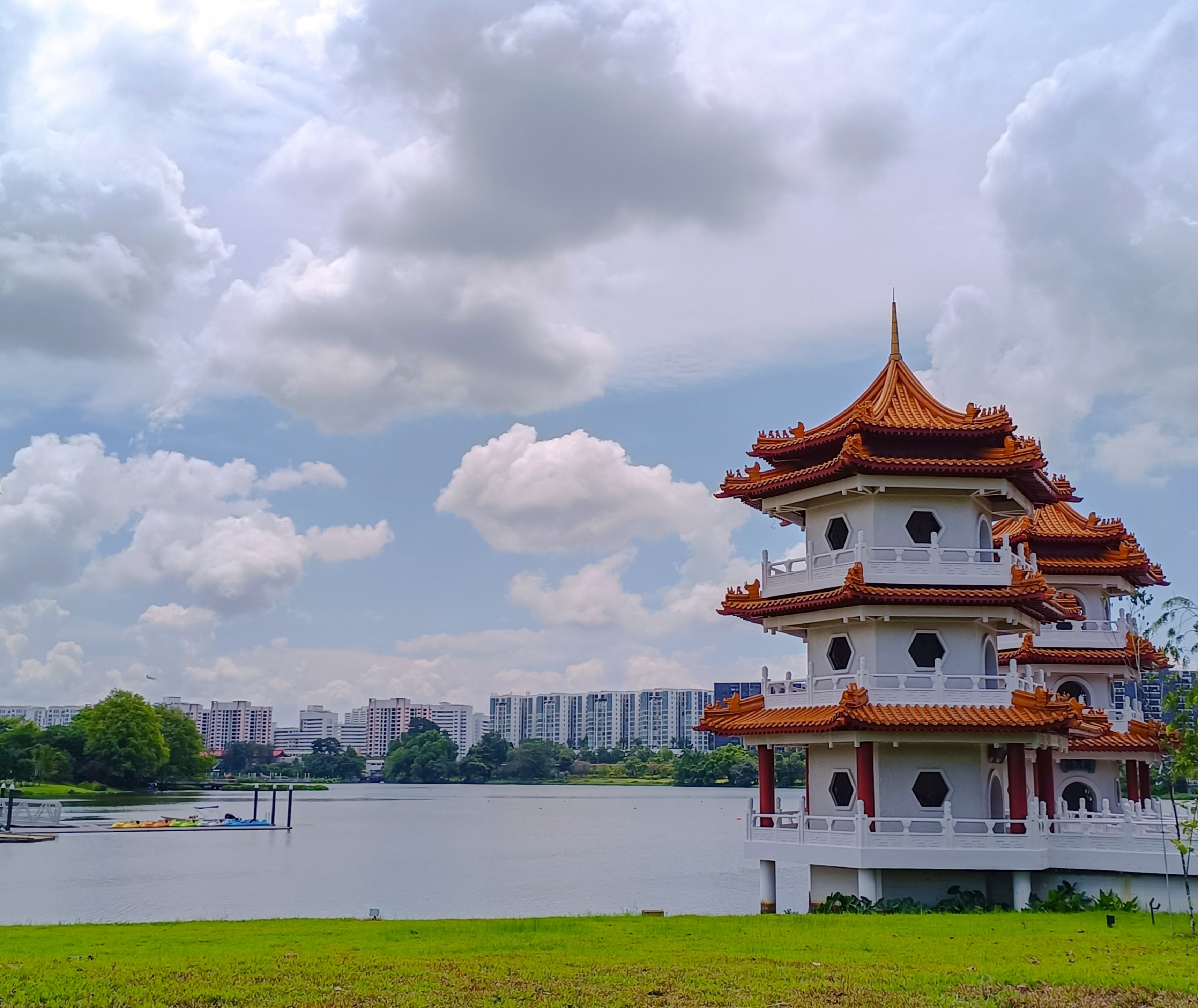
The Twin Pagoda page describes two three-storey lakeside towers called Cloud Draping Tower and Moon Receiving Tower. The structures are inspired by traditional Chinese architecture and presented as complementary forms symbolising yin and yang. They have spiral staircases and balconies, making them visually memorable. Their normal opening is 7 a.m.–10 p.m.. A visitor can examine the towers from the public approach without climbing, while someone interested in the upper views should assess stairs and personal comfort. Their design offers a lesson in form, symbolism and site arrangement.
The twin towers are deliberately different
NParks explains that the broader tower represents yang and the slender tower yin, creating a contrast associated with balance and harmony. This is a documented design interpretation, not a reason to assign every architectural difference across Chinese history to the same symbolism. Ask which features differ in width or silhouette and which elements unite the pair. A child can sketch the two shapes, while a Secondary student can study how contrasting proportions create a coherent composition. Do not infer the builders’ full cultural intentions beyond the official account. A specific feature can embody a design idea without representing all traditions of a civilisation.
Why a pagoda changes how we view the lake
A tower provides a different spatial perspective from a ground-level path. From an authorised balcony, a visitor may notice how lakes, paths and planted areas relate across the wider landscape. But even the best view cannot identify every species of plant or quantify the health of the water. A learner can make two observations: one about geometry and one about the lake’s surrounding green space. Do not block staircases or lean beyond safety barriers for photographs. A pagoda’s value can be understood from its form and cultural role even if someone does not wish to climb its stairs.
The Cloud Pagoda is another, separate landmark
The Chinese Garden feature directory describes the seven-storey Cloud Pagoda, with wider panoramic views and twelve Chinese zodiac stone statues. It is not the same structure as the Twin Pagoda. A guide that calls every tower the Twin Pagoda would mislead visitors. If you choose this feature, check its current access and the stairs required rather than assuming it is suitable for every visitor. The zodiac sculptures can prompt questions about symbolism and calendrical traditions, while the elevated viewpoint helps explain the layout of the garden. Treat architecture and cultural meaning as connected but distinct subjects.
The Chinese zodiac is a cultural system
The twelve-animal zodiac appears in Chinese traditions associated with calendar cycles and storytelling. The Cloud Pagoda’s stone figures reference that cultural vocabulary. An educational outing can introduce the names, artistic forms and historical significance without promising that an animal sign predicts a child’s personality or destiny scientifically. Symbolic systems are meaningful to communities in ways that differ from empirical claims about human behaviour. Ask a child to recognise one animal carving, then discuss how a culture uses symbols to represent time. A respectful explanation distinguishes a living tradition from a claim tested by scientific methods.
Stone sculptures are not playground equipment
Statues and architectural features invite close inspection, but visitors should not climb or sit on sculptures unless signs explicitly permit it. The zodiac figures and ornamental details may be vulnerable to damage even when made from durable material. A good sketch or photograph can be taken from the public path. Explain to young children that an object created for interpretation or decoration is different from a designated climbing structure. The rule helps protect the collection for other visitors. Learning to respect public art is part of cultural literacy and supports the continued use of a shared garden.
Bonsai is about long-term horticultural skill
The Bonsai Garden description presents a Suzhou-inspired setting where miniature trees and carefully arranged landscapes echo visual traditions of Chinese painting. Bonsai and related forms of miniature tree cultivation require pruning, container management, species knowledge and patient maintenance. A small tree is not necessarily a young tree; training and growing conditions influence its form. Do not touch the branches, soil or display containers. Ask how the artist maintains an impression of maturity and landscape within a limited space. The gallery demonstrates how biological growth and human design decisions interact across time.
Why a miniature tree is not just a model
A bonsai is a living organism, not a plastic replica of a full-sized tree. It still requires suitable water, light, nutrients and care. Its size and form are guided by techniques applied over time, and different species respond differently. A visitor may find the scale surprising because the tree’s appearance can suggest a large landscape. A Secondary Biology question might concern how root space, pruning and growth patterns interact, but precise techniques require horticultural training. The museum-style lesson is to appreciate skilled stewardship of life rather than assume the plant simply stays small without intervention.
The limits of bonsai observation
One striking specimen cannot teach every species-specific horticultural method. Some trees tolerate pruning differently, and the long-term health of plants depends on their biology. Visitors should not copy an apparent technique by cutting branches from home trees without appropriate guidance. The display can inspire a safe introduction to plant care and the aesthetics of proportion. Ask which features create the impression of age, then distinguish artistic perception from the biological age of the plant. A bonsai gallery makes patience visible as a form of craftsmanship, combining aesthetic decisions with ongoing responsibility for a living subject.
The Bamboo Grove and waterfall
The Bamboo Grove and Waterfall feature combines a dense planting of bamboo with moving water to create a quieter sensory setting. Bamboo can carry symbolic associations with flexibility and resilience in various cultural traditions, while also being an important botanical group with real structural properties. Do not assume every species of bamboo has the same growth habit. Observe movement, sound and the arrangement of stems without entering planting or breaking branches. An arts student may analyse the atmosphere while a Science student asks how water and vegetation affect the local experience.
The sound of water is part of garden design
A waterfall or cascading creek creates sound, motion and a contrast with still water. Those elements can change how visitors experience a landscape even without complex technology. But a designed garden waterfall is not automatically a natural river system. Its operation may depend on pumps, water management and maintenance. A student can distinguish the visual effect from the physical mechanism responsible for moving water. Do not assume the continuous sound proves a natural mountain spring exists below the garden. This is a useful design lesson in how engineering creates experiences inspired by nature while remaining an intentionally managed public installation.
Cascading Creek has five stages
The Cascading Creek feature presents five different stages of a watercourse, from highland streams to lowland swamps, to demonstrate varied Southeast Asian freshwater environments. The feature normally opens 7 a.m.–7 p.m.. It is educational because each setting can be associated with different physical conditions and living organisms. But the display simplifies the variety of real regional rivers and should not be treated as an exact copy of one named ecosystem. Observe from the permitted paths, and ask how flow and surrounding vegetation change between the designed stages.
Why flowing and still water support different life
Fast-moving freshwater and sheltered lowland pools differ in flow, oxygen conditions, sediment and the kinds of organisms suited to them. A designed Cascading Creek can make some of those contrasts visible. A student may notice turbulence in one section and more settled conditions in another, but exact biological claims should be checked with the official labels or scientific sources. Do not enter the water or attempt to collect aquatic animals. A model is useful when it supports a question about mechanisms; it does not need to reproduce every organism living in Southeast Asia’s rivers and wetlands.
The Edible Garden teaches food-system thinking
The Chinese Garden’s Edible Garden includes thematic areas such as the Kitchen Garden and Herb & Spice Garden. Its purpose is to help visitors recognise how some plants grow and connect them with everyday food. A leaf in a kitchen may have originated from a plant with particular soil, light and water needs. This is relevant to Singapore’s discussions of food resilience, but a display garden does not prove the country can grow every ingredient it consumes. Do not harvest or taste plants unless an authorised programme specifically permits it. Use labels to identify species accurately.
A kitchen herb is a living organism
A child may know the smell of a herb from cooking while never having seen its leaves growing on a plant. An edible garden bridges that gap. Ask what parts of the plant are used, how it obtains resources and what conditions help it grow. Do not guess that every fragrant leaf is safe to eat. Plants can look similar while differing in identity or toxicity, and public garden planting is not a free food source. The educational goal is understanding the biological origins of familiar ingredients and the work required to cultivate them responsibly.
Food resilience is not one vegetable bed
Food resilience concerns the ability of food systems to cope with disruption and continue supplying people. Urban cultivation can contribute to knowledge and some production, but it depends on resources and practical limits. An Edible Garden can introduce growing methods without establishing the economic viability of every proposed farming technology. Ask what plants need from land, water, nutrients, labour and energy. A mature discussion distinguishes a small educational bed from commercial agriculture and national supply chains. The garden is valuable because it makes part of the food system visible, not because it contains a complete answer to food security.
The Stoneboat and Tea Pavilion
The Chinese Garden Stoneboat and Tea Pavilion feature combines ornamental architecture and a view over the Lotus Pond. A stoneboat can evoke historic Chinese garden design and a sense of movement or rest without actually functioning as a sailing vessel. A student can ask how a sculpture shaped like a boat communicates meaning differently from a working boat. Do not assume it could float or was built for transport. Architectural symbolism can make a garden narrative richer, while the actual physical role of the structure remains a carefully designed visitor space.
The Lotus Pond is another plant-learning setting
Lotus and water lily plants share some superficial features but belong to different botanical groups and can have distinct growth patterns. A visitor at the Lotus Pond can observe how leaves and flowers emerge relative to the water, then read the official species information before identifying a particular variety. Do not remove blossoms or enter the pond for a close photograph. The most interesting question is why a plant growing in water needs leaves and structures suited to air, sunlight and changing levels. A calm pool can introduce several biological processes without any invasive fieldwork.
Waterwall Court is closed in November 2026
The NParks operating page explicitly says Waterwall Court in Chinese Garden is closed for maintenance until further notice. The fact that the feature appears on the current design directory does not guarantee public access today. Do not climb barriers or make the closed installation the centre of a family itinerary. Its design can still be discussed through official material, but choose another open viewpoint for the actual outing. Maintenance notices are a separate source of truth from architectural descriptions. A reliable guide distinguishes what exists from what can currently be visited.
Japanese Garden begins with waterscapes
Japanese Garden is designed around aquatic planting, bridges, shaded views and particular forms of landscape composition. The official Japanese Garden page includes the Water Lily Garden, Water Lily Pavilion, Sunken Garden, Floral Garden and Breathing Gallery. The experience is a contemporary Singapore public garden drawing on Japanese aesthetic traditions, not a complete historical survey of every type of garden in Japan. Choose one water-related feature and one planted environment. A good visit can reveal how designers organise the relationship among open views, vegetation, rock and water without requiring a large number of separate stops.
Singapore’s largest water lily collection
NParks describes the Water Lily Garden as Singapore’s largest collection of water lilies. The garden’s cascading ponds and boardwalks allow visitors to observe different colours and growth habits from designated paths. However, no flower collection guarantees that every plant blooms at every hour. Flowering depends on species, conditions and management. A learner should appreciate the plants visible on the day and consult labels before making precise identification claims. The educational question is how aquatic plants occupy the surface and obtain light while remaining rooted or supported in a watery environment.
How a water lily uses its leaves
Water lilies often produce broad floating leaves that help them reach sunlight while the plant remains associated with water. The details vary by species, so not every lily has identical anatomy or flowering times. A visitor can observe whether leaves float and how flowers sit relative to the surface. Do not lift a leaf to inspect its underside or enter the water to take photographs. A student can compare a floating leaf with a terrestrial plant leaf and ask how their environmental challenges differ. This makes water-lily observation a clear Biology lesson requiring only patience and the right public viewpoint.
Water lilies are not all lotuses
The terms water lily and lotus are sometimes used casually for similar-looking aquatic flowers, but they refer to different groups. Water lilies generally belong to Nymphaeaceae, while sacred lotus belongs to Nelumbonaceae. Visible leaf and flower position can provide clues, but exact identification depends on the plant. A school student can learn the distinction without touching the specimens. The garden demonstrates why scientific naming is useful: familiar everyday words may group together organisms that differ biologically. Accurate vocabulary helps explain the plants rather than merely describing everything as a pretty flower in water.
Water Lily Pavilion as a designed viewpoint
The Water Lily Pavilion offers an arranged vantage over water-lily terraces and the wider setting. Its purpose is partly to shape how visitors look at the landscape. From a public location, identify which pond is closest and which features draw the eye toward the distance. Do not assume the pavilion provides a complete view of every collection or has unrestricted capacity during events. This is a useful Arts question: a landscape architect can design not only what is planted but how people encounter it through movement, framing and rest.
The Sunken Garden is a cave-inspired setting
The Sunken Garden feature includes a cenote-inspired water feature, moss-covered walls and epiphytic planting. This is a constructed interpretation rather than a natural limestone sinkhole that happened to form inside Jurong Lake Gardens. The design can evoke cooler, enclosed habitats and invite discussion of plants that grow on vertical surfaces. Do not assume the wall’s species and humidity match a particular cave ecosystem. The current NParks notice says the Sunken Garden toilet is closed for maintenance until further notice. Plan toilet access elsewhere and do not mistake the facilities notice for a guaranteed full closure of the garden feature.
What an epiphyte is
An epiphyte is a plant that grows on another plant or suitable surface for support without necessarily taking nutrients from a living host as a parasite would. Certain orchids, ferns and other plants may use this habit. In a designed vertical wall, plants may be mounted to a structure that supplies suitable growing conditions. A visitor can observe where roots or leaves appear, then consult labels for species-specific details. Do not pull on plants to inspect attachments. The science lesson is that organisms can obtain physical support in several ways, and support is not the same as extracting food from a host.
Moss does not prove a place is a natural cave
Mosses often thrive in suitable moist conditions, but their presence on a wall does not by itself establish that the setting is a natural cave. At Sunken Garden, planting, water and materials were deliberately arranged. That is an important distinction between ecological processes and landscape representation. A child might notice how green wall surfaces differ from ordinary painted concrete. An older learner can ask how moisture, shade and growing substrate affect moss. Avoid assigning a precise species name from appearance alone. The designed environment offers a good question about habitat while remaining a public garden feature requiring maintenance.
The Breathing Gallery presents miniature ecosystems
The Breathing Gallery page introduces terrariums, paludariums and aquariums as ways of representing terrestrial, mixed and aquatic habitats. It normally opens 9 a.m.–9 p.m., Tuesday–Sunday, with Monday and certain Tuesday maintenance closures. These are managed displays, not untouched slices of the wild placed inside glass. A visitor can compare which materials and organisms are present in each model and ask what maintenance is needed. The educational strength is revealing ecological relationships at an approachable scale while explaining that natural systems are more complex than any container.
Terrarium: a small terrestrial environment
A terrarium is a container-based arrangement supporting selected land plants and sometimes other suitable organisms. Its conditions can differ substantially from those outside, depending on light, moisture and ventilation. At Breathing Gallery, look at how rocks, substrate and planting create a tiny landscape. Do not open cases or assume every terrarium is completely self-sustaining. Many require maintenance and monitoring. A student can describe what the design makes visible and what it necessarily simplifies. The aim is understanding the relationship between living organisms and environmental conditions, not concluding that a small glass container can replace an entire forest.
Paludarium: the land–water boundary
A paludarium combines land and water features within a managed environment, representing some qualities of wet habitats. It can make the transition between aquatic and terrestrial life easier to study. A visitor can identify where plants grow in water and where they grow on raised surfaces. But the display’s ecological value and species requirements depend on careful design and maintenance. Do not assume a container’s water is safe for handling or that its animal inhabitants can be touched. A student can compare it with the water-lily ponds outside to understand the difference between a controlled miniature model and a larger managed public landscape.
Aquarium and the limits of a model
An aquarium is a managed aquatic environment in which water quality, food, lighting and animal care may require active monitoring. A small exhibit can provide close views of selected species but cannot reproduce every aspect of a natural river or lake. At Breathing Gallery, ask which physical conditions are represented and which are controlled by staff. Do not infer that a fish’s behaviour in a tank is identical to its full range of behaviour in the wild. The lesson is valuable because it helps visitors appreciate both the usefulness and limitations of ecological displays. A model is informative when its boundaries are understood.
The Floral Garden draws on Japanese motifs
The Japanese Garden Floral Garden incorporates planting, landscape composition and educational design with Japanese inspiration. A visitor can observe how colour, texture and path arrangement shape the experience. Do not claim that every flower or stone has a universal sacred meaning or that the planting reproduces one historic garden perfectly. Designers adapt ideas for a tropical public park and particular users. A student can choose one view and explain why certain features appear closer, more prominent or more sheltered. Landscape design includes the creation of visual rhythm, not merely the selection of attractive flowers.
The Resthouse as an invitation to slow down
The Japanese Garden’s Resthouse uses architecture, water and views to support a quieter pause. A rest location affects how people experience the landscape: it frames particular features and offers a place to consider them without walking continuously. That is important in a large public garden where visitors may have different mobility needs. Do not assume all seats are available during private events or maintenance. A short rest can also become an observational exercise. Ask what makes the surrounding composition feel different from a busy city street and identify the actual design elements that contribute to that impression.
Cycads planted in 1970
The NParks Japanese Garden overview notes mature cycads planted by then-Crown Prince Akihito and Crown Princess Michiko during a 1970 visit. Their continued presence connects botanical care with diplomatic and cultural history. Cycads are ancient plant lineages but a specimen planted in 1970 is not an individual that lived millions of years. A student can distinguish evolutionary history from a plant’s actual age. Read the site interpretation rather than guessing a tree’s planting year from its appearance. The lesson is how a living plant may carry historical associations while continuing to grow and require care.
Why cycads are botanically interesting
Cycads are seed plants with a long evolutionary history and forms that can resemble palms, although they are different botanical groups. They provide a useful introduction to plant classification. A visitor can observe a labelled cycad’s leaves and growth form, then investigate how it differs from flowering plants. Do not pick or touch unfamiliar plant structures; some cycads contain substances that can be harmful if consumed. The educational value is discovering that familiar-looking forms may belong to distinct evolutionary lineages. A garden can preserve living specimens while helping visitors avoid simplistic assumptions about what makes plants related.
A Japanese-inspired garden is not a full cultural lesson
Landscape architecture can reflect aesthetic principles associated with Japanese gardens, but the culture of Japan is much broader than rocks, water and carefully placed trees. A good visitor avoids treating a modern public park as the definitive expression of an entire society. Ask which specific features the operator describes as inspired by Japanese design and how they have been adapted for Singapore’s tropical climate. A student may compare planting strategies without claiming that every design choice has a single timeless cultural rule. Respectful cultural learning is detailed, specific and open to variation rather than based on stereotypes.
The value of water in both gardens
Both Chinese and Japanese Garden use ponds, streams or cascades to shape visitor experience. Water may create reflections, movement, sound and habitat for aquatic plants. But the function of one ornamental pond is not necessarily identical to that of a stormwater canal or a reservoir supplying drinking water. Ask what each feature is designed to accomplish. At Cascading Creek, education about freshwater habitats is prominent; at Water Lily Garden, the living collection is the main focus. A careful comparison distinguishes aesthetic, ecological and infrastructural roles rather than using “water feature” as a complete explanation.
A water feature requires maintenance
A public pond or cascade may depend on water management, cleaning and the care of living plants. A natural-looking setting can still require engineered systems. Maintenance closures are therefore part of a functioning garden rather than evidence of failure. If a feature is unavailable, use the opportunity to discuss the responsibilities that continue after an attraction opens. A student can ask what happens to water quality, accessibility and public safety without monitoring. Do not claim a particular installation is energy-free merely because its purpose is environmental education. Good design includes consideration of operating resources and long-term care.
Why visitor paths matter to plant health
Public gardens allow many people to enjoy living collections. Repeated trampling outside paths can damage soil, roots and delicate plants, especially around wet features. Boardwalks and barriers help direct movement while providing opportunities for observation. Do not step into flowerbeds, climb ornamental structures or collect plant material. A child can learn that a beautiful garden remains attractive because visitors respect boundaries and staff maintain it. The relationship between public access and conservation is a design problem: visitors want closeness, while plants need appropriate growing conditions. Thoughtful paths help both needs coexist.
Plant labels are evidence tools
A label can identify a species, explain its origin or describe its use. It is a stronger source for precise identification than a quick impression from leaf shape. But labels may not explain every ecological relationship or historical claim. A student should record the name and read the explanation carefully, then state what remains unknown. Do not assume a botanical garden’s display represents natural distribution of every species in Singapore. Curated plants may come from several regions. The educational habit is to distinguish an organism’s identity from the particular place where gardeners have chosen to grow it.
An edible plant is not a free snack
The Edible Garden introduces plants used for food, but public planting is not an invitation to harvest or taste unfamiliar species. Some plants require preparation, contain parts unsuitable for consumption or may be treated differently from household food. Follow NParks visitor rules and use the display for education. A Primary child can match a labelled plant with a familiar kitchen ingredient, while an older learner can investigate the resources required to cultivate it. The correct outcome is understanding the food source without damaging the display or making unsafe assumptions about edibility.
A family should not attempt all ninety hectares
The gardens’ combined scale is an advantage for repeat visits, but can overwhelm a family planning one afternoon. A route linking Lakeside Garden play spaces, the Chinese Pagodas and the Japanese Water Lily Garden may involve substantial walking or dependence on the shuttle. Choose one garden and two features first. Leave optional additions for people who still have energy. That approach is especially useful for children and older visitors who need shade and regular rests. An outing succeeds when it provides a memorable explanation, not when every feature on the map has been completed.
A short Chinese Garden itinerary
Use Chinese Garden MRT, enter by the public bridge and choose the Twin Pagoda as your primary architectural feature. Observe the contrast between its paired towers, then select either the Bonsai Garden for plant craftsmanship or the Edible Garden for food science, according to current access. Check each gallery’s hours and the wider walking route. Do not assume Waterwall Court is open during the November 2026 maintenance restriction. End with one sentence explaining how a designer used proportion, planting or water to create a particular experience. The itinerary can be short and satisfying without crossing to Japanese Garden.
A short Japanese Garden itinerary
Start from an appropriate public entrance after checking the route from MRT or shuttle service. Choose Water Lily Garden as the living-plant anchor and Breathing Gallery as an optional indoor comparison when it is open. Observe how ponds create a larger aquatic landscape, while terrariums and paludariums represent selected conditions in smaller controlled displays. Check toilet access because the Sunken Garden toilet is closed until further notice under the current notice. Allow time for resting and the return journey. This outing is complete when you understand one difference between an aquatic plant in a pond and a plant in a miniature habitat.
A low-cost afternoon with no gallery admission
The public garden grounds offer a substantial free outdoor experience. Visitors can study architecture, paths, water and planting without purchasing commercial add-ons. But transport, food, parking and optional programmes may cost money, and indoor gallery access follows separate operating rules. Set a realistic budget and choose a route that works even if a particular display is closed. A meaningful free visit might include the Twin Pagoda exterior and a quiet garden observation. Value comes from asking good questions, not buying every available experience. A short reflective outing can be more educational than a complicated schedule of paid activities.
Morning light and garden comfort
Early hours can be attractive for outdoor observation, but not every gallery or pagoda opens at 5.30 a.m. The grounds may be available while indoor displays remain closed. Check the individual attraction hours if a particular collection is the main goal. Bring water and appropriate footwear, and consider how humidity and sun will affect the group. A photographer may enjoy changing light on the lake, but should keep paths clear and respect plants and other visitors. The gardens are living public spaces, not a private studio. A safe, calm observation supports both appreciation and learning.
Evening visits have limits
The Chinese and Japanese grounds normally remain open until midnight, but certain natural areas, galleries and features may close earlier. NParks warns that Grasslands and Neram Streams in Lakeside Garden are not illuminated at night, and visitors should avoid entering those areas after dark. Do not assume the entire 90-hectare landscape is equally suitable for evening walking. Plan the return transport and stick to approved lit routes. The Twin Pagoda closes at 10 p.m. under the current schedule, whereas indoor exhibits may close earlier. An evening garden photograph should never require entering a closed or unlit nature area.
Safety near ponds and bridges
Water features and bridges can look inviting, but their primary purpose is not unrestricted swimming, wading or climbing. Follow signs and keep children close, especially where paths meet water. Wet stone surfaces may become slippery after rain or during cleaning. Do not lean beyond railings, step into planted beds or use a viewing balcony as a playground. A family can learn about aquatic plants and landscape architecture from appropriate public routes. Public access is designed so that many people can enjoy the same features safely; treating barriers as optional undermines that purpose.
Rain and thunderstorm planning
The gardens contain open lawns, elevated structures and water features exposed to Singapore’s weather. Check NEA forecasts before departure. During nearby lightning, seek appropriate substantial shelter rather than remaining on a pagoda balcony, bridge or open shore for a photograph. Some attractions or shuttle operations may change because of rain. An indoor gallery can be useful when open, but do not assume it offers shelter if it is closed for maintenance. A good plan can be shortened or postponed, leaving the learning goal for a safer day.
Visiting with older relatives
Older visitors differ in walking ability and preferences. Some enjoy long outdoor exploration, while others prefer a short approach with seats and accessible toilets. Ask about individual needs and plan around the actual route. The free shuttle can help during its operating periods, but cannot be relied on when suspended or outside service hours. Wheelchair rental is first-come first-served and not a guarantee that all pagoda staircases are accessible. A gentle visit to a public pavilion and water garden can still be meaningful. Inclusion means choosing a shared experience that people can enjoy comfortably rather than demanding the full circuit.
A Primary-school garden comparison
Ask a Primary child to identify one tower, one tree and one water feature. Which was built by people? Which is alive? Which contains both biological processes and human-designed infrastructure? Let the child draw simple shapes and explain what the features need. A bonsai is living even though it looks sculpted; a stone pagoda is engineered even when it resembles an ancient cultural form. This distinction teaches Science and Design together. A child need not memorise the names of every gallery. One clear comparison between living and non-living components can provide an excellent first learning outcome.
A Primary-school water lily lesson
At Japanese Garden, choose one suitable public viewpoint over the Water Lily Garden. Ask the child where the leaves are and how the flowers sit relative to the water. Explain that a plant needs light, water and nutrients, though the details vary by species. Do not pick a flower or reach into the pond. A drawing of a leaf floating on the surface can become the basis for a discussion about aquatic habitats. The child may notice things adults overlook, such as the arrangement of stems or different colours. Support that curiosity with accurate simple language rather than a long technical lecture.
Secondary Biology: miniature ecosystems
Use Breathing Gallery’s terrariums, paludariums and aquariums as a starting point. Choose one display and identify its living and non-living components. Ask what conditions staff might need to manage and which features differ from a natural habitat. Then compare it with an outdoor garden feature. A strong response acknowledges that a model makes selected processes visible while leaving out much environmental complexity. Do not assume every container operates without maintenance. The lesson builds understanding of ecosystems as relationships among organisms, physical conditions and human interventions rather than simply a collection of plants arranged attractively.
Secondary Geography: public gardens and land use
Jurong Lake Gardens is a major green area serving communities in the western part of Singapore. A student can ask how a national garden contributes to recreation, biodiversity, education and the identity of a surrounding district. Use NParks sources and observe actual pathways, information counters and public spaces. Avoid claiming every visitor obtains the same benefits or that green space automatically achieves measurable cooling without supporting data. The strongest explanation considers multiple functions and the trade-offs involved in allocating land to them. The garden is a useful example of urban planning that can be studied without visiting a formal planning museum.
A Mathematics exercise in proportion
The Twin Pagoda’s contrasting tower widths and the repetition of roof shapes offer opportunities to practise geometry. A student can draw simplified silhouettes and compare approximate proportions, making clear that a sketch is not a surveyed architectural plan. Do not invent exact tower dimensions from a photograph taken at an angle. Older learners may consider how perspective changes apparent scale when viewing an object from the ground. The learning value is recognising pattern, symmetry and contrast, not assigning an unsupported numerical precision. A living public garden can connect Maths with art and architecture through careful observation.
An Arts inquiry into garden composition
Choose one public viewpoint and ask what draws the eye first. Perhaps the pagodas frame a stretch of water; perhaps a pavilion directs attention toward a water-lily terrace. Notice foreground, middle distance, repetition and negative space. A landscape designer creates an experience through what is shown and what is hidden until the visitor moves. But a visitor’s interpretation should not be presented automatically as the designer’s documented intention. Compare observations with NParks’ descriptions where possible. A good arts response explains which visible elements support an emotional impression rather than simply calling the view peaceful or beautiful.
The meaning of cultural inspiration
Chinese and Japanese garden features draw on traditions, symbols and forms developed across many periods and regions. A modern Singapore garden selects and adapts some elements rather than representing every culture in full. To appreciate the result, identify the specific tradition or principle documented by the operator and observe how it appears in the design. Avoid reducing Chinese architecture to pagodas or Japanese design to stones and water. Those are only parts of much broader artistic histories. Respectful cross-cultural learning combines particular examples with an awareness that traditions continue to change and contain many variations.
A heritage question about the 1970s
Jurong’s earlier Chinese and Japanese Gardens were established in the 1970s, and some historic landmarks or plantings have been retained or interpreted in the renewed landscape. A visitor can compare archival photographs and current structures where reliable material is available. The 1970 cycad planting provides a specific documented link to the garden’s early history. Do not claim a newly constructed feature is the original 1970s object simply because it uses a familiar name. A mature heritage discussion considers what was preserved, what was changed and why. Public landscapes can develop across generations while keeping selected memories visible.
The difference between a garden and a nature reserve
Jurong Lake Gardens is a public designed garden with curated collections and landscaped amenities. A nature reserve such as Bukit Timah protects specific natural ecosystems with stricter rules and different visitor experiences. Both can support biodiversity learning, but their purposes and levels of human intervention differ. Do not describe a bonsai display or miniature terrarium as untouched rainforest. For a primary-forest outing, see What to do in Singapore | Explore Rainforest Ecology at Bukit Timah Nature Reserve. The comparison helps a student distinguish conservation of existing habitat from the creation and care of designed planting.
How this differs from Gardens by the Bay
Gardens by the Bay includes cooled conservatories and Supertrees designed around distinctive horticultural and environmental technology. Jurong Lake Gardens offers a different, mainly outdoor experience of landscape architecture, lakeside planting and cultural garden forms in a heartland setting. Both are public green spaces but should not be treated as interchangeable. See What to do in Singapore | Learn How Gardens by the Bay Work for its separate engineering story. A visitor interested in bonsai and water lilies may prefer Jurong, while someone focused on climate-controlled conservatories may choose Marina Bay.
Why gardens need careful plant management
Bonsai, water lilies, epiphytes and edible crops have different requirements. Maintaining their displays can involve watering, pruning, monitoring and replacing plants where necessary. A visitor should not assume an attractive landscape exists without continuous work. The maintenance closures in November 2026 make that responsibility visible. A school student can ask what would happen if a pond’s water system stopped or a bonsai were left without care. Sustainable design considers not only installation but also long-term resources and staff expertise. A garden is a living institution, not a completed static photograph.
Photography without disturbing the plants
Pagodas, water lilies and pavilions are photogenic, but a good photograph should not require stepping into planted areas or blocking staircases. Respect railings, closing times and other visitors’ use of paths. Do not move bonsai containers, pick flowers or photograph into private event spaces. An accurate caption can identify the Twin Pagoda or Water Lily Garden, using the official name and avoiding claims that all structures are historic originals. Photos document appearances at particular times; they do not guarantee future blooming conditions or visitor access. Ethical photography preserves the setting for people who arrive later.
What a school group should check
Organised groups should confirm current park guidelines, event or activity permits where applicable, and the suitability of selected indoor galleries. The large garden size increases the importance of supervision and clear meeting points. If relying on the shuttle, check whether it operates on the chosen date and whether all participants can use it. Allow time for toilets and weather changes. A teacher can choose a narrow objective, such as comparing a paludarium with an outdoor pond, rather than requiring a class to cross the entire 90 hectares. A focused learning journey is easier to supervise and produces clearer student explanations.
A five-word garden vocabulary pack
Choose pagoda, bonsai, epiphyte, paludarium and landscape architecture. A pagoda is a type of tower associated with several Asian architectural traditions. Bonsai involves cultivating living trees in miniature form. An epiphyte grows on another surface for support. A paludarium combines terrestrial and aquatic components in a managed container. Landscape architecture concerns the design of outdoor spaces for human and environmental purposes. Use each term in a sentence tied to a documented feature. Avoid describing every plant-growing container as an untouched ecosystem or every tower as the same cultural form.
A simple observation notebook
Draw five columns: feature, what I saw, what NParks says, my explanation and what I still need to verify. For example, describe the contrasting shapes of the Twin Pagoda and cite the official yin-yang design account. Or observe floating lily leaves and use a botanical source to explain their growth. Do not infer precise dates, water chemistry or species identity from visual resemblance alone. This method turns a pleasant walk into an evidence-based exercise without making it stressful. A younger child can draw the same observations in pictures while an older student writes fuller sentences.
What not to do at Jurong Lake Gardens
Do not plan to visit Waterwall Court during the current maintenance closure, or assume the Sunken Garden toilet is open. Do not rely on the Garden Shuttle on 3 November 2026. Do not expect indoor galleries to stay open until midnight simply because the grounds do. Do not pick edible plants or water lilies, climb sculptures or enter ponds. Avoid a route that forces a tired family across all three garden zones. The correct repair is to check the live schedule, choose one main destination and treat living collections and public infrastructure respectfully.
The best reason to return
The gardens are large enough that a second visit can answer an entirely different question. One day may focus on Chinese-inspired architecture and bonsai, while another explores aquatic plants and miniature ecosystems in Japanese Garden. Seasonal changes in flowers and ongoing maintenance also mean the experience will not be identical every time. A repeat visit is worthwhile when it deepens observation rather than merely reproducing a photograph. The broader lesson is that public landscapes are living, managed systems in which art, culture, plants and infrastructure meet. Understanding those connections is more valuable than covering every path in one afternoon.
Frequently asked questions
Are Chinese and Japanese Gardens free?
The public garden grounds are generally free to enter. Check any individual programmes or commercial services separately.
What are the grounds’ opening hours?
Both Chinese and Japanese Garden grounds normally open from 5.30 a.m. to midnight daily.
What is the best MRT for Chinese Garden?
Chinese Garden MRT EW25 is about five minutes from Chinese Garden Bridge and eight minutes from Pagoda Plaza under NParks’ indicative guide.
What is the best approach to Japanese Garden?
NParks lists an approach from Jurong East MRT of about twenty minutes to Japanese Garden Bridge, while other connected garden routes and a shuttle may be options.
Is the free shuttle operating on 3 November 2026?
No. NParks lists a suspension on 3 November 2026 under its current Garden Shuttle trial notices.
Is Waterwall Court open in November 2026?
NParks lists Waterwall Court closed for maintenance until further notice.
Is the Sunken Garden toilet open?
No. The current NParks notice lists this toilet closed until further notice; check alternative facilities.
When does the Twin Pagoda open?
The Twin Pagoda normally opens daily 7 a.m.–10 p.m., with access subject to current conditions.
What is in the Bonsai Gallery?
Living miniature trees arranged in a Suzhou-inspired garden setting; its normal hours are 9 a.m.–7 p.m. Tuesday–Sunday, with maintenance exceptions.
What is the Breathing Gallery?
An indoor display of terrariums, paludariums and aquariums, normally 9 a.m.–9 p.m. Tuesday–Sunday with maintenance exceptions.
What makes Japanese Garden special?
Its water lily collection, aquatic landscaping, Sunken Garden and miniature ecosystem displays.
Can I hire a wheelchair?
NParks offers complimentary wheelchair rental from information counters daily 8.30 a.m.–6.30 p.m., first-come first-served.
Can children enjoy the gardens?
Yes, with suitable walking distances, supervision near water and activities such as comparing plants, towers and pond features.
Do I need to visit all three sections of Jurong Lake Gardens?
No. Chinese Garden and Japanese Garden each provide a complete focused outing and can be explored on separate days.
Official references and connected eduKate reading
Check the Jurong Lake Gardens official overview, operating hours and October 2026 notices, transport and garden map, Chinese Garden attractions, Japanese Garden attractions, Twin Pagoda and Breathing Gallery before visiting.
Further eduKate reading: What to do in Singapore | Learn How Gardens by the Bay Work, What to do in Singapore | Explore Plant Science at the Botanic Gardens, What to do in Singapore | Understand City Planning at Singapore City Gallery and Touring Singapore | Things to Do and Places A–Z.
Featured photograph: Twin Pagodas at Jurong Lake Gardens, 15 September 2024, by FN-082, Wikimedia Commons, licensed CC BY-SA 4.0. Unaltered photograph; 2026 visitor conditions may differ.

The lesson worth taking home
Chinese and Japanese Gardens at Jurong Lake are living designed places, not simple scenery. Pagodas express particular architectural choices, bonsai reveals long-term plant craftsmanship, water lilies show aquatic biology, and miniature habitats illustrate how people represent ecological systems. Choose a manageable route, check the actual open features and observe carefully without damaging plants. If you leave understanding one connection between culture, science and public design, the visit has succeeded.