
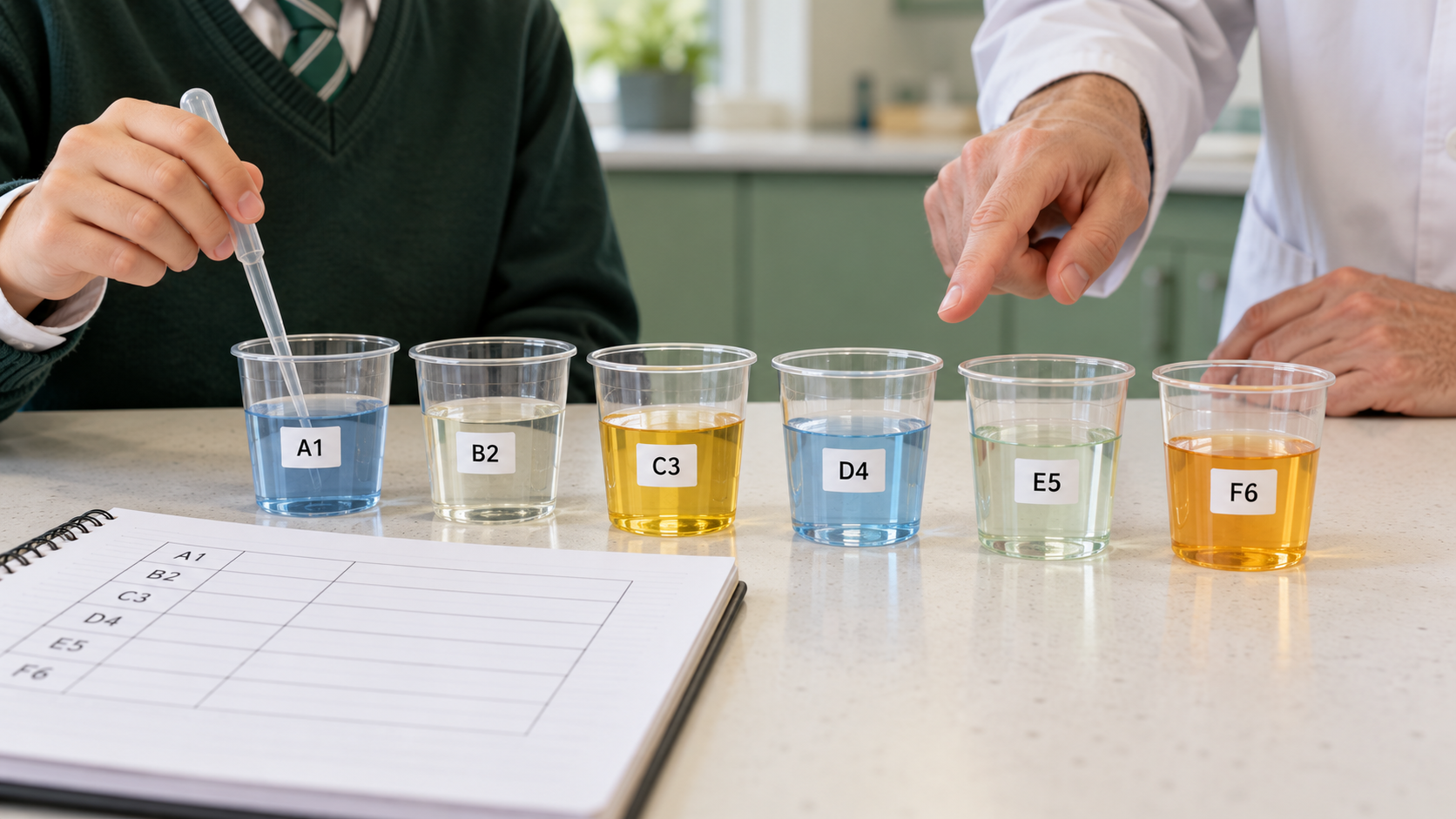
Toa Payoh Primary 3 students can understand materials by asking which physical properties make an object suitable for its purpose. Strength, flexibility, ability to float, waterproofness and the amount of light a material allows through are useful comparisons. A correct Science explanation names the material, identifies a relevant property and connects that property to a specific use; it does not simply describe an object as good, expensive or beautiful.
Singapore’s MOE Primary Science syllabus places Diversity of Materials in Primary 3 and names wood, metal, ceramic, rubber, glass, plastic and fabric as familiar types. The syllabus focuses on comparing physical properties and explaining how those properties make materials suitable for different uses. It defines strength as withstanding a load without breaking, flexibility as bending without breaking and waterproofness as not absorbing water. Advanced density calculations and formal transparent, translucent and opaque terminology are not required outcomes here.
- Distinguish an object from the material or materials it is made of
- Describe a physical property with a precise testable meaning
- Strength concerns resisting loads without breaking
- Flexibility concerns bending without breaking
- Floating is an object’s ability to stay on or near the water surface
- Waterproof material is defined in this syllabus as not absorbing water
- Transparency concerns how much light passes through a material
- Compare wood, metal, ceramic, rubber, glass, plastic and fabric fairly
- Remember that shape, thickness and design can affect an object’s performance
- Choose materials based on the intended use rather than one attractive feature
- Use school-approved observations and avoid unsafe cutting, heat or glass tests
- Justify conclusions with evidence instead of guessing from appearance
Definition lock: material properties are measurable characteristics
A material is the substance or substances making up an object. Strength, flexibility, ability to float, water absorption and light transmission describe different properties and must not be treated as synonyms. The MOE Primary 3 syllabus does not require density calculations or the formal transparent/translucent/opaque terms for the listed learning outcome.
Materials from definition to practical selection
What is the difference between an object and a material?
An object is a particular thing with a purpose or form; a material is what the object is made from. A school ruler may be plastic, metal or wood. The ruler is the object, while plastic, metal and wood are materials. Different materials can be used for a similar object.
A child may say that a chair is a material because the word chair appears in the photograph. Ask what the chair is made of and whether a different material could perform the same basic role. This question helps separate function from composition.
Many objects contain more than one material. A lunchbox can have a rigid body, a flexible seal and a metal fastener. The student should identify the relevant part before deciding which property matters.
A material category is broad. Not all plastics have identical strength or flexibility, and not every wood sample behaves the same way. The syllabus introduces useful general patterns, but the actual question’s sample and conditions determine the evidence.
Practise by naming an ordinary safe object, identifying its materials and explaining one reason each material might be chosen. The aim is an accurate property-to-purpose connection rather than an exhaustive manufacturing description.
Why materials are classified by observable properties
Classification is a way to organise evidence. A pupil might group materials according to whether they bend without breaking, float in water or let light pass through. Each grouping uses a defined criterion rather than arbitrary labels.
The same materials may be sorted differently under another property. A flexible rubber sample may not behave like a rigid glass sample, yet both could resist absorbing water under the stated test. Different criteria legitimately produce different groupings.
Ask the learner to state the rule before sorting objects. If the rule is can bend, it is not fair to move one item into a new group halfway through because it has an attractive colour.
An observation can be recorded in a table, with columns for material, property and evidence. The pupil should distinguish what was seen or given from the conclusion drawn from that evidence.
Classification becomes useful when it supports selection. Once a material has been compared accurately, its relevant strengths and limitations can help decide whether it suits a particular product or task.
Strength is the ability to withstand a load without breaking
The MOE Primary 3 syllabus defines the strength of a material in relation to whether it can be subjected to a load without breaking. The everyday word strong can otherwise be vague, so students should connect it to a relevant load and a suitably described comparison.
A fictional test might compare strips of similar dimensions made from different teacher-approved materials under the same carefully controlled loading conditions. The question may provide which strip broke and which remained intact; the learner need not perform it at home.
A strip that supports more of the stated load without breaking may provide evidence of greater strength in that test. The conclusion should not automatically claim that the material is superior in every possible form or manufacturing use.
Thickness, shape and defects can affect an object’s response. Comparing a thick wooden plank with a very thin metal foil would not isolate the underlying material as neatly as comparing suitably matched samples.
The correct answer names what was loaded, what happened and why the result supports a property comparison. Never ask children to test strength by standing on furniture, suspending heavy weights or intentionally breaking glass.
Strength and hardness do not mean the same thing
A material can resist scratching yet fail suddenly under a particular load, while another can bend considerably without breaking. The familiar adjectives hard, tough, strong and rigid describe different aspects of behaviour; they are not interchangeable.
At Primary 3, pupils need not master advanced engineering definitions. They should, however, recognise that a hard-looking object is not automatically the strongest choice for every load-bearing task.
A ceramic cup may maintain a rigid shape in everyday use, but dropping it can cause a fracture. Some other materials may deform rather than break. The specific comparison must follow the given conditions and observation.
Ask the pupil whether the question tests the ability to resist a load, to bend or to resist a surface mark. The answer should refer to the property that was actually observed.
This distinction improves decision-making. A material suited to one purpose may be unsuitable for another, and the choice cannot be justified with a generic statement that it is strong without explaining the required behaviour.
Flexibility means bending without breaking
The MOE syllabus uses the ability to bend without breaking as the meaning of flexibility. A ruler that bends suitably without snapping demonstrates flexibility in the context of that observation, while a rigid sample may not bend in the same way.
Flexibility does not mean that an object must return exactly to its original shape in every case. Elastic recovery and bending without fracture are related but distinct characteristics. Avoid introducing an unnecessary advanced definition when a simple Primary 3 comparison is requested.
A flexible material can help form a seal, a strap or a part that needs to change shape during use. The learner should connect the material’s movement with the product’s function rather than claim flexibility is always desirable.
A window pane usually needs to retain its form and allow visibility, so extreme flexibility is not the central property. A fabric strap, by contrast, may need to wrap comfortably around an object.
Ask the child to compare two school-approved descriptions of bending and state which one demonstrates flexibility. Do not ask pupils to bend unknown rods, sharp metal, brittle plastic or glass to the breaking point.
Rigid and flexible materials can both be useful
Rigid objects resist large changes of shape under the circumstances considered. Flexibility is useful in some tasks, while rigidity may be useful when an object must maintain its form. Neither property is universally better.
A classroom desk benefits from stable support, while a suitable bag handle may need flexibility for carrying. The answer depends on what part of the product is being considered and which purpose it serves.
Students sometimes assume all plastic objects are flexible and all metal objects are rigid. Real materials come in different compositions, thicknesses and shapes. A soft plastic film and a thick plastic block can behave differently.
The school question may compare samples under fixed conditions. The learner should use the evidence provided rather than generalise from a familiar household example.
A practical exercise asks: what would go wrong if a rigid component were replaced by an unsuitable flexible one, or the reverse? This connects property knowledge with the consequences of material choice.
Floating and sinking concern the object in water
The Primary 3 syllabus defines the ability to float as whether an object can stay on or near the surface of water without sinking. It specifically notes that knowledge of density is not required for the learning outcome.
Ask what the actual object does in the supplied conditions. A small piece of a material may float, while a differently shaped or weighted object made partly from the same material may behave differently.
Some pupils memorise that every metal sinks, but boats can include metal and still float under suitable designs. The object’s structure and overall conditions matter, so a broad material stereotype is unreliable.
A fictional data table might compare a wooden sample and another approved sample in water. Pupils should report which stayed afloat in that setup rather than invent an explanation involving unmeasured density values.
Any practical test involving water must be school-approved and supervised. Children should never use waterways, ponds, drains, deep containers or unfamiliar objects to conduct an unsupervised floating experiment.
Waterproofness is about water absorption in this syllabus
MOE defines a waterproof material for the Primary 3 comparison as one that does not absorb water. This precise school meaning is more useful than treating waterproof as an advertising word with no testable interpretation.
A plastic sheet and a fabric sample might behave differently under a described water exposure, depending on their actual composition and treatment. The pupil should use the stated observation rather than assume every fabric absorbs water or every plastic item is identical.
Waterproofness does not automatically prove that a finished bag, tent or lunchbox cannot leak. An object can contain seams, holes or openings, and overall design may affect its performance even when a component material does not absorb water.
Ask whether the question concerns absorption by a material or leakage through an assembled object. Confusing them leads to answers that appear sensible but describe different properties.
Do not test waterproofness with electrical devices, chemicals or valuable belongings. Use teacher-provided observations or safe paper-based examples to develop accurate explanations.
Transparency describes the passage of light
The MOE syllabus asks pupils to consider whether a material allows most, some or no light to pass through. The formal terms transparent, translucent and opaque are expressly not required for the Primary 3 learning outcome.
An ordinary clear window can let much of the light through, while a suitable frosted material can allow some light without a clear view. A dark panel may block most visible light under the described conditions.
Students sometimes assume that a material’s colour tells them everything about light transmission. Actual appearance, thickness and the specific sample affect what a person can see through it.
Ask what the task really needs. A material for a viewing window should permit a useful view; another for a room divider may be chosen to admit light while reducing visibility.
A good explanation identifies the amount of light passing through and connects it to the intended purpose. The student does not need advanced refraction formulas or formal light-category labels to communicate the relationship.
Wood has uses, but not one universal property profile
Wood appears in furniture, building components and many everyday objects because particular types and constructions can provide useful strength, form and appearance. The exact property depends on the wood and how the object is made.
A wooden ruler, plank and thin craft stick may behave differently under bending or loading. Students should not describe all wood as equally strong or rigid without specifying the context.
Some wood samples float, while others may sink depending on their properties and conditions. The syllabus’s introductory task concerns observation of an object in water rather than a blanket rule based on the material’s name.
A wooden chair may be appropriate where strength and stability matter, but wood is not automatically the best choice for every wet environment or flexible component.
Ask which feature of a given wooden object matters to its use. A property-based explanation is stronger than saying that wood is popular or looks nice.
Metals can be selected for strength and other needs
Metal is a broad material category that includes substances and alloys with different properties. Many metal objects are used where useful strength and stable form are required, but thickness, design and specific composition remain important.
A pupil may see a metal spoon and conclude that all metals are equally hard or impossible to bend. Thin metal foil and heavier metal tools behave differently because objects differ in construction as well as material.
The Primary 3 comparison can focus on a particular sample supporting a load or keeping its shape. Conductivity and advanced corrosion chemistry belong to other lessons unless the teacher intentionally connects them.
An object made from metal may also contain rubber or plastic components, such as a grip or protective layer. The material chosen for one part need not suit every other part.
The learner should explain the benefit relevant to the stated use and avoid the universal claim that metal is always best because it is strongest.
Ceramics often offer rigidity with limitations
Ceramic materials appear in household objects such as tiles and dishes. They may provide a rigid, stable surface, but some ceramic items can fracture under impact or unsuitable loads.
A child may confuse being hard with resisting every kind of breakage. A ceramic plate can be rigid yet brittle in a familiar school example. This distinction shows why one adjective cannot describe all performance.
Do not conduct drop tests with glass or ceramic objects at home. Broken fragments can create injury risks. Printed comparisons and teacher-approved safe investigations can teach the property without creating hazards.
Ask which use is being considered. A tile may benefit from maintaining a stable surface, while a bendable strap requires different behaviour.
The student should connect the observed material property to the chosen purpose and acknowledge the limitation when the question asks for suitability.
Rubber can combine flexibility with other properties
Rubber is often associated with flexible components, seals and grips. Its usefulness depends on the specific rubber product and the performance required, not merely the familiar material name.
A rubber band can stretch or bend in an everyday description, but not every rubber item has the same flexibility or strength. A thick protective pad may behave differently from a thin band.
In a hypothetical school comparison, rubber might be chosen for a flexible seal because it conforms to a shape. The pupil should explain which property supports that function.
Do not assume that rubber is completely waterproof, insulating or safe in every setting based solely on category. Material formulations and product design influence real properties and safety ratings.
A useful explanation states the required property, evidence about the actual sample and the reason it helps the object perform its intended task.
Glass can transmit light but needs careful handling
Glass is used in many windows because suitable glass allows light through and can support a view. The amount transmitted depends on the kind, treatment and thickness of the glass.
A pupil may assume glass is always colourless or that every glass object has the same strength. Tinted, textured and differently designed glass objects illustrate why the broad category contains variation.
Glass can break into sharp pieces when damaged. Any property comparison should be conducted through teacher-approved information or safe demonstration, not by bending, dropping or striking objects at home.
Ask which feature matters in the intended object. A viewing panel requires appropriate light transmission, while a protective container may need other properties and design considerations.
Avoid the answer ‘glass is the best material’ without naming a purpose. A scientifically useful choice weighs relevant strengths and limitations together.
Plastics vary more than one familiar example suggests
Plastic is a broad category of materials rather than a single substance with one fixed behaviour. A flexible packaging film, rigid storage box and clear sheet can each display different properties.
Students should not infer that all plastics are weak, waterproof, bendable or transparent in the same way. The given sample, construction and test are the source of the relevant evidence.
A plastic container may be chosen partly because it is lightweight or resists water absorption, but its suitability also depends on shape, durability and intended use.
Environmental concerns should be discussed responsibly. The broad word plastic does not determine whether a particular item can be recycled under a specific local collection scheme; official waste guidance and product labelling matter.
A good Primary 3 answer identifies which property makes the chosen plastic sample useful and avoids unsupported claims about every plastic object in the world.
Fabric properties depend on fibre and construction
Fabric appears in clothing, bags and many coverings. Some fabric samples bend easily, while water absorption, strength and light transmission can vary with fibre type, weave, coating and thickness.
A pupil may assume that every fabric absorbs water or is too weak to carry anything. Actual material and design matter. A suitable heavy fabric bag can support a load that a thin fabric sample cannot.
When comparing samples, use a stated property such as flexibility or absorption. The word fabric alone is not a precise measurement of how an item performs.
A fictional design choice might require a soft flexible cover rather than a rigid panel. The pupil can explain why bending and draping matter, without claiming that softness is the correct choice for every purpose.
The task should end with evidence: what behaviour was observed in this fabric sample, and how does that behaviour help or hinder the intended use?
Material selection involves trade-offs
An object may need several properties simultaneously. A school bag could require strength to carry items, flexibility for comfort and suitable resistance to water exposure. One material may provide some advantages while another provides others.
Students sometimes choose a material because it is strongest on one measure even when the task demands light transmission or flexibility. The purpose should determine which property receives priority.
Consider a fictional display cover. A clear material may allow visibility, but its strength and handling characteristics still matter. A strong opaque sheet would fail the visibility requirement despite performing well on another test.
Ask pupils to state both one advantage and one limitation, then justify the final selection in relation to the task. This produces a more useful explanation than a generic list of material names.
The broader lesson is that engineering choices balance requirements. Primary Science provides a foundation for thinking about design, safety and responsible resource use without pretending one material is universally superior.
A fair test needs comparable samples
A material comparison is meaningful when the tested specimens and procedure are sufficiently comparable for the property being investigated. Comparing two very different shapes may reveal object-design effects instead of isolating a material property.
If a fictional investigation compares strength under a specified load, ask whether sample dimensions, placement and loading conditions are similar. When these differ, the conclusion needs appropriate caution.
The measured variable should match the property. A test of flexibility asks about bending without breakage, not simply which sample has the prettiest surface. A waterproofness comparison concerns water absorption under the defined setup.
A school may supply observations in a table. The pupil should identify which result supports the conclusion and what alternative factor might influence the comparison.
Physical tests involving sharp objects, weights, broken glass or water near electrical devices require proper professional supervision or should not be attempted. Paper-based evaluation of a written method can teach the same reasoning safely.
Evidence should determine the conclusion, not stereotypes
A material’s familiar reputation can help form an initial prediction, but a prediction is not the recorded result. A child who expects wood to float must still examine the particular object and conditions described in the task.
Ask the student to state what was actually observed, what can be inferred and what remains uncertain. A picture of a plastic bag does not prove whether it would support a specified weight or prevent all leakage.
A photograph can also conceal thickness, composition and internal construction. A sensible classification may require a label, diagram or written description rather than an unsupported guess based on colour.
After a comparison, ask whether the conclusion applies to the tested samples or every material bearing the same name. Scientific language should remain proportionate to the available evidence.
This habit matters beyond Primary Science. Careful use of evidence supports later experiment design, critical reading and responsible decisions about products and resources.
A practical six-week learning programme
Week one distinguishes objects from materials, followed by classification of familiar samples. Week two focuses on strength and flexibility, using safe teacher-approved descriptions to show why loads and bending are different observations.
Week three practises floating, water absorption and light transmission, with all experiments kept within suitable school supervision. Week four compares the seven named material categories through specific physical properties rather than absolute stereotypes.
Week five asks students to recommend materials for several fictional purposes, naming an advantage and a relevant limitation. Week six examines unfamiliar evidence tables and asks for conclusions whose scope matches the actual observations.
The goal is not a guaranteed grade. Progress means a pupil can read a new design question, identify the necessary property, compare credible evidence and defend a material choice independently.
Frequently asked questions
Is a material that bends necessarily weak? No. Flexibility is the ability to bend without breaking, while strength concerns withstanding a load without breaking. A sample may have both properties to different degrees.
Does every metal sink? No. Whether an object floats depends on its circumstances and design. The Primary 3 syllabus does not require density theory for this outcome.
Is waterproofness exactly the same as a leakproof bag? Not necessarily. The syllabus defines waterproof material by not absorbing water, whereas a finished object can leak through openings or seams.
Do pupils need to memorise the words translucent and opaque? The official Primary 3 syllabus specifically says those formal terms are not required; pupils can explain whether most, some or no light passes through a material.
What shows mastery? A learner can describe an observed property, explain why it matters for a particular purpose and recognise that a different sample or design may produce a different outcome.
Your next step: choose a material with a reason
Take two safe, familiar objects and ask what each is made of, which property matters most to its use and what would change if the material were replaced. Then use a new hypothetical object to test whether the child can transfer the property-based reasoning without a memorised answer.
Official sources and related reading
MOE — 2023 Primary Science Syllabus, Diversity of Materials, pages 39–40
MOE — Primary Science Curriculum
National Environment Agency — Waste Management and Recycling
eduKateSG — Primary Science Inquiry Through Safe Everyday Observations
eduKateSG — Primary Science Light, Shadows and Reflection
eduKateSG — Primary Science Electricity and Safe Circuits
eduKateSG — Secondary Science Particle Model and Matter
eduKateSG — Immutable Clementi Mathematics Tutorial Reference
Arrange a parent–student consultation
eduKateSG offers premium three-student small-group academic tutorials by appointment at 8 Fourth Avenue, Singapore 268674, near Sixth Avenue MRT. Toa Payoh families may bring one actual Primary Science question and the child’s attempt to discuss a specific learning gap. The centre is not in Toa Payoh; confirm the suitable subject programme and travel before enrolling.
Properly taught kids shine a bright light into the future.