
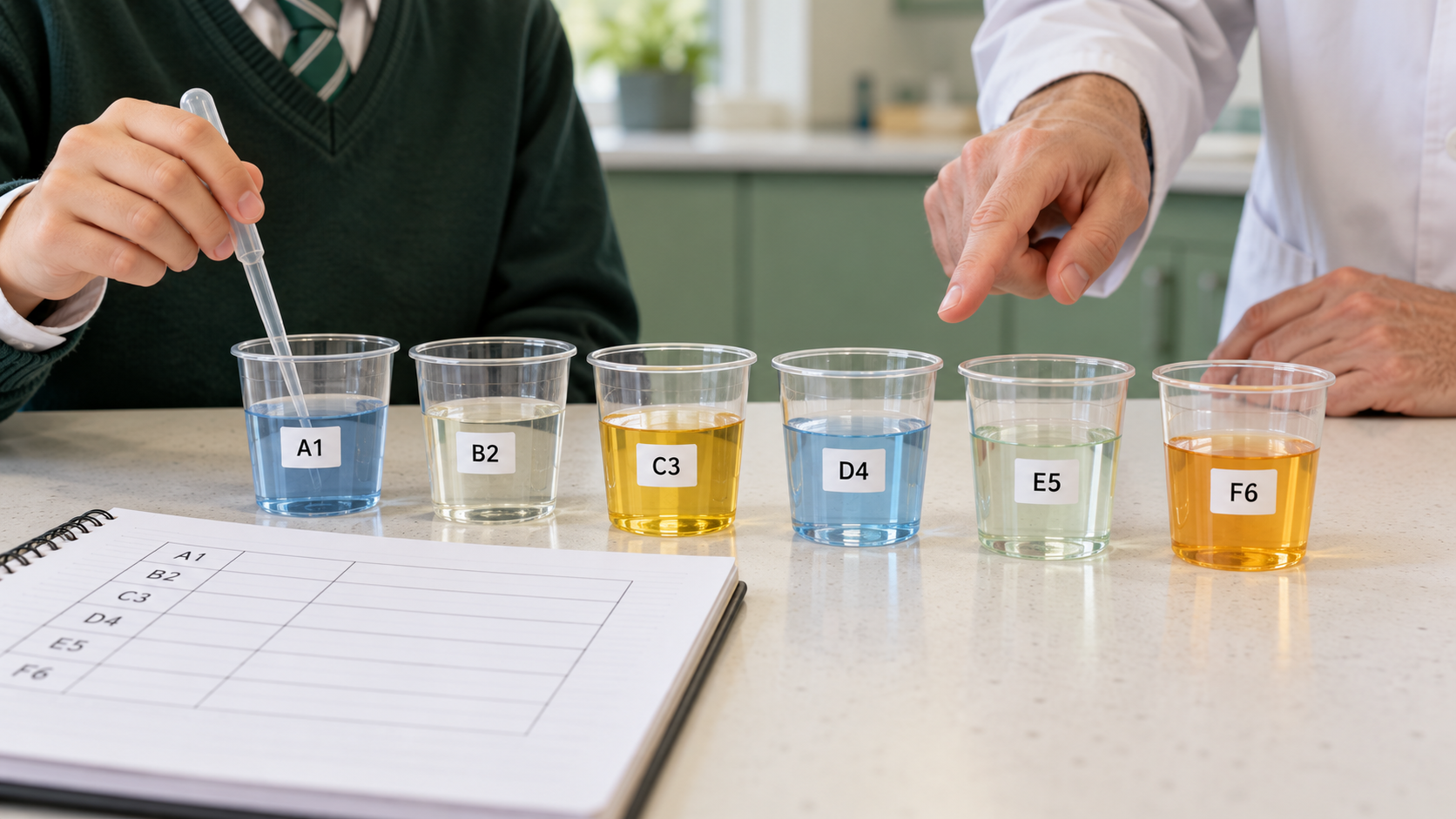
Toa Payoh Secondary 1 and Secondary 2 students can understand the particle model by connecting an observation to the spacing, arrangement and movement of tiny particles. Solids keep a stable shape, liquids flow, and gases spread through available space because particles behave differently in these states. Heating does not simply make each particle bigger, and evaporation does not destroy matter.
Singapore’s MOE G2/G3 Lower Secondary Science syllabus, updated in April 2024, covers the particulate nature of matter, diffusion, expansion and contraction, and conservation of mass. Melting and boiling model outcomes are marked optional for G2, so the child’s actual school syllabus matters. This guide explains the science through original diagrams in words, interpretation checks and safe classroom-oriented reasoning rather than home experiments involving unknown chemicals or heat.
- Particles are modelled as tiny entities undergoing continuous random movement
- Solid particles vibrate around relatively fixed positions
- Liquid particles remain close but move past one another
- Gas particles are far apart and occupy the available container
- Compression changes spacing, not the physical size of individual particles
- Diffusion has net movement from higher to lower concentration
- Heating and cooling can change motion, arrangement and bulk volume
- Physical state changes ordinarily preserve the identity of the substance
- Conservation of mass depends on a correctly defined system boundary
- Models simplify reality and are not microscopic photographs
- Do not handle unfamiliar vapours, solvents, heated materials or electricity at home
- Follow the real G2 or G3 syllabus and qualified school supervision
Definition lock: particle diagrams are scientific models
The particulate model represents matter as tiny particles in continuous random motion. It can explain many properties of states of matter and net diffusion, but it is not a literal microscopic photograph. Physical handling of laboratory materials follows school safety rules, and G2/G3 content should be verified against the student’s course.
Why Science needs particle models
A microscope photograph cannot always show everything a learner wants to know about matter. Scientists therefore use models that represent properties and relationships. The familiar lower-secondary particle model shows material as small entities whose spacing, movement and arrangement can explain observations at a larger scale.
A model is useful because the same basic ideas help explain a solid retaining shape, liquid taking the shape of its container and gas filling available space. The student need not memorise three disconnected descriptions if they can identify the underlying relationships.
The circles in a school diagram are symbols, not literal photographs of coloured atoms. Their sizes, colours and perfect rows are often chosen for teaching clarity. A good student knows which part of the drawing is an assumption and which observation it helps explain.
Ask your child to describe what the material does before naming its particle arrangement. This starts from evidence and lets the model provide a reason. Then show an unfamiliar diagram and ask which bulk property the model predicts.
How solid particles behave
In a simple solid model, particles occupy closely spaced positions and vibrate about those positions. They do not need to remain completely motionless for the object to keep its overall shape.
A neat grid of circles is an easy teaching picture, but not every real solid forms the same regular crystal. The important introductory ideas are restricted movement and a stable structure rather than perfect geometric rows.
Heating a solid can alter particle motion or the average arrangement before it melts. Do not teach that every small increase in temperature instantly turns a solid into a liquid.
A useful practice question asks the child to rotate the picture. The solid’s properties do not change because its diagram faces another direction. Structure, not the drawing’s orientation, governs the explanation.
How liquids can flow
Liquid particles remain relatively close to one another but can rearrange and move past neighbouring particles. This helps explain why a liquid does not retain its own rigid shape while generally occupying a fairly definite volume under ordinary classroom conditions.
Some pupils draw liquid particles almost as far apart as gas particles because liquids flow. That confuses freedom of motion with separation. The diagram should represent both features appropriately.
When water is transferred to a different-shaped vessel, the outline changes without requiring the amount of water to change. A good explanation follows what happened to the arrangement rather than inventing lost or newly formed particles.
A liquid may look still to a person looking at the container while its particles remain in motion. Distinguish microscopic particle movement from visible waves, stirring or pouring.
Why gases fill their containers
The introductory gas model represents particles as widely separated and moving randomly in multiple directions. Gas can spread through an available volume because its particles have much more freedom of motion than the particles of a solid.
Avoid saying that gas particles want to escape. Intention is not a scientific mechanism. Particle motion, collisions and the conditions of the container explain how they spread.
A sealed vessel expanded to a larger volume can hold the same particles at a lower average concentration. More space does not automatically mean more particles were created.
An open container is different because material may leave or enter. Ask whether the question describes an open or closed system before interpreting changes in mass or particle number.
Compressibility is about space between particles
Gases can generally be compressed much more readily than ordinary liquids or solids. Their particles are far apart in the model, so reducing the volume can reduce average separation between them.
A child might draw smaller circles after compression. That is usually the wrong representation: the particle size has not been reduced merely because the container became smaller.
Liquids and solids are not absolutely incompressible under every possible condition, but their behaviour differs substantially from that of gases. At this level the learner should understand the comparison without making universal claims.
Physical gas compression is not a suitable improvised home experiment. Sealed containers or compressed-gas equipment can present hazards. Printed diagrams allow the essential relationship to be taught safely.
Diffusion: concentration and net movement
Diffusion is net movement of particles from higher concentration to lower concentration as a result of random particle motion. The system can become more evenly distributed even while individual particles continue moving in different directions.
A diagram with many particles in one region and fewer in another invites a question: which region has the larger number per unit volume? The answer requires examining the space represented as well as counting dots.
Diffusion arrows should follow concentration differences, not a memorised left-to-right direction. Rotate the diagram or place the crowded region on the right; the reasoning remains the same.
Do not ask children to release unknown smells or use volatile chemicals to investigate diffusion. Written scenarios and supervised demonstrations can teach the mechanism without unnecessary exposure.
Concentration is not the same as total particle count
Consider ten particles in a small box and twenty particles in a much larger box. It is possible for the ten-particle region to be more concentrated because its volume is much smaller.
Students who count dots while ignoring relative volumes may reverse their answers. Ask what the diagrams state about their sizes and whether a precise numeric concentration can actually be calculated.
In a solution, the syllabus describes concentration using the number of solute particles per unit volume. This makes concentration a relationship, not merely an absolute quantity.
When the sketch gives only a qualitative impression, make a qualitative statement. Inventing a concentration with several decimal places would add unsupported information rather than improve the answer.
Diffusion is not identical to bulk flow
Stirring water can distribute a substance quickly because the liquid itself is moving. Diffusion refers to microscopic net movement associated with concentration. The two processes can operate together but are not synonymous.
A pupil may watch a drop of colour spread while water is stirred and conclude that every visible movement proves diffusion alone. The experimental method also includes mixing caused by stirring.
In a written exercise, compare still and stirred conditions and ask which factor differs. A suitable scientific answer should avoid attributing the entire outcome to diffusion when the setup includes bulk movement.
Wind can similarly transport air as a whole while particles are also diffusing. Reading the stated conditions allows the child to separate a model mechanism from an additional influence.
Heating and the motion of particles
Heating transfers energy into a material under relevant conditions. In the particle model, motion, arrangement or average spacing can change. Those microscopic changes help explain temperature-related behaviour and some changes of state.
The model does not require each particle to grow larger when a material expands. A student should distinguish particle size from particle separation.
Not every gain of energy causes an immediate rise in temperature. During certain state changes, energy contributes to changing the phase while temperature can remain nearly constant under suitable conditions.
Ask which situation is described: warming without a state change, or a transition between states. The answer should match the given observations instead of automatically naming melting or boiling.
Cooling and thermal contraction
Cooling can reduce particle motion and may reduce average spacing in many materials. This can explain contraction of an object under familiar school conditions without describing its particles as shrinking.
Avoid absolute statements such as every material always contracts as it cools. Water near freezing has special behaviour, and real substances differ. A correct response respects the material and temperature range given.
A paper diagram of a rod before and after cooling can be interpreted safely. The student should identify the unchanged particle identity and the change represented by their spacing.
The deeper skill is conditional explanation. A statement that fits one material under certain conditions should not be applied automatically to all matter.
A scientific model must admit its limits
A model leaves information out deliberately. The circles in introductory diagrams do not show all forces, quantum behaviour or complicated molecules, and they should not be treated as exact pictures of atoms.
The space between the drawn circles is not automatically ordinary air trapped within every material. That would be an extra claim not established by the basic representation.
Teach the pupil to name what the model explains well: state, relative spacing, motion, diffusion and broad physical changes. Then ask what it cannot determine, such as exact rates without data.
Scientific confidence means using the model appropriately, not pretending that every diagram answers every question.
Part Two: physical changes, evidence and independent application
Melting connects particle arrangement with state
Melting changes a solid into a liquid when suitable conditions are reached. In the basic model, the same substance’s particles become able to move past one another. The process is not explained by every particle splitting into smaller pieces.
Students may correctly name melting while drawing new particles in the liquid diagram. Ask what happened to the identity and number of particles in the represented sample. A physical change does not ordinarily create additional matter.
During certain state changes, added energy contributes to changing phase while measured temperature can remain nearly constant under appropriate conditions. A simple diagram need not include every detail of the energy interaction, but it should not contradict known relationships.
Ask the pupil to compare the starting and ending states with a fixed set of particle symbols. The movement and arrangement should change, not the chemical identity of the water or other specified substance.
Evaporation and boiling need different descriptions
Evaporation can occur at a liquid’s surface at temperatures below its normal boiling point. Boiling involves vapour formation throughout the liquid under relevant temperature and pressure conditions. The two share a liquid-to-gas change but differ in behaviour.
A drying towel does not need to reach one hundred degrees Celsius to lose water by evaporation. The school explanation should connect the observation with the correct process and avoid claiming that every visible loss of water involves boiling.
Gas particles in a model move much more freely and are usually represented as farther apart than liquid particles. The symbol size need not increase during the change. Greater spacing is not the same as larger particles.
MOE identifies some melting and boiling explanation outcomes as optional for the G2 lower-secondary course. Verify what the particular school teaches before demanding the same advanced details from every student.
Condensation and freezing reverse different processes
Condensation changes gaseous matter into liquid under suitable conditions, while freezing changes liquid into solid. Students should identify the states on either side of an arrow before selecting a process name.
In a hypothetical cooling diagram, water vapour can condense into small liquid droplets. The visible droplets are not identical to invisible gaseous water vapour, and the diagram’s conditions should support the proposed explanation.
Freezing involves a more constrained particle arrangement and restricted motion in the basic solid model. Do not draw particles disappearing as the material becomes a solid. The physical change preserves the relevant substance.
Use two pairs of reverse arrows: melting and freezing, evaporation and condensation. When the student can explain each using altered drawings, the words have become usable knowledge rather than memorised positions on a page.
Conservation of mass needs a well-defined system
A sealed container can hold the same amount of matter before and after an ordinary physical change, even if the contents have moved between liquid and gaseous states. A change in appearance does not demonstrate destruction of mass.
An open bowl may lose water from the region being observed as vapour enters the surrounding air. The mass remaining in that particular bowl can decrease without the water ceasing to exist in the wider environment.
Students must read whether the diagram represents an open or closed system. A line drawn around a container should not automatically be treated as a perfect seal unless the description establishes that condition.
Ask the pupil to identify which matter is inside the boundary and what could enter or leave. This is a foundational habit for later Chemistry and the interpretation of experimental results.
Dissolving is not the same as melting
When a soluble solid dissolves, its constituent particles become dispersed in an appropriate solvent. Melting is instead a change from solid to liquid state. Both can make an original solid shape disappear, but the physical explanations differ.
An illustration of sugar in water should not automatically be explained as liquid sugar formed by melting. The representation needs to show the solute distributed within the solution according to the model taught.
A substance may no longer be visible as a separate grain and still remain in the mixture. Loss of visible shape is not proof that its particles have been destroyed. This is another case where a model supports an observation.
Do not ask pupils to taste unknown solutions or improvise mixing experiments with household cleaners. Teacher-approved diagrams and suitable supervised demonstrations are enough to discuss the conceptual difference.
Brownian motion and evidence of particles
Brownian motion describes irregular movement of small particles suspended in a fluid as they are struck by molecules of the surrounding fluid. It is historically important evidence supporting particulate explanations of matter.
A student should distinguish the suspended object that may be observed from a single invisible molecule. The observed speck can be much larger than the molecules whose collisions contribute to its motion.
The MOE syllabus also uses particle theory to discuss scientific attitudes: observations can motivate a model, and models may be refined when new evidence becomes available. Science is not simply the memorisation of one attractive drawing.
A safe classroom video or qualified teacher demonstration can illustrate the concept. Do not claim every random-looking motion is necessarily Brownian motion without examining the actual conditions.
Diffusion is not the same as stirring
Diffusion is associated with random particle motion and net transport down a concentration gradient. Stirring, in contrast, causes bulk movement of fluid. Both can help distribute material, but they describe different mechanisms.
If coloured water is deliberately stirred, the observed rapid mixing cannot all be attributed to diffusion alone. The experimental procedure has changed the motion of the fluid, so the interpretation needs to consider that fact.
Wind can move a gas mixture as a whole while diffusion still occurs at the microscopic level. Students should identify which process the problem states or which conditions make an inference reasonable.
Compare fictional still and stirred liquid descriptions on paper. Ask which observation would test diffusion more directly and why. This trains scientific evaluation without requiring the pupil to handle chemicals.
Compare particle concentration carefully
Concentration relates the number or amount of a substance to a specified volume. Ten represented particles in a small box may be more concentrated than twenty particles distributed through a box many times larger.
Students often count dots and choose the larger number without comparing the size of the regions. That procedure answers a question about total count, not necessarily concentration. Ask which denominator belongs in the comparison.
When two boxes represent equal volumes, counting the relevant particles may be sufficient to identify which region is more concentrated. If the volumes differ or are not stated, the learner should be more cautious.
Avoid reporting a precise concentration from a purely schematic picture that supplies no scale. A model can establish a qualitative relationship while leaving numerical questions unanswered.
Expansion involves spacing and interactions
Heating can cause many materials to expand. The simplified particle model uses changes in motion, interactions or average separation to help explain increased bulk volume. It does not require each particle to become physically larger.
A pupil who redraws a heated rod using bigger circles may have confused particle size with material dimensions. Ask the learner to draw the same number of dots with greater appropriate separation.
The amount of expansion depends on the substance and conditions. Do not assert that every material expands identically or that every system behaves normally across all temperatures. Water near freezing is a useful reminder that exceptions exist.
For a school question, describe the particular material and the stated heating process. Correct conditional reasoning is more useful than a memorised slogan applied to unrelated substances.
Cooling and contraction have qualifications
Under many ordinary conditions, cooling can reduce particle motion and lead to a contraction of the material. The school model may depict particles becoming closer on average without themselves shrinking.
Do not assume all substances contract in exactly the same way. Matter can behave differently near phase transitions, and some familiar examples such as water show unusual density changes.
Compare before-and-after diagrams using the stated temperature change. Ask which features are constant and which change. The student should not create or remove particles merely to represent a smaller volume.
A strong explanation respects both the model and the question’s limits. If the material or conditions are unknown, it may not be possible to predict every exact dimensional change.
Particle diagrams can be misleading
Particles drawn as coloured dots are visual symbols. Their colour does not prove that real atoms are bright red or blue, and their equal size does not establish that every substance consists of identical spheres.
Some pupils think the spaces between all particles are full of ordinary air. That is not a justified reading of the model. The gaps represent separation without automatically specifying a second material.
Arrows can indicate movement, but the meaning of their length or direction depends on the diagram’s conventions. A large arrow is not a measured velocity unless the source explains that scale.
Ask what the diagram explains well: relative motion, spacing and arrangement. Then ask which properties it leaves out. This trains the learner to use models rather than worship them as exact photographs.
Interpret a particle diagram systematically
First read what substance or mixture the symbols represent. Check whether different dots indicate different particle types, whether the boxes share a scale and whether they describe equal amounts of matter.
Next determine whether the picture illustrates a solid, liquid, gas or concentration difference. The arrangement and movement should support that conclusion; an attractive colour scheme is not evidence.
Then read the question. Does it ask about compression, diffusion, heating, conservation of mass or a state change? A student who identifies the task can select a relevant principle rather than write about every property of matter.
Finally, explain one relationship in a complete sentence. A good response connects the model to an observable property and does not introduce unsupported chemical reactions or newly created particles.
Temperature measurements and the particle model
Temperature can relate to the motion and energy of particles, but a single temperature reading does not disclose the complete internal energy of every possible sample. The number of particles and material properties also matter.
Two samples may be at the same measured temperature while containing different amounts of matter. The child should distinguish a temperature measurement from the total energy associated with an entire system.
Heating can influence particle motion, but phase changes may involve additional changes in arrangement. A simplistic claim that every particle gains identical speed whenever energy is supplied does not represent the full physics.
At school level, ask which observations or measurements are available and which interpretation the particle model can reasonably support. This is more useful than writing advanced terminology without a connection to the question.
Observations, inferences and predictions
An observation is something measured or detected. An inference interprets the observation through an explanatory idea. A prediction describes an expected outcome under a proposed set of conditions.
For example, a fictional table might show a coloured region becoming more uniform over time. This observation may be consistent with diffusion, but an explanation also depends on whether the liquid was stirred or otherwise moved.
Students should avoid treating the first familiar chapter word as proof. Ask which detail supports the particle explanation and whether another process could influence the result.
For a prediction, specify the changed condition and expected relationship without inventing a numerical diffusion rate that the question has not supplied.
Common mistakes and the correct repair
If a student draws bigger particles after heating, reteach the distinction between individual particles and average separation. If an arrow points toward higher concentration, revisit the meaning of net diffusion.
If a pupil says matter disappears during evaporation, clarify the system boundary and the presence of vapour in the surroundings. If they describe dissolving as melting, compare the two processes using consistent particle identities.
The correction depends on the first wrong idea, not the final score. Do not label every problem carelessness or assign twenty nearly identical questions without checking what the learner believes.
Show a corrected example and then change the diagram. A child who can interpret the new version without prompting has stronger understanding than someone who only copies the red-ink answer.
A six-week learning programme
Week one introduces model assumptions and solids, liquids and gases. The pupil should explain particle spacing and movement in unfamiliar drawings rather than recite labels beside one fixed diagram.
Week two practises compression, expansion and contraction, with careful attention to particle size. Week three introduces concentration and diffusion, including the difference between microscopic net movement and stirring.
Week four explores changes of state and conservation of mass under the actual school syllabus. Week five contrasts dissolving and melting and considers what models can and cannot establish.
Week six mixes teacher-approved diagrams, short data tables and explanations. The student should identify the relevant concept independently and describe an observation, an inference and a limitation.
The plan is illustrative rather than a promised route to a grade. Progress means the learner can connect a changed observation with scientifically sound particle reasoning.
Questions from Toa Payoh parents
Do particles in a solid stop moving? No. The introductory model describes them vibrating around relatively fixed positions, even while the solid maintains its shape.
Does heating make each particle bigger? Not in the ordinary thermal-expansion model. Changes in movement, arrangement and average spacing help explain the bulk behaviour.
Does diffusion always proceed left to right? No. Net diffusion follows the relevant concentration gradient regardless of how a textbook diagram is oriented.
Does evaporation destroy water? No. Water changes to vapour, which may leave an open region; conservation of mass requires a correctly defined system boundary.
Is dissolving another name for melting? No. Dissolving distributes solute particles in a solvent, while melting changes a solid to a liquid.
What demonstrates learning? An unfamiliar diagram can be interpreted accurately, including the particle identity, movement, spacing, relevant conditions and limits of the model.
Your next step: analyse an unfamiliar representation
Choose a teacher-approved particle diagram with a changed condition. Ask the child what stays constant, what changes and which observation the model explains. Repeat with an altered diagram without adding particles or changing their sizes. Physical laboratory work must remain supervised and authorised.
Official references and related reading
MOE — G2/G3 Lower Secondary Science Syllabus, Updated April 2024
MOE — Full Subject-Based Banding
eduKateSG — Secondary Science Laboratory Safety
eduKateSG — Primary Science Heat and Water Changes
eduKateSG — PSLE Science Data Questions and Graphs
eduKateSG — Study Notes and Retrieval Practice
eduKateSG — Secondary 1 Mathematics Tutor Clementi | Small Groups Tutorials
Arrange a parent–student consultation
eduKateSG provides premium three-student small-group academic tutorials by appointment at 8 Fourth Avenue, Singapore 268674, near Sixth Avenue MRT. Toa Payoh families can bring a Secondary Science work sample and discuss a specific learning gap, subject level and practical travel. Laboratory handling remains under trained school supervision.
Properly taught kids shine a bright light into the future.