
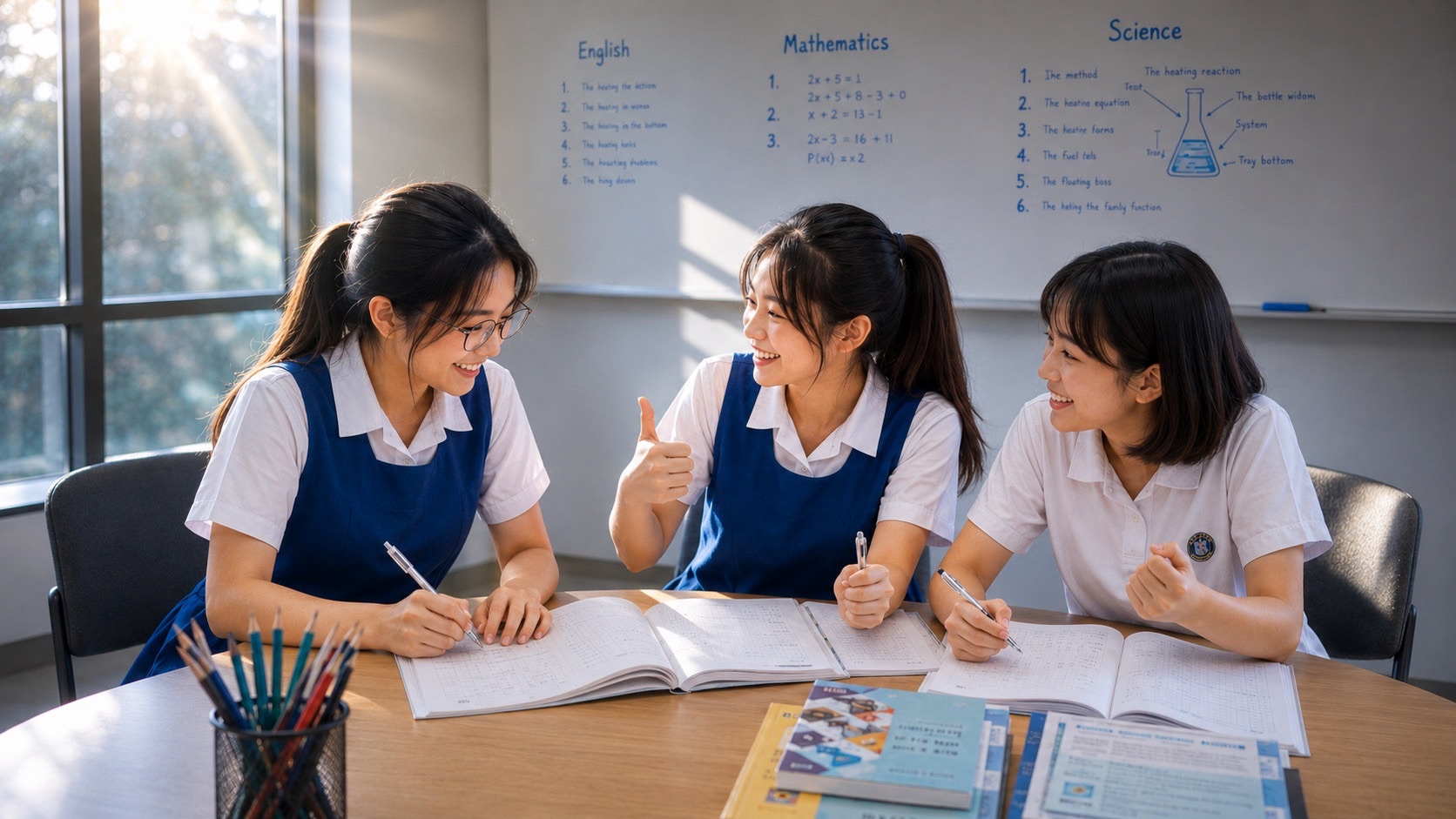
Toa Payoh Primary and Secondary students can become clearer classroom presenters by learning to identify one message, organise evidence, speak for a particular audience and handle questions without memorising every sentence. A strong presentation does not require a loud personality, dramatic gestures or elaborate slides. It helps listeners understand an idea, follow the reason for it and remember what matters when the speaker finishes.
A practical preparation cycle is to interpret the teacher’s task, write the main message, choose two or three supporting points, rehearse with a simple outline, ask for specific feedback and deliver a revised version. Singapore’s MOE 21st Century Competencies emphasise communication, collaboration and information skills, but each school sets its own assessment and presentation requirements. This guide addresses speeches, class reports and individual sharing; PSLE English oral examination procedures and group-project allocation are separate topics.
- Identify purpose: explain, persuade, report, demonstrate or reflect
- Describe the audience and the one idea they should retain
- Read the actual school rubric, time limit and permitted digital-tool rules
- Build an opening, a logical middle and a conclusion that answers the task
- Select evidence that supports each claim, and cite it where required
- Use slides for maps, diagrams or short labels rather than full scripts
- Speak audibly and naturally; do not imitate an unrelated television accent
- Rehearse with keywords, not only a memorised paragraph
- Give and receive feedback on clarity, content and delivery separately
- Prepare for reasonable questions and acknowledge uncertainty honestly
- Respect privacy, consent and school requirements for recorded presentations
- Aim for independent communication rather than a perfect performance
Definition lock: classroom public speaking is purposeful communication
A school presentation is an age-appropriate spoken explanation, argument, demonstration or reflection tailored to a defined audience and assigned task. It is not a personality test, a licence to invent evidence or an automatic substitute for PSLE oral examination practice. The teacher’s format, accessibility arrangements, use-of-tools rules and marking criteria remain authoritative.
The complete guide to planning, speaking and presenting
A school presentation is a service to the listener
The purpose of speaking in class is to help another person understand something. That goal changes how a student selects information, arranges points and uses their voice. A presentation that displays everything researched may overwhelm the audience instead of communicating the essential answer.
Begin with one sentence: ‘After my presentation, the audience should understand…’ This statement becomes a test for every paragraph, image and example. If a slide contributes nothing to that intended understanding, the student should question why it is included.
Students sometimes judge a talk by how impressive they felt on stage. The audience’s comprehension is a stronger criterion. Can a classmate summarise the main point and identify the reason supporting it? That is evidence that the communication worked.
A Toa Payoh student giving a report about a neighbourhood heritage source could focus on why a particular historical change mattered, rather than recite every landmark known to the family. A narrow, clear question helps the audience follow the logic.
Public speaking is therefore not an exercise in becoming the loudest person in the classroom. It is a craft of selecting, organising and expressing material in a way suited to actual listeners.
Read the task, audience and permitted format first
A student’s first responsibility is to understand what the teacher assigned. A short oral report, persuasive speech, project reflection and demonstration require different kinds of content. The rubric may specify evidence, time, visuals or individual contribution, and those instructions take priority over generic internet advice.
Ask whether the speech should describe, explain, compare, evaluate or persuade. A descriptive talk may focus on accurate features; an evaluation needs criteria and a reasoned judgement. A persuasive speech requires a defensible position and relevant support.
Identify the audience. A talk to Primary 3 classmates should not assume the same background vocabulary as a Secondary 4 presentation. The speaker can define technical words briefly rather than exclude listeners through jargon.
Check the actual time limit and any requirements for slides, notes or recorded delivery. Do not guess based on another school’s example. A student who designs a fifteen-minute talk for a five-minute task may need painful last-minute cuts.
Prepare a checklist containing the teacher’s requirements, the central message, supporting points and the final submission process. Clarity at the beginning prevents a visually polished but inappropriate result.
Choose one message the audience can remember
Students may have ten interesting facts but no central idea. A useful talk states what those facts collectively mean. The speaker should be able to express the message in an ordinary sentence before creating the first slide or recording.
For a fictional presentation about reducing waste during a class event, the message might be that planning reusable supplies can reduce unnecessary disposal. Supporting points could examine the event’s actual needs, suitable choices and limits. No unsupported numerical saving needs to be invented.
Ask the pupil whether the message answers the teacher’s question. If a report on source reliability becomes a general speech about protecting nature, the content may be interesting yet irrelevant. Relevance should govern selection.
Do not overload the message with four unrelated promises. A focused idea gives the listener a framework for understanding details. Two or three well-developed reasons are often more useful than a list of twelve barely explained slogans.
At the end of drafting, ask the child to say the main message again without consulting the slides. If it has changed radically, revisit the outline. The central idea should remain stable while the evidence develops.
Open by orienting the listener quickly
An opening should introduce the subject, explain why it matters and give the listener a simple route through the talk. It need not begin with a dramatic quotation, joke or impossible statistical claim. A direct question or familiar observation can be effective when genuinely connected to the topic.
For example, a talk about historical evidence might begin: ‘Two photographs can show the same street differently. What can we conclude, and what remains hidden?’ The opening names the intellectual problem and prepares the audience for the method that follows.
Students sometimes use a generic introduction such as ‘Since the beginning of time, humans have always…’ without establishing the assignment’s actual purpose. Ask what the sentence contributes. If the talk becomes clearer without it, remove it.
The opening should match the tone of the task. A serious safety topic needs appropriate language, while a personal reflection can be warm and conversational. A prepared attention-grabbing phrase is not worth misleading the audience.
Rehearse the first few sentences until the child knows where the talk begins, but avoid making the entire performance depend on perfect recitation. Once the opening works, the speaker should be able to continue through understood ideas.
Organise the middle around relationships
A collection of facts is not automatically an explanation. The middle should show how points relate to the central message: one factor causes another, two approaches differ, evidence supports a claim, or a process unfolds in stages. Choosing the relationship is the core planning decision.
Use a simple structure appropriate to the task. A process explanation might move from problem to method to result; a comparison might examine the same criteria across two options; a historical account might follow chronology and then discuss significance.
Ask the student to label each section with a short purpose. If two sections repeat the same idea, combine them or give each a distinct function. If one section contains attractive information but no connection to the question, consider removing it.
Transitions should communicate meaning. ‘Because of this’ implies causation; ‘however’ introduces contrast; ‘for example’ provides illustration. Do not insert them mechanically into every paragraph without checking the underlying relationship.
A coherent middle allows the listener to predict where the explanation is going without knowing the answer in advance. The audience should not have to reconstruct the logical links after the speaker finishes.
Evidence makes a claim worth hearing
A presentation may sound convincing while relying on unsupported statements. Students should identify which claims need a source, an observation, an example or a reasoned calculation. A voice full of confidence cannot make an invented figure accurate.
For a local-history presentation, an NLB article or an archival image can support a specific dated claim. It should be labelled correctly. A future planning announcement cannot be presented as evidence that a facility has already opened, and an old photograph cannot be described as a present-day view.
Ask whether each source supports exactly what the slide says. If a source gives one official date, the speaker should not extend it into a claim about how every resident felt. The source’s scope limits the strength of the conclusion.
Use short quotations only when the words themselves matter and the school permits them. Usually a clear paraphrase with attribution will help the audience more than reading a long excerpt from the screen.
Teach the student to distinguish a fact, personal opinion and inference. The talk can contain all three when appropriate, but listeners deserve to know which is which. That distinction supports credibility and critical thinking.
A concluding sentence should complete the promise
A conclusion returns to the central idea and shows what the evidence has established. It should not introduce a new major claim, a surprise statistic or an unrelated moral. The audience needs closure, not a second introduction.
Ask what the listener should now understand that was unclear at the start. A good closing sentence names that change. For a comparison, it may state which option is better under the defined criteria; for a report, it may state what the evidence demonstrates and where limits remain.
Students often finish by saying ‘That is all, thank you’ because they have reached the final slide. Courtesy matters, but the conclusion should first explain the intellectual outcome. A strong short ending can do both.
Do not exaggerate certainty. If the evidence is incomplete, saying which question remains open is a legitimate conclusion. A responsible speaker does not need to pretend every complex problem is settled after five minutes.
During rehearsal, remove the slides and ask the child to say the message and conclusion together. They should form a coherent pair, demonstrating that the presentation answered the task it announced.
Slides should support speech rather than replace it
Slides are useful for diagrams, tables, photographs and simple signposts. They are less useful when they reproduce the entire speech in tiny paragraphs. A presenter who reads every word from a crowded screen turns the audience into simultaneous readers rather than listeners.
Place one central idea on a slide, then use a small amount of relevant support. The exact number of words is not governed by a universal rule; what matters is legibility, the room’s size and whether the information helps the audience follow the explanation.
Choose an image because it contributes evidence or meaning. A photograph of a Toa Payoh landmark might be helpful for a local-history claim, but not for an unrelated presentation about algebra. Decorative visuals can consume attention and obscure the point.
Every chart needs a title, meaningful axes and units. A beautiful graph that hides its scale can mislead. Students should explain what the visual actually establishes rather than assume its appearance proves the claim.
If the task prohibits slides or uses a different digital format, respect that instruction. Clear verbal structure can make a strong presentation without any screen. Tools should serve the lesson, not define the speaker’s ability.
Describe diagrams as meaningful relationships
A student should not simply point at a figure and say ‘as you can see’. Some listeners may be unable to read the small labels or may not recognise the intended relationship. Explain the relevant features in words before interpreting them.
Begin by identifying what the diagram represents and what each important symbol means. Then guide the listener through the relationship, such as an increase, sequence or comparison. Avoid explaining every decorative element when only a few features matter.
With an imaginary chart of reading sessions across a week, the speaker might compare the two highest values and explain what the graph does not reveal about book difficulty. This is more useful than naming each bar without drawing a conclusion.
A real dataset should have reliable provenance. If values are invented for practice, label them hypothetical. Do not present them as measured Toa Payoh school or household data merely to make the presentation sound locally researched.
Rehearse describing the figure without pointing. If the listener can reconstruct the important pattern from the words, the student has learned to communicate information rather than simply display it.
Speak audibly without forcing a new personality
Audience members need to hear the words clearly, but volume is not the same as confidence or intelligence. A naturally reserved student can communicate effectively with appropriate audibility, measured pace and accurate phrasing. A dramatic voice that distorts meaning is not the objective.
Practise from a realistic speaking distance in a quiet room. Ask the listener whether they can understand every important phrase. Adjust volume gradually and avoid encouraging shouting or straining the voice.
Good pacing allows the audience to process ideas. A student who races through a technical explanation may finish within the time limit but leave listeners confused. A short pause after a key claim can help more than an extra paragraph.
Breathing and posture may support clear speech, but there is no need to turn an ordinary class talk into a performance of artificial gestures. The student should feel able to stand or sit according to the task and any accessibility arrangements.
Feedback should be descriptive: ‘The final explanation was hard to hear’ is more useful than ‘You are not confident enough’. The first identifies an observable issue and an actionable improvement.
Eye contact should support inclusion, not discomfort
Speakers benefit from looking toward their listeners periodically, but demanding constant eye contact can distract some students or create discomfort. The purpose is to stay connected to the audience rather than stare at an examiner or teacher.
Ask the student to move attention naturally between a few parts of the room, or use an appropriate alternative when necessary. They can consult brief notes without apologising. What matters is that the audience can follow the talk.
Do not grade a child by the number of seconds they look at someone. Cultural practices, neurodiversity and individual needs may influence comfortable eye contact, and teachers can provide suitable support where required.
Listening to the audience also matters. The student should notice whether a question has been asked or a clarification is needed, without making every listener’s facial expression into a personal verdict.
A successful presentation connects speech, evidence and audience. Eye direction is a tool within that broader purpose, not an isolated test of personality.
Gestures should make meaning clearer
Natural gestures can help point to a sequence or emphasise a contrast. They become distracting when rehearsed as a rigid choreography unrelated to the message. A student should not be told to wave their hands constantly to appear enthusiastic.
Practise one simple explanatory gesture where appropriate, such as indicating two compared options. Ask whether the gesture adds meaning. If it does not, the speaker can keep their hands relaxed and focus on the explanation.
Movement should follow the venue and teacher’s instructions. Walking across the room may be unsuitable in a small classroom or when cables, bags or other obstacles create safety risks.
Some pupils have physical or sensory needs that affect gestures. An accessible presentation can communicate clearly through voice, visuals or another approved mode. Meaning and participation matter more than imitating a standard performance style.
After rehearsal, ask the student which gesture helped the listener and which was simply a nervous habit. This reflection encourages purposeful action without shame.
Notes should guide the speaker, not become a transcript
Memorising every word can make a presentation fragile. If one sentence is forgotten, the student may lose their place completely. A short outline of keywords and relationships helps the speaker recover and adapt while preserving accuracy.
Begin with the central message, three section labels and one evidence cue under each. The student should be able to explain the points in different wording without changing their meaning. This shows understanding rather than dependence on a fixed text.
For an early learner, full sentences may be a temporary scaffold. Gradually shorten them to prompts as competence improves. The teacher’s permitted-note rules take priority in any assessed presentation.
A common mistake is reading cue cards continuously. Ask the student to practise one section while glancing only for the next idea. They should not need to memorise exact punctuation in order to communicate a concept.
Prepare a recovery phrase for when the speaker loses their place: briefly restate the main point and move to the next planned section. The skill is knowing the argument well enough to resume naturally.
Rehearse the reasoning before timing the performance
The first rehearsal should test whether the presentation makes sense. A pupil who does not understand a slide will not fix that weakness by repeating the talk faster. Ask for an untimed explanation of the structure and claims.
Once the content is clear, check whether the talk fits the teacher’s time limit. If it is too long, remove repetition and irrelevant detail before rushing. Speaking much faster can reduce intelligibility and increase anxiety.
Rehearse with a listener who has not seen the full research notes. Ask what they understood and what remained confusing. This is a better test of communication than approval from an adult who already knows every point.
Record a private practice attempt only if it is useful and permitted. There is no need to publish a child’s voice or face online. Consent, school policy and sensible privacy protection apply.
Use feedback to revise one or two meaningful features at a time. After the change, rehearse with a slightly different question or audience. Transfer matters more than performing one familiar script perfectly.
Stage fright needs practical preparation, not a label
Feeling nervous before speaking is common, but students experience it differently. Some worry about forgetting words, others about peer reactions or making a factual mistake. A useful response identifies the actual difficulty rather than saying that the child lacks courage.
Start with a low-pressure audience, perhaps a family member or trusted peer. Gradually increase the challenge according to the learner’s readiness. A short successful explanation can build a base for more demanding tasks.
Practise the opening, know the structure and keep appropriate cue notes when allowed. These steps reduce uncertainty without promising that all nervousness will vanish. The goal is to communicate despite manageable discomfort.
Avoid public embarrassment or forcing a child to perform repeatedly as punishment for hesitating. Where anxiety persistently interferes with ordinary functioning or school attendance, involve appropriate school support staff rather than treating the issue as merely a rehearsal deficit.
Measure progress through concrete abilities: beginning on time, recovering after a missed phrase, answering one question or explaining an unfamiliar diagram. These are useful milestones regardless of personality.
Question-and-answer sessions test genuine understanding
An audience question may address a detail not covered in the prepared speech. The speaker should listen, identify the demand and answer with relevant evidence. A rehearsed response about an unrelated topic is not an effective way to preserve the appearance of confidence.
Teach students to repeat or paraphrase a question briefly when that helps clarify it. If the question has several parts, select the order and address them systematically. A short pause to think can be more useful than immediate filler.
When the answer is unknown, honesty is appropriate. The pupil might explain what the presentation established and what further research would be needed. They should not invent a statistic, authority or historical date to avoid saying ‘I am not sure’.
Practise follow-ups that test interpretation and limits. Why did you choose that source? What alternative would you consider? What changes if one assumption is false? These questions invite deeper understanding rather than memorised performance.
The strongest indicator is flexibility. A student who can answer a changed question without distorting the evidence has learned the material, not merely the order of slides.
Group presentations need shared understanding
When several pupils present together, transitions and division of roles matter. A group may allocate speaking time fairly but still produce disconnected sections if members do not understand the shared question and conclusion.
Before rehearsing, ask every student to explain the central message, main evidence and purpose of the other sections. Each person should know enough to answer a reasonable question about the overall argument even if another member delivers the relevant slide.
Do not assign all difficult reasoning to the most confident speaker while others only introduce names. Each student should have a meaningful opportunity to learn, subject to the school’s rubric and appropriate support needs.
Agree on speaking transitions, file control and a backup plan if a slide or device fails. Technical uncertainty should not cause the whole presentation to collapse when a clear verbal outline is available.
Feedback should consider coherence and contribution as well as individual delivery. The group succeeds when the audience understands one argument, not simply when every pupil has taken a turn.
Citations and privacy strengthen presentation credibility
School presentations sometimes borrow photographs, charts, quotations and short video material. Students should follow the teacher’s rules about attribution and reuse. A link in tiny text does not always make unlicensed material appropriate to republish.
Use official or properly licensed images where needed, and preserve dates, context and source identities. If an image shows a historical place, do not caption it as present day unless the evidence supports that claim.
Obtain permission for recording or sharing images of classmates and members of the public. A project does not require students to upload personal details to a public platform simply because a presentation can be recorded.
Digital tools, including generative AI, can suggest wording but may introduce invented information. Follow school academic-integrity requirements and verify claims against their original sources. A polished AI script is not evidence that the pupil understands the subject.
Attribution and privacy are not decorative finishing details. They are part of communicating responsibly and respecting the people and work represented in the presentation.
A six-week programme for independent public speaking
Week one clarifies one presentation’s purpose, audience and central message. Week two organises supporting points and checks evidence. Ask the learner to describe the outline without creating elaborate slides.
Week three practises the opening, transitions and conclusion. The pupil should communicate an understandable argument in ordinary language before worrying about performance technique. Week four focuses on audibility, pace and simple visual explanation.
Week five introduces limited cue notes, unfamiliar audience questions and recovery after a stumble. Give specific feedback on content and delivery separately. A short question-and-answer practice often reveals more understanding than repeated script recitation.
Week six includes a full rehearsal matched to the school’s actual format and a final independent explanation. The child should know what to cut if the talk is too long and how to respond honestly if a question exceeds the available evidence.
Do not promise every student will become an extrovert. Success means clear, responsible communication that improves with practice and allows a learner to participate meaningfully in class.
Frequently asked questions for Toa Payoh families
Must a confident student speak loudly? The audience needs audible, clear language, but loudness alone does not demonstrate understanding. Natural pace and meaningful phrasing matter more than exaggerated projection.
Should pupils memorise entire presentations? Some younger learners benefit from full sentences initially, but an outline of understood ideas usually supports more flexible responses. The school’s permitted-note rules apply to assessments.
Can a presentation work without slides? Yes. A clear verbal structure, suitable examples and good audience awareness can communicate effectively. Use visual aids only when they add something the listener needs.
What if the student forgets a point? A brief pause, return to the main message and transition to the next idea can recover the talk. Repeatedly restarting the entire speech is not necessary.
Can parents write a polished script for the child? Parents can guide planning and feedback, but the assigned work should remain the student’s own. An adult-written speech may conceal gaps in understanding and conflict with academic-integrity expectations.
What is the clearest evidence of progress? The student can explain an unfamiliar topic accurately, use appropriate support, adapt to audience questions and identify limits without relying on a rigid memorised performance.
Your next step: one clear message and one supportive listener
Ask your child to explain a school topic in two minutes without a slide deck. Have them state the message, give one reason and explain one example. Then ask a new question and listen to the reply. Revise only the most important weakness and repeat on a changed topic. That modest cycle builds genuine confidence through knowledge and communication.
Official sources and related reading
MOE — 21st Century Competencies
MOE — Education Conversations and Communication Skills
National Library Board — S.U.R.E. Information Literacy
eduKateSG — School Project Research and Reliable Sources
eduKateSG — Fair Group Projects and Shared Responsibility
eduKateSG — PSLE English Oral and Listening
eduKateSG — Secondary 1 Mathematics Tutor Clementi | Small Groups Tutorials
Arrange a parent–student consultation
eduKateSG provides premium three-student small-group tutorials by appointment at 8 Fourth Avenue, Singapore 268674, near Sixth Avenue MRT. Toa Payoh families can bring a school presentation assignment, a draft outline or feedback about reasoning and communication, and should confirm that the available tutorial is appropriate before arranging travel.
Properly taught kids shine a bright light into the future.