
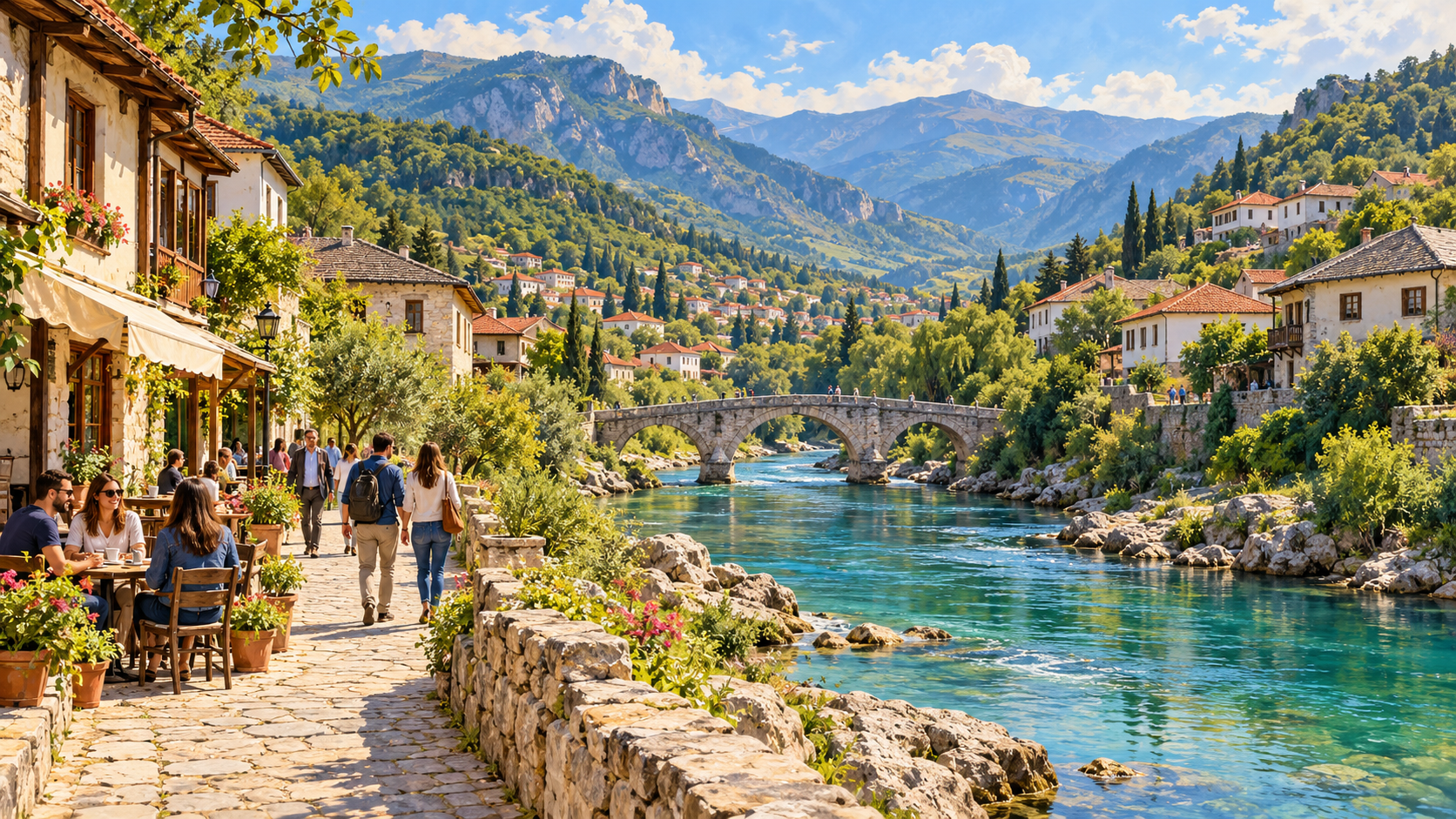
Did you know that touring Bosnia and Herzegovina can connect an old trading quarter, a reconstructed bridge, hillside heritage towns and two very different national-park landscapes? Ten places worth considering are Sarajevo, Mostar, Blagaj, Počitelj, Kravica Waterfall, Trebinje, Travnik, Jajce, Una National Park and Sutjeska National Park. These places to visit in Bosnia and Herzegovina offer a varied introduction to architecture, living faith, rivers, mountain environments and the country’s layered history.
For a first Bosnia and Herzegovina itinerary, start with Sarajevo and Mostar, then choose your extensions. Blagaj, Počitelj and Kravica belong to the wider Herzegovina chapter, while Trebinje needs its own southeastern plan. Travnik and Jajce offer a central route. Una is a separate northwestern nature chapter; Sutjeska lies in the southeast and should be planned around the activities you actually want to undertake. A short holiday does not need to cross every region, and a famous waterfall does not make all river activities equally suitable.
Check transport, site access and the current official travel guidance before booking. Landmines and unexploded weapons remain in some rural and less populated areas: do not leave roads and paved areas without an experienced guide. Use authorised visitor routes and suitable local guidance for outdoor excursions. River currents, weather and mountain terrain also deserve proper attention. You can enjoy a rich trip through historic towns and managed viewpoints without adding rafting, remote hiking or bridge diving.
Find your route through Bosnia and Herzegovina
Choose a Sarajevo–Mostar introduction; a focused Herzegovina route with Blagaj, Počitelj and Kravica; a central heritage chapter through Travnik and Jajce; or a national-park trip with appropriate guides. Trebinje, Una and Sutjeska need deliberate time rather than being treated as small additions to the same day.
Compare the places · Start exploring · Plan your route · Quick answers · Official sources
Ten places at a glance
| Place | What it offers | Region |
|---|---|---|
| 1. Sarajevo | Trading-quarter streets, cultural institutions and contemporary capital life | Central-eastern Bosnia |
| 2. Mostar | Bridge heritage, reconstruction and a historic urban setting | Herzegovina |
| 3. Blagaj | A tekke and river-spring setting with a distinct spiritual subject | Near Mostar |
| 4. Počitelj | A hillside heritage settlement and an introduction to urban form | Neretva valley, Herzegovina |
| 5. Kravica Waterfall | A managed waterfall visit in the Herzegovina landscape | Ljubuški area |
| 6. Trebinje | A southeastern town chapter of public spaces, river views and regional food | Southeastern Herzegovina |
| 7. Travnik | A central historic town and a fortress-focused visit | Central Bosnia |
| 8. Jajce | A historic town whose river and waterfall are part of its identity | Central-western Bosnia |
| 9. Una National Park | A northwestern river landscape and a deliberate outdoor chapter | Northwestern Bosnia |
| 10. Sutjeska National Park | Mountain landscapes, forest interpretation and Second World War remembrance | Southeastern Bosnia and Herzegovina |
Open the full reading index
1. Sarajevo
2. Mostar
3. Blagaj
4. Počitelj
5. Kravica Waterfall
6. Trebinje
7. Travnik
8. Jajce
9. Una National Park
10. Sutjeska National Park
Planning and regional routes
Frequently asked questions
Official sources and further reading
Connect the places without flattening their histories
Bosnia and Herzegovina is easier to appreciate when you let each place introduce a particular subject. Sarajevo’s trading quarter can lead into the city’s religious and urban layers. Mostar asks you to understand a bridge as both architecture and a symbol shaped by destruction and reconstruction. Blagaj offers a spiritual site beside a river spring, while Travnik and Jajce open different historic-town chapters.
The pleasure of travelling here includes meals, conversations and attractive views. It also includes subjects that deserve a quieter tone. Do not ask a guide to turn the conflict of the 1990s into dramatic entertainment. Seek careful explanation, use reliable institutions for history and respect people whose lives are connected with the events being discussed.
The same care applies to living religious spaces. A mosque, church or tekke can be a visitor destination and an active place of faith at the same time. Ask when access is appropriate, how to dress and what photography is permitted. Learning about a place does not require unrestricted access to every room.
This selection combines towns, individual sites and parks because they serve different travel purposes. It is an editorial menu, not an official ranking. Choose a regional route with enough time to enjoy it, and let the practical details of roads, terrain and access shape the final programme.
Sarajevo is a rewarding starting point because a city walk can introduce several layers without requiring a long journey between them. Baščaršija, the old trading quarter, provides a useful focus. Begin with an explanation of how commerce, public spaces and religious institutions relate to one another rather than trying to collect every landmark immediately.
The lanes invite close attention. Look at the scale of buildings, the arrangement of shops and the relationship between a working business and the street outside it. If a craft demonstration is offered, ask whether it is an agreed part of the visit. A shop is not automatically a performance space because visitors find the work interesting.
Coffee or a meal can give the city walk a pleasant rhythm. Ask about the way something is served and the ingredients available that day. You do not need to turn the encounter into a test of whether you have mastered every local custom. A polite question and a willingness to listen are excellent starting points.
Choose a small number of cultural institutions according to your interests. Religious heritage, urban history and the events of the 1990s require different programmes and emotional pacing. Confirm the actual museum or memorial visit, and avoid assuming that a general city tour will cover each subject with equal depth.
If the visit discusses the siege and war, keep the human context visible. Let a knowledgeable guide distinguish personal testimony, documented events and interpretation. Do not photograph grief or private experiences as if they were part of a staged attraction.
Sarajevo deserves time as a living capital. Leave an ordinary walk or meal in the programme after the formal introduction. The city becomes more memorable when the visitor can connect what the guide has explained with the daily activity around them, rather than moving immediately to the next long transfer.
Mostar’s Old Bridge is an obvious focus, but the surrounding city deserves attention too. UNESCO’s World Heritage property concerns the Old Bridge Area of the Old City, not every part of the municipality. Keeping that scope clear helps you understand what the heritage designation actually recognises.
Ask your guide to explain the bridge’s history, its destruction during the war and its reconstruction. The structure you encounter carries a story of repair as well as an older architectural tradition. Treating it simply as an unchanged medieval object would miss an important part of its significance.
Take time in the surrounding streets. Look at how passages, trading spaces and the river connect. One attractive view is enjoyable; a walk that reveals the relationship between the bridge and the town is more informative. Choose a route that suits your group, including the uneven surfaces that may be involved.
The bridge can attract crowds and spectacle. Enjoy the setting while staying within the ordinary visitor experience. Diving from the bridge is dangerous and is not a casual activity to add to a holiday. A photograph of someone else undertaking it does not establish that it is appropriate for you.
A confirmed cultural or religious visit can broaden the day, but check access and conduct before entering. If you include history related to the conflict, give it the appropriate time and tone. Do not let the attractive townscape become a reason to omit the more difficult part of the story.
An overnight stay can help you enjoy Mostar beyond a brief day-trip window. It may also provide a practical base for a selected Herzegovina excursion. Check the actual location of your accommodation and departure arrangements, then choose how much time belongs to the town and how much to the surrounding sites.
Blagaj offers a focused visit rather than another full-city programme. The tekke beside the Buna spring is the best-known setting. Its combination of built space and water is striking, but the religious subject should remain central to the explanation.
Ask a guide or the site’s visitor information to explain what a tekke is and how the Blagaj site relates to Sufi traditions. Avoid replacing that explanation with a vague label such as an unusual house. A little context changes what you notice in the building and how you approach the visit.
Confirm current access, clothing and photography requirements. Follow the instructions for entry and movement. You can appreciate the exterior and setting if entering the interior does not suit your circumstances or the arrangements on the day.
The river spring also deserves attention in its own right. Ask how it shapes the site’s location and atmosphere. Keep to appropriate visitor areas and do not interpret proximity to water as a general invitation to enter it. The conditions of a river setting cannot be inferred from a calm-looking photograph.
Blagaj can combine with Mostar or a wider Herzegovina outing, but give it a clear purpose in the day. A visit involving interpretation and an unhurried look differs from a brief stop made only for one photograph. Decide which experience you want before booking the excursion.
A meal or pause nearby can make the visit more comfortable when it fits the actual schedule. Check what is included rather than assuming every advertised tour leaves the same amount of free time. Blagaj is most rewarding when its spiritual and environmental setting remains a coherent chapter instead of disappearing among several hurried stops.
Počitelj invites you to read a settlement through its hillside arrangement. Buildings, paths and fortified features occupy a setting beside the Neretva valley. The appeal lies partly in how the parts relate, rather than in one isolated landmark.
Choose a walking route that suits the group. A hillside visit can involve slopes, steps and uneven surfaces. Ask how much ascent is proposed and whether a lower-level introduction would be more appropriate. You do not have to reach every high point to understand the place.
A guide can help explain the architectural layers and the relationship between the settlement and the route through the valley. Ask about the use of particular buildings and the evidence for their history. Do not assume that all the surviving features were constructed at the same time.
Počitelj appears on Bosnia and Herzegovina’s UNESCO Tentative List. That is different from inscription on the World Heritage List. The distinction does not reduce the place’s interest; it simply keeps the description accurate and prevents an important heritage term from being used loosely.
Respect homes and private areas. A picturesque lane can also be part of someone’s daily environment. Ask before close photographs of residents or entry into a courtyard, and avoid treating quiet spaces as freely available for a visitor group.
Počitelj can fit a Herzegovina route when the confirmed road itinerary gives it enough time. If the day already includes Mostar, Blagaj and a waterfall, discuss which stops need a fuller visit and which might be saved. A smaller selection often allows the settlement’s structure and history to become much clearer.
Kravica Waterfall provides a nature-focused chapter within Herzegovina. The site’s official information places it on the Trebižat River. Choose it for the river landscape and a well-planned visit, rather than assuming that the photograph describes identical conditions throughout the year.
Check the current visitor arrangements through the site before departure. Admission, opening, facilities and permitted activities should come from current information. Avoid budgeting around an old price or assuming that a tour listing describes the same access available on your dates.
Ask about the route from the arrival point to the viewing areas. A waterfall excursion may involve steps, slopes and wet surfaces even when the driving portion is straightforward. Travellers with mobility needs should confirm the actual route rather than relying on a generic claim that the attraction is suitable for everyone.
Enjoy the waterfall from approved positions. Water volume and conditions can change, and an attractive pool does not establish that entering it is appropriate. If swimming is contemplated, confirm current permissions and conditions locally. You can have a satisfying visit without making water entry part of the programme.
Leave room for an ordinary pause. A nature stop can provide a different rhythm after historic-town walking, but it becomes less relaxing when the itinerary allows only enough time to descend, take a picture and hurry back. Check the amount of time on site before booking a combined excursion.
Kravica and Jajce’s waterfall are not duplicates. One belongs to a managed Herzegovina nature setting; the other helps define a historic town farther north. Choose according to the region you are visiting and the kind of day you want, rather than trying to include every waterfall named in a country guide.
Trebinje can add a slower southeastern chapter to a Bosnia and Herzegovina journey. Its public spaces and river setting invite a town visit with time for a walk and a meal. It has a purpose beyond serving as a place to pass through near an international border.
Start with a guided introduction to the town’s built environment and historical layers. Ask how the different areas connect and which sites have current visitor access. An explanation of a few selected places is more useful than an extensive itinerary of names you will barely have time to see.
Regional food can make the stay enjoyable and informative. Ask what is available locally and how a meal reflects the surrounding area. The official tourism organisation also discusses the region’s wines, but a wine-focused programme is optional rather than a requirement for appreciating Trebinje.
If you arrange an adult winery visit, confirm the property and visitor format in advance. Use suitable transport and avoid driving after drinking. Travellers who do not drink can ask for a town, food or heritage programme that suits their interests equally well.
Trebinje needs a clear place in the route. If you arrive from or continue into a neighbouring country, confirm entry requirements and the time needed at the border. Do not treat a short line on the map as a guaranteed quick transfer, especially when the day also contains several planned visits.
An overnight stay can let the town become more than a brief stop. Leave some time without a formal activity and see how residents use the public spaces. The southeastern chapter is strongest when you can enjoy its own rhythm rather than measuring it only against the more familiar Sarajevo and Mostar visits.
Travnik offers another historic-town chapter with a different setting from Mostar. The medieval fortress, Stari Grad, provides a useful focus. The local museum’s information can help you confirm access and understand the ongoing work of conserving and presenting the site.
Ask your guide to explain how the fortress relates to the town below it. A high position is visually interesting, but its historical purpose becomes clearer when you connect it with routes, defence and settlement. Look for that relationship instead of treating the view as the whole visit.
The walk should be chosen with the actual ground and ascent in mind. Check the route before committing everyone in the group to it. A shorter programme with a clear explanation can be a better experience than pushing through a climb whose demands were not discussed.
Travnik also deserves time beyond the fortress. A town walk can introduce public spaces, religious buildings and the broader urban history. Choose the institutions that fit your interests, and confirm their current access. An old online opening schedule should not define the whole day.
A meal or coffee stop can help make the visit feel like time in a town rather than only a climb to an attraction. Ask about local preferences and what is available. These ordinary moments can connect the formal history with the contemporary place.
Travnik and Jajce can form a central route, but they need realistic travel and visit time. If you have only a short window, discuss whether to prioritise one. Visiting both hurriedly may provide fewer memorable details than a fuller day focused on the town whose subjects most interest you.
Jajce is especially engaging because the natural and urban setting can be understood together. The Pliva reaches the Vrbas through a waterfall close to the town centre. Official local heritage information identifies that relationship as a defining feature of the town.
Begin by choosing an appropriate viewing route. Ask about access, steps and current conditions before arriving. A waterfall can be an excellent focus for a family visit, but the route and barriers matter more than the impression created by a photograph.
Then give the town’s heritage a separate part of the programme. A fortress visit or a selected cultural institution can broaden your understanding beyond the water. Ask how different periods appear in the town and choose a few themes to follow carefully.
The Pliva lakes and watermills can extend the regional chapter when the actual route allows. Confirm where the excursion goes and what activities are proposed. A wider landscape visit should not be assumed to fit within the same walking programme as the town centre.
Jajce also holds important twentieth-century history. If that subject interests you, request a confirmed museum visit with adequate explanation. Historical importance does not mean that every visitor programme automatically includes the relevant institution.
Choose Jajce because the connection between town, river and heritage appeals to you. It can pair with Travnik or a further northwestern journey, but do not let the regional connection erase the time needed to enjoy the town itself. A well-paced visit can combine an attractive landscape with a much richer understanding of place.
Una National Park should be treated as a northwestern nature chapter, not a small detour from Mostar. The river environment and waterfall settings provide compelling reasons to visit, but the park contains different visitor areas. Ask which locations your programme actually reaches.
Use current park information and appropriate local guidance to choose a route. A name such as Štrbački Buk identifies a particular site; it does not describe every part of the park. Confirm the entrance, access road, permitted route and facilities relevant to the specific visit.
A managed viewpoint or suitable walk can provide a rewarding introduction without rafting. If a water activity is proposed, ask about the operator, equipment, participant requirements and current river conditions. River recreation is a separate decision from sightseeing.
Outdoor access needs particular care in Bosnia and Herzegovina. Follow the authorised route and seek experienced guidance when leaving paved areas. Do not use an apparently quiet path or an abandoned structure as an invitation to explore spontaneously. Local route knowledge matters.
The park’s conservation purpose also deserves attention. Ask how visitor movement and activities are managed to protect the river landscape. Keep waste with you, stay within the programme and avoid disturbing plants or wildlife for a photograph.
Give the northwestern chapter adequate overnight and travel consideration. It may suit a trip designed around nature or a longer regional journey. If your available days support only Sarajevo and Herzegovina, save Una for another visit rather than spending most of a short holiday travelling to and from the park.
Sutjeska National Park combines mountain and forest landscapes with a significant remembrance setting at Tjentište. It offers several possible programmes, which should not be presented as one standard walk suitable for every visitor. Begin by deciding what you want to experience.
A memorial visit can introduce the Battle of Sutjeska and its place in Second World War history. Ask for a careful explanation of what the monument commemorates and how the surrounding complex has been interpreted. Respect the subject rather than treating the sculpture only as an unusual photo backdrop.
For nature, choose a specific authorised outing. A managed viewpoint, a guided forest-related visit and a demanding mountain hike have different requirements. Ask about the route, current access, ascent and expected conditions. A general statement that the park has beautiful scenery cannot answer those questions.
Perućica’s forest setting is an important part of the park’s identity. Access and guidance should be arranged through the appropriate local channels. Do not assume that a protected forest is available for unrestricted wandering or that an online trail automatically describes permitted access.
Mountain programmes need an honest assessment of the group’s experience and equipment. Discuss alternatives for changing weather or unsuitable conditions. You can appreciate the park without attempting a summit, and a thoughtful operator should help you make that choice before the day begins.
Sutjeska deserves a deliberate southeastern itinerary. Combine the memorial and landscape subjects only when the schedule gives each enough time. The park is most rewarding when its history, environment and practical demands remain visible together, rather than being reduced to another name between distant towns.
Plan a trip that fits your time
Start with Sarajevo and Mostar, then choose extensions
For a first introduction, give the two cities clear purposes and adequate time. Sarajevo can centre on urban and cultural history; Mostar can connect bridge heritage with the surrounding town.
Add selected Herzegovina sites when the road programme and visit times support them. A day containing several stops should still show where meals, walking and interpretation fit. If the schedule leaves no margin, remove a stop rather than shortening every experience.
Keep the central and northwestern routes distinct
Travnik and Jajce offer a central heritage chapter. Una adds a further northwestern nature decision. Ask for a map with overnight locations and daily travel visible before combining them.
These are regional ideas, not a promise that every connection is equally convenient. Check current transport or road arrangements for your dates. A route can be geographically possible while still being a poor fit for a short visit.
Give the southeast a separate purpose
Trebinje and Sutjeska offer different subjects within a wider southeastern plan. One is a town stay; the other may involve remembrance, managed viewpoints or demanding outdoor activity.
Discuss the actual sequence and departure requirements. If an international border is involved, confirm the relevant entry conditions and allow appropriate time. Do not build the day around the assumption that border crossings and mountain roads will always proceed at their shortest estimate.
Use current guidance for countryside and water activities
Official advice warns about remaining landmines and unexploded weapons in some areas. Use experienced local guidance, authorised visitor routes and current site information for rural excursions.
Treat rafting and swimming as activities requiring their own assessment. Ask about equipment, conditions and participant requirements. A managed viewpoint is often a complete and enjoyable alternative when water recreation does not fit your group.
Plan history and religious visits thoughtfully
Confirm museums, memorials and places of worship before setting the daily programme. Ask about guiding language, clothing, photography and current access.
For families, discuss how the war and other difficult subjects will be explained. A useful guide can be clear without turning suffering into spectacle. Leave room for quieter time after a substantial memorial or historical visit.
Choose accommodation for the route you are actually taking
Check the specific location of the property, arrival arrangements and proximity to your meeting points. An attractive old-town address may have different practical access from a roadside hotel.
Build in ordinary meals and rest. Comfortable pacing makes it easier to enjoy the conversations and details that give the journey substance. Keep important transfer days less crowded so a minor delay does not remove the whole programme.
Frequently asked questions
Which places should I prioritise on a first visit?
Sarajevo and Mostar provide a varied introduction. Add a few Herzegovina sites or the Travnik–Jajce chapter according to your interests. Una, Sutjeska and Trebinje each need deliberate regional planning.
Is the Mostar bridge an unchanged original structure?
The Old Bridge was destroyed during the war and subsequently reconstructed. Its heritage story includes that destruction and repair alongside the earlier architectural history. Ask a guide to explain both.
Is Počitelj a UNESCO World Heritage Site?
Počitelj appears on the UNESCO Tentative List, which is different from inscription on the World Heritage List. Mostar’s Old Bridge Area is an inscribed property. Use the terms accurately when researching.
Do I need to go rafting to enjoy Una National Park?
No. A suitable managed viewpoint or authorised walking programme can provide a rewarding park visit. Rafting has separate requirements and should be chosen only after checking the operator, conditions and suitability.
Can I wander independently into rural areas?
Follow current official advice and local guidance. Remaining mines and unexploded weapons are a concern in some areas, so do not leave roads and paved areas without an experienced guide. Use authorised routes rather than improvising.
Are Kravica and Jajce’s waterfall interchangeable?
They offer different settings. Kravica is a Herzegovina waterfall visit, while the Pliva waterfall is closely connected with Jajce’s historic town. Choose the site that fits your regional route and interests.
Official sources and further reading
Sources checked in October 2026. Heritage and tourism descriptions explain the places; confirm current transport, admissions, weather and travel advice before making a booking.
Sarajevo Canton Tourism Association
UNESCO: Old Bridge Area of the Old City of Mostar
UNESCO Tentative List: the historic urban site of Počitelj
Kravica Waterfall: official visitor information
Tourist Organisation of Republic of Srpska: Trebinje
Travnik Museum: medieval fortress
Jajce heritage agency: rivers and waterfall
Federal Ministry of Environment and Tourism: Una National Park
Tourist Organisation of Republic of Srpska: Sutjeska National Park
UK government: Bosnia and Herzegovina travel advice
UK government: current safety and outdoor guidance
Continue exploring
Top 10 Things to Learn When Visiting and Touring Bosnia and Herzegovina · Top 10 Things to Do When Visiting and Touring Bosnia and Herzegovina