
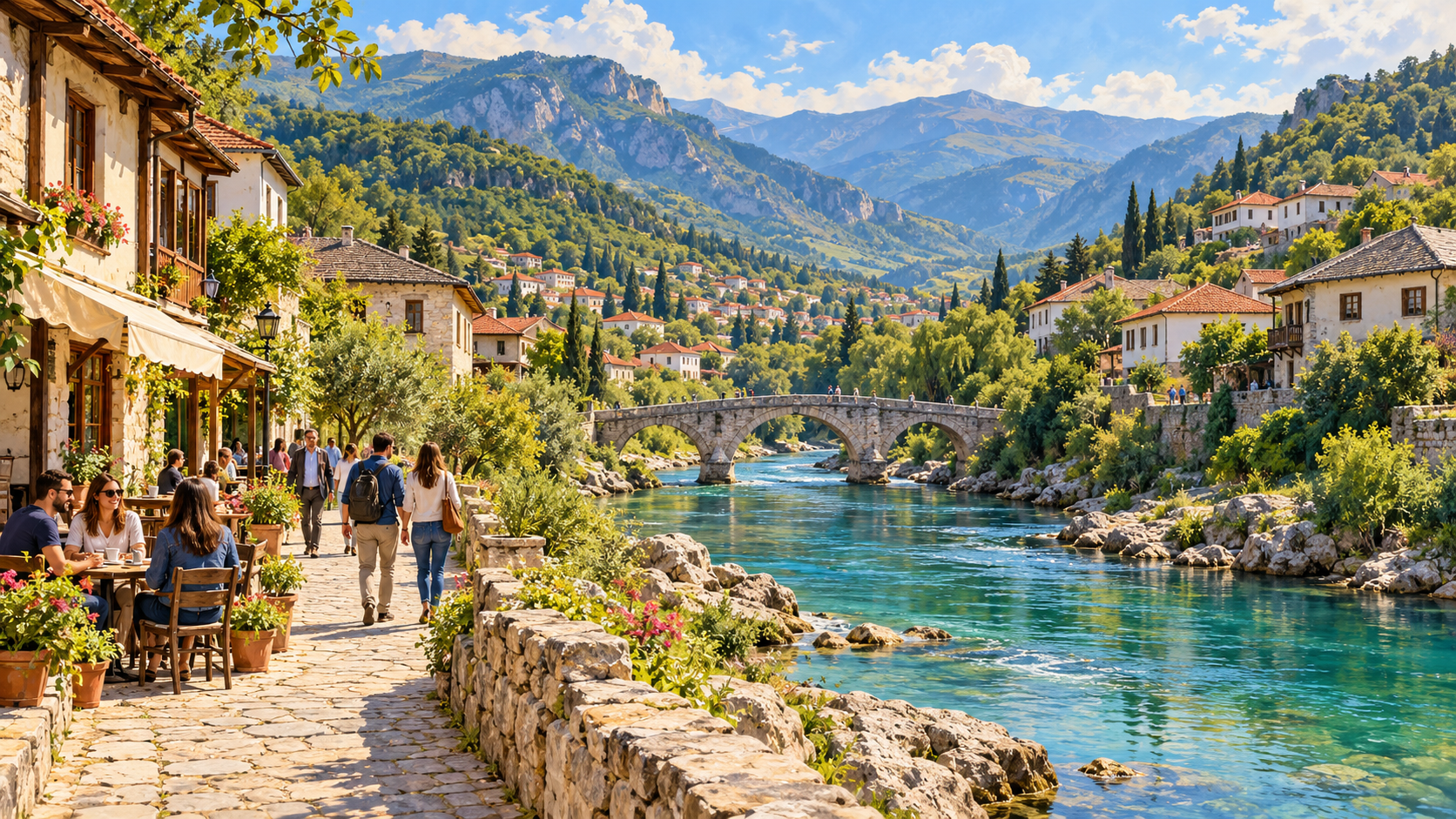
Bosnia and Herzegovina invites you to look at the connections between places and people. A bridge can introduce engineering and public memory, a carved wooden object can reveal a living skill, and a song can carry a story that a photograph cannot. These top 10 things to learn when visiting and touring Bosnia and Herzegovina bring geography, history, culture and everyday observation into a country learning guide that is clear enough for a family conversation and substantial enough to revisit afterwards.
For Singapore families considering educational travel in Bosnia and Herzegovina, a useful question often begins with something small: how a river shapes a town, how a maker cuts a pattern, or how a museum explains an object. This Bosnia and Herzegovina travel learning guide offers ten lessons, English–Chinese vocabulary and gentle activities for parents and students. Use the chapter routes to prepare for appropriate visits or explore from home through official cultural resources. You do not need to see every place to learn something meaningful.
Check current official Bosnia and Herzegovina travel advice before arrangements. Official safety guidance warns that landmines and unexploded weapons remain in some rural, neglected and former conflict areas. Do not leave roads and paved areas without an experienced guide or enter abandoned buildings. The countryside lessons below are map-based or require verified professional access; they are not invitations to explore off-route. Diving from Mostar’s bridge is dangerous and is not a learning activity in this guide.
Choose your reading route
Read the ten lessons in order, or begin with the part of Bosnia and Herzegovina that makes you curious. The short observation tasks are invitations to look closely; they do not require a school worksheet.
Read the landscape · Meet culture and daily life · Connect the bigger story
Full contents · Country learning directory · Travel vocabulary directory
Contents
Read the landscape
Meet culture and daily life
Connect the bigger story
A calm family learning route · English–Chinese vocabulary for the learning journey · Questions families often ask · Continue the country learning journey
A map gives the country a framework before you begin collecting images of individual landmarks. Locate Sarajevo and Mostar, then identify the rivers and relief around the places you are studying. Notice how a town’s shape and position relate to its surroundings. A river drawn as a thin blue line may be a major physical presence on the ground, while a nearby mountain can be easy to miss on a simplified road map.
Start with a geographical map and its legend. Does it show elevation, roads, administrative boundaries or several layers together? Each layer answers a different question. A student can compare two representations of the same area and identify what became easier to understand in each. This is more useful than assuming the map with the most detail must always be the best one.
The UNESCO account of Mostar’s Old Bridge Area places the settlement in the Neretva valley and connects its development with a river crossing. Use that as one documented example of geography meeting urban history. It does not mean that every town has the same origin or that rivers alone explain settlement. It supplies a specific relationship you can examine carefully.
For younger learners, make a conceptual drawing with a river, two banks, a crossing and nearby streets. Label it as a sketch, not a surveyed plan. Ask how a crossing changes the connections on the drawing. What remains separate without it? The activity makes the role of a bridge visible before the family discusses its architectural or historical significance.
Older students can ask what a map cannot establish. A line representing a road does not prove its present condition; an apparent short cut does not establish safe access. Current local arrangements require responsible checks. In Bosnia and Herzegovina, the official warning about unexploded weapons makes the distinction particularly important. Map curiosity must never become a reason to enter unknown countryside or abandoned structures.
Bring the exercise back to Singapore by choosing a familiar waterway and a crossing. Compare the questions you ask about movement rather than claiming the two settings share a history. Which connections does the crossing provide? Which features of the surrounding town can you actually observe? Familiar examples help children recognise that geography concerns everyday relationships as well as dramatic landscapes.
Notice and discuss: identify one town, one waterway and one relationship between them. State whether the relationship is visible on the map or explained by a historical source. That distinction will help you read the following chapters with greater precision.
Stari Most is not simply an attractive curve above a river. UNESCO’s Mostar account explains the bridge’s destruction during the 1990s conflict and its reconstruction, completed in 2004, alongside work on the historic area. The site provides a powerful question: what changes when a structure is understood as a crossing, an architectural achievement and a public symbol at the same time?
Begin with form. From an authorised photograph or suitable public viewpoint, describe the arch, the banks and the approaches. Which relationship first draws your eye? You can discuss how a crossing connects places without claiming to calculate the bridge’s structural forces. Technical performance requires engineering knowledge and evidence beyond a visitor’s impression of an elegant shape.
Now put the structure into time. A reconstructed bridge is not an untouched object carried unchanged from its first construction. Nor does reconstruction make it historically meaningless. Read what the official account says about the work and its significance. Older students can distinguish original fabric, reconstructed form and continuing public meaning as related but different aspects of heritage.
For a family, compare two kinds of caption. One might say only that the bridge is beautiful. A second might explain its role in connecting the banks and acknowledge the reconstruction. Which helps another reader understand more? The aim is not to remove the pleasure of the view. It is to let the historical context add depth to what initially attracted you.
The surrounding streets matter too. A bridge belongs to an urban setting, not an isolated postcard. Look at the public interpretation of nearby buildings and routes. Ask how the area is presented as a connected whole. Respect active homes, businesses and places of worship. Historic value does not turn every doorway into a visitor attraction or make people’s everyday spaces available for inspection.
Keep the safety boundary explicit. Watching an activity is not a reason to imitate it. Official guidance warns that jumping or diving from the bridge has caused serious injury and death. A child can learn about engineering and memory from an image, a plan or an appropriate viewpoint. No risky physical demonstration is necessary to make the lesson vivid.
Notice and discuss: explain the bridge in three short sentences: one about visible form, one about a documented historical change and one about its public significance. Check that the final sentence attributes interpretation rather than guessing what every resident feels.
LESSON 3 OF 10
3. Approach Sarajevo through public space rather than a single label
Sarajevo is best approached with attention to particular streets, institutions and public explanations rather than an attempt to summarise the city with one dramatic phrase. Begin with a city map and choose a small, suitable area to study. Where are the streets, the river, public buildings and cultural institutions in relation to one another? The arrangement creates an entry point into urban life without pretending to reveal everything about it.
Choose one publicly documented building or street feature. Describe an entrance, a frontage, an open space or the movement between two places. Then consult an authoritative interpretation for its historical context. The order matters. A visitor can observe appearance, but appearance alone does not establish a building’s age, religious role or the identity of the people who use it.
The National Museum of Bosnia and Herzegovina provides a dependable cultural starting point in Sarajevo. Its public resources connect archaeology, ethnology and natural sciences. You can use an institution as an anchor for your enquiry, then connect what you learned inside with questions about the wider city. That is often more coherent than rushing from one unfamiliar façade to another.
For younger children, notice a threshold. What marks the change from street to entrance or from a busy route to a quieter public space? A drawing can show the sequence without needing architectural terminology. For older students, compare a current image with a documented historical account. Ask which changes the source establishes and which you can only speculate about.
Religious and cultural diversity require care with language. A building’s public identity does not allow you to assign beliefs to every person nearby. Follow current dress, access and photography guidance at active institutions. If a guide explains the relationship between places of worship, attribute the account and keep the particular examples named. Respect is more precise than treating difference as colourful background scenery.
The city also contains ordinary contemporary life. Shops, schools, transport and workplaces do not disappear because a visitor is interested in history. Ask how your chosen source presents present-day use alongside the past. A thoughtful travel account can describe a historic feature without writing as though all residents are living inside a museum.
Notice and discuss: select one urban relationship, such as an institution beside a route or an entrance facing a public space. Explain what you saw and add a documented contextual point. End with a question that would require local knowledge rather than a visitor’s guess.
The National Museum’s official collections offer more than a list of valuable objects. They provide an opportunity to understand how institutions organise knowledge. An archaeological artefact, an ethnological object and a natural-history specimen do not all answer the same question. Reading their labels carefully helps a student connect visible material with the research that makes it meaningful.
Choose one item that is currently displayed or publicly documented. Start with what you can describe: material appearance, shape, arrangement or a visible feature. Then identify the information supplied about date, place, use or classification. Which facts could you see directly? Which rely on professional investigation? An object can be small while the knowledge required to interpret it is substantial.
The museum’s publicly introduced Butmir culture bowl is one possible starting point, subject to current display arrangements. A bowl invites a familiar question about making and use, while its archaeological context prevents it from becoming merely an attractive household shape. Use the responsible institution’s explanation rather than assigning a purpose from resemblance to something in your own kitchen.
For younger learners, draw one feature and write a single attributed fact. Older students can make a short evidence record: object, documented context, observation and unresolved question. Both approaches slow the visit down helpfully. They replace the pressure to see everything with the pleasure of understanding one item more clearly than you did when you arrived.
Read the exhibition arrangement as well as the individual label. Are objects grouped by period, material, region or theme? Describe the sequence that the display presents. Do not infer a curator’s private intentions unless they are stated, but consider the effect on your understanding. A change in grouping can make different relationships visible even when the objects themselves remain the same.
Conservation deserves attention. Display cases, controlled access and restrictions on handling or photography support the institution’s responsibilities. They are not obstacles to real learning. If a particular object is unavailable, use another documented example or an official digital resource. Do not promise access to a famous item from an old visitor article; current museum information is the appropriate source.
Bring the lesson home with an object whose history you know. Which information would be lost if someone found it without a label? What would they need to ask? This makes the museum’s interpretive work tangible. The object does not explain itself completely, and a clear account of its context is part of its educational value.
Notice and discuss: explain one object with a direct observation and one attributed fact. Add a question about its context or preservation. A careful paragraph can show more historical understanding than a long list of things you passed in a gallery.
The Federal Ministry of Culture and Sports heritage introduction identifies Konjic woodcarving among Bosnia and Herzegovina’s recognised living heritage practices. That gives you a specific place and skill to investigate. A carved object can be admired visually, but its deeper interest lies in the planning, judgement and practice that make the finished work possible.
Begin with a documented example or an authorised demonstration. Notice how a pattern relates to the object’s surface and shape. Does the design repeat, change direction or frame an edge? Describe those visible relationships in plain language. You do not need to invent a symbolic meaning for every motif. Ask a knowledgeable maker or public interpretation what is actually explained about it.
Next, distinguish design from execution. A drawing and a finished wooden surface are not the same thing. Ask which decisions must be made before cutting and which adjustments arise during work. A brief demonstration may reveal only part of the process. Recognise that years of practice can sit behind a movement that looks effortless to someone watching for a few minutes.
For a younger child, make a repeated pattern on paper. Compare what happens when the spacing changes or an edge interrupts the sequence. Label this as a simple design exercise, not a recreation of Konjic woodcarving. Do not offer carving tools as a casual travel activity. The learning goal is to notice structure and appreciate professional skill.
Older students can ask how knowledge is passed on. Which parts can be described in words, and which require demonstration and feedback? This distinction helps explain why living heritage is not preserved only by storing finished objects. The people who practise and teach a skill are part of its continuing existence. A photograph of the result cannot replace their knowledge.
If considering a purchase, ask about maker, material and origin where information is available. Avoid assuming that every object sold nearby is made through the same process. Respect a maker’s time, pricing and permission around photographs. A thoughtful exchange can teach about work without turning someone else’s workshop into a free performance for the visitor.
Connect the lesson with any skilled work you recognise at home: tailoring, instrument repair, food preparation or joinery. Compare the relationship between practice and judgement, not the cultural traditions themselves. A student may begin to see expertise in ordinary actions that previously looked simple because the person performing them was already proficient.
Notice and discuss: describe one pattern relationship, one documented detail about the practice and one question about learning the skill. Keep the maker within the account. Craftsmanship is not just an object category; it is knowledge expressed through work.
The official cultural heritage introduction identifies sevdalinka as a traditional urban folk-song practice. Music offers a different way into the country because some relationships are heard rather than seen. Begin with an authorised recording and its public context: performer, title, occasion and source where these are supplied. A labelled example is more useful than an unattributed clip circulating online.
Listen once without trying to explain everything. Which feature holds your attention: the voice, a pause, a repeated phrase or the relationship with accompanying sound? Describe the effect on your listening rather than claiming a fixed meaning. A listener’s response is real, but it is not evidence that every performer or audience member experiences the song in the same way.
Listen again with the supplied interpretation or a reliable translation. What changed? A line that first sounded only melodic may now carry a story or emotional relationship. Keep translation and musical performance distinct. Understanding words can add context, while the timing, voice and phrasing still contribute something that a printed translation cannot fully reproduce.
For a family, divide attention gently. One person follows repetition, another notices a pause and another reads the contextual note. Share what you noticed without declaring a winner. This allows learners with different interests to contribute. Someone who does not know musical terminology can still describe a precise relationship within the recording.
Older students can compare two authorised performances of the same song if the identification is clear. What varies in tempo, accompaniment or vocal delivery? Avoid presenting personal preference as a judgement of cultural authenticity. Differences can raise questions about interpretation and occasion. They do not necessarily mean that one version is the single correct expression of the tradition.
Keep lyrics within appropriate boundaries. A brief discussion of a theme is enough; there is no need to reproduce a long copyrighted text. Credit the performer and source when sharing a recording, and follow event rules if listening in person. Participation should be invited and appropriate rather than assumed because a visitor feels enthusiastic.
Bring the lesson to a song you know well. How would your understanding change if you heard it without knowing its words or context? The comparison builds empathy with your first experience of sevdalinka. It also shows why patient listening and knowledgeable explanation can work together without reducing music to a worksheet.
Notice and discuss: identify one audible feature and one contextual point supplied by a reliable source. Explain how they meet in your understanding of the example. The result should help another person listen more attentively, not make a broad claim about a nation’s emotions.
The UNESCO account of Stećci Medieval Tombstone Graveyards describes a serial heritage property extending across Bosnia and Herzegovina and neighbouring countries. The tombstones date broadly from the medieval period and include carved motifs and inscriptions. This provides a useful lesson in scale: heritage can be associated strongly with a country while also belonging to a wider regional history.
Begin with a documented image and its location. Do not travel to an unfamiliar rural site simply because a map marks a graveyard. Access requires current checks and responsible professional guidance, particularly given unexploded-weapon risks in some areas. An official image can support careful study without bringing a learner into uncertain terrain.
Describe one stone’s form or carved arrangement. Which features are visible? Is an inscription transcribed by the source, or are you merely seeing marks that resemble lettering? Use the supplied reading rather than guessing words. Weathering, language and script can all make interpretation difficult, and a confident invented translation is less useful than an honest unresolved question.
Then consider the cemetery as an arrangement rather than only a collection of objects. A plan or official photograph may show relationships between stones. What can you say about spacing or orientation from the particular representation? Avoid generalising from one frame to every site in the serial property. The relationship is interesting precisely because the examples have their own settings.
For younger learners, draw the outline of a documented stone and annotate one feature. Do not rub, chalk, touch or climb monuments to make a pattern clearer. A home-based drawing is sufficient. Older students can ask how a carved motif, an inscription and a location provide different kinds of evidence about the past.
The cross-border listing introduces a gentle discussion of categories. A present-day political boundary does not automatically define the full distribution of a historical practice. Compare the locations supplied by UNESCO on a map. The exercise is about understanding the relationship between the current map and historical evidence, not about making unsupported claims concerning identity or ownership.
Respect the commemorative nature of the sites. A grave marker is not simply a convenient background for a playful pose. Follow local guidance and keep the people associated with remembrance in mind. A restrained account can still be visually descriptive and intellectually engaging; respectful behaviour does not reduce the opportunity to learn.
Notice and discuss: connect one visible feature with an attributed contextual fact. Add a sentence explaining why the wider regional distribution matters. Your account should distinguish a particular stone, its cemetery and the serial property rather than treating them as interchangeable.
Learning about Bosnia and Herzegovina should not ignore the violence of the 1990s, but it should not reduce the country or its people to that history either. The Srebrenica Memorial Center’s official resources provide a responsible starting point for remembrance of the Srebrenica genocide. Approach such material with care for victims, survivors and the learner’s age and readiness.
Parents should review the material before sharing it with children. Choose an appropriate public explanation and allow questions without requiring every child to engage with graphic content. Older students can study documented history, testimony and the responsibilities of remembrance with adult support. A memorial is not a dramatic attraction to add casually between leisure stops.
Begin with purpose. What does the institution say it preserves or commemorates? Distinguish a personal testimony, a historical chronology, a photograph and a legal judgement when the source presents them. These forms of evidence are connected but not identical. Careful attribution helps a learner understand what supports a statement and why the source matters.
Language deserves particular attention. Use accurate terms from responsible historical and institutional accounts. Do not turn genocide into a vague story of general disagreement or present established atrocity history as merely competing opinion. At the same time, avoid assigning guilt or experience to an individual today on the basis of a guessed identity. Precision supports both historical accuracy and human dignity.
The memorial’s visitor information invites advance communication about needs and interests. If a visit is appropriate, seek current guidance directly about access, interpretation and the needs of the group. Respect photography and behaviour rules. A quiet encounter and a thoughtful conversation may be more suitable than a large programme of tasks.
For a remote enquiry, use a short, carefully chosen institutional explanation. Ask what remembering an individual adds to a broad historical account, without copying private grief into a school performance. The learner can reflect on evidence, responsibility and the importance of naming people as people. There is no requirement to produce a clever analogy for suffering.
End with space rather than a forced positive conclusion. A child or teenager may need time to process what they learned. It is acceptable to say that the material is difficult and to return to it later. The educational goal is informed, humane understanding, not proving emotional toughness or completing an exercise quickly.
Notice and discuss: with appropriate adult support, explain the memorial’s stated purpose and one responsibility of a visitor or reader. Keep the response factual and respectful. Let it remain a distinct part of the country’s history rather than the only lens through which you see contemporary life.
A meal can introduce everyday knowledge that monumental buildings do not show. Choose a suitable place under current local arrangements, or use a responsible culinary account from home. Begin with one dish or one service practice rather than making claims about what everybody in Bosnia and Herzegovina eats. Menus, households and individual preferences vary; a visitor encounters a particular example.
Observe what is actually available to you. How is the food presented? Which components can you identify, and which ingredients need to be explained? Ask the responsible person rather than inferring a recipe from appearance. This is especially important for allergies, dietary requirements and unfamiliar preparations. A familiar word on a menu is not a guarantee of a familiar ingredient list.
Preparation makes a useful enquiry. Which parts involve timing, temperature, arrangement or judgement? If an appropriate explanation is offered, connect one step with the finished result. Do not demand access to a working kitchen or assume someone must provide a demonstration. The labour that supports hospitality remains work, even when the visitor is enjoying a relaxed meal.
Coffee service, where appropriate for adults, can be studied as an arrangement of objects and conversation without encouraging children to consume it. A cup, a serving vessel and the order in which things are offered may catch your attention. Ask what the particular host chooses to explain. Avoid turning one encounter into a rigid national etiquette rule that every person must follow.
For younger learners, describe texture and temperature using precise but ordinary vocabulary. Older students can connect a meal with questions about supply, preparation and service. Which questions could the cook answer, and which would require an agricultural or historical source? The different kinds of knowledge prevent an enjoyable sensory impression from becoming an invented food history.
Bring the comparison to a family meal in Singapore. How much work sits behind an apparently simple dish? Which decisions are invisible once the plate is served? The aim is to appreciate skilled preparation and human attention. It is not to rank cuisines or describe another person’s ordinary food as strange entertainment for the visitor.
Notice and discuss: explain one dish or service arrangement with a direct observation and a fact supplied by the responsible person. Add a question about the work behind it. A meal becomes a meaningful learning encounter when the people providing it stay within the story.
LESSON 10 OF 10
10. Connect preservation, public life and your own changed understanding
The preceding lessons have introduced several kinds of continuity. A reconstructed bridge carries a documented history; a craft continues through skilled practice; a museum preserves material evidence; a song gains new expression through performance. They do not all preserve the past in the same way. The final lesson is to recognise those differences and explain one relationship clearly.
Choose three examples you studied. They need not come from three physical visits. A museum object, an authorised recording and a map can provide substantial material. For each, write what first attracted your attention and what a reliable explanation added. A change in understanding is a better conclusion than a list of adjectives such as beautiful, historic and interesting.
Now compare the form of preservation. A monument involves material and setting. A skill involves people, practice and transmission. A memorial involves evidence, remembrance and responsibilities toward those whose lives it records. These categories overlap, but distinguishing them helps a student ask a more useful question about what continuation requires.
Keep contemporary life visible. Bosnia and Herzegovina is not a collection of reconstructed façades or a permanent representation of conflict. The country includes ordinary work, study, creativity and personal choices beyond the examples in this guide. Say which place or source your account concerns rather than claiming to have discovered what an entire population is like.
For younger children, create three cards: a place, an object and a sound. Add one explained detail to each. For older students, write a short paragraph connecting two examples and identifying a limit. Perhaps the bridge and woodcarving both invite questions about making, while their historical and social contexts remain different. A comparison is strongest when it preserves those differences.
Finally, think about your behaviour as part of the learning. Asking permission, following current access advice and listening to a knowledgeable explanation are not additions after the real experience. They help make an encounter responsible and understandable. Curiosity works best when it is joined with care for places and the people associated with them.
Notice and discuss: finish the sentence, “I understood this example differently after…” Use a specific source or encounter to support the answer. Leave room for another person, region or institution to add a perspective your short study has not yet reached.
A calm family learning route
Start with the closest interest. A student fascinated by design can begin with Mostar or Konjic woodcarving; someone drawn to stories can start with the museum or a song. Let the child choose one question before a suitable encounter. The choice makes the activity personal without requiring a large research project or a full-country checklist.
During the encounter, notice one feature and read or hear one explanation. Afterwards, talk about how they connect. Parents can model careful language: “I noticed this,” “the museum explains that,” and “I still want to know…” This is especially helpful when the history is unfamiliar and a confident guess would be easy to mistake for knowledge.
Keep difficult-history learning separate enough to receive proper attention. Review material in advance, choose an age-appropriate approach and allow time afterwards. No child needs to complete every chapter for the family to learn meaningfully. The guide’s navigation makes selective reading straightforward, and remote resources allow a topic to be revisited when the learner is ready.
Finish with one manageable follow-up. Compare a network or street map, listen to a recording again, or write a caption for one object. A small task done thoughtfully is sufficient. The aim is a learner who can explain a relationship clearly and remains curious about what has not yet been understood.
English–Chinese vocabulary for the learning journey
| English | 中文 | Use it in your learning |
|---|---|---|
| relief | 地形起伏 | Read elevation and shape on a map. |
| river crossing | 渡河通道 | Explain how two banks are connected. |
| reconstruction | 重建 | Distinguish rebuilding from untouched survival. |
| public memory | 公共记忆 | Discuss how places are interpreted collectively. |
| artefact | 人工制品;文物 | Identify material evidence in a museum. |
| interpretation | 诠释;解说 | Separate explanation from direct observation. |
| craftsmanship | 工艺;手艺 | Recognise judgement within skilled work. |
| transmission | 传承;传播 | Ask how knowledge continues between people. |
| motif | 装饰图案 | Describe a repeated carved feature. |
| inscription | 铭文 | Use a responsible reading of written marks. |
| remembrance | 纪念;追思 | Approach memorial material respectfully. |
| testimony | 证言 | Attribute a person’s account carefully. |
These are English–Chinese learning equivalents, not translations into local languages. Use them within a clear sentence, such as, “The reconstruction preserved a form while the interpretation explained its history.” Precision is more valuable than trying to fit every new word into one paragraph.
Questions families often ask
Is this a sightseeing itinerary?
No. It is a learning guide with cultural examples and public resources. Current travel advice, access, transport and personal suitability need separate checks. The geography and graveyard lessons are not permission to enter unknown countryside, leave approved routes or explore abandoned buildings.
Should younger children study Srebrenica?
Parents should review the material and choose an age-appropriate approach. The chapter is not a compulsory stop or an invitation to graphic content. Some learners may begin with a gentle discussion of remembrance; older students may be ready for more detailed institutional resources with adult support.
Can we learn without attending a live performance?
Yes. An authorised recording can be paused and revisited, while its contextual information helps explain what you hear. Identify the source and example clearly. A recording is valuable evidence of a performance, but it is not the complete experience of every occasion or every practitioner.
What is the best writing task afterwards?
Ask for one observation, one attributed explanation and one open question. This supports vocabulary, evidence and clear organisation. A concise paragraph about one bridge, object or song is a stronger outcome than a long account filled with unsupported statements about the whole country.
Continue the country learning journey
Return to the country learning directory. The preceding alphabetical guide is Bolivia, and the next is Botswana.
Explore the travel vocabulary directory for another language-learning route, or return to the World Travel and Luxury Hub for wider connections between places and public life. Carry the same habit into the next country: begin with a particular example, learn its context and explain what changed in your understanding.