
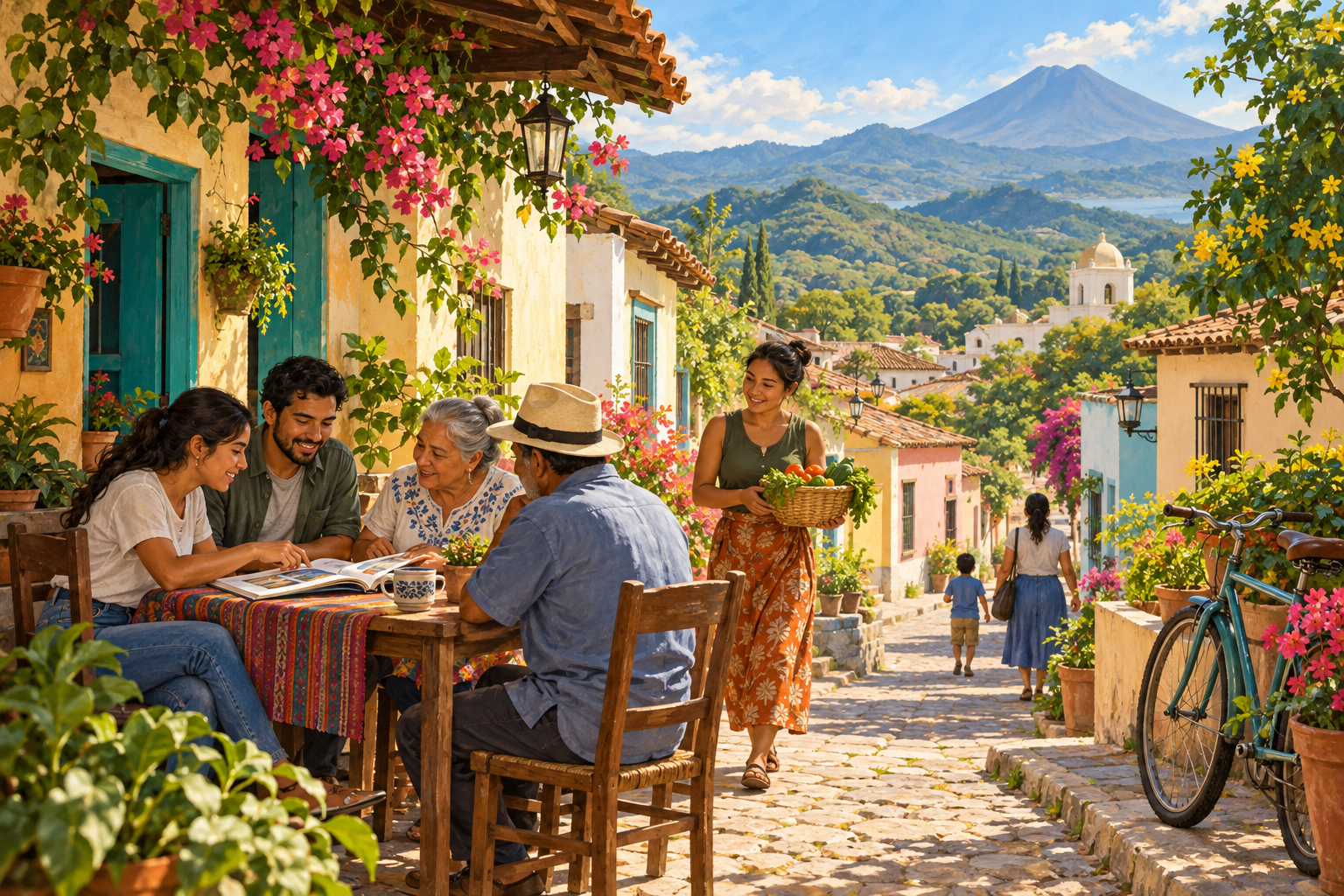
Did you know that El Salvador’s archaeological story includes a farming settlement preserved by volcanic ash, not only monumental Maya structures? A varied ten-place shortlist is San Salvador, Suchitoto, Joya de Cerén, Tazumal, Santa Ana, Santa Ana Volcano, Lake Coatepeque, Concepción de Ataco, Juayúa and El Tunco. Together they introduce city life, everyday ancient history, highland towns, volcanic landscapes and the Pacific coast.
The best places to visit in El Salvador become easier to organise when you separate the capital and Suchitoto from the western cluster around Santa Ana, Chalchuapa, Coatepeque and the Ruta de las Flores towns. El Tunco adds a different coastal chapter. Santa Ana the city and Santa Ana Volcano are different experiences: a cathedral-and-theatre day is not preparation for a crater hike.
For a first El Salvador itinerary, choose a few contrasting places and leave time to understand them. Check current security guidance, the continuing state of exception, transport, volcanic access and weather before booking. Pacific surf is not a guarantee of safe swimming. This guide is an editorial selection, not a measured national ranking or an assurance that every path, interior or excursion is open; live travel guidance should shape the actual journey.
eduKateSG · El Salvador travel guide
Find your reading route
Choose a city-and-history route, a western highland stay or a coastal contrast. Keep a demanding outdoor activity separate from an ordinary sightseeing day.
ROUTE 4
Plan your visit
ROUTE 5
Check official sources
The ten places at a glance
| Place | What it adds | Planning context |
|---|---|---|
| 1. San Salvador | The capital and a starting point for contemporary cultural context | Choose a precise city route with current local advice |
| 2. Suchitoto | A historic townscape and opportunities to understand craft and culture | A separate town visit north of the capital area |
| 3. Joya de Cerén | Exceptional evidence of ordinary life preserved by volcanic ash | Archaeological visit; use current park arrangements |
| 4. Tazumal | Maya monumental structures and a different archaeological perspective | Chalchuapa; distinct from Joya de Cerén |
| 5. Santa Ana | A western city and an architectural-cultural base | Distinguish the city from its neighbouring outdoor attractions |
| 6. Santa Ana Volcano — Ilamatepec | A volcanic landscape requiring a deliberate hiking decision | Current access, guide arrangements and conditions matter |
| 7. Lake Coatepeque | A lake landscape that complements the western highlands | Choose an authorised viewpoint or a specific visitor facility |
| 8. Concepción de Ataco | Murals, coffee and a western highland town | Ruta de las Flores; allow time within the town |
| 9. Juayúa | A highland town with a strong food-and-public-space appeal | Ruta de las Flores; confirm any special event |
| 10. El Tunco | A Pacific coastal setting known for surf culture | La Libertad coast; surfing and swimming need separate assessments |
Choose a place, then read its practical notes
PLACE 1 OF 10
1. San Salvador
The capital and a starting point for contemporary cultural context
San Salvador is a useful introduction because a country cannot be understood through waterfalls, waves and ruins alone. The capital gives the journey a present-day setting. Its historic centre offers public spaces and cultural buildings that can make a focused first outing, while the wider city should be approached with current local guidance.
Begin with a short, coherent route rather than trying to cross the entire capital. A square, a religious building and a cultural institution can introduce different ways a city gathers people. Ask what each place is used for now, not only when it was built.
Choose an interior according to your interests and check its arrangements. A theatre exterior and attending a performance are different experiences; visiting a church requires respect for worship and site instructions. Do not assume every building mentioned in a city guide has unrestricted visitor access.
Keep the practical plan as clear as the cultural one. Use appropriately arranged transport, follow current advice about areas and movement, and avoid demonstrations. The continuing state of exception is relevant to travellers, not background information to dismiss because you are sightseeing. A modest, locally informed day can be both more enjoyable and more coherent than an improvised urban circuit.
PLACE 2 OF 10
2. Suchitoto
A historic townscape and opportunities to understand craft and culture
Suchitoto offers a smaller-scale contrast with San Salvador. Its historic townscape makes it a good place to enjoy a walk through streets and public spaces while considering how a town’s appearance relates to the life taking place within it.
Do not rush the central setting. Choose a manageable route, pause to look at façades and entrances, and notice how the square connects different activities. A compact centre can still involve paving, gradients and heat, so ask about access needs rather than equating small with effortless.
An arranged craft or cultural experience can add depth. If you are interested in indigo, ask about the material, the process and the people doing the work. Distinguish a demonstration from a chance to participate, and do not assume a workshop is available without advance arrangements.
The town can be enjoyed without adding every surrounding nature excursion. A lake outing or waterfall route needs its own access, weather and operator checks. Giving Suchitoto time as a living town—perhaps a walk, a meal and one cultural visit—may be more satisfying than using it only as a launch point for another activity.
PLACE 3 OF 10
3. Joya de Cerén
Exceptional evidence of ordinary life preserved by volcanic ash
Joya de Cerén is one of the most meaningful places in this list because it changes what you look for in archaeology. UNESCO recognises the evidence of a pre-Hispanic agricultural community preserved beneath volcanic material. The interest lies in everyday life rather than the grandeur of a ruler’s monument.
Ask what researchers can learn from a dwelling, a storage area or the relationship between structures. How did people organise work and domestic space? What kinds of activities leave traces? A site can be enormously informative even when it does not look like a towering temple.
Use interpretation to distinguish evidence from reconstruction. A label or guide should explain what was found and what is inferred from it. The familiar comparison with Pompeii can help communicate preservation, but the settlement deserves to be understood in its own Salvadoran and regional context.
Check current opening and the visitor route before travelling. Stay within permitted areas and do not touch or collect material. For a family, this can be an excellent place to ask, ‘What would our ordinary home tell a future archaeologist?’ That question connects the past with experience without reducing the people who lived here to a curiosity.
PLACE 4 OF 10
4. Tazumal
Maya monumental structures and a different archaeological perspective
Tazumal introduces a different kind of archaeological scene. The official tourism account identifies Maya structures at Chalchuapa, providing a monumental contrast with Joya de Cerén’s evidence of everyday agricultural life.
Compare the questions the two sites encourage. At Tazumal, you may ask about formal structures, public activity and the way a settlement expressed importance. At Joya de Cerén, the focus can be household life. Neither is a complete account of the past, and one is not more valuable simply because its structures look more imposing.
Look carefully at how the site is interpreted and maintained. Archaeological remains may include conservation work or restoration; ask which elements are original and how the presentation helps visitors understand them. Visible completeness is not the same as untouched survival.
Do not climb structures unless the responsible site authority explicitly permits it, and follow the current visitor route. Check admission and opening arrangements independently rather than assuming all parks operate on the same calendar. A well-understood visit to one archaeological site is more useful than racing through several because they appear close on a map.
Santa Ana adds a western urban chapter to the journey. Its cathedral and theatre associations give visitors a way to explore the city through architecture and cultural activity rather than treating it only as a base for a volcano outing.
Choose a short route that lets you consider the public setting around major buildings. What changes between a square, a religious space and a performance venue? Those places bring different kinds of people together and can help you read the city more thoughtfully.
Check each institution directly if you want to enter or attend an event. A picture of an attractive theatre does not establish a tour or performance on your dates. Keep a worthwhile city walk as the core plan, then add interiors that are genuinely available and suited to your interests.
Santa Ana can help organise a western stay, but nearby destinations are not interchangeable. Tazumal, the volcano and Lake Coatepeque ask for different preparation. Do not assume arriving in the city completes the planning for all three. A balanced stay can combine one urban day with a carefully selected outdoor or archaeological contrast.
PLACE 6 OF 10
6. Santa Ana Volcano — Ilamatepec
A volcanic landscape requiring a deliberate hiking decision
Santa Ana Volcano, also called Ilamatepec, offers an entirely different experience from the city sharing its name. The attraction is the volcanic landscape and crater setting, but the decision to hike should come before any assumption that it belongs in everyone’s itinerary.
Ask about the current authorised route, guide requirements, distance, gradients, exposed sections and weather. A popular hike can still be demanding. A promotional view does not show how the approach feels to someone with limited fitness, mobility needs or discomfort near heights.
Volcanic and local access instructions take precedence over a tour description. Respect closures and barriers, remain on the approved route and do not approach an edge to improve a photograph. This article provides no self-guided route or guarantee of crater access.
If the outing does not suit your group, choose a permitted lower-effort viewpoint or a different destination, subject to current conditions. Appreciating a volcano does not require reaching the most dramatic position. A rewarding visit is one that everyone can take part in appropriately, not one that asks the least confident traveller to keep up at any cost.
PLACE 7 OF 10
7. Lake Coatepeque
A lake landscape that complements the western highlands
Lake Coatepeque provides a broader water-and-landscape contrast with the nearby highland and volcanic choices. It can be appealing for travellers who want time to look, eat and pause rather than commit to another strenuous walk.
Decide what kind of visit you want. A viewpoint, a meal at a particular facility and a water-based activity are separate plans. Check the actual access and arrangements instead of assuming an open-looking shoreline can be used anywhere.
Swimming, kayaking or a boat outing should be assessed independently, with current conditions, rules, equipment and operator information. A lake view is not evidence of suitable water quality or a safe entry and exit for every visitor. Do not let an attractive image replace those checks.
Lake time can also be meaningful without entering the water. Ask how the setting relates to the surrounding landscape, or compare the view from different permitted positions. If your western itinerary already includes a demanding hike, a carefully chosen, restful lake visit may provide the balance the group needs.
Concepción de Ataco is an inviting choice within the Ruta de las Flores. Its murals and coffee associations give a town visit several points of interest without requiring a long list of major attractions.
Treat street art as more than a backdrop. What subject does a mural choose? Who made it, and what local story does it communicate? You may not be able to answer every question on the spot, but asking them changes the visit from collecting colourful walls to paying attention to a place.
If you want a coffee experience, check whether it is a café stop, a tasting or an arranged production visit. They explain different parts of the story. Ask about origin and process rather than assuming a cup served in a coffee region automatically comes from the nearest farm.
Ataco can pair with another highland town when the transfers work, but leave time for a walk, a pause and any arranged visit. Do not try to complete every Ruta de las Flores destination in one hurried outing. A single town appreciated well can communicate more than five seen mainly through a vehicle window.
Juayúa offers another perspective on the western highland route. Its food associations, cafés and central religious architecture can make it a pleasing town visit, especially when you give the ordinary public setting time rather than heading immediately for an adventure excursion.
Research the particular experience you want. If a food event is the attraction, check the current schedule and what is actually happening on your dates. A description of a recurring festival or market does not guarantee the same arrangement every day.
Food can be a doorway into learning. Ask how a dish is prepared, what accompanies it and whether a seller is explaining a family method or a wider regional convention. Be considerate about photographs and avoid requiring everyone to taste the same things; allergies and preferences still matter.
Waterfall excursions associated with the area are separate decisions, not automatic additions to lunch. They need current route, guide and water-condition assessment. Juayúa is already worthwhile as a town, and a restful day here may fit your trip better than adding wet terrain or a long return after a meal.
El Tunco brings the Pacific coast into a guide otherwise concentrated on cities and the western highlands. Its surf associations make it interesting even for someone who wants to watch rather than participate.
Notice how the sea shapes the atmosphere. Surfing depends on conditions that are not the same as those desired for relaxed swimming. A beach can be lively and attractive while presenting currents, uneven surfaces or challenging entries.
Official advice warns about dangerous undertows on the Pacific coast. Follow current local instructions and do not assume a well-known surfing destination is a suitable swimming place. If you want lessons, assess the instructor, equipment, conditions and requirements for your ability.
The coast can be enjoyed from an appropriate shore setting, with time to eat and observe. Plan your transfer and return with current security and road guidance, and avoid letting a sunset photograph create a rushed or unsuitable journey afterwards. El Tunco is a contrasting chapter to choose thoughtfully, not proof that a visit must include going into the sea.
Make the journey work for you
Build a small number of regional days
A capital-and-Suchitoto focus can give the journey a cultural introduction. A western stay can choose among Santa Ana, archaeology, lake scenery and the Ruta de las Flores towns. A Pacific coast visit adds another kind of experience. These groupings do not prescribe one route or guarantee convenient transport.
Select the main reason for each day and allow time for it. If a visit depends on an interior, a food event or a guide, confirm that arrangement first.
Keep security guidance current
Read the official advice and local instructions for the specific places and transfers. The state of exception remains relevant. Arrange reputable transport, avoid political gatherings and carry the identification recommended by the responsible authorities; do not rely on a general claim that conditions have improved everywhere.
Separate views from demanding activities
A crater hike, waterfall route or surf lesson needs its own suitability check. Ask what the actual activity involves and let the needs of the whole group shape it. A viewpoint, town walk or museum can be a complete experience rather than a consolation prize.
Let weather change the plan
Rain, landslides, volcanic conditions and coastal water conditions can affect outings. Follow current park and local guidance and keep alternatives. Do not pressure an operator to proceed because a particular photograph was the reason you booked.
Read evidence and living culture carefully
Compare household archaeology with monumental sites, ask about restoration and learn from local voices. In towns and markets, respect residents, workers and worship. Curiosity is most useful when it is specific, considerate and willing to hear a more complex answer.
Questions readers often ask
Are Santa Ana and Santa Ana Volcano the same destination?
No. The city and volcano offer different experiences and need different planning. An urban visit does not establish suitability for a hike.
What makes Joya de Cerén different from Tazumal?
Joya de Cerén is especially important for evidence of everyday agricultural life preserved by volcanic material. Tazumal offers a different monumental archaeological setting.
Do I need to visit every Ruta de las Flores town?
No. Choose the towns that fit your interests and actual transfers, and allow time within them. The name describes a regional route, not a requirement to complete it.
Is El Tunco automatically suitable for swimming?
No. Surfing conditions and swimming suitability are different. Follow current local advice and take the Pacific-coast undertow warnings seriously.
Does a tourist itinerary remove the need to consider security measures?
No. Read current guidance for the exact route and follow local instructions. This shortlist is not a safety guarantee.
Sources and current checks
Destination context and travel advice checked on 12 October 2026. Older heritage accounts explain significance, not current access. Advice, permits, opening arrangements and transport can change; follow the live sources before making a commitment.