
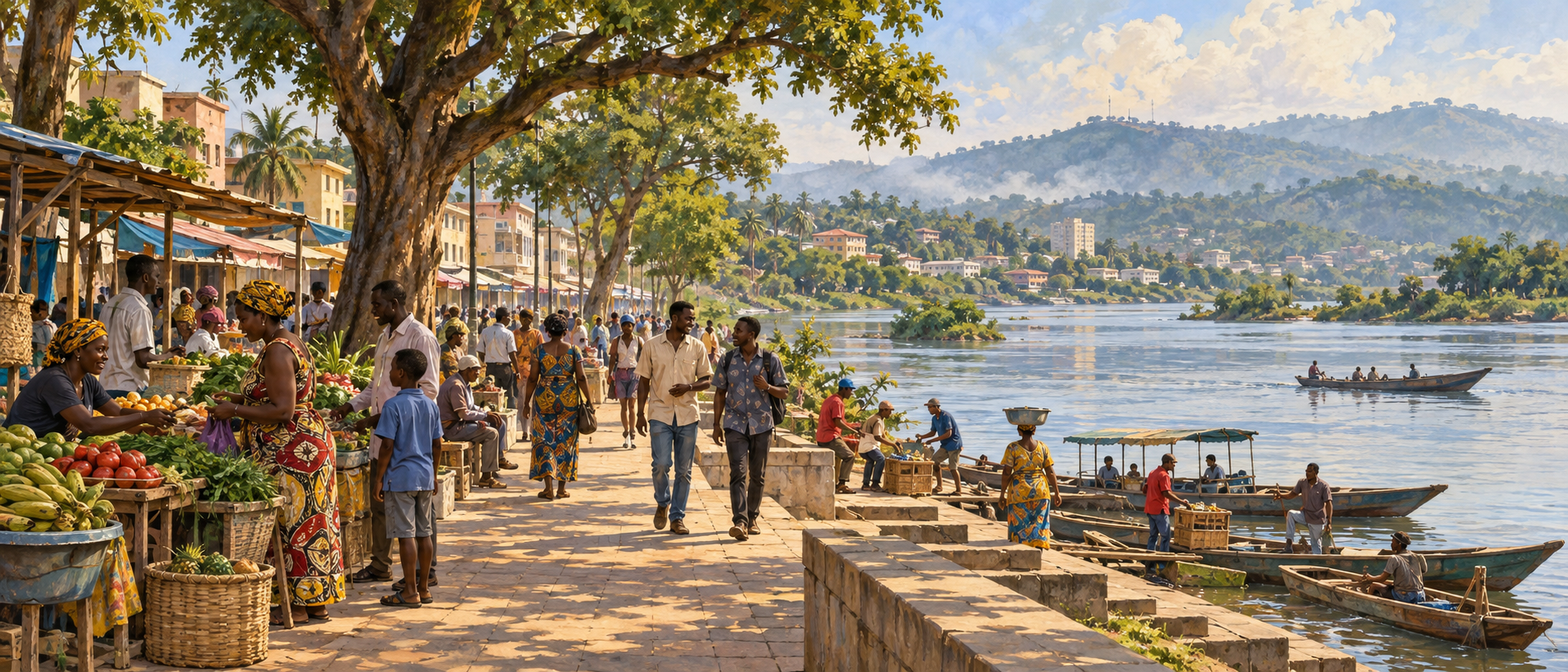
Congo, also called the Republic of the Congo or Congo-Brazzaville, rewards curiosity about more than rainforest photographs. The best things to do when visiting and touring the Republic of the Congo include exploring Brazzaville’s cultural life and river landscape, understanding Pointe-Noire and the historic Loango coast, and learning about forest elephants and western lowland gorillas in the Odzala-Kokoua conservation landscape. These experiences sit far apart, and not every northern forest area is appropriate for a visitor.
This Republic of the Congo travel guide introduces ten meaningful experiences with practical Brazzaville itinerary ideas, Congo Basin wildlife context, UNESCO heritage, coastal history and essential security and health checks. It is specifically about the Republic of the Congo, whose capital is Brazzaville—not the Democratic Republic of the Congo, whose capital is Kinshasa. A little geographical clarity, patient planning and attention to current official guidance make the difference between an informative guide and an unrealistic promise.
Travel information checked 9 October 2026: The UK FCDO advises against all travel within 50 km of the Central African Republic border in the Republic of the Congo’s Likouala Region and warns about instability and road conditions elsewhere, including some risks in Pool. Entry rules include visa arrangements in advance and health certificate requirements for travellers covered by the UK advice. Enhanced arrival health screening may apply. Never plan a rainforest excursion using a generic map alone. Verify the latest conditions for your own travel dates.
eduKateSG · A WORLD WORTH UNDERSTANDING
Plan Congo (Republic of the Congo) by interests, not by pressure
Two river-facing capitals across the water, Atlantic history and extraordinary but highly managed rainforest ecosystems.
Congo (Republic of the Congo) at a glance
First, read the name carefully. This guide covers the Republic of the Congo, often labelled Congo-Brazzaville, with Brazzaville as capital and Pointe-Noire on the Atlantic coast. The much larger Democratic Republic of the Congo, also called Congo-Kinshasa, is a different sovereign country with different permits and security conditions. The two capitals face one another across the Congo River, but crossing the river is an international border journey.
Within the Republic of the Congo, the contrast between city and rainforest is enormous. Brazzaville is a centre of urban life and political and cultural history. Pointe-Noire is a major coastal city. Odzala-Kokoua, inscribed as UNESCO World Heritage in 2023, protects important forest, savanna and river ecosystems. These are not stops one can casually string into a two-day driving loop.
The country also contains vulnerable heritage places and living communities. The Loango coast calls for a serious engagement with the history of the transatlantic slave trade. Conservation work must be understood alongside the rights and livelihoods of people living near protected forests. The strongest journey gives both histories room.
- For a city-focused visit: Start by understanding Brazzaville’s river setting, music, art and urban heritage.
- For a coast-focused visit: Pointe-Noire, Diosso and the Loango heritage landscape belong to a separate, verified itinerary.
- For conservation: Odzala-Kokoua is a remote protected destination requiring organised access, robust health planning and current security verification.
- Never confuse: Republic of the Congo / Brazzaville with the Democratic Republic of the Congo / Kinshasa.
Safety, respect and realistic access
Regional security advice is the first essential distinction. The UK FCDO currently advises against all travel within 50 kilometres of the border with the Central African Republic in Likouala. The Pool region carries a history of conflict and residual risk of sudden clashes, so the exact roads and districts deserve up-to-date assessment. Avoid converting a national park map into a self-drive expedition.
Roads may be in poor condition, particularly in remote areas and in the wet season; the UK FCDO advises caution and notes that the Brazzaville–Pointe-Noire passenger rail service can be slow or unreliable. International ferry movement between Brazzaville and Kinshasa can change or stop with little warning and is subject to immigration procedures. A compelling river view is not a reason to improvise a cross-border trip.
Health requirements also matter. The UK advice describes advance visa requirements for its travellers, yellow-fever and polio certificates at the border, and enhanced screening related to an Ebola outbreak centred in the neighbouring DRC. Confirm the most current rules for your nationality and route with consular and medical professionals. Remote wildlife programmes need specialist logistics and adequate medical and evacuation provisions.
1. Read Brazzaville through the Congo River
Start in Brazzaville by understanding the river. Across the broad Congo River lies Kinshasa, capital of an entirely different country. That relationship makes the waterfront one of Central Africa’s most striking urban geographies: two major cities facing each other, linked by trade and history but separated by an international border.
A carefully chosen public viewpoint or guided city introduction can reveal how river transport, settlement and administration shaped modern Brazzaville. Ask how the river appears in city life and memory. The story becomes richer when you resist the easy tourist temptation to describe one bank as simply a better version of the other.
The view is also a lesson in logistics. Crossing the river is not a small commuter hop for an international visitor. Ferries can be interrupted and paperwork is not interchangeable between countries. Enjoy the geography without turning an uncertain crossing into an unplanned afternoon adventure.
Experience it thoughtfully: Use a reputable guide to learn about Brazzaville’s riverfront and city history, and look carefully at a regional map.
Practical boundary: Confirm safe public access and current neighbourhood conditions; never improvise a Brazzaville–Kinshasa crossing.
2. Explore Brazzaville’s art, architecture and everyday culture
Brazzaville’s cultural interest does not fit neatly into a single museum ticket. Historic buildings, churches, music, contemporary artists and neighbourhood enterprises offer different ways to understand the capital. Sites associated with the Poto-Poto artistic tradition and distinctive urban architecture are starting points for questions, not guarantees of a current exhibition schedule.
Ask who made the work and what it means to the people around it. An artwork can speak to language, identity or the atmosphere of a city more powerfully than a list of famous landmarks. A guide or host with a local perspective will help distinguish functioning public institutions from names preserved only in old guidebooks.
Leave space for a meal and ordinary conversation. Foods shaped by cassava, river fish, market ingredients and regional preferences invite learning without pretending one plate represents the whole nation. This chapter is about contemporary people, not a stage set of inherited culture.
Experience it thoughtfully: Choose one verified cultural site or local-led gallery experience and give time to music or food.
Practical boundary: Check live opening details, neighbourhood advice, permission for photography and responsible transport.
3. Give Pointe-Noire a separate Atlantic-coast chapter
Pointe-Noire introduces a different rhythm from Brazzaville. The Atlantic coast, urban commerce and nearby cultural landscapes make this more than an incidental port on the way to a beach. The sea tells stories of trade and ecology, while the city itself rewards time to notice its neighbourhoods and contemporary life.
Start with geography. The coastal road or the historical railway route is not a guarantee of an easy transfer from Brazzaville. The UK travel advice specifically cautions about unreliable passenger rail services and road conditions. Build realistic arrival and departure time into any coastal plan.
The waterfront may invite a walk or seafood meal, but beach safety comes first. Atlantic currents and conditions can be dangerous, and not every shoreline is a supervised swimming location. Ask local professionals about accessible public areas and current precautions.
Experience it thoughtfully: Allow a genuine urban day in Pointe-Noire instead of making it a two-hour stop between distant excursions.
Practical boundary: Verify safe transport, neighbourhoods, marine conditions and any current coast-related restrictions.
4. Study the Diosso Gorge as a landscape shaped by erosion
Near the Loango cultural area, the dramatic red and ochre forms of the Diosso Gorge invite a different kind of attention. The scenery is sometimes described in tourist writing as a canyon, but the most useful way to approach it is through processes: the role of water, erosion, soil and time in shaping exposed slopes.
Look at how vegetation and geology meet. A line of trees beside bare earth may reveal where water drains or where soils behave differently. Landscape interpretation becomes much more interesting when you can explain why a colour, cliff or hollow looks the way it does.
Such places require caution because exposed ground can be unstable. A photograph cannot tell you about recent rain or the condition of an edge. Choose only an established, locally verified viewpoint and follow the advice of a qualified host.
Experience it thoughtfully: Pair an accessible landscape viewpoint with an explanation of local geology and weathering.
Practical boundary: Confirm permitted viewpoints, road access and ground stability after rain; do not approach unprotected edges.
5. Learn about the Kingdom of Loango and its museum heritage
The historic Kingdom of Loango belongs to the deeper story of the Atlantic coast. UNESCO’s tentative-list description for the old Loango embarkation port also refers to Diosso as an earlier political centre, with a museum associated with the Mâ Loango, or king. Those references invite careful cultural research, not assumptions that every building is open on demand.
Approach the kingdom as a history of real communities, politics, trade and cultural continuity. Names such as a royal court or palace can sound romantic in a travel brochure; they deserve the clarity of evidence, dates and local interpretation. A responsible guide will explain what is established and what is contested.
Where a museum or heritage site is currently open, support its local custodians. If not, research through official cultural documentation and postpone the specific visit. The goal is to understand history rather than to arrive at a locked gate and call the day a failure.
Experience it thoughtfully: Seek verified heritage interpretation around Diosso and Loango with respect for community-held knowledge.
Practical boundary: Confirm live institutional access and current travel conditions instead of relying on old opening-hours lists.
6. Remember the old Loango embarkation port with seriousness
UNESCO’s tentative-list entry records the old port of Loango as a major place connected with the forced embarkation of enslaved people across the Atlantic. This is a subject that deserves precision, dignity and time. Calling it a picturesque hidden gem would do violence to the history.
Read the site as a landscape of departure, loss and remembrance. The official description refers to the relationship between coast, former political centre and material traces associated with the slave trade. It also identifies coastal erosion and pressure on heritage as threats, reminding us that memory can be physically vulnerable.
Not all heritage tourism is cheerful, and it need not be. A respectful visit or even a carefully sourced reading should include acknowledgement of the people whose lives were taken and the descendants who continue to live with that history. Ask whose voices are represented in interpretation and support accurate scholarship.
Experience it thoughtfully: Use the UNESCO tentative-list history as a beginning and seek locally responsible interpretation, never entertainment.
Practical boundary: This is on UNESCO’s tentative list, not the inscribed World Heritage List; verify actual site access.
7. Discover why Odzala-Kokoua became World Heritage
Odzala-Kokoua National Park is a globally significant conservation landscape. Inscribed by UNESCO in 2023, its forest massif contains a mosaic of rainforest, savanna, wetland and river systems. The ecological value comes partly from the interaction among these landscapes over time, not simply from the opportunity to see a famous animal.
African Parks, working with Congolese authorities, describes long-term management, ecological monitoring and local employment. The organisation’s reporting highlights western lowland gorillas, forest elephants and rich bird life. Conservation here must be read as ongoing work involving skilled people, community relationships and scientific uncertainty.
This is not an ordinary independent road-trip attraction. Remote protected-area travel requires specialist operators, verified routes and significant health and evacuation planning. Official management information can tell you what exists; it cannot replace a dated security assessment.
Experience it thoughtfully: Begin with UNESCO’s ecological description and African Parks’ current management material, then ask whether a professionally supported visit is genuinely appropriate.
Practical boundary: Check regional warnings for every approach route, permissions, operator standards, health precautions and emergency response.
8. Understand forest bais as places of observation rather than performance
In Congo Basin conservation writing, a bai is a natural forest clearing used by animals, sometimes for mineral-rich soil or water. Such clearings help scientists observe species that can otherwise remain concealed within dense forest. A bai is not a theatre where elephants appear reliably for a ticket holder.
African Parks describes camera-trap and wildlife monitoring that helps researchers understand how forest elephants and other animals use the landscape. The presence of animals at different times is itself information: habitat quality, seasons, social behaviour and disturbance matter.
Good wildlife observation stays quiet, distant and governed by park rules. If visitors are admitted to an authorised viewing programme, animals must be allowed to choose their behaviour. There is no justification for approaching them, using drones without permission or insisting on a close photograph.
Experience it thoughtfully: Learn to read forest-clearings research, or observe only from a specifically authorised and professionally managed location.
Practical boundary: Never seek clearings independently; verify permissions and current safe access with park managers.
9. Learn about western lowland gorilla protection and disease risk
Western lowland gorillas are part of the biological story of Odzala and connected protected forests. The conservation challenge involves habitat, illegal trade, monitoring and diseases that can affect both great apes and humans. African Parks records long-term research and the importance of protected corridors.
A guided gorilla programme, where genuinely available and advised, is not an intimate encounter. It is a carefully controlled experience built around the welfare of a vulnerable species. Ill visitors, especially those with symptoms of contagious illness, must not go near great apes; distance and behaviour restrictions are part of protecting them.
Even without a visit, learning from conservation work offers much. Ask how researchers identify groups without causing disturbance and how community participation influences protection. These questions leave a stronger impression than a social-media photo taken too close.
Experience it thoughtfully: Prioritise ethical conservation learning and strictly follow any operator’s disease-prevention and wildlife rules.
Practical boundary: No guaranteed encounter; do not pursue unlicensed tracking or travel despite regional safety or medical constraints.
10. Read the wider Congo Basin through Sangha Trinational and marine protection
The Republic of the Congo belongs to larger ecological networks. UNESCO’s Sangha Trinational World Heritage landscape extends across Cameroon, the Central African Republic and the Republic of the Congo. Its value lies in contiguous forest ecosystems, wildlife movement and cross-border cooperation, not in creating an easy tourist route through three states.
On the Atlantic side, the Wildlife Conservation Society describes marine protection efforts around Loango, Mvassa and Conkouati-Douli. Those coastal places matter for marine turtles, habitats and fisheries. They demonstrate that Congo Basin conservation reaches from river forest to ocean, even though the habitats and practical visitor considerations differ.
This is an excellent chapter to explore from reliable publications before adding any travel. Parts of northern border areas fall within an explicit UK warning against all travel. A UNESCO designation or marine protected area should never be treated as proof that entry is safe or currently permitted.
Experience it thoughtfully: Compare the UNESCO Sangha landscape map with WCS’s marine conservation work to see how habitat protection crosses boundaries.
Practical boundary: Do not attempt a transboundary forest itinerary or enter the warned CAR-border zone; any marine visit requires verified safety and permission.
Routes that make sense on a map
Brazzaville, three or four deliberate days
Focus on urban geography, verified heritage spaces, art, cuisine and the Congo River viewed from safe public locations. Keep the journey within city areas for which you have current information rather than driving into uncertain regions.
Pointe-Noire and the Loango coast, with meaningful time
Plan a separate coastal stay for Pointe-Noire, Diosso geology and carefully interpreted Loango history. Confirm exact heritage-site access and ground transport. This is not automatically an easy add-on to a short Brazzaville stay.
Odzala conservation, only with specialist support
Treat Odzala as a distinct, professionally arranged expedition subject to current security, park-management permissions, medical guidance and operator assessment. Expect long logistics, no guaranteed wildlife sightings and alternatives if conditions do not allow a safe visit.
The northern UNESCO forest as a research route, not a border tour
Read about Sangha Trinational through UNESCO and conservation partners, especially the role of forest corridors and local rights. This is not a suggestion to travel through the CAR border region under a strong official warning.
Practical travel decisions
Begin with the precise passport and consular rules for the Republic of the Congo, not DRC. The UK FCDO guidance says a visa must be obtained before travel and lists yellow-fever and polio certificates among border requirements. Health screening can be strengthened because of outbreaks in the neighbouring country. Review qualified medical advice for your situation.
Roads and transfers require realistic expectations. The UK advisory warns of rough remote roads in wet seasons and unreliable rail on the Brazzaville–Pointe-Noire route. Do not improvise driving into remote forest or assume river borders can be crossed without permissions and a reliable return plan.
Responsible nature travel must respect Indigenous communities and local consent. The UNESCO Odzala description expressly highlights free, prior and informed consent in protected-area management. Visitor curiosity does not grant access to a settlement, traditional knowledge, ceremony or an animal research site.
- Specify ‘Republic of the Congo / Brazzaville’ in every visa, flight and accommodation search.
- Read the latest regional warnings and avoid the warned 50 km Likouala–CAR border area.
- Verify visa approval, health certificates and any updated entry screening before departure.
- Choose city and coastal sections separately from any remote nature programme.
- Treat gorilla research and wildlife welfare rules as non-negotiable.
- Use licensed support, dated park permits, medical cover and evacuation plans where appropriate.
- Do not assume museums, trains, ferries or park activities operate on fixed schedules.
- Credit local voices and distinguish tentative heritage listings from inscribed UNESCO World Heritage.
Useful English–中文 travel vocabulary
These words make bilingual travel reading easier. Use local professionals and community voices rather than assuming a literal Chinese or English phrase replaces place-specific language, permission or safety guidance.
| English | 中文 | Helpful reminder |
|---|---|---|
| republic | 共和国 | Confirm which Congo is meant. |
| capital city | 首都 | Brazzaville is the capital here. |
| river border | 河流边界 | International rules may apply. |
| forest | 森林 | Remote access is complex. |
| protected area | 保护区 | Check permits and warnings. |
| forest clearing | 林间空地 | Wildlife has the right of way. |
| gorilla | 大猩猩 | Keep distance and prevent disease. |
| heritage site | 遗产地 | Check custodianship and access. |
| coastal erosion | 海岸侵蚀 | Fragile history needs protection. |
| visa | 签证 | Apply according to nationality. |
| yellow fever certificate | 黄热病接种证明 | Check medical entry requirements. |
| travel advisory | 旅行安全建议 | Use the newest official version. |
Notice one thing that a photograph cannot tell you
Draw two maps before you pack. On one, put Brazzaville, Pointe-Noire and the coastline. On the other, put Odzala and Sangha Trinational, marking security zones and travel distances separately. That exercise makes one crucial fact visible: heritage tourism and rainforest research belong to different logistics, and neither exists outside the present political and environmental setting.
Then write a paragraph about something that cannot be reduced to a picturesque view: what Loango’s history means, how a bai helps researchers or how a community contributes to protected-area work. The depth of understanding will last much longer than a list of ten names.
Five questions readers ask
Is this guide about Congo-Brazzaville or DR Congo?
The Republic of the Congo, whose capital is Brazzaville. It is a different country from the Democratic Republic of the Congo, capital Kinshasa.
Can I visit Odzala-Kokoua as an independent day trip?
No. It is a remote, specially managed protected landscape. A genuine visit requires organised logistics, current permissions, health preparations and a regional security check.
Are all Congo rainforests safe because Odzala is UNESCO-listed?
No. UNESCO recognises natural value; it does not certify safety. The UK FCDO advises against all travel within 50 km of the CAR border in Likouala.
Why is the Loango coast important?
It contains heritage linked to the Kingdom of Loango and the transatlantic slave trade. The old embarkation port is on UNESCO’s tentative list and deserves serious, respectful interpretation.
Can I use a DR Congo visa for this trip?
Do not assume that. They are separate sovereign countries with different entry policies. Obtain guidance for the Republic of the Congo from the correct consular authority.
Reliable sources and what to read next
The official reference links below support background, heritage, protected-area and safety information. They do not promise operating hours, live availability or safe access. Reconfirm advice immediately before planning or travelling.
- UK FCDO — Republic of the Congo travel advice
- UK FCDO — Congo entry, vaccines and screening
- UK FCDO — specific regional risks
- UNESCO — Forest Massif of Odzala-Kokoua
- African Parks — Odzala-Kokoua conservation programme
- African Parks — wildlife monitoring and bais
- UNESCO — Republic of Congo World Heritage inventory
- UNESCO — Old slave embarkation port of Loango (tentative list)
- WCS — marine conservation in Congo
Continue alphabetically: Comoros ← Congo (Republic of the Congo) → Costa Rica. Find the published guides in the World Country Directory and explore the World Travel Hub.
Related reading: World City Experiences · World City Travel Essentials · World City Places.