
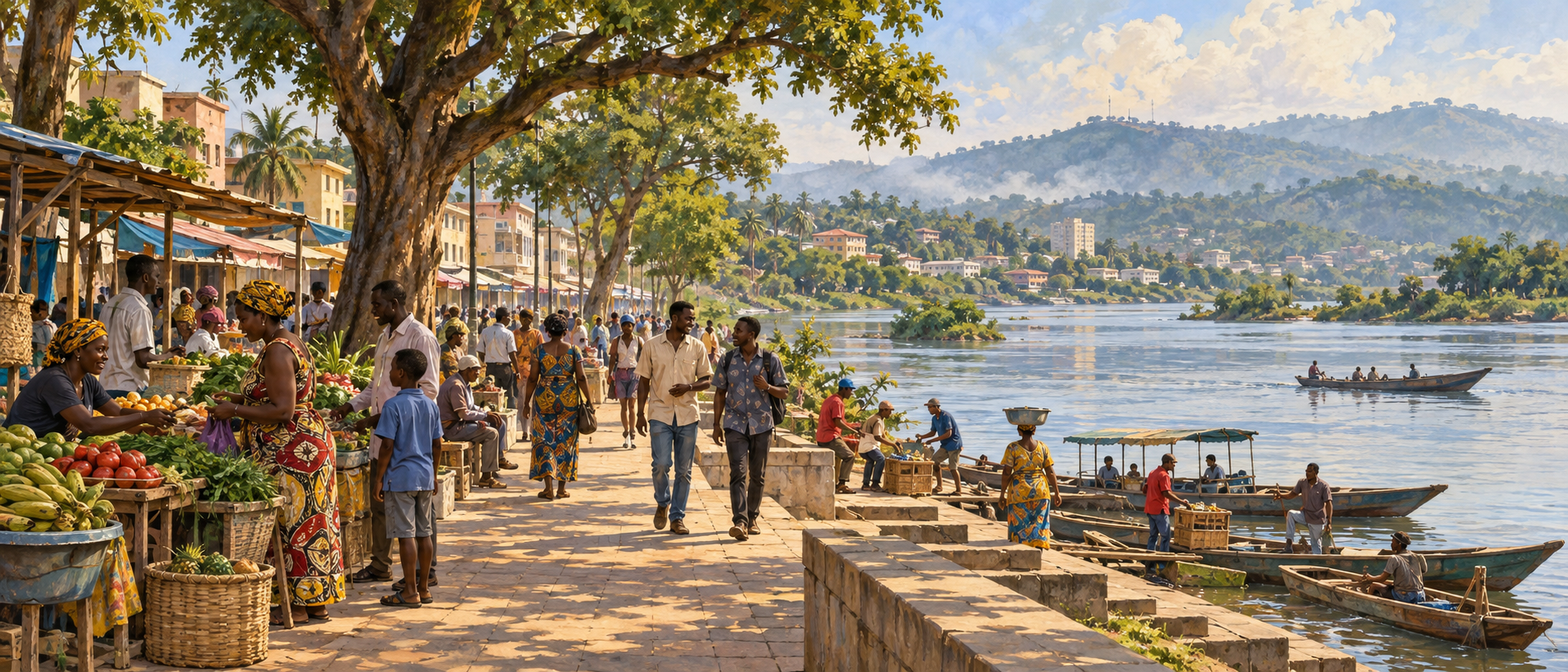
How does the Republic of the Congo work, what is the difference between Congo-Brazzaville and DR Congo, and why are oil, forests, ports and rivers so important? The Republic of the Congo is a Central African presidential republic on the western side of the Congo River. It is often called Congo-Brazzaville to distinguish it from the much larger Democratic Republic of the Congo, whose capital is Kinshasa. President Denis Sassou N’Guesso won another term in March 2026; Prime Minister Anatole Collinet Makosso heads the government under the current constitutional system. A 2025 administrative reorganisation created 15 departments, replacing outdated descriptions that show only twelve.
The country becomes easier to understand when we connect the parts: national institutions → departments and municipalities → revenue, roads, rail, ports and electricity → businesses, schools, hospitals and households. Offshore oil earns substantial export revenue. Forests and peatlands store carbon and support livelihoods. The Congo River connects communities and regional trade, while the railway and port at Pointe-Noire provide an Atlantic gateway. The question is whether these advantages translate into reliable services and productive jobs for people across the country.
The Republic of the Congo at a glance
- Which Congo? Republic of the Congo (Congo-Brazzaville); a different sovereign state from the Democratic Republic of the Congo (DR Congo or Congo-Kinshasa).
- Capital: Brazzaville, facing Kinshasa across the Congo River.
- Government: a strong presidential executive, prime minister, National Assembly, Senate and other state institutions.
- Leadership in October 2026: President Denis Sassou N’Guesso and Prime Minister Anatole Collinet Makosso.
- Departments: 15 since the reorganisation implemented in 2025, including Brazzaville and Pointe-Noire.
- Economy: oil and gas, forestry, agriculture, freight, trade, services and smaller-scale manufacturing.
- Major trade gateway: Pointe-Noire’s Atlantic port, connected to Brazzaville and inland markets.
- Currency: Central African CFA franc, issued by BEAC within the CEMAC monetary union.
- Development priority: translating natural-resource income into dependable electricity, health, learning, jobs and opportunity.
This guide is reviewed on 20 October 2026. For current economic and presidential information, see the World Bank’s Republic of the Congo country overview. The Congolese government’s March 2025 prefect appointments provides the updated department count. For the current prime minister see the April 2026 appointment notice.
1. Are the Republic of the Congo and Democratic Republic of the Congo the same country?
No. They are two distinct sovereign states, separated in important places by the Congo River. The Republic of the Congo has its capital in Brazzaville; the Democratic Republic of the Congo has its capital in Kinshasa. The countries have different presidents, constitutions, currencies, public institutions and histories.
Because the names are similar, news reports and educational articles sometimes unintentionally apply statistics from one to the other. For instance, the Republic uses the Central African CFA franc, while DR Congo uses the Congolese franc. Their size, population and administrative map are also substantially different.
Whenever a source says only ‘Congo’, look for the capital or the full official name before copying its facts. This simple check prevents errors in school assignments, investment research and country comparisons.
2. Who governs Congo-Brazzaville in 2026?
Denis Sassou N’Guesso is president, having exercised power for much of the period since 1979. Anatole Collinet Makosso is prime minister and coordinates the government’s work within the constitutional arrangement. National ministries oversee sectors such as finance, health, education, infrastructure, hydrocarbons and local government.
The government’s official cabinet listing identifies ministers and portfolios. The National Assembly and Senate have legislative roles, while courts and territorial administrations operate according to law. A cabinet title is a description of authority, not evidence that every government service reaches all residents equally.
This is a presidential system with concentrated power, and independent observers have raised concerns about political competition, public accountability, corruption and civil liberties. A responsible explanation considers both formal institutions and the real ability of people to challenge decisions.
3. What happened in the March 2026 presidential election?
The Republic held a presidential election on 15 March 2026. Final results reported by the World Bank gave Sassou N’Guesso approximately 94.90% of the vote and reported turnout around 84.99%. He was sworn in for another term on 16 April 2026.
Major opposition groups boycotted the election, and reporting described restrictions on campaigning, an internet blackout on voting day and concerns about transparency. These circumstances matter to any balanced analysis. The official vote and questions about a fair political process should be identified separately, rather than describing either as the sole complete story.
See the 16 April 2026 government record for the inauguration, and Reuters’ March 2026 reporting for independent election context.
4. Who is Prime Minister Anatole Collinet Makosso?
Makosso first became prime minister in 2021. Following Sassou N’Guesso’s April 2026 inauguration, the prime minister and cabinet followed the transition procedure, and Makosso was reappointed by presidential decision issued on 23 April.
The government notice of 24 April 2026 states the reappointment. This is an example of why dated sources matter: a report between a government’s resignation and a subsequent reappointment can describe a short transitional situation that is no longer current.
Prime ministerial coordination is different from a completed service. Ministries still need approved programmes, staffing, finance and reliable local systems to deliver results.
5. What does Parliament do?
The Republic of the Congo has a bicameral Parliament composed of the National Assembly and Senate. It considers legislation and has formal roles involving budgets and oversight. Its members and processes operate within the country’s political system.
A law setting a public-health objective does not automatically create hospitals or recruit nurses. Regulations and budgets must be translated through government departments, providers, procurement and real facilities. Only then can a patient receive treatment.
To understand a legislative headline, separate five milestones: proposal, adoption, legal effect, programme operation and measured outcome. Confusing them can make an uncompleted public promise look like an established success.
6. How many departments does the Republic of the Congo have?
Fifteen departments is the current count recorded in the Congolese government’s 31 March 2025 announcement appointing prefects. Older sources, including some official pages not yet updated, list only twelve departments. The change matters when building local maps, school geography guides or current service directories.
The 15 are Brazzaville, Pointe-Noire, Bouenza, Congo-Oubangui, Cuvette, Cuvette-Ouest, Djoué-Léfini, Kouilou, Lékoumou, Likouala, Niari, Nkeni-Alima, Pool, Plateaux and Sangha. They contain lower administrative units and local institutions, and each prefect has responsibilities defined through the state system.
The government list of all fifteen is a dated primary source. A new boundary does not mean new roads, documents or public offices automatically become available on the same day.
7. What is the difference between a prefect and a mayor?
Prefects are part of territorial state administration. Mayors and municipal authorities have their own local-government roles under applicable law. One is not simply a translated word for the other. The correct authority for a local market, main road or school may differ by asset.
Imagine a damaged drainage channel at the edge of a town. The local council may need to coordinate a response, while an important highway or utility pipe could be managed by a different body. Knowing a district name is only the start of finding the right office.
The practical civic test is: who owns the infrastructure, who can authorise the repair, who finances it, and who checks whether it works after maintenance?
8. Why is Brazzaville the capital?
Brazzaville is the seat of national institutions and an important commercial and cultural centre on the Congo River. It faces Kinshasa on the other bank, a remarkable pair of national capitals separated by a relatively narrow river in places.
Being close on a map does not make them one city or remove the international border. Travellers and businesses need immigration rules, safe crossings, customs procedures and suitable vessels. Two large markets may be geographically near and still face administrative friction.
A strong city also needs water, sanitation, electricity, roads, public transport, schools and healthcare. The quality of those everyday connections matters more to residents than a photograph of the riverfront.
9. What makes Pointe-Noire different?
Pointe-Noire is the country’s main Atlantic port and a major industrial and oil-services centre. It serves shipping, freight, offshore energy operations and domestic distribution. Goods reach and leave through terminals, customs, warehouses, roads and the railway to Brazzaville.
A ship full of imported machinery can arrive successfully, but the equipment must still be cleared and transported to a factory or business inland. A port is not a single facility; it is the network from the seller to the eventual user.
Pointe-Noire and Brazzaville perform complementary roles. The port connects Congo with the ocean, while the inland capital connects government, the river and other domestic services.
10. What is the Congo–Ocean Railway?
The Congo–Ocean Railway links Pointe-Noire to Brazzaville, connecting the Atlantic port with inland markets. Its historic route crosses challenging terrain, and its useful capacity depends on track, locomotives, freight terminals, security, maintenance and schedules.
A working rail line can reduce costs for appropriate cargo, but it cannot serve a community that lacks a usable road from its warehouse to a station. The railway and local road networks must cooperate.
A student can draw a five-stage route: international ship → Pointe-Noire terminal → freight train → Brazzaville depot → final delivery truck. Then mark which authority or company operates each step.
11. Is there already a road-and-rail bridge between Brazzaville and Kinshasa?
As of the July 2026 report by the Economic Community of Central African States (ECCAS), a proposed Brazzaville–Kinshasa road–rail bridge was still moving through technical meetings, site visits and the process of selecting a strategic partner. It should not be described as an existing operational bridge.
The report identifies joint technical discussions on 22–25 July 2026 and the selection process underway. Land approach improvements and preliminary work are not equivalent to a completed river crossing.
The ECCAS account illustrates the difference between a project on the map and an available service. When ready, such a crossing could have broad trade implications, but the operating date must be verified.
12. How does the Congo River support people and trade?
The Congo River and its tributaries connect settlements, fishing communities and transport routes. In places where roads are sparse, river transport can be a practical alternative for people and cargo. The waterways also support ecosystems, farming and wider regional connections.
However, navigation depends on river conditions, vessels, safe landing areas and transport from the riverbank to homes or markets. A river does not automatically act like a smooth highway throughout its entire length.
Water quality, erosion, flooding and environmental protection affect communities living beside the river. Managing the river means balancing transport, ecology and public health.
13. Why is oil the country’s economic engine?
Oil production is a major source of export earnings and government revenue. The World Bank says oil accounts for roughly half of national GDP and around 80% of exports in the period it assessed. These are large shares, yet they do not imply that half the population works directly in oil.
Offshore fields, contractors, pipelines, terminals, engineers and commercial agreements form the operating chain. Revenue depends on oil prices, production, costs, taxes and contractual arrangements. A good price year can strengthen public finances but cannot guarantee that hospitals or schoolrooms improve.
A government must convert resource earnings through credible budgets, procurement, oversight and long-term investment into services that people can actually use.
14. Why can oil revenue rise while poverty remains high?
An oil sector can generate considerable revenue with relatively few direct workers. Jobs and household opportunities depend on farming, manufacturing, services, training and infrastructure as well. Resource income may also be lost to inefficiency, weak accountability or poor targeting.
The World Bank describes considerable poverty, youth unemployment and uneven access to basic services despite substantial natural resources. In 2026 it projected oil-supported growth of around 4.4%, while warning that non-oil development and fiscal management remained fragile. This is a growth projection, not a claim that every family’s income increased by 4.4%.
A true development assessment looks at purchasing power, jobs, learning, medical access and infrastructure quality alongside GDP.
15. What happens when global oil prices fall?
Lower oil prices can weaken export receipts and public finances even while the country must continue paying teachers, maintaining roads and buying medicine. That dependence can make annual budgets unstable.
A well-designed fiscal strategy smooths essential spending across commodity cycles, maintains appropriate reserves and increases non-oil revenue without unfairly burdening vulnerable households.
The World Bank’s 2025 Economic Update urges stronger management of debt, non-oil revenue and the country’s broader wealth.
16. Why are public debt and arrears important?
Debt is money owed over time; arrears are payments not made when due. A government can have valuable oil exports yet struggle with cash management or debt obligations. Businesses may suffer if public payments are delayed, even if contracts were signed correctly.
The World Bank estimated public debt around 95% of GDP in 2026, while highlighting recurring arrears and institutional weaknesses. This is a time-bound estimate; the important idea is that a growing economy still needs credible financial management.
For ordinary residents, fiscal sustainability means essential services can continue through difficult years without sudden interruptions or unmanageable future costs.
17. Why do forests matter as much as oil?
Much of the Republic of the Congo is covered by tropical forest. These ecosystems support biodiversity, water cycles, local livelihoods and carbon storage. They are also valuable for timber and other products when managed lawfully and sustainably.
The World Bank’s 2025 report describes forests covering more than 69% of the country and storing very large quantities of carbon. Forest degradation can destroy resources that are difficult to replace, while effective management can preserve value for future generations.
A country’s natural wealth is therefore not only minerals beneath the ground. Its forests and healthy water systems are also long-term capital, with benefits that do not always appear immediately in export statistics.
18. What are the Congo Basin peatlands?
Peatlands are wetlands where organic material builds up over long periods and stores substantial amounts of carbon. Parts of the Congo Basin, including areas of the Republic of the Congo, contain exceptionally important tropical peatlands.
Draining or damaging peat soils can release stored carbon and change local hydrology. Protecting them requires scientific monitoring, appropriate land rights, community participation and long-term environmental management.
An undisturbed wetland is not ‘unused land’. It performs real ecological functions and may support local livelihoods and cultural values. That makes environmental stewardship part of national economic planning.
19. Can timber processing create better jobs?
Forestry activities can involve harvesting, transport, milling, furniture production and exports. Processing more wood locally may create employment and technical skills, but only if forests are harvested lawfully and firms have reliable energy, tools, trained staff and market access.
A log exported without further processing creates a different value chain from timber manufactured into doors or furniture. More processing does not guarantee higher household benefits if conditions are unsafe or supplies are not sustainable.
The World Bank recommends better traceability for forest products and stronger local processing. The key is long-term value with credible conservation and community rights.
20. What role does agriculture play?
Agriculture supports rural work and local food supplies, although the country imports many goods. Cassava, bananas, fruits and other crops are important in suitable areas. Farms need land, water, technical knowledge, storage and roads that connect them to buyers.
A farmer may grow enough produce for a market but lose income when a road is unsafe or a trader cannot obtain fuel. Improving rural transport can therefore help food security, wages and business activity simultaneously.
The World Bank’s Economic Update identifies agriculture and local food processing as opportunities for diversification away from excessive dependence on hydrocarbons.
21. Why is electricity access unequal?
Electricity requires generation, high-voltage transmission, local distribution and household connections. The World Bank reports a sharp urban–rural divide in access: an estimated 67% in urban areas compared with 12.4% in rural areas in the period it describes. These are context-specific indicators, not live measurements of every individual settlement in October 2026.
A village can be geographically near a power source yet lack the distribution lines and reliable connection needed to use it. A clinic may have a refrigerator but cannot keep medicine at required temperatures without dependable energy.
Success should be measured by usable power, reliability, cost and maintenance—not simply the number of generating plants or kilometres of cable installed.
22. How do drinking water and healthcare connect?
The Congo Basin contains abundant water, but natural water resources are not the same as safe piped water in every home. Treatment, testing, storage, pumping and distribution are necessary. Remote communities can face different costs from dense urban districts.
The World Bank reports markedly lower access to clean water sources in rural areas than nationally. An apparently water-rich country can therefore still have serious household hygiene and health challenges.
A functioning clinic needs safe water, trained workers, medicine, electricity and referral transport. The public-health result requires those separate systems to work together.
23. Does the Republic of the Congo have a working school system?
Yes. The education system includes primary school, lower- and upper-secondary routes, technical education and further study, with qualifications such as the BEPC and baccalauréat in relevant pathways. However, enrolment and time in school do not always mean strong learning outcomes.
The World Bank reports that only about 30% of pupils meet basic reading proficiency at the end of primary education under the measure it uses. That is a warning about learning quality, not a claim that other pupils are incapable of progress.
For detailed school stages see Schools of the Republic of the Congo, How Education System of Congo Works and How Ministry of Education for the Republic of the Congo Works.
24. Why do technical skills matter beyond school examinations?
A railway needs technicians and safe operations. A port requires cargo-handling experts, mechanics, customs professionals and accountants. Forest management needs surveyors and scientists. Healthcare needs trained practitioners and technicians.
Good primary literacy and mathematics are the foundation for these later skills. Secondary and vocational training can provide practical options, but graduates also need businesses that invest and operate in a functioning environment.
The World Bank’s Economic Update emphasises technical and vocational education aligned with labour demand as part of a broader diversification agenda.
25. What does a typical small business need?
Original fictional example: a food processor near Brazzaville buys agricultural goods from rural suppliers. It needs suitable roads, electricity for equipment, safe water, packaging and a buyer network. Employees need transport and wages; the company may need a bank loan to grow.
A single power outage can damage ingredients, stop production and reduce weekly pay. New financial support may help but cannot fix an unreliable distribution network alone. Successful enterprise depends on several shared public and private services.
This is why country development cannot be assessed only by registering new businesses. The businesses must be able to survive, sell and provide good jobs.
26. How would a new Brazzaville–Kinshasa bridge change trade?
If a future road-and-rail bridge is completed and operated well, it could reduce some crossing costs and improve commercial links between the two capital cities. But it would also require border procedures, road and railway connections, maintenance, safety systems and clear responsibilities.
An infrastructure concept is not a finished benefit. The July 2026 ECCAS account concerned site visits and partner selection; readers should check subsequent official reports before describing a complete bridge or giving traffic estimates.
The practical measures would be safe travel, goods cleared, reliable schedules and business value, rather than solely the bridge’s design length.
27. Republic of the Congo compared with Singapore
Both countries need functioning ports, education, reliable electricity, clean water, government coordination and trade. Singapore is a compact island city-state with little domestic natural-resource production and an exceptionally dense logistics network. The Republic of the Congo has Atlantic access, large forests, significant oil resources and long transport routes to sparsely populated areas.
Pointe-Noire’s gateway role and Singapore’s port can be compared by function: goods must enter, be checked, move onward and reach buyers. Their size, geography and supply chains differ substantially, so the same operational design cannot simply be copied.
Read How Singapore Works and How Singapore Connects | Roads, Expressways and Junctions for the contrasting city-state case.
28. A five-minute systems exercise
Draw a line from a health clinic in an inland Congolese village to an international medical supplier. Add the local road, warehouse, Brazzaville depot, railway or truck route, Pointe-Noire port and vessel. Then place a source of delay under each stage: bad weather, electricity, paperwork, unsafe road or unavailable personnel.
Now identify which institution could address each delay. The exercise makes it clear why a nation’s health system is partly a transport, energy, finance and administration system.
Repeat the diagram for a cocoa or timber shipment and compare which infrastructure is shared. That overlap is where coordinated public investment can have the greatest effect.
Frequently asked questions about the Republic of the Congo
Is Congo-Brazzaville the same as DR Congo?
No. The Republic of the Congo and Democratic Republic of the Congo are two different sovereign states, with capitals in Brazzaville and Kinshasa respectively.
Who is the president in October 2026?
Denis Sassou N’Guesso, re-elected in March 2026 and sworn in on 16 April after a vote criticised for limited competition.
Who is the prime minister?
Anatole Collinet Makosso, reappointed in April 2026.
Does the Republic of the Congo have twelve or fifteen departments?
Fifteen. The Congolese government listed the fifteen departments when appointing prefects in March 2025; older maps may still list twelve.
Is Pointe-Noire the capital?
No. Brazzaville is the capital. Pointe-Noire is the major Atlantic port and industrial city.
Why is oil so important?
Oil accounts for a large share of GDP, exports and public revenue, leaving the economy exposed to price and production changes.
Is the Brazzaville–Kinshasa bridge already open?
No. In July 2026 a road–rail bridge remained a project undergoing partner selection and related planning.
Why do forests matter to the country’s economy?
They store carbon, support biodiversity and community livelihoods, and may provide lawful sustainable products and environmental services.
What is the Central African CFA franc?
The shared currency issued by BEAC for the CEMAC monetary area; it is not the Congolese franc used in neighbouring DR Congo.
Why is schooling relevant to economic diversification?
Literacy, mathematics, technical training and professional skills provide the people needed to grow productive non-oil businesses.
How can a student distinguish plans from outcomes?
Check whether a project was merely announced, financed, built, operating or independently shown to benefit its intended users.
Continue the country systems
This article belongs to How Countries Work, the international companion to How Singapore Works. Use the How Countries Work A–Z directory for all 195 country guides. Compare Comoros’ inter-island networks, Chad’s landlocked oil economy, Cameroon’s bilingual institutions and trade, and Gabon’s forest and oil systems.
Sources and editorial review
- World Bank Republic of the Congo overview, 2026 — March election, population, oil, human development and fiscal outlook.
- Congo Government, 31 March 2025 — 15 departments and prefects.
- Government, 24 April 2026 — prime minister reappointment.
- Government, 16 April 2026 — presidential inauguration.
- Reuters, March 2026 — contested election context.
- World Bank Economic Update 2025 — forestry, debt, technical skills and diversification.
- ECCAS, 25 July 2026 — proposed Brazzaville–Kinshasa bridge.
- BEAC currency FAQ — Central African CFA franc.
- Reviewed: 20 October 2026. Market and clinic examples are fictional. Future bridge plans and development forecasts are not reported as completed infrastructure.