
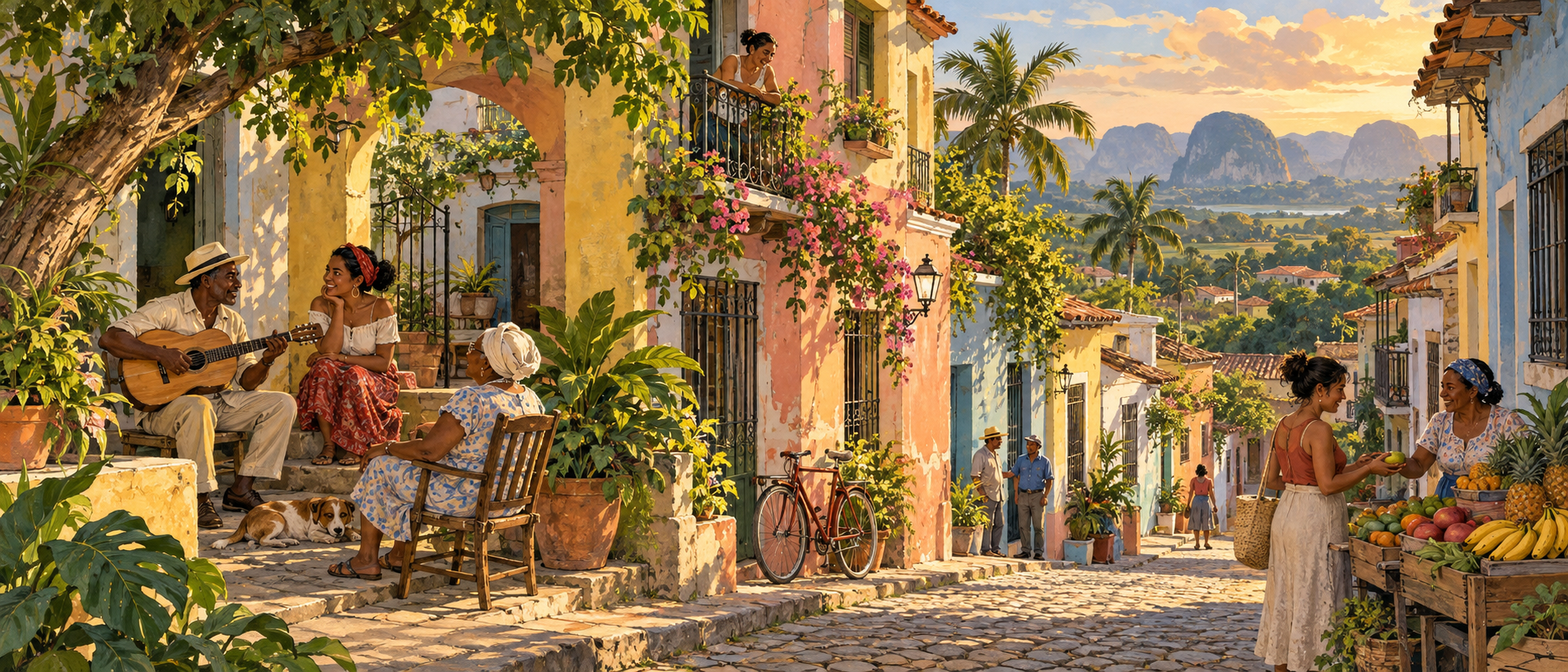
The most memorable things to do when visiting and touring Cuba begin with stories that still reach the rest of the world: Old Havana’s layered streets, the music and creative life of its cities, Viñales Valley’s unusual limestone hills, and the architectural histories of Trinidad, Cienfuegos and Santiago de Cuba. Cuba has extraordinary cultural and natural heritage, but a beautiful photograph is not the same as a safe or practical holiday plan in 2026.
This Cuba travel guide explains ten experiences and places worth understanding, from UNESCO World Heritage in Havana and Viñales to sugar history, music and eastern forest conservation. If you searched for the best things to do in Cuba, Havana itinerary ideas, Cuban travel requirements or famous Cuba tourist attractions, begin with the current reality: the UK FCDO advises against all but essential travel because fuel, electricity, water, medicine and transport shortages have made visitor operations unreliable. This edition is primarily a cultural reading guide, not an invitation to book a leisure trip against that advice.
Travel position checked 9 October 2026: The UK Foreign, Commonwealth and Development Office, in advice updated 25 September 2026, advises against all but essential travel to Cuba. It reports frequent grid collapses, fuel and water shortages, disrupted medical and transport services, flight suspensions and serious difficulty using international payment cards. Australian advice also says reconsider your need to travel. Do not interpret a preserved old town or a published tour price as evidence of viable tourism. Always check newer official notices, transport and real access before taking action.
eduKateSG · A WORLD WORTH UNDERSTANDING
Cuba deserves an informed journey
Heritage remains worthy of wonder, even when the responsible decision is to postpone the actual journey.
Cuba at a glance
Cuba stretches across the northern Caribbean, with Havana on the northwest coast, central towns including Cienfuegos and Trinidad, and eastern centres such as Santiago de Cuba. The landscapes vary too: western karst valleys, central agricultural plains and eastern mountainous forests make a national tour a substantial undertaking even in ordinary conditions.
UNESCO recognises nine properties in Cuba, from Old Havana’s fortification system to the Viñales Valley, Cienfuegos, Camagüey, Trinidad and several eastern heritage or conservation sites. Their significance is genuine and does not depend on the present ability of visitors to travel. Reading these places alongside their social and environmental histories is a rich project in its own right.
The immediate travel setting is, however, exceptional. Official warnings describe energy and water disruption, fuel rationing, closures, aviation-fuel difficulties and reduced flight options. This means there is no responsible basis here for promising a seven-day hotel route, car hire circuit or boat excursion. The ten chapters below are about understanding, with clear travel caveats.
- Current advice: UK FCDO: against all but essential travel; other governments also caution strongly.
- Heritage study: Old Havana, Viñales, Trinidad, Cienfuegos and Camagüey reveal different architectural and agricultural stories.
- East Cuba: Santiago, Baracoa and Alejandro de Humboldt National Park deserve context beyond a simple beach brochure.
- Entry rules: Nationality-specific; Singapore MFA says Singaporeans can visit up to 30 days visa-free, while British tourist travellers need the applicable tourist visa/eVisa. A D’Viajeros form and medical-insurance proof are required.
Safety, legality and respectful boundaries
The UK FCDO’s late-September 2026 warning is unusually strong. It advises against all but essential travel and says the national electricity grid has collapsed several times, with further outages likely. Fuel shortages are disrupting transport, medical care and communications; shortages of safe water and essential supplies add complexity. The advice reports that several international airlines have suspended Cuba services and warns that options to leave could shrink further. This is not a minor matter to resolve by choosing a different hotel.
The same advice reports that international Visa and Mastercard payment cards are no longer accepted in Cuba, and ATMs cannot be relied upon for international withdrawals. Australia likewise warns about cash requirements, shortages and potential worsening conditions. Even a careful budget does not remove medical or evacuation challenges. Travellers already in Cuba should monitor their airline and their own government guidance, and consider the essential nature of their stay.
Visa rules also differ by passport. Singapore’s Ministry of Foreign Affairs says Singapore citizens can visit for up to 30 days without a visa, while the UK’s requirements for British travellers include a tourist visa or eVisa. Both sources explain that D’Viajeros information must be completed before travel, and Singapore MFA specifies medical-insurance proof. Do not erase those differences by quoting Cuba’s generic tourism site as if every nationality followed the same process. Hurricane season generally runs from June through November and adds a separate risk.
1. Read Old Havana as a living city, not a frozen postcard
Old Havana and its fortifications form one of Cuba’s most celebrated UNESCO heritage landscapes. The city grew through maritime trade, colonial institutions, faith and daily residential life. Broad plazas and impressive stone facades can be visually overwhelming, but the best first question is what these spaces were built to do.
Try mapping the old street network and its relationship to harbour defences. Ask how a trading city defended itself and how people have adapted inherited buildings to new lives. UNESCO’s documentation makes it possible to understand the architecture without assuming that every museum, hotel or historic interior operates now.
Living heritage is also about the residents who continue to inhabit it through difficult circumstances. The current utility and supply crisis affects their everyday experience, and an article written for visitors should not turn that reality into charming atmosphere. Study with both curiosity and care.
A responsible way to learn: Use UNESCO’s Old Havana page and historical maps to identify plazas, fortifications and ordinary residential streets.
Important limitation: This is not a recommendation to travel to Havana or assume institutions are operating during the current crisis.
2. Understand Havana’s Malecón and transport culture with historical honesty
The Malecón waterfront is one of Havana’s most recognised public scenes. It offers a strong way to think about an urban coastline: buildings meet the sea, coastal weather alters daily life and a road can become a social landscape. The photograph makes the view look easy, but it cannot tell you about safety, transport or public services on any particular evening.
Cuba’s old vehicles are another famous image. Their continued use tells a story about technology, repair skills and economic conditions, not merely nostalgic design. A thoughtful study asks how local mechanics maintain equipment and how vehicle age changes road safety.
Current FCDO guidance specifically warns about poor vehicle maintenance and unlit roads, alongside serious fuel shortages. A sightseeing route in a classic car is therefore not a reliable or necessarily safe 2026 recommendation. A historical transport notebook can be valuable without persuading anyone to take such a ride.
A responsible way to learn: Compare historical images of Havana’s waterfront and urban transport with current reporting on the everyday city.
Important limitation: Do not treat vintage cars, street lighting or fuel availability as dependable tourism services.
3. Listen to Cuban music as a story of community and exchange
Cuban music is one of the country’s most generous cultural gifts, but it is not a single genre. Son, rumba, trova and a variety of modern forms emerged through different histories of exchange, collaboration and social life. A good listener explores named artists and venues rather than assuming every performance exists merely for international tourists.
Try building a playlist that includes information about the performer, city, period and musical structure. What instruments carry the rhythm? How do call and response, dance and improvisation shape the experience? Listening can become a conversation across history and generations.
Creative life continues even when visitor infrastructure is strained. Respect the circumstances in which performers work: support authorised recordings, credit musicians and avoid appropriating a tradition after hearing one song. There is no need to promise an evening club itinerary while official warnings discourage non-essential travel.
A responsible way to learn: Create a credited listening journey across different Cuban musical forms, accompanied by reputable cultural histories.
Important limitation: Do not promise live performances or currently functioning nightlife venues without reliable contemporary confirmation.
4. Explore Viñales Valley through its karst and working farms
UNESCO’s Viñales Valley description highlights the distinctive limestone hills known as mogotes, along with agricultural land and vernacular villages. This is a landscape worth studying twice: once through geology and again through the way human communities work the land.
Look at photographs of the hills from different angles and ask how rainfall and rock processes produce these rounded forms. Then study cultivation practices, architecture and the relationships among soil, farming and settlement. An area sometimes marketed primarily through tobacco production is more complex than a souvenir cigar stop.
The image of a peaceful valley should not become an invitation to improvise remote transport during fuel and service shortages. Geography, land use and the ethics of agricultural tourism are worthy subjects even when travel must be postponed.
A responsible way to learn: Read UNESCO’s landscape account and sketch a map of the mogotes, farms and villages.
Important limitation: Current road availability, health support, accommodation and authorised visit access cannot be assumed.
5. Understand Trinidad and the Valley de los Ingenios beyond colourful houses
Trinidad’s historic streets are famous for their colours and paving, but UNESCO describes a deeper story of prosperity linked to the surrounding sugar industry. The Valley de los Ingenios preserves evidence of plantation houses, mills, worker quarters and the structures of a powerful historical economy.
That history includes slavery, and any responsible account must place the people compelled to work the plantations at the centre of the story. The elegant architecture is not a complete explanation without labour, violence and inequality. Study the valley as a linked cultural landscape rather than treating the old mills as pretty ruins.
A virtual exploration can compare maps, preserved structures and archaeological writing. Ask who built the houses, who harvested the cane and how today’s communities interpret that inheritance. These questions are more useful than promising a guaranteed walking tour or train service under the present crisis.
A responsible way to learn: Compare UNESCO’s account of Trinidad’s urban fabric with its description of the surrounding sugar mills and slavery.
Important limitation: Do not present a plantation excursion or hotel stay as a dependable near-term holiday activity.
6. Find the urban-planning lessons in Cienfuegos
Cienfuegos is often described as a beautiful southern coastal city, but its UNESCO-inscribed historic centre is more specifically important for its urban planning and architecture. The street geometry, civic spaces and relationships with the bay invite a different kind of observation from Havana’s older urban fabric.
Use a map to follow the street layout and identify how buildings, plazas and waterfront activities connect. Good heritage learning compares not only monuments but urban choices: what could a planned grid make easier, and what social priorities might it reveal?
The city’s elegance can coexist with the hardships affecting services in 2026. An honest travel narrative must distinguish a heritage label from present visitor access. Reading its planning history is rewarding without promising transport from Havana or reliable accommodation on the coast.
A responsible way to learn: Compare official UNESCO descriptions of Cienfuegos and Old Havana to identify how city design changes over time.
Important limitation: Current electricity, water, mobility and venue operations require contemporary verification; non-essential travel remains discouraged.
7. Explore Camagüey’s historic street pattern on paper
Camagüey’s historic centre is another UNESCO World Heritage site. Its irregular streets, squares and historic buildings help explain how an inland settlement evolved differently from a port city built around a rigid plan. A route through the town looks different on a map even before you see a single building.
Study how lanes connect to plazas, religious places and economic activity. A town’s street plan often stores generations of decisions, including responses to heat, trade and security. That makes urban design a surprisingly accessible way to travel intellectually from home.
Camagüey is also a living city, not a preserve maintained only for visitors. Credit local researchers and contemporary voices where available. The goal is to explore its cultural significance without inventing a list of safely open restaurants or museums amid nationwide infrastructure disruption.
A responsible way to learn: Draw a simplified route through Camagüey’s historic centre using UNESCO information and maps.
Important limitation: A heritage walk described here is an educational exercise, not a current travel recommendation.
8. Learn Santiago de Cuba’s coastal fortification history
Santiago de Cuba occupies an important place in Cuba’s eastern cultural and historical life. UNESCO recognises the San Pedro de la Roca Castle as a powerful example of maritime military architecture. Its coastal setting opens questions about sea routes, colonial conflict and the technical choices involved in fortifications.
The east of Cuba also has distinctive music and urban histories. To study these well, pair official monument descriptions with writing by Cuban artists and historians. Ask why the port mattered and how a fort could influence the relationship between a city and its harbour.
Current flight, road and fuel disruptions make a national itinerary particularly unreliable, and the UK FCDO notes lingering impacts from Hurricane Melissa in eastern Cuba. The ethical version of this chapter is to value Santiago’s heritage without suggesting a hard-to-reverse long-distance leisure trip.
A responsible way to learn: Use the castle’s UNESCO description and eastern Cuban cultural histories to make a city-and-harbour research map.
Important limitation: Do not assume road travel, power, water, ferry or medical services function reliably in the east.
9. Read Baracoa and Alejandro de Humboldt’s biodiversity as conservation history
Eastern Cuba’s mountains and forest ecosystems contain remarkable biodiversity. UNESCO’s Alejandro de Humboldt National Park is among the island’s major natural heritage properties, recognised for its exceptional biological diversity and long ecological history. A forest here is more than a green backdrop: it is an intricate record of geology, climate and species adaptation.
Baracoa, in the eastern part of the island, has its own cultural and environmental identity. Read about regional food, agricultural practices and forest relationships without assuming a distant ecotourism excursion is easy to arrange. Protected nature and local communities both require respectful stewardship.
Conservation literature can reveal more than wildlife-tour photography. Ask what makes species endemic, how habitats are monitored and what pressures managers face. That knowledge remains useful whether a visitor trip happens in a future safer period or not at all.
A responsible way to learn: Study UNESCO’s eastern natural heritage accounts and follow named Cuban researchers where available.
Important limitation: Protected-area recognition is not proof of safe access; remote medical and transport conditions are especially relevant.
10. Understand Cuban cooking and daily resilience without romanticising shortages
Cuban meals carry histories of agricultural ingredients, household practice and cultural exchange. Rice, beans, plantains, pork and seasonal vegetables feature in many accounts, but preparations differ by region and family. A recipe can be an inviting way to learn about a place without setting foot on an aircraft.
The current situation adds an important ethical responsibility to food writing. A shortage of ingredients, electricity or water is not a charming element of culinary authenticity. Official advisories describe genuine hardship that affects residents and essential services. The reader can appreciate traditional cooking without treating deprivation as part of the holiday atmosphere.
Choose a recipe attributed to a Cuban cook or a reliable cultural source. Ask how a dish changes across families and how migration reshapes food traditions. Cooking and listening at home can keep curiosity alive until any future travel is supported by materially better safety and infrastructure conditions.
A responsible way to learn: Make a well-sourced Cuban recipe or read firsthand food writing, crediting the people whose knowledge you use.
Important limitation: Do not convert current food shortages into a recommendation for culinary tourism.
Responsible reading routes, not tourist itineraries
An armchair Havana history route
Read UNESCO’s Old Havana documentation, locate the harbour fortifications on a map and pair architectural research with the history of transportation and neighbourhoods. Then listen to a credited Cuban playlist. This is a reading sequence, not a current multi-day travel plan.
An armchair central-Cuba route
Explore Viñales’ karst geology, then compare Trinidad and the Valley de los Ingenios with Cienfuegos’ planned streets and Camagüey’s urban pattern. The variety becomes clear without depending on presently unreliable roads and fuel.
An armchair eastern-Cuba route
Learn the maritime history of Santiago’s castle and the ecological significance of Alejandro de Humboldt National Park. Pair scientific reports with regional music and food histories. Do not reframe the exercise as an unsupported cross-country road trip.
A future route must be rebuilt from zero
If advice and infrastructure materially improve, start planning again using current visa guidance, airline operations, medical cover, local accommodation confirmation and updated conditions. A fixed itinerary written during the 2026 disruptions would be misleading.
What must change before leisure travel is sensible
The most important practical decision is whether a leisure trip should happen at all. Current UK government advice is against all but essential travel, and Australia’s position is to reconsider the need to travel. The cited reasons include blackouts, medical and water shortages, limited fuel, protests and reduced options for leaving. Travellers should not construct a holiday around an assumption that this crisis will resolve on schedule.
Nationality-specific immigration rules still matter for people assessing essential journeys. Singapore MFA describes visa-free access of up to 30 days for Singaporeans, while British visitors are subject to the tourist visa/eVisa requirement described by the UK. A D’Viajeros declaration and medical-insurance proof are part of the broader entry preparation. Check the applicable government and embassy, including any special conditions affecting onward travel to the United States.
Current official advice reports that international credit and debit card payment systems may not be usable and essential services may be unpredictable. If travel is unavoidable, specialist planning must cover cash and lawful payment, communications, medical needs, potable water, onward flights and contingencies. A casual sightseeing guide cannot make those hazards go away.
- Read the latest UK FCDO, Australian and your own passport government’s Cuba travel guidance.
- Do not book ordinary leisure travel against the current strong warnings.
- Distinguish nationality-specific visa exemptions from tourist eVisa requirements.
- Check the D’Viajeros declaration and required proof of medical insurance for any essential trip.
- Do not assume international cards, ATMs, electricity, water or medical services will work.
- Confirm airline schedules and actual exit options directly with carriers if travel is unavoidable.
- Respect residents and do not portray shortages as a tourist attraction.
- Use UNESCO and Cuban cultural material for heritage learning while actual travel remains inappropriate.
Twelve useful English–中文 travel words
Translations here assist English–Chinese reading. For local speech, rules and sensitive subjects, use the appropriate local language and qualified cultural interpretation.
| English | 中文 | Helpful context |
|---|---|---|
| travel advisory | 旅行安全建议 | Check the latest government warning. |
| power outage | 停电 | Can affect communications and water. |
| fuel shortage | 燃料短缺 | Disrupts road and air travel. |
| medical insurance | 医疗保险 | Proof may be required at entry. |
| entry declaration | 入境申报 | D’Viajeros generates a QR code. |
| historic fortification | 历史防御工事 | Learn how harbour defence worked. |
| karst landscape | 喀斯特地貌 | Limestone hills have a geological story. |
| sugar mill | 制糖厂 | Study labour and agricultural history. |
| intangible heritage | 非物质文化遗产 | Music and craft require respect. |
| conservation | 自然保护 | Forest habitats need stewardship. |
| contingency plan | 应急预案 | Essential under service disruptions. |
| responsible research | 负责任研究 | Credit local voices and source dates. |
Build a thoughtful travel notebook
Create a folder for each UNESCO site with three documents: an official heritage description, a map and a piece of contemporary Cuban writing or culture related to the place. Write down what is historically established and what remains uncertain. A good reader can keep the two categories separate.
Then make a final page titled ‘What cannot be made into a tourist experience’. The answer should include the reality of shortages, medical infrastructure pressures and the difference between looking at a preserved photograph and living there today. That is how responsible travel writing protects both curiosity and human dignity.
Frequently asked questions
Should I book a Cuba holiday in October 2026?
The UK FCDO currently advises against all but essential travel, citing serious disruption to essential services and transport. This guide does not recommend ordinary tourism under those conditions.
Can Singaporeans visit Cuba without a visa?
Singapore’s MFA states that Singapore citizens may visit for up to 30 days visa-free. Other documents, insurance and entry declarations still apply, and the safety situation is a separate concern.
Can I pay using international Visa or Mastercard in Cuba?
The UK and Australian 2026 advisories warn that international card use is no longer available and that travellers should not rely on ATMs. Read their current money guidance if assessing an essential journey.
What are Cuba’s best UNESCO heritage subjects?
Old Havana, Viñales Valley, Trinidad’s sugar landscape, Cienfuegos, Camagüey and the eastern castle and biodiversity heritage offer excellent starting points.
Could I follow a normal Havana–Viñales–Trinidad driving itinerary right now?
That would be an unsafe assumption. Fuel and transport disruption mean normal tourist logistics cannot be promised, and official advice discourages non-essential travel.
Original sources and your next country
The links below are primary government, tourism and heritage references. A historic-site description supports background facts, not a claim that the attraction is currently open, safe or bookable. Official rules can change after the cited update date.
- UK FCDO — Cuba warning, updated September 2026
- UK FCDO — Cuba entry and eVisa requirements
- UK FCDO — Cuba transport, hurricane and road risks
- Australia Smartraveller — 2026 Cuba warning
- Singapore MFA — Cuba advice and Singapore passport visa exemption
- Cuba Travel — official entry and declaration guidance
- UNESCO — Cuba’s World Heritage inventory
- UNESCO — Trinidad and the Valley de los Ingenios
- UNESCO — Viñales Valley
Continue alphabetically: Croatia ← Cuba → Cyprus. Return to the World Country Directory or the World Travel Hub.
Find related reading in the World City Experiences Directory and World City Travel Essentials.