
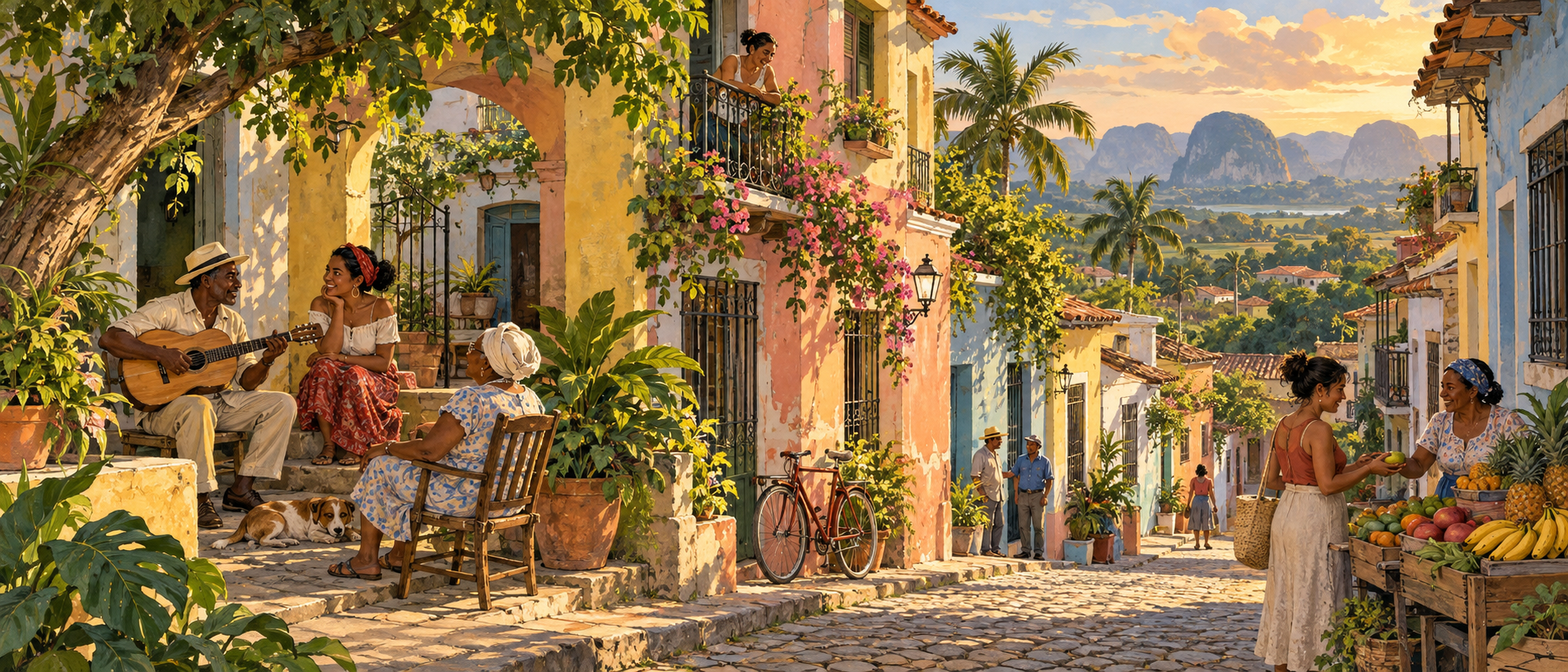
Cuba Children Vocabulary | Words for Character and Nation Building. Learn twenty English words through four careful cultural, historical and community examples, followed by an original story and worked learning tasks. One city neighbourhood can build a musical tradition from shared performance. Another Cuban genre joins storytelling, instruments and dance. A rural valley reflects generations of agricultural knowledge, and a historic capital has buildings shaped by colonial commerce and community life. Cuba offers children four ways to practise vocabulary that is specific, verifiable and respectful.
For international English learners aged roughly eight to twelve, with parent and teacher support. This independent reading resource is not Cuba’s official syllabus, political advocacy, a music qualification, or guidance to process or use tobacco products. Any fictional pupils and class events are explicitly educational inventions. Different communities and people do not share one compulsory national musical or political identity.
UNESCO-backed country context: UNESCO inscribed rumba in Cuba as intangible heritage in 2016, followed by the practice of Cuban Son in 2025. The Viñales Valley became a World Heritage cultural landscape in 1999, while Old Havana and its Fortification System was inscribed in 1982. These four recognitions refer to two related but distinct music-and-dance forms, a working rural landscape and an urban historic property with its own conservation challenges.
Character and nation-building learning goal: Here character and nation building means recognising people’s skill, preserving historical context, attributing creative works, and helping others understand facts without stereotyping them. The lesson is about truthful words and achievable responsibilities, not support for a government or copying adult work.
Quick answer: learning outcomes and boundaries
| Learning feature | What a child should be able to do | Common error to avoid |
|---|---|---|
| 20 defined English terms | Explain meaning and a non-example, then use the word in a fresh sentence | Recognition alone is word mastery |
| Four source-grounded chapters | Distinguish a cultural or historic source fact from a guess | A particular tradition represents everybody |
| Fictional story and six worked checks | Repair misleading information and explain why it needed revision | Imaginary dialogue constitutes historical testimony |
| Seven-day practice guide | Read, speak, compare, write and transfer vocabulary independently | Children must do adult cultural or conservation work |
Go to 20-word bank · four chapters · model story · six checks · seven-day plan · teaching notes · FAQs · verified sources and hubs.
20 children’s vocabulary words: meanings, distinctions and original sentences
Every definition explains a meaning and excludes a tempting misconception. Example sentences are original English-learning material, never an invented quotation attributed to a real child or heritage practitioner.
1. Cuban rumba: voices, gestures, percussion and community transmission
| Word | Meaning and important distinction | Original example sentence |
|---|---|---|
| rumba | A named Cuban music-and-dance practice involving singers, dancers and percussion; not every Spanish-language dance. | UNESCO recognises rumba in Cuba as a living cultural practice. |
| percussion | Music made by striking, shaking or otherwise sounding an instrument or object; not simply shouting. | The rumba performance used percussion. |
| gesture | A meaningful movement of the body or hands; not necessarily a spoken word. | The dancer’s gesture added expression to the music. |
| call-and-response | An exchange where a phrase receives an answering phrase; not uncontrolled simultaneous talking. | The pupils tried a simple original call-and-response. |
| transmission | Passing skills and cultural knowledge through learning and practice over time; not merely saving one video. | Community performances support transmission. |
2. Cuban son: the tres, music making and respect for creators
| Word | Meaning and important distinction | Original example sentence |
|---|---|---|
| son | A Cuban music-and-dance genre inscribed by UNESCO in 2025; not just the English word for a male child. | The class checked the name Cuban son rather than guessing its meaning. |
| tres | A Cuban string instrument strongly associated with son performance; not the French word ‘very’. | The UNESCO entry mentions the tres. |
| improvisation | Creating or varying an artistic part during a performance with learned skill; not an absence of preparation. | The singer’s improvisation drew on musical practice. |
| ensemble | Performers working together with different musical roles; not necessarily a full orchestra. | The ensemble included several instruments. |
| attribution | Naming creators or sources rather than claiming others’ work as one’s own. | The programme gave attribution to the musicians. |
3. Viñales Valley: karst, agriculture and people in a living landscape
| Word | Meaning and important distinction | Original example sentence |
|---|---|---|
| Viñales | A valley in western Cuba recognised as a cultural landscape; not the name of every Cuban farmland region. | The map placed Viñales in Pinar del Río. |
| karst | A landscape produced through processes involving soluble rocks such as limestone; not any dry cliff. | Viñales is known for karst features. |
| mogote | A steep-sided, rounded limestone hill typical of some karst landscapes; not a manufactured tower. | The drawing showed a mogote rising from the valley. |
| agriculture | Growing crops or raising livestock; not identical to selling the finished product. | Agriculture shaped parts of the rural landscape. |
| stewardship | Responsible care for shared resources or places under suitable rules; not control over other people’s farms. | The class discussed stewardship through careful land use. |
4. Old Havana: a working historic city, port and conservation duties
| Word | Meaning and important distinction | Original example sentence |
|---|---|---|
| Old Havana | The UNESCO-listed historic core of Havana with its fortification system; not all of modern Cuba. | The heritage guide focused on Old Havana. |
| colonial | Relating to outside imperial administration and settlement in history; not simply old-fashioned decoration. | The caption acknowledged colonial urban history. |
| fortification | A structure or system built for defence; not any large stone house. | The harbour’s historic fortification guarded an approach. |
| urban fabric | The network of streets, buildings and public spaces in a city; not a kind of cloth. | The class drew a map of the urban fabric. |
| restoration | Careful work to repair or recover historic features with evidence; not pretending the building never changed. | Heritage specialists oversee restoration. |
Four substantial learning chapters: words connected with genuine sources
Read each chapter as an investigation: what is the actual place or practice, which people contribute, what does the source establish, which attractive conclusion is unsupported, and what can a child practise safely? General classroom analogies must never be mistaken for an authentic cultural performance or a professional field task.
1. Rumba in Cuba is a shared performance with roots in specific communities
Five focus words: rumba · percussion · gesture · call-and-response · transmission.
UNESCO inscribed rumba in Cuba, a festive combination of music, dance and associated practices, in 2016. It describes a tradition with African cultural roots and influences from other Caribbean and Spanish cultural forms. The heritage has strong connections with communities in urban neighbourhoods including Havana and Matanzas and has spread through other places over time. It would be inaccurate to say that everyone in Cuba performs rumba or that the term means every song with a Cuban rhythm. A named living practice must not be turned into a stereotype about an entire country.
Percussion is an important part of the sound. UNESCO identifies instruments and ordinary objects that can be sounded in rhythm during performances. A learner should not assume every performance uses identical instruments, or that loudness itself proves a particular musical genre. The rhythms accompany chanting, singing, dance and other elements. Different practitioners may have particular roles, and the relationship among those roles matters more than the volume of a recording.
The word gesture describes a movement that contributes meaning or expression. UNESCO’s account of rumba includes body movements, dance, clapping and communication both with and without words. A person watching a silent video may see the gesture but not hear the song or understand the participants’ social context. A photograph cannot identify the exact performer, cultural purpose or date of the performance unless the caption provides those details. Observation and interpretation should remain distinct.
Call-and-response can explain a general structure of musical or verbal exchange in which one phrase is answered by another. It is a useful English term for students practising dialogue and attentive listening. But an original classroom call-and-response is not necessarily a traditional Cuban rumba. The teacher should label any simple speaking exercise as an analogy rather than claim that pupils have learnt the actual repertoire or style of experienced practitioners.
UNESCO connects rumba’s history with communities that faced disadvantage and, in earlier eras, enslavement and racial marginalisation. A children’s guide can explain that people used music and dance to express dignity, social ties and creativity even under unjust circumstances. Such history should not be presented as a cheerful tale in which exploitation was harmless. The presence of beauty and resilience does not excuse those injustices. A factual explanation of the context helps protect the contributions and experiences of communities whose work was historically overlooked.
Transmission is how people pass knowledge and performance practices across generations. UNESCO describes learning through families, neighbourhoods, observation and participation. A recorded performance is helpful to listeners but does not replace training or the relationships through which a practice remains meaningful. A young child does not become an expert by watching an online clip, and an international classroom should not demand that a Cuban classmate demonstrate rumba in order to prove their identity.
Music videos introduce a question of attribution. An online title saying ‘traditional Cuban song’ may not identify who performed, arranged or recorded it. Teachers should choose authorised materials and credit performers when known. Copyright can apply to music and recordings even when the heritage tradition itself is longstanding. Children can describe the genre in their own words without reproducing entire lyrics or taking credit for someone else’s performance.
Imagine a fictional music exhibit with a caption: ‘Cuba’s rumba is made by every family in exactly one way’. After checking UNESCO, the class changes it to ‘UNESCO recognises rumba as a community-based music-and-dance practice in Cuba with varied participating groups and methods of transmission’. The correction gives the reader more real information and avoids assigning one activity to millions of people. It is an example of how accuracy can be a form of respect.
A class may organise an original speaking exercise in which one group reads a short English sentence and another responds with a different sentence. Pupils can listen for timing and repeat the words clearly. The activity needs no borrowed rumba song or dance steps, and should not be presented as a reconstruction of the tradition. The point is learning the words percussion, gesture and call-and-response while respecting the people who practise the real cultural form.
The same model teaches character through group work. A performer might listen to the lead and contribute one part without insisting every person do the same job. In school, a reader, writer and source-checker can cooperate while retaining distinct responsibilities. Those school tasks are not culturally equivalent to rumba performance; they simply show how different parts can work together.
Finally, ask the child to explain why a rumba performance involves more than a sound. A strong answer names musical rhythm, physical communication, community tradition and learning between people. It also acknowledges that a particular recording needs a reliable source. That is a richer achievement than remembering that rumba comes from Cuba without knowing who sustains it.
Repair the misleading claim: Misleading: ‘Rumba in Cuba is any loud dance performed identically by every Cuban.’ Repair: ‘UNESCO recognises a specific living music-and-dance practice carried by communities and differing performers.’
Safe transfer activity: Prepare an original short English call-and-response and a separate UNESCO-based programme note about rumba. Do not label the exercise an authentic cultural performance.
2. Cuban son shows why musical improvisation is built on knowledge
Five focus words: son · tres · improvisation · ensemble · attribution.
UNESCO inscribed the practice of Cuban son on its intangible-heritage list in 2025. The recognition is recent, but the musical practice existed long before 2025. The inscription describes a music-and-dance tradition combining singing, instrumental roles, structured rhythm, improvisation and movement. A learner should not confuse the English family word ‘son’ with the name of a Cuban genre. The correct meaning comes from the context of the sentence.
A characteristic instrument is the tres, a Cuban string instrument. UNESCO’s description associates it with an important musical role in son. Students need not learn advanced instrument construction to recognise the term. It is sufficient to understand that it differs from percussion and that musicians may contribute distinct sounds. A child who sees several instruments on a stage cannot identify their names without source information or suitable musical knowledge.
Improvisation is often misunderstood as doing something randomly without learning. UNESCO explains that son performers can improvise verses and movements within a musical framework. This draws on experience, attention and a repertoire of skills. A pupil who says that performers improvise because they cannot rehearse has reversed the idea. Flexible expression can be a sign of preparation, not a substitute for it.
An ensemble is a group whose roles combine. UNESCO names singers, instrumentalists, dancers, composers and instrument makers as contributors to the tradition. A singer may guide certain parts of the performance, while bass and other instruments help organise the dancers’ steps. A photograph of the main singer cannot replace the names or work of the people whose instruments and choices support the whole event. The principle of giving credit applies to music and ordinary school projects alike.
Attribution should identify the specific creative roles where documented. A concert programme may need to name a composer, singer, instrumentalists and the source of a recording. If the information is unknown, the label should say so instead of inventing a plausible artist. A downloaded song file does not automatically grant permission to repost or perform it publicly. Pupils can use the institutional description to write their own educational account without reproducing protected lyrics.
UNESCO describes son as combining African and European musical influences, with lyrics connected to daily life and knowledge passed through performance. The tradition is not a complete definition of Cuban identity or a survey of everyone’s musical tastes. Some people may perform son regularly, others may listen occasionally, and others may favour different styles. A national heritage listing does not require every resident to practise an art.
The relationship between son and rumba makes an excellent comparison. Both have cultural significance in Cuba and can involve rhythm, dance and transmission, but they are distinct UNESCO elements with separate inscription years and descriptions. A child cannot substitute ‘rumba’ for ‘son’ merely because the recording has percussion or the performers are Cuban. The vocabulary task is to identify the correct form and avoid making a single category out of several traditions.
Imagine a school poster reading ‘UNESCO invented son in 2025, so rumba and son are identical’. A source-checker finds the official son and rumba entries and changes the caption to identify them as two existing traditions recognised in different years. The correction also notes that Cuban son involves musicians and instrument-makers as well as singers. This turns a mistaken statement into a more useful explanation with clear dates.
For a safe classroom transfer, pupils can write a four-line original English poem. One learner reads the first lines and then makes up a new final line while maintaining the topic. The class can discuss whether the improvised line is clear and fits the earlier ideas. The activity illustrates the general meaning of improvisation, not the musical technique of son. It should be labelled as an English writing exercise.
Transmission of a musical tradition may involve family gatherings, bands and cultural centres, as UNESCO’s description explains. These spaces provide opportunities to watch experienced performers and receive guidance. A recording can help someone hear a performance but cannot replace all the knowledge of when and how it is used. Children should not pretend to be authorised son teachers after playing one clip.
At the end, ask the learner to write an original sentence containing tres, ensemble and improvisation correctly. The sentence should explain the roles in a performance without inventing a musician’s name. A student who distinguishes these terms from rumba’s separate history has acquired useful cultural and musical precision.
Repair the misleading claim: Misleading: ‘Son was invented when UNESCO listed it in 2025, and every improvised verse proves the singer never practised.’ Repair: ‘Son is an older learned music-and-dance tradition, with improvisation supported by skill and experience.’
Safe transfer activity: Write a programme note for a verified son recording, naming the genre, the tres if documented and any actual performer information. Practise an unrelated original English improvisation task separately.
3. Viñales Valley is a working rural cultural landscape, not an empty photograph
Five focus words: Viñales · karst · mogote · agriculture · stewardship.
UNESCO inscribed the Viñales Valley on the World Heritage List in 1999. It lies in western Cuba and is known for its limestone karst formations, rural settlements and traditional farming landscapes. The property is not the whole island and is not an empty landscape without residents. A cultural landscape is shaped through long interaction between people and nature, and that is the concept behind Viñales’s World Heritage value.
A mogote is a steep-sided rounded limestone hill rising from a flatter area. UNESCO describes these striking formations as a defining part of the valley. The rock forms did not appear because modern farmers built hills by hand; they are part of the area’s geological history. A class can draw an imaginary mogote to understand the shape, but should not claim its sketch is a surveyed map of a particular hill.
Karst involves geological processes acting on soluble rock such as limestone. Water, rock properties and long periods of change can create caves, depressions and other formations. These terms help learners see why the valley contains both distinctive hills and agricultural land in the lower areas. A photograph of a rounded hill cannot tell us the exact rate of erosion or the age of the feature without geological evidence.
UNESCO describes the valley’s agriculture, including historical tobacco cultivation and other crops, as central to the living landscape. This article discusses the agricultural heritage as history and geography, not as encouragement for children to buy, smoke or handle tobacco products. Tobacco is an age-restricted, health-harming product, and children should not be given any of its leaves, processing tools or products as a school activity. The safe lesson is how to describe land use and the people whose skills shaped a region.
Agricultural work includes choices about land, water and soil, as well as the lives of the people who farm. UNESCO’s description emphasises continuing methods, local crafts and traditional architecture. It does not prove that all farmers have identical incomes, that every plot is managed the same way or that all residents want to pursue the same occupation. A country guide should treat livelihoods with specificity rather than making a picturesque valley into a symbol of universal rural happiness.
Stewardship is informed care for a place. In a cultural landscape, the challenge can include preserving valued historical features while allowing residents to live and work. UNESCO identifies pressures such as hurricanes, tourism, water availability and development. A World Heritage inscription is not a guarantee that these concerns no longer exist. The status recognises significance, and ongoing management must address changing conditions.
A simple picture of a mogote beside a field may be useful, but cannot tell a viewer who owns the plot or whether every farm has enough water. A child should not invent a farmer’s private economic or family details. If a photograph identifies a particular person or property, the class needs suitable consent and reliable records before publishing personal information. A landscape can be understood through geology and heritage without turning residents into anonymous tourist props.
Imagine a classroom map coloured green with the caption ‘The Viñales Valley is an untouched natural park where nobody works’. UNESCO’s description of agriculture, rural settlements and vernacular architecture contradicts that claim. A better label says ‘Viñales is a working cultural landscape whose distinctive limestone mogotes and long farming history are protected’. The correction names both nature and people.
For an age-appropriate learning exercise, draw an imaginary valley with a limestone hill, a path, a house and a non-tobacco crop such as beans. Clearly mark the diagram as fictional, not a technical agricultural plan or a replica of Viñales. Explain which part shows karst landform and which illustrates human land use. The teacher can ask what additional evidence would be needed to discuss real water quality or soil erosion in the protected property.
Cultural landscapes also contain living architecture and art. UNESCO names local building traditions, crafts and music as part of Viñales’s significance. A pupil should not infer from this that all rural residents perform the same music or use one identical house style. The article’s purpose is to give the learner vocabulary for different aspects of the landscape while keeping each generalisation within the source.
At the end, ask what makes a cultural landscape different from untouched wilderness. The answer includes people, work, settlements, traditional knowledge and the natural environment interacting across time. A child who can explain mogote, karst, agriculture and stewardship together understands why the Viñales Valley is more than a spectacular photograph.
Repair the misleading claim: Misleading: ‘Viñales is uninhabited wilderness and its historic agriculture makes tobacco products appropriate for children.’ Repair: ‘It is a living cultural landscape, and learning about its agricultural past does not require handling or promoting tobacco.’
Safe transfer activity: Draw a fictional limestone valley with homes and a harmless example crop. Label karst and mogote, and write one UNESCO-backed sentence distinguishing natural and human features.
4. Old Havana’s urban fabric reminds us that historic cities still need people and repairs
Five focus words: Old Havana · colonial · fortification · urban fabric · restoration.
UNESCO inscribed Old Havana and its Fortification System as World Heritage in 1982. Havana developed as an important port under Spanish colonial administration, with a historic urban core containing plazas, houses, official buildings and defensive structures. The property is a part of a much larger modern city, not a synonym for every neighbourhood in Cuba. A child looking at a colourful street should not assume the photograph tells the history of every resident or that all the buildings are the same age.
The word colonial identifies a historical relationship involving outside imperial control. It does not simply mean that a building is pretty or old. UNESCO describes Havana’s role in Spanish maritime routes, shipping and the protection of a significant port. Those functions helped shape the city, but a description of successful colonial trade does not establish that every worker or resident enjoyed equal rights. Good historical writing makes room for unequal power and different social experiences without inventing individual testimony.
Fortification means a building or system constructed for defence. UNESCO identifies several major forts protecting access to Havana’s harbour and describes their strategic role. A fortification is not the same thing as a private townhouse, even if both may be built from stone. A school map can show where historic defensive structures stood in relation to the harbour, but it should not invent exact modern access arrangements or claim all structures were built in one year.
Urban fabric is the relationship among streets, plazas, houses and other spaces making up a city. UNESCO describes Old Havana’s historic pattern of five major plazas and diverse buildings. That network gives the property a recognisable character. A courtyard, balcony or arcade may be visible from a photograph, while the way different parts of the neighbourhood connect requires a map. A writer should avoid reducing urban history to one famous facade.
The historic city contains architecture from different periods, including Baroque and neoclassical features. One street can have more than one construction date or period of alteration. A pupil who says ‘everything here was built in 1519’ confuses the founding of Havana with the making of every surviving house or fort. The correct vocabulary describes phases, adaptations and continuing uses. A historical timeline should separate the town’s development from the World Heritage inscription.
Restoration is careful work to repair, recover or conserve historic features using appropriate evidence. It does not mean every material is original or that all buildings can be repaired identically. UNESCO’s description identifies ongoing challenges with decaying built fabric, environmental pressures and the need for planned conservation. A recognised heritage city is not automatically fully restored or free from residents’ practical needs.
People continue to use and care for Old Havana. Houses, public spaces, institutions and services have present-day roles alongside architectural value. A tourist photograph can reveal painted walls and balconies but not a family’s experience of living there or the economic conditions facing a household. A child should never invent a quote from a resident in order to make an exhibit seem lively. If a story is included, label it fiction; if a real person is quoted, get a trustworthy source and permission as appropriate.
A common mistake is to assume that conservation means keeping a city completely unchanged. Buildings and streets may require safe maintenance, and heritage managers must balance protection with present needs. A broken roof or damaged wall is not a classroom project for unsupervised pupils. Conservation work involves engineers, historians, planners, craftsmen, residents and responsible authorities. Children’s suitable contribution is accurate labelling and safe respect for the rules of a place.
Imagine a fictional exhibit label reading, ‘Old Havana is an abandoned colonial movie set whose buildings are all perfect’. After reading UNESCO, the class changes it: ‘Old Havana is a lived-in historic city with plazas, fortifications, diverse architecture and continuing restoration needs’. This is more than a stylistic improvement. It recognises people in the present, different historical periods and responsibilities for the future. One vivid photograph does not substitute for an urban history.
For an original learning exercise, draw a fictional town grid with a harbour, public plaza, homes and a fort. Label the urban fabric, then create a separate sentence based on UNESCO identifying Old Havana’s fortification system and historic port role. Ask which details in the drawing are purely invented. This prevents the activity from being mistaken for a real navigation map or a plan for entering protected buildings.
There is an important difference between a celebrated monument and everyone who helped create or maintain it. Builders, craftspeople, households, workers and officials participated in different ways over centuries. A plaque naming one leader does not establish that leader carried out every job. Children can learn to ask whose skilled work is visible and whose experience might require further documentation. This connects the built environment with responsible recognition of human contribution.
The chapter ends with a practical test: a pupil should be able to say that Old Havana is a colonial-era historic urban property containing multiple periods and a network of defensive structures, now requiring ongoing management and care. That statement is both accurate and humane. It shows that a country article can appreciate architecture while describing the people and responsibilities beyond the photograph.
Repair the misleading claim: Misleading: ‘All of Havana was built in a single year and every historic building is an empty, fully repaired museum.’ Repair: ‘Old Havana preserves layers of colonial-era urban fabric, still-used spaces and ongoing conservation needs.’
Safe transfer activity: Make a fictional harbour-town diagram with a plaza, homes and a defensive wall. Write a separate UNESCO-sourced caption distinguishing fortification, urban fabric and restoration.
Fictional school story: better explanations after checking evidence
At a fictional children’s cultural exhibition about Cuba, Daniela writes that rumba is simply loud dancing invented by a single artist. Her classmates use UNESCO to identify community roots, percussion and transmission. Mateo calls Cuban son the same thing as rumba and says UNESCO invented it in 2025; another pupil checks the two separate inscriptions and explains the difference between a tradition and its recognition date. Camila draws Viñales as an empty valley and forgets the farms and residents, so the group changes the caption to cultural landscape. Finally, Pablo describes every Old Havana building as a perfect, unchanged colonial museum; a source-checker explains restoration and current community life. The pupils and event are fictional; the heritage facts are cited below.
Four comprehension questions
- 1. Why was Daniela’s description of rumba missing important contributors?
- 2. What inscription and music distinctions changed Mateo’s poster?
- 3. What made Camila’s first landscape drawing incomplete?
- 4. How did the source check change Pablo’s Old Havana caption?
Each answer should identify a supporting detail from the invented story. Use UNESCO or another named institutional source for actual country history, rather than treating school fiction as eyewitness evidence.
Six vocabulary checks with worked answers
Check 1: When was rumba in Cuba inscribed by UNESCO?
Worked answer: In 2016, recognising an existing music-and-dance tradition.
For full understanding, explain which fact the answer fits, identify a tempting but inaccurate alternative, and use the relevant word in a new school or family example. Accurate reasons matter more than simply repeating the glossary.
Check 2: Which year was the practice of Cuban son inscribed?
Worked answer: 2025. The practice is much older than the inscription.
For full understanding, explain which fact the answer fits, identify a tempting but inaccurate alternative, and use the relevant word in a new school or family example. Accurate reasons matter more than simply repeating the glossary.
Check 3: What role does the tres have in the UNESCO description of son?
Worked answer: It is a string instrument with an important musical role.
For full understanding, explain which fact the answer fits, identify a tempting but inaccurate alternative, and use the relevant word in a new school or family example. Accurate reasons matter more than simply repeating the glossary.
Check 4: Is Viñales an empty wilderness?
Worked answer: No. It is a karst cultural landscape with farming communities and local architecture.
For full understanding, explain which fact the answer fits, identify a tempting but inaccurate alternative, and use the relevant word in a new school or family example. Accurate reasons matter more than simply repeating the glossary.
Check 5: What is a mogote?
Worked answer: A steep-sided rounded limestone hill in a karst landscape.
For full understanding, explain which fact the answer fits, identify a tempting but inaccurate alternative, and use the relevant word in a new school or family example. Accurate reasons matter more than simply repeating the glossary.
Check 6: Is Old Havana the same as every part of modern Havana?
Worked answer: No. The UNESCO property concerns the historic core and a defined fortification system.
For full understanding, explain which fact the answer fits, identify a tempting but inaccurate alternative, and use the relevant word in a new school or family example. Accurate reasons matter more than simply repeating the glossary.
Seven-day learning plan: practise words until they are usable
| Day | Child-friendly activity | Evidence of understanding |
|---|---|---|
| Day 1 — Notice | Read words 1–5 and explain each without copying. Give one near-miss. | Meaning and distinction are accurate |
| Day 2 — Speak | Use words 6–10 in two supervised ordinary conversations. | Original clear oral sentences |
| Day 3 — Source | Read an age-appropriate excerpt from an official source with an adult. | One verified fact and one unresolved question |
| Day 4 — Compare | Study words 11–15. Sort claims as direct observation, sourced fact, inference or fiction. | Invented details never become unlabelled history |
| Day 5 — Decide | Use words 16–20 in a small fictional group planning problem. | One age-appropriate task and a test of success |
| Day 6 — Write | Write 80–120 original words using at least three terms and naming the evidence. | Coherent, respectful explanation |
| Day 7 — Transfer | Apply three general-purpose terms to a different school, place or community. | Correct meaning outside the source example |
A practical check for parents and teachers
Ask the learner to define a word without quoting the table, correct a convincing misuse, and make an original sentence in a new situation. Record ‘not yet’, ‘with support’ or ‘independently’. Revisit the same terms several days later. Reward the learner who revises a false claim after checking evidence; correction is a sign of progress.
In writing, check clear subjects and verbs, words that contribute necessary meaning, source attribution, sensitivity toward real people and an explicit distinction between actual heritage and classroom fiction. A precise short answer is stronger than a confident stereotype.
Guidance for parents and teachers: practical character, not slogans
- Connect each fact to its source. UNESCO inscribes particular practices or properties; a listing is not a description of every person’s identity.
- Credit the makers and community bearers. Performers, artisans and conservators deserve recognition rather than an anonymous country label.
- Respect belief and choice. A religious or culturally specialised practice can be described without requiring a child to adopt or perform it.
- Protect historic and archaeological sites. A child can study an authorised image but should not remove objects, touch murals or alter protected buildings.
- Distinguish an object, a model and an interpretation. Reconstructed houses and fictional diagrams are useful but are not untouched originals.
- Keep hazardous work with trained adults. Music equipment, protected monument repair, restricted sites and high-risk industries are not unsupervised children’s tasks.
- Test real comprehension. An invitation is not inclusive if readers cannot understand the required time, place or actions.
- Make corrections visible. Responsible learning includes admitting the original wording was too broad and explaining why the revised wording is better.
Frequently asked questions
Are rumba and son the same thing?
No. They are related parts of Cuban musical culture but distinct UNESCO-inscribed practices with separate histories.
Does improvisation mean a son performer has never practised?
No. Improvisation is supported by learned skill and performance knowledge.
Why discuss tobacco growing without recommending tobacco products?
It is part of Viñales’s UNESCO cultural-landscape history, but children should not use, handle or be encouraged to buy tobacco.
Is Viñales Valley only scenery?
No. Its outstanding value includes limestone karst, traditional agriculture, settlements and cultural work.
Why is Old Havana a World Heritage property?
UNESCO identifies its historic urban pattern, plazas, architecture and defensive system linked with Havana’s port history.
What is the child-sized meaning of stewardship?
Learning accurate facts, respecting rules and making safe, modest improvements rather than undertaking heritage repairs.
Verified sources and connected eduKateSG learning
Country details and inscription years are based on the official sources linked below, reviewed in October 2026. School characters, invented examples, questions and exercises are independent English-teaching material, not official national syllabuses or eyewitness records. Check current rules with responsible heritage authorities before any real visit.
- UNESCO Intangible Heritage | Rumba in Cuba
- UNESCO Intangible Heritage | Practice of Cuban Son (2025)
- UNESCO World Heritage | Viñales Valley
- UNESCO World Heritage | Old Havana and its Fortification System
- UNICEF | Convention on the Rights of the Child
Further learning about this country
- Everything About Cuba
- How Education System of Cuba Works
- English Tutors of Cuba
- Top 10 Places to Visit When Touring Cuba
Continue the A–K Children Vocabulary country sequence
Côte d’Ivoire Children Vocabulary · Croatia Children Vocabulary · Cuba (this article) · Cyprus Children Vocabulary · Czechia Children Vocabulary
Main vocabulary and world-learning hubs
- Vocabulary Learning Hub
- Vocabulary by Age and Purpose
- How Countries Work | A–Z
- World Country Vocabulary Index
Children completing this Cuba article should be able to use twenty English words accurately, recognise whose knowledge a source describes, separate evidence from a guess and make one small safe contribution to shared learning. Responsible words make respect practical.