
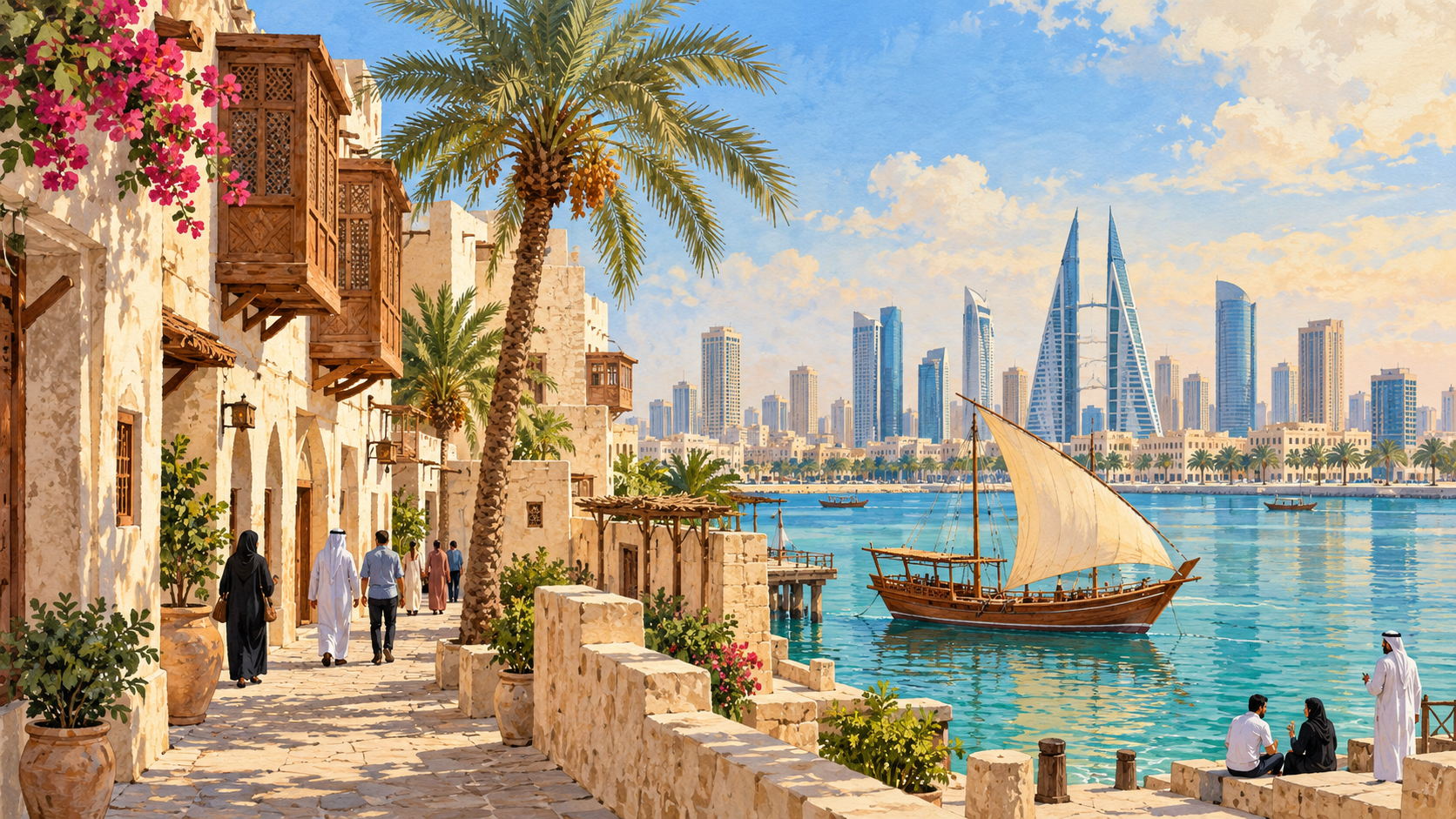
Bahrain becomes especially interesting when you connect the island with the work that has passed through it. An ancient harbour introduces trade, a burial landscape raises archaeological questions, and Muharraq’s pearling heritage joins the sea to shops, houses and human effort. These top 10 things to learn when visiting and touring Bahrain bring geography, Dilmun history, architecture, craft, food and music into a clear country learning guide. A small place on a regional map can open a surprisingly large conversation.
For Singapore families planning educational travel in Bahrain, the richest learning often comes from a carefully chosen detail rather than a packed list of attractions. This Bahrain travel learning guide helps parents and students understand what a museum, heritage house, pottery workshop or meal can reveal, with English–Chinese vocabulary and observation ideas to use before and after a visit. You can also explore from home through the linked official cultural resources. The purpose is to make the country easier to understand and more enjoyable to notice.
At the source check on 8 October 2026, Singapore time, official Bahrain travel advice described unpredictable regional tensions and possible transport disruption. Read current advice from your government, entry requirements and local guidance before making plans. The lessons below are cultural learning subjects, not a guarantee of access or suitability. Museum and house restoration, programmes and workshop arrangements must be checked directly; an old event listing does not establish a performance today.
Choose your reading route
Read the ten lessons in order, or begin with the part of Bahrain that makes you curious. The short observation tasks are invitations to look closely; they do not require a school worksheet.
Read the landscape · Meet culture and daily life · Connect the bigger story
Full contents · Country learning directory · Travel vocabulary directory
Contents
Read the landscape
Meet culture and daily life
Connect the bigger story
A family learning route for Bahrain · English–Chinese vocabulary for reading Bahrain · Questions families often ask · Continue your country learning journey
Start with two maps: one showing Bahrain in the Gulf region, another showing the places you intend to study. Locate Manama and Muharraq, then identify where the ancient harbour and pearling heritage fit. The first map explains regional position; the second helps you understand local relationships. Neither tells you automatically which journeys are practical or appropriate for your travel dates.
The Bahrain Authority for Culture and Antiquities destination directory is a useful starting point for cultural research. Use it to identify named places and their subjects, then check access and conditions with the managing organisations. A destination description is not a personalised itinerary. The most useful plan connects a place with a question and leaves room for changing arrangements.
An island can be understood through both boundaries and connections. Water separates land areas, but it also raises questions about movement, resources and exchange. Bahrain’s ancient harbour and pearling sites make these questions concrete. Ask how the sea appears in the historical account, rather than assuming that island geography has the same effects everywhere or at every point in time.
For a Singapore learner, compare the two places through a shared enquiry: how does a maritime setting become part of a country’s story? Keep the comparison precise. Singapore and Bahrain have different histories, institutions and regional contexts. Their island settings can help you ask similar questions without making their experiences interchangeable. A comparison is strongest when it reveals both a connection and a difference.
Try drawing Bahrain from memory before consulting the map. Add only the places you recognise. Then revise the sketch, marking what you actually know and what you inferred. Perhaps your first version treated Manama and Muharraq as one undifferentiated city area. The correction becomes an honest record of learning. A geographical mistake is useful when it helps you identify the next question.
Notice and discuss: Put one cultural destination beside one learning purpose. Add the source you will use and the practical detail you still need to check. A short table of four well-understood possibilities can be more useful than twenty names without context.
UNESCO identifies Qal’at al-Bahrain as an ancient harbour and capital of Dilmun. Its account connects the archaeological site with long histories of settlement and exchange, including connections between Mesopotamia and the Indus region. Begin with that framework rather than reading the visible fort as the entire story. A prominent structure can be only one layer of a much longer history.
An archaeological site teaches you to think in depth as well as across a surface. Buildings, objects and deposits may relate to different periods. Ask what the interpretation identifies as earlier or later, and what evidence supports the sequence. Do not assume that everything visible was built at once. The act of separating layers is part of historical reasoning, not just a specialist detail added after the exciting facts.
Trade also needs more than a line between two places on a map. An object, written record or archaeological interpretation may suggest a connection, but each type of evidence contributes differently. Look for what the museum or official account actually states. “The source identifies a trading relationship” is stronger than inventing a vivid scene of merchants because the setting makes that scene easy to imagine.
For younger learners, make a simple sequence with three labelled periods supplied by the interpretation. For older learners, add the kind of evidence used for each. Leave gaps where the explanation does not answer your question. A timeline can organise learning while still being incomplete. Its usefulness comes from accurately showing relationships, not from filling every available space with a confident date.
From a permitted viewing area, compare the archaeological interpretation with the surrounding landscape. Which relationships remain visible, and which require historical explanation? A shoreline, settlement or built feature can change through time. Do not assume that today’s view reproduces ancient conditions. The comparison should prompt research rather than provide an excuse to treat the modern scene as a window with no distortion.
Notice and discuss: Choose one feature explained by the site interpretation. Write what you saw, what the source established and how that changed your first understanding. A useful caption may be only three sentences long, but it should make the difference between appearance and historical evidence clear.
The Dilmun Burial Mounds are recognised by UNESCO as a significant burial landscape associated with the Dilmun civilisation. The property contains multiple components rather than one isolated mound. This gives you an important starting point: a repeated form across a landscape can carry evidence about a society, while each surviving feature still needs careful interpretation.
Begin by resisting the temptation to treat the mounds as an obstacle course or a dramatic photographic platform. They are archaeological remains connected with burial. Follow current access rules and do not climb, enter or disturb features unless a legitimate managed visit explicitly permits the relevant activity. Respect for evidence and respect for human remains belong together here.
Ask what specialists can infer from arrangement, construction and associated finds. The interpretation may explain distinctions among mound forms or identify a historical sequence. Record those specific explanations. A visitor cannot determine a person’s status, identity or beliefs simply by looking at the size of an earthwork. A plausible guess can sound convincing while still lacking the evidence needed to support it.
For a child, the first lesson may be that people in the past organised spaces for the dead and that these spaces deserve care. For an older student, the question becomes how archaeology moves from material traces to an account of social life. What is observed? What is inferred? What remains unknown? That sequence can be explored without sensationalising death or inventing a ritual.
The landscape also encourages a discussion about preservation amid contemporary use. A heritage area does not exist outside the surrounding country. Roads, buildings and human activity can frame the surviving remains. Use official material to understand protection and management rather than assuming that a visible boundary explains the whole system. A designation identifies value; practical care requires ongoing decisions.
Notice and discuss: Draw a simplified arrangement from an official map or permitted view. Label only what the source identifies, and add one question about how the arrangement is interpreted. The exercise trains you to use a diagram as an aid to enquiry rather than as proof of a story you already wanted to tell.
UNESCO’s Pearling, Testimony of an Island Economy links offshore oyster beds, seashore, a fort and buildings in Muharraq. Residences, shops and storehouses belong within that account. The key idea is that pearling was not only an underwater activity. Its economy shaped relationships between maritime work and urban life, leaving traces that a visitor can learn to read together.
Begin with a chain of questions. Where did work happen? How did goods move? Where were they stored, exchanged or discussed? Who participated in the different stages? Let the official interpretation supply the actual answers. You do not need to reconstruct a complete business system from one house. A clear partial account is better than an elaborate diagram built on assumptions.
It is especially important to keep labour visible. The beauty or value of a pearl can draw attention towards the finished object while obscuring the people and conditions behind it. Ask what the heritage explanation says about workers, merchants and social relationships. Do not make a history of wealth into an uncomplicated success story, and do not invent an individual worker’s experience where no record is supplied.
For younger learners, place three named components on a map and explain one sourced connection. For older learners, compare the view of the sea with the view of a city building. Which part of the same historical economy does each reveal? This is an effective lesson in systems thinking: one subject may need evidence from several places before its relationships become understandable.
Any route associated with the pearling heritage should be checked for current access, weather and venue arrangements. This lesson does not recommend diving or entering oyster-bed areas. Maritime interpretation can be studied through museums and official resources. You can learn about work at sea without participating in a specialised activity or assuming a heritage designation permits access everywhere within it.
Notice and discuss: Write a paragraph containing one sea-related component, one urban component and the relationship explained by the official source. Then identify whose labour you would like to understand more deeply. That final question keeps the people in the story after the landmark names have been learned.
The Bahrain National Museum provides a broad introduction to the country’s heritage. A museum is a good place to connect several lessons without moving between every site. Its value comes partly from the way objects and explanations are brought together. A small displayed item can answer a question that a large outdoor view leaves unresolved.
Choose one object and read its label slowly. What does the museum identify: material, date, place, use or discovery context? Which details are certain, and which are presented as interpretation? Do not skip the label in favour of an imaginative caption. The object has a documented story that may differ from the one its appearance suggests to you.
Then describe the object without looking at the explanatory text. Notice shape, size as displayed, surface and arrangement. Compare your description with the label. You are learning how observation and knowledge interact. The label may supply information you could never see directly, while your observation may help you ask a question that the label does not address.
For younger learners, draw the object and add one verified fact. Older learners can write two captions: one for a general reader and one explaining a specific historical enquiry. A concise caption is not necessarily a shallow one. Selecting the relevant fact and stating it accurately often requires more thought than producing a paragraph full of loosely connected information.
Museum displays also make editorial decisions. They select, group and explain. Ask why an object appears beside another, or what the sequence of a gallery encourages you to notice. You should not assume you know the curator’s intentions without documentation. You can describe the effect of the arrangement on your own understanding and compare it with any published explanation of the gallery.
Notice and discuss: Record one object, one sourced fact and one unanswered question. At the end of the visit, return to that question. Did another display help? The exercise gives the museum a thread you can follow while leaving space to enjoy unexpected discoveries.
The cultural authority’s Muharraq destination account introduces restored houses and cultural places within the former capital. The Shaikh Isa bin Ali House account identifies a residence that also served a governmental role. Confirm current restoration and access directly; the architectural learning can also begin through official interpretation from home.
A house invites questions about relationships between spaces. Which areas connect? How does someone move from an entrance towards another room or open area? Where does the interpretation identify a particular use? Describe the arrangement before concluding how everyone lived. A historic residence may reflect the circumstances of particular occupants and does not automatically represent an entire country’s domestic life.
For students interested in design, compare enclosure and openness. Observe where light reaches a permitted space and how the layout frames movement. Do not claim a cooling mechanism, social rule or architectural purpose solely from appearance. If a guide explains such a relationship, add the explanation with attribution. A building can generate excellent questions without allowing every answer to be seen at first glance.
The governmental association gives older learners another route. What happens when a residence also supports public or administrative activity? How might access and formality differ among spaces? Use documented interpretation to investigate. The question helps you see that buildings may carry several roles and that a modern category such as home or office does not always explain a historical setting neatly.
Compare with a familiar home or public building in Singapore using one criterion, such as the sequence of arrival. Avoid ranking the places by size or prestige. Ask what a person needs to know to move through each appropriately. Layout is connected with behaviour, and learning to read that connection can make you more attentive in many kinds of buildings.
Notice and discuss: Sketch a short sequence of spaces from reliable interpretation or a permitted visit. Label documented uses separately from your observations. Explain one way the arrangement affected your experience, then add a question that would require a guide’s knowledge to answer.
The cultural authority’s A’ali burial mounds and pottery workshops introduction identifies pottery work near the archaeological landscape and traditions of firing passed between generations. The useful craft lesson is process. A finished vessel can look simple while depending on knowledge about material, shaping, drying and firing that is not visible in its surface.
At an authorised demonstration, ask which stage you are seeing. A piece being shaped and a finished piece are different kinds of evidence. Do not assume that an action you observe explains the whole process. A maker may help you understand what must happen before or after it, and why timing or handling matters. Record the actual explanation rather than replacing it with a generic pottery story.
For younger learners, notice one relationship between form and use: an opening, base or handle. For older learners, ask how consistency is maintained across repeated work. The question is not whether handmade objects are all identical. It is what judgement helps a maker control the result. Variation can be intentional, tolerated or corrected, and only a knowledgeable explanation can tell you which applies.
Respect the workshop as a workplace. Ask before photographing people or interrupting an activity. Follow instructions about heat, tools, dust and unfinished pieces. A demonstration does not automatically permit touching or participation. Your observation task should fit the maker’s arrangements and the site’s guidance, never require someone to change their work for your convenience.
If considering a purchase, ask about maker, material and intended use. A decorative item may not be suitable for food or drink, and a local sale does not by itself prove local manufacture. You can value a craft encounter without buying anything. The learning is in recognising skilled decisions, not in using a souvenir as proof that the experience was authentic.
Notice and discuss: Describe one observed action with a precise verb. Add the maker’s explanation of its purpose and one question about a stage you did not see. This small account makes practical knowledge visible and avoids presenting a brief visit as mastery of a craft.
Return to the museum lesson with a different question: how can a small object contribute to understanding movement and exchange? Bahrain’s ancient-harbour interpretation provides the wider historical context, while a properly labelled artefact may supply a specific material example. Choose an object actually identified by the museum. Do not assume that an unfamiliar style proves a foreign origin or that a resemblance establishes trade.
The distinction between object and inference is central. Material, manufacture, discovery context and comparison can all matter to specialists, but a visitor may not have access to the full evidence. Read what the label says and how confidently it says it. “Associated with” and “made in” are not interchangeable. Good historical writing preserves those differences rather than upgrading cautious language into certainty.
For a student, this is a lesson in scale. A small item may connect with a large story, yet it does not explain that story alone. Put the object beside a map and a sourced historical point. Ask what each contributes. The map locates places; the account describes a relationship; the object may provide material evidence. Their roles complement each other without becoming identical.
Try a modest three-part display in your journal. Draw the object, identify the verified information and explain the larger question it helps you ask. Do not add a fictional journey for the object unless you clearly label it as imaginative writing in a separate activity. A factual account can be engaging without pretending to know every hand through which something passed.
Parents can support this by asking for the source rather than testing dates. “Where did you learn that?” is a friendly question when it helps a child distinguish looking, reading and guessing. It encourages the habit of checking knowledge at its point of origin. That habit travels well into school research, news reading and ordinary conversations.
Notice and discuss: Complete the sentence “This object helps me ask about…, because the museum identifies…” Then state one thing the object cannot tell you on its own. Recognising a limit makes the connection more trustworthy and leaves curiosity somewhere useful to go.
The official Bahrain street-food guide introduces food through everyday settings rather than only formal dining. Use it as a starting point, then ask about the particular dish and venue you encounter. A country’s food culture is not a fixed menu eaten in the same way by every person. Specificity makes a meal more interesting to describe.
Begin with a name and a verified explanation. What does the menu or staff say about ingredients and preparation? If dietary restrictions or allergies matter, ask directly and seek appropriate professional advice for individual needs. A cultural description is not an ingredient guarantee, and recognising a dish name does not establish that every version is suitable for you.
For younger learners, describe one sensory detail accurately. Texture, temperature or preparation can be more useful than a long sequence of praise. Older learners can ask how translation changes the description of a dish. Which word is retained in its original form, and what does the English explanation add? A menu can become a small lesson in language and the choices made for visitors.
The setting matters too. A quick meal, a market encounter and a formal venue may organise conversation and service differently. Record the particular experience without assigning a national personality to it. A crowded lunch service does not prove that a culture is hurried, just as a leisurely dinner does not prove that everyone lives at that pace.
Food can also introduce questions about work and exchange. Who prepares it, and what information is supplied about sourcing or technique? Use only the explanation actually provided. Do not assume that every ingredient is local or that every familiar flavour has one simple origin. The meal can remain enjoyable while your account admits that some of its story still needs research.
Notice and discuss: Write three sentences: a verified preparation detail, a personal observation and a question about the dish’s context. Then compare the same kind of question with a familiar food in Singapore. The comparison should expand understanding rather than rank cuisines.
Dar Al Muharraq appears in the Bahrain cultural authority’s destination information as a cultural place in Muharraq. Use the authority’s current programmes to research a suitable musical or cultural encounter. Past announcements document past events; they do not establish today’s schedule. A living tradition is best approached through the people presenting and explaining it.
Start with listening rather than trying to sound knowledgeable. At a properly explained performance or through an official recording, notice a repeated sound, a change or an interaction. Use expert interpretation for technical names and cultural context. Your personal response is also valid, provided you state it as your response rather than as the single meaning of the music.
For younger learners, ask what became clearer on a second listening. An initial impression may be energy or mood; later attention may reveal relationships among sounds. Older learners can compare the programme’s explanation with what they heard. Does the source help them notice a feature they missed? Learning often begins when an explanation changes attention, not when it supplies a name to memorise.
Respect performance conventions and recording rules. A public event is not permission to film every person or enter preparation spaces. Read performer attribution where available. Treat musicians and cultural practitioners as people doing skilled work, rather than as anonymous atmosphere for a holiday scene. Curiosity should support their presentation instead of interrupting it.
This final lesson connects with pearling heritage and craft without reducing every cultural expression to a single historical cause. Ask which links the official interpretation makes, and which you are merely wondering about. A coherent account can contain several connected subjects while leaving their differences intact. Bahrain’s history is richer when it is not forced into one tidy explanation.
Notice and discuss: Record one audible feature, one attributed contextual point and one question for further study. Return to the recording or account later. If your description becomes more precise, that is a real learning gain even without a large collection of technical terms.
A family learning route for Bahrain
Choose a compact combination that fits current access and your circumstances. The ancient-harbour lesson, National Museum and a carefully researched Muharraq experience can connect archaeology with urban and maritime history. A pottery encounter adds practical craft knowledge if a legitimate workshop arrangement is available. These are learning combinations, not transport instructions or a promise that every venue is open.
Give each learner one question before an encounter. At the museum, a primary learner might choose a shape or material; a secondary learner might ask about the evidence for exchange. At a house, focus on movement through spaces. During music, listen for one relationship. Small goals help the family remain curious without requiring a worksheet at every stop.
Afterward, share one changed idea over a relaxed conversation. Perhaps a fort no longer seems to contain the whole site’s history, or a pearl no longer appears detached from labour. These are meaningful changes in understanding. Let them develop at the learner’s pace rather than turning the visit into a quiz about all ten topics.
English–Chinese vocabulary for reading Bahrain
| English | 中文 | A useful learning question |
|---|---|---|
| maritime | 海事的/与海洋有关的 | How does the sea enter the historical account? |
| harbour | 港口 | What evidence explains movement and exchange? |
| archaeology | 考古学 | How are material traces interpreted? |
| stratigraphy | 地层研究 | Which layers are earlier or later? |
| Dilmun | 迪尔蒙 | What does the official source establish? |
| burial mound | 墓冢 | What can form and arrangement help specialists ask? |
| pearling | 采珠业 | How are sea work and urban life connected? |
| artefact | 人工制品/文物 | What is documented about this particular object? |
| residence | 住宅/居所 | Which uses are identified historically? |
| kiln | 窑 | Which stage of making does it support? |
| interpretation | 解说/诠释 | What evidence supports the explanation? |
| attribution | 作者与来源说明 | Whose work or knowledge are you describing? |
Use the translations as reading supports, not substitutes for local terminology or specialist interpretation. A strong sentence combines a term, a particular context and evidence. Revisit it at home and explain the idea without relying entirely on a photograph.
Questions families often ask
Does Bahrain’s size mean everything can be understood quickly?
No. A smaller area can contain complex historical layers and living traditions. Choose a few questions and spend time understanding them. Travel efficiency and learning depth are different goals, and a brief museum observation can be more substantial than many stops remembered only by name.
Is the pearling lesson a recommendation to dive?
No. It concerns heritage interpretation and relationships between sea and city. Study through official resources and suitable managed cultural experiences. Specialised water activities require independent professional guidance, current conditions and individual suitability checks; this article provides no diving instruction.
Can we learn if a house or workshop is closed?
Yes. Official interpretation, maps and museum material can support the same historical or design question. Clearly identify researched knowledge as researched knowledge. A changed plan does not remove the learning goal, and you should never enter a closed or restricted place to complete a journal task.
What should we verify before travelling?
Check current regional advice, your passport’s entry requirements, transport, local instructions and venue access. Bahrain’s practical circumstances can change, and heritage significance does not establish present-day suitability. Use current official guidance when making decisions rather than treating this cultural article as clearance.
Continue your country learning journey
Return to the country learning directory. The preceding alphabetical guide is the Bahamas, and the next is Bangladesh. Explore the travel vocabulary city directory for related language learning.
Bahrain’s lasting lesson is connection. An object can open a trade question, a house can reveal several social roles, and a craft can make practical knowledge visible. When those links become clear, you leave with more than a list of places. You bring home a better way to ask how work, landscape and culture fit together.