
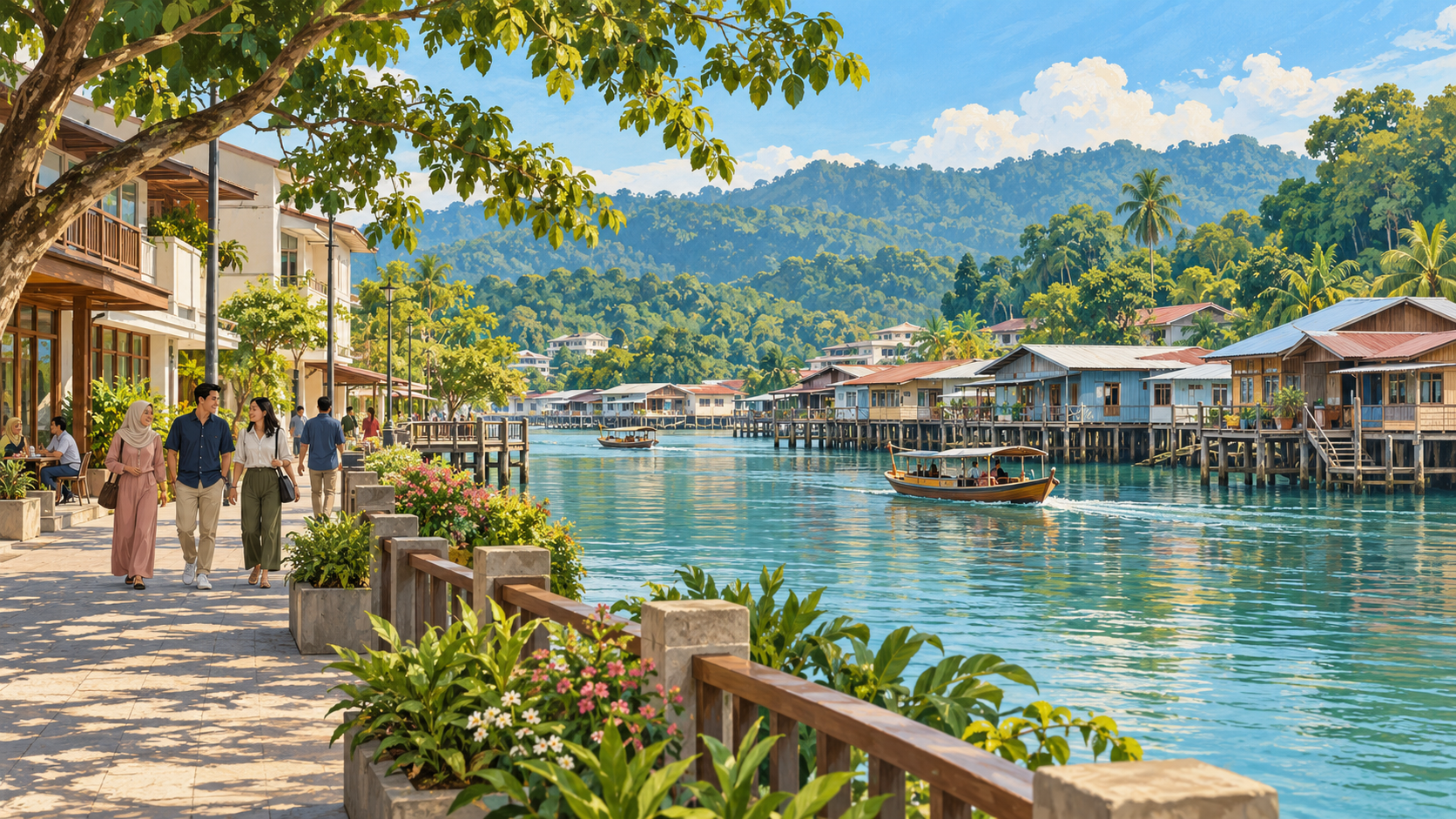
Brunei rewards the traveller who notices the relationship between a place and the life around it. Its river settlements, royal institutions, religious architecture, forest landscapes and everyday meals tell connected but different stories. These top 10 things to learn when visiting and touring Brunei are a practical Brunei travel learning guide: ten ways to understand a small Southeast Asian country without reducing it to golden domes, rainforest photographs or quick sightseeing stops.
For Singapore families researching educational travel in Brunei, the most memorable discoveries often begin with an ordinary question. Why are houses raised above the river? What can a museum object tell us about public ceremony? Why does a national park need local expertise? The following Brunei culture, history and geography lessons include reliable reading, English–Chinese vocabulary, thoughtful family conversations and learning that also works from home. No worksheet is required; curiosity and careful observation are enough.
Planning and cultural courtesy: Before travelling, read the Singapore MFA advice for Brunei. It describes local customs, Friday prayer closures, entry conditions for Singaporeans and the Singapore–Brunei dollar currency arrangement. Verify requirements for your own nationality, observe mosque visiting rules and book licensed or locally appropriate nature activities; no article can guarantee access or safety.
Choose your reading route
Follow the ten lessons in order, or pick a section that raises a question for your family. Visiting is optional; each lesson also works through official reading, recorded explanations and an attentive map.
Jump to the ten lessons · A gentle family route · English–Chinese vocabulary · Country learning directory
Contents
- Read Brunei’s position on Borneo before drawing a route
- Understand Kampong Ayer as a living water community
- Look at Omar Ali Saifuddien Mosque through architecture and respect
- Read the Royal Regalia Museum as an account of public ceremony
- Notice Malay, Jawi and everyday communication
- Study Ulu Temburong National Park as a protected forest system
- Learn how rivers, forests and local knowledge fit together
- Understand ambuyat through sago, technique and shared meals
- Connect public customs with Brunei’s social life
- Bring the ten lessons into one coherent Brunei story
Start by locating Brunei Darussalam on the northern edge of Borneo, facing the South China Sea. A small outline on a regional map can conceal a surprisingly important geographical detail: Brunei has a western main portion and the Temburong district to the east, separated by Malaysian territory. That shape influences the routes people use and the way visitors imagine distance. Ask a map to explain a route before trusting a casual phrase such as ‘just nearby’.
Now compare three kinds of map. A political map labels borders, a physical map displays rivers and relief, and a journey map emphasizes transport links. The same place changes appearance depending on what question each map was designed to answer. None by itself can tell you how a particular neighbourhood feels or whether a journey is suitable that day.
Bandar Seri Begawan is the capital, but it is not a substitute for the whole country. The Brunei-Muara district, the western districts of Tutong and Belait, and Temburong offer different geographic settings and stories. Hold those distinctions in mind when an article uses one familiar capital image as though it represented every community.
Pause on the question behind this lesson: What does the unusual outline make you ask about movement and connection? A useful answer names the specific object or place, identifies whose explanation is being used and leaves room for another perspective. That combination turns travel curiosity into an account another reader can trust.
Brunei’s equatorial conditions also matter. Heat, rain and monsoon-related flooding change how outdoor days are planned. Singapore readers will recognise some of the climate vocabulary, but similarity does not imply identical rainfall, infrastructure or local experience. Use each country’s current advisories and forecasts rather than applying a one-size-fits-all tropical itinerary.
Try a small map experiment: mark Bandar Seri Begawan, the Brunei River and Temburong. Write a sentence about the question that each of two maps answers best. Leave a third question open for a resident, guide or trusted local source; a responsible learner knows that maps have limits.
Read the source: Brunei travel advice, Singapore MFA. Official information is useful for facts and interpretation, while access rules and opening details should always be checked again shortly before travel.
Notice and discuss: What does the unusual outline make you ask about movement and connection? Explain one observed or verified detail, one relationship and one further question. A child can say it aloud; an older reader can write a concise paragraph.
Kampong Ayer is more than an attractive line of stilt houses. The official Brunei tourism guide describes a long-established community along the Brunei River, connected by paths and bridges. Its water setting helps explain why access, local services, daily work and social ties may take forms different from those in a street-based residential district.
A photograph normally captures the roofs and wooden walkways; a thoughtful visitor also asks who uses the place. Homes are not open-air displays, and a resident’s daily routine is not an attraction. If you take a river tour or explore a publicly accessible area, respect privacy, follow local guidance and avoid treating occupied spaces as sets for photography.
Look closely at how the built environment responds to the water. Raising structures, linking separate buildings and moving between land and river all involve choices and trade-offs. A learner can ask why one kind of walkway exists, without assuming that the answer is only heritage or only convenience. Communities adapt over time, and modern services coexist with older patterns.
Pause on the question behind this lesson: How does river geography shape everyday community life? A useful answer names the specific object or place, identifies whose explanation is being used and leaves room for another perspective. That combination turns travel curiosity into an account another reader can trust.
The Cultural and Tourism Gallery mentioned by Brunei Tourism offers a public starting point for interpretation. Compare its account with what is visible from approved visitor routes. An interpretation tells a story; observation adds detail. Neither licenses a stranger to claim they know everything about the people who live there.
From home, use the tourism description and an authorised map to sketch a simple relationship diagram: houses, pathways, river, transport and community spaces. Label what you can verify and mark unknowns with questions. That is a much better result than calling a living neighbourhood the ‘Venice of the East’ and stopping there.
Read the source: Brunei Tourism: Kampong Ayer. Official information is useful for facts and interpretation, while access rules and opening details should always be checked again shortly before travel.
Notice and discuss: How does river geography shape everyday community life? Explain one observed or verified detail, one relationship and one further question. A child can say it aloud; an older reader can write a concise paragraph.
LESSON 3 OF 10
3. Look at Omar Ali Saifuddien Mosque through architecture and respect
Completed in 1958, the Omar Ali Saifuddien Mosque is a major feature of central Bandar Seri Begawan. Brunei Tourism describes its dome, columns, lagoon, stained glass and ceremonial barge, as well as its dedication to the twenty-eighth Sultan. These details are not merely a list of decorative materials. Together, they tell a story about religious devotion, public space, craftsmanship and nationhood.
Begin by looking for contrasts: water and solid building, light and shadow, a formal roofline against the city around it. Think about why a lagoon changes the view and why a public religious building may also become a widely recognised city landmark. A photograph can help you notice proportion, but an official description helps distinguish a documented element from your own impression.
Architecture has a social life. The mosque is used for worship, so a visitor should never assume that ordinary tourist behaviour is appropriate at every hour. Check official visiting arrangements, prayer times, modest-dress requirements and restrictions on photography. If entry is not available, learn respectfully from the public exterior and official resources instead.
Pause on the question behind this lesson: What can design show, and what must we learn from people and context? A useful answer names the specific object or place, identifies whose explanation is being used and leaves room for another perspective. That combination turns travel curiosity into an account another reader can trust.
Try explaining the building without using the words ‘amazing’, ‘spectacular’ or ‘luxurious’. Name an element, what it does visually or practically, and the interpretation supported by a source. For example, a reflection on water changes the composition of a public view; it does not, by itself, prove what every worshipper experiences.
This approach travels well. A Singapore family could compare the role of another religious landmark at home without collapsing distinct beliefs into the same story. Respectful comparison requires careful names, local explanations and the recognition that sacred space is more than an architectural object.
Read the source: Brunei Tourism: Omar Ali Saifuddien Mosque. Official information is useful for facts and interpretation, while access rules and opening details should always be checked again shortly before travel.
Notice and discuss: What can design show, and what must we learn from people and context? Explain one observed or verified detail, one relationship and one further question. A child can say it aloud; an older reader can write a concise paragraph.
The Royal Regalia Museum provides a different view of Brunei’s institutions. Brunei Tourism describes ceremonial regalia, royal heirlooms, symbolic weapons, gifts and exhibits relating to jubilee celebrations. The displayed golden chariot associated with the Silver Jubilee is especially useful for thinking about how public occasions become part of remembered history.
Do not treat an exhibit as an object isolated from the event that gave it meaning. Ask who used it, what occasion it marked, who observed the event and how the museum invites visitors to interpret it now. One label may answer the date; a photograph may show a procession; the collection may reveal the materials and scale of the ceremony.
A museum offers a curated account, not an unlimited archive of every perspective. That is not a reason to dismiss the display. It is a reason to identify clearly what it does explain and what further questions would need other sources. Historical understanding is often built from several types of evidence, not a single impressive object.
Pause on the question behind this lesson: How does an object become evidence of a public event? A useful answer names the specific object or place, identifies whose explanation is being used and leaves room for another perspective. That combination turns travel curiosity into an account another reader can trust.
Notice how craft and institution meet. Ceremonial objects take technical skill to make, but their social importance comes from use and interpretation. A well-written travel note can include both facts: the described material and the documented occasion, without guessing at an item’s age, rarity or monetary value.
If you visit, consult current opening details and gallery rules rather than relying on an old blog post. Afterwards, write a three-sentence museum label for one permitted observation: object, supported context, remaining question. That tiny exercise gives an ordinary museum visit the shape of historical enquiry.
Read the source: Brunei Tourism: Royal Regalia Museum. Official information is useful for facts and interpretation, while access rules and opening details should always be checked again shortly before travel.
Notice and discuss: How does an object become evidence of a public event? Explain one observed or verified detail, one relationship and one further question. A child can say it aloud; an older reader can write a concise paragraph.
Language makes Brunei visible in ways that a landscape photograph cannot. Malay is the national language, and visitors may encounter Jawi alongside Roman letters in signs and public contexts. English also appears in various settings. Rather than assuming every sign is written for tourists, notice who might need it and what it is designed to communicate.
A useful first step is to distinguish a language from a writing system. Two signs may share a language but use different scripts, or use different languages for different readers. Look up the exact public sign you encounter through a reliable source rather than guessing at its meaning from nearby images.
Names deserve special care. A place name, a personal title and a term connected to religious practice are not interchangeable. Record the spelling before writing an explanation. If you do not know the pronunciation, an invitation to ask politely is better than confident invention.
Pause on the question behind this lesson: Who is each sign addressing, and what does translation leave unexplained? A useful answer names the specific object or place, identifies whose explanation is being used and leaves room for another perspective. That combination turns travel curiosity into an account another reader can trust.
For families who speak English or Mandarin at home, compare how a bilingual information panel makes decisions. Which wording remains untranslated? Which terms need cultural explanation? Translation can help, but it does not automatically preserve every meaning or register. The best learner is curious about what cannot fit neatly into one equivalent.
Make a two-column observation card from reliable public materials: exact words on one side, verified function on the other. Add ‘uncertain’ for anything not checked. The exercise reinforces a valuable habit: learning about another culture begins by listening to its own terms rather than supplying familiar labels too quickly.
Read the source: Singapore MFA country information. Official information is useful for facts and interpretation, while access rules and opening details should always be checked again shortly before travel.
Notice and discuss: Who is each sign addressing, and what does translation leave unexplained? Explain one observed or verified detail, one relationship and one further question. A child can say it aloud; an older reader can write a concise paragraph.
Ulu Temburong National Park is regularly introduced as Brunei’s ‘Green Jewel’. The official tourism account places it in Temburong and describes rainforest habitats and biodiversity. That description is an invitation to ask an ecological question, not permission to walk into unfamiliar forest alone. Protected environments demand rules, approved arrangements and local knowledge.
Build a food-web question without pretending that you have seen particular animals. Forest layers differ in light, moisture and vegetation, and those conditions help shape habitats. A photograph of green canopy is visually rich but limited: it does not give you a complete species inventory or prove the health of every part of the ecosystem.
Think also about conservation boundaries. Why does a country designate a national park, and how might recreation, research, community knowledge and protection interact? A responsible discussion should distinguish what Brunei Tourism states from broader ecological possibilities. Do not turn a marketing adjective such as ‘untouched’ into a literal claim that no human relationship exists.
Pause on the question behind this lesson: What can a park protect that a photograph cannot show? A useful answer names the specific object or place, identifies whose explanation is being used and leaves room for another perspective. That combination turns travel curiosity into an account another reader can trust.
If you choose an appropriate guided visit, ask the authorised operator which activities are permitted, what equipment is required and how weather affects routes. Never pressure a guide to approach wildlife or go off track for a better photograph. When access is unsuitable, official descriptions and publicly provided images offer meaningful remote study.
Try writing a short explanation of why the forest has value beyond the traveller’s experience. Include a named place, a documented characteristic and one open question about stewardship. That makes environmental learning a conversation about responsibility rather than a checklist of sightings.
Read the source: Brunei Tourism: Ulu Temburong National Park. Official information is useful for facts and interpretation, while access rules and opening details should always be checked again shortly before travel.
Notice and discuss: What can a park protect that a photograph cannot show? Explain one observed or verified detail, one relationship and one further question. A child can say it aloud; an older reader can write a concise paragraph.
Brunei’s rivers and wetlands offer another chance to learn how landscapes connect. Rivers support movement and settlement, while adjacent vegetation can influence banks, habitats and the way people use the water. A map of the Brunei River and a description of Temburong show that ‘nature’ and ‘city’ are not two completely separate topics.
Watch the boundaries of your claims. Seeing a river from a bridge is not enough to identify a water-quality trend, count a species population or describe every local fishing practice. Curiosity becomes more useful when it produces a precise next question: what is known about this stretch, in this season, from this institution?
Local knowledge matters especially in changing conditions. Guides and residents may know relevant routes, weather patterns and community protocols. Their expertise should be treated as knowledge rather than as colourful commentary added after a visitor has formed a conclusion. When you cite someone, distinguish their words from your own interpretation.
Pause on the question behind this lesson: Where do environmental systems and human decisions meet? A useful answer names the specific object or place, identifies whose explanation is being used and leaves room for another perspective. That combination turns travel curiosity into an account another reader can trust.
Use an official park account and public map to trace where forests and water meet. Add one possible relationship, such as vegetation helping shape a river corridor, and label it a question if the source does not substantiate it for the chosen place. There is no need for an unsupervised boat trip or close wildlife approach.
Compare the method with looking at Singapore’s own waterways: ask what is engineered, what is conserved, who manages access and where reliable explanations can be found. The comparison is about enquiry, not a claim that the landscapes have identical histories or species.
Read the source: Brunei Tourism: Temburong district. Official information is useful for facts and interpretation, while access rules and opening details should always be checked again shortly before travel.
Notice and discuss: Where do environmental systems and human decisions meet? Explain one observed or verified detail, one relationship and one further question. A child can say it aloud; an older reader can write a concise paragraph.
Ambuyat makes an excellent lesson because it invites an explanation rather than a judgement about whether a dish looks familiar. Brunei Tourism describes it as a sago-based preparation commonly eaten with a dipping sauce, using a distinctive bamboo utensil called a candas. Ingredients, texture and technique all matter to its identity.
Begin by distinguishing sago from the many starches a traveller already knows. Learn how a plant-derived ingredient becomes a cooked food and how the accompanying sauces contribute flavour. A written description can reveal more than a photograph, which cannot convey texture or the social rhythm of a shared meal.
Food customs deserve respect, especially when you are a guest. Ask what a dish is called, how it is normally served and whether there are customs around sharing. Do not turn a dining table into an experiment without the host’s consent. Also check dietary needs, allergies and food safety with the provider rather than treating an online guide as personalised advice.
Pause on the question behind this lesson: What makes a dish a cultural practice, not just an ingredient list? A useful answer names the specific object or place, identifies whose explanation is being used and leaves room for another perspective. That combination turns travel curiosity into an account another reader can trust.
There is an appealing practical enquiry here: compare two descriptions of the same dish, one by a local tourism source and one written by a visitor. Which includes the name of the utensil? Which explains preparation rather than only personal taste? A reliable detail may be small, but it makes the cultural account less superficial.
The point is not to rank national foods. It is to recognise how environment, ingredients, skilled preparation and sociability combine. A learner can remember ambuyat through a four-step relationship—plant, starch, preparation, shared table—even without sampling it on a trip.
Read the source: Brunei Tourism: Local Delicacies. Official information is useful for facts and interpretation, while access rules and opening details should always be checked again shortly before travel.
Notice and discuss: What makes a dish a cultural practice, not just an ingredient list? Explain one observed or verified detail, one relationship and one further question. A child can say it aloud; an older reader can write a concise paragraph.
Brunei’s official religion is Islam, and the country is a monarchy. These two basic facts help visitors read public institutions and customs, but they must not be stretched into assumptions about every resident. A country has many voices, communities, experiences and everyday routines. Good travel writing allows those distinctions to remain visible.
Singapore MFA advises visitors about the Friday prayer period, when many businesses close for part of the day. That detail is immediately practical, yet it can also prompt a wider question: how does shared time shape the rhythm of a city? The answer is not visible in a tourist itinerary unless you pay attention to local expectations.
Respectful behaviour is not simply a list of prohibitions. It includes asking permission before taking photographs, dressing appropriately for religious and formal spaces and understanding that private celebrations are not public performances. People do not owe travellers an explanation of their beliefs; public cultural materials offer a useful alternative.
Pause on the question behind this lesson: How do shared institutions affect daily routines without defining every individual? A useful answer names the specific object or place, identifies whose explanation is being used and leaves room for another perspective. That combination turns travel curiosity into an account another reader can trust.
Think about how a single capital city street may contain public offices, shops, worship spaces and homes. Each has different purposes and expectations. A visitor who reads those functions accurately is better able to enjoy the place without treating everything as an attraction.
Try composing a ‘visitor’s courtesy’ note based only on the published advice and the exact place you plan to visit. Separate verified rules from your own suggestions. This exercise makes practical respect concrete, especially for families visiting a culture that is geographically close but not identical to Singapore.
Read the source: Singapore MFA Brunei: Culture and Friday prayers. Official information is useful for facts and interpretation, while access rules and opening details should always be checked again shortly before travel.
Notice and discuss: How do shared institutions affect daily routines without defining every individual? Explain one observed or verified detail, one relationship and one further question. A child can say it aloud; an older reader can write a concise paragraph.
Finish by selecting just three details: perhaps a river walkway, a ceremonial object and a rainforest map. Explain why each matters and then connect them without pretending they are parts of the same activity. The strongest link might be a shared question about how people organize space, preserve memory and care for the environment.
Travel often supplies images faster than explanations. Reverse that tendency. For every photograph you keep, add one sentence that names the subject correctly, one that credits a reliable interpretation and one that tells the reader what remains uncertain. This approach works as well for a family journal as it does for a longer travel essay.
If you visit only Bandar Seri Begawan, be honest about the scope of your first-hand knowledge. If you study Temburong remotely, say so. A thoughtful writer does not pretend that a single week provides comprehensive knowledge of a country, and does not borrow the voice of a resident without permission.
Pause on the question behind this lesson: Which three details can you explain without exaggeration? A useful answer names the specific object or place, identifies whose explanation is being used and leaves room for another perspective. That combination turns travel curiosity into an account another reader can trust.
Draw a small route of ideas rather than a hectic itinerary: geography leads to the river settlement; the mosque and museum lead to questions of public meaning; the forest and food chapters return attention to environment and daily practice. Different readers can choose different orders according to their interests and arrangements.
Above all, allow Brunei to be complex in an enjoyable way. It is possible to appreciate beauty and ask difficult questions at the same time. Returning home with one carefully understood relationship is a more lasting souvenir than a notebook full of unexplained place names.
Read the source: Brunei Tourism: Explore the country. Official information is useful for facts and interpretation, while access rules and opening details should always be checked again shortly before travel.
Notice and discuss: Which three details can you explain without exaggeration? Explain one observed or verified detail, one relationship and one further question. A child can say it aloud; an older reader can write a concise paragraph.
A gentle family learning route
Before departure, invite each traveller to choose one curiosity: water communities, architecture, history, rainforest ecology, food or language. Put its question beside a verified source and one relevant map. This small amount of preparation helps a child arrive with a reason to look closely rather than an obligation to remember a dozen facts.
On a suitable city day, concentrate on one public cultural encounter. A museum, an approved view of the riverside or a properly arranged heritage walk can provide enough material. Allow time for breaks and local rhythms. Do not fill the day with timed photography stops or presume that any public-looking space is free to enter.
On another day, read or discuss a different kind of evidence. Contrast a museum’s curated explanation with a contemporary tourism description, then compare both with what you actually observed. A place name, date and carefully attributed claim are worth more than dramatic but unverified details.
At home, ask each person to give a one-minute account with the pattern: what I noticed, what I learned from a source, and what I now want to know. Families with younger children can make a labelled picture; older learners can add a source link and a sentence about uncertainty.
English–Chinese vocabulary for understanding Brunei
These are English–Chinese conceptual equivalents for discussion, not Malay translations. Use a word in a sentence about a specific source instead of memorising it without context.
| English | 中文 | Useful question |
|---|---|---|
| cultural landscape | 文化景观 | Where does this appear? |
| water settlement | 水上聚落 | What is the verified example? |
| stilt house | 高脚屋 | Who can explain its meaning? |
| ceremonial regalia | 礼仪器物 | How is this connected to daily life? |
| sultanate | 苏丹国 | Where does this appear? |
| religious architecture | 宗教建筑 | What is the verified example? |
| rainforest canopy | 雨林林冠 | Who can explain its meaning? |
| biodiversity | 生物多样性 | How is this connected to daily life? |
| conservation | 保护;保育 | Where does this appear? |
| sago starch | 西米淀粉 | What is the verified example? |
| interpretation | 诠释;解说 | Who can explain its meaning? |
| community knowledge | 社区知识 | How is this connected to daily life? |
Questions families often ask
Is Brunei a suitable destination for learning with children?
Many places and public resources support thoughtful family learning, but suitability depends on your children’s ages, interests, current conditions and specific activity arrangements. Choose one meaningful focus instead of promising to complete every chapter on a short trip.
Do we need to enter a mosque to learn about its architecture?
No. Official descriptions, public exterior views and respectful discussion are enough for a useful learning task. Worship and visitor access take priority over photography or a checklist.
Can we explore Kampong Ayer without disturbing residents?
Use approved visitor routes or guided experiences, respect private homes and ask permission before photographing people. A living community deserves ordinary privacy and courtesy.
Does the forest chapter recommend independent hiking?
No. It explains protected forest knowledge and encourages officially permitted, locally guided arrangements only where appropriate. Remote learning is a complete alternative.
Are the Chinese terms translations of Malay words?
No. The table gives English–Chinese conceptual equivalents for discussion; it is not a Malay language phrasebook and does not replace local naming or pronunciation.
How can we write a useful one-page Brunei reflection?
Choose a verified object, setting or custom. Write what you noticed, what an identified source explains and what you still want to ask. Precision beats an overlong list of superlatives.
Continue the country learning journey
Return to the country learning directory. The preceding alphabetical country guide is Brazil. Next in this chapter of the series are Bulgaria, Burkina Faso and Burundi.
Explore the travel vocabulary directory and World Travel Hub for related city and country guides. The next useful step is not another checklist but a clearer explanation of one thing that caught your attention.