
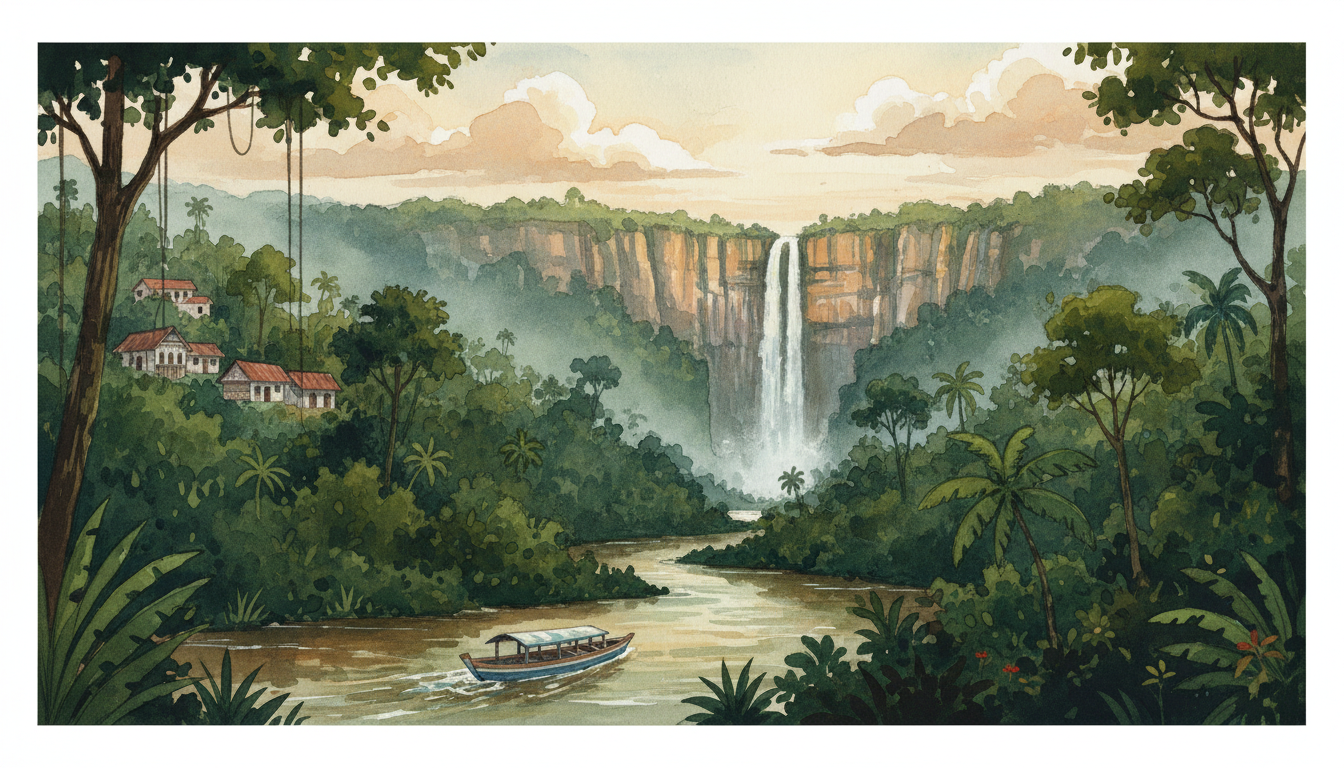
Guyana invites a different kind of South American curiosity. A wooden cathedral in Georgetown reveals how nineteenth-century builders adapted Gothic forms to tropical conditions, old drainage canals show how a coastal town grew out of plantation land, and a giant waterfall turns the science of rivers into a breathtaking sight. Far inland, rainforest researchers and Indigenous communities work on the difficult question of how conservation can support people’s livelihoods. These top 10 things to learn when visiting and touring Guyana connect history, engineering, natural science and living knowledge.
For Singapore families exploring Guyana travel, Georgetown, Kaieteur Falls, Iwokrama Rainforest, Shell Beach and cultural heritage, the following ten lessons replace a rushed attractions list with useful explanations. A central fact matters immediately: Guyana currently has **no inscribed UNESCO World Heritage properties** but maintains **five Tentative List proposals**. We’ll examine the architecture and historical structures on that list, then turn to turtle conservation and sustainable forests. With official sources, English–Chinese vocabulary and relaxed family questions, the guide is equally useful from home, particularly where travel or river conditions are uncertain.
Check current safety and local permission (October 2026): Consult UK FCDO Guyana travel guidance and its regional safety information. It describes significant crime risks, political demonstrations, disputed and tense borders with Venezuela and Suriname, river-transport hazards and seasonal flooding. Use approved boat services with lifejackets if travel is needed, and never assume remote forests or waterfalls are accessible or safe. Guyana’s UNESCO-listed candidates are **tentative nominations**, not permissions to enter private homes, Indigenous settlements or protected wildlife habitats.
Choose your reading route
The ten chapters are ways to understand Guyana’s ecology, architecture and communities, not one proposed national travel route. Contents · Family route · Vocabulary · Country directory
Contents
- Locate Guyana in South America and distinguish it from Guinea
- Read Georgetown’s old plantation layout through its canals and streets
- Understand St George’s Cathedral as an extraordinary wooden building
- Study Georgetown City Hall as civic architecture and public responsibility
- Remember the difficult histories of Fort Zeelandia and the Court of Policy
- Understand Shell Beach’s 1995 proposal as sea turtle conservation
- Discover Kaieteur Falls through geology, river science and Indigenous memory
- Explore Iwokrama as a rainforest research and conservation partnership
- Understand sustainable forestry as a difficult practical experiment
- Learn from the Umana Yana and Wai Wai craftsmanship in Georgetown
Guyana is on the north coast of South America, neighbouring Venezuela, Brazil and Suriname, with Georgetown as its capital. It is not Guinea in West Africa or Guinea-Bissau. Although the names may look similar in a search result, the countries have separate histories, institutions, languages and travel rules.
A coastal plain, huge river networks, savannas and extensive rainforest help explain the environmental variety. Locate the Essequibo, Demerara and Berbice rivers, the coastal capital and the Potaro River system inland. A political map shows borders; a relief map helps explain water and terrain, but neither represents every community’s experience.
UNESCO records **zero inscribed World Heritage properties** for Guyana and five entries on its World Heritage Tentative List. Four older proposals concern buildings and coastal natural heritage; the fifth, proposed in 2005, concerns Georgetown’s plantation structure and historic townscape.
One additional distinction matters: Guyana’s UNESCO intangible-heritage country profile indicates that it is not presently party to the 2003 Convention. That does not mean Indigenous or other living traditions lack significance; it means a claim that they are internationally inscribed under this convention needs proof rather than assumption.
Make a map with three labels: a coastal historic site, a protected rainforest and a river feature. Name the institution that explains each. This habit avoids mixing up countries and treating all ecological and cultural significance as one institutional label.
Notice and discuss: Why is it important not to confuse a country with a similarly named place or an unverified UNESCO status? Give one verifiable observation, a relationship and a question the source does not settle.
Official or institutional source: Locate Guyana in South America and distinguish it from Guinea. Heritage interpretation does not replace current legal access, boating safety, wildlife protections or community consent.
LESSON 2 OF 10
2. Read Georgetown’s old plantation layout through its canals and streets
Georgetown’s Plantation Structure and Historic Buildings entered Guyana’s UNESCO Tentative List in **2005**. The proposal explains that the historic layout of the city developed partly from former Dutch plantations, with canals and streets that continued to influence later town planning.
Coastal engineering is a useful learning subject. Low-lying land needs drainage and control of water, and canal routes can affect how streets and neighbourhood blocks were organised. The geometry visible in an aerial image becomes more meaningful when connected with historical land use and flood management.
The old streets also preserve evidence of colonial institutions, commerce, unequal power and changing urban identities. A description that admires nineteenth-century façades without acknowledging plantation history would leave out people whose labour shaped the place.
UNESCO’s proposal names surviving or altered canals and neighbourhoods. It should not be treated as a live engineering survey of present flood-defence capacity, and a 2005 state document cannot tell us how every drainage system works today.
Compare an eighteenth- or nineteenth-century map with a contemporary street plan. Identify one canal or route that influenced the grid, and then ask what a resident might need from the same area now. The lesson is continuity through change rather than nostalgia for colonial urbanism.
Notice and discuss: How can a drainage canal preserve evidence of earlier economic and urban decisions? Give one verifiable observation, a relationship and a question the source does not settle.
Official or institutional source: Read Georgetown’s old plantation layout through its canals and streets. Heritage interpretation does not replace current legal access, boating safety, wildlife protections or community consent.
LESSON 3 OF 10
3. Understand St George’s Cathedral as an extraordinary wooden building
St George’s Anglican Cathedral in Georgetown has been on the UNESCO World Heritage Tentative List since **1995**. The proposal describes a high timber Gothic Revival structure whose current building dates to the late nineteenth century. The National Trust of Guyana records the laying of its foundation stone in 1889 and its consecration in 1894.
The architectural interest comes from applying Gothic forms in wood rather than relying on masonry alone. Pointed arches, tracery, buttresses and a tall spire express a particular visual tradition while requiring practical knowledge of local building materials and tropical environmental conditions.
An imposing religious building is more than a beautiful exterior. Its use by a congregation continues, and its construction required artisans, designers, patrons and people maintaining the structure across generations. A protected place needs current care against weathering and material deterioration.
The National Trust’s historical account describes several earlier buildings used by the congregation before the present cathedral. Keeping that sequence clear prevents a common error: the long history of the institution is not the same as the date of the current timber structure.
Choose an official exterior photograph and mark three Gothic Revival features. Ask how their construction differs in timber and stone. Respect worship and current admission arrangements; a Tentative List nomination is not a licence to enter private areas.
Notice and discuss: How can timber craftsmanship make a familiar architectural style work in a different climate? Give one verifiable observation, a relationship and a question the source does not settle.
Official or institutional source: Understand St George’s Cathedral as an extraordinary wooden building. Heritage interpretation does not replace current legal access, boating safety, wildlife protections or community consent.
LESSON 4 OF 10
4. Study Georgetown City Hall as civic architecture and public responsibility
Georgetown City Hall was placed on UNESCO’s Tentative List in **1995**. The official state submission describes a striking Gothic Revival building constructed during 1887–1889, with timber, iron decorative features and a tower. The National Trust of Guyana explains that the building was formally opened on 1 July 1889.
Unlike the cathedral, City Hall was designed for municipal government. Rooms, a council function and a public architectural appearance were connected with the institutions administering a growing colonial town. Buildings with similar decorative styles may therefore serve very different civic and religious purposes.
Architectural splendour should not hide the political history of British Guiana. Official records reveal how government institutions developed, while social histories are needed to explain who enjoyed political representation and who was excluded during different periods.
The structure also raises a modern conservation question. Wooden urban heritage requires work from owners, craftspeople and public authorities, as well as decisions about current municipal uses. A UNESCO Tentative List proposal does not guarantee the building is fully restored or open.
Compare the cathedral and City Hall through form, materials and institutional role. Write one common design feature and one major functional difference. That is much more useful than merely calling both landmarks pretty Gothic buildings.
Notice and discuss: How can similar architectural details communicate different social and political purposes? Give one verifiable observation, a relationship and a question the source does not settle.
Official or institutional source: Study Georgetown City Hall as civic architecture and public responsibility. Heritage interpretation does not replace current legal access, boating safety, wildlife protections or community consent.
LESSON 5 OF 10
5. Remember the difficult histories of Fort Zeelandia and the Court of Policy
Fort Zeelandia and the Court of Policy Building on Fort Island in the Essequibo River form one UNESCO Tentative List proposal from **1995**. The state submission describes Dutch-era brick structures associated with defence and administration from the mid-eighteenth century.
The fort’s ramparts and bastions belong to the management of river approaches and maritime control. The nearby Court of Policy served institutional roles, but the official submission also identifies a part used for the auctioning of enslaved people. A serious country guide must state that painful history rather than present the site as a picturesque riverside ruin.
Material remains can support questions about military engineering, government and the circulation of goods, while archives and descendant-community perspectives help explain the social consequences of colonial rule and enslavement. A stone wall cannot give voice to every person harmed by the system.
The river landscape has also changed through time and erosion. Historic ruins may be fragile, and reaching an island can require water transport with risks unrelated to its heritage importance. Public officials and the National Trust control access and conservation priorities.
Make a respectful study note with three headings: defensive purpose, administrative function and human consequences. Avoid invented testimony and use museum or National Trust materials to guide interpretation. A remote account can be complete without a boat journey.
Notice and discuss: How can a small fort and government building preserve evidence of institutions and historical injustice? Give one verifiable observation, a relationship and a question the source does not settle.
Official or institutional source: Remember the difficult histories of Fort Zeelandia and the Court of Policy. Heritage interpretation does not replace current legal access, boating safety, wildlife protections or community consent.
LESSON 6 OF 10
6. Understand Shell Beach’s 1995 proposal as sea turtle conservation
Shell Beach, also called Almond Beach in Guyana’s UNESCO Tentative List entry, was submitted as potential natural World Heritage in **1995**. The proposal describes an extensive shell-rich coastline that provides nesting habitat for marine turtles, including green, leatherback, olive ridley and hawksbill turtles.
Nesting beaches support a particular phase of turtles’ life cycles. Animals spend substantial periods at sea yet depend on suitable shores to lay eggs. Light, noise, unnecessary handling and alteration of nesting areas can create disturbance. A spectacular wildlife photograph is not a permit to approach an animal.
UNESCO’s brief 1995 proposal provides historical institutional context, but not a live population study or updated local map of nesting activity. Scientific counts, beach conditions and access rules need modern sources and methods. It is important not to turn an older listing into a guarantee of sightings.
The coastline also belongs to changing tidal, sediment and mangrove relationships and to people who depend on coastal environments. Sustainable protection asks what nearby communities need as well as what wildlife requires.
Draw a conceptual sequence from ocean feeding habitat to beach nesting and hatchling return. Then mark where human behaviour matters. Guyana’s maritime and northern coastal conditions require current specialist guidance; remote wildlife learning is entirely sufficient.
Notice and discuss: Why can a protected beach be essential to species whose lives extend far into the ocean? Give one verifiable observation, a relationship and a question the source does not settle.
Official or institutional source: Understand Shell Beach’s 1995 proposal as sea turtle conservation. Heritage interpretation does not replace current legal access, boating safety, wildlife protections or community consent.
LESSON 7 OF 10
7. Discover Kaieteur Falls through geology, river science and Indigenous memory
Kaieteur Falls is one of Guyana’s most remarkable natural features, on the Potaro River within Kaieteur National Park. The National Trust of Guyana describes a waterfall with a single plunge of about 225 metres and a protected landscape of rainforest and distinctive species.
A waterfall is a geological relationship among river, elevation, rock and erosion. Its dramatic height is instantly visible in a photograph, but that view does not explain the Potaro River’s wider basin or the long processes that shaped the plateau and gorge.
The National Trust also records Indigenous accounts associated with the name Kaieteur. Such narratives have community meaning and should be attributed properly rather than presented as verified geological explanations. Respect for Indigenous storytelling and for natural science can coexist without confusing the forms of evidence.
UNESCO’s Guyana record does not list Kaieteur among the country’s five Tentative List proposals and the country has no inscribed World Heritage property. The national park’s significance and status therefore need to be stated independently of international UNESCO listing.
Make two short notes: how falling water and rock create the physical feature, and how an attributed Indigenous account gives another form of meaning. Difficult access, cliffs and uncertain transport demand proper local arrangements, never unsupported directions from a travel article.
Notice and discuss: How can the same waterfall be studied through both physical processes and carefully attributed stories? Give one verifiable observation, a relationship and a question the source does not settle.
Official or institutional source: Discover Kaieteur Falls through geology, river science and Indigenous memory. Heritage interpretation does not replace current legal access, boating safety, wildlife protections or community consent.
LESSON 8 OF 10
8. Explore Iwokrama as a rainforest research and conservation partnership
The Iwokrama International Centre was established in **1996** through cooperation between Guyana and the Commonwealth. Its published mission is to promote conservation and sustainable, equitable use of tropical forests through research, training and practical models. It manages approximately 371,000 hectares of rainforest in central Guyana.
The forest is not merely scenery. Scientists study biodiversity, climate, water and forest management, while local and Indigenous communities have important relationships with the landscape. The Iwokrama Centre’s description emphasises partnerships rather than a claim that nature must be protected in isolation from people.
Iwokrama is an independent conservation initiative, **not** an inscribed UNESCO World Heritage property. That distinction protects the accuracy of the country guide while still recognising important environmental work.
Research uses monitoring, sample plots, species inventories and management plans developed over time. An old wildlife list or public photograph cannot demonstrate current conditions or guarantee that an animal will appear during an encounter.
Create a conceptual diagram linking forest habitat, scientific monitoring, local livelihoods and conservation decisions. Ask what data a research centre would need to assess success over a decade. This exercise works from home without entering a remote reserve.
Notice and discuss: How can scientific research and community participation support the same conservation objective? Give one verifiable observation, a relationship and a question the source does not settle.
Official or institutional source: Explore Iwokrama as a rainforest research and conservation partnership. Heritage interpretation does not replace current legal access, boating safety, wildlife protections or community consent.
LESSON 9 OF 10
9. Understand sustainable forestry as a difficult practical experiment
Iwokrama’s sustainable forestry work provides a specific way to study how conservation and economic decisions interact. The Centre documents selective harvesting methods, low-impact operations, certification and the monitoring of biodiversity. This is more informative than a broad statement that all forest use is automatically good or bad.
Forest management requires practical choices: which areas remain protected, what trees may be harvested, what methods minimise damage and how communities benefit. The Centre reports mechanisms for local participation and benefits, rather than simply selling timber without an ecological framework.
Iwokrama describes maintaining certification and monitoring its operations. Such claims should be read as evidence tied to particular audit dates and criteria, not permanent proof of environmental success under every possible measure. Independent checks and changing conditions remain relevant.
Social questions matter too. Indigenous and nearby communities have relationships with forest resources, and the fairness of conservation and commercial arrangements cannot be judged only from an overhead photograph of trees. Community voices and responsible governance belong in the research.
Compare protected forest with a carefully managed forestry area through a simple two-column diagram. Write one ecological indicator, one livelihood question and one unresolved issue. This is a case study of decisions and evidence, not instructions for harvesting trees.
Notice and discuss: How can a conservation organisation test whether limited resource use and forest protection can coexist? Give one verifiable observation, a relationship and a question the source does not settle.
Official or institutional source: Understand sustainable forestry as a difficult practical experiment. Heritage interpretation does not replace current legal access, boating safety, wildlife protections or community consent.
LESSON 10 OF 10
10. Learn from the Umana Yana and Wai Wai craftsmanship in Georgetown
Umana Yana is a remarkable circular, thatched meeting structure in Georgetown associated with Indigenous Wai Wai building knowledge. The National Trust describes the first Umana Yana as constructed in **1972** for an international meeting, with Wai Wai men from the Konashen region contributing specialised materials and construction skills.
The building later deteriorated, was reconstructed, and a further replacement was created after a 2014 fire. The current structure was completed in **2016**, with Wai Wai craftsmen once again participating in the project. This chronology matters because the building’s cultural significance depends partly on skills kept alive through making and repair.
The National Trust’s account names its roof materials and describes how traditional techniques were combined with modern tools. Architecture can be an expression of practical knowledge and community identity without claiming that all Indigenous groups in Guyana use the same building styles.
This is national heritage, not a World Heritage inscription, and the living practice of Indigenous construction should not be assigned an invented UNESCO intangible designation. Guyana’s UNESCO intangible country page currently records that it is not a party to the 2003 Convention.
Compare the 1972 and 2016 building accounts. Explain what changed materially and what forms of skilled knowledge continued. Finish the Guyana guide by connecting one wooden cathedral, one living Indigenous building tradition and an actively managed rainforest. Each provides a distinct reason to value the people behind a place.
Notice and discuss: How can reconstruction preserve building knowledge even when the physical structure has changed? Give one verifiable observation, a relationship and a question the source does not settle.
Official or institutional source: Learn from the Umana Yana and Wai Wai craftsmanship in Georgetown. Heritage interpretation does not replace current legal access, boating safety, wildlife protections or community consent.
A gentle family learning route
Begin with Georgetown’s historic grid and one of its wooden buildings. Ask how waterways, a colonial economy and skilled carpentry contributed to the city. Distinguish visible architecture from evidence about the social system surrounding it.
On another day, compare the natural Kaieteur Falls and a rainforest research question at Iwokrama. A waterfall needs a geological explanation, while sustainable forest management depends on monitoring and decisions involving people.
End with Shell Beach and the Umana Yana. Turtle protection requires restraint and ecological knowledge, whereas Indigenous building heritage requires crediting craftspeople and their community. Both make a valuable remote-learning session without entering sensitive places.
English–Chinese vocabulary for Guyana
These English–Chinese conceptual equivalents are for discussion, not translations into the languages of Guyana’s communities.
| English | 中文 | Learning use |
|---|---|---|
| coastal drainage | 海岸排水系统 | Locate the relevant evidence. |
| plantation town planning | 种植园式城镇规划 | Explain the physical process. |
| Gothic Revival timber | 哥特复兴式木结构 | Credit the community or institution. |
| municipal architecture | 市政建筑 | Identify conservation or heritage status. |
| colonial fortification | 殖民防御工事 | Locate the relevant evidence. |
| historical enslavement | 历史上的奴役 | Explain the physical process. |
| turtle nesting habitat | 海龟产卵生境 | Credit the community or institution. |
| waterfall geology | 瀑布地质 | Identify conservation or heritage status. |
| rainforest conservation | 雨林保护 | Locate the relevant evidence. |
| sustainable forestry | 可持续林业 | Explain the physical process. |
| Indigenous building craft | 原住民建筑工艺 | Credit the community or institution. |
| Tentative List | 预备申报名录 | Identify conservation or heritage status. |
Questions families often ask
How many UNESCO World Heritage properties does Guyana have in 2026?
None. UNESCO currently records zero inscribed properties and five Tentative List proposals.
Are St George’s Cathedral and Georgetown City Hall UNESCO World Heritage sites?
No. They are separate Guyana Tentative List entries from 1995, not completed inscriptions.
Is Kaieteur Falls on Guyana’s World Heritage Tentative List?
No. The National Trust recognises its national significance, but the current UNESCO country record lists five other tentative properties.
What is unusual about Umana Yana?
It is a Georgetown meeting structure associated with Wai Wai craftsmanship, first built in 1972 and reconstructed again with Indigenous participation in 2016.
Can visitors approach Shell Beach turtles or explore the Venezuela border independently?
No. Nesting turtles require protection, and FCDO identifies significant security tensions and crime risks around border areas.
Are these Chinese terms translations of Indigenous Guyanese languages?
No. They are English–Chinese conceptual equivalents, not a translation of Wai Wai, Makushi or other community languages.
Continue the country learning journey
Return to the World Country Learning Directory. The preceding alphabetical guide is Guinea-Bissau. The next planned batch begins with Haiti, Honduras, Hungary and Iceland; their directory links will be added once live.
Explore the Travel Vocabulary Directory and the World Travel Hub for more destinations and connected knowledge.