
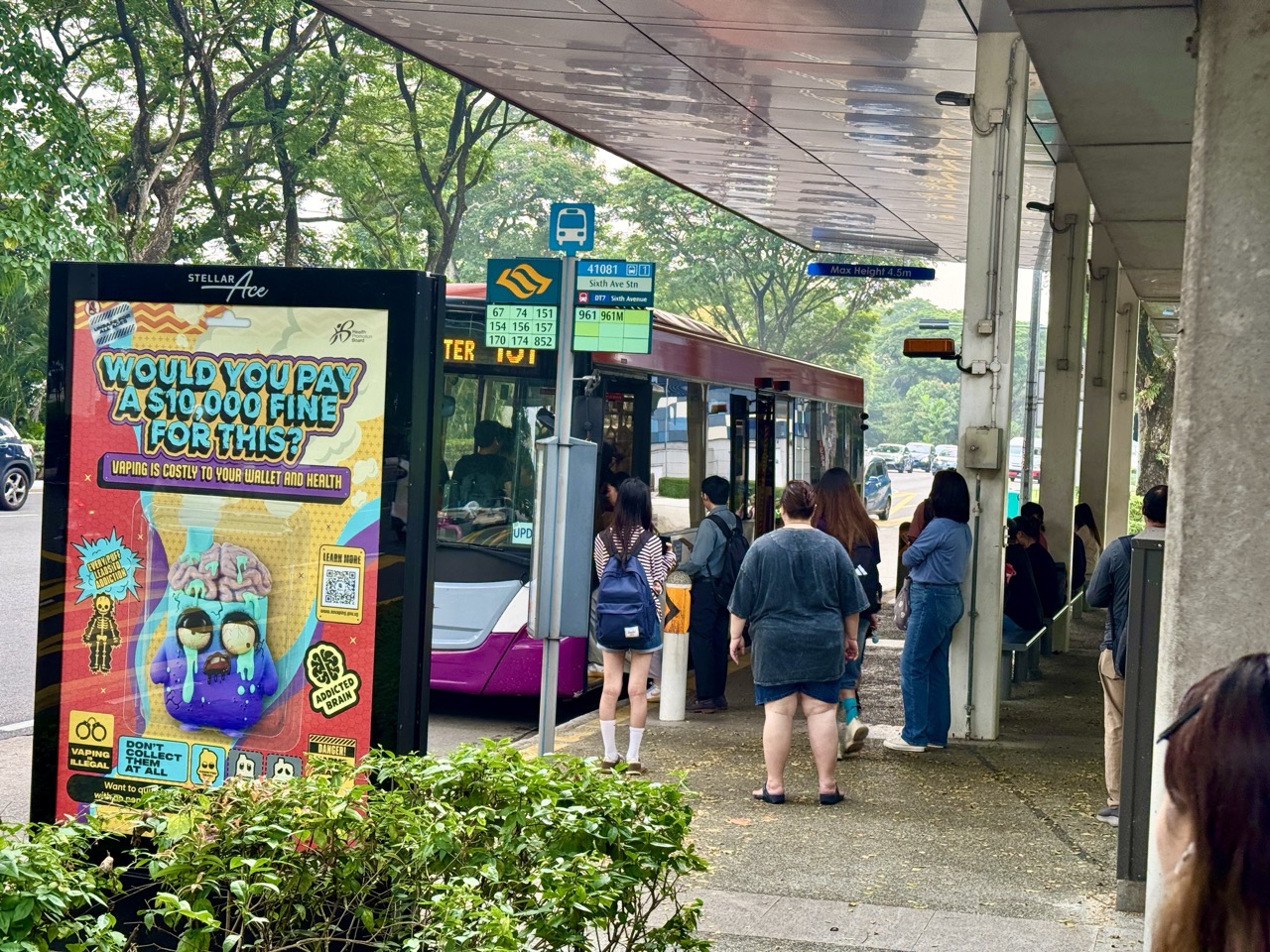
Riding a public bus in Singapore: how to ask, pay and alight correctly
Standing beside a Singapore bus stop, you might know the place you want to visit but still have three questions: “Is this the right stop?”, “Does this service go in my direction?”, and “Where should I get off?” These questions matter more than sounding local. They help you choose a bus, pay correctly and travel with confidence.
The key distinction comes before the bus arrives: a five-digit bus stop code identifies a particular stopping place, while a service number identifies a route. For a contactless-card journey, you normally tap in when boarding and tap out with the same card when alighting. If the bus is approaching your destination, press the stop bell in good time. Clear questions, not copied accents, are the useful skill.
This guide teaches the same 20 terms in English, Simplified Chinese, Hindi and Russian. Each entry links to its matching translation, includes natural English to say to local people, and explains a predictable mistake. Sample conversations use imaginary journeys rather than claiming that a particular bus is running at a particular time. Always confirm real routes and fares with the transport operator.
Switch language without losing your place: 简体中文 · हिन्दी · Русский
Twenty bus terms to recognise at the stop and on board · Six decisions for a successful bus trip · All 20 terms explained in practical context · Ten worked conversations from bus stop to destination · Five-minute practice: turn a word list into a real journey · Frequently asked questions about Singapore public buses · Official Singapore references and source notes · Continue to more Singapore conversations
Twenty bus terms to recognise at the stop and on board
| Word | Meaning | Phrase to practise |
|---|---|---|
| 1. Bus stop code | A bus stop code is the five-digit identifier for a particular stopping place. | Could you check this five-digit bus stop code? |
| 2. Service number | The service number identifies a bus route, sometimes with a letter suffix. | Is this the service number I need? |
| 3. Bus interchange | A bus interchange is a transport facility where several bus services connect, commonly with clearly marked places to board. | Does this bus go to the bus interchange? |
| 4. Berth | At an interchange, a berth is the designated bay or boarding position for one or more bus services. | Which berth is for this bus? |
| 5. Destination display | The destination display on the front of a bus identifies its service and displayed destination. | What destination is shown on the front? |
| 6. Opposite direction | Opposite direction means a vehicle is travelling the other way along a route. | Am I waiting on the wrong side of the road? |
| 7. Loop service | A loop service follows a route that returns through a loop rather than operating like a simple straight trip between two distinct terminals. | Does this service loop back? |
| 8. Feeder bus | A feeder service is a local bus route designed to connect neighbourhoods with important transport nodes or facilities. | Is this a feeder service for the neighbourhood? |
| 9. Estimated arrival / ETA | Estimated arrival, often shortened to ETA, is a prediction of when the next bus may reach the stop. | How many minutes until the next bus? |
| 10. Queue up | Queue up means line up and wait your turn. | Where should I queue for this bus? |
| 11. Flag down | To flag down a bus is to signal that you wish to board, normally by raising your hand where the bus captain can see you. | Should I signal for this bus to stop? |
| 12. Bus captain | Bus captain is the Singapore public-transport term used for a bus driver. | Could you tell me when my stop is near? |
| 13. Tap in | Tap in means present an accepted payment card or enabled mobile wallet to the bus reader when boarding. | Do I need to tap in when boarding? |
| 14. Tap out | Tap out means present the same fare medium when alighting so the fare system records the end of the journey. | Where do I tap out before leaving? |
| 15. Same card | Same card means using the identical card or mobile-payment medium for boarding and alighting. | Must I tap out with the same card? |
| 16. Multiple cards | Multiple Cards is a reader message that can appear when more than one contactless card is presented together, for example through a wallet containing bank and transit cards. | Why does the reader say “Multiple Cards”? |
| 17. Stop bell | The stop bell, also called a stop-request button, alerts the bus captain that someone wants to alight at an upcoming bus stop. | When should I press the bell? |
| 18. Alight | Alight is a formal or transport-English word meaning get off a bus. | Is this where I should alight? |
| 19. Priority seat | Priority seats are intended to support passengers who need seating because of mobility, age, pregnancy or other circumstances. | May I have a seat, please? |
| 20. Wheelchair ramp / step-free access | A wheelchair ramp is a device bus staff can deploy to support wheelchair boarding or alighting on suitable vehicles. | Could you help me with the wheelchair ramp? |
The list mixes official transport terminology with simple visitor questions. It is not a list of twenty uniquely Singlish expressions. The goal is to understand everyday Singapore transport language and speak respectfully in whichever clear English form works for you.
Six decisions for a successful bus trip
Identify the exact stop
Write down your destination and search for a suitable route. Read the five-digit code on the bus stop you are actually standing at. A stop across the road can have a similar name but serve traffic moving the opposite way. A precise code is more useful than a photograph of a shelter without a readable sign.
Confirm route and direction
Compare the service number, front destination display and list of upcoming stops. If the route loops, do not assume the vehicle takes you directly to every familiar stop. Ask a short question before boarding, rather than discovering the wrong direction halfway through the trip.
Board safely and register payment
Wait at the right berth or stop, queue, and flag down a suitable bus where needed. Let it stop fully. If using a supported card or mobile payment, tap in. Separate the card you intend to use from other cards in your wallet. If you plan to use cash, confirm the current cash-fare procedure and required amount rather than guessing.
Travel considerately
Keep clear of doors and wheelchair bays, hold a handrail, and offer priority seating when appropriate. A bus captain must concentrate on driving, so make necessary questions brief. An on-board screen, if fitted, can help you follow upcoming stops. Do not stand on stairs, crowd the exit or use the fare reader as a handhold.
Request your stop and complete the journey
When the correct stop is approaching, press the stop bell in time. Wait for the vehicle to stop fully, then use the indicated exit and tap out using the exact same card or payment medium. The bell requests a designated bus stop, not an immediate stop wherever the bus happens to be.
Recover from uncertainty
If you boarded the wrong direction, ask calmly where to alight safely and plan a new route. For a card-reader error, use the operator or SimplyGo assistance route; do not assume another card can close the original trip. Ask early about wheelchair boarding or assistance with recognising a stop rather than trying to solve the problem by rushing.
All 20 terms explained in practical context
1. Bus stop code
Meaning and local use: A bus stop code is the five-digit identifier for a particular stopping place. It is different from the bus service number painted on the front of a vehicle. The stop name alone may not distinguish two stops on opposite sides of a road. Use the actual stop code in a journey planner to see services calling there.
Say it naturally: “Could you check this five-digit bus stop code?” A printed code is an identifier, not a timetable. Do not assume a service calling at the stop goes in your desired direction. Check the side of the road and the next few stops before committing to a route.
Read the same entry: 简体中文 01 · हिन्दी 01 · Русский 01
2. Service number
Meaning and local use: The service number identifies a bus route, sometimes with a letter suffix. It does not by itself identify the stop or guarantee the direction of travel. Say the complete number shown on the vehicle, and compare it with the route panel at your stop. A bus on the opposite carriageway may use the same number in the reverse direction.
Say it naturally: “Is this the service number I need?” If your app shows a number and a destination, check both. Do not invent a timetable from a route number or assume two services sharing a first digit serve the same neighbourhood.
Read the same entry: 简体中文 02 · हिन्दी 02 · Русский 02
3. Bus interchange
Meaning and local use: A bus interchange is a transport facility where several bus services connect, commonly with clearly marked places to board. It can sit near an MRT station or shopping centre, but its entrance and boarding locations may not be the same as those buildings. Ask for the full interchange name, then use the signs to find your berth.
Say it naturally: “Does this bus go to the bus interchange?” A bus interchange is not the same as a single roadside bus stop. A bus may terminate there, start there or pass through a nearby road; check the actual route rather than assuming every bus entering the district serves every berth.
Read the same entry: 简体中文 03 · हिन्दी 03 · Русский 03
4. Berth
Meaning and local use: At an interchange, a berth is the designated bay or boarding position for one or more bus services. A service number may appear on the overhead sign, queue rail or electronic display. Follow the local signs rather than assuming the same berth number at every interchange.
Say it naturally: “Which berth is for this bus?” A berth number is not a bus route number. If you are unsure, show the sign to an interchange staff member and ask, “Is this where I queue for this service?” Avoid blocking an exit while reading the display.
Read the same entry: 简体中文 04 · हिन्दी 04 · Русский 04
5. Destination display
Meaning and local use: The destination display on the front of a bus identifies its service and displayed destination. Combined with the route list, it helps you distinguish outward and return journeys. A destination written on the front does not necessarily mean the bus follows the fastest path there; the intermediate stops still matter.
Say it naturally: “What destination is shown on the front?” Before boarding, compare three clues: service number, destination display and the stops listed for your desired direction. A phone route planner can help, but verify the live signs if a bus is diverted.
Read the same entry: 简体中文 05 · हिन्दी 05 · Русский 05
6. Opposite direction
Meaning and local use: Opposite direction means a vehicle is travelling the other way along a route. A pair of stops on opposite sides of a road may serve a similar set of numbers but lead towards different destinations. When asking, include a landmark or destination rather than saying only “the other side.”
Say it naturally: “Am I waiting on the wrong side of the road?” Do not cross a road merely because the same route number appears opposite. First establish the correct destination and use a proper pedestrian crossing. Direction is about where the bus is going, not where its doors face.
Read the same entry: 简体中文 06 · हिन्दी 06 · Русский 06
7. Loop service
Meaning and local use: A loop service follows a route that returns through a loop rather than operating like a simple straight trip between two distinct terminals. The route may still have stopping points in a defined order, and the outward and return segments can feel similar to a newcomer. Use the actual stop list to determine when you should get off.
Say it naturally: “Does this service loop back?” Never assume “it loops back” means you can sit on indefinitely or without further fare consequences. Check the published service details and ask if you are not sure whether the bus continues, changes direction or ends its trip.
Read the same entry: 简体中文 07 · हिन्दी 07 · Русский 07
8. Feeder bus
Meaning and local use: A feeder service is a local bus route designed to connect neighbourhoods with important transport nodes or facilities. The word feeder describes a service function, not a promise of a short ride, direct travel or a particular fare. A trunk service can be more convenient for some trips.
Say it naturally: “Is this a feeder service for the neighbourhood?” Do not decide solely by the label “feeder.” Compare the actual route, its stopping places and the direction. If you must transfer, ask where and whether the next stop is accessible for your needs.
Read the same entry: 简体中文 08 · हिन्दी 08 · Русский 08
9. Estimated arrival / ETA
Meaning and local use: Estimated arrival, often shortened to ETA, is a prediction of when the next bus may reach the stop. Some shelters have electronic displays; an official transport app or journey planner may show expected times elsewhere. Forecasts can change with traffic, service adjustments and data updates.
Say it naturally: “How many minutes until the next bus?” Two buses shown under one service do not guarantee both will arrive exactly when the numbers reach zero. Check the service number and the stop code together. For a time-sensitive appointment, allow a margin rather than relying on a single estimate.
Read the same entry: 简体中文 09 · हिन्दी 09 · Русский 09
10. Queue up
Meaning and local use: Queue up means line up and wait your turn. At a crowded bus interchange, signs or railings may organise passengers by service. At an ordinary roadside stop, observe how people board without obstructing the shelter or someone who needs accessible space. Waiting calmly improves safety more than running when you notice a bus.
Say it naturally: “Where should I queue for this bus?” Let passengers alight before trying to board when this applies, and do not enter via an exit door against operator instructions. Some buses and facilities use different door configurations. Follow the actual signs and bus captain’s directions.
Read the same entry: 简体中文 10 · हिन्दी 10 · Русский 10
11. Flag down
Meaning and local use: To flag down a bus is to signal that you wish to board, normally by raising your hand where the bus captain can see you. Check that the number is right before signalling. Stand safely at the bus stop, never in the carriageway or at a road junction. A moving bus should not be chased.
Say it naturally: “Should I signal for this bus to stop?” The operator advises letting buses stop fully before boarding. A driver may not stop outside a designated bus stop. If the vehicle passes or you are too late, use the next bus rather than trying to intercept it somewhere unsafe.
Read the same entry: 简体中文 11 · हिन्दी 11 · Русский 11
12. Bus captain
Meaning and local use: Bus captain is the Singapore public-transport term used for a bus driver. You can ask a short question while boarding, such as whether the service travels towards a landmark. The person’s primary responsibility is operating the vehicle safely, so do not demand a prolonged conversation while the bus is moving.
Say it naturally: “Could you tell me when my stop is near?” If you need to know when your stop is approaching, the Land Transport Authority describes assistance for commuters who have difficulty recognising their stop. Be specific about your destination and use on-board displays when available; the captain may not be able to give turn-by-turn directions.
Read the same entry: 简体中文 12 · हिन्दी 12 · Русский 12
13. Tap in
Meaning and local use: Tap in means present an accepted payment card or enabled mobile wallet to the bus reader when boarding. A successful entry is part of recording the journey. SimplyGo supports specified cards and payment schemes, but a card that works for shopping is not automatically suitable for transit. Confirm your intended medium is accepted.
Say it naturally: “Do I need to tap in when boarding?” A cash fare is a separate option on some services and may differ from the card fare; use current official fare guidance rather than guessing. Do not assume the amount immediately shown is your complete settled card fare, especially with bank-card aggregation.
Read the same entry: 简体中文 13 · हिन्दी 13 · Русский 13
14. Tap out
Meaning and local use: Tap out means present the same fare medium when alighting so the fare system records the end of the journey. On buses, tapping out is part of the normal card-payment procedure and can affect the amount charged. Use the card reader provided for your exit rather than assuming a front-door reader is the only option.
Say it naturally: “Where do I tap out before leaving?” Do not forget to tap out and then try to board again through an exit door just to repair the mistake. Follow the operator’s fare-claim process if necessary. A bus trip is not the same as a shop purchase where one payment action completes everything.
Read the same entry: 简体中文 14 · हिन्दी 14 · Русский 14
15. Same card
Meaning and local use: Same card means using the identical card or mobile-payment medium for boarding and alighting. Two cards linked to the same bank account are not necessarily the same medium for the transport reader. Likewise, tapping in with a physical card and out with a phone wallet may not create one consistent journey record.
Say it naturally: “Must I tap out with the same card?” Choose your payment medium before boarding and keep it ready until you leave. If the reader gives an error, ask staff or use the official SimplyGo help channel; do not assume a second unrelated card will close the first trip correctly.
Read the same entry: 简体中文 15 · हिन्दी 15 · Русский 15
16. Multiple cards
Meaning and local use: Multiple Cards is a reader message that can appear when more than one contactless card is presented together, for example through a wallet containing bank and transit cards. The reader may be unable to determine which one to use. Separate your intended card from the wallet and present only that one.
Say it naturally: “Why does the reader say “Multiple Cards”?” Never repeatedly press a pile of cards against the reader. If a payment seems unsuccessful, check the actual message before trying again. The goal is one clear fare record, not simply a beep from any card.
Read the same entry: 简体中文 16 · हिन्दी 16 · Русский 16
17. Stop bell
Meaning and local use: The stop bell, also called a stop-request button, alerts the bus captain that someone wants to alight at an upcoming bus stop. Press it in good time before your stop, after confirming the approaching location. A display or announcement may help, but not all buses have identical equipment.
Say it naturally: “When should I press the bell?” Pressing the bell is a request for the next designated stop, not an order to stop immediately in a traffic lane. If you realise your mistake late, do not rush to the exit or demand an unsafe manoeuvre. Ask calmly about where to alight next.
Read the same entry: 简体中文 17 · हिन्दी 17 · Русский 17
18. Alight
Meaning and local use: Alight is a formal or transport-English word meaning get off a bus. You may see it on signs or hear it in travel instructions. “I need to alight at the next stop” is grammatically correct, while “I need to get off at the next stop” is more familiar everyday English.
Say it naturally: “Is this where I should alight?” Wait for the bus to stop fully before moving through the exit. Tap out with the same fare medium. Buses do not normally allow alighting at a traffic junction or somewhere between official stops, however convenient a shortcut seems.
Read the same entry: 简体中文 18 · हिन्दी 18 · Русский 18
19. Priority seat
Meaning and local use: Priority seats are intended to support passengers who need seating because of mobility, age, pregnancy or other circumstances. Not all disabilities are visible. A polite, direct request such as “May I have a seat, please?” may help when you need to sit. Giving up a seat can be thoughtful without making assumptions about a stranger.
Say it naturally: “May I have a seat, please?” Avoid questioning someone’s medical history or photographing commuters to shame them. LTA promotes respectful assistance for people with visible and non-visible needs. A priority seat is part of shared public transport, not permission to argue over who looks deserving.
Read the same entry: 简体中文 19 · हिन्दी 19 · Русский 19
20. Wheelchair ramp / step-free access
Meaning and local use: A wheelchair ramp is a device bus staff can deploy to support wheelchair boarding or alighting on suitable vehicles. Step-free access refers more generally to a route without stairs. Bus captains are trained to assist with ramps and may need time to prepare the safe space. The exact arrangement depends on the vehicle and stop.
Say it naturally: “Could you help me with the wheelchair ramp?” Ask early and leave the wheelchair bay clear for those who need it. Do not try to operate bus accessibility equipment yourself without instruction. “Could you explain where to wait for accessible boarding?” is a practical, respectful request that avoids making assumptions about someone’s ability.
Read the same entry: 简体中文 20 · हिन्दी 20 · Русский 20
Ten worked conversations from bus stop to destination
The following conversations are teaching examples, not transcriptions of specific drivers or promises about real services. Switch roles when practising: the reply is just as important as the opening question.
1. Confirm the bus stop
Visitor: “Does this five-digit code identify this stop?”
Local commuter: “Yes, it identifies this stop. The bus service has a different number.”
Visitor: “Thanks. I will also check the route direction.”
Why this exchange works: A stop code answers “where am I waiting?”; the service number answers “which bus route?” Neither alone answers the direction question. The traveller correctly verifies one fact at a time.
2. The wrong side of the road
Visitor: “I see the same service number opposite. Which direction do I need?”
Commuter: “Check the destination on the bus and the next stops.”
Visitor: “I will verify that before using the crossing.”
Why this exchange works: The same service number can appear on both sides. Naming the intended destination is more helpful than choosing the nearest shelter. The visitor plans to use a pedestrian crossing only after confirming direction.
3. A berth at the interchange
Visitor: “Which berth is for this service?”
Staff member: “Check the service sign above that queue.”
Visitor: “So I should line up beneath the matching number?”
Staff member: “Yes, and watch the departure display.”
Why this exchange works: A berth is a place to board at an interchange, not the bus service number itself. Looking for a matching sign and display prevents accidental joining of a queue for another route.
4. Will it loop?
Visitor: “Does this bus loop back to the interchange?”
Commuter: “It may be a loop service; check the stop order.”
Visitor: “I only need the stop before the turn, so I will look it up.”
Why this exchange works: A loop service does not promise that every part of the route is a good ride to your destination. Ask about the stop sequence, especially if you will not stay until the end of the service.
5. An estimated arrival
Visitor: “The display says the bus is coming soon. Is that a fixed time?”
Commuter: “No, it is an estimate. Keep an eye on the service display.”
Visitor: “I will wait safely and signal once I see my bus.”
Why this exchange works: ETA is a forecast, not a contract. The visitor checks the arriving vehicle instead of running after an expected time. At a roadside stop, a clear hand signal helps show the intention to board.
6. The Multiple Cards warning
Visitor: “The reader says “Multiple Cards”. What should I do?”
Helpful commuter: “Take out one card. Do not tap the whole wallet.”
Visitor: “I will use this card again when I leave.”
Why this exchange works: More than one contactless card can confuse the reader. The corrective step is to separate the intended medium and check the result. Keeping that same medium ready for tap out prevents a second problem.
7. Paying with the same card
Visitor: “Can I tap in with my card and tap out with my phone?”
Commuter: “Use the very same payment medium for both taps.”
Visitor: “Understood. I will keep the physical card ready.”
Why this exchange works: A phone wallet and physical card may be recorded as separate payment media even when connected to one account. This example makes that distinction explicit without relying on a guessed fare amount.
8. Asking the bus captain
Visitor: “Could you tell me when the museum stop is near?”
Bus captain: “Please follow the display; I will help if I can.”
Visitor: “Thank you. I will watch the stops and ring the bell in time.”
Why this exchange works: The request is brief and specific. The bus captain’s focus remains driving safely. The passenger also uses available on-board information instead of expecting continual spoken guidance.
9. Pressing the stop bell
Visitor: “Is my stop next?”
Commuter: “Yes. Please press the stop bell now.”
Visitor: “I will get ready and wait for the bus to stop completely.”
Why this exchange works: The bell requests the upcoming designated stop, and the visitor still waits for the vehicle to stop fully. If the bell was pressed too late, rushing through a moving bus would not improve the situation.
10. Accessibility and priority seating
Visitor: “Could you help me with an accessible boarding route?”
Staff member: “Please wait here; I will check the wheelchair ramp arrangement.”
Visitor: “Thank you. I will keep the boarding area clear.”
Why this exchange works: Access arrangements depend on the vehicle and stop. Asking first lets trained staff assess the safe method and keeps space available. Someone who needs a priority seat can also use a direct, courteous request without disclosing private medical details.
Five-minute practice: turn a word list into a real journey
Minute 1: describe the destination and the stop code. Minute 2: practise confirming route number and direction. Minute 3: simulate queuing, signalling and tapping in with one card. Minute 4: practise asking about the next stop, pressing the bell and tapping out. Minute 5: have your partner introduce a surprise—wrong direction, card error or request for accessibility support—and answer without blaming the other person.
Your language practice
For a fuller exercise, imagine travelling from a neighbourhood stop to a museum. You find two stops with almost identical names and a familiar bus number on each side. Explain which details you would verify. While boarding, a card reader shows “Multiple Cards”; decide what to do. Near your destination, show when to use the bell. This is a fictional situation; no route, arrival time or museum connection is implied.
Review your answers
Try six checks without looking: (1) Does a five-digit stop code equal the service number? (2) Is the same route number proof of the correct direction? (3) What does Multiple Cards mean? (4) Which payment medium must you use when leaving? (5) Is pressing the bell an instruction to stop instantly? (6) What can you say when you need a seat? Answers: no; no; more than one contactless card may be detected; the same medium used to enter; no, it requests the next designated stop; “May I have a seat, please?”
Five-minute practice: turn a word list into a real journey — 4
Write three short sentences after a real trip: where you waited, which clue confirmed the direction, and how you knew when to alight. Record your own learning without making identifiable photos or recordings of strangers. A useful account explains the sequence, not just that the ride was “easy”.
Frequently asked questions about Singapore public buses
1. Is the bus stop code the same as the service number?
No. The five-digit stop code identifies a stopping place. The service number identifies the bus route. Check both, plus the direction, before waiting.
2. Why can the same number appear across the road?
Some routes travel in opposite directions. Compare the destination display and next stops, and cross safely only after confirming which direction you need.
3. Must I flag down the bus?
Signalling that you want to board is often useful at roadside stops. Stand in a safe place where the bus captain can see you and do not chase a moving bus.
4. Can I pay cash?
Cash fares are listed for public bus services, and the amount may differ from card fares. Verify the applicable current cash-fare and payment procedure. A foreign bank card may carry a separate daily administration fee; check SimplyGo.
5. Can an overseas bank card work?
Some supported contactless card schemes can be used, subject to card and merchant requirements. SimplyGo currently describes a daily administration fee for foreign-issued bank cards. Do not assume every overseas card or wallet works.
6. Why must I tap in and tap out using the same card?
The system needs a consistent journey record to calculate the fare correctly. A physical card and the same account loaded into a phone can be treated differently.
7. What if the reader says Multiple Cards?
Remove other contactless cards from the reader’s range and present only the intended card. Read the screen rather than relying solely on a beep.
8. When do I press the stop bell?
In good time when the intended stop is approaching. The button requests a designated stop, not immediate alighting at an intersection.
9. What if I need priority seating or cannot see my stop clearly?
Ask respectfully, for example “May I have a seat, please?” or “Could you tell me when my stop is near?” LTA describes assistance for passengers whose needs may not be visible.
10. Can a bus stop wherever I want?
No. Operators advise boarding and alighting at designated bus stops rather than traffic junctions. If you missed your stop, stay calm and plan to get off safely at an appropriate stop.
Official Singapore references and source notes
Land Transport Authority — Bus route information and arrival displays · SimplyGo — Public transport travel guide and bus stop codes · SimplyGo — Contactless bank-card FAQs, foreign card fees and multiple cards · SimplyGo — Card terms and tapping on buses · SBS Transit — Bus safety and boarding rules · Land Transport Authority — Inclusive public transport · Land Transport Authority — Public-bus carriage conduct changes, September 2026 · Land Transport Authority — Fare calculator
Sources were checked against official transport-operator and government material on 21 October 2026. Route numbers, stop locations, fares, payment fees and vehicles can change. The examples are learning scenarios, not live journey information.
Continue to more Singapore conversations
Shopping in a Neighbourhood Shop · Shopping at a Mall · Asking About Sizes, Exchanges and Returns · Buying Groceries · Taking the MRT · Vocabulary Learning Hub
A successful bus conversation is one that helps you travel safely and understand the next step. Learn the stop code, direction and tapping sequence first; add local vocabulary as it becomes useful. A visitor does not need to imitate Singlish to be a considerate passenger.
Switch language without losing your place: 简体中文 · हिन्दी · Русский
Continue: Taking a Taxi or Ride-Hail in Singapore
For a direct trip after public transport, learn how to find an approved pickup point, verify the vehicle and driver, distinguish metered from upfront fares, and request a safe drop-off. Top 20 Vocabulary Singapore | Taking a Taxi or Ride-Hail. English · 简体中文 · हिन्दी · Русский
From Bus Stop to Hotel Reception
After getting off at the right stop, the next conversation may be about booking details, room readiness, breakfast and the final bill. Top 20 Vocabulary Singapore | Checking Into a Hotel. English · 简体中文 · हिन्दी · Русский