
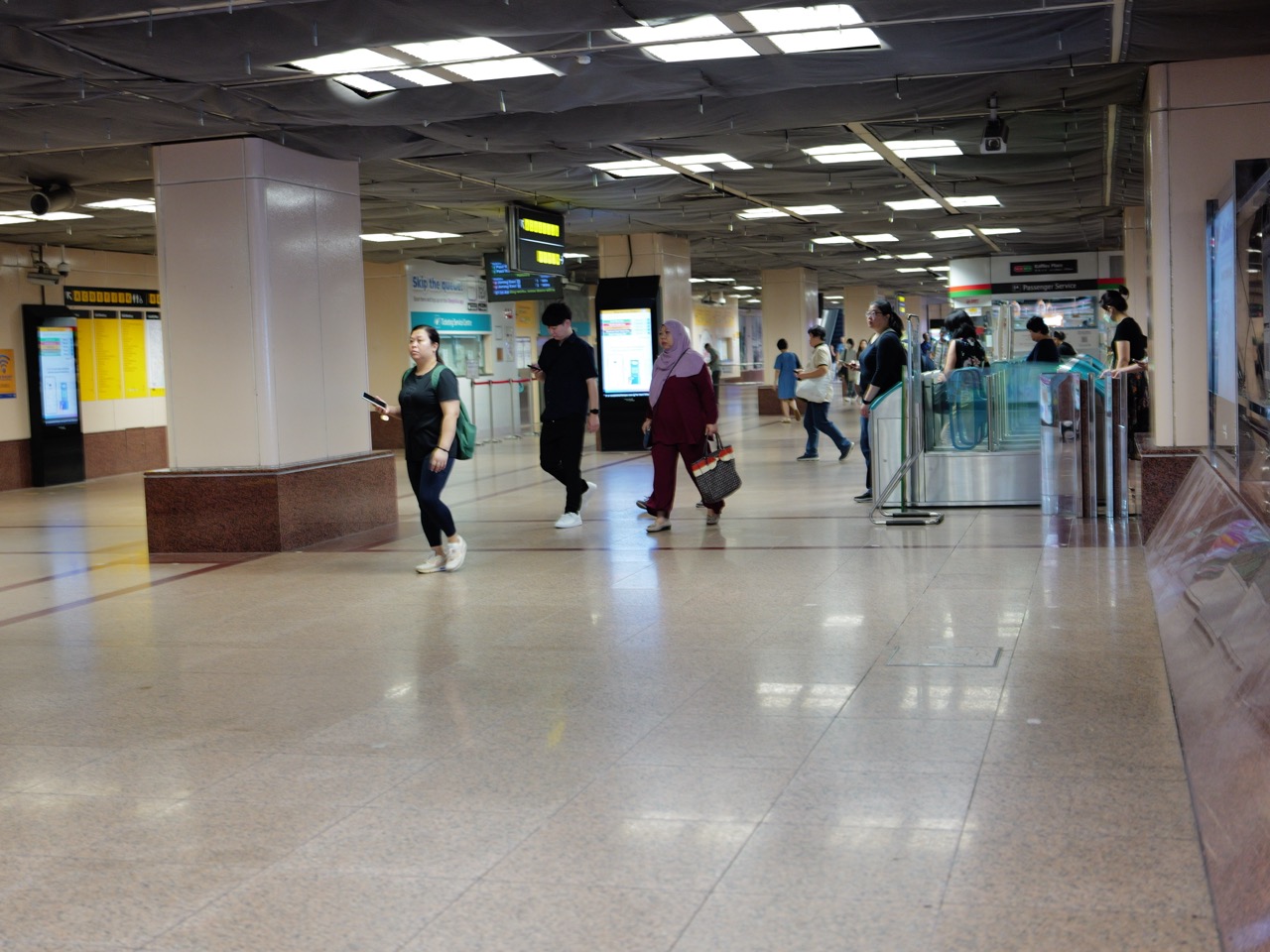
Taking the MRT — a visitor’s practical guide
“Excuse me, which platform is for my train?” “Where do I transfer?” “Which exit is closest to the entrance?” These practical questions are useful even if it is your first visit to Singapore. The Mass Rapid Transit system is called the MRT. You do not need to imitate Singlish to use it: clear English, the station name and a quick look at the map are generally the best combination.
This four-language visitor guide follows a complete journey: identifying the station, choosing the correct line and direction, changing trains, paying at the gates, and finally finding the correct street exit. All 20 numbered expressions match the Simplified Chinese, Hindi and Russian editions. You can switch at a particular word without losing your place.
One detail deserves special care. Land Transport Authority (LTA) says you should tap in and out using the same card or the same mobile device. A phone and its linked physical card can register as different payment identifiers. Single-trip paper train tickets are no longer issued; check the current accepted fare methods before relying on an old travel guide.
LTA Rail Network · LTA Journey Planner · LTA: Same Card or Device · SimplyGo
English · 简体中文 · हिन्दी · Русский
Twenty MRT expressions at a glance · Twenty terms with a phrase and a common misunderstanding · Plan a trip in five decisions, from entrance to exit · Ten practical MRT conversations to rehearse · A five-minute practice route and answer key · Ten frequently asked questions about taking the MRT · Official transport sources and accuracy notes · Continue the Singapore everyday conversation series
Twenty MRT expressions at a glance
| No. / Word | Meaning / 提示 / अर्थ / Значение |
|---|---|
| 1. MRT | Mass Rapid Transit, the name of Singapore’s main urban rail system |
| 2. Station code | A short alphanumeric label for a station, often shown beside its name |
| 3. MRT line | An individual route within the rail network, identified by its name and colour on signs |
| 4. Platform | The area where passengers wait to board |
| 5. Towards / direction | A direction label tells you which way the train is heading; “towards” is common in instructions such as “towards the city” |
| 6. Terminus | The end station of a train service in a given direction |
| 7. Interchange | A station at which you can connect from one rail line to another |
| 8. Transfer | The act of changing from one train or line to another during a journey |
| 9. Exit | A labelled way out of a station, frequently identified by a letter |
| 10. Step-free route / lift | A route that avoids steps and uses lifts or other accessible paths where available |
| 11. Fare gate / gantry | A fare gate or gantry is the barrier you pass through when entering or leaving the paid area |
| 12. Tap in | To present an accepted card or device at the reader when beginning your train journey |
| 13. Tap out | To present the same payment credential at the exit reader and complete the journey record |
| 14. Same card or device | The identity of the fare-paying bank card, transport card or mobile device must match at entry and exit |
| 15. SimplyGo | The account-based fare-payment system that accepts specified contactless bank cards, compatible mobile wallets and SimplyGo travel cards |
| 16. EZ-Link card | A familiar name for a Singapore travel card; check whether you have a compatible SimplyGo EZ-Link card or another accepted travel product |
| 17. Fare / distance-based fare | The amount charged for the journey; Singapore’s public-transport fares commonly depend on distance and fare category |
| 18. Last train | The final scheduled service on a particular route for the day |
| 19. Priority seat | Seats intended to be offered to passengers who need them more, such as older people, pregnant passengers or travellers with mobility difficulties |
| 20. Service disruption / alternative route | An interruption, planned adjustment or unexpected incident that changes normal train travel |
The first ten words help you choose a route; the next seven cover payment; the final three help you plan timing, courtesy and alternatives. These are recommended learning clusters, not a popularity ranking.
Twenty terms with a phrase and a common misunderstanding
1. MRT
Meaning and use: Mass Rapid Transit, the name of Singapore’s main urban rail system. Saying “MRT” is ordinary local usage and useful even when you do not know a line’s name. Try saying: “Where is the nearest MRT entrance?”
Watch out: A station sign may also mention LRT, which is a different light-rail system in some neighbourhoods. Follow the map and station signs rather than assuming every train runs on one continuous network.
Read this exact term in: 简体中文 01 · हिन्दी 01 · Русский 01
2. Station code
Meaning and use: A short alphanumeric label for a station, often shown beside its name. It helps you match maps, signs and planned interchanges without relying solely on pronunciation. Try saying: “What is the station code on the map?”
Watch out: A code identifies the station, not the exit or platform number. Confirm the station name and line where several codes appear at one interchange.
Read this exact term in: 简体中文 02 · हिन्दी 02 · Русский 02
3. MRT line
Meaning and use: An individual route within the rail network, identified by its name and colour on signs. Singapore has several MRT lines; your destination may require more than one. Try saying: “Which line should I take?”
Watch out: Colours are guides, not directions: both directions on the same line normally use that colour. Use the line name together with the destination or terminus displayed on the platform.
Read this exact term in: 简体中文 03 · हिन्दी 03 · Русский 03
4. Platform
Meaning and use: The area where passengers wait to board. A station may have platforms for opposite directions and possibly multiple services. Try saying: “Is this the correct platform?”
Watch out: Finding the correct station is not enough. Check the line and direction before waiting, stand behind the marked safety boundary and allow people to alight before boarding.
Read this exact term in: 简体中文 04 · हिन्दी 04 · Русский 04
5. Towards / direction
Meaning and use: A direction label tells you which way the train is heading; “towards” is common in instructions such as “towards the city”. Try saying: “Does this train travel towards my destination?”
Watch out: Check the displayed destination or terminus rather than assuming that the colour or a platform number determines direction. When unsure, ask “Does this train stop at ___?” before boarding.
Read this exact term in: 简体中文 05 · हिन्दी 05 · Русский 05
6. Terminus
Meaning and use: The end station of a train service in a given direction. Platform signs may use a terminus to identify the train’s travel direction. Try saying: “What is the terminus shown on the sign?”
Watch out: The end station need not be where you are going. Ask whether your intermediate stop lies on the route, and note that service patterns can change during planned works.
Read this exact term in: 简体中文 06 · हिन्दी 06 · Русский 06
7. Interchange
Meaning and use: A station at which you can connect from one rail line to another. One interchange may display several line colours and station codes. Try saying: “Where is the interchange?”
Watch out: An interchange is not an instruction to exit the paid area. Follow the transfer signs first; passing through exit gates unnecessarily can affect your fare or route.
Read this exact term in: 简体中文 07 · हिन्दी 07 · Русский 07
8. Transfer
Meaning and use: The act of changing from one train or line to another during a journey. The change may involve walking along signed corridors or moving between floors. Try saying: “Where do I transfer to the other line?”
Watch out: A transfer is not automatically immediate or across the same platform. Allow sufficient time, follow the right line’s signs, and ask for lift directions if stairs are unsuitable.
Read this exact term in: 简体中文 08 · हिन्दी 08 · Русский 08
9. Exit
Meaning and use: A labelled way out of a station, frequently identified by a letter. Exits can lead to different roads, malls, bus stops and sheltered walkways. Try saying: “Which exit is nearest the main entrance?”
Watch out: The nearest exit to the platform is not necessarily nearest your actual destination. Identify your destination’s street or entrance, then use the station’s official exit information.
Read this exact term in: 简体中文 09 · हिन्दी 09 · Русский 09
10. Step-free route / lift
Meaning and use: A route that avoids steps and uses lifts or other accessible paths where available. “Lift” is the usual Singapore English word for elevator. Try saying: “Is there a step-free route with a lift?”
Watch out: An escalator is not step-free access. Check the actual lift route and whether it is available during works; you need not disclose private medical details when asking for a usable route.
Read this exact term in: 简体中文 10 · हिन्दी 10 · Русский 10
11. Fare gate / gantry
Meaning and use: A fare gate or gantry is the barrier you pass through when entering or leaving the paid area. Look for the appropriate reader and authorised direction. Try saying: “Is this the entrance fare gate?”
Watch out: A successful beep or gate movement indicates a reader response, not a reason to ignore a displayed error. Never tailgate or force the gate. Ask station staff for help if entry is rejected.
Read this exact term in: 简体中文 11 · हिन्दी 11 · Русский 11
12. Tap in
Meaning and use: To present an accepted card or device at the reader when beginning your train journey. This records entry into the paid transit system. Try saying: “I will tap in with this card.”
Watch out: Use only one selected payment credential, not a wallet stuffed with several contactless cards. Single-trip paper tickets are no longer sold for MRT travel according to LTA.
Read this exact term in: 简体中文 12 · हिन्दी 12 · Русский 12
13. Tap out
Meaning and use: To present the same payment credential at the exit reader and complete the journey record. This is distinct from leaving the station through the correct street exit. Try saying: “Where do I tap out?”
Watch out: If you entered with your phone, tapping out with the physical card linked to that phone can produce a mismatch. Use the same device or card and seek help if the transaction seems wrong.
Read this exact term in: 简体中文 13 · हिन्दी 13 · Русский 13
14. Same card or device
Meaning and use: The identity of the fare-paying bank card, transport card or mobile device must match at entry and exit. LTA says each device can have its own digital payment identifier. Try saying: “I will use exactly the same card or device.”
Watch out: Do not switch from a watch to a phone, or between a physical card and a wallet version, just because they seem connected to the same account. Record which you used at entry.
Read this exact term in: 简体中文 14 · हिन्दी 14 · Русский 14
15. SimplyGo
Meaning and use: The account-based fare-payment system that accepts specified contactless bank cards, compatible mobile wallets and SimplyGo travel cards. Try saying: “Can I use this contactless card for SimplyGo?”
Watch out: SimplyGo is not a magical universal acceptance label. Check your card type and the operator’s latest rules. Foreign-issued Mastercard/Visa cards can incur a daily administration fee, so look up current details.
Read this exact term in: 简体中文 15 · हिन्दी 15 · Русский 15
16. EZ-Link card
Meaning and use: A familiar name for a Singapore travel card; check whether you have a compatible SimplyGo EZ-Link card or another accepted travel product. Try saying: “Where can I ask about an EZ-Link card?”
Watch out: A card purchased in a shop is not necessarily ready for every fare reader. Ask which version you have, where to top it up if needed, and whether enough value or credit is available.
Read this exact term in: 简体中文 16 · हिन्दी 16 · Русский 16
17. Fare / distance-based fare
Meaning and use: The amount charged for the journey; Singapore’s public-transport fares commonly depend on distance and fare category. Try saying: “How can I check the fare for my journey?”
Watch out: Do not infer the fare from one example trip or the number of stations alone. Use LTA’s fare calculator and check whether your adult, concession, pass or foreign-card circumstances change the amount.
Read this exact term in: 简体中文 17 · हिन्दी 17 · Русский 17
18. Last train
Meaning and use: The final scheduled service on a particular route for the day. Train schedules may differ by station, direction, holiday and planned maintenance. Try saying: “How can I check the last train tonight?”
Watch out: Do not assume every line runs until midnight or use an old screenshot to plan a late journey. Check the operator’s current schedule and leave time for transfers.
Read this exact term in: 简体中文 18 · हिन्दी 18 · Русский 18
19. Priority seat
Meaning and use: Seats intended to be offered to passengers who need them more, such as older people, pregnant passengers or travellers with mobility difficulties. Try saying: “Would you like this priority seat?”
Watch out: Not every need is visible. An invitation such as “Would you like this seat?” is courteous; respect a decline and avoid judging people whose needs you cannot see.
Read this exact term in: 简体中文 19 · हिन्दी 19 · Русский 19
20. Service disruption / alternative route
Meaning and use: An interruption, planned adjustment or unexpected incident that changes normal train travel. Operators may advise another line, station or bus option. Try saying: “What alternative route is recommended during the disruption?”
Watch out: Do not invent a replacement route or assume a delay duration. Check official live announcements and the journey planner, then ask staff for the current best option.
Read this exact term in: 简体中文 20 · हिन्दी 20 · Русский 20
Plan a trip in five decisions, from entrance to exit
Imagine that you want to travel from your hotel to an appointment. You do not need to know every station; you need to resolve five successive questions. The five steps below use no fictional departure time or unverified route instruction.
1. Find the exact station
Start with the station name and a code where available. Look for an official sign, not just a map pin. A station can have more than one entrance, and the nearest entrance to you may not be the best exit at the destination. Tell your companion which entrance you plan to use, especially where roads and shopping-centre links make the site complicated.
2. Check line and direction
Identify the line colour and name, then read the directional sign showing the terminus or next stations. Looking only for the correct colour can send you the wrong way. Before boarding, compare at least two pieces of information: your destination appears on the route map, and the platform sign points in the expected direction.
3. Understand a transfer before boarding
If the route crosses lines, identify the interchange and count the required changes. Some transfers involve corridors and stairs or lifts; the number of stations is not a reliable estimate of transfer walking time. Keep the journey planner available and plan a step-free option if needed.
4. Choose a fare-payment method
LTA lists eligible contactless bank cards, compatible mobile wallets and various transport cards. Verify your particular credential rather than assuming all foreign cards and wallets work. SimplyGo notes that a foreign-issued Mastercard or Visa can attract a daily administration fee. Most importantly, tap with the same card or device at both ends.
5. Select the right exit and check service information
Once off the train, find the exit letter serving your intended street or building entrance. If it is late or services are adjusted, use current official announcements and the LTA journey planner instead of relying on a static article. An exit, a transfer corridor and a ticket gate describe different decisions.
LTA journey planner · LTA fare calculator · SimplyGo payment guidance
Ten practical MRT conversations to rehearse
These are fictional practice exchanges, not quotes from real employees, official directions to a named building or a live service status report. Read both parts so you can understand a response, not just recite your question.
1. Finding the entrance
Visitor: “Excuse me, is this the entrance to the MRT station?” Local: “Follow the station sign. Check the station name at the entrance.” Visitor: “Thank you. I will confirm the name before going in.”
Why it works: The useful outcome is identifying the station name before entering, not simply following a crowd into an underground passage. A polite clarification can prevent a journey from starting at the wrong place.
2. Using the code
Visitor: “The map shows a station code. Does it match this station?” Staff: “Please check the name and line shown on the sign too.” Visitor: “I see both now, thanks.”
Why it works: A code is a second check, not a substitute for reading the full station name. Codes can repeat visually on a crowded interchange sign; look at the line too.
3. Choosing the direction
Visitor: “Is this the platform for trains going towards my stop?” Staff: “Check the direction and your stop on that route map.” Visitor: “Yes, my stop is on this side.”
Why it works: The traveller verifies both the line and the direction. Avoid rehearsing a real destination as if one permanent platform assignment applied across every station.
4. Changing trains
Visitor: “Where do I transfer to the other MRT line?” Staff: “Follow the signs for that line inside the interchange.” Visitor: “Do I need to leave the paid area?”
Why it works: Transfer signage usually guides passengers within the paid area; the final question is prudent because exits and transfers are different. Follow actual station instructions.
5. Finding a street exit
Visitor: “Which exit is closest to the building entrance?” Local: “Check the exit map for the road name first.” Visitor: “I’ll match the road and exit letter.”
Why it works: The exit decision comes after the train journey and can save unnecessary walking outdoors. Street names and building entrances are more helpful than guessing which letter is nearest.
6. Asking for a lift
Visitor: “Is there a step-free route to that platform?” Staff: “Let me show you the lift route on the station map.” Visitor: “Thank you. I need to avoid stairs.”
Why it works: Step-free needs are a normal reason to ask for assistance. The traveller describes the practical requirement, without needing to disclose a diagnosis.
7. Paying at the gate
Visitor: “Can I tap in with this contactless card?” Staff: “Check that it is a supported card for public transport.” Visitor: “I’ll use only this card at entry and exit.”
Why it works: Acceptance of one bank card elsewhere does not prove it will work for MRT travel. Confirm the accepted method and keep other cards away from the reader.
8. Avoiding a payment mismatch
Visitor: “I entered using my phone. Can I tap out with the plastic card?” Staff: “Use the same device you tapped in with.” Visitor: “Understood. I will use my phone again.”
Why it works: LTA specifically warns that linked devices can have different payment identifiers. The passenger corrects a plausible error before triggering a mismatched trip.
9. Catching the last train
Visitor: “How do I check the last train for this direction tonight?” Staff: “Use the current operator schedule or official journey planner.” Visitor: “I’ll allow time for the transfer too.”
Why it works: Timetables depend on date, route and direction. No exact last-train time is promised in the teaching example; check today’s information.
10. Handling a disruption
Visitor: “Is the normal train service running?” Staff: “Please follow the current service announcement and route advice.” Visitor: “What alternative should I check for this destination?”
Why it works: A train disruption needs live facts. This dialogue deliberately does not invent an alternative bus, reopening time or cause. Ask staff and use official updates.
A five-minute practice route and answer key
Spend one minute on each action: locate your station, read its code and line, describe your direction and interchange, select a payment credential, and choose the correct destination exit. Your partner should introduce one unexpected reply; respond by clarifying rather than pretending you understood.
Check your understanding
1. Does a line colour tell you the direction? No. Check the terminus or directional display.
2. Is an interchange identical to an exit? No. Transfer inside the interchange unless signs direct otherwise; exit leaves the station.
3. Can you switch from phone to physical card between tap in and tap out? No. Use the same device or card.
4. Does an exit letter identify a destination by itself? No. Match it to the street or building entrance.
5. Are MRT paper single-trip tickets still on sale? No. LTA says the paper single-trip ticket was phased out.
6. Does “last train” have one universal time? No. Verify the current station, direction and date.
A complete visitor’s model conversation
“Excuse me, is this the MRT entrance? I need to take the line shown on the map. Is this platform heading in the right direction? Where should I transfer? I will tap in with this card and use the same card on my way out. Once I arrive, which exit leads to the road I need? Thank you for helping me check.” This fictional script combines questions rather than pretending one sentence tells you everything.
Ten frequently asked questions about taking the MRT
1. Is MRT the same as LRT?
No. MRT is the main metro rail network, while LRT is the separate light-rail system operating in certain parts of Singapore. The official system map identifies each route.
2. Does a line colour tell me which direction to board?
Not by itself. The colour identifies a line; directions on that line may be different. Check the terminus or destination text on the platform sign.
3. Is changing trains the same as leaving through an exit?
No. A transfer usually follows interchange signs; an exit takes you out of the station. Avoid crossing a fare gate simply because you saw a doorway.
4. Can I tap in with a phone and tap out with its bank card?
Do not do this. LTA explains that a device and physical card may have separate identifiers even when linked to one account. Use the same card or device for the complete journey.
5. Can foreign bank cards pay on MRT?
Some compatible foreign-issued American Express, Mastercard and Visa cards are supported. Eligibility and fees vary: SimplyGo states that certain foreign-issued Mastercard/Visa cards incur a daily administration fee. Check your card with the issuer and current SimplyGo guidance.
6. Can I still buy a paper single-trip ticket?
LTA states that single-trip tickets were phased out in March 2022. Check the currently accepted contactless bank cards, travel cards and pass options before entering.
7. How can I check a train fare?
Use LTA’s journey planner or fare calculator with the relevant boarding and alighting stations and fare category. A flat fare guessed from the number of stops may not be accurate.
8. How do I find the right exit?
Identify the street, bus stop or building entrance you need, then consult the station’s exit map. A letter by itself means little if you do not know the destination.
9. When is the last train?
It depends on the station, direction and service date. Do not use a fixed generic time for every line; check official schedules and allow for required transfers.
10. What should I do during a train delay?
Read the station’s official announcements, check current operator/LTA information and ask staff about the available alternatives. Avoid relying on an unsourced screenshot or guessing when service will resume.
Official transport sources and accuracy notes
Primary references checked in October 2026. The official sources, not this teaching article, determine actual service times, accepted payment products, fare charges and operational changes.
1. Land Transport Authority — Rail Network
2. Land Transport Authority — Plan Your Journey
3. Land Transport Authority — MRT/LRT rail map
4. Land Transport Authority — Same Card or Device
5. SimplyGo — Contactless Bank Cards FAQ
6. Land Transport Authority — Fare Calculator
Continue the Singapore everyday conversation series
Vocabulary Learning Hub · Singapore Visitor Vocabulary
Asking About Sizes, Exchanges and Returns
Shopping in a Neighbourhood Shop
English · 简体中文 · हिन्दी · Русский
Speaking successfully in Singapore means asking one precise question, listening to the answer and correcting any misunderstanding. A clear, polite sentence is more useful than a perfect imitation of local speech.
Continue: Riding a Public Bus
From the MRT, learn how to find a bus stop, check the route direction, use SimplyGo, press the stop bell and transfer safely. Top 20 Vocabulary Singapore | Riding a Public Bus. English · 简体中文 · हिन्दी · Русский
Continue: Taking a Taxi or Ride-Hail in Singapore
For a direct trip after public transport, learn how to find an approved pickup point, verify the vehicle and driver, distinguish metered from upfront fares, and request a safe drop-off. Top 20 Vocabulary Singapore | Taking a Taxi or Ride-Hail. English · 简体中文 · हिन्दी · Русский
From the MRT to Hotel Check-In
Once you reach the correct station exit and hotel, learn how to confirm your reservation, registration details, room arrangement and charges. Top 20 Vocabulary Singapore | Checking Into a Hotel. English · 简体中文 · हिन्दी · Русский