
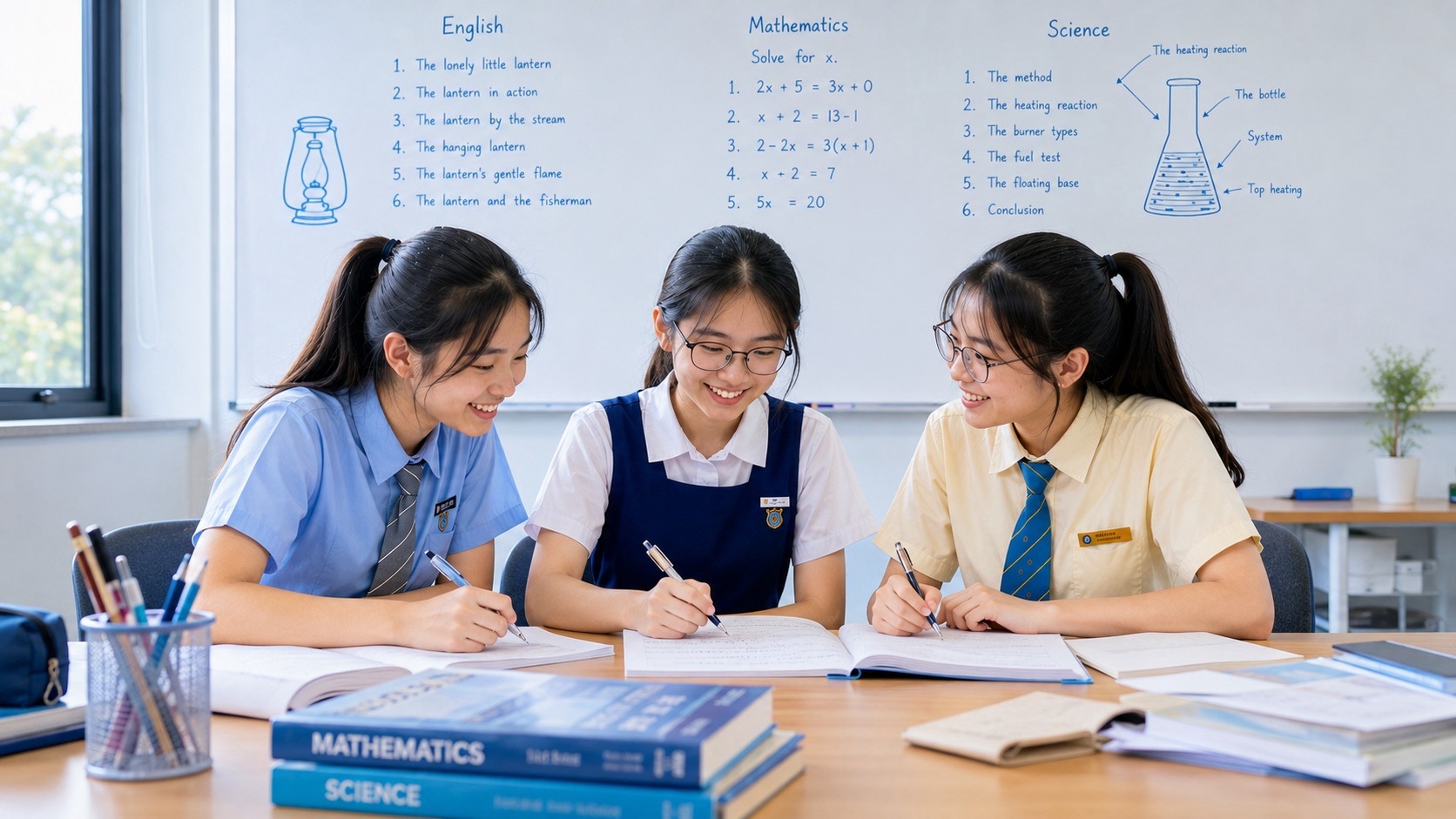
Tuition in Minsk is often searched as репетитор Минск, репетитор по математике, падрыхтоўка да экзаменаў, or private help with Russian, Belarusian, English and science. Some families are thinking about Grade 9 final examinations; others are planning Grade 11 centralised examinations (ЦЭ) or centralised testing (ЦТ). Before choosing hours or worksheets, the useful question is what the pupil cannot yet understand independently.
A pupil may know fraction calculations but fail when they appear inside algebra. Another may remember an entire literary passage without being able to write a coherent interpretation. A third can solve a practice test while a tutor supplies each hint, then finds the actual test question unexpectedly difficult.
A good Minsk tutor should distinguish those errors rather than assign the same exercise package to everyone. The first conversation should examine the learner’s original work, identify the earliest weak connection and decide how progress will be checked.
This article shares the eduKate Singapore teaching philosophy. Our premium three-pupil tuition programme operates in Singapore, not Minsk. We are not advertising a Belarusian eduKate branch, local class or tutor team. The approach is transferable, not the geographic service location.
Our immutable instructional reference is Secondary 1 Mathematics Tutor Clementi | Small Groups Tutorials. Its promise is an educational design: diagnosis before tuition, understanding before speed, and learning continuity after the tutor has withdrawn the prompts.
What Does a Minsk Family Actually Need From Репетитор?
Private lessons can help a student repair a mathematics concept, practise academic writing, strengthen language comprehension or prepare for an assessment. Homework supervision and exam coaching, however, are different tasks.
A child who understands a mathematical method but forgets to check units needs a checking routine. One who cannot explain why dividing an equation by a number preserves equality needs concept teaching. A pupil who cannot get started on homework despite understanding school lessons may need help organising study rather than additional lectures.
The most persuasive tutor is not automatically the one selling the longest course. It is the one who can inspect a mistake and explain what the next teaching question should reveal.
Ask to see a short teaching demonstration: what does the child do, which prompts are gradually removed and what different question will show the pupil has actually learned?
- Concept repair: identify and teach a missing prerequisite or rule.
- Homework help: organise and interpret assignments without taking ownership from the pupil.
- Exam tutoring: connect subject knowledge with the relevant 2027 assessment conditions.
- Extension: deepen reasoning for students who are already secure in the current material.
Belarus’s Eleven-Year School Route: Why the Stage Matters
Belarus’s usual general secondary schooling leads through Grade 11. Completion of Grade 9 marks general basic education, while Grade 11 is a separate school-completion and progression stage. The aims of their examination tutorials should therefore not be confused.
Earlier grades focus on stable numeracy, reading, writing and basic conceptual development. Middle grades increasingly require symbolic mathematics, accurate subject language and connected reasoning. Later students must handle more demanding subject work and make decisions about further study.
The Ministry of Education publishes teaching plans and 2026/2027 subject-methodology guidance, including mathematics, informatics, languages, sciences and history. A tutor should follow the actual student’s grade, course materials and examination stage rather than impose a foreign curriculum label.
The ministry’s official 2026/2027 school-year page provides the relevant instructional references and school calendar.
A family may be exploring a general upper grade, lyceum opportunities or further professional study. The correct teaching plan should reflect the real pathway without implying every learner takes identical subjects or pursues the same next institution.
Minsk’s 2026/2027 School Calendar: Use Actual Dates, Not Guesses
For the school year beginning 1 September 2026, Belarus’s Ministry of Education confirms four terms. The first runs from 1 September to 31 October, followed by 9 November to 24 December, 11 January to 20 March, and 29 March to the end of May. The final term ends earlier for relevant graduating grades.
School holidays and other breaks are also laid out in the official calendar. This matters for tutoring because a learner needs time to practise independently between lessons; a dense revision timetable that ignores school obligations can create needless fatigue.
Parents should identify the next school assessment and the actual concept requiring attention. The calendar gives a planning boundary, not a reason to buy the same number of lessons for every child.
Consult the Belarusian Ministry of Education’s 2026/2027 calendar rather than relying on a commercial tuition site’s unsourced timetable.
A six-week teaching review can fit into a term without promising a particular grade or treating every school break as an opportunity for endless extra work.
Grade 9 Final Examinations in 2027: Four Distinct Skills
An education-ministry regulation of 19 August 2026 sets the 2026/2027 final-examination arrangements. For ordinary Grade 9 graduates, the published subjects are Belarusian language (written exposition), Russian language (written exposition), mathematics (written written-control work), and History of Belarus (an oral examination using tickets).
The main Grade 9 examination period is scheduled for 1–10 June 2027. Alternative dates apply to relevant eligible candidates and special arrangements can differ. Families should confirm their student’s precise requirements with the school.
For details see the official legal-information summary of 2027 school examinations and the ministry’s current school-year information.
A maths tutor should diagnose which mathematical relationships are insecure. A language tutor must help the pupil understand and reconstruct a passage, not only memorise prepared phrases. An oral-history tutor should practise chronology and explanation rather than a long list of disconnected words.
These are different teaching objectives. A child who struggles with written language may need comprehension and organisation, while another loses marks because punctuation or grammar is inaccurate. The next lesson should follow the actual error.
Grade 11 ЦЭ and ЦТ: Do Not Confuse the Different Assessments
For ordinary Grade 11 graduates in the 2026/2027 school year, the published schedule sets two centralised examinations (ЦЭ). On 27 May 2027, the learner takes a chosen subject from the permitted list. On 31 May 2027, the language examination is Belarusian or Russian, as selected under the rules.
Centralised testing, ЦТ, is also relevant to university-entry arrangements, but a tutor should not casually present ЦЭ and ЦТ as interchangeable. The exact subject choices, eligibility, admission rules and reserve arrangements should be checked for the student’s intended pathway.
The Ministry of Education’s ЦТ and ЦЭ information provides an official context, while the August 2026 legal-information report describes the 2027 final-exam changes.
A mathematical problem on a practice assessment can be useful evidence. The tutor must determine whether the difficulty comes from missing algebra, misunderstanding the question or inaccurate execution.
Timed practice is valuable when the concept is already reasonably secure. When it is not, the next step should be clear teaching followed by an independent variation.
Why One Weak Mark Is Not a Learning Diagnosis
A mark compresses numerous decisions into one number. Two Minsk students may have identical mathematics results even though their underlying gaps are completely different.
One might not recognise equivalent fractions. Another knows them but cannot build an equation from a word problem. Another chooses the right method and repeatedly loses a negative sign. A generic extra worksheet may help the last student while leaving the first two stuck.
At eduKate we use the concept of learning continuity: earlier knowledge must remain available and correctly connected when new chapters change the symbols, language or setting.
The tutor should first ask for a genuine independent attempt. Then change the representation and listen to the child’s explanation. The earliest missing connection becomes the teaching target.
- Missing node: an essential prerequisite has not been secured.
- Broken link: two separately known ideas cannot be connected.
- Translation problem: words, diagrams, quantities and symbols appear unrelated.
- Wrong edge: a memorised shortcut is used outside its valid conditions.
- Routing gap: the pupil cannot decide which method applies.
- Execution gap: units, signs, copying or arithmetic disrupt otherwise sound work.
- Delayed recall: the pupil succeeds with the model present but cannot retrieve it later.
- Calibration gap: an implausible result goes unchecked.
- Regulation difficulty: pace or overload makes useful knowledge hard to access.
A Minsk Mathematics Tutorial: A Fictional Museum Ticket Problem
Imagine a fictional school museum exercise in Minsk. Four identical admission tickets cost 32 Belarusian rubles. If the cost per ticket remains unchanged, what would seven tickets cost?
Each ticket costs eight rubles, so seven cost 56 rubles. That answer alone is not evidence that the child understands proportionality. Ask why dividing by four first was meaningful: it found the constant unit price.
Now change the fictional conditions. A reduction of six rubles applies to a booking of six or more tickets. Seven tickets cost 56 rubles before the reduction and 50 afterwards. A pupil who memorised only the first arithmetic operation may ignore the new rule.
Use a table of tickets and base prices. Then write C = 8n for the undiscounted relationship, where n is ticket quantity and C is cost in rubles. Ask the child when that formula would fail to describe the final price.
The activity makes arithmetic, algebra, reading comprehension and method selection work together. Its ticket prices and promotion are deliberately invented teaching quantities, not current Minsk museum fees.
Fractions and Algebra: Show Why the Operation Works
Many children understand 3 × 7 = 21 but hesitate when an unknown is introduced as 3x = 21. The relationship remains three equal groups adding to twenty-one; one group is seven.
A tutor can use three matching boxes before writing the equation. Dividing both sides by three preserves equality, and the answer can be checked by substitution.
Next, change the example to 3(x + 2) = 27. Each group includes x plus two. Dividing by three gives x + 2 = 9, so x = 7.
Simply telling the pupil to move the three across the equals sign may work on a simple example but gives no robust explanation for expressions containing fractions, negatives and brackets. Understanding balance is a stronger foundation.
Sometimes a Grade 8 or Grade 9 pupil needs to revisit a primary fraction model. The tutor is not sending the child backwards; they are repairing the bridge the current algebra chapter needs.
The same connected approach is explained in How Mathematics Works at eduKateSG.
Russian and Belarusian Tuition: Interpretation, Exposition and Clarity
Language tutorials should be precise about the task. Reading comprehension, spelling, composition and a written exposition are related skills, but they are not identical. A Grade 9 examination that asks for an exposition requires accurately understanding a passage and reconstructing its information in coherent writing.
A useful tutor can teach the pupil to identify the central idea of each section, distinguish supporting details and produce a faithful structure in their own words. Merely memorising a model answer does not make the student a stronger writer.
For a literary interpretation, begin with a defensible point, choose evidence in the text and explain why it supports the judgement. Consider the sentence, ‘The narrator was fair.’ What action or line demonstrates fairness? Could the passage support a competing interpretation?
Help the pupil improve the paragraph, then ask for a similar explanation using a different text. The independent attempt is the test of transfer.
Belarusian and Russian language and literature are distinct curricula. A tutor must check which material and exam requirements apply to the student and respect the learner’s actual language of instruction.
History Tuition: Oral Reasoning Is Not Only Date Memorisation
History of Belarus is an oral Grade 9 examination subject under the published 2027 arrangements. A successful tutorial should prepare the pupil to organise accurate facts into a clear response, rather than simply recite a list of names.
Begin with a historical timeline and one carefully scoped question. Ask what happened, when it occurred, which factors contributed and what consequences followed. Distinguish evidence from interpretation.
Next, give a different question that uses some of the same knowledge but requires an altered argument. This tests whether the pupil can retrieve and organise facts without a memorised paragraph.
The tutor should remain aligned to the official curriculum and the student’s school’s preparation guidance. This is an educational skill-development task, not an invitation to replace evidence with unsupported claims.
Chronology, source interpretation and clear explanation also support later humanities work and examination confidence.
English and Science Tutorials: Knowledge Must Be Usable
A learner might translate a word correctly and use it incorrectly in an English sentence. A tutor needs to teach the meaning relation, not only the translation. For example, ‘although’ expresses contrast; the child should construct a new sentence where the contrast is genuine.
Likewise, a science pupil can name photosynthesis but fail to explain what a controlled comparison of two plants should measure. The correct scientific term is only the beginning of the answer.
Explain the condition, mechanism, expected observation and evidence. Ask what variables remain comparable and what happens if another variable changes unexpectedly.
Science also depends on mathematics and language: units, graphs, ratios and clear causal statements. A tutor who diagnoses these prerequisite links may do more than one who repeats the science chapter unchanged.
- English: explain vocabulary in context and use it in a new sentence.
- Science: identify a relevant mechanism, not just a term.
- Maths: make graph scales, units and comparisons accurate.
- Transfer: test the same relationship in a different task.
- Retrieval: return to the idea after several days.
A Premium Three-Pupil Model: What Can Minsk Parents Learn?
At eduKate Singapore, premium tuition groups are limited to three students. The tutor can inspect the reasoning of each pupil, require frequent verbal explanation and use peers’ alternative methods to deepen understanding.
This is a Singapore teaching design, not an advertisement for three-pupil eduKate lessons in Minsk. Local families should still ask whether each student in a proposed class is seen, questioned and corrected.
A one-to-one tutor may be best when the gap is highly unusual or individual pacing matters. A small group can work when students are appropriately matched and everyone participates. Online lessons can be suitable if the teacher sees working and provides live feedback.
The format earns its value when the pupil actively solves, explains and gradually needs fewer hints.
The Learning Loop Inside a Strong Tutorial
A useful session begins with a short retrieval question from a previous topic. The tutor does not reveal which formula to use. This shows whether the idea is genuinely available.
Next, the teacher explains one missing relationship with the simplest suitable example. The pupil attempts a new question, and feedback focuses on the first wrong decision rather than only the final answer.
The tutor then changes the numbers, wording or diagram and withdraws hints. Can the student recognise the structure and solve it independently?
Return to that concept during a future lesson. Understanding that survives the delay is more reliable than immediate repetition after demonstration.
The cycle is diagnosis → explanation → attempt → feedback → retrieval → transfer. It helps a child build a learning system, not a permanent dependency on somebody else working through homework.
Repair, Maintain and Progress
For a pupil who is falling behind, repair the earliest important gap and reconnect it to current schoolwork. An initial success might be starting a basic question without a tutor beside them.
For a learner who understands but is inconsistent, maintain the foundation with mixed questions, delayed retrieval and careful self-checking.
For a student who is ready for deeper work, progress means alternative methods, unfamiliar applications and clearer explanation. Teaching ahead should be based on readiness, not the number of available hours.
These pathways are teaching responses, not permanent categories of students. One pupil may need repair in algebra and extension in reading.
A Six-Week Parent Plan for Minsk
Start with authentic schoolwork, define one teaching target and review independent performance after a short sequence of lessons. Exam preparation can be included where it matches the learner’s level, but should not overwhelm the instructional core.
Progress can appear as the child needing fewer prompts, choosing the correct method sooner and checking an answer without being told. A particular grade should not be guaranteed.
The family should also protect sleep, ordinary school participation, leisure, reading and the time needed for independent practice.
- Week 1: gather unaided work and identify the earliest unstable idea.
- Week 2: teach the relevant prerequisite and reconnect it to the current chapter.
- Week 3: change the representation to test independent choice of method.
- Week 4: retrieve an earlier idea without hints and classify errors.
- Week 5: mix old and new tasks with appropriate exam practice.
- Week 6: compare new independent work with the starting point; continue, adapt or reduce support.
Questions to Ask a Minsk Tutor
An effective tutor should be familiar with the learner’s current grade, school materials and applicable assessment arrangements. Ask for a demonstration of how a misconception would be diagnosed and corrected.
Do not choose only on promises of top marks or a glamorous list of former pupils. The more useful evidence is a clear teaching method, transparent feedback and an ability to tell when further tuition is no longer necessary.
- Do you teach the student’s actual Grade 9 or Grade 11 syllabus where relevant?
- Are you using the official 2026/2027 examination arrangements?
- Can you diagnose a real error from the pupil’s written work?
- How do you distinguish language interpretation from missing subject knowledge?
- How often will the student attempt work independently?
- How do you check retention after a week and transfer to a new question?
- What are the qualifications, group size, safeguarding arrangements, fees and cancellation rules?
Frequently Asked Questions
Is the Grade 9 final assessment the same as ЦЭ? No. The ordinary Grade 9 assessments and the Grade 11 centralised examinations have different purposes and subjects.
What is scheduled for Belarus’s Grade 11 ЦЭ in 2027? The published schedule identifies a selected-subject exam on 27 May and Belarusian or Russian language on 31 May, subject to the relevant rules.
Should a pupil spend every session on timed papers? No. Use diagnostics to find weak knowledge and repair the concept before repeating high-pressure tasks.
How much tuition does every child need? There is no universal number. The task, pupil’s capacity and independent progress determine the decision.
Does eduKate operate a Minsk branch? No. Our premium three-pupil classes operate in Singapore; this is an informational guide.
Official Sources and Related Learning
School programmes, examination conditions and published timetables should be confirmed with the student’s school and the competent authority for the correct year.
- Belarusian Ministry of Education: 2026/2027 school year
- Belarus legal-information portal: 2027 final assessments
- Ministry: ЦТ and ЦЭ information
- eduKateSG: How Mathematics Works
- eduKateSG: immutable three-pupil tuition reference
Tuition | Minsk: The Best Result Is Independent Understanding
The valuable tutor helps a child understand what a question is asking, identify which rule is justified and recognise when the conditions have changed.
A fraction becomes the foundation for algebra. A language exercise becomes a clear explanation. An examination paper becomes evidence for the next teaching step rather than a label for the child’s ability.
Repair what is missing, maintain what is working and extend when the student is ready. A completed worksheet is useful; a student who needs fewer prompts is the result that matters.
Continue with the eduKateSG Singapore tutorial model and the connected Tuition | Vilnius guide.