
Tuition in Vitebsk is usually called репетитор Витебск, репетитор по математике, помощь с домашним заданием, or preparation for выпускные экзамены, ЦЭ and ЦТ. The names describe a service, but the real parent decision is more precise: what does the pupil understand already, where does the reasoning fail, and what will an extra lesson help the child do alone?
A pupil may know a fraction rule while watching a worked example but lose the method when fractions appear inside algebra. Another may read Russian or Belarusian fluently yet struggle to reconstruct a passage accurately in a written exposition. A third understands the historical facts but cannot organise an oral response with clear causes and consequences.
These are different learning needs. The best tutor should identify the missing connection instead of giving every child another large stack of routine practice.
This guide is written by eduKate Singapore. Our premium three-pupil tutorial programme operates in Singapore, not Vitebsk. We are not claiming a Belarusian branch or local eduKate classes. We share the teaching principles so parents can evaluate local private lessons more carefully.
The immutable instructional reference is Secondary 1 Mathematics Tutor Clementi | Small Groups Tutorials. Its central lesson is diagnosis before tuition, first principles before speed, and independent transfer before more worksheets.
What Vitebsk parents mean by репетитор
Some families need subject teaching. Others need help organising assignments, reading questions accurately or working under examination conditions. A successful tutor should determine which of these is the actual task before recommending a timetable.
Subject tuition can repair a concept. Homework help can make routines more predictable. Examination coaching can teach question selection, checking and time control when the underlying content is sufficiently secure.
A student who misunderstands how an equation balances needs explanation and guided practice. A student who understands the equation but copies one negative sign incorrectly needs a different type of feedback. Repeating the entire chapter would not be equally productive for both.
Ask a prospective tutor to identify the first mistaken decision in an original school exercise. Then ask how the student will attempt a new question without the tutor providing every step.
- Concept tuition: teach the earliest relevant missing relationship.
- Homework guidance: develop useful routines without completing the pupil’s work for them.
- Examination support: use the correct grade, subjects and currently published requirements.
- Extension: challenge a capable learner through unfamiliar applications, not merely additional volume.
A tutoring package earns its cost when the student can do something independently that was difficult before the lessons began.
Belarusian school stages: Grade 9 is not Grade 11
Belarus has an eleven-year general secondary schooling pathway. The completion of general basic education around Grade 9 and the end of general secondary education in Grade 11 have different assessment requirements.
Earlier school years establish reading, arithmetic and mathematical language. Middle years join fractions, percentages, equations, written exposition and scientific reasoning. Later years bring subject specialisation and the preparation needed for examinations or further study.
A tutor in Vitebsk should work from the actual pupil’s syllabus, language and school materials. The fact that another learner at a different grade is studying difficult physics does not mean that a younger pupil should begin advanced equations before fractions are stable.
The Belarusian Ministry of Education maintains its 2026/2027 general-secondary school year information, including instructional arrangements and materials.
Parents should check the student’s school calendar, examination stage and next route before buying an examination package. A lesson should serve the child’s actual educational progression.
Grade 9 exams in June 2027: the four different learning tasks
Belarus’s Ministry of Education regulation No. 148 of 19 August 2026 sets the subjects, forms and periods of the 2026/2027 final assessments. The ordinary Grade 9 subjects include Belarusian language, Russian language, mathematics and History of Belarus.
The language assessments use written exposition, mathematics involves written control work, and History of Belarus is examined orally using tickets. The ordinary main period is 1–10 June 2027. Special candidates and alternative sittings may follow additional rules.
These are not four identical types of test preparation. An exposition requires comprehension and the ability to rebuild a passage coherently. Mathematics needs reliable concepts, accurate workings and checking. Oral history needs chronology, accurate knowledge and structured explanation.
For the official foundation, consult the National Legal Internet Portal’s 2026 assessment notice and the Ministry’s 2026/27 school guidance.
A child struggling with Grade 9 mathematics should not be given examination-style timed papers exclusively. Use an initial diagnostic to identify whether the cause is algebra, fractions, reading, geometry or execution, then teach the specific weakness.
Grade 11 centralised examinations: ЦЭ and ЦТ are not interchangeable
The published ordinary Grade 11 centralised examination arrangements specify a chosen-subject assessment on 27 May 2027 and a Belarusian or Russian language assessment on 31 May 2027. Candidate rules, additional dates and relevant school pathways should be confirmed with official guidance.
ЦЭ, the centralised school examination, and ЦТ, centralised testing, have different administrative functions and must not be treated as identical terms. A pupil’s admission route and the institution being considered can affect the appropriate plan.
A mathematics tutor should establish whether the pupil is preparing for the mathematics assessment applicable to them and then identify the tested subjects and level. A language tutor should match instruction to the student’s actual examination language and tasks.
For official planning see the Ministry’s centralised testing and examination directory and the legal-information notice for the 2026/27 final assessments.
A responsible tutor should not promise a particular result or invent later exam dates. The strongest preparation develops secure subject knowledge and a calm method for unfamiliar questions.
Vitebsk learning continuity: what a grade hides
One low mathematics result may represent several unrelated learning problems. A student might have forgotten the meaning of equivalent fractions, misunderstood a comparison, selected a memorised shortcut in the wrong context or simply copied a sign incorrectly.
A score compresses those difficulties into one result. The tutor must examine the learner’s actual working to find the first broken connection.
At eduKate we call this learning continuity: concepts learned earlier should remain usable across time, chapters, question formats and new situations.
- Missing node: a prerequisite has not become secure.
- Broken edge: two known concepts cannot be joined.
- Weak link: a method works only in simple versions.
- Wrong edge: a rule is applied where it is invalid.
- Routing difficulty: the pupil cannot choose among methods.
- Translation difficulty: words, diagrams, symbols and graphs feel disconnected.
- Execution difficulty: arithmetic, signs or units interrupt a good method.
- Calibration difficulty: an implausible answer is accepted.
- Regulation difficulty: pace or fatigue prevents a known skill from being used.
The tutor should ask for an independent first step, listen to the reasoning, and then change the task slightly. The point of failure becomes the next teaching target.
A Vitebsk maths tutorial: an invented festival ticket problem
Imagine a hypothetical school activity based on a cultural festival. Four identical admission tickets cost 48 Belarusian rubles. How much would seven cost at the same price per ticket?
The pupil divides 48 by four to find 12 rubles per ticket, then multiplies by seven to obtain 84 rubles. But the educational goal is not simply the number 84; it is the underlying constant unit-price relationship.
Now imagine a fictional promotion giving a 9-ruble reduction on purchases of six or more tickets. The base price of seven remains 84 rubles, but the discounted total becomes 75 rubles.
A learner who simply repeats the first calculation may fail to consider the new condition. A learner who understands the model knows when direct proportion is sufficient and when an additional rule applies.
Use a table with one, two, four and seven tickets. Then write the base-price equation C = 12n and explain what n and C represent.
Ask the child to invent an alternative pricing rule where C = 12n would not give the final amount paid. This tests whether they understand the scope of the equation.
These ticket prices and promotions are invented for teaching, not a claim about actual Vitebsk events or current admission prices.
Fractions to algebra: explain the equality
A student may know that three times eight is twenty-four while feeling uncertain about 3x = 24. The arithmetic relationship remains: three equal groups make 24, so each contains eight.
A tutor can begin with three boxes, each holding an unknown quantity. Dividing the total by three gives eight. Now the symbolic equation has a clear meaning.
Next consider 3(x + 2) = 30. Three equal groups each contain x plus two. Divide by three to obtain x + 2 = 10, and therefore x = 8.
This approach is safer than memorising a phrase such as ‘move the three across’. That shortcut provides no explanation when brackets, fractions and negatives appear.
Ask the pupil to substitute x = 8 into the original expression and verify equality. Then change the numbers, context or representation. Understanding that survives the variation has become more independent.
Sometimes the fastest way to improve secondary algebra is to revisit earlier fractions and number relationships deliberately.
Mathematics tuition: graphs and units must describe the same thing
Consider a fictional service with a fixed starting price of five rubles and a charge of two rubles per additional item. The cost model is C = 5 + 2n.
For zero, one, two and three items, the corresponding totals are five, seven, nine and eleven rubles. Plotting these pairs should produce a straight line with an initial value of five.
A child who starts the graph at zero may know how to calculate each number but misunderstand the fixed part of the relationship. That is a representation gap, not merely a multiplication mistake.
Reverse the problem. If the total is seventeen rubles, solve 5 + 2n = 17 and obtain n = 6. The pupil should explain why six fits the model.
Finally change the cost rule and ask whether the original graph remains appropriate. Real mathematical competence includes knowing the conditions of a model.
For a connected mathematical introduction, see How Mathematics Works at eduKateSG.
Belarusian and Russian language tutoring: expositions require understanding
Written exposition is not simply copying a passage from memory. A pupil must understand the main ideas, organise relevant information and express it coherently in their own written response, under the applicable exam conditions.
A tutor can ask the pupil to identify the main thought of each paragraph, decide which details support it and rebuild a shorter, well-connected account. The learner needs practice preserving meaning rather than decorating the answer with difficult words.
For literary interpretation, begin with a claim and relevant evidence. A student writes, ‘The character made a brave decision.’ Which action demonstrates courage? What risk was involved? How does the text support the conclusion?
The child should attempt the revision themselves. A beautiful paragraph supplied by the tutor is not evidence that the pupil will construct a clear response during an independent examination.
Belarusian and Russian language curricula should be treated as their own programmes. The tutor must use the child’s actual school materials rather than assume the same spelling, grammar or literary requirements apply to every pupil.
History of Belarus: an oral explanation must have structure
The published Grade 9 final assessment includes History of Belarus as an oral examination using tickets. A strong tutorial should therefore practise accurate recall and a logical spoken explanation, not merely word-for-word memorisation of a long answer.
Ask the learner what happened, when, which events came before it, what forces contributed and what consequences followed. A timeline can help, but it must lead to a meaningful causal explanation.
Then change the question. Can the student use the same knowledge to answer a new prompt in a different order? That tests understanding rather than repetition of one rehearsed paragraph.
A tutor should use the official school course and examination guidance. The objective is accurate historical reasoning and clear communication, not unsupported statements delivered confidently.
These oral explanation skills later support presentations, humanities coursework and the ability to build an argument from evidence.
English and science: vocabulary must become usable reasoning
English tuition may involve reading, grammar, vocabulary, communication or writing. A learner can translate ‘although’ correctly but use it when the two ideas do not contrast. The tutor should teach the meaning relationship, then ask for another original sentence.
Science creates a parallel problem. A pupil may know the term photosynthesis yet fail to explain an investigation comparing similar plants under different lighting conditions.
A useful science tutorial asks what variable changes, what must remain comparable, what mechanism might explain a difference and what evidence could test the prediction.
- Explain a word or scientific process in ordinary language.
- Identify the relationship behind the task.
- Use it in one clear example.
- Change the conditions or wording.
- Ask for an independent explanation.
- Revisit the skill after a delay.
Science also depends on graph scales, ratios and units, which may be mathematical prerequisites rather than science-specific gaps.
The three-pupil teaching design: attention and peer comparison
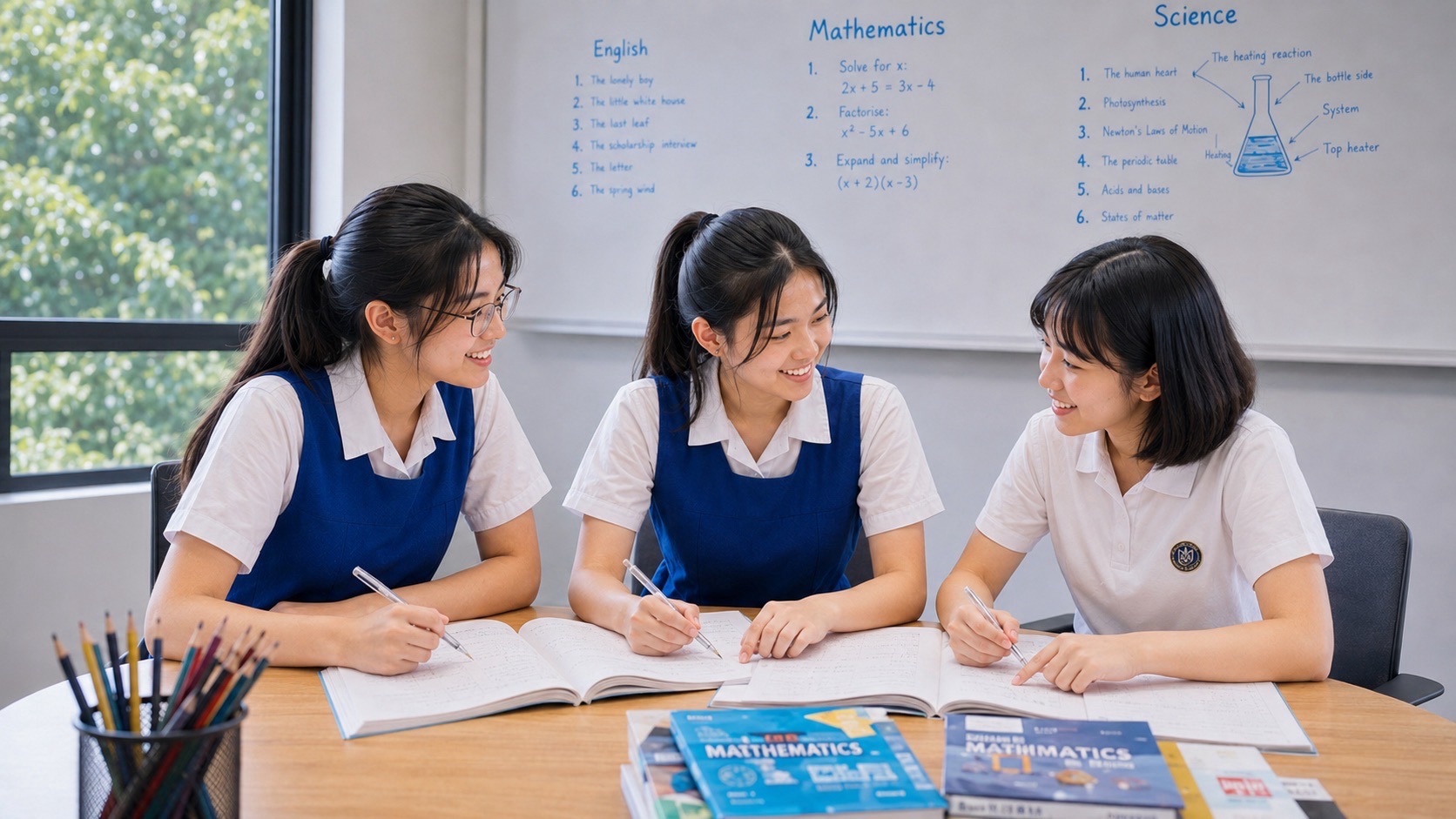
Our premium eduKate Singapore tuition model caps a small group at three pupils. The tutor can inspect each learner’s written working closely and ask every pupil to explain, while different approaches among peers create useful discussion.
This is not an offer of three-pupil tuition in Vitebsk. Families can use the principle to evaluate local individual tutors, small groups and online teaching.
One-to-one tuition suits unusual gaps or highly individual pacing. A group can work when the pupils are appropriately matched and every student participates. Online tutoring can help when the teacher can see real working and provide live correction.
Neither the most expensive lesson nor the smallest advertised group is automatically the best. Ask what the learner actually does and how the tutor responds to an error.
A purposeful tutorial has five important jobs
Begin with retrieval. Ask a question from earlier learning without telling the child which method applies. This tests whether the idea remains available after a delay.
Explain the precise missing relationship using a simple diagram or example. Let the pupil attempt a related question and observe the first wrong turn.
Correct the cause of that error. A misread instruction, a missing algebraic rule and a copied sign deserve different corrections.
Present an independent variation and gradually withdraw hints. The student needs to decide the method and explain why it fits.
Return to the idea next week among mixed questions. Learning that only survives immediately after demonstration is not yet secure.
The cycle is diagnosis → explanation → attempt → feedback → retrieval → transfer. Its purpose is to make the child less dependent on the tutor.
Repair, maintain or progress?
Repair is for a pupil who is falling behind because an earlier prerequisite is unstable. Rebuild the relevant idea and connect it back to current schoolwork.
Maintain is for a learner who understands the material but performs inconsistently. Mixed questions, spaced retrieval and careful checking help make learning reliable.
Progress is for a student who is ready for more. Offer unfamiliar applications, alternate methods and stronger explanations. Do not accelerate merely to create an impressive list of completed chapters.
These are teaching responses, not permanent categories attached to children. A pupil may be ready for extension in reading while needing repair in algebra.
A six-week Vitebsk parent plan
- Week 1: collect two examples of unaided work and identify a specific recurring error.
- Week 2: repair the earliest important prerequisite.
- Week 3: change the question format and check independent method selection.
- Week 4: retrieve the concept after a delay and classify remaining errors.
- Week 5: mix old and new work, adding relevant assessment tasks where useful.
- Week 6: compare the child’s new independent attempts with Week 1.
The plan should fit the learner’s real school timetable, rest, reading and family activities. Progress may appear as fewer hints, clearer working and stronger explanations before a large mark change.
After six weeks, decide whether the pupil needs further tuition, a changed approach or reduced assistance. Successful teaching should not create permanent dependency.
Questions to ask a Vitebsk tutor
- Do you teach the student’s actual grade, syllabus and language of instruction?
- If preparing for Grade 9 exams or Grade 11 ЦЭ, do you use current official arrangements?
- Will you diagnose errors in unaided schoolwork before recommending lessons?
- How will you distinguish language comprehension from a mathematical misconception?
- How often does the pupil attempt a new problem without prompts?
- How do you check retention and transfer after a week?
- What are the teacher’s qualifications, group size, safeguarding arrangements, fees and cancellation terms?
An experienced tutor should explain both the teaching process and the conditions under which regular tuition might become unnecessary.
Frequently asked questions about tuition in Vitebsk
Which exams apply to Grade 9 in 2027? The ordinary published subjects include Belarusian language, Russian language, mathematics and History of Belarus, with different written and oral formats.
Is ЦЭ the same as the Grade 9 final examination? No. The centralised Grade 11 exam has a different purpose and published timetable.
Should exam preparation begin with full timed papers? A paper can diagnose errors, but missing concepts need explanation before repeated timed practice.
Can a bilingual pupil benefit from tutoring? Yes, when the tutor distinguishes subject understanding from the language needed to express it.
Does eduKate operate in Vitebsk? No. This is an educational guide from our Singapore-based tutorial programme.
Official sources and further reading
- Belarus Ministry of Education: 2026/2027 school-year information
- National Legal Internet Portal: 2027 final-exam subjects and periods
- Belarus Ministry: centralised testing and examinations
- eduKateSG: How Mathematics Works
- eduKateSG: immutable Clementi three-pupil teaching reference
Check school-specific rules and official amendments for the actual examination cohort before planning exam practice.
Tuition | Vitebsk: the child should own the method
The strongest tutoring result is not a perfectly completed worksheet produced under adult supervision. It is a pupil who can recognise an unfamiliar relationship, select a suitable method and explain why the answer makes sense.
A fraction becomes algebra. A written exposition becomes coherent communication. An oral history answer becomes an accurate explanation of events and consequences.
For the learner who is behind, repair. For one who is coping, maintain. For one who is ready, extend. The purpose is increasing independence.
Less noise. More structure. Better learning continuity. Continue with the immutable eduKate Singapore tutorial model and Tuition | Minsk.