
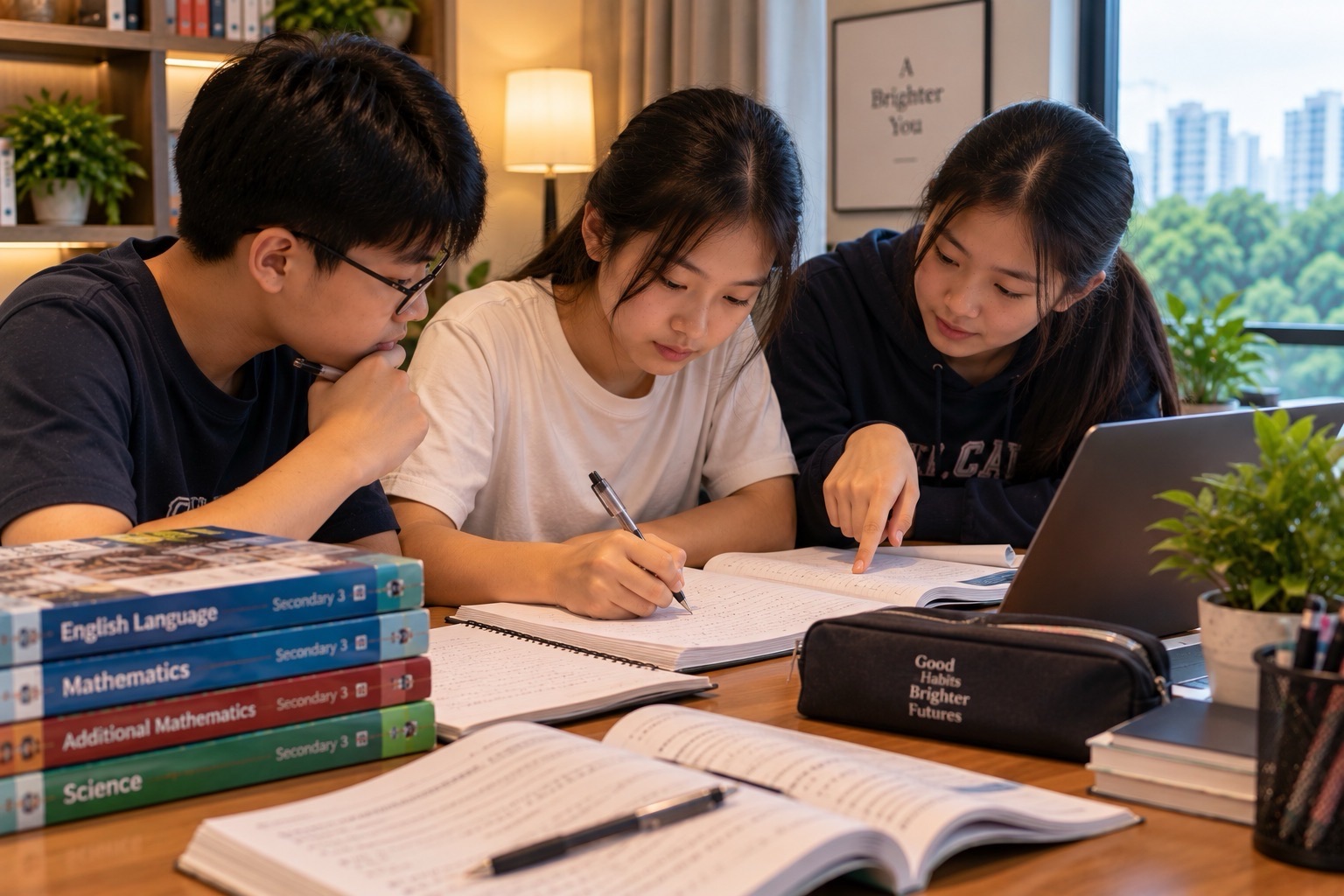
Is your child too shy for small-group tuition in Bukit Timah? Not necessarily. A quiet child may be thoughtful, careful and perfectly capable of learning with two classmates. The real question is whether the tutor gives them time to think, checks their individual work and makes it safe to say ‘I don’t understand.’ Small groups can help when teaching is patient and well matched, but a group of three is not automatically right for every learner.
eduKate Singapore’s established Bukit Timah tutorial format is up to three students in a group, normally one 90-minute lesson each week, at 8 Fourth Avenue, Singapore 268674, near Sixth Avenue MRT. This parent guide explains how a tutor can support quiet learners in English, Mathematics and Science. It does not claim a specialist therapeutic service or guarantee that any particular group is currently suitable or available.
Parents often tell us that their child knows an answer at home but will not ask a question at school or in front of others. Sometimes the child needs thinking time; sometimes the instructions are genuinely confusing; sometimes they are cautious about making errors. A useful tutor observes what is happening rather than treating every quiet student as the same kind of learner.
Quick Answer: What Helps a Quiet Student Learn?
| What you notice | What the tutor can do | What parents should look for |
|---|---|---|
| The child rarely raises a hand. | Invite an individual written attempt before group discussion. | The pupil’s own understanding becomes visible. |
| The child answers only after another learner speaks. | Protect quiet thinking time and ask each student separately. | Responses become less dependent on classmates. |
| The pupil is afraid of getting an answer wrong. | Explain mistakes as learning information and avoid public comparison. | The pupil attempts fresh tasks without constant reassurance. |
| The learner gives very short spoken replies. | Use focused, low-pressure prompts and allow preparation. | Explanations grow more precise, not necessarily louder. |
| The child understands work but dislikes group attention. | Check whether the actual group feels manageable and respectful. | The class supports learning without forcing personality change. |
| There is substantial ongoing distress or avoidance. | Coordinate appropriately with family and school; seek relevant support where needed. | Educational help does not replace wellbeing or specialist care. |
Quietness is not an academic defect. Being the loudest pupil in a tuition room does not prove strong comprehension, and being the quietest does not prove weakness. Good teaching looks for clear reasoning and independent skills, not just speaking volume.
First, Distinguish Thinking Quietly From Being Unable to Ask
A student who pauses before answering may be comparing two possible methods. Another who stays quiet may not know how to formulate their question. A third may be uncomfortable speaking in front of classmates despite being able to explain the topic one-to-one. These situations can look identical from the back of the room but require different teaching responses.
A tutor should observe what happens when the child receives a new task. Can they read it, decide how to start and complete an original attempt? Do they hesitate only when asked to explain aloud? Or is the underlying concept genuinely missing even when the room is quiet?
If the pupil’s written work is sound but their speech is hesitant, the tutor can allow private preparation and offer a simple prompt. If the written attempt is also incomplete, the lesson may need direct subject teaching rather than a strategy aimed only at confidence.
Parents should be cautious about labels. ‘My child is shy’ is a useful observation, but it is not a full educational diagnosis. Ask the child what feels difficult and give the tutor actual schoolwork to work from.
Why a Group of Three Can Sometimes Feel Easier Than a Large Class
In a large class, some pupils may feel that every spoken answer is a performance in front of many peers. An appropriately matched group of three can create more frequent opportunities for short questions and individual feedback. The tutor can more readily notice who has not yet tried a problem.
Another benefit is hearing a classmate ask a question that the quiet learner also had. That can normalise uncertainty: even strong students sometimes need a different explanation. A peer’s diagram or wording may reveal a relationship that the first model did not make clear.
But small does not automatically mean comfortable. If one confident pupil answers every question or if students compare marks aggressively, a three-person class can still feel intimidating. The tutor’s behaviour and group culture determine whether the format works.
Parents should therefore ask how the actual teacher handles quiet learners, ensures turn-taking and responds when someone cannot answer. A small number is an opportunity for good teaching, not a guarantee of emotional comfort.
The Best First Tool: Let Every Student Write Before Anyone Speaks
Imagine a Maths question appearing on a whiteboard. If the tutor immediately asks ‘Who knows the answer?’, one fast student may call it out, leaving others to copy or withdraw. A better strategy is to give every pupil a short period to make a private first attempt.
Afterwards, the tutor can ask each learner to explain one part of their thinking. A quiet student might point to a diagram or read their first line before speaking more. The teacher can acknowledge a correct step even if the final answer needs revision.
This protects evidence of individual learning. It also prevents the most outspoken student from becoming an unofficial assistant who solves everything for the group. A child who needs a little more time can still show meaningful understanding.
The same strategy works in English and Science. Ask everyone to write a short inference or identify a controlled variable first. Group discussion then compares real thinking instead of rewarding whoever replies fastest.
A Mathematics Example: Confidence Through a Correct First Step
Suppose a Secondary 1 learner sees 3(x + 4) = 24 and freezes because another pupil seems to know the solution already. The tutor can ask everyone to interpret the bracket independently, perhaps by drawing three complete groups.
The correct expansion is 3x + 12 = 24. Then 3x = 12 and x = 4. A tutor can invite the quiet pupil to explain only why the twelve appears, instead of demanding a full polished solution in front of the class.
After discussion, each student solves 2(y − 5) = 18 separately, giving y = 14. This changed task is a learning check and an opportunity for a small success based on independent reasoning.
A quiet child who can explain a sound mathematical step may become more willing to ask about the next step. The teacher should make accuracy and meaning the focus rather than speed or who volunteered first. Confidence grounded in a real skill is more reliable than generic praise.
What If the Student Knows the Maths but Is Afraid of Making Mistakes?
Some pupils avoid answering because they want to be certain. The tutor can model how a mathematician checks an idea without treating the first attempt as a public verdict. For instance, after solving an equation, substitute the value into the original expression to see whether both sides agree.
If the child answers x = 5 for 2(x + 3) = 16, substitution gives 2(5 + 3) = 16, confirming the answer. If they instead propose x = 4, substitution gives 14 rather than 16. The check identifies a problem without requiring the teacher to label the child careless.
Ask which step led to the mismatch. Was the bracket interpreted incorrectly, or was a calculation mistaken? The learner can revise the particular step and try a related question.
Mistakes become easier to discuss when they are treated as clues about reasoning. A tutor who humiliates pupils over an error is not helping build independent mathematical judgement. The “+math+” guide gives more first-principles examples.
English Comprehension: Give the Quiet Student Evidence to Point To
A quiet pupil may find it easier to explain an idea when they can begin with a specific passage detail. Suppose a short story says: ‘Amir read the invitation twice and slipped it into his bag without showing anyone.’ The tutor can ask every pupil to underline the relevant clue before proposing an inference.
An appropriate interpretation is that Amir may want to keep the invitation private. It would be too strong to insist that he is angry or has committed a wrongdoing without more evidence. The tutor can ask the quiet learner, ‘Which action shows that he did not want others to see it?’
The child can point to ‘without showing anyone’ before speaking a full answer. That reduces the demand to invent an answer instantly and gives the response a concrete starting point.
Later, a new passage can test the same skill without leading hints. The purpose is not making the student talk constantly; it is helping them interpret text and explain their choice when appropriate.
Composition: Don’t Confuse a Short Draft With a Lack of Ideas
A quiet child might write only a few sentences because they are unsure what detail to include, not because they lack imagination. A tutor should ask what the character wants, what changes in the scene and which observation would show that change.
Suppose the student writes: ‘The boy was worried. The door was closed. He went away.’ A teacher can encourage a more specific decision: ‘He stopped in front of the locked door, reread the message and wondered whether he had arrived too late.’ The improved version gives the reader something to infer from actions.
But the tutor should not rewrite every paragraph for the child. After explaining how purposeful detail works, the pupil needs to write a new paragraph using their own situation and words.
Some quiet students prefer to share writing privately before reading it aloud. That can be reasonable as an initial step, while the teacher gradually supports necessary spoken tasks in a respectful way. The “+eng+” guide explains the wider reading and writing skills.
Science: Asking a Question Is Part of Reasoning, Not a Test of Personality
In Science, uncertainty can be productive because an investigation often asks what is known and what evidence remains missing. A pupil may hesitate to say an answer because several causes seem possible. A tutor can show that identifying a missing control is good scientific thinking.
Consider two potted plants placed in different light conditions, with different amounts of water also supplied. The taller plant might lead a pupil to say that light caused the difference. A careful teacher can ask which factors differed and what further experiment would isolate the effect of light.
A quiet pupil can contribute by naming one uncontrolled variable, such as water amount, before giving a longer explanation. The class then works toward an investigation that changes only one relevant condition while keeping others comparable.
The tutor should not reward only confident guesses. An answer that says ‘we cannot attribute the result to light alone because water also changed’ shows genuine reasoning. The “+science+” guide has additional examples.
Why Some Children Become Quiet After a Poor Test Result
A disappointing mark can make a pupil cautious about giving answers. They may be concerned about making another error in front of classmates, especially if adults have emphasised ranks and comparisons. The tutor’s first task is to find a genuine learning target and make early progress observable.
One useful approach is to choose a manageable misconception, explain it clearly and provide a changed question the pupil can solve independently. The teacher can then describe the concrete skill that improved rather than merely saying that the child should believe in themselves.
For an English pupil, this may be learning to support one inference with a textual clue. For Maths, it may be recognising a negative sign inside brackets. For Science, it may be identifying the dependent variable in a simple experiment.
School performance is affected by many factors. A tutor should not promise that a confidence-building lesson guarantees the next examination grade. Instead, they can show how the pupil is gaining a reliable method and gradually reducing dependence on adult hints.
The Tutor’s Role: No Public Ranking of Who Is Smartest
A three-student group may contain learners with different personalities and starting skills. If the teacher continually praises the fastest pupil while others watch, the group can become a speed contest instead of a learning setting.
Good teaching recognises useful reasoning, clear checking, thoughtful questions and correct application. A student who identifies a hidden assumption in a Science question has contributed something valuable even if they did not answer first.
The tutor can structure turn-taking so that each learner contributes in a manageable way. Some may begin by drawing a diagram, others by speaking an explanation or locating evidence. Different forms of participation make understanding visible without requiring everyone to behave identically.
Parents should ask for examples of how the tutor responds to a wrong answer and what happens when one student dominates. A vague assurance that ‘the group is very small’ is not a sufficient description of teaching quality.
Can Peers Help a Shy Student Understand More?
Peers can help when they offer different ways of seeing a problem. One pupil may draw a model for ratio, another may write an equation, and a third may explain what the total represents. Hearing the same principle in different representations can make a difficult concept clearer.
A student who has not been comfortable questioning the tutor might hear a classmate ask exactly what they were unsure about. This can encourage future questions, provided the teacher treats the conversation as a shared investigation rather than a competition.
However, peer explanation must be checked. One confident pupil might be incorrect, or the quiet child might simply copy a solution without understanding it. The tutor needs to verify each student’s own working on a changed task.
The purpose of a three-student lesson is not social activity for its own sake. It is a useful combination of teaching, individual thinking and discussion in which no learner can remain invisible.

Primary 1 and 2: Gentle Participation Matters
Young children differ widely in how readily they speak to an unfamiliar adult. A Primary 1 child may need time to become familiar with the classroom and teacher before offering longer answers. The tutor should provide age-appropriate tasks and make it clear that a first wrong attempt is not a problem.
For early reading, a pupil might point to a picture or act out a sentence before speaking about it. For numeracy, they may use counters to demonstrate how six and four make ten. These responses show understanding even when the child is not yet giving a long verbal explanation.
Parents should not assume that formal tuition is necessary for every quiet young child. Shared reading, school routines, play and patience may be sufficient. If a persistent learning difficulty appears, support should match the actual skill gap and the pupil’s developmental stage.
The established ninety-minute class format needs to be assessed for a particular young learner’s stamina. A shorter or different arrangement may be more appropriate, depending on the child’s genuine needs and available support.
Primary 3 and 4: The First Real Fear of ‘Wrong Answers’
By Primary 3 and 4, school subjects can include more multi-step questions and formal Primary Science. Some learners notice that classmates finish sooner or answer more confidently. A tutor can reduce unhelpful comparison by focusing on how each student thinks.
Suppose a child tries 1/3 + 1/4 and writes 2/7. The teacher can ask the pupil to draw equal parts and see why adding unlike part sizes directly does not work. Converting to twelfths gives 4/12 + 3/12 = 7/12. The learner’s original attempt becomes the starting point for a new understanding.
The teacher should not ask classmates to judge the pupil’s mistake. Instead, invite the whole group to explain why denominators describe sizes of equal parts, then let everyone attempt a fresh fraction sum independently.
In English and Science, giving a moment for private reading before asking a question helps quiet pupils prepare a relevant response. The habit of thinking before speaking can be a strength, not something that needs to be eliminated.
Primary 5 and 6: PSLE Preparation Without Public Pressure
Upper-primary learners may be sensitive to marks, Achievement Levels and comments about speed. A tutor can prepare pupils for school-style questions while separating practice from competition. A child should be able to show an error log, ask about a missing step and try a changed problem without being judged against a classmate’s score.
For Mathematics, a tutor might use ratio and percentage problems with deliberate checkpoints. For English, the pupil can draft a comprehension inference individually and then compare explanations. For Science, learners can discuss whether an experimental conclusion follows from the data.
Timed practice becomes useful where it is appropriate, but a student who needs conceptual repair should not be rushed through repeated full papers in front of peers. The tutor should identify whether the issue is understanding, method selection, accuracy or pacing.
No teacher can guarantee a PSLE Achievement Level. The helpful early evidence is that the pupil can begin and explain tasks with less prompting. Parents should praise the growth of specific capabilities instead of comparing a shy child with a faster classmate.
Secondary 1 and 2: A New School Can Make Quietness More Visible
Secondary school introduces unfamiliar teachers, classmates, subject combinations and often longer days. A pupil may be confident at home but hesitant to speak in a new environment. That adjustment should not automatically be treated as an academic deficit.
A Secondary 1 student might need a bridge into algebra or longer English comprehension. The tutor can begin with a low-pressure independent task to discover whether the concept is understood before asking for a spoken explanation.
Secondary 2 learners may be adjusting to more connected work in graphs, science investigations and essay writing. A student who quietly thinks through a problem can be doing valuable work, even if their response arrives later than that of peers.
Ask the tutor how they distinguish unfamiliarity with a subject from discomfort in speaking. The teaching response should match the issue: clearer explanation for a concept gap, more preparation time for verbal participation and an appropriate class culture for both.
Secondary 3 and 4: Confidence Does Not Mean Performing Without Mistakes
Upper-secondary pupils may worry that uncertainty will be interpreted as weakness, particularly in Additional Mathematics, Chemistry, Physics or examination English. A tutor should make it acceptable to ask about a fundamental prerequisite when advanced material begins to feel unstable.
An A-Math pupil might know how to expand algebraic brackets but become confused by factorisation or functions. A Physics learner may struggle to choose the correct forces rather than with arithmetic. The student should be able to show the exact line where understanding stopped.
The tutor can teach the missing principle, provide a changed task and check retention. A quiet learner who solves a new function problem independently has made meaningful progress, even if they still prefer short spoken answers.
For SEC 2027 candidates, tutors must also use the correct G1/G2/G3 course and syllabus. A small group cannot be called supportive if the pupil repeatedly faces material from an incompatible subject level. Proper placement matters more than enthusiasm.
When One-to-One Tuition Might Be More Suitable
A three-student group is not the best choice for every quiet child. A learner may need unusually individual pacing, a substantial foundational rebuild or a calmer initial setting in which they can explain thoughts without peer attention.
An individual tutor can focus continuously on the child’s particular reasoning and adjust the pace. But one-to-one sessions can also create excessive dependence on hints if the adult supplies the next step too quickly. The learner still needs genuine independent tasks.
Some pupils may do well with a temporary individual intervention and then move into a compatible group. Others may continue in a group once the teacher changes the way participation is managed. These are educational decisions rather than permanent judgements about a child’s personality.
The “+home+” explains the broader advantages and limitations of home tuition and small groups. Parents should ask the prospective teacher to demonstrate how the actual format serves the learner’s specific needs.
What if the Child Refuses to Speak or Shows Significant Distress?
A child who is quiet in class is not necessarily experiencing a serious problem. But persistent distress, strong avoidance or difficulty functioning across school and everyday situations deserves sensitive attention. The family should listen carefully, speak with relevant school staff where appropriate and seek qualified wellbeing or professional support if needed.
A tuition provider should not claim that a three-person tutorial can diagnose or treat anxiety or a developmental condition. Teaching can be adapted to make participation safer, but tutoring is not a substitute for an appropriate assessment or support plan.
Do not pressure the child to disclose private worries in front of other students. An honest conversation between the family, school and tutor can identify practical accommodations and whether the proposed class is suitable.
Sometimes the right educational decision is to avoid extra tuition for now, adjust the student’s workload or choose a different support arrangement. A good tutor should be comfortable with that conclusion.
Three Small Changes Parents Can Try Before a Lesson
First, tell the tutor what the child finds difficult in precise, non-judgemental terms. For example, ‘My child understands examples at home but rarely asks when the next question is confusing’ gives more information than ‘My child is hopelessly shy’.
Second, encourage the pupil to bring one question written in their own words. It could be: ‘Why do we multiply the negative number inside the bracket?’ or ‘Which sentence shows that the character is worried?’ A written question gives the child a starting point.
Third, avoid rehearsing perfect answers before every class. Some preparation is useful, but the tutor needs to see genuine uncertainty to teach effectively. Parents can reassure the child that their first attempt need not be correct to be useful.
These are small educational steps, not a promise of personality change. The goal is making questions and independent thinking more accessible.
A Two-Week Participation Review Without Personality Labels
| Review point | What the teacher can observe | What it might show |
|---|---|---|
| First lesson | Can the child attempt a short task privately? | Understanding may be visible without immediate speech. |
| After a clear explanation | Can the child point to or explain one correct step? | The student has a meaningful entry point. |
| New example | Can the pupil solve a changed question independently? | The concept may be transferring. |
| Second lesson | Can the learner recall the idea and pose a more precise question? | Participation and learning habits may be strengthening. |
| Home or school follow-up | Is the child experiencing less difficulty starting tasks? | Skills may be moving beyond the tuition setting. |
Two weeks is only an illustrative period for observing fit, not a guaranteed programme or deadline for confidence. A pupil may need time to become familiar with new people. Parents should focus on authentic work and the child’s lived experience rather than count spoken contributions as though they were examination marks.
What a Supportive Three-Student Tutor Should Be Able to Explain
Ask the tutor what happens when a child waits for another pupil to answer. A good response might involve private first attempts, non-threatening individual questions or a chance to explain a diagram rather than deliver a complete oral performance.
Ask how students are matched. A quiet Secondary 1 pupil studying G2 Mathematics may struggle if placed in a group following a very different syllabus. The teacher should check school programme, current topic and prerequisite knowledge before confirming a place.
Also ask about mistakes. Does the tutor calmly diagnose the error and provide another explanation, or make the pupil perform the same question repeatedly while classmates watch? Does the teacher prevent interruptions and unhelpful comparison?
The quality of these practices tells you more than the advertised class size alone. The “+lesson+” describes the educational purposes of a full ninety-minute tutorial.
Location and Timetable: A Calm Arrival Helps
eduKate Singapore’s Bukit Timah teaching address is 8 Fourth Avenue, Singapore 268674, near Sixth Avenue MRT on the Downtown Line. Parents should confirm the actual venue, tutor and appointment before travelling.
A child who arrives rushed from school or CCA may have less attention available for an unfamiliar group. Allow enough time for transport, a snack or dinner and a normal transition into the lesson where possible. A practical route can help the child arrive ready to work.
For younger pupils, accompaniment and pick-up arrangements should be clear. For Secondary learners, ask whether the proposed lesson conflicts with school responsibilities or creates an exhausting evening.
The most socially welcoming class may still be academically unsuitable if the subject level or timing is wrong. A good enrolment decision considers teaching fit, learner comfort and the full weekly routine together.

How to Measure Progress for a Quiet Student
A tutor should not report success solely because the child spoke more during one session. A learner can become more talkative while still lacking the underlying concept; another can remain reserved while making strong independent academic progress.
Better evidence includes a pupil beginning a previously difficult question without waiting for the teacher, choosing a sound mathematical method, writing an inference with support or identifying the controlled variable in a new experiment.
Parents can also ask whether the learner now formulates questions more precisely. ‘I cannot do Maths’ offers little direction; ‘I understand the first equation but not why the negative term changes sign’ reveals a meaningful target for teaching.
School grades may offer additional information later, but immediate changes in confidence are not reliable guarantees of examination performance. Keep the original attempt, the changed attempt and a later retrieval task to make progress visible.
What if the Group Isn’t a Good Match?
Even with a patient tutor, a particular group may be unsuitable. The subjects or syllabus levels might differ too much, the pupils may have incompatible pacing needs or the child may feel consistently unable to participate productively.
Parents should discuss the specific difficulty with the provider, ask what adjustments are possible and check whether the child is making independent progress. The answer should not automatically be ‘the child must become louder’ or ‘buy more lessons’.
A different class, an individual intervention, school support or a period without tuition may be more appropriate. A responsible provider should make educational fit more important than filling a place.
Before enrolling, request the actual tutor, class makeup, subject level, current fee, duration and missed-lesson arrangements. This guide does not guarantee an available group specifically designed for shy students.
Frequently Asked Questions About Shy Children and Tuition in Bukit Timah
Can a shy child benefit from small-group tuition?
Yes, when the teacher provides respectful thinking time, individual feedback and appropriate group matching. It is not automatic.
Is being quiet a sign that a student does not understand?
No. Written work and changed independent tasks often reveal understanding better than speaking volume.
Can a child who rarely asks questions still learn?
They can, but the tutor should make doubts visible through written attempts, precise prompts and low-pressure opportunities to ask.
Is one-to-one tuition always better for shy children?
No. Some learners value individual pacing; others benefit from a well-managed group. Assess actual needs and comfort.
How does a tutor stop one student from dominating?
Use individual first attempts, managed turn-taking and personal checks rather than rewarding only the quickest spoken answer.
Does a three-student class guarantee confidence?
No. Confidence depends on many things; a tutor can create a supportive learning environment but cannot promise personality change.
What if my child knows answers but cannot explain aloud?
Allow a written or visual first response, then help the child build a short explanation in a manageable way.
Can group tuition help with Primary English oral tasks?
It may offer appropriate speaking practice, but subject-specific teaching and individual comfort need to be checked.
What if my child becomes upset when answers are wrong?
Respond calmly, identify the teachable misconception and consider school or qualified support if distress is significant or persistent.
How do I know whether the issue is shyness or weak foundations?
Compare private independent working with spoken participation and ask the tutor to diagnose actual subject skills.
Can a quiet learner succeed in Maths?
Yes. Correct reasoning, checking and independent problem solving do not require loud participation.
How can Science tuition encourage quiet students?
Ask everyone to write observations and identify variables before discussing conclusions.
Is a quiet Primary 1 child ready for 90-minute tuition?
That depends on actual learning need, age, stamina and class suitability. Many young children do not need extra tuition.
Should I tell a tutor that my child is introverted?
Share relevant observations and preferences without assigning a negative label or expecting the tutor to change the child’s personality.
What if my child is shy because of a new school?
Allow time for adjustment and discuss appropriate school support before assuming tuition is the solution.
Can three students have different confidence levels?
Yes, provided the teacher manages group participation respectfully and the subject syllabus and readiness are compatible.
How many students are in eduKate Singapore’s established group?
Up to three, subject to current class capacity and actual pupil matching.
How long are the usual tutorials?
Normally 90 minutes weekly in the established format, with the specific programme confirmed before enrolment.
Where is the Bukit Timah teaching location?
8 Fourth Avenue, Singapore 268674, near Sixth Avenue MRT.
Is a trial class available for shy children?
The guide does not confirm trials or specialist groups; enquire about current consultation and enrolment terms.
How should parents assess early improvement?
Check independent task starts, clearer reasoning and more precise questions, not merely how many times the student spoke.
Can a tutor treat anxiety?
Tuition is educational support, not diagnosis or treatment. Seek appropriate qualified help for significant distress.
What if my child refuses to join the class?
Listen to the reason, check fit and consider a different arrangement or school support rather than forcing an unsuitable group.
Can a tutor guarantee examination results for shy students?
No. Responsible teaching supports learning but cannot guarantee grades.
How can parents enquire?
Share the child’s subject, year, actual learning difficulty, participation needs and suitable times, then ask about compatible class availability.
Further Reading About Bukit Timah Tuition and Confidence
- Bukit Timah Tuition Hub — all school-year and subject pathways.
- Bukit Timah small-group tuition guide — the established three-student teaching model.
- 90-minute tutorial example — what happens in a 90-minute lesson.
- how to find a good tutor — questions to ask a tutor.
- English tuition for Primary and Secondary — English communication and writing.
- Mathematics tutorial guide — Maths first-principles learning.
- Science learning guide — scientific reasoning.
- home tuition versus three-student group — one-to-one compared with small groups.
- joining a class mid-year — joining a new group mid-year.
- what to do when tuition is not working — recognising genuine progress.
Ask About a Suitable Small-Group Tutor for a Quiet Learner
Share the child’s year, subject, current difficulties and what happens when they are asked a question in class. An original piece of schoolwork can help distinguish a genuine knowledge gap from hesitation in speaking. We can discuss whether a compatible three-student tutorial is available, and confirm the actual teacher, fee and timetable.
eduKate Singapore: 8 Fourth Avenue, Singapore 268674, near Sixth Avenue MRT. Established format: up to three students, normally 1.5 hours weekly. A particular specialist or group is not guaranteed by this guide.
Ask eduKate Singapore about a class for a quiet learner. Explore the Bukit Timah Tuition Hub for other year-level routes.
A pupil does not need to become the loudest person in the room to become a stronger learner. Good teaching gives every child a way to think, try, question and understand.