
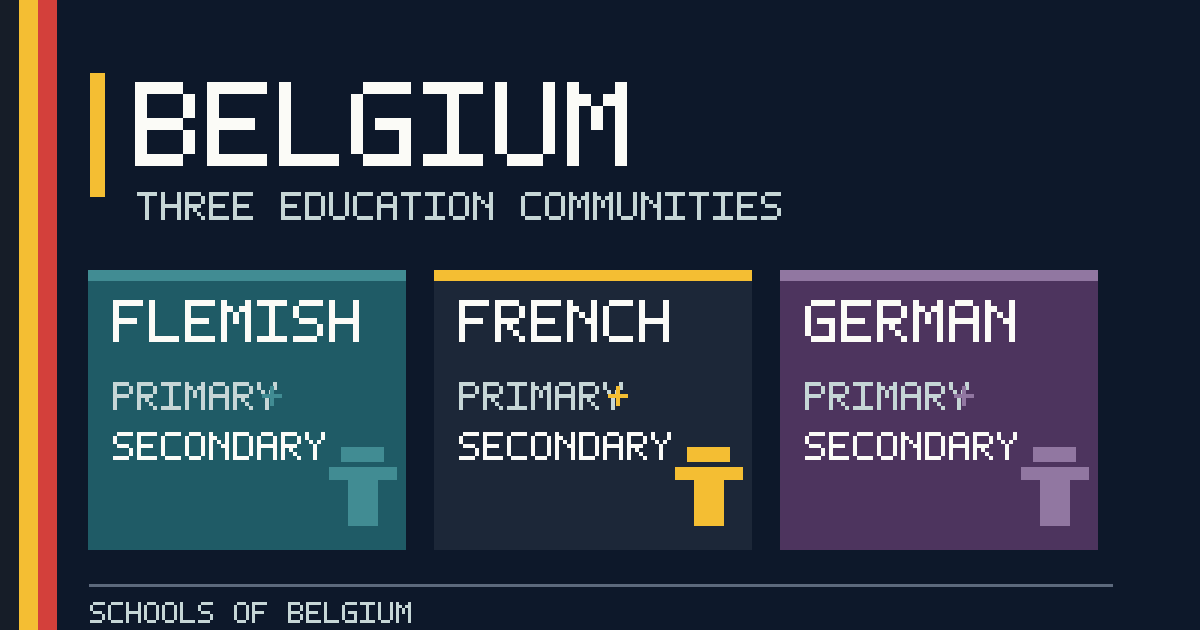
Belgium’s education system is different from that of most countries because three language-based Communities organise education within one federal state. The Flemish Community organises Dutch-language education, the French Community (Fédération Wallonie-Bruxelles) organises most French-language education, and the German-speaking Community administers German-language schooling in eastern Belgium. A Belgian pupil’s age, school stage and certificate cannot be interpreted reliably without knowing which Community and programme the learner follows.
The nationwide rule is comparatively simple: education is compulsory from the calendar year in which a child turns five until around age eighteen, subject to the exact end-of-obligation conditions and earlier recognised secondary graduation. Most pupils follow kindergarten, six primary years and approximately six secondary years, although vocational, specialised and additional-year routes can differ. But Belgium does not have one national final-school examination or one universally named secondary diploma. For example, French Community pupils may encounter CEB, CE1D and CESS; Flemish pupils receive documents organised around onderwijskwalificatie (OK3 or OK4) and school orientation; German-speaking pupils have their own certificate terminology.
This guide explains Belgian education in 2026–2027, from preschool and primary school to secondary pathways, dual learning, the French Community’s common-core reform entering first-year secondary in September 2026, Flemish 2025–2026 qualification rules, tertiary study, university admissions and transfer documents. The purpose is to let families and international researchers answer the right question immediately, without assuming that Dutch-, French- and German-language schools are identical.
Belgium education system: quick reference
| Question | Immediate answer |
|---|---|
| Who makes education decisions? | Three Communities: Flemish, French and German-speaking, with particular remaining federal powers. |
| When is education compulsory? | From 1 September in the year the child turns five until the applicable age-eighteen end point or earlier recognised secondary graduation. |
| Is compulsory education identical to attending a school? | No; approved home education may meet the obligation under Community rules. |
| How long is primary school? | Commonly six school years, beginning around six, after kindergarten. |
| How long is ordinary secondary school? | Commonly six years, organised in stages and programmes; some routes add a seventh year. |
| What does a French Community primary certificate mean? | CEB, Certificat d’études de base, ordinarily associated with successful completion of primary education. |
| What is CE1D? | A certification examination connected to the first secondary degree in the French Community, subject to cohort-specific reform. |
| What is CESS? | Certificat d’enseignement secondaire supérieur, a recognised upper-secondary completion credential in the French Community. |
| What is the Flemish modernised secondary distinction? | Doorstroomfinaliteit, dubbele finaliteit, arbeidsmarktfinaliteit, with OK3/OK4 qualifications and different progression. |
| What is new in French Community schools in 2026? | Tronc commun extends into first-year secondary during 2026–2027, beginning a phased senior school reform. |
| Do all pupils use the same teaching language? | No: Dutch, French or German depends on the Community and school, with specific language-learning provisions. |
| What happens after secondary school? | Recognised professional training, college or higher education, depending on the actual diploma and programme rules. |
The best first step is to identify the education Community and certificate, not merely the school town. Brussels, for example, is geographically bilingual but does not operate an independent fourth education Community. A school there is generally linked to a French- or Dutch-language educational authority.
One Belgium, three education Communities
Belgium has three Regions and three Communities. These are not the same administrative categories. The three Communities are organised around language: Dutch, French and German. The federal government retains powers over the broad duration of compulsory education and certain diploma minima, but the Communities govern much of curriculum, school organisation and educational qualifications.
The Belgian federal government’s education guide expressly identifies the Flemish, French and German-speaking Communities as the responsible education authorities. The federal Community overview explains why this political arrangement differs from a simple geographical map.
Consider two children attending schools a few kilometres apart in Brussels. One follows a Dutch-language Flemish programme, the other a French Community programme. Their broad ages and subjects overlap, but school-stage terminology, report format, assessment practice and later qualification wording may differ. No one should assume the pupils are taking an identical national exam because they live in the same city.
The situation is different again in the German-speaking Community in eastern Belgium. The official Ostbelgien school-system guide distinguishes a regular kindergarten, six-year primary route and secondary schooling with academic and vocational possibilities.
This is why an accurate international transcript must identify both location and responsible Community. A country’s language diversity is not a footnote here; it is central to how the educational system operates.
What does compulsory education from five to eighteen mean?
Belgium requires children to receive education beginning on 1 September of the calendar year they turn five. According to the Flemish government’s nationwide compulsory education guidance, the obligation normally continues until the eighteenth birthday or the applicable June end-of-school-year date; it can end earlier when a recognised secondary diploma has been obtained under the legal conditions.
The distinction between compulsory education and compulsory physical school attendance matters. Home education is legally possible under the relevant Community’s notification, quality and assessment conditions. A parent cannot simply stop enrolment and call any informal arrangement home schooling without following the rules.
Part-time education combined with recognised work or training may be permissible from the appropriate age, usually around fifteen or sixteen, subject to conditions. It is not an unrestricted right to leave education entirely at fifteen.
Children arriving from abroad also have educational rights. The Flemish government’s information says that children with foreign nationality who live in Belgium enter the compulsory framework after the relevant registration period and that schools may not refuse a child merely for lacking official residence documents.
A family’s immediate practical question should be which education authority governs the child, which enrolment or home-education rules apply and which supporting documents are needed. Legal rights and the availability of an appropriate local place are related but different issues.
Kindergarten: why the age-five rule is important
Belgian compulsory education includes a kindergarten year because the obligation begins at five, before ordinary primary school starts around six. Most children attend nursery or kindergarten for more than one year, but the legal requirement from five should not be converted into a false assertion that all three preschool years are mandatory.
Early childhood education helps children develop oral language, turn-taking, social confidence, movement, pattern recognition and curiosity. It is not simply a place to practise written primary-school examinations. A child who can tell a story, follow instructions and compare simple quantities is developing real school readiness.
Language context matters more than a quick school label. A family may use Polish, Arabic, English, Dutch, French or another language at home. A child can understand a concept in a familiar language while still learning words and routines used by the selected school.
In the Flemish Community, primary-school admission can involve kindergarten attendance or Dutch language-readiness checks under the applicable rules. Families should read the receiving school’s current instructions, rather than infer that one year of preschool automatically makes all language requirements disappear.
A useful home routine is shared reading and conversation: ask what happened first, what a character wants, how two objects differ and what the child would do next. Such activities build meaning and expression without introducing unnecessary high-stakes pressure.
Six years of primary school
Primary schooling usually runs for six years, after kindergarten, with a child entering around age six. Dutch-language schools call the stage lager onderwijs; French-language schools use enseignement primaire; the German-speaking Community uses Primarschule. These labels all refer to a primary stage, but their precise documents and curricular prescriptions belong to the Community.
Across subjects, primary learning should develop independent reading, accurate writing, number sense, mathematical reasoning, basic scientific inquiry and social understanding. Teaching is more than getting a correct answer. A child who performs 6 × 8 = 48 should also recognise six equal groups of eight and know when multiplication is relevant.
In literacy, decoding, vocabulary and comprehension are separate skills. A pupil who reads aloud fluently but cannot explain the main idea needs different support from one who cannot recognise printed words. In mathematics, a child who calculates fractions incorrectly may have a conceptual part–whole difficulty, not merely a lack of practice.
At the end of six years, the receiving secondary institution may need an approved primary completion certificate. In the French Community that is normally the CEB; Flemish schools have their primary qualification arrangements; German-speaking schools also have stage-completion certificates. Translating each into a generic “primary diploma” without the issuing system can obscure useful information.
For international transfers, ask for the original school report, year level, subjects, grading explanation and issuing Community. A one-line age comparison does not tell the receiving school what the child has actually learned.
The French Community’s CEB: what it represents
CEB means Certificat d’études de base. It is associated with successful completion of the fundamental or primary stage in the French Community. It is not the same thing as the CE1D, which relates to the first part of secondary education, or the CESS, which is associated with upper-secondary completion.
The French Community publishes common external certification arrangements and assessment documents through Enseignement.be. Its official 2025–2026 examinations circular distinguishes CEB, CE1D and CESS. These distinctions matter to pupils, researchers and schools reviewing documents.
A child who holds a CEB has achieved an important stage, but they have not thereby completed secondary school or acquired a university entrance award. A family should confirm the next class and the support the student needs at the secondary transition.
The external test is also not the full definition of educational quality. Teachers assess progress in classrooms, identify misconceptions and support development over years. The certificate records a completion milestone; the student’s work samples reveal current strengths.
Parents should check the current year’s examination programme and applicable cohort rules. During reform periods, a qualification may still exist for one cohort while the school structure for younger pupils is changing.
Secondary school is not one identical pathway
Ordinary Belgian secondary schooling is typically organised over approximately six years. But a useful guide must explain the qualifications and educational tracks rather than write “Years 7–12” and stop there.
In Flanders, secondary schooling is modernised around different finaliteiten, or destinations: doorstroomfinaliteit prepares for higher education, dubbele finaliteit combines higher-education and employment preparation, and arbeidsmarktfinaliteit is oriented towards employment and professional qualifications. Older school-type labels such as ASO, TSO, KSO and BSO still appear within this structure, but destination and qualification level now provide crucial detail.
In the French Community, secondary education includes transition and qualification routes, with relevant certificates and vocational components. The first years are being affected by the tronc commun reform, while older pupils may still follow the rules of earlier cohorts.
The German-speaking Community likewise offers academic and vocational routes in its own system. Its official educational description says regular secondary school ordinarily lasts six years and vocational routes can involve a seventh.
A parent should compare programme curriculum, language, assessment, qualifications and future options. No single track should be used as a permanent label for a child’s intelligence.
Flanders: the modernised qualification framework
The Flemish Community’s official education objectives page explains the three modernised secondary finaliteiten. The qualification and progression page identifies an important change: from 2024–2025, pupils in certain labour-market-oriented sixth-year programmes can receive an OK3 secondary diploma, while pupils in higher-education preparation or double-purpose routes can obtain OK4 under the specified requirements.
These are different formal education qualifications. An OK4 credential normally supports direct entry to relevant bachelor’s study, subject to other admission conditions. An OK3 diploma offers different direct opportunities and recognised bridging routes, including an appropriate seventh year to progress towards OK4.
This distinction is far more precise than telling every Flemish school-leaver that “a secondary diploma automatically means university.” The exact onderwijskwalificatie level must be recorded.
Some programmes offer occupational qualifications alongside general educational credentials. Dual learning and employment-oriented routes can be rigorous and valuable, but the resulting rights are linked to the actual awarded qualification.
A family comparing two programmes should ask for the award after Year 6, whether a seventh year is needed for a desired next step and what subjects the student must master. The current rules, not a decade-old track diagram, should govern the decision.
What happens in a seventh secondary year?
Belgium’s education system can include an additional seventh year for particular programmes and progression routes. The phrase “Year 7” does not mean every pupil must spend seven years in secondary school, nor does every seventh year award the same credential.
In Flemish schooling, the government’s progression information distinguishes seventh years oriented towards higher education and others intended to deepen occupational competence or enter work. After a labour-market-oriented OK3 diploma, an appropriate seventh year can provide a route towards the higher qualification required for certain bachelor’s programmes.
For a family, the useful question is what changes on successful completion. Is it a higher education qualification level, a professional competency certificate, or additional preparation without a new general diploma? The answer belongs to the particular programme.
A seventh year can be valuable where it expands opportunities, supports learning recovery or develops recognised skills. It should not be described as automatically remedial or automatically superior.
A foreign admissions officer should not infer a document’s meaning merely from “seven secondary years.” The actual qualification and progression rights need verification.
The French Community’s CE1D and CESS
In French-language schools, CE1D refers to a certification connected to the end of the first secondary degree, while CESS refers to a qualification associated with completion of upper secondary education. Certificates, orientation attestations and vocational awards do not all perform the same function.
The French Community’s official examination guidance treats CEB, CE1D and CESS as distinct assessments and awards. As the reform moves through the first secondary years, the assessment arrangements for younger and older cohorts can differ. Thus an undated sentence saying that every student now takes an identical CE1D on the same permanent date is unsafe.
The CESS matters for many pathways into higher education, although university and professional programmes can impose additional examinations, prerequisites or recognition conditions. Technical or qualification routes can award additional occupational credentials whose names should not be collapsed into the CESS.
For a student transferring from a French-language school, ask for the exact certificate, whether it belongs to transition or qualification teaching, the programme year and grading detail. If a document lists a certificat de qualification, that is not automatically the same evidence as a general upper-secondary completion award.
A good parent plan follows the actual school programme and the child’s next legitimate destination, not a generic “French Belgian school exam” headline.
The 2026–2027 French Community tronc commun reform
A current country guide must address the Pacte pour un Enseignement d’excellence and its tronc commun. The French Community’s official programme page says reforms begin progressively in first-year secondary from the September 2026 return to school.
The aim includes strengthening core learning, supporting student progress and updating the organisation of subjects. The official guidance describes more space for Mathematics and digital learning, with links between science, technology, engineering, arts and Mathematics. This affects the current cohort, not every upper-secondary student immediately.
A French Community timeline describes phased progression into later secondary years. The safe principle is to state which school year and which cohort a change applies to, especially where regulations are amended during implementation.
A parent of a first-year secondary pupil in October 2026 should obtain the school’s new timetable and subject programme, rather than prepare only from a sibling’s earlier schedule. A parent of an older pupil should not assume the reform automatically rewrites that pupil’s current certification.
The reform’s long-term objectives are educational aspirations. Measuring whether it succeeds requires evidence about learning, inclusion and participation over time; a new policy text alone cannot establish those outcomes.
The German-speaking Community
The German-speaking Community is small in population but important in its legal and educational identity. Its official school-system page describes kindergarten, usually six years of primary school, and normally six years of secondary school or seven years in certain vocational programmes.
The Community issues its own school-stage documents and recognises academic and vocational routes under its rules. A reader should use the correct German terminology rather than assume a French CESS label appears unchanged on a German-language certificate.
The official description also notes that higher education options within the German-speaking Community are relatively limited. Certain professional higher-education programmes are available locally, while many students pursue further studies elsewhere in Belgium or abroad. This reflects the regional organisation of tertiary provision, not a lack of educational ambition.
A student planning university in a different Belgian Community should confirm certificate recognition and any language or programme prerequisites with the receiving institution. German schooling may prepare students in one language while a university programme teaches in Dutch, French or English.
This is why language of instruction, qualification identity and destination institution belong in the same application plan.
Brussels: does the city have its own school system?
No single Brussels-only education Community replaces the Flemish and French systems. Brussels is a bilingual region, and families can encounter Dutch-language or French-language schools with different competent authorities. International and European schools may also operate within their own recognised frameworks.
A child’s address in Brussels is therefore not enough to identify the curriculum. Ask which Community governs the specific school, what language it teaches through and which certificate it will award. These are basic documentary facts, not political questions about which school is “more Belgian.”
A family relocating from overseas may be interested in a particular language pathway because of future work, higher education or the child’s previous learning. That is a legitimate planning factor, but the decision should also consider support for a pupil who is learning a new academic language.
French and Dutch school years can overlap substantially in content while differing in assessment and timetable. It is unsafe to copy a progression rule from one Community to another without checking.
The best school comparison is concrete: curriculum, teaching language, qualification, learning support, travel, inclusion and the child’s present skills.
Language learning: understanding before translation
Belgium’s three official languages—Dutch, French and German—have distinct roles in school administration. English and other languages are also taught, and some university courses use English. But the phrase “Belgian schools are multilingual” does not mean a child automatically receives every subject in three languages.
Imagine a learner who can solve a ratio problem in Dutch but is entering a French-language school. The mathematical concept may already be secure; the French terms for numerator, denominator, share and comparison may be unfamiliar. Treating the child as weak at Mathematics and restarting everything would waste prior learning.
A careful diagnostic separates concept comprehension, subject vocabulary, reading of exam instructions and written explanation. Each can be improved deliberately. Translating terminology alone, however, does not guarantee the learner can model a new word problem.
Language support for newcomers is organised differently in each Community and may include reception or bridging programmes. Parents should seek current guidance from the receiving school, not apply the same Flemish language programme name to a French school.
The goal is to make academic knowledge portable while helping students communicate in the destination curriculum and gain a recognised qualification.
An original mathematics task for a multilingual student
Consider this original illustrative exercise, not a Belgian national paper. A school library has 84 books, and three sevenths belong to a science collection. The student must determine how many books are science books.
The calculation is 84 ÷ 7 × 3 = 36. The learner should also explain that the whole collection contains seven equal parts of twelve books each, with three parts used for science. If the problem later says trois septièmes, drie zevenden or drei Siebtel, the underlying mathematical relationship remains the same.
A pupil who produces 84 × 7 ÷ 3 may have misunderstood the part–whole concept. Another who correctly draws the groups but cannot understand the printed instruction may need academic-language support. Those are not equivalent weaknesses.
To test independence, change the fraction and the total. Can the learner explain why the denominator divides the whole into equal parts? Can they identify whether the answer should be more or less than half?
This method demonstrates how Mathematics, language and diagnostic teaching interact. An accurate transfer assessment preserves the learner’s understanding instead of labelling every language challenge as a subject failure.
Dual learning and professional education
Belgian vocational and professional pathways offer structured routes for learners who want practical education, workplace experience and recognised qualifications. In Flanders, duaal leren combines learning at school with supervised learning in the workplace under approved programmes.
The Flemish government’s dual-learning guide describes the system and its role in recognised occupational preparation. The professional competence is assessed through more than presence at a workplace; learners must meet the programme’s educational and occupational requirements.
A vocational route can involve demanding Mathematics, reading and science. A pupil learning electrical systems needs measurement, formulas, safety, documentation and troubleshooting. The value of such learning should be judged through assessed competencies and recognised progression rather than a stereotype about ability.
A crucial qualification detail remains: an occupational credential, an OK3, an OK4 or a French-language secondary certificate may confer different further-study eligibility. A family should obtain the exact title from the awarding authority before assuming it permits a particular degree.
Good vocational guidance asks what the learner will be able to do independently, where those skills are recognised and which legitimate next steps remain open.
Higher education and university in Belgium
Belgium has universities, university colleges and other recognised higher-education providers. Many qualifications are organised through bachelor’s, master’s and doctoral cycles compatible with the wider European Higher Education Area, though exact programme design, professional recognition and admission requirements differ.
The education Community matters at university as well. Degree programmes may teach through Dutch, French, German or English depending on the institution, degree and approved offering. A child who completes secondary education in one language should not assume entry to a programme in another language without demonstrating the relevant competence.
An OK4, CESS or another accepted diploma may establish a normal basis for applying to higher education. It is not an unconditional offer. Medicine, engineering and other programmes can have selection tests, specific prerequisites or capacity restrictions, subject to current rules.
Tuition and financial aid also vary by programme, institution and residence or nationality category. A general article should not publish one universal Belgium-wide university fee or promise free study to every international applicant.
An internationally mobile student should verify the exact certificate, the receiving programme’s recognition, accepted translations and any applicable visa or language evidence before paying fees or committing to a move.
How to compare Belgian qualifications internationally
A school record should state the issuing Community and institution, the stage and year, subject results, qualification name and any grading details. A receiving institution may also request the curriculum and language of instruction.
It is unsafe to translate CEB as “High School Certificate.” It is a fundamental-stage award. It is also inaccurate to treat a French CE1D as the same as a Flemish OK4. They represent different points and purposes.
The receiving school or university makes an equivalence decision. An online guide can explain what a certificate generally means, but cannot make a legal recognition determination. This applies whether a learner transfers to another Belgian Community, Singapore, Australia, Britain or a different European country.
For a student with interrupted schooling, a subject diagnostic may reveal that important knowledge is present even if formal documentation is incomplete. That is useful for a bridging plan, while official admission remains a separate administrative step.
The safest comparison asks: What has the pupil completed? What can they demonstrate now? What does the next programme require? Which authority accepts the evidence?
Case study: moving from a French to a Dutch school
Imagine a fictional thirteen-year-old who has studied in a French Community secondary programme and moves into a Dutch-language school. The family is tempted to say “same country, same school year” and expects no transition work.
The responsible receiving school needs to compare the actual stage and certification. It must also determine how the child’s subject readiness and Dutch academic language match the new environment. Mathematics and science knowledge may transfer more smoothly than written essays or local terminology.
A useful learning check might include a short Mathematics explanation, a science graph and an unfamiliar reading passage. Ask the learner to demonstrate the concept in the familiar language first, then identify the academic expressions needed in Dutch.
If the student understands ratios but cannot interpret a Dutch word problem, focused language instruction may be a better first step than reteaching fractions. If a science concept is genuinely missing, that can be taught directly.
This is a fictional scenario illustrating the distinction between legal placement, qualification and learning. The institution determines actual admission.
Case study: choosing an upper-secondary pathway
A fictional Flemish pupil is selecting a programme that may lead to a doorstroom, dubbele or arbeidsmarkt qualification. The family assumes all secondary diplomas automatically permit an identical bachelor’s admission.
The first action is to check the programme’s actual OK3 or OK4 award. If the learner’s desired next step requires OK4, an OK3-oriented route may involve a relevant additional year or other pathway. That is a crucial planning fact, not a judgment on the academic value of vocational education.
The second action is to look at strengths. A student who enjoys computing may need better algebra, technical reading and problem-solving. A learner attracted to healthcare or business may have a different balance of theory, communication and practical tasks.
The third action is to compare recognised programmes and support. Ask what students learn, how practical work is supervised, which further-study destinations accept the award and whether language prerequisites matter.
The result should be an informed choice with credible next steps, not a promise that an attractive school brochure can overrule qualification regulations.
Education access, inclusion and equal opportunity
Belgian schools serve children with varied economic circumstances, home languages, disability-related needs and educational histories. Different Communities operate their own support and inclusion frameworks. The existence of compulsory education does not mean all families have identical access to subject electives, local places or specialist services.
A fair educational comparison should distinguish registration, attendance, successful stage completion and independently demonstrated learning. Statistics on enrolment cannot alone establish reading proficiency or the quality of feedback in a particular classroom.
The right school choice must consider accessibility, travel, language support, curriculum fit, safety and the learner’s ability to participate. A child’s academic potential should never be inferred from their family’s immigration status or from a stereotype about a neighbourhood.
Educational reform can improve curricular consistency and support, but the outcomes need actual evidence from teachers and pupils. The Flemish diploma reform and French Community common-core programme should therefore be examined through their reported implementation and results over time.
A country guide succeeds when it describes how the system works and what limitations or differences a reader needs to check for their own case.
A four-week study transition plan
- Week 1 — identify the authority and baseline. Confirm the Community, programme, certificate target and current syllabus. Review a real reading, Mathematics and science task.
- Week 2 — repair the earliest weak link. Separate subject concepts from language comprehension and teach one precise gap, asking the learner to explain the principle.
- Week 3 — vary the context. Use unfamiliar examples, a new language formulation or a fresh application to determine whether the learner can transfer the idea.
- Week 4 — check independence and administrative progress. Reassess with a fresh task, confirm the next programme’s documentation and set a realistic learning goal.
This is an educational support method, not an official four-week CEB, CE1D, CESS or Flemish diploma syllabus. Official programmes and assessment guidance remain authoritative.
The most useful progress record states what the student can now do alone. “Completed five tutoring sessions” measures an activity; “can explain a fraction in the teaching language and solve an unfamiliar problem” measures a meaningful change.
A tutor cannot award a Belgian secondary diploma or decide that a foreign certificate is legally equivalent. Those actions belong to authorised institutions.
Ten mistakes to avoid when explaining Belgian schools
Mistake one: describing Belgium as one curriculum governed only by Brussels. Education is largely a Community competence.
Mistake two: claiming education starts being compulsory only at age six. The nationwide rule starts in the calendar year of the fifth birthday.
Mistake three: treating compulsory education as proof that home education is prohibited. It can be permitted under conditions.
Mistake four: assuming Brussels is a fourth education Community. Dutch- and French-language Community governance remains central.
Mistake five: mixing CEB, CE1D and CESS as though they were one examination. They relate to different stages.
Mistake six: presenting every Flemish secondary diploma as identical. OK3 and OK4 have distinct recognised progression.
Mistake seven: assuming every Belgian student sits one national BAC. Qualifications and assessment are Community-specific.
Mistake eight: assuming the 2026 French common-core reform has already rewritten every secondary year. Its implementation is phased.
Mistake nine: dismissing dual or vocational learning as unqualified employment. Recognised programmes combine education and professional competence.
Mistake ten: interpreting a transcript without its Community, programme language, cohort and awarding institution.
Frequently asked questions about Belgium’s education system
Does Belgium have three education systems?
It has three education-governing Communities—Flemish, French and German-speaking—with distinct programme and qualification arrangements. They operate within a common Belgian federal and compulsory-education framework.
Is education compulsory between five and eighteen?
Yes, under the nationwide rule and its precise start/end conditions. It begins from 1 September in the year a child turns five and ordinarily ends around eighteen or with earlier recognised secondary completion.
Is kindergarten compulsory?
The obligation from age five includes kindergarten before ordinary primary school. It does not make every earlier preschool year automatically compulsory.
How many years is primary school?
Usually six years, beginning around age six. The certificate name depends on the education Community.
What is CEB?
The Certificat d’études de base is an important French Community fundamental-education certificate normally associated with completing primary school.
What is CE1D?
The Certificat d’enseignement secondaire du premier degré is tied to the first part of French Community secondary education under the applicable cohort and examination rules.
What is CESS?
The Certificat d’enseignement secondaire supérieur is an upper-secondary certificate in the French Community, important for many higher-education pathways subject to admissions criteria.
What do ASO, TSO, KSO and BSO mean?
They are Flemish secondary education-type labels broadly connected to general, technical, arts and vocational programmes. Modernised programme finaliteiten and actual qualification levels provide crucial additional information.
What is doorstroomfinaliteit?
A Flemish secondary orientation preparing for progression into higher education. The actual programme and award should be checked, not inferred only from the label.
What is dubbele finaliteit?
A programme combining preparation for higher education and employment, within the recognised modernised Flemish system.
What is arbeidsmarktfinaliteit?
A labour-market-oriented pathway. The OK3 diploma and approved progression to further study are important for understanding its outcomes.
Does OK3 give direct entry to every bachelor’s degree?
No. The Flemish government distinguishes OK3 from OK4; a relevant additional route may be needed for direct bachelor’s entry.
What changed in French secondary school in 2026?
The tronc commun reform began entering first-year secondary during 2026–2027, with revised curricula and changes to the learning structure. Later cohorts are phased in according to official rules.
What about the German-speaking Community?
It operates German-language schooling with its own regulations and certificates, normally six primary years and six secondary years, with some longer vocational routes.
Can students move between Communities?
Movement is possible under the applicable enrolment, documentation, language and recognition rules. Placement is not automatically fixed by a simplified grade-number comparison.
Is university education free in Belgium?
There is no universal promise of zero tuition for every applicant. Fees and aid depend on Community, institution, course and the student’s eligibility category.
Does a secondary diploma guarantee university admission?
It may establish general eligibility, but some programmes require additional selection, aptitude, language or qualification conditions.
Can a foreign family enrol a child?
The right to education and the applicable rules support access, including provisions concerning children without regular residence documents. Actual registration and school arrangements should be confirmed with the competent Community.
What if a student knows a subject but not the teaching language?
Assess concept understanding and academic language separately. A targeted language bridge can help while formal placement and qualification recognition remain the institution’s responsibility.
The right next step for every reader
For a parent of a five-year-old, find the Community and relevant kindergarten rules. For a primary family, understand the six-year stage and its certificate. For a secondary family, establish whether the student is following Flemish OK3/OK4, French CE1D/CESS or German-language qualification arrangements. For an international applicant, preserve the original award name and ask the receiving institution about recognition.
The existing Education | Belgium article offers a related orientation, while the eduKate Education Hub covers general learning methods. The Belgium education-system mechanisms guide addresses broader institutional workings. This article instead gives the country-specific school ladder, certificate map and parent decisions.
Continue the 195-country series
Previously published alphabetical guides include Belarus, Belize and Benin. Compare Belgium with Denmark for a very different national folkeskole and vocational route. Every country needs a locally accurate explanation rather than a copied grade template.
Official sources and verification
- Belgium federal government: studying in Belgium and Community responsibilities.
- Belgium federal government: the three Communities.
- Flanders: compulsory education age five to eighteen and home education.
- Flanders: modernised secondary education objectives and finaliteiten.
- Flanders: OK3, OK4, sixth and seventh-year qualification progression.
- Flanders: dual learning in secondary school.
- French Community: tronc commun and entry into first secondary in 2026.
- French Community: certification examination circular 2025–2026.
- German-speaking Community: official school-stage and qualification overview.
Editorial verification: 29 October 2026. Community-specific and cohort-specific arrangements are distinguished. Worked learners and questions are original examples, not Belgian state examination questions.