
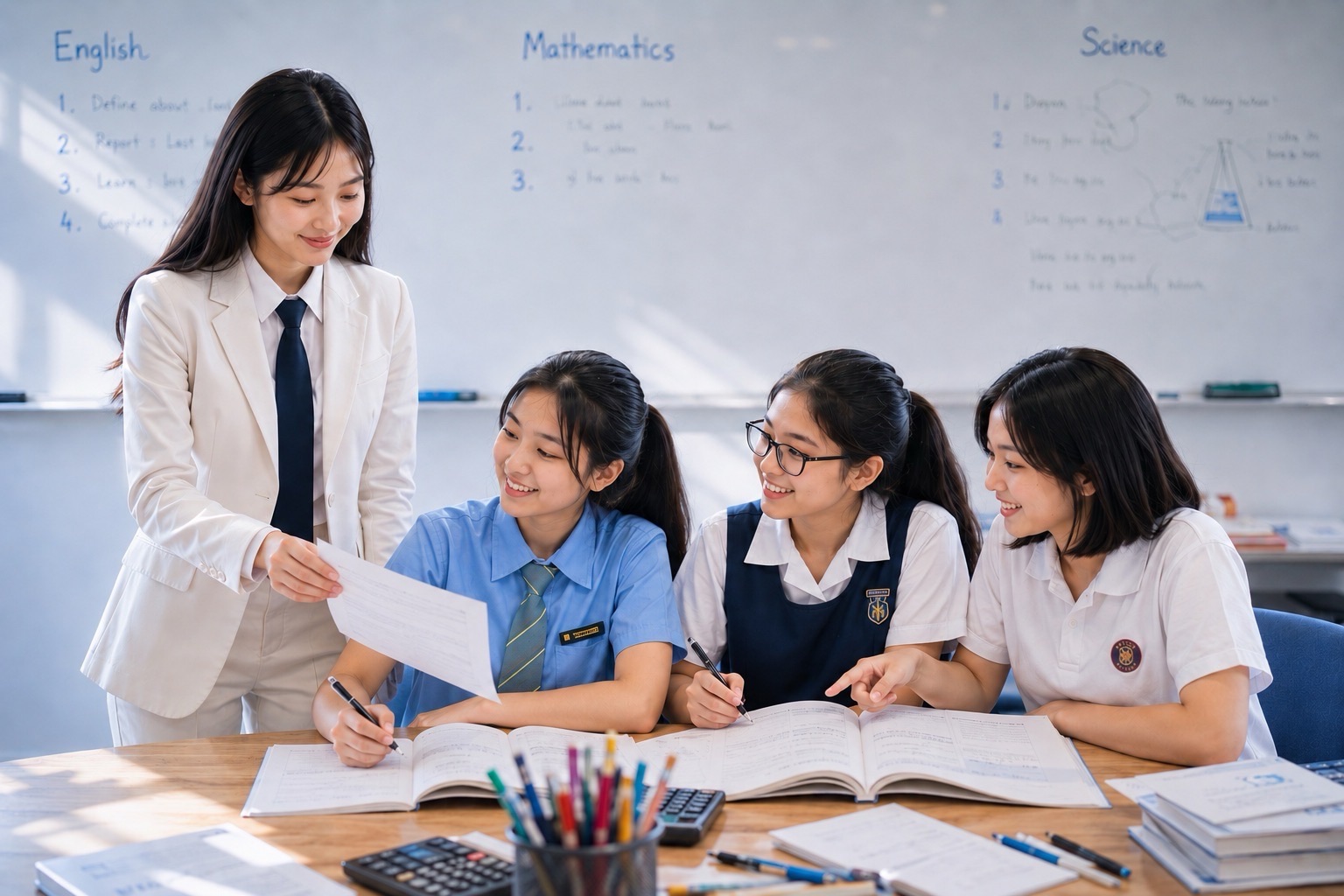
A Secondary 1 child returning to Yio Chu Kang after school can be surprisingly uncertain about a question that would have been easy in Primary 6. The numbers are modest: three identical notebooks and one extra charge make $29. Yesterday the child might have drawn three equal boxes, and today the school writes 3x + 8 = 29. The mathematics is familiar; the symbolic language is not yet fluent. A helpful tutor shows how the bar, sentence and equation describe exactly the same quantities.
What happens in Secondary 1 Yio Chu Kang Mathematics tuition? Useful Sec 1 Maths lessons connect PSLE fractions, ratios, percentages and bar-model thinking with signed integers, algebraic expressions, simple equations, inequalities and early graphs. A tutor observes a first unaided solution, identifies the precise mathematical misconception or representation gap, and retests the corrected concept later using an altered problem. Revision for the first school weighted assessment must match the pupil’s actual G1, G2 or G3 Mathematics subject level and the chapters their teacher has taught.
This article starts a four-year Mathematics progression for Yio Chu Kang families. The first year is about making new symbols readable, not forcing graduating-year papers on a child who has barely entered secondary school. Over time the learner should be able to choose a representation, perform legal steps, explain what an answer means and recognise a mistake independently. We will show those habits using original worked examples, an eight-week plan and practical parent questions.
The PSLE bar model has become a shorter mathematical sentence
Imagine three identical notebooks and an $8 stationery case costing $29 altogether. A Primary pupil may draw three equal bars and one separate block marked eight. In algebra, let x be the price of one notebook and write 3x + 8 = 29. The coefficient three counts identical notebooks; the constant eight is one fixed extra amount.
Subtract eight on both sides to obtain 3x = 21, then divide by three to get x = 7. One notebook costs seven dollars. Return to the words: three seven-dollar notebooks cost $21, and adding the case cost gives $29. That check confirms both the arithmetic and which quantity x represents.
Change the stationery case to $5 but keep the total $29. The equation becomes 3x + 5 = 29, giving x = 8. A child who repeats seven has remembered the last example rather than reading the new relationship. A changed-condition exercise diagnoses transfer more clearly than another identically formatted worksheet.
One school mark is not a full learning diagnosis
Suppose three pupils each score 62 in their first Mathematics weighted assessment. One correctly builds equations but repeatedly drops negative signs. Another calculates accurately after an equation is supplied but cannot translate a story into an equation. A third has an unstable fraction foundation. Their total marks match, but the first weakness is different.
Ask for ordinary schoolwork and one fresh unassisted task. Does the child define the unknown, distinguish fixed and variable amounts, select a mathematically legal first operation and show working that follows? Read from the start until the earliest unsupported line. The problem may be a missing concept, failed translation, incorrect method choice, inaccurate execution or absent checking.
After teaching the specific weakness, schedule a changed related question a few days later. A neat solution immediately after watching a tutor demonstrates guided understanding. A fresh problem started and checked independently is better evidence that the correction has become usable.
Negative numbers need a number line before a slogan
Compare −7 + 10 = 3, −7 − 10 = −17 and −7 − (−10) = 3. The first moves right ten units along a number line; the second moves left; the third removes a negative ten and therefore raises the value. Similar-looking minus signs can label a negative quantity or specify subtraction.
Now calculate −7 − (−2). The result is −5, not a positive number. Removing negative two makes the value two greater, but it remains below zero. A pupil who relies on ‘two negatives make positive’ without considering the whole expression may need the number-line meaning taught explicitly.
Multiplication is another relationship: −4 × 3 = −12, while −4 × (−3) = 12. Later the student expands −4(x − 3) into −4x + 12. That Secondary algebra error may actually be an unresolved arithmetic foundation from Primary School.
Fractions remain part of the story after PSLE
Calculate 3/4 − 1/6. Express the fractions in common twelfths: 9/12 − 2/12 = 7/12. The denominator identifies the size of each part. A pupil who separately subtracts numerators and denominators has lost that meaning, rather than simply forgetting a line of working.
Now solve x/4 + 3 = 10. Subtract three from both sides, giving x/4 = 7, then multiply by four to obtain x = 28. The check 28/4 + 3 = 10 links the Primary idea of one-quarter of an amount with the Secondary idea of an equation.
Change the task to x/5 − 2 = 4, whose solution is x = 30. Ask why adding two and then multiplying by five reverse the operations affecting x. A phrase such as ‘move the five across’ can be convenient shorthand later; it should not replace equality-preserving reasoning.
Like terms are quantities of the same kind
The expression 6a + 2a − 5 simplifies to 8a − 5. Both variable terms count the same mathematical quantity. In contrast, 6a + 2b − 5 cannot automatically simplify to 8a − 5, because a and b might represent different amounts.
Imagine a is the price of an apple and b the price of a banana. Six apples and two bananas do not automatically cost the same as eight apples. The everyday story makes clear why coefficients can be combined only when the attached variable terms are alike.
Change just one letter in a familiar expression and ask the pupil to justify which steps remain possible. A child who correctly refuses to combine unlike terms is reading mathematical structure rather than memorising the appearance of yesterday’s task.
A bracket represents an entire repeated group
Expand 4(x + 3) to obtain 4x + 12. Four groups each contain both x and three. An incorrect result 4x + 3 counts four copies of x but only one copy of the constant. Drawing four full packets explains the missing multiplication.
Compare 4(x − 3) = 4x − 12 with −4(x − 3) = −4x + 12. Every term is multiplied, including when the factor is negative. A learner who understands the first but not the second should revisit signed multiplication before being given more complex expressions.
Test x = 2. The original 4(x + 3) gives twenty and the correct expansion 4x + 12 also gives twenty. The wrong expression 4x + 3 gives eleven. Numerical substitution can detect an invalid identity, although the distributive law explains its general form.
An equation is a relationship kept in balance
Solve 5x − 7 = 18. Add seven to both sides and get 5x = 25, then divide by five to obtain x = 5. Each transformation preserves equality. The helpful shorthand ‘send seven across’ means an inverse operation has been applied to both sides, not that a symbol has moved by magic.
Change the equation to 5x + 7 = 18. The solution is 11/5 or 2.2. Reusing five from the first question fails substitution in the revised equation. This shows why a pupil should read each sign and condition before repeating a known calculation routine.
Another equation, 3(x + 2) = 24, can be solved by dividing by three before expanding, or by expanding first. Both lead to x = 6. Comparing two valid routes teaches flexibility and helps the child choose a simpler method when future questions mix several chapter skills.
Similar wording can produce different equations
‘Twice a number, increased by three, is seventeen’ can describe 2x + 3 = 17, giving x = 7. ‘Twice the sum of a number and three is seventeen’ instead gives 2(x + 3) = 17, so x = 5.5. The numbers are identical; what is doubled has changed.
A pupil who writes 3x + 2 for both has noticed numerals without assigning their meaning. Ask the child to define x, draw two copies of the correct group, and explain why a constant is inside or outside brackets before solving.
A strong routine is to read, define, represent, solve and check. It need not take long once familiar. By learning it in Secondary 1, the pupil develops an approach that remains valuable in upper-secondary contextual problems without topic headings.
Reverse percentages depend on the original whole
An imaginary stationery item is sold for $68 after a fifteen-per-cent discount. That is eighty-five per cent of the original price, so 0.85x = 68 and the original is x = $80. Adding fifteen per cent of the reduced $68 would use the wrong percentage base.
A Primary percentage bar shows the original 100%, the removed 15% and the remaining 85%. The equation describes exactly the same part–whole relationship in symbols. A pupil who can move between the diagram and the equation understands more than a remembered divide-by formula.
Change the question to a fifteen-per-cent increase that produces a final $92. The original is 92/1.15 = $80. Ask whether the original should be smaller or larger than the increased amount before calculating, providing a reasonableness check independent of calculator arithmetic.
Fixed charges and per-unit rates are not the same
Imagine a fictional school activity with a one-time booking charge of $6 and a $4 cost for each participant. If n pupils attend, the total is C = 6 + 4n. Four participants cost $22, while six participants cost $30. The fixed six dollars is paid once; the four-dollar amount repeats.
A child who multiplies the four-person total of $22 by 6/4 gets $33, a wrong answer because the one-off charge has been treated as if it scales with every pupil. Ask which quantity stays fixed when attendance changes.
The numbers are invented for teaching, not an actual service price in Yio Chu Kang. The distinction will later become the meaning of intercept and gradient in straight-line graphs. Understanding it as a story now makes the later symbolic connection less abrupt.
Inequalities describe a set of possible answers
The statement x < 4 allows three, zero and negative eight, but excludes four. On a number line an open endpoint at four communicates that exclusion. The statement x ≤ 4 includes four and every smaller value. Unlike an ordinary equation, an inequality may describe an entire range.
Where the student has studied it, solve 3x + 2 ≤ 14. Subtract two to obtain 3x ≤ 12 and divide by three to give x ≤ 4. Test x = 4, which satisfies the original, and x = 5, which does not. The substitution tests the boundary.
Ask the pupil for two numbers that satisfy an inequality and one that fails before manipulating the symbols. Understanding the allowed set prevents the student from treating an inequality sign as decoration while copying equation methods.
Coordinates let an algebraic rule become a graph
For y = 2x + 1, x-values zero, one and three produce y-values one, three and seven. Plotting (0,1), (1,3) and (3,7) gives points on one straight line. The equation, table and graph are three ways of describing the same relationship.
A pupil may reverse an ordered pair, misread a vertical axis marked in twos, or place the independent variable on the wrong axis. Such errors involve representation even when arithmetic is correct. Ask what the coordinate means and check it through substitution into the rule.
Where covered by the school, setting y = 9 gives 9 = 2x + 1, so x = 4. The point (4,9) should lie on the same line. This prepares the child for Secondary 2, when graph gradients, equations and contexts interact more frequently.
Set diagrams can teach how to avoid double-counting
Imagine a class of twenty pupils in which twelve choose a reading activity, nine choose a drawing activity and five choose both. The number choosing at least one is 12 + 9 − 5 = 16, leaving four choosing neither. The shared five would otherwise be counted twice.
In a Venn diagram, put five in the intersection first, then seven in reading only, four in drawing only and four outside. Those disjoint regions total twenty. The diagram shows why the overlap must be subtracted once.
Change the number choosing both from five to three while leaving the total group and individual activity counts unchanged. The union becomes eighteen and the outside group two. Ask the pupil to explain the changed overlap before repeating the calculation. Use this illustration where the relevant set content has been taught.
Weighted assessments differ by school and subject level
Secondary 1 weighted assessments are school-based. Pupils living in Yio Chu Kang may attend different secondary schools and study Mathematics at G1, G2 or G3 level. Their tested chapter orders and assessment formats can differ, so no one national WA1 paper applies automatically to all families in the estate.
Ask for the teacher’s exact assessed chapters before choosing school-specific revision. When marked work returns, classify the earliest repeated problems: a fraction concept, a sign operation, a word-to-equation translation, an inappropriate method or an arithmetic slip. Each demands a different next lesson.
One early WA mark is not a reliable forecast of national examinations years later. It is useful evidence of present understanding, especially when paired with independent changed-question retests that show whether the missing concept is becoming secure.
Three-pupil teaching should reveal three different first attempts
The existing eduKateSG Yio Chu Kang Mathematics overview describes premium groups of three pupils and instruction that focuses on how a student arrived at an answer. The small number should enable the tutor to see the first line each pupil produces before hints are given.
One child may need the number-line meaning of subtraction, another a diagram-to-equation bridge, and a third a better method for checking a percentage base. A shared lesson may have one broad topic but require distinct corrective questions for different pupils.
End with an altered question solved independently and a small delayed retest. Parents can ask which mistake is now less frequent and what fresh work proves this. Group size creates an opportunity for personalised feedback; it cannot guarantee a grade.
Retrieval and transfer practice serve different needs
Retrieval asks whether the pupil can recall a method after a gap with notes closed. Transfer asks whether the same concept is recognised after the story, diagram or numbers change. Error-detection practice presents a believable but incorrect solution and asks the pupil to find its earliest invalid line.
For retrieval, revisit 5x − 7 = 18 after three days. For transfer, write an equation from a story about five equal items and a fixed deduction. For error detection, explain why 4(x + 3) is not equal to 4x + 3. Each task requires a different kind of thinking.
A missing concept needs explicit explanation before practice. An understood but forgotten idea benefits from spaced recall. A method that works only on familiar-looking exercises needs new contexts. The right homework is not necessarily the longest homework.
An eight-week Mathematics bridge after PSLE
In weeks one and two, inspect actual schoolwork and a short independent sample of signed numbers, fractions and variable meanings. Identify one or two high-impact missing prerequisites rather than assume every Primary chapter must be retaught.
In weeks three and four, work on like terms, brackets and equation balance, matched to the school’s course. Require a short explanation of each legal operation and vary a sign or coefficient after the model. In weeks five and six, connect ratios, percentages, word stories, inequalities and simple graphs where taught.
In weeks seven and eight, use the actual school weighted-assessment scope for short mixed practice. After the paper, correct repeated first wrong decisions and test them after a delay. Report increasing independence and fewer recurring errors, not an arbitrary promised percentage gain.
From Yio Chu Kang MRT to an established teaching venue
Yio Chu Kang MRT sits on the North–South Line, and families may start from different schools, buses or activities around Ang Mo Kio and Yio Chu Kang Road. The existing eduKateSG Mathematics Yio Chu Kang guide identifies teaching at 8 Fourth Avenue, Bukit Timah, near Sixth Avenue MRT, rather than a separate classroom beside Yio Chu Kang station.
One practical route travels from Yio Chu Kang on the North–South Line to Newton, then changes to the Downtown Line for Sixth Avenue. Newton’s line interchange involves a signposted out-of-station transfer, so include walking and waiting in the full journey rather than assuming an instantaneous platform change.
Read the established Mathematics Tuition Yio Chu Kang | Primary and Secondary page and Surviving Tuition | Yio Chu Kang for the actual programme and family scheduling context. Confirm the venue, fees, appropriate subject group and current availability directly.
G1, G2 and G3 define subject pathways rather than potential
Full Subject-Based Banding lets secondary students take subjects at G1, G2 or G3 levels under school arrangements. Core number and equation concepts matter across relevant levels, but curriculum depth and assessment complexity differ. A tutor should use the actual Mathematics subject on the child’s timetable rather than automatically hand everyone a G3 worksheet.
The Singapore-Cambridge Secondary Education Certificate begins in 2027. This future national examination is useful context, not a reason to prescribe full graduating-year papers to a new Secondary 1 pupil before sufficient chapters have been taught.
For the national framework consult SEAB’s SEC school-candidate syllabuses. The immutable small-group learning reference is Secondary 1 Mathematics Tutor Clementi | Small Groups Tutorials.
Questions parents can ask at the first consultation
- Can the pupil define the unknown before writing an equation?
- What is the earliest invalid line in a genuine unassisted solution?
- Are signed numbers and fractions reliable inside the current algebra?
- Can the child explain why an operation preserves equality?
- Are WA tasks aligned to the school’s actual G1/G2/G3 Mathematics syllabus?
- Does each learner in the three-pupil group get individual unaided practice?
- Can the full Yio Chu Kang–tuition journey fit CCAs, meals, homework and sleep?
Frequently asked questions
Does every pupil need tuition immediately after PSLE?
No. Many make the transition through school and independent study. Additional tutoring is most useful when a specific persistent gap or appropriate extension aim has been identified.
Why can a strong PSLE pupil suddenly find algebra confusing?
The same quantities may now be expressed with more compact symbols. Connecting Primary diagrams, verbal stories and equations can complete that bridge.
Are negative-number mistakes always careless?
No. Some reflect incomplete understanding of the operation, and others are transcription slips. The first wrong line helps distinguish the correction.
Is the first weighted assessment a national exam?
No. Schools set and sequence their own WAs within relevant subject levels. Confirm the actual teacher-provided tested chapters.
Does a small group of three guarantee a grade?
No. It creates opportunities for individual feedback but does not guarantee outcomes.
Is the teaching classroom at Yio Chu Kang MRT?
The existing programme describes teaching near Sixth Avenue MRT at its Bukit Timah venue. Confirm the actual current class and travel arrangements before enrolling.
A five-minute independent Mathematics check
Where already taught, ask the pupil to calculate −7 − (−2), solve 3x + 8 = 29, and find the original price when a fifteen-per-cent reduction leaves $68. Ask which relationship applies, then request one substitution or reasonableness check.
Change the figures a few days later. A child who begins and checks the new problem without prompting shows stronger mathematical transfer than one who remembers the earlier answer.
Continue the four-year Yio Chu Kang Mathematics progression
The connected articles lead from Secondary 1: algebra after PSLE and first WA to Secondary 2: linear graphs and EOY revision, Secondary 3: trigonometry and quadratic graphs and Secondary 4: O-Level E-Math and SEC K310 exam papers. Each year asks the pupil to make progressively more independent mathematical decisions.
Start a consultation using the child’s actual schoolwork
Bring the current Mathematics level, an unaided school question, a marked exercise and a realistic weekly timetable. Ask which first mathematical misunderstanding should be taught and how a changed task will demonstrate improvement. Confirm teaching venue, fees and group fit.
Contact eduKate Singapore about suitable premium three-pupil Maths tutorials. Diagnosis before tuition. Less noise. More structure. Better learning.