
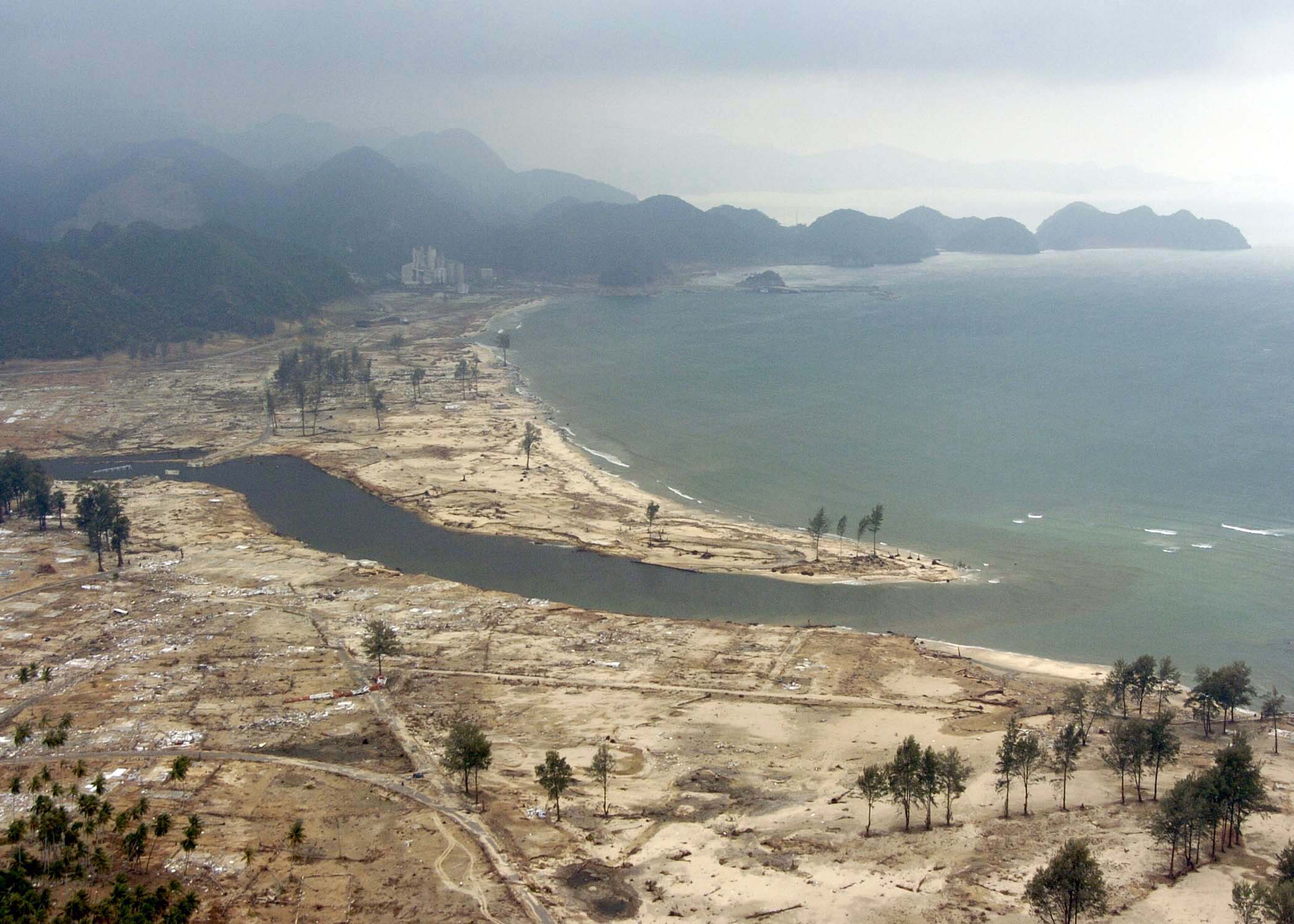
What is a tsunami? A tsunami is a series of long waves generated when a large volume of water is displaced suddenly. Common causes include undersea earthquakes, submarine landslides and volcanic activity. A tsunami is not simply one unusually large wind-generated wave. It can travel across an ocean, arrive as several surges and cause dangerous flooding and strong currents far from its source.
In deep water, a tsunami may have a relatively small height but a very long wavelength and travel at high speed. As it enters shallower water, it slows, its wavelength shortens and its height can increase. The approaching water may look like a rapidly rising tide or powerful current rather than a dramatic curling breaker. This is why people should never go to the shore to watch a tsunami.
Quick notes: Tsunamis are usually generated by sudden displacement of seawater. Undersea earthquakes are a major cause, but not all earthquakes create tsunamis. A tsunami is a wave train, not necessarily one wave. Several waves may arrive over hours, and the first may not be the largest. Natural warning signs include strong or long coastal shaking, an unusual rapid sea-level change and a loud ocean roar. Move to high ground or inland when instructed or when natural warnings are present.
How a tsunami forms
A tsunami begins when a large amount of water is displaced. A strong undersea earthquake can lift or drop the seafloor over a wide area, pushing the water column above it. The disturbance creates waves that spread away from the source through the ocean.
A submarine landslide can push water aside as sediment moves downslope. A volcanic eruption, collapse or flank failure can also displace water. Rarely, an impact from a large object can generate waves. The precise size and pattern depend on how much water is moved, how quickly it is moved and the shape of the seafloor and coastline.
- Water is displaced: an earthquake, landslide or volcanic event moves the seafloor or a large mass of water.
- Waves are generated: the disturbance creates a series of long waves.
- The wave train travels: waves spread across deep water, often with relatively small surface height offshore.
- Water becomes shallower: the waves slow and their energy is compressed into a shorter wavelength.
- Coastal water levels change: water can surge inland, flood low-lying areas and create powerful return flows.
Why a tsunami is different from an ordinary ocean wave
Wind waves are mainly generated by wind transferring energy to the sea surface. Their wavelengths and periods are generally much shorter than those of tsunamis. Tsunamis involve movement of the water column across a very large area and can have wavelengths of many kilometres and periods ranging from minutes to over an hour.
A tsunami can cross an entire ocean because its energy is not confined to a small surface ripple. In deep water it may pass beneath ships with little noticeable movement, yet become destructive when it reaches shallow coastal areas. The scale of the wave system is what makes the hazard so unusual.
How fast can a tsunami travel?
In deep ocean, tsunami speed depends largely on water depth. A useful simplified relationship is that speed increases with the square root of water depth. This means a tsunami can travel at speeds comparable to a jet aircraft in very deep water, while slowing markedly near a coast.
The wave’s height offshore can be modest, so it may not be obvious to a person on a ship. As the wave enters shallower water, its speed and wavelength change, and wave height can grow. Local coastline shape, reefs, bays, harbours and underwater topography can affect the resulting currents and flooding.
Why the first wave may not be the largest
A tsunami is a series of waves. Different parts of the wave train can interact with the seabed and coastline in different ways. The largest surge may arrive after the first arrival, and dangerous currents can continue after the sea appears to retreat. People should not return to the beach after one wave or one lull.
A retreating sea can expose the seabed and tempt people to collect fish or investigate. This is a dangerous warning sign, not an invitation to explore. Move away from the shoreline and follow official evacuation instructions.
What is run-up and inundation?
Run-up is the maximum vertical height reached by the tsunami onshore relative to a reference sea level. Inundation describes how far inland the water floods. These are different measurements. A steep coastal slope, a river channel or a low-lying plain can create different flooding patterns even under a similar incoming wave.
The depth and speed of floodwater matter as much as the visible water level. Fast-moving water can carry vehicles, timber, debris and building materials, creating impact hazards. Saltwater can damage infrastructure, contaminate freshwater and leave dangerous debris behind.
What causes the most destructive tsunamis?
Large undersea earthquakes that cause substantial vertical displacement of the seafloor can generate destructive tsunamis. However, magnitude alone does not determine tsunami size. Fault geometry, depth, rupture area, seafloor movement and bathymetry all matter. Earthquakes dominated by horizontal movement may displace less water than a comparable event with large vertical movement.
Submarine landslides can produce severe local tsunamis, sometimes with very short warning times. Volcanic flank collapses and explosive activity can also create dangerous waves. A tsunami-warning assessment therefore considers multiple kinds of evidence rather than assuming every large offshore earthquake produces the same result.
Tsunami warning systems: what they can and cannot do
Warning systems use seismic networks, sea-level gauges, deep-ocean pressure sensors and numerical models to assess whether an event may generate a tsunami and where hazardous waves could travel. Authorities then issue alerts, warnings or advisories according to the regional system and the evidence available.
A warning system cannot guarantee long lead time everywhere. Communities close to the source may have only minutes, or no time for a formal warning before strong natural signs arrive. Sensor coverage, communications, forecast uncertainty and local geography affect the process. A warning may also be updated as observations arrive.
For that reason, people in coastal hazard areas should know natural warnings and evacuation routes in advance. Do not wait for a message if the ground shakes strongly or for a long time, the sea behaves unusually or an official instruction tells you to leave.
What to do if a tsunami threatens
- Recognise natural warnings: strong or long earthquake shaking, a sudden unusual sea retreat or rise, and a loud ocean roar can indicate danger.
- Move immediately: go inland or to high ground using the recognised evacuation route. Walk if roads are congested or damaged.
- Follow official alerts: listen to emergency services and local authorities; use designated evacuation zones and shelters.
- Stay away from the coast: do not go to the beach to watch, take photographs or retrieve belongings.
- Wait for the all-clear: several waves may arrive, and dangerous currents can continue for hours.
- Return safely: follow official instructions; avoid floodwater, damaged structures, downed power lines and contaminated water.
A tsunami evacuation plan should account for people with mobility needs, children, visitors, pets where feasible, transport restrictions and a meeting point. Practise the route before an emergency. A hotel or school near the coast should explain its evacuation procedure clearly.
Can Singapore experience a tsunami?
Singapore is not directly exposed to every tsunami source in the same way as coastlines facing the open Pacific or Indian Ocean, but regional geography does not justify assuming that all tsunami risk is impossible. The Indian Ocean tsunami of 2004 demonstrated how far destructive waves can travel and how important regional warning and preparedness are.
Risk depends on the source, wave path, bathymetry and local coastal conditions. Residents and travellers should follow Singapore’s official emergency information and the advice of authorities in any country they visit. This article does not provide a live hazard assessment or predict whether a particular coastline will be affected.
For the historical example, read Indian Ocean Tsunami 2004: When the Ocean Crosses Borders. For a school explanation of displacement and wave travel, see What Is a Tsunami in G3 Geography?.
Tsunami versus storm surge
A tsunami is generated by sudden displacement of water, commonly due to seismic or volcanic processes. A storm surge is an abnormal rise of coastal water driven mainly by wind stress and low atmospheric pressure during a storm. Both can cause coastal flooding, but their causes, warning signals and wave behaviour differ.
A hurricane or typhoon can produce destructive storm surge and waves, while an undersea earthquake can generate a tsunami. Coastal planning should consider all relevant hazards instead of using the word ‘tidal wave’ for every form of flooding.
Frequently asked questions about tsunamis
What is a tsunami in simple words?
A tsunami is a series of long ocean waves caused by sudden displacement of a large volume of water.
Are tsunamis caused only by earthquakes?
No. Undersea landslides and volcanic activity can also displace water and generate tsunamis.
Can a tsunami cross an entire ocean?
Yes. Tsunami waves can travel across ocean basins, with speed depending strongly on water depth.
Is the first tsunami wave the biggest?
Not necessarily. Later waves can be larger, and dangerous currents may continue for hours.
Why does a tsunami grow near the coast?
As the wave enters shallower water it slows and its wavelength shortens, which can increase its height and coastal impact.
Should I go to the beach if the sea suddenly retreats?
No. An unusual rapid sea retreat can be a natural warning sign. Move away from the coast and follow evacuation guidance.
How long should I stay away after a tsunami warning?
Remain away until the responsible authorities issue an all-clear. Wave trains and strong currents may continue long after the first arrival.
Continue learning at eduKateSG
For the earthquake process that can generate some tsunamis, read Understand Earthquakes, Seismic Waves and Risk. For the 2004 Indian Ocean disaster, explore When the Ocean Crosses Borders.
Sources and further reading
The NOAA tsunami education resources explain wave formation and coastal behaviour. The US National Tsunami Warning Center provides official warning information for its area of responsibility, while UNESCO’s tsunami programme describes international warning and preparedness efforts. Always follow the local authority responsible for the coastline where you are.