
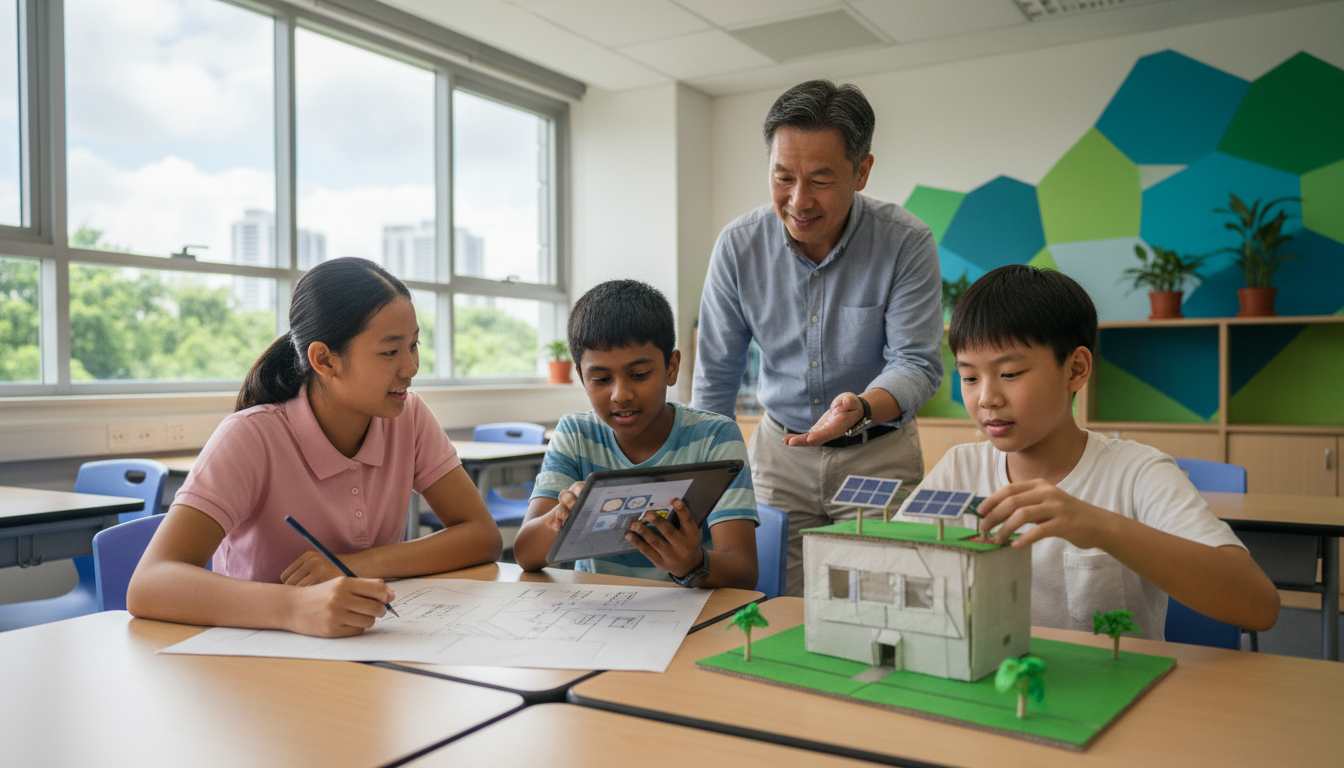
Singapore’s 21st Century Competencies (21CC) framework brings together core values, social-emotional competencies and three emerging areas of capability: Critical, Adaptive and Inventive Thinking; Communication, Collaboration and Information Skills; and Civic, Global and Cross-Cultural Literacy. These are intended to help students use academic knowledge responsibly in changing circumstances. They complement Mathematics, English, Science and other subjects rather than replace them with a single futuristic skills class.
Parents asking about future-ready education need a clear account of what schools can actually teach, how these capabilities appear in normal lessons, how Singapore’s MOE framework differs from generic ‘4Cs’ slogans, and what credible evidence of progress looks like. This guide explains the framework, links it to CCE and digital literacy, offers practical subject and home examples, and gives a four-week plan without promises that a coding course or leadership camp guarantees future employment.
- Core values: Respect, Responsibility, Resilience, Integrity, Care and Harmony.
- Social-emotional competencies: Self-Awareness, Self-Management, Responsible Decision-Making, Social Awareness and Relationship Management.
- Emerging 21CC: Critical, Adaptive and Inventive Thinking; Communication, Collaboration and Information Skills; Civic, Global and Cross-Cultural Literacy.
- Desired outcomes: Confident Person, Self-Directed Learner, Active Contributor and Concerned Citizen.
- Practical aim: apply strong subject knowledge, reason with evidence, cooperate responsibly and keep learning.
Find the answer you need
- What are 21st Century Competencies in plain English?
- What is Singapore MOE’s 21CC framework?
- Why the framework includes values rather than only technical skills
- Respect: learning without humiliation
- Responsibility: follow through on an appropriate task
- Resilience: respond constructively to setbacks
- Integrity: why accurate evidence matters
- Care: competence with concern for others
- Harmony: working across differences
- The five social-emotional competencies
- Self-awareness: recognising when learning is difficult
- Self-management: choosing helpful responses
- Responsible decision-making: consequences and fairness
- Social awareness and relationship management
- Emerging competency one: Critical, Adaptive and Inventive Thinking
- What critical thinking looks like in an actual lesson
- Adaptive thinking: knowing when to change strategy
- Inventive thinking: creation grounded in knowledge
- Emerging competency two: Communication, Collaboration and Information Skills
- Communication: clarity beats impressive vocabulary
- Collaboration: every learner must think
- Information skills: verify rather than forward
- Emerging competency three: Civic, Global and Cross-Cultural Literacy
- Civic literacy and responsible citizenship
- Cross-cultural literacy in Singapore
- Desired outcome: Confident Person
- Desired outcome: Self-Directed Learner
- Desired outcome: Active Contributor
- Desired outcome: Concerned Citizen
- How the OECD Learning Compass relates to Singapore 21CC
- Why 21CC should be embedded in subject teaching
- Primary Mathematics and inventive thinking
- English comprehension and communication skills
- Science investigations and responsible innovation
- Humanities, media and global information
- Digital literacy and cybersecurity
- AI literacy as part of future-ready learning
- CCA and 21CC: meaningful participation
- Values in Action and civic learning
- Edusave EAGLES and recognition of competencies
- How to measure communication without rewarding loudness
- How to measure collaboration fairly
- What schools should not promise about future skills
- The role of teachers as capable, supported professionals
- What parents can do without buying more enrichment
- A fictional Primary case: Alicia evaluates two designs
- A fictional Secondary case: Kai checks a digital claim
- A fictional group case: Ben learns collaboration
- A four-week parent and student 21CC plan
- Common myths about 21st Century Competencies
- The final test: use knowledge responsibly in a new situation
- Frequently asked questions
- Sources and further reading
What are 21st Century Competencies in plain English?
A student learns Mathematics, reads different accounts of an event and works with classmates on a project. The school also wants the learner to recognise which claims are credible, explain an answer clearly, listen to another perspective and adapt when new evidence appears. These actions connect academic knowledge with choices beyond a familiar examination question.
21st Century Competencies are a policy and curriculum framework for developing such capacities. They do not mean that all historical skills became irrelevant after 2000, or that academic knowledge has been replaced by generic creativity. Reading, number understanding, scientific concepts and subject expertise remain essential. The framework directs attention toward the responsible ways students use and extend those foundations.
What is Singapore MOE’s 21CC framework?
Singapore’s MOE 21st Century Competencies page, last updated 6 January 2026, places core values at the foundation, followed by five social-emotional competencies and three emerging competency groupings. The framework supports desired student outcomes and emphasises that schools and families can work together.
The official terminology matters because many websites use generic labels like innovation, AI-ready or 4Cs without specifying what is meant. MOE’s framework provides a more concrete vocabulary for describing development. Still, a framework alone does not prove that a child has acquired every competency. The school must teach, model and provide opportunities for students to apply these skills in subject lessons and everyday relationships.
Why the framework includes values rather than only technical skills
A student can be technically proficient yet misuse information, exclude others from a project or hide a mistake. Values guide decisions about how to use knowledge and capability. In Singapore, MOE names Respect, Responsibility, Resilience, Integrity, Care and Harmony as core values.
Parents need not treat these values as a checklist for ranking children’s personalities. They can observe how values are taught through specific actions: reporting accurate results, acknowledging another viewpoint, keeping private information secure and correcting an error. Values become educational when adults explain them, demonstrate them consistently and respond appropriately when behaviour falls short.
Respect: learning without humiliation
Respect includes recognising one’s own dignity and that of others. In a classroom, it can mean allowing a pupil to ask a genuine question without mockery and responding to disagreement with reasons rather than insults. Academic correction remains important; respecting a learner does not mean declaring every answer correct.
A Mathematics teacher can explain why an operation fails while preserving the student’s confidence to try again. A student can challenge a historical claim by examining evidence instead of attacking the person who proposed it. These examples show how respect supports both intellectual rigour and participation. The value is visible in everyday routines, not only in a school assembly.
Responsibility: follow through on an appropriate task
Responsibility includes recognising obligations to oneself and others. A student may need to prepare materials for a practical lesson, complete an agreed group contribution or report when they cannot meet a deadline. Such behaviour requires clear expectations and support, particularly while executive functions are still developing.
Adults can model responsibility by explaining why a task matters and how to repair a mistake. A student who forgets an assignment may need an organisation routine as well as an appropriate consequence. The aim is a progressively more reliable learner who can make decisions and seek help, not a child who is publicly shamed for every oversight.
Resilience: respond constructively to setbacks
Resilience involves responding to challenge and adapting with appropriate support. A student who struggles with an algebraic equation may need to identify the first wrong step and learn the missing concept. Simply telling the child to be resilient will not teach the relationship between negative numbers or equality.
MOE’s values should be interpreted alongside sound pedagogy and wellbeing. Some challenges are useful and manageable; others require changes to the learning environment, accessible materials or professional assistance. A resilient learner is not someone who never feels distress or never asks for help. The educational goal is a safe, realistic route through difficulty.
Integrity: why accurate evidence matters
Integrity becomes important during Science experiments, research projects, examinations and digital work. A student should record what was actually observed rather than invent results to make a model look successful. When citing an online source, they should check the original material rather than copy an unsupported claim.
AI tools make this value particularly relevant because a fluent generated paragraph can appear to be independent work or contain fabricated citations. Teachers need clear rules about permitted assistance and opportunities to verify students’ understanding. Integrity supports trust in assessment and public communication, not simply compliance with an anti-plagiarism poster.
Care: competence with concern for others
Care can appear when students notice that a classmate cannot access the assigned materials or when a group designs an activity that includes participants with different needs. The behaviour requires practical judgement, not only kind language. A learner may need to ask what support is useful rather than assume what another person wants.
A community service project should begin with the partner’s real needs and preserve recipients’ dignity. A CCA teammate may contribute by encouraging safe participation without ignoring necessary standards. Care can coexist with challenging academic work and clear boundaries. It is demonstrated through appropriate action and respect for the circumstances of others.
Harmony: working across differences
Harmony in Singapore’s multicultural context involves valuing social cohesion while respecting diversity. A classroom can provide opportunities to hear different perspectives, discuss sensitive issues carefully and distinguish personal preferences from factual claims. The goal is not to erase disagreement or pretend every argument has equal evidence.
Students can practise explaining why they disagree without stereotyping others. Teachers should provide suitable knowledge, age-appropriate boundaries and ways to manage conflict safely. A cooperative school culture is developed through consistent behaviour and fair participation. Harmony becomes meaningful when students can interact responsibly beyond their immediate friendship group.
The five social-emotional competencies
MOE names Self-Awareness, Self-Management, Responsible Decision-Making, Social Awareness and Relationship Management as five interconnected competencies. These involve recognising emotions and strengths, managing behaviour, considering consequences, noticing others’ perspectives and maintaining appropriate relationships.
They can be taught through explicit discussion and reinforced across ordinary school activities. A student who is frustrated by a project can learn to identify the problem, request clarification and communicate respectfully. But these competencies are not therapy, clinical diagnoses or measures of a person’s permanent worth. Significant wellbeing concerns need appropriate professional or school support beyond generic lessons.
Self-awareness: recognising when learning is difficult
A student may know that a task feels impossible without knowing why. Self-awareness can help them distinguish confusion about a concept, anxiety about public mistakes and fatigue after a long day. Naming the difficulty accurately makes the next action more appropriate.
Parents can ask, ‘Which part is unclear?’ and listen to the response. The child may need explicit subject teaching, a clearer timetable or a safe conversation. It would be counterproductive to demand disclosure of private feelings during a public group lesson. Self-awareness supports responsible help-seeking when adults preserve dignity and respond with a usable plan.
Self-management: choosing helpful responses
Self-management includes dealing with distractions, organising work and responding to frustration appropriately. A student who notices a repeated algebra error might pause, check the sign rule and seek a reliable explanation rather than continue copying. The subject concept must still be taught accurately.
A school can model short routines for planning, checking and revising work. Some pupils require more scaffolding, accessible materials or support as they develop. Self-management should not become a slogan that children must solve every problem alone. Good education gradually transfers responsibility while keeping suitable help available.
Responsible decision-making: consequences and fairness
Students make decisions about sharing information, academic honesty, group roles and safe conduct. A useful routine asks who may be affected, what evidence is available and whether the action respects necessary rules and boundaries. Digital communication makes the privacy dimension particularly important.
A pupil who sees an embarrassing screenshot of a classmate should consider not forwarding it and seeking suitable adult help. The learner need not manage serious cyberbullying alone. Responsible decision-making combines knowledge with realistic awareness of personal limits and institutional safeguards. The school should model this through its own treatment of pupils and information.
Social awareness and relationship management
Social awareness involves recognising other people’s perspectives and needs; relationship management involves communicating, cooperating and addressing conflict constructively. A student working with classmates can listen to a different interpretation and explain a concern without attacking the speaker.
Groupwork does not automatically develop these skills. One student may dominate while another is repeatedly assigned decoration. Teachers can rotate meaningful roles, establish discussion norms and check individual understanding. These are practical ways of connecting social development with academic rigour. Relatedness and inclusion are taught through daily interaction rather than only through worksheets about empathy.
Emerging competency one: Critical, Adaptive and Inventive Thinking
Critical thinking asks whether claims are supported by relevant evidence. Adaptive thinking involves revising a method when circumstances change. Inventive thinking concerns generating and testing plausible approaches to a problem. Together they encourage students to understand, evaluate and use knowledge in different contexts.
A Science class can identify a flaw in an experiment, explain why it matters and design a fairer comparison. A Mathematics student can check which method fits a new equation. The teacher still needs to teach the underlying subject. Creativity without factual accuracy can produce an attractive but unreliable answer; critical thinking without knowledge can become empty scepticism.
What critical thinking looks like in an actual lesson
A secondary student reads an article claiming a programme guarantees excellent exam results. They ask how many students were included, whether the comparison is fair and what evidence supports causation. They also check whether the original claim applies to students with similar starting positions.
This is not a lesson in rejecting everything. A credible claim can survive reasonable examination, and professional expertise deserves appropriate weight. Teachers can demonstrate how to identify the precise question, inspect the source and adjust confidence to the strength of evidence. The eduKate critical-thinking guide explores the method in detail.
Adaptive thinking: knowing when to change strategy
A student may start a Mathematics problem with a familiar operation and realise the answer is implausible. Adaptation means noticing the mismatch, returning to the problem’s relationship and choosing another justified approach. Switching methods at random is not inherently adaptive.
Teachers can compare examples in which one strategy works and another does not. Ask students to explain what changed. This requires subject knowledge and feedback. A good learner develops both persistence when a method is sound and flexibility when the evidence shows it is not. That combination is more useful than a generic instruction to be innovative.
Inventive thinking: creation grounded in knowledge
A class designing a simple paper bridge can propose alternative folds, test them safely and explain why a particular structure holds weight in its classroom model. The learning is inventive when students develop and evaluate meaningful alternatives rather than merely follow an elaborate craft recipe.
Novelty is not enough. A proposed design must respect the task’s constraints and the evidence gathered. The teacher can ask what was observed, which principle is relevant and what the model cannot prove about real engineering. Creativity grows from accurate knowledge, relevant practice and constructive criticism; it is not guaranteed by asking students to brainstorm without guidance.
Emerging competency two: Communication, Collaboration and Information Skills
This grouping concerns communicating ideas appropriately, working with others and handling information responsibly. Students need to read and interpret information, explain arguments, listen, contribute fairly and check sources. These capabilities often develop through English and humanities lessons but also matter in Mathematics and Science.
A group can submit an impressive poster while most members remain unable to explain the underlying concept. Teachers should therefore combine collaboration with individual accountability. Communication quality includes accuracy and evidence, not only confident presentation. Information skills include knowing what a source can and cannot establish and recognising when a claim requires further verification.
Communication: clarity beats impressive vocabulary
A student presenting an experimental result should state what was tested, how it was measured and which conclusion the observations support. Decorative language does not compensate for a missing causal explanation. A good educator helps the learner communicate precisely for the intended audience.
English composition provides similar opportunities. A paragraph should contain a defensible claim, relevant reasons and suitable evidence. Teachers can model a clear example and ask for an original changed response. The skill is not simply speaking loudly or writing many words. Clear communication depends on understanding the subject and making the important relationship visible.
Collaboration: every learner must think
Collaboration requires meaningful shared work, fair roles and respectful discussion. A student can contribute by questioning a graph’s units, comparing another solution or summarising a group decision accurately. These are intellectual contributions even if the pupil is quiet.
A poorly designed group activity may allow one person to do all the reasoning while others decorate the final product. Teachers can rotate roles and collect short individual explanations. A cooperative environment makes participation safer and distributes opportunity more fairly. The purpose is learning with others while retaining responsibility for one’s own understanding, not merely producing an attractive group photograph.
Information skills: verify rather than forward
Students encounter information through textbooks, search results, social media and AI-generated responses. They need to distinguish verified facts, interpretation, opinion and prediction. A source may be authoritative for one question but outdated or irrelevant for another. The date and original issuer matter.
A practical task asks students to open the original document and compare a claim with what it actually states. A secondary pupil researching national examinations should verify the current SEAB subject syllabus rather than copy a social-media list from an earlier year. Information literacy is an application of subject knowledge and responsible judgement, not merely the ability to operate a search bar.
Emerging competency three: Civic, Global and Cross-Cultural Literacy
This competency concerns understanding communities, cultures, civic relationships and global connections. Students can learn about Singapore’s institutions and diverse society while examining how events, trade, environment or communication connect places and people. It requires accurate historical and geographic knowledge, not only polite slogans.
Classroom activities can compare reliable sources, discuss different perspectives and evaluate how a decision affects groups. Teachers should avoid presenting a single student’s cultural experience as representative of everyone. Meaningful cross-cultural literacy includes listening, evidence, humility and the capacity to participate responsibly in a diverse society.
Civic literacy and responsible citizenship
Civic literacy involves understanding institutions, rights, responsibilities and public issues appropriate to the learner’s age. A class may discuss why public facilities have accessibility features or how information about community services should be verified. Students should distinguish official policy from their own proposed improvements.
A useful lesson does not require children to endorse a political position. Teachers can help them identify credible sources, consider consequences and communicate respectfully about different views. Responsible civic participation builds on knowledge and fair reasoning. When the question concerns current rules, the class should consult the relevant official authority rather than invent an answer from memory.
Cross-cultural literacy in Singapore
Singapore classrooms bring together learners with different languages, family experiences and cultural backgrounds. Cross-cultural literacy can develop when students listen to different perspectives, avoid stereotypes and examine how history or language shapes meaning. It should also include the capacity to disagree respectfully.
Teachers can use literature, Social Studies or collaborative projects to provide accurate context. A learner should not be required to speak on behalf of an entire community or disclose private beliefs. The educational goal is informed understanding and responsible relationships rather than superficial festivals that present cultural difference as a set of costumes.
Desired outcome: Confident Person
MOE’s Desired Outcomes of Education include the Confident Person: someone with a strong sense of right and wrong, adaptability, self-knowledge, independent critical thinking and effective communication. Confidence here should not be reduced to being loud or willing to perform on stage.
A student may be quiet yet able to present a carefully justified argument when appropriate. Teachers can support confidence by providing clear subject knowledge, real opportunities for success and respectful feedback. Empty praise cannot replace the experience of becoming more competent. Confidence should have a foundation in what learners understand and can do.
Desired outcome: Self-Directed Learner
A Self-Directed Learner takes increasing responsibility for their own learning, reflects on progress and persists in developing capabilities. This does not mean avoiding teachers. It means identifying what needs to be understood, using appropriate resources, accepting feedback and choosing better strategies.
Home-Based Learning and the Student Learning Space can provide opportunities for these decisions, but only when tasks are well designed and accessible. A pupil who clicks through a video without understanding is not necessarily learning independently. The Self-Directed Learning guide offers a practical plan for transferring responsibility gradually.
Desired outcome: Active Contributor
An Active Contributor can work effectively with others, take initiative and make useful contributions to a group or community. This may occur through classroom projects, CCAs, Values in Action or ordinary support for classmates. A formal leadership title is not the only way to demonstrate contribution.
Teachers can observe whether the student performs meaningful work, responds to feedback and helps the group reach an appropriate goal. A child who notices an accessibility problem and proposes a practical improvement may contribute effectively without winning an award. The learning task should preserve dignity and avoid turning other people into props for a certificate.
Desired outcome: Concerned Citizen
A Concerned Citizen understands connections with Singapore and the wider world, considers others’ wellbeing and can participate responsibly. This involves subject knowledge, empathy and careful judgement. A student learning about a community issue should examine reliable information rather than assume enthusiasm alone produces a good solution.
Schools can provide age-appropriate opportunities through civic education, local history and service learning. Different perspectives can be considered without treating unsupported claims as equally credible. A student’s contribution should be realistic and respectful of official responsibilities. Concern for society becomes meaningful through informed actions rather than a compulsory declaration of sentiment.
How the OECD Learning Compass relates to Singapore 21CC
The OECD Learning Compass 2030 offers an international framework addressing student agency, wellbeing, knowledge, skills, attitudes and values. Like Singapore’s 21CC approach, it recognises that future education requires more than recalling facts. However, the OECD framework is not the same document as MOE’s national framework.
Parents can use the comparison to understand the broader direction while relying on MOE for the official Singapore categories and curriculum arrangements. International frameworks should be locally interpreted rather than treated as identical national examination specifications. Both stress the importance of navigating new situations responsibly, but neither guarantees future employment or particular academic results.
Why 21CC should be embedded in subject teaching
A school may schedule a special innovation workshop, but core subject lessons provide repeated opportunities to practise many competencies. Mathematics can teach problem solving and justification. English can develop communication and textual evidence. Science can teach fair inquiry and honest data handling. Humanities can build source literacy and civic understanding.
Integration works only when the teacher identifies what students will actually learn. A project that merely uses a tablet or coloured markers does not demonstrate creative thinking. A group discussion in which only one pupil contributes does not establish collaboration. Every activity needs a meaningful objective, suitable instruction and evidence of independent understanding.
Primary Mathematics and inventive thinking
A Primary pupil compares fractions with equal denominators and learns to explain what each quantity represents. The teacher may then present an unfamiliar diagram and ask for a justified comparison. When the pupil notices that the two wholes have different sizes, they have identified a meaningful limitation in the original assumption.
This uses mathematical knowledge together with critical and adaptive thinking. The learner cannot succeed merely by reciting the word creative. A useful next step is to design a changed example that makes the relevant distinction visible. Accuracy and explanation matter more than how sophisticated the worksheet looks.
English comprehension and communication skills
A student studying a passage identifies the writer’s argument and evidence. The teacher asks which sentence actually supports a particular inference and which interpretation goes beyond what the text establishes. Students can discuss two plausible responses and explain why one is better justified.
This develops reading comprehension, critical thinking and communication together. A pupil should not be rewarded merely for using confident language when the selected evidence is irrelevant. Clear subject teaching remains central. A changed passage can test whether the learner transfers the reasoning without a model answer in front of them.
Science investigations and responsible innovation
Students investigate a safe question about how two materials absorb clean water. They identify changed, measured and controlled variables, gather evidence and explain limitations. If the first comparison is unfair, they revise the procedure. The task can develop critical and adaptive thinking alongside the Science concept.
Teachers need appropriate supervision and correct scientific instruction. A colourful prototype does not establish that pupils understand variables or can make claims about the real world. Students should be able to describe what was observed, what remains uncertain and what a better trial would test. This is an example of competence emerging through rigorous subject learning.
Humanities, media and global information
Humanities lessons can help students compare accounts of historical or social events, identify source provenance and evaluate whether evidence supports a conclusion. These are meaningful opportunities for critical thinking and civic or global literacy. The same skills can help learners examine contemporary digital claims.
However, source evaluation requires knowledge of context and a willingness to correct misconceptions. A student who says all sources are biased has not necessarily demonstrated mature reasoning. Teachers should show how to weigh authority, purpose, date and corroboration. A reasoned, proportionate conclusion is stronger than an automatic rejection of unfamiliar information.
Digital literacy and cybersecurity
Digital tools can help students research, collaborate and present ideas, but they also create privacy and misinformation risks. Students need to protect login information, recognise suspicious requests, assess digital sources and understand school rules on appropriate use. A child who uses a device fluently is not necessarily skilled at verifying what it displays.
Teachers and families can practise simple routines: verify an official URL, question an unexpected demand for a password and distinguish a plausible AI-generated answer from confirmed evidence. For current guidance, consult Singapore’s Cyber Security Agency and relevant MOE material. Digital education should support agency and responsible choices, not simply maximise screen time.
AI literacy as part of future-ready learning
Generative AI can explain concepts, produce practice questions and offer alternatives, but it can also make errors or complete the intellectual task the student is supposed to practise. Responsible learners should verify important claims, understand what the tool can and cannot establish and follow school rules about independent work.
A student who pastes an essay and submits the generated answer may appear productive without developing writing ability. A learner who asks for a hint and then completes a changed task independently can use the tool more constructively. The AI Literacy guide explores privacy, accuracy and educational integrity.
CCA and 21CC: meaningful participation
Sports, arts, clubs and uniformed groups can provide opportunities for collaboration, communication, responsibility and leadership. A pupil may practise managing disagreement or coordinating a project. But the CCA label alone does not guarantee that everyone acquired these skills.
Teachers should make roles and learning expectations clear, respond to access barriers and ensure pupils receive useful feedback. A student who does not win an award may still develop meaningful capability. Parents can ask what the child learned, how they used it and whether the commitment is sustainable. Co-curricular experiences should enrich the student rather than become another race for certificates.
Values in Action and civic learning
Values in Action projects can connect students with community needs and social responsibility. A strong activity begins by understanding the partner’s actual needs, planning safely and treating people with dignity. Students should learn to distinguish what they hoped to achieve from what was actually accomplished.
Reflection can ask which assumption changed, what evidence supports a conclusion and how the approach could improve. A photograph of volunteers does not show that these questions were answered. Students should be able to explain the real contribution and its limits. Service is educational when careful action is connected to understanding.
Edusave EAGLES and recognition of competencies
At Singapore’s 2024 Committee of Supply, MOE announced enhancements to recognise students’ non-academic achievements through the Edusave Award for Achievement, Good Leadership and Service (EAGLES), including a 21CC domain. The announcement highlighted the three emerging competencies and changes in eligible proportions for different year groups.
The 2024 MOE announcements provide historical policy context. Current award eligibility, award amounts and school nomination criteria should be checked with MOE and the student’s school for the applicable year. Recognition is valuable but not a complete measure of a learner’s capability. Parents should avoid assuming that participating in one workshop guarantees an award.
How to measure communication without rewarding loudness
Communication can be assessed through clarity, accuracy, audience awareness and appropriate response to questions. A quiet student may write a clear explanation or contribute thoughtfully to a small group. A confident speaker who makes unsupported claims may need further teaching in evidence and reasoning.
Teachers should give learners fair opportunities to demonstrate the relevant skill and avoid equating extroversion with competence. A rubric may ask whether the student states a claim, supports it and responds respectfully. The learning goal should determine the assessment format. Public speaking is one form of communication, not the whole category.
How to measure collaboration fairly
A group product does not prove every member has collaborated effectively. Teachers can observe meaningful role participation, how decisions were made and whether pupils listened and resolved differences. An individual explanation of the subject concept can help distinguish group success from actual learning.
Students should not be permanently assigned low-level roles based on confidence, language or social status. Rotate meaningful responsibilities where possible and provide appropriate support. A student with an accessibility need should be able to contribute intellectually rather than merely be present. Collaboration is a capability that must be taught and reviewed, not assumed from seating arrangements.
What schools should not promise about future skills
No school can guarantee that one coding course, public-speaking programme or creativity workshop will make a child employable decades into the future. Technologies, occupations and social conditions change. A future-oriented curriculum aims to develop adaptable knowledge and judgement rather than predict every job title accurately.
Families should ask what specific capability the programme teaches and how the child demonstrates it. A short course may legitimately introduce a tool or concept without producing advanced professional competence. Avoid promotional claims that treat 21CC as a magic advantage. Accurate instruction and sustained practice remain central to learning.
The role of teachers as capable, supported professionals
Developing 21CC requires teachers to integrate subject expertise with opportunities for reasoning, dialogue and appropriate applications. It is unrealistic to expect every educator to invent complex projects without time, resources or support. Teacher wellbeing and agency matter to curriculum implementation.
The OECD’s related Teaching Compass highlights teacher agency, wellbeing and competencies as part of a wider education system. This is not a replacement for MOE requirements, but it reminds policymakers that student development depends on the adults and institutions providing instruction. A slogan cannot substitute for sustained professional practice.
What parents can do without buying more enrichment
Families can support critical thinking by discussing a verified news claim, communication by asking children to explain a school idea clearly, and responsible decision-making through age-appropriate conversations about privacy or community needs. These are short opportunities that connect with ordinary life and school learning.
Parents do not need to purchase every newly advertised future-skills programme. First identify the child’s actual interests and learning gaps. A child who needs a clearer explanation of fractions may gain more from accurate Mathematics teaching than another generic innovation seminar. Useful experiences are specific, sustainable and grounded in real understanding.
A fictional Primary case: Alicia evaluates two designs
Alicia’s class compares two safe paper structures. She observes that one holds a small load better in the classroom test and initially claims it is the best design possible. The teacher helps her recognise the limited scope of the trial and asks what conditions should be compared before drawing a wider conclusion.
Alicia then proposes a modified fair test and explains why she changed her reasoning. The fictional case shows critical, adaptive and inventive thinking integrated with Science and Mathematics. It does not claim the classroom project verifies real engineering safety. The educational result is better reasoning from evidence.
A fictional Secondary case: Kai checks a digital claim
Kai encounters a social-media claim that a new examination rule applies to every Secondary student. He first reads the post, then finds that the cited official information concerns a different cohort. He checks the applicable document and corrects his initial impression before sharing the information with classmates.
The case illustrates information skills, civic responsibility and critical thinking. The learner does not have to distrust every source; the point is to check the original authority and relevant date. Teachers can model these steps with harmless examples. A student’s careful decision is more valuable than a confident but unverified summary.
A fictional group case: Ben learns collaboration
Ben is enthusiastic about a class project but tends to make every decision before classmates finish explaining. His teacher gives the group a routine: each member proposes one evidence-based idea, the team compares options and one person summarises the final decision. Ben practises listening while keeping the quality standard clear.
The next task asks whether he can use the same process with less prompting. The example is fictional and not a guarantee of lasting social improvement. It shows how collaboration can be explicitly taught through subject work, rather than assuming students learn it merely by being placed in groups.
A four-week parent and student 21CC plan
Week 1 — Choose one real capability. Select a specific goal, such as evaluating a news claim, supporting a reading inference or contributing fairly during groupwork. Record the starting position using a small authentic task. Avoid trying to assess the student’s entire personality at once.
Week 2 — Teach and practise. Explain the relevant subject knowledge and the target behaviour. For information skills, model how to inspect a source and date. For communication, show how a claim connects to evidence. Let the learner attempt a manageable example with feedback.
Week 3 — Change the situation. Use a new passage, problem or group context and reduce adult prompts. Ask what strategy still works and what must change. Recognise a justified correction rather than rewarding confident presentation alone. Protect privacy and appropriate boundaries.
Week 4 — Review and continue. Compare the learner’s independent performance with the baseline. Describe one specific improvement and one remaining difficulty, then choose the next appropriate learning opportunity. This is a family study routine, not an official MOE assessment or guaranteed award pathway.
Common myths about 21st Century Competencies
Myth: future skills replace academic content. Correction: they depend on subject knowledge. Myth: every child must learn coding to be future-ready. Correction: digital literacy and critical judgement are broader than coding. Myth: confident speakers automatically communicate well. Correction: check clarity and evidence.
Myth: groupwork alone teaches collaboration. Correction: make roles and individual understanding meaningful. Myth: a creative poster proves inventive thinking. Correction: examine the reasoning behind decisions. Myth: 21CC guarantees career outcomes. Correction: describe only what a course genuinely teaches and assesses.
The final test: use knowledge responsibly in a new situation
Singapore’s 21CC framework offers a useful way to connect academic learning with values, social relationships and informed action. It recognises that students need knowledge to reason, communication to explain, appropriate flexibility when circumstances change and ethical judgement about how their abilities affect others.
A school or family can begin without an expensive programme: teach one concept accurately, give a meaningful opportunity to apply it and check how the learner responds when the situation changes. Real future readiness is not a slogan about tomorrow. It is the growth of capabilities that help people keep learning and contribute responsibly today.
Frequently asked questions
What are Singapore’s 21st Century Competencies?
An MOE framework combining six core values, five social-emotional competencies and three emerging competency groupings to support desired student outcomes.
What are the three emerging 21CC groups?
Critical, Adaptive and Inventive Thinking; Communication, Collaboration and Information Skills; and Civic, Global and Cross-Cultural Literacy.
What are the six core values?
Respect, Responsibility, Resilience, Integrity, Care and Harmony.
What are the five social-emotional competencies?
Self-Awareness, Self-Management, Responsible Decision-Making, Social Awareness and Relationship Management.
Do 21CC replace Mathematics and English?
No. They complement rigorous subject knowledge and are developed through the curriculum and school experiences.
Is coding compulsory for every future-ready student?
No. The broader framework includes reasoning, communication, information skills, citizenship, values and social-emotional capabilities.
How can schools assess critical thinking?
Ask students to evaluate a claim using relevant subject knowledge and evidence, then test a changed question independently.
Does a CCA automatically develop leadership and collaboration?
No. Quality teaching, meaningful roles and feedback matter, and individual progress should be checked.
Is the OECD Learning Compass the same as MOE 21CC?
No. It is a related international framework, while MOE defines Singapore’s official 21CC categories.
How can parents help with 21CC at home?
Use age-appropriate conversations about sources, reasons, privacy, fairness and new applications of school knowledge without adding unnecessary pressure.
Sources and further reading
Official frameworks: Singapore MOE: 21st Century Competencies (updated 6 January 2026); MOE 2024 Committee of Supply: Recognition of 21CC through EAGLES; MOE Secondary Character and Citizenship Education syllabus; and OECD Learning Compass 2030. Check current year and school-level arrangements for awards and programmes rather than relying on a historical policy announcement alone.
Continue at eduKate’s Education Hub, Holistic Education, Social-Emotional Learning, Critical Thinking and AI Literacy. Choose one meaningful competency and look for real evidence of growth.