
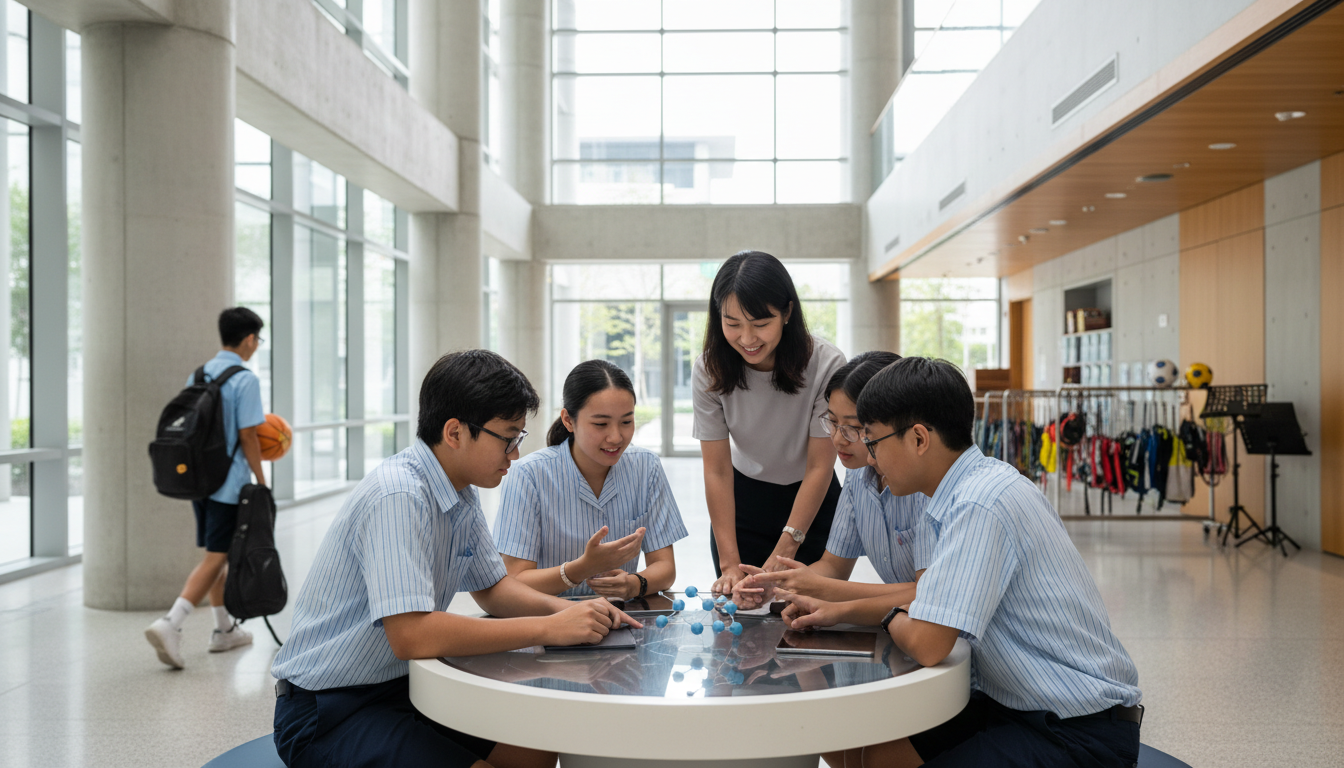
Holistic education means developing a student’s academic understanding alongside character, physical wellbeing, social relationships, creativity and responsible participation. It does not mean giving up rigorous Mathematics, English or Science. It means recognising that knowledge, health, relationships and opportunities beyond the examination room all contribute to how a young person grows. In Singapore, Character and Citizenship Education (CCE), Co-Curricular Activities (CCAs) and Student Development Experiences are important parts of that wider picture.
This guide explains holistic education for parents comparing schools and programmes in Singapore. It covers the role of CCE and CCAs, LEAPS 2.0, learning journeys, leadership, Values in Action, school wellbeing, subject foundations and the risk of too many enrichment classes. It offers specific questions for evaluating programmes, fictional family cases and a practical four-week planning routine. The aim is to help families protect meaningful learning without turning childhood into another race for certificates.
- Academic capability: knowledge, conceptual understanding, accurate reasoning and transferable skills.
- Personal development: character, social and emotional learning, decision-making and dignity.
- Physical and creative opportunities: safe sport, movement, arts, practical work and expression.
- Belonging and citizenship: relationships, community participation, leadership and service.
- Parent decision: evaluate actual teaching, student fit, workload and support rather than programme counts.
Find the answer you need
- What is holistic education in plain English?
- Why holistic education is not the opposite of academic rigour
- The intellectual dimension: learning that lasts
- The physical dimension: movement, health and safety
- Social development: more than sitting in a group
- Emotional development: recognising and managing difficulty
- Character and ethical judgement
- Creative and aesthetic education
- What Singapore MOE says about holistic development
- CCE: Character and Citizenship Education
- Co-Curricular Activities: what a good CCA can teach
- LEAPS 2.0 and co-curricular recognition
- Why one meaningful CCA can be better than many
- Sport is not only about winning
- The value of school arts programmes
- Learning journeys: an outing needs a purpose
- Values in Action and community participation
- Student leadership: beyond titles and awards
- Outdoor adventure with appropriate evidence limits
- Education and Career Guidance
- Academic learning must still be monitored
- Primary 1 and 2: foundations without unnecessary pressure
- Primary 3 to Primary 6: as examinations approach
- Secondary school: a more complex weekly life
- Full Subject-Based Banding does not define the whole child
- Inclusion and accessible participation
- When a packed timetable harms the intended balance
- How tuition fits into a balanced plan
- What parents should ask at a school open house
- Travel, equipment and household cost matter
- How to measure progress without scoring a personality
- Fictional example: Alicia chooses depth over certificates
- Fictional example: Ben needs targeted Mathematics teaching
- Four-week family plan for a realistic balance
- Mistakes that weaken holistic education
- What a successful holistic education programme looks like
- Frequently asked questions about holistic education
- Primary sources and next reading
What is holistic education in plain English?
A Secondary student learns to solve equations, evaluate a historical source and work effectively with others during a CCA project. These experiences are not interchangeable, yet all can contribute to education. The equation develops mathematical reasoning, the source develops judgement about evidence and the CCA may require practical cooperation and responsibility. Holistic education keeps those different capabilities in view.
It does not follow that a student automatically learns teamwork from any group activity, or that one concert improves examination results. Schools must choose meaningful experiences, teach relevant skills and respond when learning is incomplete. A useful holistic programme can explain what each component contributes and why a student may need different kinds of support at different times.
Why holistic education is not the opposite of academic rigour
A child with weak fraction understanding needs accurate Mathematics teaching. A student struggling with reading comprehension may need vocabulary and support in using textual evidence. Holistic development should not become an excuse for allowing academic gaps to grow while advertising attractive activities.
At the same time, a learner is more than a score. Someone may excel academically while feeling socially excluded, exhausted or unable to ask for help. A school needs appropriate responses to those concerns too. Strong education combines credible subject standards with attention to safety, dignity, belonging and opportunities for non-academic development.
The intellectual dimension: learning that lasts
Intellectual growth involves building knowledge, understanding concepts, reasoning accurately and applying ideas in unfamiliar situations. A student who can calculate a ratio only when the question looks exactly like the textbook may not yet have a durable understanding. A strong lesson provides explanation, examples, independent practice and feedback.
Holistic education respects this work. It helps students connect subject knowledge with other experiences without assuming that a school project can replace foundations. Parents can ask what the child can explain, whether the method works after a delay and which misconception needs repair. These are more useful questions than asking how many advanced chapters the class has nominally completed.
The physical dimension: movement, health and safety
Children benefit from opportunities to move, coordinate their bodies and develop safe physical habits. Sport, PE and other activities can also involve planning and cooperation. Physical education should not be reduced to elite performance or medals. A child may develop worthwhile skills through steady participation without competing at the highest level.
Safety and accessibility matter. A student with a mobility need or an injury may require a suitable alternative. Repeated fatigue from travel or training can also affect the daily experience. Parents should examine the actual schedule, supervision and enjoyment. Holistic education values health rather than treating physical activity as a performance requirement at any cost.
Social development: more than sitting in a group
Schools provide opportunities for children to negotiate responsibilities, hear different perspectives and develop friendships. But placing several students around one table does not guarantee cooperation. One child may dominate while another receives no meaningful role. Teachers need to model respectful communication and ensure fair participation.
An important skill is learning to disagree without attacking another person. A student can say a group’s graph uses the wrong units while explaining why and offering a correction. This preserves both intellectual accuracy and social dignity. Parents can ask how the school responds when a pupil is excluded or repeatedly unable to participate.
Emotional development: recognising and managing difficulty
Children sometimes feel anxious, frustrated or disappointed while learning. Social-emotional education can help them recognise these feelings, seek help and choose constructive responses. It does not demand that students be cheerful all the time. A disappointed student should still be allowed to communicate that something is difficult or unfair.
Teachers can model safe ways to respond to mistakes, disagreements and uncertainty. The eduKate Social-Emotional Learning guide describes practical competencies and their limits. When distress is serious or persistent, appropriate school or professional support may be needed; a general SEL lesson is not a substitute for specialist care.
Character and ethical judgement
Values such as honesty, care, fairness and responsibility become meaningful through decisions. A student can practise honesty by reporting actual experimental results rather than adjusting them to fit a prediction. A group leader can practise fairness by ensuring that quieter members have a chance to contribute. These situations require adults to teach the relevant standard and explain consequences.
A school may state impressive values in its prospectus, but everyday adult behaviour communicates how those values are applied. Parents should look at how teachers handle errors and disagreements. A respectful correction may teach more about responsibility than a poster. Students learn from what institutions do, not only from what they say.
Creative and aesthetic education
Music, drama, visual arts and design involve technique, understanding, expression and critique. Students may learn to interpret a composition, revise a design or work with an audience. These are serious forms of learning, not merely distractions from academic subjects.
However, it is misleading to promise that any arts programme automatically raises performance in unrelated examinations. Its direct outcomes deserve honest evaluation. Ask who teaches the subject, how practice is organised and what students can create or explain independently. Creative opportunity should not depend entirely on expensive equipment or extra classes outside school.
What Singapore MOE says about holistic development
Singapore’s secondary CCE syllabus explains that Student Development Experiences contribute to physical, aesthetic, intellectual, moral and social development. It identifies programmes through which learners can apply values and social-emotional and citizenship competencies.
This official description is more useful than a vague slogan because it recognises multiple domains and intentional learning outcomes. Parents should still check which activities their specific school offers and for whom. A national framework does not mean every school has identical clubs, camps, timetables or specialist resources. Current school documents govern the actual choice.
CCE: Character and Citizenship Education
CCE provides structured opportunities to consider identity, values, relationships, civic life and responsible decisions. It also connects with wider activities and everyday school culture. Students may explore questions about online conduct, respect or community responsibility through discussion, reflection and real situations.
The educational outcome depends on whether students understand the issue and can act more responsibly, not simply whether they attend an assembly. A programme about integrity should connect with accurate research and honest academic work. A lesson on respect should be reinforced when classmates disagree. Parents can ask how values are taught, practised and reviewed.
Co-Curricular Activities: what a good CCA can teach
CCAs can offer sustained skill development through sport, music, art, uniformed groups, clubs and societies. Students may develop friendships, learn teamwork and practise commitments over several years. The outcomes differ by activity and quality of supervision.
A strong CCA should explain expected learning and have a manageable schedule. The student needs a meaningful role and feedback rather than permanent exclusion from important tasks. A child who has no award may still have learned something significant. Parents should weigh the child’s interests, travel, fatigue and safety alongside formal recognition.
LEAPS 2.0 and co-curricular recognition
Singapore’s LEAPS 2.0 framework recognises student development across Leadership, Enrichment, Achievement, Participation and Service. The framework can help schools organise recognition, but it should not be mistaken for a complete measure of a child’s character or future potential.
Tampines Secondary’s CCA guidance, updated August 2026, gives a current school example of LEAPS 2.0 and participation expectations. It is not a timetable or availability guarantee for every secondary school. Families making decisions that affect admissions should verify the current official rules for their child’s cohort.
Why one meaningful CCA can be better than many
An activity becomes valuable when students practise, receive guidance, improve and remain interested enough to continue. Joining many clubs for brief periods may produce an impressive list while offering little depth in any one discipline. Quality and continuity can matter more than the number of certificates.
Parents can ask what the child wants to learn and whether the activity suits their current needs. A pupil who enjoys percussion may benefit from regular practice and ensemble work. Another may prefer outdoor sport or service. The right choice depends on actual fit, not a universal ranking of which CCA sounds most prestigious.
Sport is not only about winning
Competitive events can teach strategy, physical competence and coping with outcomes, but the coaching environment matters. A learner may develop useful habits through deliberate practice and respectful team participation even without a medal. Schools should also make appropriate space for students who are new to an activity or need adapted participation.
A schedule that constantly compromises sleep or worsens an injury is not an automatically good development plan. Parents should consider load, supervision, safety and enjoyment. Holistic education values sustainable growth, not only the immediate pursuit of a result. Feedback on technique and effort should remain specific, not humiliating.
The value of school arts programmes
Arts offer opportunities to learn detailed skills: reading notation, analysing images, using materials, performing for audiences and revising creative work. A child in drama may practise language and timing. A student in visual art may discover how composition and colour influence meaning.
These skills can be valuable without a claim that they directly cause better Mathematics scores. A good arts teacher explains progression and offers critique appropriate to age and experience. Families should ask whether participation is accessible, whether the student can develop from a beginner and how the school supports sustained interest without requiring unlimited outside spending.
Learning journeys: an outing needs a purpose
A museum visit, environmental walk or workplace tour can connect school content to real examples. Students may observe a historical object, examine a physical process or compare a public system with what they have learned in class. These opportunities can expand knowledge when the activity has a clear educational question.
Taking photographs is not enough. Teachers can prepare pupils with relevant background and ask them to distinguish observation from inference. Afterwards, students should be able to explain what they learned and apply it elsewhere. The learning journeys guide shows why follow-through matters.
Values in Action and community participation
Values in Action can give students opportunities to understand community needs and practise responsible service. A useful project begins by listening to the relevant community partner rather than assuming what recipients need. Students should also consider the dignity and privacy of people involved.
Reflection can ask what changed, what did not work and which assumption should be corrected. Counting volunteer hours is one form of record, but it does not alone establish what students understood. The programme’s educational purpose should connect real action with informed judgement, rather than simply producing photographs for an institutional newsletter.
Student leadership: beyond titles and awards
Leading a team can involve organising work, listening to others, setting expectations and accepting responsibility when a plan fails. A formal title creates an opportunity to practise those behaviours but does not guarantee that the learner has developed them.
Students who are quieter or less socially prominent should also have meaningful opportunities to contribute. A school can teach leadership by rotating small responsibilities and giving specific feedback. Parents should be cautious of programmes selling a leadership certificate without describing the practical skills taught or how improvement is evaluated.
Outdoor adventure with appropriate evidence limits
Outdoor programmes may support cooperation, confidence and responses to unfamiliar environments. Their goals should be clear, the activities safe and the support suitable for students with differing needs. A camp should not be sold as a guaranteed examination booster.
Schools can examine what participants learned through observation, reflection and follow-up work. If a programme aims to develop teamwork, assess cooperation in relevant tasks rather than invent a direct Maths score benefit. Parents can ask about supervision, medical arrangements, accessibility and alternative activities.
Education and Career Guidance
Career guidance can help young people understand fields, study routes, qualifications and the variety of work people do. A secondary student may not yet know whether they prefer academic research, applied training, creative work or another area. Exploration should widen informed choices rather than lock a child into an identity too early.
Parents should compare the actual curricula and entry conditions of institutions, including technical and academic pathways. A label such as prestigious or practical is not a substitute for programme fit. eduKate’s vocational versus academic guide offers a structured comparison.
Academic learning must still be monitored
A school can offer excellent CCAs while a student remains confused about basic fractions or scientific variables. The presence of wider opportunities does not eliminate the need for careful subject teaching. Parents and teachers should identify which concept is missing and what appropriate explanation or practice can repair it.
Ask the child to explain and solve a changed task without hints. If that is difficult, return to a prerequisite and provide accurate support. This reduces the temptation to treat every academic problem as a failure of motivation. Holistic education succeeds when it supports academic capability along with other forms of growth.
Primary 1 and 2: foundations without unnecessary pressure
Younger learners need language, number understanding, safe movement, friendships and predictable school routines. Singapore removed weighted assessments and examinations for P1 and P2 from 2019 as part of its approach to managing excessive examination pressure. That change does not remove the expectation of teaching or checking progress.
A child may still need explicit phonics or number-sense support. Short, age-appropriate checks can help an educator select the next lesson without making every week another examination. Parents can read together, talk about the school day and protect free play and rest. The aim is a secure foundation and a manageable relationship with learning.
Primary 3 to Primary 6: as examinations approach
Academic expectations become more demanding across primary years, particularly as students prepare for PSLE. Families should respond with good teaching, realistic revision and evidence about specific gaps. Repeatedly increasing the number of hours is not always effective if the student is practising the same error.
At the same time, children benefit from meaningful interests and relationships. Parents can examine the timetable and preserve worthwhile participation when feasible. Holistic development does not mean ignoring examinations; it means preparing responsibly without assuming that all non-exam activities are wasted time.
Secondary school: a more complex weekly life
Secondary students may manage more subject teachers, different classroom expectations, CCAs and unfamiliar social environments. A child can understand the academic content but struggle to organise the day. Another may settle socially yet need support with algebra or reading. The problems should be distinguished.
Parents can help students learn to use timetables, ask questions and identify the first subject misconception. Avoid buying a large package of tuition and enrichment before the actual workload is understood. A balanced plan gives space for practice, participation and recovery.
Full Subject-Based Banding does not define the whole child
Singapore’s Full Subject-Based Banding allows students to study subjects at different levels under applicable rules. Posting groups and G1, G2 or G3 subject levels are part of an educational arrangement, not complete descriptions of a student’s worth, talents or future.
Parents should verify current MOE and school information for qualifications and progression. A learner may be strong in a particular subject, enjoy performance arts and need support in another topic. Holistic education should recognise these combinations while maintaining accurate information about the standards and pathways that apply.
Inclusion and accessible participation
Students with disabilities, language barriers or other functional needs may face obstacles to joining school activities. Equal attendance does not automatically create meaningful participation. A school may need accessible instructions, adapted equipment, appropriate supervision or specialist collaboration.
The learning goal should remain clear, with suitable support and honest evaluation. Families can ask what their child will actually be able to do and how progress will be reviewed. The inclusive education guide explains why accessibility and classroom participation deserve attention alongside formal academic outcomes.
When a packed timetable harms the intended balance
Holistic education can be misinterpreted as enrolling a child in every possible activity: sport, music, coding, debate, leadership and extra tuition. The child may spend much of the week travelling and have little time to practise independently or rest. A long list is not evidence that these experiences were beneficial.
Start with needs and interests. Identify which commitments teach something useful, which are required and which mainly add stress. A family may decide to keep one demanding CCA and reduce unrelated enrichment. That is not a failure of holistic education; it may be the decision that allows learning to become deeper and more sustainable.
How tuition fits into a balanced plan
Tuition can help when a student has a specific academic gap or needs additional subject feedback. It should not automatically replace all independent study or personal interests. The first step is to understand the student’s starting position and the reason for difficulty.
A tutor should be able to explain which knowledge is insecure, what method will be used and how independent progress is checked. A smaller class may support observation, but teaching quality still matters. eduKate’s Secondary 1 Mathematics guide offers a model of foundation-focused subject support.
What parents should ask at a school open house
Ask what every student can access, how selected programmes work and what costs are involved. Enquire about CCA availability, academic support, safeguarding, accessible participation, teacher feedback and the normal weekly timetable. School brochures can be informative but may highlight exceptional students rather than ordinary experiences.
Try to obtain an example of what a programme teaches and what evidence the school gathers afterward. A leadership camp should have clear learning objectives. A STEM activity should develop conceptual understanding. A service project should respect its community partner. These questions help families compare the quality of the educational experience rather than its marketing.
Travel, equipment and household cost matter
Two families may have different capacities for transport, weekend activities and enrichment fees. A programme technically offered to everyone may still be difficult to access. Holistic planning should include realistic travel times, equipment, meals and family schedules.
A long journey can reduce sleep and time available for homework or relationships. A costly activity may create significant financial pressure. Parents should weigh actual participation and wellbeing rather than assume the most expensive option is educationally superior. Ask schools about relevant assistance or alternatives when there is a real barrier.
How to measure progress without scoring a personality
Some development is visible through written work, while other progress may appear in conversation, collaboration or practical tasks. A teacher can observe whether a student communicates more clearly, uses feedback or participates responsibly. But a single good day cannot establish a permanent character trait.
Choose evidence appropriate to the goal. If the objective is Mathematics, test mathematical understanding. If it is teamwork, observe whether roles are managed fairly. Avoid inventing one numerical score for a student’s whole identity. Assessment should identify next steps, not reduce the child to an arbitrary label.
Fictional example: Alicia chooses depth over certificates
Alicia enjoys performing arts and has become confident with an ensemble, but her family also enrolled her in several unrelated weekend programmes because they appeared useful for future applications. She is exhausted and has little time to practise the activity she enjoys.
After reviewing the schedule, the family keeps the meaningful ensemble and a sustainable academic routine while reducing other commitments. The decision does not presume that music guarantees higher grades. It respects the student’s interest, practice needs and capacity. This is a fictional example of a careful family choice.
Fictional example: Ben needs targeted Mathematics teaching
Ben participates happily in football but loses marks in algebra because he misunderstands signed-number operations. His parents consider cancelling all sport to increase revision time. A closer review of his independent work identifies a precise concept that needs explanation.
His tutor reteaches the relationship and asks Ben to solve a changed equation after a delay. The family keeps a manageable level of physical activity while monitoring schoolwork. This outcome is not guaranteed for every child; it illustrates why the actual cause of difficulty should determine the response.
Four-week family plan for a realistic balance
Week 1 — Observe. Record one important academic need, one meaningful interest, school and travel commitments, and any concerns about wellbeing or belonging. Avoid broad labels. Ask the child which parts of the routine feel useful or overwhelming.
Week 2 — Change one thing. Select a targeted teaching step or a manageable schedule adjustment. Do not introduce multiple expensive activities at once. Discuss school support needs with the responsible teacher where appropriate.
Week 3 — Practise and participate. Provide time for independent work, meaningful activity and ordinary rest. Check academic understanding using a new example, and discuss other development through suitable observations rather than test marks alone.
Week 4 — Review. Compare the new situation with the baseline. Keep what helped, reduce avoidable overload and identify the next practical step. If a serious issue persists, seek appropriate school or professional help. This is a family planning routine, not a formal wellbeing assessment.
Mistakes that weaken holistic education
Mistake: treating broad development as a reason to neglect academic teaching. Repair: keep subject learning goals clear. Mistake: buying more activities to appear well rounded. Repair: choose depth and sustainable participation. Mistake: claiming every CCA guarantees academic gains. Repair: describe the actual skill it develops.
Mistake: using one trophy or score to judge the whole child. Repair: evaluate different outcomes with appropriate evidence. Mistake: ignoring access and safety barriers. Repair: discuss suitable support with the school. Mistake: assuming a glamorous school programme fits every child. Repair: consider the individual learner and current offering.
What a successful holistic education programme looks like
A strong programme is coherent: accurate subject teaching, appropriate opportunities to explore interests, respectful relationships, safe participation and responsive support. It teaches important knowledge rather than merely filling the timetable. It helps children grow in ways that can be observed without making extravagant guarantees about adulthood.
For families, the best choice is often the one that provides meaningful challenge and a manageable daily life. A child needs opportunities to learn, ask for help, practise, rest and belong. Holistic education should make those opportunities more available—not turn every hour into another contest for recognition.
Frequently asked questions about holistic education
Primary sources and next reading
What is holistic education?
Education that develops academic understanding together with physical wellbeing, social relationships, character, creativity and responsible participation.
Does holistic education reduce academic standards?
Not necessarily. Strong subject teaching and reliable assessment remain important alongside wider development.
What is MOE’s approach to holistic development?
Singapore’s CCE and Student Development Experiences address intellectual, physical, aesthetic, moral and social domains.
Are CCAs part of holistic education?
Yes, they can develop interests and skills when taught, supervised and made accessible appropriately.
What does LEAPS 2.0 recognise?
Leadership, Enrichment, Achievement, Participation and Service in Singapore’s secondary co-curricular framework.
Does sport or music guarantee better grades?
No. Each can develop worthwhile capabilities, but effects on unrelated examination outcomes must not be assumed.
Is SEL the same as holistic education?
No. Social-emotional learning is one component within a broader approach to development.
Should a child attend many enrichment classes?
Not automatically. Focus on useful instruction, interests, time, cost and wellbeing rather than maximising certificates.
How should parents compare schools?
Look at subject teaching, support systems, CCAs, actual availability, access, culture, travel and the child’s fit.
What if my child struggles academically?
Identify the specific misconception and arrange accurate teaching rather than treating general enrichment as a substitute.
Use the MOE Secondary Character and Citizenship Education syllabus, Tampines Secondary’s CCA and LEAPS 2.0 information (updated August 2026) and Bowen Secondary’s holistic CCE explanation. These provide authoritative context and real school examples; current arrangements and eligibility should be checked with the relevant school.
For further reading, use the eduKate Education Hub, CCAs and Holistic Education in Singapore, Social-Emotional Learning and Education versus Schooling. Use the article’s practical questions to understand what a child can learn, not just what activities appear in the prospectus.