
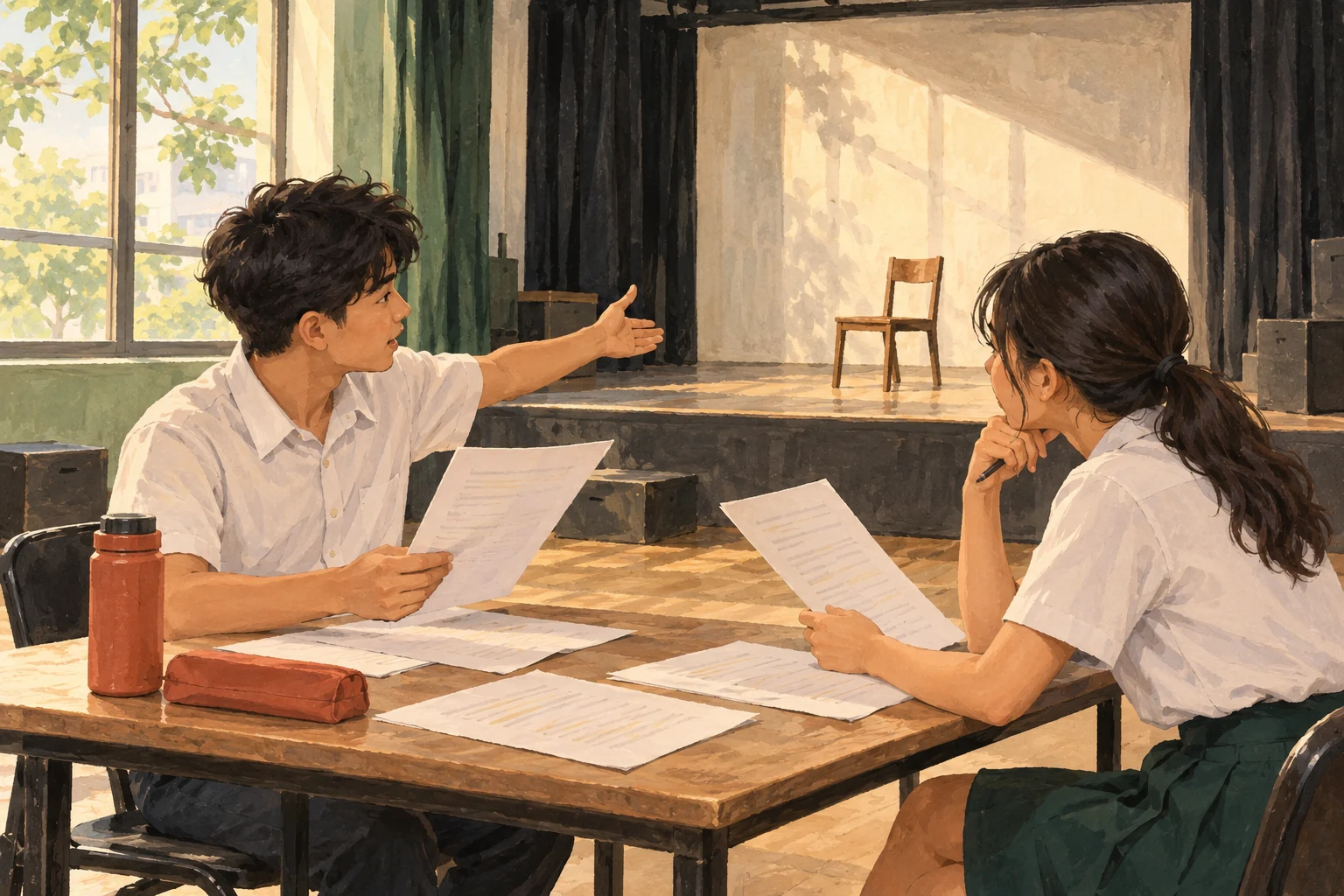
Did you know the same line—’You came back’—can communicate joy, accusation or fear? An actor’s pause, eye contact, movement and relationship with another character can change the audience’s interpretation, even though the script’s words remain identical.
Drama is therefore not just standing confidently on a stage. It is a serious study of intention, conflict, interpretation, voice, movement, collaboration and the evidence that helps performers make a meaningful choice.
When parents search ‘PG1 Drama’, begin with the official level: PG1 is Secondary 1 posting. SEAB’s 2027 Drama examination is G3 K352, a revised syllabus involving both a written paper and assessed practical work. A drama CCA or lower-secondary classroom activity is not by itself a national G1 or G3 Drama entry.
A practical Singapore guide informed by MOE and SEAB’s 2027 SEC arrangements and the 2028 Post-Secondary Admissions Exercise. Reviewed 24 October 2026. Confirm your child’s actual school offering, registered subject code and destination intake.
The 60-second answer
- Posting Group 1 is an admission label, not a Drama examination grade.
- SEAB’s 2027 Singapore-Cambridge SEC G3 Drama subject is K352; the G1 list has no Drama examination.
- Paper 1 is a two-hour written paper worth 80 marks and 40%.
- Coursework is worth 120 marks and 60%, involving an individual scripted performance, group devised performance and personal Development Journal.
- Individual scripted performance lasts three to five minutes.
- Group devising involves two to five candidates and a finished performance no longer than 15 minutes.
- ITE, diploma, JC and university choices depend on the whole academic qualification and any additional auditions or selection, not Drama K352 alone.
First, PG1 and the examined G3 subject are different
PG1 is Posting Group 1 for entry into Secondary 1 under Full Subject-Based Banding. Schools may allow eligible pupils to study different subjects at G1, G2 or G3 levels based on strengths, readiness and availability. But the initial Posting Group is not itself a national examination title.
SEAB’s 2027 Singapore-Cambridge Secondary Education Certificate (SEC) lists Drama as a G3 subject, K352. There is no separate G1 Drama national paper. A child’s personal interest does not guarantee an eligible subject offering or formal examination entry.
Lower-secondary students may encounter literature, creative expression and Humanities exposure in ordinary school learning. Valuable as this may be, it is not the same as a standalone examined G3 Literature or Drama subject. Likewise, one strong performance or home reading project is not by itself a national qualification.
The SEC beginning in 2027 records the subjects and levels actually sat. From the 2028 intake, MOE’s new Post-Secondary Admissions Exercise consolidates the main results-based admission pathways to ITE, polytechnic and JC/MI, but each destination continues to set formal academic prerequisites.
Parents should therefore keep two separate questions in mind: what useful skill should the child learn today, and what official qualifications would the intended future course require? They often overlap, but they are not interchangeable.
Why Drama is worth understanding
Drama trains students to connect written words with live human action. A character may say they are pleased to see somebody, yet remain physically distant or avoid eye contact. An audience notices the contrast and begins to wonder which feeling is real.
A performer should begin by asking what the character wants in the scene. The character’s objective gives purpose to a pause, gesture or movement. The next question concerns obstacles: what prevents the character from obtaining that aim?
Voice offers many choices—pace, pitch, volume, emphasis, breath and silence—but louder is not automatically better. A quiet line spoken at the right moment may be more powerful than shouting, depending on the relationship and scene.
Physical expression and spatial relationships matter too. Moving closer, turning away, using different levels or choosing where to focus can suggest conflict or intimacy. Every choice should be linked to dramatic meaning rather than added as decoration.
Group devising develops another form of learning. Students propose ideas, test them against audience responses, refine timing and coordinate contributions. A compelling finished scene is not simply several individuals delivering unrelated monologues.
Drama can support communication and collaboration across many careers; it may also lead to interest in theatre, media, education or creative production. But subject participation alone does not guarantee an arts diploma, acting role or university entry.
Eight core skills
- Identify a character’s objective, obstacle and relationship from dialogue and context.
- Analyse unseen script extracts with specific evidence rather than merely summarise the plot.
- Use voice, pauses and emphasis to communicate an intentional interpretation.
- Use gesture, space, proxemics and movement to show dramatic relationships.
- Compare two staging approaches and explain the audience effect of each.
- Prepare a coherent three-to-five-minute individual scripted performance under school rules.
- Contribute original material and responsible collaboration to group devising.
- Maintain an authentic personal Development Journal showing decisions, feedback and revision.
What the 2027 G3 SEC K352 assessment requires
SEAB’s revised 2027 SEC G3 Drama K352 syllabus has two compulsory assessment components: a written examination and supervised coursework. It is not offered as a national G1 paper. The school’s actual course, teacher provision and registration determine eligibility.
Paper 1 is two hours, carries 80 marks and contributes 40% of the final grade. It includes study of unseen and pre-release dramatic extracts, with written questions concerning scripts, interpretation and understanding of practical dramatic exploration.
Paper 2 is coursework worth 120 marks and 60%. Candidates prepare an individual scripted performance lasting three to five minutes. It must show purposeful use of characterisation and stagecraft rather than simply accurate recitation.
Group devised performance involves two to five candidates, with a finished piece no longer than 15 minutes. Devising includes original exploration, collaborative decisions and rehearsal. Each student must contribute authentically, rather than rely on an adult or professional to create assessed material.
The Development Journal is the student’s own account of practical exploration, decisions, feedback and refinement. A rehearsal diary that only lists dates is much weaker than one explaining why an interpretation was changed and how the new version affected the intended audience.
Authenticity and supervision matter. Families can support a sensible schedule, provide encouragement and discuss ideas, but cannot write the assessed journal or script in place of a candidate.
A school Drama CCA, community performance or lower-secondary arts activity can be educationally meaningful without being an SEC K352 entry. Do not assume that applause or performance confidence substitutes for the required written and coursework tasks.
Did you know? A worked example with visible reasoning
Consider an original two-line scene. Character A says, ‘You kept the letter.’ Character B answers, ‘I did.’ The audience does not yet know whether keeping it was an act of care, selfishness or something required by a promise. This is a fictional practice task, not a real exam extract.
First, identify the objective of each character. Character A may want an explanation; Character B may want forgiveness or to protect information. These are interpretations to test, not facts guaranteed by the two lines.
Next perform B’s line in two ways. In the first, the actor avoids eye contact and steps backward. In the second, the actor steps forward, speaks calmly and looks directly at A. Ask an observer what they inferred and which particular movement or vocal choice created that impression.
Do not conclude that a bigger gesture or a longer pause is always more dramatic. If a movement distracts the audience from the relationship, the effect may be weaker. Judge each choice against the intention and the evidence of actual audience understanding.
Now document the experiment in a practice journal: what was tried, which observation was useful, what changed and why. The learner needs to show that the change made the scene communicate more clearly, rather than merely claim that the second rehearsal ‘felt better’.
Finally, write a short analysis: how did the physical relationship between the characters support or complicate the dialogue? A good answer references particular choices and their effect instead of listing theatre vocabulary.
Repeat with a different scene, so the student can make and justify fresh decisions without tracing a first performance. That independence helps build both written and practical understanding.
Six learning gaps and targeted repairs
- Assuming louder means stronger emotion: test vocal choice against the character’s actual intention.
- Retelling the script instead of analysing theatrical technique: select dialogue and a staging detail and explain their effect.
- Running a rehearsal repeatedly with no purpose: record one observed problem and a targeted improvement.
- Writing only dates in a Development Journal: explain authentic decisions and evidence of refinement.
- Allowing parents or outsiders to create assessed devising work: preserve student authorship and school supervision.
- Confusing Drama as a CCA with the national G3 K352 subject: verify official school availability, registration and required coursework.
An independent practice routine
Begin with a short text or original scene the student can understand. Ask for the literal situation and what the task actually requests before discussing any literary or stage technique.
Invite one interpretation, then ask for the precise word, action, gesture or staging detail that supports it. Recognising an uncertainty is better than pretending that every creative interpretation is established fact.
Compare a second possible explanation or performance choice. What different audience impression does it create, and which would be better for the purpose?
Let the learner write, speak or perform independently. Offer feedback on one meaningful issue at a time: evidence, clarity, sequence, expression or relation to the actual question.
After a delay, introduce an unfamiliar scene or passage. Progress is strongest when the learner can apply the principle without a model or adult script.
Secondary 1 to Secondary 4
- Secondary 1: learn to follow a text or scene, describe a character and explain one supported inference.
- Secondary 2: compare alternative meanings and develop confidence with independent reading, speaking or creative tasks; review future subject availability with the school.
- Secondary 3: if an eligible G3 subject is offered, use the precise year’s syllabus and learn its formal reading, written or coursework obligations.
- Secondary 4: complete authentic assessment, consolidate the correct SEC academic subject profile and review actual post-secondary entry criteria.
The value of the skill beyond examination marks
Interpretation, clear expression and understanding an audience can be useful in teaching, media, publishing, performance, service, research or other study areas. These are possible interests rather than assured jobs from one subject.
A strong student does not need to decide on a career from a single secondary elective. The near-term priority is reliable understanding, ability to respond to unfamiliar tasks and appropriate planning alongside English, Mathematics and other academic subjects.
Where a school offers assessed creative or literary work, keep authorship authentic. Parents can ask useful questions, support scheduling and encourage reflection without doing the student’s work or promising admissions outcomes.
Education pathway: ITE, Polytechnic, JC and University
Did you know there is a difference between ‘Can someone who started in PG1 eventually attend university?’ and ‘Does this particular subject qualify the learner for immediate diploma admission?’ The first depends on future attainment through recognised routes; the second needs a precise current admissions rule.
No single Literature or Drama grade guarantees all possible routes, and the child’s initial posting group is not a lifelong admissions judgment.
1. ITE Higher Nitec
An eligible pupil may apply for Higher Nitec courses whose academic requirements they meet. Communication, careful analysis and teamwork can be useful across practical and service training, but the full recognised SEC result profile governs admission.
Successful ITE graduates may explore further diploma progression according to the relevant qualification and grade rules. This is a possible route to investigate rather than an automatic transition.
2. Polytechnic diploma
Direct polytechnic entry depends on the programme’s actual SEC subject levels, aggregate, grades and prerequisites. The 2028 arrangements permit a defined G2 fifth aggregate subject in eligible circumstances, rather than allowing any G1 interest subject to substitute for required results.
Some creative or media-related diplomas may use additional aptitude criteria, portfolios or interviews. The existence of such assessments does not remove other mandatory academic requirements.
3. Junior College and Millennia Institute
MOE’s 2028 JC L1R4 framework counts the required qualifying G3 results and follows the published academic mix. A pupil originally admitted via PG1 must actually obtain that recognised subject combination if pre-university admission becomes the goal.
PG1 is not a permanent bar; equally, taking one G3 Literature or Drama paper does not make the entire JC aggregate or MI entry conditions automatic.
4. University
University admission may follow a qualifying pre-university route or a recognised diploma, subject to the selected course’s academic and other requirements. Some arts programmes may ask for auditions or portfolios, while other courses may prioritise specific subject prerequisites.
Students can explore literature and performing arts without assuming a guaranteed degree place. Successful progression rests on the qualifications earned at each step.
One-week practice plan
- Monday: read a very short scene and state what each character wants.
- Tuesday: perform one line with two different pauses or spatial choices.
- Wednesday: ask an observer how each version changed the relationship’s meaning.
- Thursday: invent a brief second scene where an obstacle alters the character’s plan.
- Friday: write three sentences reflecting on one actual rehearsal decision.
- Weekend: examine an unseen dramatic extract and identify one supported interpretation independently.
Four questions before subject selection
Does the school actually offer this G3 Literature or Drama subject, and what subject-level criteria and timetabling limits apply? An SEAB syllabus listing is not universal school availability.
Which exact set texts, assessment instructions, production facilities or teacher-supervised coursework are required for the examination year? Do not rely on generic past examinations or older stream assumptions.
Can the learner demonstrate basic readiness independently: accurate comprehension, relevant writing, thoughtful performance or managing the assigned work without adult completion?
Which recognised full qualifications and subject-level results will the desired ITE, polytechnic or JC route require? Compare the destination’s real criteria with the student’s actual planned results.
What parents can track simply
Write four columns in a notebook: task attempted, first uncertainty, independent correction and the date for a changed retest. This makes progress visible without overwhelming a student with extra paperwork.
Review the same skill after a few days with a different passage or scene. If a child can explain the new problem independently, the underlying idea is becoming useful rather than just memorised.
Frequently asked questions
Is PG1 Drama an examined G1 SEC subject?
No. The 2027 SEC examination is G3 Drama K352.
How much of K352 is coursework?
Sixty percent; the two-hour written paper is worth 40%.
What is the individual scripted performance requirement?
A three-to-five-minute scripted piece under the syllabus’s assessment and supervision rules.
How long is the group devised performance?
A group of two to five candidates performs an original devised piece no longer than 15 minutes.
Does the Development Journal have to be the student’s own work?
Yes. It documents authentic personal decisions, feedback and development under supervision.
Is a Drama CCA equivalent to the national Drama subject?
No. CCA participation and national exam registration are separate.
Will a Drama K352 grade guarantee entry to a performance degree?
No. A complete qualifying academic profile and possible audition, portfolio or other selection apply.
Where to check the official syllabus and post-secondary rules
SEAB’s 2027 G3 school-candidate directory lists Drama as K352. The official syllabus document defines the papers, any prescribed works or supervised performance requirements, and their assessment details.
MOE’s Full SBB information explains why different eligible subject levels can coexist. The 2028 PSE guidance and the receiving programme’s official requirements should be read again when the pupil is ready to apply.
Keep the original PG1 admission status, the specific national exam subject and later admissions criteria separate. They serve different administrative purposes and cannot be substituted for one another.
SEAB — 2027 G3 Drama K352 official listing
SEAB — official 2027 Drama K352 syllabus PDF
SEAB — 2027 G1 school-candidate list
SEAB — 2027 G2 school-candidate list
SEAB — the Singapore-Cambridge SEC qualification
MOE — Full Subject-Based Banding and academic subject levels
MOE — Post-Secondary Admissions Exercise from 2028
MOE — 2026 education-pathways announcements
ITE — academic progression from Higher Nitec
Continue reading on eduKateSG
What is PG1? Posting Group versus G1, G2 and G3 subject levels
PG1 Humanities: how early exposure differs from examination Literature
2027 SEC correct syllabus and code directory
ITE, Polytechnic, JC and University: routes after SEC
What is G3 Drama? Detailed 2027 syllabus and explanations
Related subject: combined Humanities or Drama versus Literature
Related lower-secondary language or literature pathway
Next PG1 Literature or Drama article for comparison
Secondary 1 Mathematics Tutor Clementi | Small Groups Tutorials — foundations-first learning
One question to ask tonight
Ask your child: ‘What does your character want in this scene, and which stage choice communicates it most clearly?’ A clear explanation supported by evidence can show where understanding is secure and what remains to be practised.