
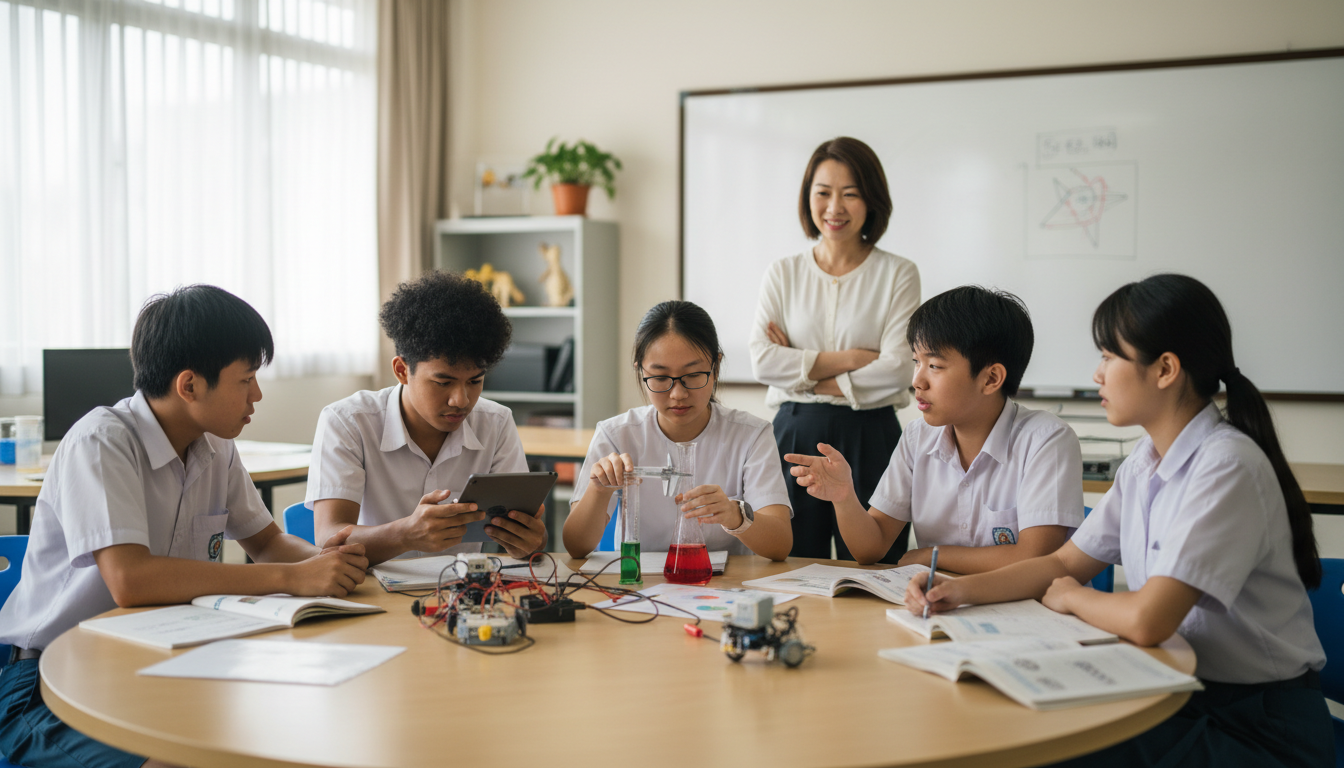
PG3 is the Secondary 1 Posting Group, while G3 is a subject level under Full Subject-Based Banding. A student can perform well in G3 Mathematics and still lose marks on G3 Science calculations because the Science question first requires understanding a measured quantity, experiment, graph, unit or physical relationship. Mathematics fluency does not automatically tell the child which values to use, what they represent or whether a scientific conclusion follows from the data.
Start with one marked Science question. Ask the student to name what is measured, list the numbers with their units, state the scientific relationship needed and check whether the answer’s units and magnitude make sense. If the arithmetic is accurate but the wrong information was selected, teach the Science concept and data interpretation instead of assigning more generic Maths sums. Use the school’s current lower-secondary topic scope and teacher feedback.
- G3 Science assessment may require careful measurement, appropriate SI units, data analysis and explanations—not just computation.
- A strong G3 Mathematics score does not guarantee correct interpretation of a Science situation.
- Distinguish unit conversion, graph-reading, relationship selection, calculation and conclusion errors.
- Use small school-aligned quantitative examples and confirm that each concept has actually been taught.
- Check the current lower-secondary MOE Science syllabus; the 2027 SEC G3 directory is an examination-year reference for graduating candidates.
Why parents see this surprising pattern
A child who is confident with algebra, fractions and percentages may still be unsettled by a Science table. They may see several numbers but not know which ones matter, which variable was measured or whether the question asks for an observation rather than a calculation. Parents sometimes respond, “But you are good at Maths—how can this be wrong?” That question assumes the same mathematical skill is being assessed in both subjects.
Science uses mathematics as a tool inside a scientific problem. The student must understand the context before choosing the calculation. They may need to interpret the unit, recognise a pattern or distinguish a measured result from an explanation. A child can be mathematically fluent and scientifically inexperienced at the same time.
The lower-secondary G3 Science syllabus has its own demands
MOE’s lower-secondary G2/G3 Science syllabus develops scientific inquiry and explicitly includes estimation and measurement, appropriate units, evidence analysis, investigation and safe practical habits. It discusses accuracy, precision, zero error and parallax error as relevant measurement concepts. Students are expected to think about how data were obtained, not merely place numbers into a formula.
The exact Science topics and calculations taught depend on the student’s school level and lesson sequence. Do not use a later national examination paper to judge whether a new Secondary 1 learner should already understand a particular upper-secondary relationship.
Five questions to ask before calculating
- What quantity? What does each number represent—distance, time, mass, volume, temperature or something else?
- What unit? Are the measurements in compatible units, and is a conversion necessary?
- What relationship? Which concept or equation taught in class connects the quantities?
- What operation? Should the student multiply, divide, subtract, average or interpret a graph?
- What conclusion? Does the answer match the question and the experimental evidence?
This routine helps distinguish selecting a method from doing arithmetic. The student should be able to explain why the chosen relationship is appropriate, not only produce a number that matches the answer key.
Example 1: centimetres and metres
Suppose a school task gives a length of 150 cm and asks for metres. Because 100 cm equals 1 m, the length is 1.5 m. A child might write 150 m because the number looks correct and they overlook the unit, or write 0.15 m because they use the wrong conversion factor.
Ask the student which unit is larger. One metre contains one hundred centimetres; a length of 150 centimetres must be greater than one metre but much less than one hundred metres. This simple reasonableness check catches an error without needing complicated mathematics.
Example 2: distance divided by time
In a simplified school investigation, an object moves 30 cm in 5 seconds at a constant average rate over the measured interval. The average speed is distance divided by time: 30 cm ÷ 5 s = 6 cm/s. Converting to metres per second gives 0.06 m/s because 6 cm is 0.06 m.
A student might calculate 6 correctly and still lose credit if the requested unit was m/s. The problem is not long division; it is understanding what the quantity means and how units transform. The teacher’s instructions determine the expected form and precision of the answer.
Example 3: time conversion can change the result
A journey lasts 1.5 hours. That is 90 minutes, not 150 minutes. If the relevant calculation uses hours, keep the value as 1.5 h; if it requires minutes, convert correctly. Some students write 1 hour 50 minutes because they mistake decimal notation for minutes after the point.
Use the relationship 0.5 hour = half of 60 minutes = 30 minutes. Then ask the child to convert 2.25 hours into hours and minutes, producing 2 hours 15 minutes. This is a mathematical skill applied to physical quantities, so both the number and the context matter.
Example 4: reading a graph before calculating
Imagine a graph with time in minutes on the horizontal axis and temperature in degrees Celsius on the vertical axis. At 0 minutes, the recorded temperature is 22°C; at 4 minutes, it is 30°C. The observed increase over that interval is 8°C. The average numerical rate of temperature increase over this interval would be 2°C per minute, if the task asks for that value.
Do not assume the graph proves a constant rate at every moment or reveals the cause. A child should first state which quantities were measured and what the graph shows. The correct scientific conclusion depends on the rest of the investigation. A good Mathematics calculation cannot compensate for an unsupported claim about why the temperature changed.
Example 5: averages and measured values
Three repeated readings are 1.2 cm, 1.4 cm and 1.3 cm. Their arithmetic mean is (1.2 + 1.4 + 1.3) ÷ 3 = 1.3 cm. A child may calculate the mean accurately but fail to recognise that the numbers are repeated measurements of the same quantity, or may report a result without units.
The mean is a summary of the readings; it is not a guarantee that the measuring instrument was accurate. Ask whether the readings are close to each other and whether there is information about the true value or instrument error. This connects computation with scientific measurement.
Example 6: a simple density relationship
If the school has taught density as mass divided by volume, a sample with mass 24 g and volume 8 cm³ has density 3 g/cm³. The calculation is 24 ÷ 8, but the Science understanding is that the mass is being considered per unit volume. If a student instead divides volume by mass, the resulting unit would not be density.
Only use this example when it matches the current teaching scope. If the learner has not studied density, asking the formula as a timed question would test unfamiliar content rather than reveal a weakness in their G3 Mathematics ability.
What makes a Science calculation different from a Maths sum?
A Mathematics worksheet may present an equation already chosen for the student. A Science question may require them to decide which scientific relationship connects the measured values. The same arithmetic operation can represent different physical situations. The units and experimental context are part of deciding whether the equation makes sense.
A useful home test is to cover the numbers and ask the student to explain the relationship in words first. If they can do so, reveal the measurements and let them calculate. If they cannot identify the relationship, return to the Science concept before practising faster arithmetic.
Recognising the first incorrect step
Look at the child’s worked answer and locate the earliest error. Did they misread the graph’s scale? Did they copy a temperature as a time? Did they choose the wrong formula? Was the conversion wrong? Did they answer in the wrong unit? Did they make an unsupported conclusion after a correct calculation?
Write a specific correction. “Converted 150 cm to 150 m” identifies an error that can be taught. “Careless in Science again” does not. Specific feedback helps the learner notice the same issue in a new question.
Accuracy, precision and significant figures require context
MOE’s lower-secondary Science curriculum discusses the quality of measurements, including accuracy and precision. Accuracy refers to closeness to the true value, while precision describes agreement among repeated measurements. A group of measurements may be tightly clustered yet systematically offset. Mathematical skill alone does not explain why.
Some later science tasks also require care with significant figures or decimal places, but the expected conventions depend on the current topic, subject and examination specification. Do not impose an advanced rule on every early school answer. Ask the teacher what the actual marking instruction requires.
A simple graph-reading checklist
Before using any numbers, the child should read the title, horizontal axis, vertical axis, units and scale. Then they can describe the observed trend and identify values relevant to the question. Only after this should they calculate or explain what the evidence supports.
If a graph begins above zero or has unequal-looking intervals, check the actual labels rather than assuming each square represents the same quantity. The student should avoid drawing conclusions beyond the data. Science graphs are evidence, not decoration.
When a strong Maths student struggles with Science explanations
Sometimes the arithmetic is entirely correct, but the question requires a scientific explanation rather than a number. A child may state that temperature increased by 8°C yet not explain why an observed change is consistent with the taught concept. Or they may claim an experimental variable caused the result without recognising that another factor changed too.
Teach the distinction between observation, inference and explanation. Ask what the data prove, which concept can be applied and what would require further investigation. More calculation drills will not fix an unsupported explanatory sentence.
A two-week targeted support plan
Week 1: separate units, graphs and relationships
Choose three short school-aligned tasks. One should emphasise units or conversions, another reading measured values from a graph, and a third selecting a taught relationship. Ask the student to describe each problem in words before calculating. Record the first point of confusion and correct it explicitly.
Avoid giving ten similar exercises immediately. A student may memorise the operation without understanding why it applies. Change one detail, such as the unit or what quantity is unknown, to check whether the method transfers.
Week 2: use a mixed independent set
Offer a few fair problems from the current school syllabus without telling the learner which formula or conversion to use. Ask them to label quantities, choose the relationship, calculate and check the units. Afterwards, let them explain what they would do differently if the same measurements were presented in another unit.
Review a similar problem after a gap of several days. If the child still requires prompts to choose the scientific relationship, more conceptual teaching may be needed. If the reasoning is secure but arithmetic is slow, limited calculation practice may help.
When to use a calculator
Follow the teacher’s current instructions and the rules for the specific assessment. A calculator can reduce arithmetic load when permitted, but it will not correct an invalid physical relationship or a unit conversion. Ask the student to estimate the answer’s order of magnitude before entering numbers.
If the instrument gives an implausible result, check units, formula and input. A perfectly executed calculation with incorrect starting values still produces the wrong scientific answer. Scientific judgement is therefore an essential partner to numerical fluency.
When to seek help from the Science teacher
Bring one correct Mathematics attempt and one Science calculation that the student missed. Ask whether the issue is a missed Science concept, the interpretation of measurements, unfamiliar notation or unit conversion. The contrast may help the teacher explain why the child’s apparent cross-subject performance differs.
Request the correct school-level prerequisite and a representative independent practice task. If the same difficulty appears repeatedly across topics, ask for a targeted support plan. Avoid assuming the child needs an advanced mathematics course because they lost units in Science.
Tuition should target the scientific reasoning
Extra lessons can be useful if they teach the meaning of a measured quantity, show why a relationship fits and check the child’s independent application to another example. A lesson that merely increases the number of calculations may miss the real issue.
Ask a tutor to describe the error they found, the explanation they used and how they will verify progress. The child should eventually identify relevant values and units without the adult naming the formula. Where schoolwork is manageable, teacher feedback and short independent practice may be enough.
What the 2027 SEC directory does and does not imply
SEAB lists G3 Mathematics, G3 separate Sciences and G3 combined Science combinations for the 2027 graduating cohort. These are distinct examination subjects and assessment arrangements. The directory is useful for confirming national subject names, but it does not mean all lower-secondary Science tasks are already upper-secondary SEC questions.
A child entering Secondary 1 in 2027 would normally sit a later national examination under their own applicable syllabus. Parents should use MOE’s lower-secondary Science curriculum and current school teaching scope for immediate practice, then verify the exact examination-year documents when relevant.
Frequently asked parent questions
If my child is strong in G3 Mathematics, should Science calculations be easy?
Not necessarily. Science requires interpretation of quantities, evidence and concepts before computation. Find out whether the student chose the correct information and scientific relationship.
Is forgetting units just carelessness?
Sometimes it is a rushed omission, but repeated unit errors may show a misunderstanding of what is measured or converted. Teach the meaning of the quantity and use a deliberate unit check.
Should we memorise formulas before understanding the experiment?
A useful formula must be connected to a defined physical relationship. Teach the concept, units and conditions, then practise recall and application. Memorisation alone may be fragile in unfamiliar situations.
Does a correct number deserve full marks if the unit is wrong?
That depends on the specific assessment criteria. A wrong or missing unit may affect credit because the physical quantity is incomplete. Follow the teacher’s marking guidance.
Is an upper-secondary Physics workbook appropriate for Secondary 1?
Not as a default. Use materials matching the current school level and taught concepts. A resource designed for later SEC Physics may contain unfamiliar content and techniques.
Should the child change from G3 Science because of several calculation errors?
Do not make a subject-level decision from one narrow error type. Review patterns, prerequisites, wellbeing and school feedback. Full SBB level changes depend on eligibility and school arrangements.
The next move for parents
Take a marked Science calculation and write the measured quantities beside the numbers. Ask which relationship applies, what unit the answer requires and whether the result is reasonable. Only then check arithmetic. Repeat with a changed problem after several days. This helps a mathematically strong learner use numbers scientifically without turning one weak skill into a judgement about the whole G3 subject.
Official sources and related eduKateSG reading
- MOE: Lower Secondary G2/G3 Science syllabus—measurement, units and inquiry.
- MOE: G2/G3 Mathematics syllabus.
- MOE: Full Subject-Based Banding and subject levels.
- SEAB: 2027 G3 national examination syllabus directory.
- eduKateSG: Why G3 Science experiments and graphs cause difficulty.
- eduKateSG: Algebraic modelling and word problems.
- eduKateSG: The Secondary 1 transition from arithmetic to structured reasoning.
Reviewed against official guidance available on 24 November 2026. Numerical examples are teaching illustrations; use the school’s current topic scope, units and marking rules.