
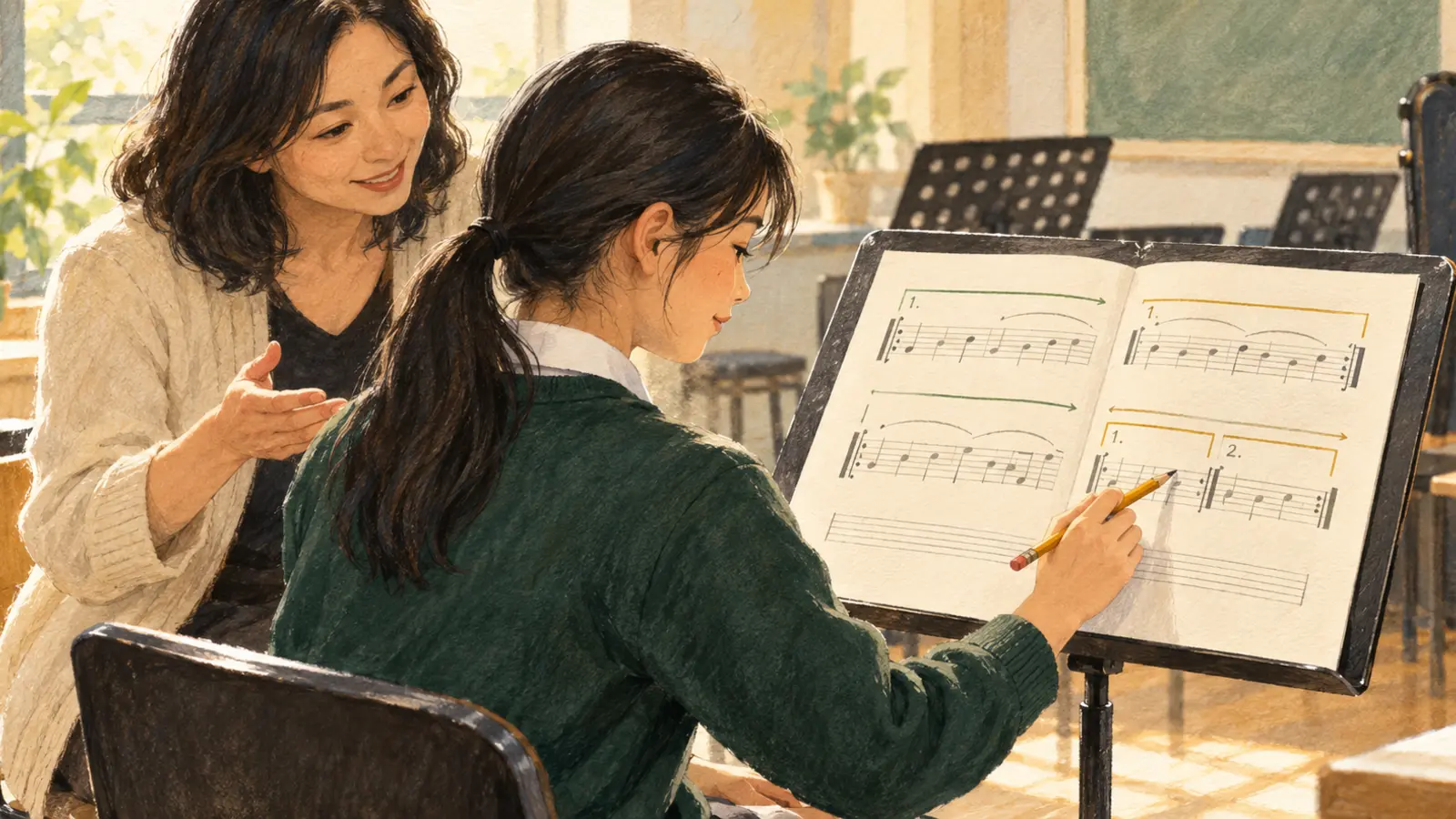
What is PG3 Higher Music? PG3 means Posting Group 3, a category for secondary-school admission under Full Subject-Based Banding. G3 Higher Music is a separately listed subject in the 2027 Singapore–Cambridge Secondary Education Certificate (SEC), with subject code K351. It includes the compulsory G3 Music components associated with Music K350 and a further Higher Music elective in musical research, creating or performing. PG3 itself is not the examination title or a measure of musical ability.
Did you know? A student can play fast and accurately yet find it difficult to explain why the music works. Another may compose an interesting short phrase but struggle to develop it into a convincing larger piece. Higher Music creates room for deeper musical investigation, but the value lies in understanding the choices—not merely adding one more performance, essay or notation file.
Families often ask whether Higher Music automatically opens a place at junior college (JC), polytechnic or a university conservatory. It does not. Musical admissions may involve auditions or portfolios, while academic entry still depends on the accepted post-secondary qualification and programme rules. This guide explains what Higher Music adds, how to approach its workload and how to explore future possibilities realistically.
Independent eduKateSG student and parent guide, prepared 24 October 2026 using SEAB’s 2027 Music and Higher Music information and MOE’s post-secondary reforms. Confirm the school’s actual offering, supervision rules, SEC assessment year and any later audition or subject prerequisites.
PG3 Higher Music: the answer at a glance
| Question | Useful answer |
|---|---|
| What does PG3 mean? | Posting Group 3: initial school posting, not a Music examination. |
| What is Higher Music’s 2027 code? | G3 Higher Music K351 (earlier reference 6086). |
| What is ordinary G3 Music? | G3 Music K350, with Music Studies 40%, Creating 30% and Performing 30%. |
| What makes it Higher Music? | A separate Higher Music elective beyond the three compulsory Music papers. |
| Which electives are available? | Research Essay, Higher Creating or Higher Performing according to the 2027 K351 specification. |
| Does the extra elective add a fourth percentage? | No. The core Music grade and additional Higher Music award follow separate SEAB rules. |
Choose what to read: PG3 versus G3 · the four components · electives · a musical example · JC/Poly/Uni · FAQ.
1. A posting group is not a Higher Music eligibility guarantee
A student enters a secondary school via PG3 and has played piano or violin for several years. Does that automatically register the student for Higher Music? No. Full SBB distinguishes a posting group from the level and title of individual subjects. Schools and authorised music programmes decide which options they offer, their selection requirements and how instruction is organised.
Music has a particular distinction in the 2027 SEC catalogue. SEAB lists G1 Music K128, G3 Music K350 and G3 Higher Music K351, but does not list a separate G2 Music examination that year. This does not prevent pupils from enjoying general school music lessons, CCAs, ensembles or other learning opportunities.
The useful parent question is therefore: “Does the school offer Higher Music K351, and which elective could this child undertake independently and well?” For the entry framework, read What is PG3 | MOE and SEAB Syllabus.
2. What does Higher Music add to the ordinary Music course?
| 2027 component | Core G3 Music K350 | Higher Music K351 |
|---|---|---|
| Paper 1: Music Studies | 40% of core Music grade | The same compulsory Music Studies component applies. |
| Paper 2: Creating | 30% | The same compulsory Creating component applies. |
| Paper 3: Performing | 30% | The same compulsory Performing component applies. |
| Additional elective | None required for K350 | One separately examined option: Research Essay, Higher Creating or Higher Performing. |
| Outcome | SEC Music grade from core papers | Core Music grade and further Higher Music award as specified by SEAB. |
The mathematical point is important. Music Studies, Creating and Performing already account for 100% of the core Music assessment. Higher Music does not change that to a four-way percentage split. The additional elective is assessed under separate award conditions. A teenager should understand that doing additional work does not automatically increase the original Music grade.
The compulsory components involve different skills. Music Studies involves careful analytical listening and knowledge. Creating requires an original musical response and reflection under prescribed school arrangements. Performing requires technically and musically purposeful playing or singing as appropriate to the student’s programme. Higher Music extends these areas through one selected form of deeper work.
3. Paper 12: research begins with a real musical question
A Higher Music Research Essay is not simply a biography of a famous musician or an enthusiastic account of favourite songs. A useful research question asks something specific that can be investigated through acknowledged musical material and reasoned analysis. It should be scoped to a project the learner can genuinely complete and explain.
A student might investigate how contrasting instrument timbres change the perception of a melodic phrase, or how one compositional approach organises musical contrast. Those are hypothetical ideas for discussing research design, not approved SEC project titles. The school and K351 syllabus determine the actual permitted scope, evidence and assessed requirements.
Good musical research distinguishes what is audible in the excerpt from what a listener infers. A source may describe the composer’s intention, while musical analysis discusses the heard result. Neither should be invented. Citations and accurate acknowledgement of recordings, scores and other references are essential.
4. Paper 22: Higher Creating requires purposeful development
Creating is not simply adding more instruments to make a texture richer. A learner can develop a motif through rhythmic variation, changes of register, harmonic contrast, transformed melodic contour or careful use of silence. Each option can serve a different intention. The choice should be heard and explained, not merely named.
A good reflection might identify that an opening motif felt too final, so the student changed the last interval or rhythm to lead into another section. The learner should then assess whether the new connection is actually audible. That is more useful than writing “I changed the notes and improved the piece”.
For assessed Higher Creating, the student must follow the school’s composition, permitted-tools and authentication rules. Adults, software and AI services must not be used to create work presented as the candidate’s unaided original achievement when the assessment rules prohibit such assistance.
5. Paper 32: Higher Performing is more than playing something difficult
Choosing a challenging piece can be motivating, but programme suitability is not determined by technical difficulty alone. Performing also concerns preparation, musical style, phrasing, accuracy, interpretation and communication. Some programmes include an oral or musical discussion of performance choices; the candidate should prepare to explain genuinely made decisions.
A brilliant fast passage is not persuasive if the piece has lost its pulse, shape or musical direction. Conversely, a measured tempo with deliberate articulation and reliable ensemble awareness may express a piece more convincingly than uncontrolled speed. Advanced performing means a more informed command of musical resources, not simply a larger number on a grading certificate.
6. Original worked example: change one motif, change the mood
Fictional classroom practice: Imagine a four-note motif played evenly and softly. On the second appearance, the first note is lengthened and the final two notes are played closer together. The pitch sequence remains the same, but the rhythm and pacing change.
A listener may notice that the altered version creates a stronger sense of anticipation or urgency. A Music student should connect that interpretation to the actual features: the longer opening duration delays progress, while the final shorter values compress the end of the phrase. Not every listener must describe the feeling identically, so the explanation should rest first on audible evidence.
Did you know? “I played it faster” and “I changed the rhythmic pattern” are different claims. A faster overall tempo changes the rate at which the underlying beat moves; a rhythmic change redistributes note durations in relation to that beat. Distinguishing the two makes a musician’s analysis more reliable.
Now add one further choice: play the altered motif at a higher register but without increasing volume. Is the sound necessarily louder? No. Register and dynamics are distinct concepts. Good musical descriptions identify what changed, what stayed constant and what possible expressive effect followed.
7. A Higher Music award is not automatically a Higher Music Distinction
The separate Higher Music award uses specific rules for both the core Music result and the additional elective. The 2027 guidance distinguishes Merit and Distinction outcomes under prescribed thresholds. It would be inaccurate to promise that choosing a more demanding elective or completing every rehearsal guarantees a particular award.
Parents and candidates should read the actual K351 award table and ask the school about registration, the elective selected and how its grade relates to the core Music examination. A practice schedule should serve musical readiness, not be built around an invented prediction of national results.
8. Secondary 1 to Secondary 4: a sustainable route to independence
| Year | What the student can develop | A useful readiness question |
|---|---|---|
| Secondary 1 | Enjoyable listening, rhythmic control, musical literacy and regular participation. | Can the learner describe one audible choice accurately? |
| Secondary 2 | Greater independence in technique, analysis and small creative decisions. | Can the student revise a short musical idea based on feedback? |
| Secondary 3 | Where offered, secure core Music work and exploration of a suitable Higher elective. | Does the learner have the time and interest for deeper independent work? |
| Secondary 4 | SEC preparation, authentic elective work and performance or research refinement. | Can the candidate defend original choices and meet the formal requirements? |
A child need not choose Higher Music merely to validate musical talent. Some students thrive with G3 Music and an ensemble CCA. Others have a genuine question that merits extended research or specialised composing or performance. A good subject choice respects both artistic motivation and the complete academic timetable.
9. What parents can do without composing or performing for the student
- Ask the learner to explain why an excerpt creates tension, release or contrast.
- Listen for a musical feature together, rather than discussing only personal preference.
- Help build a realistic timetable that protects school subjects, rest and rehearsal recovery.
- Encourage the child to keep accurate records of genuinely original ideas and practice decisions.
- Check school guidance before using recording, notation, editing or AI-assisted software in assessed work.
- Avoid writing the assessed Research Essay, arranging a candidate’s submitted composition or producing performance evidence on the child’s behalf.
Parental support can be substantial without substituting authorship. A learner who can state what they attempted, what happened and why they changed course is developing a powerful form of musical independence.
10. Is Higher Music useful for junior-college choices?
The first 2027 SEC cohort is expected to receive results in January 2028 and use the new Post-Secondary Admissions Exercise (PSE). From 2028, JC admissions shift to the revised five-subject L1R4 framework with a gross qualifying threshold of 16 and specified subject-group requirements.
A Higher Music award may add useful evidence of sustained musical study, but neither it nor the core Music grade can be assumed to secure admission or replace required aggregate subjects. Families should check the official classification of Music within the aggregate and the specific JC’s available Music pathways, auditions and subject prerequisites.
Some learners interested in continuing Music at pre-university level may investigate relevant JC music programmes or combinations. The availability and selection process differ by school. A strong SEC result can be relevant preparation, but permission to take a specific H1/H2 subject is a distinct requirement.
11. The polytechnic pathway: Music, sound and media
Polytechnic options may include music-related programmes, audio production, sound engineering, media, digital entertainment or creative technology, depending on actual programme lists. The student’s academic profile must meet the diploma’s published minimum entry requirements, competitive score and any audition or portfolio arrangements.
MOE’s 2028 polytechnic Year 1 updates adjust the ELR2B2 cut-off to 22 and allow one eligible G2 subject in the final best-subject position. That does not erase course-specific English, Mathematics or other prerequisites. A Higher Music elective is not automatically an admission pass.
Applied learning can involve recording technology, sound mixing, performance collaboration, live-event workflows and project management. Music study contributes listening and creative habits, but these programmes have their own technical and professional demands.
12. University and conservatory: accepted qualifications come first
University possibilities include music performance, composition, musicology, sound and media technology, music education or interdisciplinary arts. Some conservatories have demanding auditions, repertoire and musical evaluation requirements in addition to academic entry conditions. Other university courses place stronger emphasis on accepted pre-university or diploma qualifications.
G3 Higher Music is not a direct university entrance certificate. It can support musical preparation, but the applicant normally needs a recognised later qualification and must satisfy the programme’s specific requirements. Equally, students who did not sit Higher Music can sometimes pursue later music study through qualifying routes and suitable preparation.
Work backwards from a real degree page: what is accepted academically, what must be auditioned or submitted, and which JC or diploma route offers realistic preparation? Keep revisiting the plan as the student’s repertoire, interests and capabilities change.
13. A musician’s problem-solving habit is useful beyond performance
Musicians must recognise patterns, use feedback, cooperate and manage a long preparation process. A missed ensemble entrance can be approached like a scientific problem: was the difficulty a rhythmic cue, an unclear gesture, a balance problem or insufficient rehearsal of one transition? Diagnose, test and adjust rather than repeat the whole piece without purpose.
The same habit helps in other school subjects: explain a mistake precisely, choose an effective correction and check improvement. The point of Higher Music is not to turn every student into a professional artist; it can make learning more thoughtful wherever the teenager eventually studies.
14. Common Higher Music learning mistakes
- Treating the Higher elective as another percentage added to the 40/30/30 core Music score.
- Choosing an impressive-looking research topic with no manageable musical question.
- Writing generic claims about musical mood without identifying audible evidence.
- Adding instruments or complexity to a composition without artistic purpose.
- Choosing a demanding recital only for its difficulty rather than its musical suitability.
- Using another person’s creative material without accurate attribution or permitted authorship.
- Failing to plan the separate elective around existing core Music coursework.
- Assuming a Higher Music award guarantees a JC Music subject or university audition success.
Repair a weak response by returning to a single musical decision. Ask what changed, how the listener can hear it, whether the change served the intention and what the learner would test next. Specificity turns practice into evidence of understanding.
15. Four weeks of Higher Music readiness before assessed work
| Week | Practice | Useful evidence |
|---|---|---|
| 1 — Listen | Compare two contrasting excerpts and name rhythm, texture, register and structure. | A clear analysis distinguishes observable features from interpretation. |
| 2 — Investigate | Develop a small fictional musical research question with appropriate source notes. | The question can be addressed by real musical evidence. |
| 3 — Create | Compose or vary a tiny original motif, then explain the deliberate choices. | The musical changes are audible and purposeful. |
| 4 — Perform & reflect | Review one short rehearsal passage, identify a precise issue and practise its correction. | The learner demonstrates a change they can explain. |
These are independent learning exercises, not an assessed K351 elective. Formal project and performance work must follow national and school authentication procedures. Small, sustainable efforts are more valuable than a course built on exhaustion or unacknowledged external work.
16. Questions to ask at the school’s Music briefing
- Does the school offer G3 Higher Music K351 and how is eligibility determined?
- Which of the three higher electives can the student realistically undertake?
- How is the elective assessed relative to the compulsory Music papers and award rules?
- What school or music-centre instruction and practice commitments are required?
- Which JC, diploma or university programmes have actual auditions, portfolios or academic prerequisites worth investigating?
17. Did you know? Higher Music questions answered
Is PG3 Higher Music a separate school stream?
No. PG3 is a posting group. The examined Higher Music subject is G3 K351 in the 2027 SEC.
Does Higher Music replace ordinary Music?
No. It includes the compulsory G3 Music papers and adds a separately assessed higher elective.
Does Higher Music make the compulsory Music grade 25/25/25/25?
No. The compulsory Music papers remain weighted 40%, 30% and 30%; the higher elective is handled under separate award rules.
Can candidates choose any Higher Music elective?
The 2027 syllabus specifies Research Essay, Higher Creating and Higher Performing routes. The school must confirm eligibility, availability and registration.
Is there a 2027 G2 Music SEC paper?
There is no separate G2 Music syllabus in the 2027 school-candidate list; other school Music activities still exist.
Can parents co-write the Research Essay?
No. Assessed research must meet the candidate’s individual-authorship and school supervision requirements.
Does a musical competition prize guarantee Higher Music Distinction?
No. The national award uses the core Music and elective results under SEAB’s rules.
Can Higher Music guarantee a place at a JC with a Music programme?
No. Academic eligibility and that programme’s specific selection rules must be satisfied.
Must a future music student take Higher Music at secondary school?
There is no universal rule. Later conservatory or degree programmes have their own qualifications and audition requirements.
How can a parent who cannot read scores help?
Ask the learner to play or sing two versions of a phrase and explain the deliberate difference. Listening with curiosity can support independent reflection.
18. Official sources and the continuing reading map
- SEAB 2027 G3 Music K350 and Higher Music K351
- MOE revised JC L1R4 requirements
- MOE 2028 SEC and Post-Secondary Admissions Exercise
- 2027 Music versus Higher Music electives and awards
- Which Music levels appear in the 2027 SEC?
- What if G3 Higher Music feels challenging?
- Higher Music with G2 English? A Full SBB guide
- What is PG3 Music?
- Art, Music and Drama compared
- Why learning foundations and precise feedback matter
Explore other PG3 subject pathways
PG3 Business · PG3 Higher Art · PG3 Drama · PG3 Music
Higher Music is most rewarding when a teenager can explain a musical choice with the same care used to make it. The lasting achievement is independent listening, creating and performing—not merely an additional line on a certificate.