
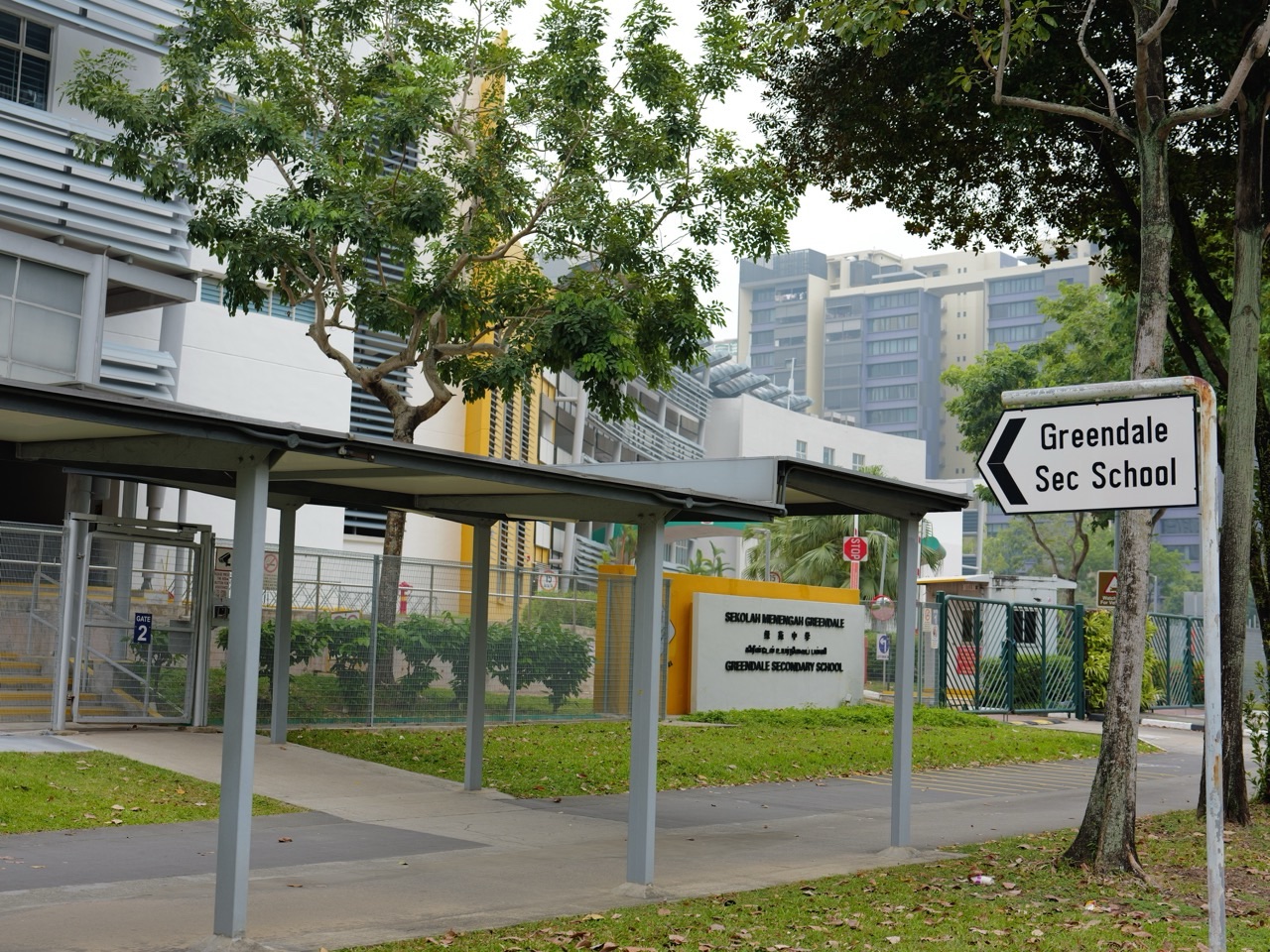
Did you know that Greendale Secondary School’s Applied Learning Programme asks students to design, code and build — then takes the work one step further by connecting Secondary 2 students with Singapore Institute of Technology and community partners for authentic problem-solving?
That is one of the clearest ways to understand Greendale Secondary School in 2026.
The school’s STEM Applied Learning Programme develops Design, Technology & Engineering through Arduino, electronics, CAD, 3D printing, laser cutting, hydroponics, aquaponics, Artificial Intelligence, drones and Design Thinking. Its Learning for Life Programme uses Outdoor Adventure — including activities such as kayaking, rock-climbing and orienteering — to develop character, teamwork and leadership. Source: Greendale Secondary Applied Learning Programme. Source: Greendale Secondary Learning for Life Programme.
Greendale Secondary School opened on 2 January 2006 with its first intake of 320 Secondary 1 students. Its current vision is Every Greendale Student a Lifelong Learner, Critical Thinker and Servant Leader, and its mission is Growing Hearts, Growing Minds. Source: school history. Source: vision, mission and values.
So what is so awesome about Greendale Secondary School? The strongest answer is the way the school repeatedly asks students to move from learning about systems to operating inside systems.
Independent eduKateSG profile checked on 4 October 2026. This is not a ranking or school-endorsed publication. Programme details may change and cohort-specific arrangements should be confirmed directly with the school.
The Quick Answer: What Makes Greendale Secondary School Stand Out?
- Design, Code and Build is genuinely hands-on. Lower-secondary students encounter coding, electronics, CAD, rapid prototyping and engineering applications.
- Sustainability is connected to technology. Hydroponics and aquaponics show students how sensing, control and environmental systems can meet.
- Secondary 2 introduces emerging technologies. Current programme information includes AI and drone applications.
- The SIT Community Challenge creates an authentic audience. Students use Design Thinking with community partners and pitch ideas to practitioners.
- Secondary 3 links STEM to future pathways. Career talks, workshops, learning journeys and Advanced Elective Modules extend the school-to-industry connection.
- Outdoor Adventure is a character curriculum. Kayaking, rock-climbing and orienteering create real conditions for teamwork, risk awareness and resilience.
- Career guidance is structured. Students develop self-awareness, explore pathways and learn to value different occupations.
- The school’s vision links academic development to service. Lifelong Learner, Critical Thinker and Servant Leader are treated as connected outcomes.
Did You Know? Greendale Secondary Opened in 2006
Greendale Secondary opened its doors to 320 Secondary 1 students on 2 January 2006. Its name combines “green”, reflecting Punggol’s landscape, with “dale”, linking it to Edgedale Plains. Source: official school history.
The school therefore belongs directly to the story of modern Punggol.
It did not move into an old established town.
It grew as the town grew.
That helps explain why technology, sustainability, outdoor learning and future pathways appear so strongly in its present programme identity.
A relatively young secondary school can design itself around the world students are entering rather than only the world schools once inherited.
Design, Code and Build: Three Verbs, One Learning Cycle
Greendale’s Applied Learning Programme in Design, Technology & Engineering can be understood through three verbs:
- Design — understand the user, context and problem.
- Code — translate intended behaviour into logical instructions.
- Build — make the idea physical enough to test.
The school describes Design Thinking as part of the programme, alongside Arduino microcontrollers, Annikken Andee, CAD, cardboard modelling, 3D printing and laser cutting. Source: ALP.
The sequence is powerful because each stage can reveal a different weakness.
A student may define the wrong problem.
The code may not behave as expected.
The physical object may expose a measurement or material problem.
Instead of hiding error, the programme creates places where error becomes visible.
Secondary 1: Electronics, Arduino, CAD and Rapid Prototyping
The current programme page describes Secondary 1 students learning basic coding and electronics through Arduino microcontrollers, including outputs such as buzzers, LEDs and servo motors. They also learn 3D-modelling CAD and rapid-prototyping technologies such as 3D printing and laser cutting. Source: Secondary 1 ALP.
This is an excellent stage for secondary-school STEM because the learner begins to see how abstract instructions produce physical behaviour.
If an LED does not light, the student needs to investigate.
Is the circuit correct?
Is the program correct?
Is the component connected to the expected pin?
Does the student understand the system, or are they only copying a procedure?
That is debugging in its most useful form.
Hydroponics and Aquaponics: Technology Inside a Living System
Greendale uses hydroponics and aquaponics setups to connect Arduino applications with sustainability and multidisciplinary learning. Source: ALP sustainability applications.
This is especially interesting because living systems do not behave like clean textbook diagrams.
Plants change over time.
Water conditions vary.
Sensors can generate readings that need interpretation.
A technology system can therefore collect information without automatically producing understanding.
The student still has to ask what the number means.
This is where Science, Mathematics, Computing and Engineering meet.
An eduKateSG Example: A Sensor Reading Is Not Yet a Conclusion
The following is our teaching illustration, not a documented Greendale assignment.
Suppose a sensor reports a value that suddenly changes.
The student has several possible explanations.
- The environment changed.
- The sensor moved.
- The connection became loose.
- The program recorded the value incorrectly.
- The reading is real but temporary.
A careful learner does not immediately choose the most dramatic explanation.
The next step is to check.
That habit — evidence before conclusion — is as important as knowing how to wire the sensor.
Secondary 2: AI, Drones and a More Complex Design Problem
At Secondary 2, students build on earlier Arduino learning, including wireless interfaces, while also encountering technologies such as Artificial Intelligence and drones. Source: Secondary 2 ALP.
The educational value is not simply exposure to fashionable technologies.
AI and drones are useful only when students understand the problem they are being asked to solve.
A drone may collect an image.
AI may classify information.
But the learner still has to decide whether the data is relevant, whether the result is reliable and whether the proposed use is appropriate.
Tools amplify judgment.
They do not replace it.
The SIT Community Challenge: When the Audience Is Not Your Teacher
One of the most distinctive parts of Greendale’s current ALP is the Secondary 2 SIT Community Challenge, a collaboration with Singapore Institute of Technology.
Students partner with a community organisation, use Design Thinking to co-create solutions and present their ideas to judges that can include SIT, design practitioners, community partners and school leaders. Source: SIT Community Challenge.
This changes the standard of success.
A classroom answer is often judged against a marking scheme.
A community solution has to survive another question:
Would the people involved actually use this?
That question forces students to confront feasibility, communication and user needs.
Feedback From Practitioners Is Different From a Score
The school emphasises idea-feasibility feedback from design practitioners and community partners during the challenge.
This is valuable because professional feedback often sounds different from school feedback.
The issue may not be “wrong answer”.
It may be:
- too expensive,
- too difficult to maintain,
- unclear to the user,
- solving only part of the problem,
- creating a new problem elsewhere.
That is the beginning of engineering judgment.
Secondary 3: STEM Starts Connecting to Careers
The school’s current programme describes Secondary 3 opportunities involving career talks, workshops and learning journeys from tertiary institutions and industry partners. Students may also participate in Advanced Elective Modules in STEM-related and engineering courses at polytechnics, while selected pupils can deepen learning through competitions. Source: Secondary 3 ALP.
This is exactly the right stage for the question to change.
Earlier, the learner asks:
“Can I build this?”
Later, the learner should also ask:
“Who does this kind of work in the real world?”
“What further study does it require?”
“Do I actually enjoy the difficult parts?”
Career exploration becomes more useful when students have enough experience to ask better questions.
Outdoor Adventure: Learning by Doing Under Uncomfortable Conditions
Greendale Secondary’s Learning for Life Programme uses Outdoor Adventure to develop character and leadership through concrete experiences.
The school lists outdoor skills such as kayaking, rock-climbing and orienteering and explains that such experiences can develop risk assessment, teamwork, leadership and personal qualities. Source: Outdoor Adventure LLP.
This matters because some qualities are difficult to understand while everything is comfortable.
Resilience sounds admirable in a classroom.
Rock-climbing or an unfamiliar outdoor task may create the moment when the student actually feels hesitation.
Teamwork sounds straightforward until a group has different levels of confidence and physical ability.
Risk management sounds abstract until the learner has to check equipment, instructions and conditions before acting.
Outdoor education gives values a physical environment.
Why “Learning by Doing” Still Needs Debriefing
Doing is not automatically learning.
A student can complete an activity without understanding what made the group successful.
That is why reflection matters.
A useful debrief may ask:
- What did we assume before we started?
- What surprised us?
- Which decision made the largest difference?
- What would we do differently?
- Where else could this lesson apply?
Now the experience can travel into another situation.
That is transfer.
Learner, Thinker, Leader: Three Roles That Need Each Other
Greendale’s current vision describes every student as a Lifelong Learner, Critical Thinker and Servant Leader. Its R³ISE values are Respect, Responsibility, Resilience, Integrity, Self-discipline and Empathy. Source: vision and values.
The order is worth thinking about.
A leader who stops learning becomes less useful.
A learner who never thinks critically may absorb information without judging it.
A critical thinker without empathy may identify problems brilliantly and still ignore the people affected.
Greendale’s framing suggests that the three roles belong together.
Education and Career Guidance: The Future Needs Better Questions
Greendale’s Education and Career Guidance framework aims to help students explore viable education and career options, build self-awareness and self-directedness, and appreciate the contribution of different occupations. Source: ECG.
This is important because a teenager is often asked “What do you want to be?” before seeing enough of the world to answer well.
Better questions are:
- What kind of problems hold my attention?
- Which difficult tasks am I willing to practise?
- Do I prefer working with people, systems, data, materials or ideas?
- What does this occupation actually involve on an ordinary day?
- Which education pathway keeps useful options open?
Career guidance improves when it becomes evidence gathering rather than fortune telling.
Blended Learning and Digital Literacy: Independence Is Part of the Goal
The Greendale Xperience includes Blended Learning and the National Digital Literacy Programme as current school priorities. Source: Greendale Xperience.
The important educational outcome is not simply the ability to learn from a device.
It is the ability to manage learning when the teacher is not physically structuring every minute.
Can the student begin?
Can the student monitor progress?
Can the student recognise confusion and seek help?
Can the student distinguish useful online information from distraction?
Those self-management skills become more important as education becomes increasingly technology-enabled.
An eduKateSG Example: From Prototype to Explanation
The following is our illustration, not a documented Greendale Secondary task.
Imagine a student group builds a small automated watering prototype.
The device works once.
Is the project finished?
Not yet.
The students should ask:
- How consistently does it work?
- What happens if a sensor reading is wrong?
- How much water does it deliver?
- Can the user understand the interface?
- What failure would matter most?
- What evidence supports the claim that the new system is better?
Now the project has moved beyond making.
It has become engineering reasoning.
What Families Can Borrow From Greendale Secondary’s Learning Design
- Make ideas physical enough to test.
- Teach coding inside a complete problem-solving cycle.
- Use community partners to make feasibility matter.
- Ask students to distinguish sensor data from conclusions.
- Use outdoor challenge to discuss real resilience and teamwork.
- Connect subject interests to actual careers before choosing pathways.
- Build self-directed learning before tertiary education requires it.
The eduKateSG Learning Connection
Greendale Secondary makes the eduKateSG words-to-technology cycle unusually visible.
Language defines the problem.
Design Thinking makes the user visible.
Mathematics formalises relationships.
Science identifies constraints and evidence.
Code controls behaviour.
Fabrication creates a testable object.
Feedback changes the next version.
Career guidance asks where this growing capability can go next.
That is how education becomes an interface with increasingly complex technology rather than a collection of disconnected subjects.
How Greendale Secondary Connects to the eduKateSG Singapore Graph
Greendale Secondary School is at 51 Edgedale Plains, Singapore 828866, directly beside the wider eastern Punggol learning landscape. Source: school information.
- History of Singapore | Punggol
- Why Singaporeans Love Punggol
- Fun facts about Singapore | Punggol
- Awesome Schools in Punggol
- What is so Awesome About Singapore Institute of Technology | 2026-2027 Edition
- Tutors and Tuition in Punggol
The SIT link is a thematic connection to applied learning and the documented Community Challenge partnership. It is not a claim of preferential admission or a guaranteed progression pathway.
Frequently Asked Questions
When did Greendale Secondary School open?
It opened on 2 January 2006 with its first intake of 320 Secondary 1 students. Official school history.
What is the Applied Learning Programme?
It is a STEM programme in Design, Technology & Engineering built around Design, Code and Build. Current activities include Arduino, electronics, CAD, rapid prototyping, hydroponics, aquaponics, AI, drones and Design Thinking. Official ALP.
What is the SIT Community Challenge?
It is a Secondary 2 applied-learning collaboration in which students work with community partners and use Design Thinking to co-create and pitch solutions. Official programme information.
What is Greendale’s Learning for Life Programme?
It focuses on Outdoor Adventure, using experiences such as kayaking, rock-climbing and orienteering to develop personal, social, leadership and risk-management skills. Official LLP.
Where is Greendale Secondary School?
The official 2026 school information lists 51 Edgedale Plains, Singapore 828866. Official contact page.
Official References Checked for the 2026–2027 Edition
- Greendale Secondary School — School History
- Greendale Secondary School — Vision, Mission & Values
- Greendale Secondary School — Instructional Programme
- Greendale Secondary School — Applied Learning Programme
- Greendale Secondary School — Learning for Life Programme
- Greendale Secondary School — Greendale Xperience
- Greendale Secondary School — Education and Career Guidance
- Greendale Secondary School — School Information
So, What Is So Awesome About Greendale Secondary School?
It is the move from abstraction to consequence.
Code has to control something.
A design has to make sense to a user.
A prototype has to survive feedback.
Outdoor leadership has to function when the situation is uncomfortable.
Career interest has to meet the reality of further study and work.
Did you know that this is what makes applied learning powerful?
The student discovers that knowledge is not finished when it is remembered.
Knowledge becomes powerful when it can survive contact with reality.