
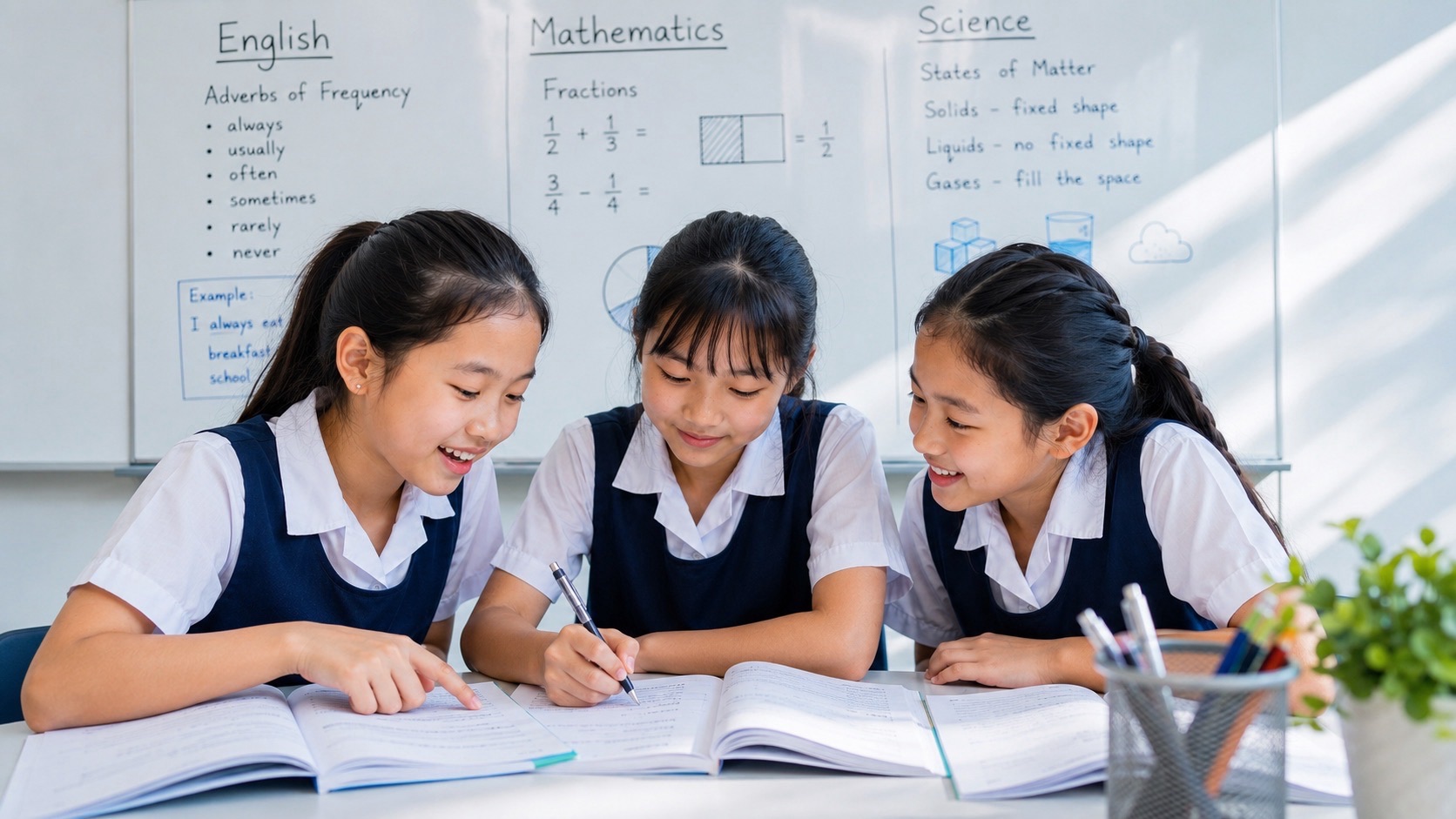
Awesome Schools in Punggol is a comprehensive town-level guide to the 15 current MOE Primary and Secondary schools physically serving Punggol in 2026. It follows eduKateSG’s strongest long-form logic: begin with the learner, explain the system, connect the schools to subjects and pathways, then hand the reader to deeper nodes when a narrower question appears.
This is not a ranking. “Awesome” is used positively, not comparatively. Each school has real programmes, CCAs, teachers, histories and opportunities worth understanding. The family decides how to weight distance, programme fit, academic support, culture, subject routes and the child’s own disposition. This page supplies a field map rather than a universal winner.
The current Punggol field contains eleven Primary schools—Edgefield, Greendale, Horizon, Mee Toh, Northshore, Oasis, Punggol Cove, Punggol Green, Punggol View, Valour and Waterway—and four Secondary schools—Edgefield Secondary, Greendale Secondary, Punggol Secondary and Yusof Ishak Secondary. Punggol Primary School is excluded because its current campus is in Hougang at 61 Hougang Avenue 8.
No current Junior College is counted inside Punggol in 2026. Catholic Junior College is planned to relocate near Punggol Digital District in the future, but planned infrastructure is not represented as if it were already operational. Singapore Institute of Technology is outside this Primary/Secondary/JC series even though SIT and the digital district are important to the town’s wider learning corridor.
Read this with History of Singapore | Punggol, Why Singaporeans Love Punggol, Fun facts about Singapore | Punggol, Things to do in Singapore | Punggol, the Complete Punggol Guide 2026, Education Hub, English Learning Hub, Mathematics Learning Hub, Science Learning Hub, From PSLE to SEC, Singapore Secondary School Directory and Tutors and Tuition in Punggol. The ecosystem works because each node has a job: town history explains place, school pages explain institutions, subject hubs explain knowledge, and tuition pages explain targeted intervention.
Why Punggol is an unusually coherent education field
Punggol makes the relationship between school and town unusually visible. Waterways, coast, park connectors, new housing, public transport and Punggol Digital District are not remote case studies. They are everyday systems children can observe. That gives sustainability, engineering, communication and urban-learning programmes a local physical context.
The schools are historically layered rather than identical products of one planning moment. Mee Toh carries an older institutional history into Punggol. Edgefield and Greendale belong to earlier new-town growth. Punggol Cove and Oasis reflect later expansion. Valour and Northshore are newer. Yusof Ishak Secondary carries another established school identity into a future-facing campus.
Across the field, several recurring themes appear: communication, sustainability, STEM and making, outdoor education, leadership, entrepreneurship and the arts. These themes differ on the surface but often train similar deep capabilities—understanding a problem, representing it, applying knowledge, communicating a response, receiving feedback and improving the next attempt.
The national curriculum still matters enormously. A school’s distinctive programme cannot compensate for weak reading, insecure Mathematics or incomplete Science concepts. The strongest applied learning deepens core knowledge by giving it authentic work to do. That is the standard used throughout this guide.
Punggol’s field also demonstrates why academic and holistic development should not be divided too sharply. Dance, sport, outdoor challenge, debate, design and leadership all teach forms of deliberate practice. Those experiences can strengthen academic habits when students learn to recognise the shared process of feedback, correction and increasingly independent performance.
All 15 current MOE schools in Punggol
| School | Level | Distinctive learning lens |
|---|---|---|
| Edgefield Primary School | Primary | sustainability-oriented STEM and character through dance; STEM Innovator uses environmental science, sustainability, authentic challenges and Design Thinking; the Learning for Life programme uses dance and performance for values and character |
| Greendale Primary School | Primary | Design Thinking and Outdoor Education; Learning by Design develops creative problem solving, prototyping and eco-stewardship; Outdoor Education develops resilience, teamwork and self-direction |
| Horizon Primary School | Primary | whole-school leadership with STEM innovation; STEMpowered Innovations uses hands-on STEM and sustainability challenges while student leadership develops responsibility and initiative across the pupil population |
| Mee Toh School | Primary | historic Buddhist school culture with eco-citizenship and sports or outdoor character development; A3 Eco-Citizens@MTS is interdisciplinary and environmentally oriented; SENCE@MTS develops character through Sports and Outdoor Education |
| Northshore Primary School | Primary | game design and making at Punggol’s coastal and digital-district edge; imaginEErs uses game design, coding and making; OCE@N develops character through sport and outdoor education |
| Oasis Primary School | Primary | language arts and caring leadership; Nurturing Language Artisans develops language through authentic and creative use; Lead with a Heart, Changemakers for the Future develops empathy, service and leadership |
| Punggol Cove Primary School | Primary | communication and music; C³ develops Confident Communicators and Collaborators while GEMS@PC develops pupils through music, performance and design |
| Punggol Green Primary School | Primary | sustainability-focused STEM and progressive student leadership; IGNITE uses hands-on STEM, Design Thinking and sustainability problems while APPLE develops purpose, performance and student leadership |
| Punggol View Primary School | Primary | empathetic communication and Outdoor Experiential Learning; E²C@PGVP develops Effective and Empathetic Communicators through oracy, authentic issues and media work; outdoor experiences develop confidence, character and teamwork |
| Valour Primary School | Primary | character through nature and adventure; Nature & Adventure @ Valour is a six-year outdoor pathway developing resilience, adaptability, courage and teamwork |
| Waterway Primary School | Primary | oracy and progressive leadership; Orators@Waterway develops listening, thinking and speaking through drama, stories, topical sharing, news writing, literature, persuasion, debate and interviews; leadership develops progressively |
| Edgefield Secondary School | Secondary | entrepreneurial thinking and character through Taekwondo; G.E.M.—Growing an Entrepreneurial Mindset—develops opportunity awareness and creative problem solving while Taekwondo builds respect, resilience, self-control and leadership |
| Greendale Secondary School | Secondary | coding, design and engineering with Outdoor Adventure Education; the Applied Learning Programme develops Design, Technology and Engineering through coding and authentic challenges while Outdoor Adventure Education develops teamwork, resilience and leadership |
| Punggol Secondary School | Secondary | environmental sustainability and community youth leadership; the Environment Education Applied Learning Programme connects Science and Nature to sustainable living while the Learning for Life programme develops community and youth leadership |
| Yusof Ishak Secondary School | Secondary | sustainable smart-city STEM and honourable leadership; S4TEM@YI uses urban farming, coding, aeronautics and sustainability while YI LEAD+ develops honourable leaders with a global outlook and commitment to the greater good |
Use this table as a navigation map. Programme names, CCAs and admissions details can change, so live decisions should return to MOE SchoolFinder, the school’s official site and current MOE information. For Primary families, All 11 Primary Schools in Punggol is the deeper local P1 comparison node.
1. Edgefield Primary School
Edgefield Primary School contributes sustainability-oriented STEM and character through dance to the Punggol school field. STEM Innovator uses environmental science, sustainability, authentic challenges and Design Thinking; the Learning for Life programme uses dance and performance for values and character. The useful way to read this is not as a slogan but as a hypothesis about repeated student experience: what will pupils actually do, how often will they do it, and how will the work become more demanding as they mature?
A distinctive programme earns its place when it creates progression. Younger students may begin through guided exposure and simple reflection. Older students should need stronger subject knowledge, more independent judgement, clearer communication and greater responsibility. If the same experience repeats without increased challenge, it remains enrichment; when the challenge rises, it can become capability.
Even though the headline identity is not primarily language-based, English remains the transmission system. Students interpret instructions, explain observations, justify designs, discuss decisions and reflect on outcomes. Language quality affects how clearly knowledge becomes visible. The deeper national progression sits in the English Learning Hub. Families can look beyond the English department itself and ask where else in the school pupils have to use language accurately for an authentic purpose.
The programme naturally creates mathematical situations involving measurement, data, ratio, variable, pattern, geometry, scale or optimisation. These contexts help students see why mathematical representations are useful when a problem contains quantity, relationship and constraint. The Mathematics Learning Hub explains the long progression from Primary number and models into Secondary algebra and advanced Mathematics. A project has educational depth when students can recognise and use underlying mathematical relationships without losing formal accuracy.
Science connects directly to the school’s applied context because students can observe systems, identify variables, test ideas and connect evidence to explanations. The strongest work still relies on explicit curriculum knowledge rather than treating activity itself as understanding. The Science Learning Hub develops the subject pathway in more detail. Punggol’s environmental and engineered landscape gives many local programmes a real-world system that students can observe rather than merely imagine.
The co-curricular field—dance, sports, Scouts, computing, environmental science and arts—adds long-horizon practice. Students train, rehearse, build, perform, compete, organise and sometimes fail publicly. That matters because improvement becomes experiential. The learner sees that a weak component can be isolated, corrected and reintegrated into a stronger whole performance.
As a Primary school, Edgefield Primary School sits inside a six-year developmental runway. Lower Primary builds reading, number sense and routines. Middle Primary adds formal Science and increasingly inferential work. Upper Primary integrates foundations into stronger independence and PSLE readiness. The larger pathway context is available through Education Hub.
PSLE preparation should grow out of the earlier foundation rather than replace it. Retrieval, timing, checking and mixed papers become increasingly important near Primary 6, but the student remains dependent on vocabulary, number sense, concept knowledge and the ability to work independently.
A second educational lens is transfer. Does the student use a communication habit outside English, a checking habit outside Mathematics, a design habit outside a project, or a resilience habit outside CCA? Transfer should not be assumed, but schools and families can help students notice when the same learning process appears in a new context.
A third lens is independence. Strong schooling gradually reduces the amount of adult control required for familiar tasks. Students should become better at starting, planning, checking, asking precise questions and recovering after mistakes. Independence is not the removal of support; it is the outcome of well-designed support that fades as competence grows.
Family logistics deserve equal seriousness. Test the real school-day journey, including rain, peak travel and CCA return time. Consider student care, meal timing, homework, sleep and any external lessons. An excellent programme is only useful when the weekly routine leaves the learner enough energy to participate and practise consistently.
Belonging matters too. The child should be able to imagine at least one plausible community inside Edgefield Primary School: a class, CCA, team, ensemble, club, service role or programme. Belonging does not remove difficulty, but it often increases the willingness to remain engaged when improvement is slow.
When reading evidence about Edgefield Primary School, keep each metric inside its proper question. P1 demand describes applicant pressure, not teaching quality. Historical S1 ranges help with realistic choice planning, not school culture. Awards show achievement, not every pupil’s daily experience. Programme descriptions reveal intent, but current implementation still deserves direct checking.
Useful parent questions are concrete: how does sustainability-oriented STEM and character through dance progress by year; what are the current CCA commitments; how are weak foundations supported; how are strong learners stretched; and how does the school help students become more independent? Specific answers support better comparison than broad reputation language.
Future-readiness should also be interpreted carefully. The newest technology will change during the child’s lifetime. Durable capabilities travel: reading accurately, reasoning with evidence, representing quantity, explaining clearly, collaborating, revising and taking responsibility. Edgefield Primary School is worth understanding partly through how its distinctive identity creates repeated practice for those capabilities.
Finally, use current sources. Programmes, staff, subject offerings and policies can change. MOE SchoolFinder and the official school site should control operational decisions. This field guide helps the family understand what to look for; it does not replace the family’s judgement or the official admissions system.
2. Greendale Primary School
Greendale Primary School contributes Design Thinking and Outdoor Education to the Punggol school field. Learning by Design develops creative problem solving, prototyping and eco-stewardship; Outdoor Education develops resilience, teamwork and self-direction. The useful way to read this is not as a slogan but as a hypothesis about repeated student experience: what will pupils actually do, how often will they do it, and how will the work become more demanding as they mature?
A distinctive programme earns its place when it creates progression. Younger students may begin through guided exposure and simple reflection. Older students should need stronger subject knowledge, more independent judgement, clearer communication and greater responsibility. If the same experience repeats without increased challenge, it remains enrichment; when the challenge rises, it can become capability.
Even though the headline identity is not primarily language-based, English remains the transmission system. Students interpret instructions, explain observations, justify designs, discuss decisions and reflect on outcomes. Language quality affects how clearly knowledge becomes visible. The deeper national progression sits in the English Learning Hub. Families can look beyond the English department itself and ask where else in the school pupils have to use language accurately for an authentic purpose.
Mathematics remains a central part of the academic spine. Even programmes centred on arts, leadership or outdoor learning rely on comparison, data, timing, measurement and logical structure at different moments. Formal Mathematics gives students a precise language for those relationships. The Mathematics Learning Hub explains the long progression from Primary number and models into Secondary algebra and advanced Mathematics. A project has educational depth when students can recognise and use underlying mathematical relationships without losing formal accuracy.
Science connects directly to the school’s applied context because students can observe systems, identify variables, test ideas and connect evidence to explanations. The strongest work still relies on explicit curriculum knowledge rather than treating activity itself as understanding. The Science Learning Hub develops the subject pathway in more detail. Punggol’s environmental and engineered landscape gives many local programmes a real-world system that students can observe rather than merely imagine.
The co-curricular field—sports, performing arts, uniformed groups, computing, environmental science, chess and leadership—adds long-horizon practice. Students train, rehearse, build, perform, compete, organise and sometimes fail publicly. That matters because improvement becomes experiential. The learner sees that a weak component can be isolated, corrected and reintegrated into a stronger whole performance.
As a Primary school, Greendale Primary School sits inside a six-year developmental runway. Lower Primary builds reading, number sense and routines. Middle Primary adds formal Science and increasingly inferential work. Upper Primary integrates foundations into stronger independence and PSLE readiness. The larger pathway context is available through Education Hub.
PSLE preparation should grow out of the earlier foundation rather than replace it. Retrieval, timing, checking and mixed papers become increasingly important near Primary 6, but the student remains dependent on vocabulary, number sense, concept knowledge and the ability to work independently.
A second educational lens is transfer. Does the student use a communication habit outside English, a checking habit outside Mathematics, a design habit outside a project, or a resilience habit outside CCA? Transfer should not be assumed, but schools and families can help students notice when the same learning process appears in a new context.
A third lens is independence. Strong schooling gradually reduces the amount of adult control required for familiar tasks. Students should become better at starting, planning, checking, asking precise questions and recovering after mistakes. Independence is not the removal of support; it is the outcome of well-designed support that fades as competence grows.
Family logistics deserve equal seriousness. Test the real school-day journey, including rain, peak travel and CCA return time. Consider student care, meal timing, homework, sleep and any external lessons. An excellent programme is only useful when the weekly routine leaves the learner enough energy to participate and practise consistently.
Belonging matters too. The child should be able to imagine at least one plausible community inside Greendale Primary School: a class, CCA, team, ensemble, club, service role or programme. Belonging does not remove difficulty, but it often increases the willingness to remain engaged when improvement is slow.
When reading evidence about Greendale Primary School, keep each metric inside its proper question. P1 demand describes applicant pressure, not teaching quality. Historical S1 ranges help with realistic choice planning, not school culture. Awards show achievement, not every pupil’s daily experience. Programme descriptions reveal intent, but current implementation still deserves direct checking.
Useful parent questions are concrete: how does Design Thinking and Outdoor Education progress by year; what are the current CCA commitments; how are weak foundations supported; how are strong learners stretched; and how does the school help students become more independent? Specific answers support better comparison than broad reputation language.
Future-readiness should also be interpreted carefully. The newest technology will change during the child’s lifetime. Durable capabilities travel: reading accurately, reasoning with evidence, representing quantity, explaining clearly, collaborating, revising and taking responsibility. Greendale Primary School is worth understanding partly through how its distinctive identity creates repeated practice for those capabilities.
Finally, use current sources. Programmes, staff, subject offerings and policies can change. MOE SchoolFinder and the official school site should control operational decisions. This field guide helps the family understand what to look for; it does not replace the family’s judgement or the official admissions system.
3. Horizon Primary School
Horizon Primary School contributes whole-school leadership with STEM innovation to the Punggol school field. STEMpowered Innovations uses hands-on STEM and sustainability challenges while student leadership develops responsibility and initiative across the pupil population. The useful way to read this is not as a slogan but as a hypothesis about repeated student experience: what will pupils actually do, how often will they do it, and how will the work become more demanding as they mature?
A distinctive programme earns its place when it creates progression. Younger students may begin through guided exposure and simple reflection. Older students should need stronger subject knowledge, more independent judgement, clearer communication and greater responsibility. If the same experience repeats without increased challenge, it remains enrichment; when the challenge rises, it can become capability.
Even though the headline identity is not primarily language-based, English remains the transmission system. Students interpret instructions, explain observations, justify designs, discuss decisions and reflect on outcomes. Language quality affects how clearly knowledge becomes visible. The deeper national progression sits in the English Learning Hub. Families can look beyond the English department itself and ask where else in the school pupils have to use language accurately for an authentic purpose.
The programme naturally creates mathematical situations involving measurement, data, ratio, variable, pattern, geometry, scale or optimisation. These contexts help students see why mathematical representations are useful when a problem contains quantity, relationship and constraint. The Mathematics Learning Hub explains the long progression from Primary number and models into Secondary algebra and advanced Mathematics. A project has educational depth when students can recognise and use underlying mathematical relationships without losing formal accuracy.
Science connects directly to the school’s applied context because students can observe systems, identify variables, test ideas and connect evidence to explanations. The strongest work still relies on explicit curriculum knowledge rather than treating activity itself as understanding. The Science Learning Hub develops the subject pathway in more detail. Punggol’s environmental and engineered landscape gives many local programmes a real-world system that students can observe rather than merely imagine.
The co-curricular field—robotics, computing, design, sports, arts, Scouts and chess—adds long-horizon practice. Students train, rehearse, build, perform, compete, organise and sometimes fail publicly. That matters because improvement becomes experiential. The learner sees that a weak component can be isolated, corrected and reintegrated into a stronger whole performance.
As a Primary school, Horizon Primary School sits inside a six-year developmental runway. Lower Primary builds reading, number sense and routines. Middle Primary adds formal Science and increasingly inferential work. Upper Primary integrates foundations into stronger independence and PSLE readiness. The larger pathway context is available through Education Hub.
PSLE preparation should grow out of the earlier foundation rather than replace it. Retrieval, timing, checking and mixed papers become increasingly important near Primary 6, but the student remains dependent on vocabulary, number sense, concept knowledge and the ability to work independently.
A second educational lens is transfer. Does the student use a communication habit outside English, a checking habit outside Mathematics, a design habit outside a project, or a resilience habit outside CCA? Transfer should not be assumed, but schools and families can help students notice when the same learning process appears in a new context.
A third lens is independence. Strong schooling gradually reduces the amount of adult control required for familiar tasks. Students should become better at starting, planning, checking, asking precise questions and recovering after mistakes. Independence is not the removal of support; it is the outcome of well-designed support that fades as competence grows.
Family logistics deserve equal seriousness. Test the real school-day journey, including rain, peak travel and CCA return time. Consider student care, meal timing, homework, sleep and any external lessons. An excellent programme is only useful when the weekly routine leaves the learner enough energy to participate and practise consistently.
Belonging matters too. The child should be able to imagine at least one plausible community inside Horizon Primary School: a class, CCA, team, ensemble, club, service role or programme. Belonging does not remove difficulty, but it often increases the willingness to remain engaged when improvement is slow.
When reading evidence about Horizon Primary School, keep each metric inside its proper question. P1 demand describes applicant pressure, not teaching quality. Historical S1 ranges help with realistic choice planning, not school culture. Awards show achievement, not every pupil’s daily experience. Programme descriptions reveal intent, but current implementation still deserves direct checking.
Useful parent questions are concrete: how does whole-school leadership with STEM innovation progress by year; what are the current CCA commitments; how are weak foundations supported; how are strong learners stretched; and how does the school help students become more independent? Specific answers support better comparison than broad reputation language.
Future-readiness should also be interpreted carefully. The newest technology will change during the child’s lifetime. Durable capabilities travel: reading accurately, reasoning with evidence, representing quantity, explaining clearly, collaborating, revising and taking responsibility. Horizon Primary School is worth understanding partly through how its distinctive identity creates repeated practice for those capabilities.
Finally, use current sources. Programmes, staff, subject offerings and policies can change. MOE SchoolFinder and the official school site should control operational decisions. This field guide helps the family understand what to look for; it does not replace the family’s judgement or the official admissions system.
4. Mee Toh School
Mee Toh School contributes historic Buddhist school culture with eco-citizenship and sports or outdoor character development to the Punggol school field. A3 Eco-Citizens@MTS is interdisciplinary and environmentally oriented; SENCE@MTS develops character through Sports and Outdoor Education. The useful way to read this is not as a slogan but as a hypothesis about repeated student experience: what will pupils actually do, how often will they do it, and how will the work become more demanding as they mature?
A distinctive programme earns its place when it creates progression. Younger students may begin through guided exposure and simple reflection. Older students should need stronger subject knowledge, more independent judgement, clearer communication and greater responsibility. If the same experience repeats without increased challenge, it remains enrichment; when the challenge rises, it can become capability.
Even though the headline identity is not primarily language-based, English remains the transmission system. Students interpret instructions, explain observations, justify designs, discuss decisions and reflect on outcomes. Language quality affects how clearly knowledge becomes visible. The deeper national progression sits in the English Learning Hub. Families can look beyond the English department itself and ask where else in the school pupils have to use language accurately for an authentic purpose.
Mathematics remains a central part of the academic spine. Even programmes centred on arts, leadership or outdoor learning rely on comparison, data, timing, measurement and logical structure at different moments. Formal Mathematics gives students a precise language for those relationships. The Mathematics Learning Hub explains the long progression from Primary number and models into Secondary algebra and advanced Mathematics. A project has educational depth when students can recognise and use underlying mathematical relationships without losing formal accuracy.
Science connects directly to the school’s applied context because students can observe systems, identify variables, test ideas and connect evidence to explanations. The strongest work still relies on explicit curriculum knowledge rather than treating activity itself as understanding. The Science Learning Hub develops the subject pathway in more detail. Punggol’s environmental and engineered landscape gives many local programmes a real-world system that students can observe rather than merely imagine.
The co-curricular field—sport, outdoor experiences, arts, clubs and service—adds long-horizon practice. Students train, rehearse, build, perform, compete, organise and sometimes fail publicly. That matters because improvement becomes experiential. The learner sees that a weak component can be isolated, corrected and reintegrated into a stronger whole performance.
As a Primary school, Mee Toh School sits inside a six-year developmental runway. Lower Primary builds reading, number sense and routines. Middle Primary adds formal Science and increasingly inferential work. Upper Primary integrates foundations into stronger independence and PSLE readiness. The larger pathway context is available through Education Hub.
PSLE preparation should grow out of the earlier foundation rather than replace it. Retrieval, timing, checking and mixed papers become increasingly important near Primary 6, but the student remains dependent on vocabulary, number sense, concept knowledge and the ability to work independently.
A second educational lens is transfer. Does the student use a communication habit outside English, a checking habit outside Mathematics, a design habit outside a project, or a resilience habit outside CCA? Transfer should not be assumed, but schools and families can help students notice when the same learning process appears in a new context.
A third lens is independence. Strong schooling gradually reduces the amount of adult control required for familiar tasks. Students should become better at starting, planning, checking, asking precise questions and recovering after mistakes. Independence is not the removal of support; it is the outcome of well-designed support that fades as competence grows.
Family logistics deserve equal seriousness. Test the real school-day journey, including rain, peak travel and CCA return time. Consider student care, meal timing, homework, sleep and any external lessons. An excellent programme is only useful when the weekly routine leaves the learner enough energy to participate and practise consistently.
Belonging matters too. The child should be able to imagine at least one plausible community inside Mee Toh School: a class, CCA, team, ensemble, club, service role or programme. Belonging does not remove difficulty, but it often increases the willingness to remain engaged when improvement is slow.
When reading evidence about Mee Toh School, keep each metric inside its proper question. P1 demand describes applicant pressure, not teaching quality. Historical S1 ranges help with realistic choice planning, not school culture. Awards show achievement, not every pupil’s daily experience. Programme descriptions reveal intent, but current implementation still deserves direct checking.
Useful parent questions are concrete: how does historic Buddhist school culture with eco-citizenship and sports or outdoor character development progress by year; what are the current CCA commitments; how are weak foundations supported; how are strong learners stretched; and how does the school help students become more independent? Specific answers support better comparison than broad reputation language.
Future-readiness should also be interpreted carefully. The newest technology will change during the child’s lifetime. Durable capabilities travel: reading accurately, reasoning with evidence, representing quantity, explaining clearly, collaborating, revising and taking responsibility. Mee Toh School is worth understanding partly through how its distinctive identity creates repeated practice for those capabilities.
Finally, use current sources. Programmes, staff, subject offerings and policies can change. MOE SchoolFinder and the official school site should control operational decisions. This field guide helps the family understand what to look for; it does not replace the family’s judgement or the official admissions system.
5. Northshore Primary School
Northshore Primary School contributes game design and making at Punggol’s coastal and digital-district edge to the Punggol school field. imaginEErs uses game design, coding and making; OCE@N develops character through sport and outdoor education. The useful way to read this is not as a slogan but as a hypothesis about repeated student experience: what will pupils actually do, how often will they do it, and how will the work become more demanding as they mature?
A distinctive programme earns its place when it creates progression. Younger students may begin through guided exposure and simple reflection. Older students should need stronger subject knowledge, more independent judgement, clearer communication and greater responsibility. If the same experience repeats without increased challenge, it remains enrichment; when the challenge rises, it can become capability.
Even though the headline identity is not primarily language-based, English remains the transmission system. Students interpret instructions, explain observations, justify designs, discuss decisions and reflect on outcomes. Language quality affects how clearly knowledge becomes visible. The deeper national progression sits in the English Learning Hub. Families can look beyond the English department itself and ask where else in the school pupils have to use language accurately for an authentic purpose.
The programme naturally creates mathematical situations involving measurement, data, ratio, variable, pattern, geometry, scale or optimisation. These contexts help students see why mathematical representations are useful when a problem contains quantity, relationship and constraint. The Mathematics Learning Hub explains the long progression from Primary number and models into Secondary algebra and advanced Mathematics. A project has educational depth when students can recognise and use underlying mathematical relationships without losing formal accuracy.
Science contributes a disciplined way to handle evidence: observe carefully, explain mechanisms, interpret data and revise conclusions when better evidence appears. Those habits matter even when the school’s distinctive programme is centred elsewhere. The Science Learning Hub develops the subject pathway in more detail. Punggol’s environmental and engineered landscape gives many local programmes a real-world system that students can observe rather than merely imagine.
The co-curricular field—making, sport, arts, outdoor activity and leadership—adds long-horizon practice. Students train, rehearse, build, perform, compete, organise and sometimes fail publicly. That matters because improvement becomes experiential. The learner sees that a weak component can be isolated, corrected and reintegrated into a stronger whole performance.
As a Primary school, Northshore Primary School sits inside a six-year developmental runway. Lower Primary builds reading, number sense and routines. Middle Primary adds formal Science and increasingly inferential work. Upper Primary integrates foundations into stronger independence and PSLE readiness. The larger pathway context is available through Education Hub.
PSLE preparation should grow out of the earlier foundation rather than replace it. Retrieval, timing, checking and mixed papers become increasingly important near Primary 6, but the student remains dependent on vocabulary, number sense, concept knowledge and the ability to work independently.
A second educational lens is transfer. Does the student use a communication habit outside English, a checking habit outside Mathematics, a design habit outside a project, or a resilience habit outside CCA? Transfer should not be assumed, but schools and families can help students notice when the same learning process appears in a new context.
A third lens is independence. Strong schooling gradually reduces the amount of adult control required for familiar tasks. Students should become better at starting, planning, checking, asking precise questions and recovering after mistakes. Independence is not the removal of support; it is the outcome of well-designed support that fades as competence grows.
Family logistics deserve equal seriousness. Test the real school-day journey, including rain, peak travel and CCA return time. Consider student care, meal timing, homework, sleep and any external lessons. An excellent programme is only useful when the weekly routine leaves the learner enough energy to participate and practise consistently.
Belonging matters too. The child should be able to imagine at least one plausible community inside Northshore Primary School: a class, CCA, team, ensemble, club, service role or programme. Belonging does not remove difficulty, but it often increases the willingness to remain engaged when improvement is slow.
When reading evidence about Northshore Primary School, keep each metric inside its proper question. P1 demand describes applicant pressure, not teaching quality. Historical S1 ranges help with realistic choice planning, not school culture. Awards show achievement, not every pupil’s daily experience. Programme descriptions reveal intent, but current implementation still deserves direct checking.
Useful parent questions are concrete: how does game design and making at Punggol’s coastal and digital-district edge progress by year; what are the current CCA commitments; how are weak foundations supported; how are strong learners stretched; and how does the school help students become more independent? Specific answers support better comparison than broad reputation language.
Future-readiness should also be interpreted carefully. The newest technology will change during the child’s lifetime. Durable capabilities travel: reading accurately, reasoning with evidence, representing quantity, explaining clearly, collaborating, revising and taking responsibility. Northshore Primary School is worth understanding partly through how its distinctive identity creates repeated practice for those capabilities.
Finally, use current sources. Programmes, staff, subject offerings and policies can change. MOE SchoolFinder and the official school site should control operational decisions. This field guide helps the family understand what to look for; it does not replace the family’s judgement or the official admissions system.
6. Oasis Primary School
Oasis Primary School contributes language arts and caring leadership to the Punggol school field. Nurturing Language Artisans develops language through authentic and creative use; Lead with a Heart, Changemakers for the Future develops empathy, service and leadership. The useful way to read this is not as a slogan but as a hypothesis about repeated student experience: what will pupils actually do, how often will they do it, and how will the work become more demanding as they mature?
A distinctive programme earns its place when it creates progression. Younger students may begin through guided exposure and simple reflection. Older students should need stronger subject knowledge, more independent judgement, clearer communication and greater responsibility. If the same experience repeats without increased challenge, it remains enrichment; when the challenge rises, it can become capability.
The school makes communication especially visible. Students need to listen accurately, sequence ideas, explain choices, adapt to an audience and respond to feedback. Those are authentic extensions of English learning because comprehension and expression are being used to do real work. The deeper national progression sits in the English Learning Hub. Families can look beyond the English department itself and ask where else in the school pupils have to use language accurately for an authentic purpose.
Mathematics remains a central part of the academic spine. Even programmes centred on arts, leadership or outdoor learning rely on comparison, data, timing, measurement and logical structure at different moments. Formal Mathematics gives students a precise language for those relationships. The Mathematics Learning Hub explains the long progression from Primary number and models into Secondary algebra and advanced Mathematics. A project has educational depth when students can recognise and use underlying mathematical relationships without losing formal accuracy.
Science contributes a disciplined way to handle evidence: observe carefully, explain mechanisms, interpret data and revise conclusions when better evidence appears. Those habits matter even when the school’s distinctive programme is centred elsewhere. The Science Learning Hub develops the subject pathway in more detail. Punggol’s environmental and engineered landscape gives many local programmes a real-world system that students can observe rather than merely imagine.
The co-curricular field—leadership, service, arts and sport—adds long-horizon practice. Students train, rehearse, build, perform, compete, organise and sometimes fail publicly. That matters because improvement becomes experiential. The learner sees that a weak component can be isolated, corrected and reintegrated into a stronger whole performance.
As a Primary school, Oasis Primary School sits inside a six-year developmental runway. Lower Primary builds reading, number sense and routines. Middle Primary adds formal Science and increasingly inferential work. Upper Primary integrates foundations into stronger independence and PSLE readiness. The larger pathway context is available through Education Hub.
PSLE preparation should grow out of the earlier foundation rather than replace it. Retrieval, timing, checking and mixed papers become increasingly important near Primary 6, but the student remains dependent on vocabulary, number sense, concept knowledge and the ability to work independently.
A second educational lens is transfer. Does the student use a communication habit outside English, a checking habit outside Mathematics, a design habit outside a project, or a resilience habit outside CCA? Transfer should not be assumed, but schools and families can help students notice when the same learning process appears in a new context.
A third lens is independence. Strong schooling gradually reduces the amount of adult control required for familiar tasks. Students should become better at starting, planning, checking, asking precise questions and recovering after mistakes. Independence is not the removal of support; it is the outcome of well-designed support that fades as competence grows.
Family logistics deserve equal seriousness. Test the real school-day journey, including rain, peak travel and CCA return time. Consider student care, meal timing, homework, sleep and any external lessons. An excellent programme is only useful when the weekly routine leaves the learner enough energy to participate and practise consistently.
Belonging matters too. The child should be able to imagine at least one plausible community inside Oasis Primary School: a class, CCA, team, ensemble, club, service role or programme. Belonging does not remove difficulty, but it often increases the willingness to remain engaged when improvement is slow.
When reading evidence about Oasis Primary School, keep each metric inside its proper question. P1 demand describes applicant pressure, not teaching quality. Historical S1 ranges help with realistic choice planning, not school culture. Awards show achievement, not every pupil’s daily experience. Programme descriptions reveal intent, but current implementation still deserves direct checking.
Useful parent questions are concrete: how does language arts and caring leadership progress by year; what are the current CCA commitments; how are weak foundations supported; how are strong learners stretched; and how does the school help students become more independent? Specific answers support better comparison than broad reputation language.
Future-readiness should also be interpreted carefully. The newest technology will change during the child’s lifetime. Durable capabilities travel: reading accurately, reasoning with evidence, representing quantity, explaining clearly, collaborating, revising and taking responsibility. Oasis Primary School is worth understanding partly through how its distinctive identity creates repeated practice for those capabilities.
Finally, use current sources. Programmes, staff, subject offerings and policies can change. MOE SchoolFinder and the official school site should control operational decisions. This field guide helps the family understand what to look for; it does not replace the family’s judgement or the official admissions system.
7. Punggol Cove Primary School
Punggol Cove Primary School contributes communication and music to the Punggol school field. C³ develops Confident Communicators and Collaborators while GEMS@PC develops pupils through music, performance and design. The useful way to read this is not as a slogan but as a hypothesis about repeated student experience: what will pupils actually do, how often will they do it, and how will the work become more demanding as they mature?
A distinctive programme earns its place when it creates progression. Younger students may begin through guided exposure and simple reflection. Older students should need stronger subject knowledge, more independent judgement, clearer communication and greater responsibility. If the same experience repeats without increased challenge, it remains enrichment; when the challenge rises, it can become capability.
The school makes communication especially visible. Students need to listen accurately, sequence ideas, explain choices, adapt to an audience and respond to feedback. Those are authentic extensions of English learning because comprehension and expression are being used to do real work. The deeper national progression sits in the English Learning Hub. Families can look beyond the English department itself and ask where else in the school pupils have to use language accurately for an authentic purpose.
Mathematics remains a central part of the academic spine. Even programmes centred on arts, leadership or outdoor learning rely on comparison, data, timing, measurement and logical structure at different moments. Formal Mathematics gives students a precise language for those relationships. The Mathematics Learning Hub explains the long progression from Primary number and models into Secondary algebra and advanced Mathematics. A project has educational depth when students can recognise and use underlying mathematical relationships without losing formal accuracy.
Science contributes a disciplined way to handle evidence: observe carefully, explain mechanisms, interpret data and revise conclusions when better evidence appears. Those habits matter even when the school’s distinctive programme is centred elsewhere. The Science Learning Hub develops the subject pathway in more detail. Punggol’s environmental and engineered landscape gives many local programmes a real-world system that students can observe rather than merely imagine.
The co-curricular field—English drama, choir, dance, arts, environmental science, computing and sport—adds long-horizon practice. Students train, rehearse, build, perform, compete, organise and sometimes fail publicly. That matters because improvement becomes experiential. The learner sees that a weak component can be isolated, corrected and reintegrated into a stronger whole performance.
As a Primary school, Punggol Cove Primary School sits inside a six-year developmental runway. Lower Primary builds reading, number sense and routines. Middle Primary adds formal Science and increasingly inferential work. Upper Primary integrates foundations into stronger independence and PSLE readiness. The larger pathway context is available through Education Hub.
PSLE preparation should grow out of the earlier foundation rather than replace it. Retrieval, timing, checking and mixed papers become increasingly important near Primary 6, but the student remains dependent on vocabulary, number sense, concept knowledge and the ability to work independently.
A second educational lens is transfer. Does the student use a communication habit outside English, a checking habit outside Mathematics, a design habit outside a project, or a resilience habit outside CCA? Transfer should not be assumed, but schools and families can help students notice when the same learning process appears in a new context.
A third lens is independence. Strong schooling gradually reduces the amount of adult control required for familiar tasks. Students should become better at starting, planning, checking, asking precise questions and recovering after mistakes. Independence is not the removal of support; it is the outcome of well-designed support that fades as competence grows.
Family logistics deserve equal seriousness. Test the real school-day journey, including rain, peak travel and CCA return time. Consider student care, meal timing, homework, sleep and any external lessons. An excellent programme is only useful when the weekly routine leaves the learner enough energy to participate and practise consistently.
Belonging matters too. The child should be able to imagine at least one plausible community inside Punggol Cove Primary School: a class, CCA, team, ensemble, club, service role or programme. Belonging does not remove difficulty, but it often increases the willingness to remain engaged when improvement is slow.
When reading evidence about Punggol Cove Primary School, keep each metric inside its proper question. P1 demand describes applicant pressure, not teaching quality. Historical S1 ranges help with realistic choice planning, not school culture. Awards show achievement, not every pupil’s daily experience. Programme descriptions reveal intent, but current implementation still deserves direct checking.
Useful parent questions are concrete: how does communication and music progress by year; what are the current CCA commitments; how are weak foundations supported; how are strong learners stretched; and how does the school help students become more independent? Specific answers support better comparison than broad reputation language.
Future-readiness should also be interpreted carefully. The newest technology will change during the child’s lifetime. Durable capabilities travel: reading accurately, reasoning with evidence, representing quantity, explaining clearly, collaborating, revising and taking responsibility. Punggol Cove Primary School is worth understanding partly through how its distinctive identity creates repeated practice for those capabilities.
Finally, use current sources. Programmes, staff, subject offerings and policies can change. MOE SchoolFinder and the official school site should control operational decisions. This field guide helps the family understand what to look for; it does not replace the family’s judgement or the official admissions system.
8. Punggol Green Primary School
Punggol Green Primary School contributes sustainability-focused STEM and progressive student leadership to the Punggol school field. IGNITE uses hands-on STEM, Design Thinking and sustainability problems while APPLE develops purpose, performance and student leadership. The useful way to read this is not as a slogan but as a hypothesis about repeated student experience: what will pupils actually do, how often will they do it, and how will the work become more demanding as they mature?
A distinctive programme earns its place when it creates progression. Younger students may begin through guided exposure and simple reflection. Older students should need stronger subject knowledge, more independent judgement, clearer communication and greater responsibility. If the same experience repeats without increased challenge, it remains enrichment; when the challenge rises, it can become capability.
Even though the headline identity is not primarily language-based, English remains the transmission system. Students interpret instructions, explain observations, justify designs, discuss decisions and reflect on outcomes. Language quality affects how clearly knowledge becomes visible. The deeper national progression sits in the English Learning Hub. Families can look beyond the English department itself and ask where else in the school pupils have to use language accurately for an authentic purpose.
The programme naturally creates mathematical situations involving measurement, data, ratio, variable, pattern, geometry, scale or optimisation. These contexts help students see why mathematical representations are useful when a problem contains quantity, relationship and constraint. The Mathematics Learning Hub explains the long progression from Primary number and models into Secondary algebra and advanced Mathematics. A project has educational depth when students can recognise and use underlying mathematical relationships without losing formal accuracy.
Science connects directly to the school’s applied context because students can observe systems, identify variables, test ideas and connect evidence to explanations. The strongest work still relies on explicit curriculum knowledge rather than treating activity itself as understanding. The Science Learning Hub develops the subject pathway in more detail. Punggol’s environmental and engineered landscape gives many local programmes a real-world system that students can observe rather than merely imagine.
The co-curricular field—robotics, design, media, arts, sport, Scouts and leadership—adds long-horizon practice. Students train, rehearse, build, perform, compete, organise and sometimes fail publicly. That matters because improvement becomes experiential. The learner sees that a weak component can be isolated, corrected and reintegrated into a stronger whole performance.
As a Primary school, Punggol Green Primary School sits inside a six-year developmental runway. Lower Primary builds reading, number sense and routines. Middle Primary adds formal Science and increasingly inferential work. Upper Primary integrates foundations into stronger independence and PSLE readiness. The larger pathway context is available through Education Hub.
PSLE preparation should grow out of the earlier foundation rather than replace it. Retrieval, timing, checking and mixed papers become increasingly important near Primary 6, but the student remains dependent on vocabulary, number sense, concept knowledge and the ability to work independently.
A second educational lens is transfer. Does the student use a communication habit outside English, a checking habit outside Mathematics, a design habit outside a project, or a resilience habit outside CCA? Transfer should not be assumed, but schools and families can help students notice when the same learning process appears in a new context.
A third lens is independence. Strong schooling gradually reduces the amount of adult control required for familiar tasks. Students should become better at starting, planning, checking, asking precise questions and recovering after mistakes. Independence is not the removal of support; it is the outcome of well-designed support that fades as competence grows.
Family logistics deserve equal seriousness. Test the real school-day journey, including rain, peak travel and CCA return time. Consider student care, meal timing, homework, sleep and any external lessons. An excellent programme is only useful when the weekly routine leaves the learner enough energy to participate and practise consistently.
Belonging matters too. The child should be able to imagine at least one plausible community inside Punggol Green Primary School: a class, CCA, team, ensemble, club, service role or programme. Belonging does not remove difficulty, but it often increases the willingness to remain engaged when improvement is slow.
When reading evidence about Punggol Green Primary School, keep each metric inside its proper question. P1 demand describes applicant pressure, not teaching quality. Historical S1 ranges help with realistic choice planning, not school culture. Awards show achievement, not every pupil’s daily experience. Programme descriptions reveal intent, but current implementation still deserves direct checking.
Useful parent questions are concrete: how does sustainability-focused STEM and progressive student leadership progress by year; what are the current CCA commitments; how are weak foundations supported; how are strong learners stretched; and how does the school help students become more independent? Specific answers support better comparison than broad reputation language.
Future-readiness should also be interpreted carefully. The newest technology will change during the child’s lifetime. Durable capabilities travel: reading accurately, reasoning with evidence, representing quantity, explaining clearly, collaborating, revising and taking responsibility. Punggol Green Primary School is worth understanding partly through how its distinctive identity creates repeated practice for those capabilities.
Finally, use current sources. Programmes, staff, subject offerings and policies can change. MOE SchoolFinder and the official school site should control operational decisions. This field guide helps the family understand what to look for; it does not replace the family’s judgement or the official admissions system.
9. Punggol View Primary School
Punggol View Primary School contributes empathetic communication and Outdoor Experiential Learning to the Punggol school field. E²C@PGVP develops Effective and Empathetic Communicators through oracy, authentic issues and media work; outdoor experiences develop confidence, character and teamwork. The useful way to read this is not as a slogan but as a hypothesis about repeated student experience: what will pupils actually do, how often will they do it, and how will the work become more demanding as they mature?
A distinctive programme earns its place when it creates progression. Younger students may begin through guided exposure and simple reflection. Older students should need stronger subject knowledge, more independent judgement, clearer communication and greater responsibility. If the same experience repeats without increased challenge, it remains enrichment; when the challenge rises, it can become capability.
The school makes communication especially visible. Students need to listen accurately, sequence ideas, explain choices, adapt to an audience and respond to feedback. Those are authentic extensions of English learning because comprehension and expression are being used to do real work. The deeper national progression sits in the English Learning Hub. Families can look beyond the English department itself and ask where else in the school pupils have to use language accurately for an authentic purpose.
Mathematics remains a central part of the academic spine. Even programmes centred on arts, leadership or outdoor learning rely on comparison, data, timing, measurement and logical structure at different moments. Formal Mathematics gives students a precise language for those relationships. The Mathematics Learning Hub explains the long progression from Primary number and models into Secondary algebra and advanced Mathematics. A project has educational depth when students can recognise and use underlying mathematical relationships without losing formal accuracy.
Science connects directly to the school’s applied context because students can observe systems, identify variables, test ideas and connect evidence to explanations. The strongest work still relies on explicit curriculum knowledge rather than treating activity itself as understanding. The Science Learning Hub develops the subject pathway in more detail. Punggol’s environmental and engineered landscape gives many local programmes a real-world system that students can observe rather than merely imagine.
The co-curricular field—outdoor learning, media creation, arts, sport and leadership—adds long-horizon practice. Students train, rehearse, build, perform, compete, organise and sometimes fail publicly. That matters because improvement becomes experiential. The learner sees that a weak component can be isolated, corrected and reintegrated into a stronger whole performance.
As a Primary school, Punggol View Primary School sits inside a six-year developmental runway. Lower Primary builds reading, number sense and routines. Middle Primary adds formal Science and increasingly inferential work. Upper Primary integrates foundations into stronger independence and PSLE readiness. The larger pathway context is available through Education Hub.
PSLE preparation should grow out of the earlier foundation rather than replace it. Retrieval, timing, checking and mixed papers become increasingly important near Primary 6, but the student remains dependent on vocabulary, number sense, concept knowledge and the ability to work independently.
A second educational lens is transfer. Does the student use a communication habit outside English, a checking habit outside Mathematics, a design habit outside a project, or a resilience habit outside CCA? Transfer should not be assumed, but schools and families can help students notice when the same learning process appears in a new context.
A third lens is independence. Strong schooling gradually reduces the amount of adult control required for familiar tasks. Students should become better at starting, planning, checking, asking precise questions and recovering after mistakes. Independence is not the removal of support; it is the outcome of well-designed support that fades as competence grows.
Family logistics deserve equal seriousness. Test the real school-day journey, including rain, peak travel and CCA return time. Consider student care, meal timing, homework, sleep and any external lessons. An excellent programme is only useful when the weekly routine leaves the learner enough energy to participate and practise consistently.
Belonging matters too. The child should be able to imagine at least one plausible community inside Punggol View Primary School: a class, CCA, team, ensemble, club, service role or programme. Belonging does not remove difficulty, but it often increases the willingness to remain engaged when improvement is slow.
When reading evidence about Punggol View Primary School, keep each metric inside its proper question. P1 demand describes applicant pressure, not teaching quality. Historical S1 ranges help with realistic choice planning, not school culture. Awards show achievement, not every pupil’s daily experience. Programme descriptions reveal intent, but current implementation still deserves direct checking.
Useful parent questions are concrete: how does empathetic communication and Outdoor Experiential Learning progress by year; what are the current CCA commitments; how are weak foundations supported; how are strong learners stretched; and how does the school help students become more independent? Specific answers support better comparison than broad reputation language.
Future-readiness should also be interpreted carefully. The newest technology will change during the child’s lifetime. Durable capabilities travel: reading accurately, reasoning with evidence, representing quantity, explaining clearly, collaborating, revising and taking responsibility. Punggol View Primary School is worth understanding partly through how its distinctive identity creates repeated practice for those capabilities.
Finally, use current sources. Programmes, staff, subject offerings and policies can change. MOE SchoolFinder and the official school site should control operational decisions. This field guide helps the family understand what to look for; it does not replace the family’s judgement or the official admissions system.
10. Valour Primary School
Valour Primary School contributes character through nature and adventure to the Punggol school field. Nature & Adventure @ Valour is a six-year outdoor pathway developing resilience, adaptability, courage and teamwork. The useful way to read this is not as a slogan but as a hypothesis about repeated student experience: what will pupils actually do, how often will they do it, and how will the work become more demanding as they mature?
A distinctive programme earns its place when it creates progression. Younger students may begin through guided exposure and simple reflection. Older students should need stronger subject knowledge, more independent judgement, clearer communication and greater responsibility. If the same experience repeats without increased challenge, it remains enrichment; when the challenge rises, it can become capability.
Even though the headline identity is not primarily language-based, English remains the transmission system. Students interpret instructions, explain observations, justify designs, discuss decisions and reflect on outcomes. Language quality affects how clearly knowledge becomes visible. The deeper national progression sits in the English Learning Hub. Families can look beyond the English department itself and ask where else in the school pupils have to use language accurately for an authentic purpose.
Mathematics remains a central part of the academic spine. Even programmes centred on arts, leadership or outdoor learning rely on comparison, data, timing, measurement and logical structure at different moments. Formal Mathematics gives students a precise language for those relationships. The Mathematics Learning Hub explains the long progression from Primary number and models into Secondary algebra and advanced Mathematics. A project has educational depth when students can recognise and use underlying mathematical relationships without losing formal accuracy.
Science connects directly to the school’s applied context because students can observe systems, identify variables, test ideas and connect evidence to explanations. The strongest work still relies on explicit curriculum knowledge rather than treating activity itself as understanding. The Science Learning Hub develops the subject pathway in more detail. Punggol’s environmental and engineered landscape gives many local programmes a real-world system that students can observe rather than merely imagine.
The co-curricular field—outdoor clubs, rugby, volleyball, performing arts, uniformed groups and media arts—adds long-horizon practice. Students train, rehearse, build, perform, compete, organise and sometimes fail publicly. That matters because improvement becomes experiential. The learner sees that a weak component can be isolated, corrected and reintegrated into a stronger whole performance.
As a Primary school, Valour Primary School sits inside a six-year developmental runway. Lower Primary builds reading, number sense and routines. Middle Primary adds formal Science and increasingly inferential work. Upper Primary integrates foundations into stronger independence and PSLE readiness. The larger pathway context is available through Education Hub.
PSLE preparation should grow out of the earlier foundation rather than replace it. Retrieval, timing, checking and mixed papers become increasingly important near Primary 6, but the student remains dependent on vocabulary, number sense, concept knowledge and the ability to work independently.
A second educational lens is transfer. Does the student use a communication habit outside English, a checking habit outside Mathematics, a design habit outside a project, or a resilience habit outside CCA? Transfer should not be assumed, but schools and families can help students notice when the same learning process appears in a new context.
A third lens is independence. Strong schooling gradually reduces the amount of adult control required for familiar tasks. Students should become better at starting, planning, checking, asking precise questions and recovering after mistakes. Independence is not the removal of support; it is the outcome of well-designed support that fades as competence grows.
Family logistics deserve equal seriousness. Test the real school-day journey, including rain, peak travel and CCA return time. Consider student care, meal timing, homework, sleep and any external lessons. An excellent programme is only useful when the weekly routine leaves the learner enough energy to participate and practise consistently.
Belonging matters too. The child should be able to imagine at least one plausible community inside Valour Primary School: a class, CCA, team, ensemble, club, service role or programme. Belonging does not remove difficulty, but it often increases the willingness to remain engaged when improvement is slow.
When reading evidence about Valour Primary School, keep each metric inside its proper question. P1 demand describes applicant pressure, not teaching quality. Historical S1 ranges help with realistic choice planning, not school culture. Awards show achievement, not every pupil’s daily experience. Programme descriptions reveal intent, but current implementation still deserves direct checking.
Useful parent questions are concrete: how does character through nature and adventure progress by year; what are the current CCA commitments; how are weak foundations supported; how are strong learners stretched; and how does the school help students become more independent? Specific answers support better comparison than broad reputation language.
Future-readiness should also be interpreted carefully. The newest technology will change during the child’s lifetime. Durable capabilities travel: reading accurately, reasoning with evidence, representing quantity, explaining clearly, collaborating, revising and taking responsibility. Valour Primary School is worth understanding partly through how its distinctive identity creates repeated practice for those capabilities.
Finally, use current sources. Programmes, staff, subject offerings and policies can change. MOE SchoolFinder and the official school site should control operational decisions. This field guide helps the family understand what to look for; it does not replace the family’s judgement or the official admissions system.
11. Waterway Primary School
Waterway Primary School contributes oracy and progressive leadership to the Punggol school field. Orators@Waterway develops listening, thinking and speaking through drama, stories, topical sharing, news writing, literature, persuasion, debate and interviews; leadership develops progressively. The useful way to read this is not as a slogan but as a hypothesis about repeated student experience: what will pupils actually do, how often will they do it, and how will the work become more demanding as they mature?
A distinctive programme earns its place when it creates progression. Younger students may begin through guided exposure and simple reflection. Older students should need stronger subject knowledge, more independent judgement, clearer communication and greater responsibility. If the same experience repeats without increased challenge, it remains enrichment; when the challenge rises, it can become capability.
The school makes communication especially visible. Students need to listen accurately, sequence ideas, explain choices, adapt to an audience and respond to feedback. Those are authentic extensions of English learning because comprehension and expression are being used to do real work. The deeper national progression sits in the English Learning Hub. Families can look beyond the English department itself and ask where else in the school pupils have to use language accurately for an authentic purpose.
Mathematics remains a central part of the academic spine. Even programmes centred on arts, leadership or outdoor learning rely on comparison, data, timing, measurement and logical structure at different moments. Formal Mathematics gives students a precise language for those relationships. The Mathematics Learning Hub explains the long progression from Primary number and models into Secondary algebra and advanced Mathematics. A project has educational depth when students can recognise and use underlying mathematical relationships without losing formal accuracy.
Science contributes a disciplined way to handle evidence: observe carefully, explain mechanisms, interpret data and revise conclusions when better evidence appears. Those habits matter even when the school’s distinctive programme is centred elsewhere. The Science Learning Hub develops the subject pathway in more detail. Punggol’s environmental and engineered landscape gives many local programmes a real-world system that students can observe rather than merely imagine.
The co-curricular field—debate, public speaking, robotics, environmental science, music, dance, sports and Scouts—adds long-horizon practice. Students train, rehearse, build, perform, compete, organise and sometimes fail publicly. That matters because improvement becomes experiential. The learner sees that a weak component can be isolated, corrected and reintegrated into a stronger whole performance.
As a Primary school, Waterway Primary School sits inside a six-year developmental runway. Lower Primary builds reading, number sense and routines. Middle Primary adds formal Science and increasingly inferential work. Upper Primary integrates foundations into stronger independence and PSLE readiness. The larger pathway context is available through Education Hub.
PSLE preparation should grow out of the earlier foundation rather than replace it. Retrieval, timing, checking and mixed papers become increasingly important near Primary 6, but the student remains dependent on vocabulary, number sense, concept knowledge and the ability to work independently.
A second educational lens is transfer. Does the student use a communication habit outside English, a checking habit outside Mathematics, a design habit outside a project, or a resilience habit outside CCA? Transfer should not be assumed, but schools and families can help students notice when the same learning process appears in a new context.
A third lens is independence. Strong schooling gradually reduces the amount of adult control required for familiar tasks. Students should become better at starting, planning, checking, asking precise questions and recovering after mistakes. Independence is not the removal of support; it is the outcome of well-designed support that fades as competence grows.
Family logistics deserve equal seriousness. Test the real school-day journey, including rain, peak travel and CCA return time. Consider student care, meal timing, homework, sleep and any external lessons. An excellent programme is only useful when the weekly routine leaves the learner enough energy to participate and practise consistently.
Belonging matters too. The child should be able to imagine at least one plausible community inside Waterway Primary School: a class, CCA, team, ensemble, club, service role or programme. Belonging does not remove difficulty, but it often increases the willingness to remain engaged when improvement is slow.
When reading evidence about Waterway Primary School, keep each metric inside its proper question. P1 demand describes applicant pressure, not teaching quality. Historical S1 ranges help with realistic choice planning, not school culture. Awards show achievement, not every pupil’s daily experience. Programme descriptions reveal intent, but current implementation still deserves direct checking.
Useful parent questions are concrete: how does oracy and progressive leadership progress by year; what are the current CCA commitments; how are weak foundations supported; how are strong learners stretched; and how does the school help students become more independent? Specific answers support better comparison than broad reputation language.
Future-readiness should also be interpreted carefully. The newest technology will change during the child’s lifetime. Durable capabilities travel: reading accurately, reasoning with evidence, representing quantity, explaining clearly, collaborating, revising and taking responsibility. Waterway Primary School is worth understanding partly through how its distinctive identity creates repeated practice for those capabilities.
Finally, use current sources. Programmes, staff, subject offerings and policies can change. MOE SchoolFinder and the official school site should control operational decisions. This field guide helps the family understand what to look for; it does not replace the family’s judgement or the official admissions system.
12. Edgefield Secondary School
Edgefield Secondary School contributes entrepreneurial thinking and character through Taekwondo to the Punggol school field. G.E.M.—Growing an Entrepreneurial Mindset—develops opportunity awareness and creative problem solving while Taekwondo builds respect, resilience, self-control and leadership. The useful way to read this is not as a slogan but as a hypothesis about repeated student experience: what will pupils actually do, how often will they do it, and how will the work become more demanding as they mature?
A distinctive programme earns its place when it creates progression. Younger students may begin through guided exposure and simple reflection. Older students should need stronger subject knowledge, more independent judgement, clearer communication and greater responsibility. If the same experience repeats without increased challenge, it remains enrichment; when the challenge rises, it can become capability.
The school makes communication especially visible. Students need to listen accurately, sequence ideas, explain choices, adapt to an audience and respond to feedback. Those are authentic extensions of English learning because comprehension and expression are being used to do real work. The deeper national progression sits in the English Learning Hub. Families can look beyond the English department itself and ask where else in the school pupils have to use language accurately for an authentic purpose.
Mathematics remains a central part of the academic spine. Even programmes centred on arts, leadership or outdoor learning rely on comparison, data, timing, measurement and logical structure at different moments. Formal Mathematics gives students a precise language for those relationships. The Mathematics Learning Hub explains the long progression from Primary number and models into Secondary algebra and advanced Mathematics. A project has educational depth when students can recognise and use underlying mathematical relationships without losing formal accuracy.
Science contributes a disciplined way to handle evidence: observe carefully, explain mechanisms, interpret data and revise conclusions when better evidence appears. Those habits matter even when the school’s distinctive programme is centred elsewhere. The Science Learning Hub develops the subject pathway in more detail. Punggol’s environmental and engineered landscape gives many local programmes a real-world system that students can observe rather than merely imagine.
The co-curricular field—sport, performing arts, clubs, uniformed groups and leadership—adds long-horizon practice. Students train, rehearse, build, perform, compete, organise and sometimes fail publicly. That matters because improvement becomes experiential. The learner sees that a weak component can be isolated, corrected and reintegrated into a stronger whole performance.
As a Secondary school, Edgefield Secondary School sits inside Full Subject-Based Banding and the transition toward the SEC era. Lower Secondary should consolidate algebra, reading, scientific reasoning and organisation; upper Secondary increases specialisation, abstraction and examination demands. The larger pathway context is available through From PSLE to SEC.
From the 2027 graduating cohort onward, families should understand the SEAB Secondary Education Certificate. Examination readiness increasingly requires independent method selection, retrieval under time, accurate written reasoning and the ability to recover after a difficult question.
A second educational lens is transfer. Does the student use a communication habit outside English, a checking habit outside Mathematics, a design habit outside a project, or a resilience habit outside CCA? Transfer should not be assumed, but schools and families can help students notice when the same learning process appears in a new context.
A third lens is independence. Strong schooling gradually reduces the amount of adult control required for familiar tasks. Students should become better at starting, planning, checking, asking precise questions and recovering after mistakes. Independence is not the removal of support; it is the outcome of well-designed support that fades as competence grows.
Family logistics deserve equal seriousness. Test the real school-day journey, including rain, peak travel and CCA return time. Consider student care, meal timing, homework, sleep and any external lessons. An excellent programme is only useful when the weekly routine leaves the learner enough energy to participate and practise consistently.
Belonging matters too. The child should be able to imagine at least one plausible community inside Edgefield Secondary School: a class, CCA, team, ensemble, club, service role or programme. Belonging does not remove difficulty, but it often increases the willingness to remain engaged when improvement is slow.
When reading evidence about Edgefield Secondary School, keep each metric inside its proper question. P1 demand describes applicant pressure, not teaching quality. Historical S1 ranges help with realistic choice planning, not school culture. Awards show achievement, not every pupil’s daily experience. Programme descriptions reveal intent, but current implementation still deserves direct checking.
Useful parent questions are concrete: how does entrepreneurial thinking and character through Taekwondo progress by year; what are the current CCA commitments; how are weak foundations supported; how are strong learners stretched; and how does the school help students become more independent? Specific answers support better comparison than broad reputation language.
Future-readiness should also be interpreted carefully. The newest technology will change during the child’s lifetime. Durable capabilities travel: reading accurately, reasoning with evidence, representing quantity, explaining clearly, collaborating, revising and taking responsibility. Edgefield Secondary School is worth understanding partly through how its distinctive identity creates repeated practice for those capabilities.
Finally, use current sources. Programmes, staff, subject offerings and policies can change. MOE SchoolFinder and the official school site should control operational decisions. This field guide helps the family understand what to look for; it does not replace the family’s judgement or the official admissions system.
13. Greendale Secondary School
Greendale Secondary School contributes coding, design and engineering with Outdoor Adventure Education to the Punggol school field. the Applied Learning Programme develops Design, Technology and Engineering through coding and authentic challenges while Outdoor Adventure Education develops teamwork, resilience and leadership. The useful way to read this is not as a slogan but as a hypothesis about repeated student experience: what will pupils actually do, how often will they do it, and how will the work become more demanding as they mature?
A distinctive programme earns its place when it creates progression. Younger students may begin through guided exposure and simple reflection. Older students should need stronger subject knowledge, more independent judgement, clearer communication and greater responsibility. If the same experience repeats without increased challenge, it remains enrichment; when the challenge rises, it can become capability.
Even though the headline identity is not primarily language-based, English remains the transmission system. Students interpret instructions, explain observations, justify designs, discuss decisions and reflect on outcomes. Language quality affects how clearly knowledge becomes visible. The deeper national progression sits in the English Learning Hub. Families can look beyond the English department itself and ask where else in the school pupils have to use language accurately for an authentic purpose.
The programme naturally creates mathematical situations involving measurement, data, ratio, variable, pattern, geometry, scale or optimisation. These contexts help students see why mathematical representations are useful when a problem contains quantity, relationship and constraint. The Mathematics Learning Hub explains the long progression from Primary number and models into Secondary algebra and advanced Mathematics. A project has educational depth when students can recognise and use underlying mathematical relationships without losing formal accuracy.
Science connects directly to the school’s applied context because students can observe systems, identify variables, test ideas and connect evidence to explanations. The strongest work still relies on explicit curriculum knowledge rather than treating activity itself as understanding. The Science Learning Hub develops the subject pathway in more detail. Punggol’s environmental and engineered landscape gives many local programmes a real-world system that students can observe rather than merely imagine.
The co-curricular field—outdoor adventure, sport, arts, technology activities and leadership—adds long-horizon practice. Students train, rehearse, build, perform, compete, organise and sometimes fail publicly. That matters because improvement becomes experiential. The learner sees that a weak component can be isolated, corrected and reintegrated into a stronger whole performance.
As a Secondary school, Greendale Secondary School sits inside Full Subject-Based Banding and the transition toward the SEC era. Lower Secondary should consolidate algebra, reading, scientific reasoning and organisation; upper Secondary increases specialisation, abstraction and examination demands. The larger pathway context is available through From PSLE to SEC.
From the 2027 graduating cohort onward, families should understand the SEAB Secondary Education Certificate. Examination readiness increasingly requires independent method selection, retrieval under time, accurate written reasoning and the ability to recover after a difficult question.
A second educational lens is transfer. Does the student use a communication habit outside English, a checking habit outside Mathematics, a design habit outside a project, or a resilience habit outside CCA? Transfer should not be assumed, but schools and families can help students notice when the same learning process appears in a new context.
A third lens is independence. Strong schooling gradually reduces the amount of adult control required for familiar tasks. Students should become better at starting, planning, checking, asking precise questions and recovering after mistakes. Independence is not the removal of support; it is the outcome of well-designed support that fades as competence grows.
Family logistics deserve equal seriousness. Test the real school-day journey, including rain, peak travel and CCA return time. Consider student care, meal timing, homework, sleep and any external lessons. An excellent programme is only useful when the weekly routine leaves the learner enough energy to participate and practise consistently.
Belonging matters too. The child should be able to imagine at least one plausible community inside Greendale Secondary School: a class, CCA, team, ensemble, club, service role or programme. Belonging does not remove difficulty, but it often increases the willingness to remain engaged when improvement is slow.
When reading evidence about Greendale Secondary School, keep each metric inside its proper question. P1 demand describes applicant pressure, not teaching quality. Historical S1 ranges help with realistic choice planning, not school culture. Awards show achievement, not every pupil’s daily experience. Programme descriptions reveal intent, but current implementation still deserves direct checking.
Useful parent questions are concrete: how does coding, design and engineering with Outdoor Adventure Education progress by year; what are the current CCA commitments; how are weak foundations supported; how are strong learners stretched; and how does the school help students become more independent? Specific answers support better comparison than broad reputation language.
Future-readiness should also be interpreted carefully. The newest technology will change during the child’s lifetime. Durable capabilities travel: reading accurately, reasoning with evidence, representing quantity, explaining clearly, collaborating, revising and taking responsibility. Greendale Secondary School is worth understanding partly through how its distinctive identity creates repeated practice for those capabilities.
Finally, use current sources. Programmes, staff, subject offerings and policies can change. MOE SchoolFinder and the official school site should control operational decisions. This field guide helps the family understand what to look for; it does not replace the family’s judgement or the official admissions system.
14. Punggol Secondary School
Punggol Secondary School contributes environmental sustainability and community youth leadership to the Punggol school field. the Environment Education Applied Learning Programme connects Science and Nature to sustainable living while the Learning for Life programme develops community and youth leadership. The useful way to read this is not as a slogan but as a hypothesis about repeated student experience: what will pupils actually do, how often will they do it, and how will the work become more demanding as they mature?
A distinctive programme earns its place when it creates progression. Younger students may begin through guided exposure and simple reflection. Older students should need stronger subject knowledge, more independent judgement, clearer communication and greater responsibility. If the same experience repeats without increased challenge, it remains enrichment; when the challenge rises, it can become capability.
Even though the headline identity is not primarily language-based, English remains the transmission system. Students interpret instructions, explain observations, justify designs, discuss decisions and reflect on outcomes. Language quality affects how clearly knowledge becomes visible. The deeper national progression sits in the English Learning Hub. Families can look beyond the English department itself and ask where else in the school pupils have to use language accurately for an authentic purpose.
The programme naturally creates mathematical situations involving measurement, data, ratio, variable, pattern, geometry, scale or optimisation. These contexts help students see why mathematical representations are useful when a problem contains quantity, relationship and constraint. The Mathematics Learning Hub explains the long progression from Primary number and models into Secondary algebra and advanced Mathematics. A project has educational depth when students can recognise and use underlying mathematical relationships without losing formal accuracy.
Science connects directly to the school’s applied context because students can observe systems, identify variables, test ideas and connect evidence to explanations. The strongest work still relies on explicit curriculum knowledge rather than treating activity itself as understanding. The Science Learning Hub develops the subject pathway in more detail. Punggol’s environmental and engineered landscape gives many local programmes a real-world system that students can observe rather than merely imagine.
The co-curricular field—environmental science, sports, arts, uniformed groups and community service—adds long-horizon practice. Students train, rehearse, build, perform, compete, organise and sometimes fail publicly. That matters because improvement becomes experiential. The learner sees that a weak component can be isolated, corrected and reintegrated into a stronger whole performance.
As a Secondary school, Punggol Secondary School sits inside Full Subject-Based Banding and the transition toward the SEC era. Lower Secondary should consolidate algebra, reading, scientific reasoning and organisation; upper Secondary increases specialisation, abstraction and examination demands. The larger pathway context is available through From PSLE to SEC.
From the 2027 graduating cohort onward, families should understand the SEAB Secondary Education Certificate. Examination readiness increasingly requires independent method selection, retrieval under time, accurate written reasoning and the ability to recover after a difficult question.
A second educational lens is transfer. Does the student use a communication habit outside English, a checking habit outside Mathematics, a design habit outside a project, or a resilience habit outside CCA? Transfer should not be assumed, but schools and families can help students notice when the same learning process appears in a new context.
A third lens is independence. Strong schooling gradually reduces the amount of adult control required for familiar tasks. Students should become better at starting, planning, checking, asking precise questions and recovering after mistakes. Independence is not the removal of support; it is the outcome of well-designed support that fades as competence grows.
Family logistics deserve equal seriousness. Test the real school-day journey, including rain, peak travel and CCA return time. Consider student care, meal timing, homework, sleep and any external lessons. An excellent programme is only useful when the weekly routine leaves the learner enough energy to participate and practise consistently.
Belonging matters too. The child should be able to imagine at least one plausible community inside Punggol Secondary School: a class, CCA, team, ensemble, club, service role or programme. Belonging does not remove difficulty, but it often increases the willingness to remain engaged when improvement is slow.
When reading evidence about Punggol Secondary School, keep each metric inside its proper question. P1 demand describes applicant pressure, not teaching quality. Historical S1 ranges help with realistic choice planning, not school culture. Awards show achievement, not every pupil’s daily experience. Programme descriptions reveal intent, but current implementation still deserves direct checking.
Useful parent questions are concrete: how does environmental sustainability and community youth leadership progress by year; what are the current CCA commitments; how are weak foundations supported; how are strong learners stretched; and how does the school help students become more independent? Specific answers support better comparison than broad reputation language.
Future-readiness should also be interpreted carefully. The newest technology will change during the child’s lifetime. Durable capabilities travel: reading accurately, reasoning with evidence, representing quantity, explaining clearly, collaborating, revising and taking responsibility. Punggol Secondary School is worth understanding partly through how its distinctive identity creates repeated practice for those capabilities.
Finally, use current sources. Programmes, staff, subject offerings and policies can change. MOE SchoolFinder and the official school site should control operational decisions. This field guide helps the family understand what to look for; it does not replace the family’s judgement or the official admissions system.
15. Yusof Ishak Secondary School
Yusof Ishak Secondary School contributes sustainable smart-city STEM and honourable leadership to the Punggol school field. S4TEM@YI uses urban farming, coding, aeronautics and sustainability while YI LEAD+ develops honourable leaders with a global outlook and commitment to the greater good. The useful way to read this is not as a slogan but as a hypothesis about repeated student experience: what will pupils actually do, how often will they do it, and how will the work become more demanding as they mature?
A distinctive programme earns its place when it creates progression. Younger students may begin through guided exposure and simple reflection. Older students should need stronger subject knowledge, more independent judgement, clearer communication and greater responsibility. If the same experience repeats without increased challenge, it remains enrichment; when the challenge rises, it can become capability.
Even though the headline identity is not primarily language-based, English remains the transmission system. Students interpret instructions, explain observations, justify designs, discuss decisions and reflect on outcomes. Language quality affects how clearly knowledge becomes visible. The deeper national progression sits in the English Learning Hub. Families can look beyond the English department itself and ask where else in the school pupils have to use language accurately for an authentic purpose.
The programme naturally creates mathematical situations involving measurement, data, ratio, variable, pattern, geometry, scale or optimisation. These contexts help students see why mathematical representations are useful when a problem contains quantity, relationship and constraint. The Mathematics Learning Hub explains the long progression from Primary number and models into Secondary algebra and advanced Mathematics. A project has educational depth when students can recognise and use underlying mathematical relationships without losing formal accuracy.
Science connects directly to the school’s applied context because students can observe systems, identify variables, test ideas and connect evidence to explanations. The strongest work still relies on explicit curriculum knowledge rather than treating activity itself as understanding. The Science Learning Hub develops the subject pathway in more detail. Punggol’s environmental and engineered landscape gives many local programmes a real-world system that students can observe rather than merely imagine.
The co-curricular field—leadership, sport, arts, clubs and community engagement—adds long-horizon practice. Students train, rehearse, build, perform, compete, organise and sometimes fail publicly. That matters because improvement becomes experiential. The learner sees that a weak component can be isolated, corrected and reintegrated into a stronger whole performance.
As a Secondary school, Yusof Ishak Secondary School sits inside Full Subject-Based Banding and the transition toward the SEC era. Lower Secondary should consolidate algebra, reading, scientific reasoning and organisation; upper Secondary increases specialisation, abstraction and examination demands. The larger pathway context is available through From PSLE to SEC.
From the 2027 graduating cohort onward, families should understand the SEAB Secondary Education Certificate. Examination readiness increasingly requires independent method selection, retrieval under time, accurate written reasoning and the ability to recover after a difficult question.
A second educational lens is transfer. Does the student use a communication habit outside English, a checking habit outside Mathematics, a design habit outside a project, or a resilience habit outside CCA? Transfer should not be assumed, but schools and families can help students notice when the same learning process appears in a new context.
A third lens is independence. Strong schooling gradually reduces the amount of adult control required for familiar tasks. Students should become better at starting, planning, checking, asking precise questions and recovering after mistakes. Independence is not the removal of support; it is the outcome of well-designed support that fades as competence grows.
Family logistics deserve equal seriousness. Test the real school-day journey, including rain, peak travel and CCA return time. Consider student care, meal timing, homework, sleep and any external lessons. An excellent programme is only useful when the weekly routine leaves the learner enough energy to participate and practise consistently.
Belonging matters too. The child should be able to imagine at least one plausible community inside Yusof Ishak Secondary School: a class, CCA, team, ensemble, club, service role or programme. Belonging does not remove difficulty, but it often increases the willingness to remain engaged when improvement is slow.
When reading evidence about Yusof Ishak Secondary School, keep each metric inside its proper question. P1 demand describes applicant pressure, not teaching quality. Historical S1 ranges help with realistic choice planning, not school culture. Awards show achievement, not every pupil’s daily experience. Programme descriptions reveal intent, but current implementation still deserves direct checking.
Useful parent questions are concrete: how does sustainable smart-city STEM and honourable leadership progress by year; what are the current CCA commitments; how are weak foundations supported; how are strong learners stretched; and how does the school help students become more independent? Specific answers support better comparison than broad reputation language.
Future-readiness should also be interpreted carefully. The newest technology will change during the child’s lifetime. Durable capabilities travel: reading accurately, reasoning with evidence, representing quantity, explaining clearly, collaborating, revising and taking responsibility. Yusof Ishak Secondary School is worth understanding partly through how its distinctive identity creates repeated practice for those capabilities.
Finally, use current sources. Programmes, staff, subject offerings and policies can change. MOE SchoolFinder and the official school site should control operational decisions. This field guide helps the family understand what to look for; it does not replace the family’s judgement or the official admissions system.
The P1–P6 runway
Primary 1 teaches the operating system of school: phonics, reading, number relationships, classroom listening, handwriting or keyboard habits, task completion and basic independence. Success should not be defined by how advanced the child looks but by how reliable the fundamentals become.
Primary 2 consolidates. Reading becomes more fluent, arithmetic more automatic and sentence control more stable. Small gaps remain inexpensive to fix. Dependency is worth watching because a child who succeeds only with constant prompting may struggle when the workload becomes more distributed.
Primary 3 is a genuine transition. Science becomes formal, texts become denser and Mathematics becomes more multi-step. Families often first see hidden gaps here. That is useful diagnostic information rather than proof that the child suddenly became weak.
Primary 4 should strengthen transfer. The pupil must recognise when to use a known idea rather than only reproduce it in a familiar chapter. Mixed practice, explanation and error analysis become increasingly important, as do independent homework and revision routines.
Primary 5 begins the serious PSLE runway. Concepts deepen and gaps become expensive. The answer is not endless papers; students still need concept repair, vocabulary growth, model selection and Science explanation alongside progressively more retrieval and timing work.
Primary 6 is synthesis and examination fitness. Students need reliable knowledge, method choice, reading accuracy, checking and emotional familiarity with realistic paper conditions. Strong final preparation cycles through performance, diagnosis, repair and retesting.
The Sec 1–Sec 4 runway
Secondary 1 changes the language of school. Mathematics becomes more symbolic, Science more formal, English texts denser and work more distributed. Algebra is a key diagnostic area because Primary weaknesses in fractions or negative numbers can immediately reappear inside symbolic work.
Secondary 2 consolidates and prepares for subject choice. Algebra should become more fluent, written reasoning more structured and Science explanations more causal. This is an excellent point for targeted repair because upper-Secondary specialisation is approaching.
Secondary 3 introduces a new workload profile. Additional Mathematics, separate sciences and upper-Secondary humanities increase abstraction. Students who depended on short-term familiarity often discover that it no longer scales. Active recall, mixed practice and error review become essential.
Secondary 4 is synthesis. Prelims and national examinations require accurate performance under time. Strong preparation cycles through timed attempt, diagnosis, repair and retesting. The student should increasingly know why a mark was lost and what practice would reduce the chance of repeating that error.
Why Punggol Primary School is not in this field
Punggol Primary School’s name preserves a historical geographic association, but its current campus is at 61 Hougang Avenue 8. A town-level knowledge graph should follow current physical location because distance, transport and daily life depend on the actual campus.
The classification is informational, not evaluative. Excluding the school from the Punggol list says nothing about its teaching quality. It simply gives the school one clear territorial home in the Hougang graph while history pages can explain the name-location mismatch.
This rule also scales cleanly across Singapore. Current official location should control the primary area assignment; school names, heritage and former sites can create secondary relationships through internal links.
That discipline protects families too. P1 distance and daily commuting cannot be inferred from a school name. Always use the current address and live MOE tools.
English, Mathematics and Science as one connected learning system
English transmits much of the curriculum. Students read Science and Mathematics through language, follow explanations through language and show understanding through language. A reading bottleneck can therefore look like a subject bottleneck.
Mathematics supplies compact structure. Number, ratio, geometry, variables, graphs and data represent relationships that appear inside design, sustainability, business and science. Punggol’s applied programmes give those structures authentic work to do.
Science supplies disciplined evidence. Students learn to observe, explain mechanisms, control variables, interpret data and revise conclusions. Punggol’s waterways, coast, environment and engineered urban systems make those habits easy to connect to real places.
The three subjects meet in explanation. A student may need Mathematics to interpret data, Science to understand the mechanism and English to communicate a conclusion. This is why interdisciplinary work can be powerful when it preserves the precision of each subject.
The risk is shallow integration: an attractive project that carries several subject labels but requires little actual knowledge. Families should look for tasks that make students retrieve, select and use disciplinary concepts.
Use the English Learning Hub, Mathematics Learning Hub and Science Learning Hub for the deeper subject spines. The school field supplies contexts for transfer.
CCA, sport, arts and outdoor education
CCA gives learners practice horizons measured in months and years. Teams train, ensembles rehearse, clubs build projects and leaders take responsibility. Improvement becomes an experience rather than an abstract message.
Sport teaches immediate feedback. Timing, fatigue, technique and teamwork have visible consequences. Students learn why training needs progression and why recovery matters. Examination preparation has a similar architecture.
Outdoor learning adds uncertainty. Weather, terrain, equipment and group decisions can change the plan. Students practise adaptation while staying safe and communicating clearly.
Music and dance make precision audible and visible. Students isolate difficult passages, repeat them and reintegrate them. The same deliberate-practice loop can improve algebra, writing or scientific explanation.
Design and visual arts train observation and revision. Drama and debate train perspective and audience. Robotics develops debugging. Uniformed groups make routine and responsibility concrete.
CCA broadens identity. A student can be an athlete, musician, designer, scout, debater or leader while also being an academic learner. That broader self-concept can protect motivation when one subject becomes difficult.
Families should therefore ask where the child is likely to practise consistently and belong. Awards are useful evidence of achievement; sustained participation may be the more important developmental experience for the individual learner.
Punggol Digital District, SIT and the visible future-learning corridor
SIT is outside the fifteen-school count because this series is limited to MOE Primary, Secondary and Junior College institutions. It still matters as town context because higher education and technology work are increasingly visible in ordinary Punggol geography.
A child does not need to choose a career because a university is nearby. The healthier lesson is that reading, reasoning, Mathematics, Science, communication and collaboration continue to matter in older and more specialised learning environments.
School themes such as coding, making, sustainability, engineering and smart cities therefore have a visible local continuation. The district can make future learning feel real without dictating what each child should become.
The planned future relocation of Catholic Junior College will eventually change the formal school map. Until then, it belongs in the planned-future layer rather than the current-school list.
Distinguishing current from planned is itself good information literacy. A reference page should make time status explicit rather than blending announcements with present reality.
A hubbed field article can be refreshed when the town changes while individual school and subject nodes retain their own roles. That is what makes the architecture durable.
PSLE, SEC, IP, IB and IGCSE: accurate boundaries
PSLE remains the Primary-to-Secondary transition. Strong preparation builds foundational knowledge first and examination fitness second. Timing and paper strategy cannot permanently compensate for weak concepts.
From the 2027 graduating cohort onward, the SEC framework matters. Students sit subjects at G1, G2 or G3. Current SEAB Secondary Education Certificate guidance should outrank old stream language.
Punggol has no current IP school in the town field. Students can pursue IP elsewhere if eligible and if the programme, commute and learning environment fit.
There is no current MOE IB school in Punggol. International schools are excluded from this series, so IGCSE is not represented as a local MOE route either.
There is no current JC in the 2026 Punggol field. Future CJC relocation remains future context until operational.
Accurate boundaries improve both SEO and family decisions. A useful page says what exists, what does not and where the reader should look next.
How to compare Punggol schools fairly
Use the same criteria across every school: location, programme, subject opportunities, CCA, support, commute, family logistics and learner disposition. Consistency reduces reputation bias.
P1 balloting history describes demand and vacancies for a specific phase and cohort. It does not directly measure teaching quality, student wellbeing or future outcomes.
Historical S1 posting ranges support realistic choice planning. They do not describe school culture, future teachers, friendships, CCAs or support.
Use the ordinary-Tuesday test: rain, CCA, homework, meals and sleep. A school plan that works only under perfect conditions is fragile.
Include the learner’s voice without outsourcing adult responsibilities. Children can identify interests and worries; adults should understand rules, transport, finances and trade-offs.
Accept uncertainty. No family can predict every future teacher, friendship or interest. The goal is a robust choice rather than perfect foresight.
Return to MOE SchoolFinder and current school information before any submission. This article is a framework for thinking, not an admissions system.
Where tuition fits
Tuition is most useful after a learning problem is defined. Weak vocabulary, fraction control, algebra, Science explanation, retrieval, timing and independent study are different problems.
School remains the main education community. Tuition cannot replace classmates, CCAs, laboratories, teachers, pastoral systems or institutional life.
A true small group can tighten feedback because the tutor sees the learner’s method rather than only the final answer. That makes diagnosis more precise.
Support should fade as capability grows. If performance depends permanently on an adult beside the student, learning has not yet transferred.
Weekly load matters. More tuition can reduce learning if it removes sleep, exercise, reading or recovery.
Tutors and Tuition in Punggol owns the deeper intervention layer so this article can remain a genuine school field rather than a disguised commercial list.
Frequently asked questions about Punggol schools
How many current schools are covered?
Fifteen: eleven Primary and four Secondary schools, using current Punggol campus geography.
Why is Punggol Primary School excluded?
Its current campus is in Hougang at 61 Hougang Avenue 8, so Hougang is its territorial home.
Does Punggol have a current JC?
No current JC is counted in the 2026 field. Catholic Junior College is a future planned relocation.
Does Punggol have an IP school?
Not inside the current town field. Eligible students can pursue IP elsewhere in Singapore.
Which schools foreground communication?
Oasis, Punggol Cove, Punggol View and Waterway make language, collaboration, empathy or oracy especially visible.
Which schools foreground sustainability or STEM?
Edgefield, Horizon, Mee Toh, Northshore and Punggol Green have especially visible sustainability, STEM, coding or making strands.
Which schools foreground outdoor learning?
Greendale Primary, Mee Toh, Northshore, Punggol View and Valour have strong outdoor or sport-and-adventure strands; Greendale Secondary also foregrounds Outdoor Adventure Education.
Which Secondary school foregrounds entrepreneurship?
Edgefield Secondary through G.E.M., Growing an Entrepreneurial Mindset.
Which Secondary school foregrounds engineering?
Greendale Secondary through design, technology, engineering and coding.
Which Secondary school foregrounds environmental learning?
Punggol Secondary through Environment Education and sustainable living.
What is distinctive about Yusof Ishak Secondary?
Its Punggol identity combines sustainable smart-city STEM with honourable leadership.
How important is P1 distance?
It can affect priority when oversubscribed and affects daily travel every school day. Use live MOE tools.
Does P1 demand prove school quality?
No. It measures applicant pressure and vacancies in a specific cohort and phase.
Should historical S1 scores decide the choice?
No. Use them for realistic planning alongside programme, subjects, CCA, support, commute and fit.
What is Full SBB?
It allows subjects at G1, G2 or G3 according to current rules and readiness. Subject level should not become an identity label for the learner.
What is SEC?
The Singapore-Cambridge Secondary Education Certificate framework applies from the 2027 graduating cohort onward.
Are there current MOE IB schools in Punggol?
No current MOE IB school is part of this Punggol field.
What about IGCSE?
International schools are excluded from the series and IGCSE is not the organising route for these MOE schools.
How should PSLE preparation work?
Build durable foundations, then progressively train retrieval, timing, mixed practice and checking.
Can CCA support learning?
Yes, through practice, feedback, teamwork and resilience, though transfer should be helped rather than assumed.
Can coding improve Mathematics?
It can support logic, variables, sequencing and debugging, but it does not replace explicit Mathematics teaching.
What is school fit?
Alignment between learner, programme, culture, commute, support and family routine that makes productive challenge sustainable.
Should friends determine Secondary choice?
Friendships matter but should remain one factor because social groups can change.
What if my child understands but cannot score?
Diagnose whether the problem is retrieval, reading, method choice, explanation, timing or checking.
Where does tuition fit?
As targeted support that repairs a specific weakness and moves the learner toward independence.
How often should this guide be refreshed?
Before live registration, posting, subject-choice or examination decisions because school and town facts can change.
Where should I read next?
Use Punggol history, love, facts, things-to-do and the complete guide for place; subject hubs for learning; Secondary Directory and PSLE-to-SEC for pathways; and Tutors and Tuition in Punggol for support.
School-by-school parent decision prompts
Edgefield Primary School: three questions to carry into the decision
First, ask how sustainability-oriented STEM and character through dance appears during an ordinary term. Which year levels participate, what do students actually produce or practise, and what evidence shows that the task becomes more sophisticated over time? A strong answer will describe progression rather than only events.
Second, connect STEM Innovator uses environmental science, sustainability, authentic challenges and Design Thinking; the Learning for Life programme uses dance and performance for values and character to the academic spine. Ask how English, Mathematics and Science foundations are protected while students participate in the distinctive work. The objective is not to force every subject into every project; it is to understand whether students retrieve and apply formal knowledge when the context genuinely requires it.
Third, test the week: dance, sports, Scouts, computing, environmental science and arts; homework; transport; school hours; support for consolidation; opportunities for extension; and the learner’s likely place of belonging. Using these same questions across schools makes comparison calmer, fairer and less vulnerable to reputation effects.
Greendale Primary School: three questions to carry into the decision
First, ask how Design Thinking and Outdoor Education appears during an ordinary term. Which year levels participate, what do students actually produce or practise, and what evidence shows that the task becomes more sophisticated over time? A strong answer will describe progression rather than only events.
Second, connect Learning by Design develops creative problem solving, prototyping and eco-stewardship; Outdoor Education develops resilience, teamwork and self-direction to the academic spine. Ask how English, Mathematics and Science foundations are protected while students participate in the distinctive work. The objective is not to force every subject into every project; it is to understand whether students retrieve and apply formal knowledge when the context genuinely requires it.
Third, test the week: sports, performing arts, uniformed groups, computing, environmental science, chess and leadership; homework; transport; school hours; support for consolidation; opportunities for extension; and the learner’s likely place of belonging. Using these same questions across schools makes comparison calmer, fairer and less vulnerable to reputation effects.
Horizon Primary School: three questions to carry into the decision
First, ask how whole-school leadership with STEM innovation appears during an ordinary term. Which year levels participate, what do students actually produce or practise, and what evidence shows that the task becomes more sophisticated over time? A strong answer will describe progression rather than only events.
Second, connect STEMpowered Innovations uses hands-on STEM and sustainability challenges while student leadership develops responsibility and initiative across the pupil population to the academic spine. Ask how English, Mathematics and Science foundations are protected while students participate in the distinctive work. The objective is not to force every subject into every project; it is to understand whether students retrieve and apply formal knowledge when the context genuinely requires it.
Third, test the week: robotics, computing, design, sports, arts, Scouts and chess; homework; transport; school hours; support for consolidation; opportunities for extension; and the learner’s likely place of belonging. Using these same questions across schools makes comparison calmer, fairer and less vulnerable to reputation effects.
Mee Toh School: three questions to carry into the decision
First, ask how historic Buddhist school culture with eco-citizenship and sports or outdoor character development appears during an ordinary term. Which year levels participate, what do students actually produce or practise, and what evidence shows that the task becomes more sophisticated over time? A strong answer will describe progression rather than only events.
Second, connect A3 Eco-Citizens@MTS is interdisciplinary and environmentally oriented; SENCE@MTS develops character through Sports and Outdoor Education to the academic spine. Ask how English, Mathematics and Science foundations are protected while students participate in the distinctive work. The objective is not to force every subject into every project; it is to understand whether students retrieve and apply formal knowledge when the context genuinely requires it.
Third, test the week: sport, outdoor experiences, arts, clubs and service; homework; transport; school hours; support for consolidation; opportunities for extension; and the learner’s likely place of belonging. Using these same questions across schools makes comparison calmer, fairer and less vulnerable to reputation effects.
Northshore Primary School: three questions to carry into the decision
First, ask how game design and making at Punggol’s coastal and digital-district edge appears during an ordinary term. Which year levels participate, what do students actually produce or practise, and what evidence shows that the task becomes more sophisticated over time? A strong answer will describe progression rather than only events.
Second, connect imaginEErs uses game design, coding and making; OCE@N develops character through sport and outdoor education to the academic spine. Ask how English, Mathematics and Science foundations are protected while students participate in the distinctive work. The objective is not to force every subject into every project; it is to understand whether students retrieve and apply formal knowledge when the context genuinely requires it.
Third, test the week: making, sport, arts, outdoor activity and leadership; homework; transport; school hours; support for consolidation; opportunities for extension; and the learner’s likely place of belonging. Using these same questions across schools makes comparison calmer, fairer and less vulnerable to reputation effects.
Oasis Primary School: three questions to carry into the decision
First, ask how language arts and caring leadership appears during an ordinary term. Which year levels participate, what do students actually produce or practise, and what evidence shows that the task becomes more sophisticated over time? A strong answer will describe progression rather than only events.
Second, connect Nurturing Language Artisans develops language through authentic and creative use; Lead with a Heart, Changemakers for the Future develops empathy, service and leadership to the academic spine. Ask how English, Mathematics and Science foundations are protected while students participate in the distinctive work. The objective is not to force every subject into every project; it is to understand whether students retrieve and apply formal knowledge when the context genuinely requires it.
Third, test the week: leadership, service, arts and sport; homework; transport; school hours; support for consolidation; opportunities for extension; and the learner’s likely place of belonging. Using these same questions across schools makes comparison calmer, fairer and less vulnerable to reputation effects.
Punggol Cove Primary School: three questions to carry into the decision
First, ask how communication and music appears during an ordinary term. Which year levels participate, what do students actually produce or practise, and what evidence shows that the task becomes more sophisticated over time? A strong answer will describe progression rather than only events.
Second, connect C³ develops Confident Communicators and Collaborators while GEMS@PC develops pupils through music, performance and design to the academic spine. Ask how English, Mathematics and Science foundations are protected while students participate in the distinctive work. The objective is not to force every subject into every project; it is to understand whether students retrieve and apply formal knowledge when the context genuinely requires it.
Third, test the week: English drama, choir, dance, arts, environmental science, computing and sport; homework; transport; school hours; support for consolidation; opportunities for extension; and the learner’s likely place of belonging. Using these same questions across schools makes comparison calmer, fairer and less vulnerable to reputation effects.
Punggol Green Primary School: three questions to carry into the decision
First, ask how sustainability-focused STEM and progressive student leadership appears during an ordinary term. Which year levels participate, what do students actually produce or practise, and what evidence shows that the task becomes more sophisticated over time? A strong answer will describe progression rather than only events.
Second, connect IGNITE uses hands-on STEM, Design Thinking and sustainability problems while APPLE develops purpose, performance and student leadership to the academic spine. Ask how English, Mathematics and Science foundations are protected while students participate in the distinctive work. The objective is not to force every subject into every project; it is to understand whether students retrieve and apply formal knowledge when the context genuinely requires it.
Third, test the week: robotics, design, media, arts, sport, Scouts and leadership; homework; transport; school hours; support for consolidation; opportunities for extension; and the learner’s likely place of belonging. Using these same questions across schools makes comparison calmer, fairer and less vulnerable to reputation effects.
Punggol View Primary School: three questions to carry into the decision
First, ask how empathetic communication and Outdoor Experiential Learning appears during an ordinary term. Which year levels participate, what do students actually produce or practise, and what evidence shows that the task becomes more sophisticated over time? A strong answer will describe progression rather than only events.
Second, connect E²C@PGVP develops Effective and Empathetic Communicators through oracy, authentic issues and media work; outdoor experiences develop confidence, character and teamwork to the academic spine. Ask how English, Mathematics and Science foundations are protected while students participate in the distinctive work. The objective is not to force every subject into every project; it is to understand whether students retrieve and apply formal knowledge when the context genuinely requires it.
Third, test the week: outdoor learning, media creation, arts, sport and leadership; homework; transport; school hours; support for consolidation; opportunities for extension; and the learner’s likely place of belonging. Using these same questions across schools makes comparison calmer, fairer and less vulnerable to reputation effects.
Valour Primary School: three questions to carry into the decision
First, ask how character through nature and adventure appears during an ordinary term. Which year levels participate, what do students actually produce or practise, and what evidence shows that the task becomes more sophisticated over time? A strong answer will describe progression rather than only events.
Second, connect Nature & Adventure @ Valour is a six-year outdoor pathway developing resilience, adaptability, courage and teamwork to the academic spine. Ask how English, Mathematics and Science foundations are protected while students participate in the distinctive work. The objective is not to force every subject into every project; it is to understand whether students retrieve and apply formal knowledge when the context genuinely requires it.
Third, test the week: outdoor clubs, rugby, volleyball, performing arts, uniformed groups and media arts; homework; transport; school hours; support for consolidation; opportunities for extension; and the learner’s likely place of belonging. Using these same questions across schools makes comparison calmer, fairer and less vulnerable to reputation effects.
Waterway Primary School: three questions to carry into the decision
First, ask how oracy and progressive leadership appears during an ordinary term. Which year levels participate, what do students actually produce or practise, and what evidence shows that the task becomes more sophisticated over time? A strong answer will describe progression rather than only events.
Second, connect Orators@Waterway develops listening, thinking and speaking through drama, stories, topical sharing, news writing, literature, persuasion, debate and interviews; leadership develops progressively to the academic spine. Ask how English, Mathematics and Science foundations are protected while students participate in the distinctive work. The objective is not to force every subject into every project; it is to understand whether students retrieve and apply formal knowledge when the context genuinely requires it.
Third, test the week: debate, public speaking, robotics, environmental science, music, dance, sports and Scouts; homework; transport; school hours; support for consolidation; opportunities for extension; and the learner’s likely place of belonging. Using these same questions across schools makes comparison calmer, fairer and less vulnerable to reputation effects.
Edgefield Secondary School: three questions to carry into the decision
First, ask how entrepreneurial thinking and character through Taekwondo appears during an ordinary term. Which year levels participate, what do students actually produce or practise, and what evidence shows that the task becomes more sophisticated over time? A strong answer will describe progression rather than only events.
Second, connect G.E.M.—Growing an Entrepreneurial Mindset—develops opportunity awareness and creative problem solving while Taekwondo builds respect, resilience, self-control and leadership to the academic spine. Ask how English, Mathematics and Science foundations are protected while students participate in the distinctive work. The objective is not to force every subject into every project; it is to understand whether students retrieve and apply formal knowledge when the context genuinely requires it.
Third, test the week: sport, performing arts, clubs, uniformed groups and leadership; homework; transport; school hours; support for consolidation; opportunities for extension; and the learner’s likely place of belonging. Using these same questions across schools makes comparison calmer, fairer and less vulnerable to reputation effects.
Greendale Secondary School: three questions to carry into the decision
First, ask how coding, design and engineering with Outdoor Adventure Education appears during an ordinary term. Which year levels participate, what do students actually produce or practise, and what evidence shows that the task becomes more sophisticated over time? A strong answer will describe progression rather than only events.
Second, connect the Applied Learning Programme develops Design, Technology and Engineering through coding and authentic challenges while Outdoor Adventure Education develops teamwork, resilience and leadership to the academic spine. Ask how English, Mathematics and Science foundations are protected while students participate in the distinctive work. The objective is not to force every subject into every project; it is to understand whether students retrieve and apply formal knowledge when the context genuinely requires it.
Third, test the week: outdoor adventure, sport, arts, technology activities and leadership; homework; transport; school hours; support for consolidation; opportunities for extension; and the learner’s likely place of belonging. Using these same questions across schools makes comparison calmer, fairer and less vulnerable to reputation effects.
Punggol Secondary School: three questions to carry into the decision
First, ask how environmental sustainability and community youth leadership appears during an ordinary term. Which year levels participate, what do students actually produce or practise, and what evidence shows that the task becomes more sophisticated over time? A strong answer will describe progression rather than only events.
Second, connect the Environment Education Applied Learning Programme connects Science and Nature to sustainable living while the Learning for Life programme develops community and youth leadership to the academic spine. Ask how English, Mathematics and Science foundations are protected while students participate in the distinctive work. The objective is not to force every subject into every project; it is to understand whether students retrieve and apply formal knowledge when the context genuinely requires it.
Third, test the week: environmental science, sports, arts, uniformed groups and community service; homework; transport; school hours; support for consolidation; opportunities for extension; and the learner’s likely place of belonging. Using these same questions across schools makes comparison calmer, fairer and less vulnerable to reputation effects.
Yusof Ishak Secondary School: three questions to carry into the decision
First, ask how sustainable smart-city STEM and honourable leadership appears during an ordinary term. Which year levels participate, what do students actually produce or practise, and what evidence shows that the task becomes more sophisticated over time? A strong answer will describe progression rather than only events.
Second, connect S4TEM@YI uses urban farming, coding, aeronautics and sustainability while YI LEAD+ develops honourable leaders with a global outlook and commitment to the greater good to the academic spine. Ask how English, Mathematics and Science foundations are protected while students participate in the distinctive work. The objective is not to force every subject into every project; it is to understand whether students retrieve and apply formal knowledge when the context genuinely requires it.
Third, test the week: leadership, sport, arts, clubs and community engagement; homework; transport; school hours; support for consolidation; opportunities for extension; and the learner’s likely place of belonging. Using these same questions across schools makes comparison calmer, fairer and less vulnerable to reputation effects.
Sources and freshness
School geography and membership are anchored to current 2026 MOE information and the live MOE SchoolFinder.
Programme summaries reflect current official school material available for this build. Because programmes and CCAs change, families should recheck the official school site when making a live decision.
National examination information should be refreshed against MOE and SEAB. The SEAB Secondary Education Certificate is particularly important during the transition away from older certificate language.
The territorial graph connects through History of Singapore | Punggol, Why Singaporeans Love Punggol, Fun facts about Singapore | Punggol, Things to do in Singapore | Punggol, Complete Punggol Guide 2026 and Singapore Area Learning Article Index. Subject depth sits in the English, Mathematics and Science hubs. This division keeps the field comprehensive without making every node duplicate every other node.
The lasting purpose of the page is to make Punggol legible: fifteen current schools, different programme identities, one national education system and many possible learner pathways. The family keeps the final decision.
How to use this Punggol school field for different family situations
If your child is entering Primary 1: begin with geography and routine before programme detail. Check the official P1 registration rules, measure the actual home-to-school distance, test the morning journey, understand student-care needs and then compare the school identities. At six or seven years old, a reliable daily routine can matter more than an impressive programme title because the child still has to arrive rested, secure and ready to learn. Once the practical frame works, look at how each school develops reading, number sense, communication, play, physical confidence and independence across the first two years.
If your child is in Primary 3 or Primary 4: use this guide diagnostically. This is often when formal Science, denser comprehension and multi-step Mathematics reveal weaknesses that lower Primary did not expose clearly. Do not interpret every struggle as a school mismatch. Ask first whether the problem is a foundation, a method-selection issue, a language bottleneck, insufficient practice or an organisational habit. Then look at the school’s distinctive programme as an additional context for growth: communication programmes can strengthen expression, maker programmes can normalise iteration, and outdoor programmes can strengthen self-management and resilience.
If your child is in Primary 5: think in a two-year runway. The objective is not to start panicking one year early. It is to finish repairing foundations while gradually increasing independent retrieval, mixed practice and examination familiarity. Punggol’s Primary schools offer different enrichment identities, but all pupils still need the same broad PSLE capabilities: read accurately, represent mathematical relationships, explain Science causality, retrieve knowledge under pressure and check work intelligently. A strong P5 year makes P6 less about emergency repair and more about synthesis.
If your child is in Primary 6: separate school choice from exam emotion. PSLE preparation is immediate; Secondary-school fit is a different problem. Historical posting ranges can help build a realistic choice set, but families should also compare travel, Full SBB subject opportunities, CCAs, distinctive programmes and the learner’s likely place of belonging. The child should not be made to feel that one score decides whether they are capable of future success. It determines a current posting range; development continues after posting.
If your child is entering Secondary 1: prioritise transition fitness. Algebra, denser reading, multiple teachers, more complex homework streams and stronger CCA commitments arrive together. A student who was highly supervised in Primary school may suddenly need operational skills they never had to practise. The family can help by transferring responsibility gradually: timetable management, packing, homework tracking, clarification and revision planning. The best school fit is one where those new demands are challenging but sustainable.
If your child is in Secondary 2: use the school field to think about subject pathways. This is the year to ask which upper-Secondary subjects may be appropriate, what foundations they require and what the learner’s actual evidence says. A student interested in Additional Mathematics needs algebraic fluency; a student considering Physics benefits from quantitative confidence; a student considering Literature needs close reading and sustained writing. Interest matters, but readiness and willingness to practise matter too.
If your child is in Secondary 3: watch the workload transition. Many students who looked comfortable in lower Secondary discover that specialised subjects require more sustained memory, abstraction and practice. The solution is rarely “more hours” in the abstract. It is better retrieval, better sequencing, mixed practice, an error log and a weekly system that prevents every test from becoming a last-minute recovery operation. The school’s applied programmes can provide motivation, but academic foundations still determine how much complexity the learner can carry.
If your child is in Secondary 4: the focus becomes examination synthesis. Prelims and SEC-era national examinations require performance under time, not only understanding in calm practice. Students should cycle through realistic attempts, diagnose errors, repair the weak component and retest. Families should also protect sleep and recovery because cognitive performance is physical as well as academic. The strongest final-year plan is demanding without becoming chaotic.
How Punggol’s school field may change — and how this article should be refreshed
Punggol is still developing, so a serious field guide should distinguish durable educational structure from volatile facts. The durable structure includes the town’s current role as a large family area, the importance of transport and daily logistics, the national Primary-to-Secondary progression, Full Subject-Based Banding, the interaction among English, Mathematics and Science, and the developmental role of CCAs. Those ideas should remain useful even as individual school programmes are revised.
Volatile facts need active refreshing. P1 registration demand changes by cohort. CCAs can be added or reorganised. Applied Learning and Learning for Life programmes can evolve. Subject combinations can change. Campus arrangements can change. Future infrastructure such as the planned Catholic Junior College relocation can move from “planned” to “current” only when the official situation actually changes. A trustworthy article should make those transitions explicitly rather than silently carrying old facts forward.
The same principle applies to Punggol Digital District. Its educational importance is structural: it makes higher education, technology work and urban innovation visible within the town. The specific organisations, facilities and programmes inside the district can change much faster. This article therefore uses the district mainly as a contextual learning corridor rather than a static catalogue of companies or university offerings.
As eduKateSG builds more town-level “Awesome Schools” articles, each school should retain one primary territorial home based on current location, while history, subject and thematic pages create secondary relationships. That prevents duplicate town ownership and makes the Singapore graph scalable. A family searching by town gets a clean field; a reader searching by school history can still discover older geographic relationships through internal links.
The final refresh rule is simple: operational decisions belong to live official sources. MOE SchoolFinder, the current school website, MOE registration and posting pages, and SEAB examination information should control the final action. eduKateSG’s long-form role is to organise the landscape, explain why the pieces matter and make the next official source easier to interpret.
What Punggol’s school field teaches us about education itself
Across fifteen schools, the programme titles vary enormously, but the underlying learning problems are remarkably stable. Students need to understand information, hold it in memory, retrieve it when needed, represent relationships, communicate clearly, receive feedback and continue after errors. The context may be a dance, environmental project, business idea, smart-city challenge or examination paper. The learning architecture underneath remains recognisable.
This is why the field should not be reduced to “academic versus holistic”. The strongest education joins both. Academic knowledge gives students powerful tools. Holistic experiences give those tools situations in which to become usable. A student who has practised feedback in sport may understand deliberate practice better. A student who has designed and rebuilt a prototype may be less afraid of revising an essay. A student who has debated respectfully may be better prepared to distinguish evidence from assertion.
It also explains why school choice remains personal without becoming arbitrary. Families can use evidence—distance, programmes, subjects, CCAs, support and the child’s own learning pattern—without pretending those dimensions collapse naturally into one score. Human agency works best when information is rich enough to expose trade-offs rather than hide them.
Punggol is especially useful for seeing this because the town itself is visibly unfinished. New institutions, transport and neighbourhoods continue to appear. Children growing up here can see that systems are designed, tested, expanded and revised. Their own learning is similar. Foundations are built, weak links are repaired, capabilities are extended and new pathways become possible. Education is not a static verdict. It is a system that can keep developing.