
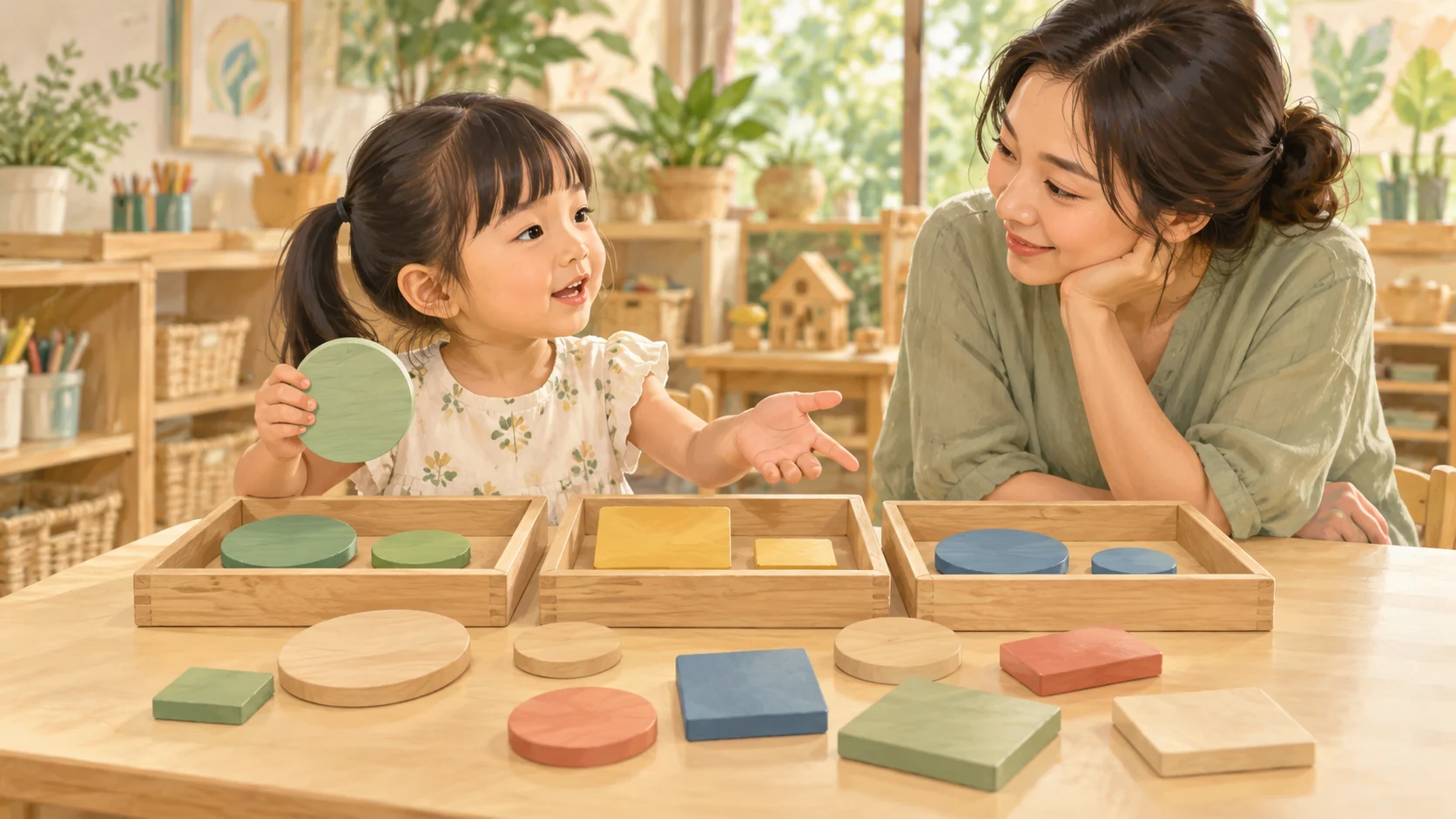
A Kindergarten child may count five blocks correctly but fail when asked to sort them by colour, or put the blocks in increasing size yet say they made a pattern. Those are different mathematical actions. Match identifies a relationship or shared attribute; sort places objects into groups according to a chosen rule; count determines how many; order arranges things according to a criterion or sequence; and pattern involves a recognisable, repeatable or otherwise structured relationship. Knowing one verb does not automatically demonstrate the others. Parents can help by asking what the child was actually supposed to do.
For K1–K2, begin with safe large counters or blocks, naming one clear rule at a time. “Match the two red blocks” is different from “Sort the blocks into red and blue groups”; “Count the red blocks” requires a quantity; “Order the blocks from shortest to tallest” requires a sequence; and “Make a red–blue–red–blue pattern” requires a structure. Let the child act, describe their choice and ask “What rule are we using?” before moving to another task. Avoid tiny objects, timed drills and hidden adult rules that make a correct response impossible to judge fairly.
- Match: pair or identify things that share a specified attribute, relation or quantity.
- Sort/group: classify objects by a stated criterion, possibly using categories that need careful boundaries.
- Count: establish quantity with one-to-one counting and a final total; order of touching objects need not change the total.
- Order: arrange items according to size, length, event sequence or another explicit relation.
- Pattern: recognise or generate a repeatable or predictable structure, such as ABAB with colours.
- Different properties can lead to different valid groupings of the same objects.
- Teach the rule, model a safe example and distinguish child understanding from the amount of language or print required.
This parent guide uses the Clementi-style answer-first format and then develops original worked examples, a comparison table, an adaptable four-week plan, the Fencing Method, teacher questions and a Primary 1–6, PSLE, Secondary 1–4, JC, university and adult-language pathway. MOE’s NEL Numeracy pages directly identify matching, sorting, comparing, ordering, patterning and counting as important early concepts; the family activities below are illustrative examples, not clinical tests or examinations.
Choose your reading route
- Understand the five different mathematical actions — chapters 1–8
- Work through colour, size and number examples — chapters 9–19
- K1–K2 and family practice — chapters 20–27
- Primary to university connections — later study
- Parent FAQs and official sources — closing chapters
Full chapter index
- 1. The same blocks can be used for different mathematical jobs
- 2. Match identifies a relation between selected things
- 3. Sort means establish groups under an agreed rule
- 4. Group can name a collection without fully explaining the rule
- 5. Counting answers how many, not how the objects are arranged
- 6. Order arranges things according to a chosen relation
- 7. Patterning is not the same as putting things neatly in a row
- 8. A visual table of the five tasks
- 9. A worked game: colour sort versus size sort
- 10. Two properties can create overlapping categories
- 11. Counting a sorted group requires a defined boundary
- 12. Matching by number is not matching by appearance
- 13. Order can concern time as well as size
- 14. A pattern can be in sound rather than coloured blocks
- 15. Pattern and prediction are connected, but not identical
- 16. A row can be counted and ordered without being a pattern
- 17. The counting order can change while the total stays the same
- 18. Grouping people deserves care and fairness
- 19. Sorting household objects must remain safe
- 20. Bilingual homes may use different words for the same operation
- 21. K1: begin with two clear matching pairs
- 22. K2: change the rule and ask for a reason
- 23. A two-week family plan that separates the operations
- 24. Fencing a meaningful sorting sentence
- 25. A four-week FENCE-style transfer plan
- 26. What to ask the preschool teacher after a numeracy misunderstanding
- 27. Primary 1–2: categories and quantities become formal question conditions
- 28. Primary 3–4: sets, classification and pattern rules gain precision
- 29. Primary 5–6 and PSLE: the command word changes the answer
- 30. Secondary 1–4: relationships become more abstract and formal
- 31. JC, university and adult life: grouping and counting influence decisions
- 32. Parent FAQs about matching, sorting, counting and patterns
- 33. Official sources and connected eduKateSG reading
1. The same blocks can be used for different mathematical jobs
Put four large toy blocks on the table: two red and two blue, with different sizes. A child may be asked to match, sort, count, order or make a pattern. The objects are unchanged, but each instruction asks for a different operation.
If the adult says “Sort these” without specifying a property, a child might organise them by colour or size. Both can be defensible. The adult should state the intended rule before announcing the answer is wrong.
A helpful introductory exchange is “Today we’re sorting by colour. What colour does each block have?” Later, the same blocks can be sorted by size. Ask what changed in the rule and why the grouping changed.
MOE’s NEL Relationships and Patterns overview distinguishes matching, sorting, comparing, ordering and patterning as related early skills. The child’s task should reflect the specific action rather than a broad label called Maths.
2. Match identifies a relation between selected things
When a child pairs two red blocks, they are matching them by colour. Matching can also involve shape, size, function or quantity. For example, a card showing three toy bears can be paired with a card showing three toy chairs when the chosen relation is equal number.
An adult should tell the learner what counts as a match. Two things may be different colours but share the same shape. Another pair may look visually similar without meeting a particular quantity rule.
Start with obvious pairs and a clear property. Let the child point or place the pieces together before requiring a sentence. Then say “You matched these because they are both red” if that accurately describes the child’s chosen criterion.
Do not teach matching as simply “find identical objects.” Several legitimate mathematical matches depend on a particular relationship rather than perfect identity. The rule and context determine the correct pairing.
3. Sort means establish groups under an agreed rule
A child has six large blocks: three red and three blue. Sorting by colour places the red blocks in one group and the blue blocks in another. The number of items remains six, but the organisation makes one attribute visible.
The same blocks could be sorted by size, shape or another child-determined property. If two attributes are present, the adult should not silently switch from colour to size and treat the child’s previous groups as mistaken.
A good prompt is “How could we sort these?” when exploring multiple possible rules, or “Sort these by colour” when one specific answer is needed. Both are legitimate activities but require different responses.
MOE’s NEL Numeracy learning goals include matching, sorting and comparing things by one or more named attributes and recognising patterns. Parent questions should preserve that clarity.
4. Group can name a collection without fully explaining the rule
The word group sometimes means any collection of things placed or considered together. Sorting is a process of grouping by a chosen criterion. A child can point to a group of toys, but that alone does not show which property was used.
Suppose five toy animals are placed in one basket because they belong to the same pretend story. That may be a meaningful group in play, but it is not necessarily sorted by colour, species or size. Ask the child why the characters are together.
An adult can say “You grouped these because they are all part of the picnic game.” Later, for a formal sorting activity, explain a more specific rule. A category should not be guessed solely from how a child arranged items.
Different purposes can justify different groupings. The child’s rule might be creative and coherent; a teacher can ask them to explain it instead of assuming every alternative is an error.
5. Counting answers how many, not how the objects are arranged
A child counts four large counters placed in a straight row. Then the adult spreads the same four counters into a circle. If none were added or removed, the total remains four. A child who counts the objects differently after rearranging may still be learning number conservation or one-to-one counting.
Move each counter once during the count so the child can see which has been included. After the last number, ask how many are present. The last number in a correct count expresses the total, not just the label of the last touched counter.
Counting is different from sorting. The child can count objects that have not been grouped, or count a subset after sorting. The grouping rule affects which objects are included, not the meaning of counting itself.
MOE’s NEL Counting Skills and Number Sense page discusses one-to-one correspondence, stable order, cardinality and order irrelevance. These are school-guided foundations, not a reason to rush a preschooler into formal proof.
6. Order arranges things according to a chosen relation
A parent asks a child to order three toy sticks from shortest to longest. The task is to create a sequence based on length. The same sticks can be placed in reverse order, longest to shortest, if the instruction changes.
This is different from simply grouping short sticks together. Ordering requires relationships between positions in the sequence, not just membership in a category.
Use clear lengths and align the sticks at the same starting point when comparing. A child may need a visual model if the differences are small. Do not ask them to handle sharp skewers or hazardous household tools; use paper strips or toy blocks.
Later, ordering can apply to events in a story or numbers on a line. Kindergarten can begin with one visible attribute and a short explanation of why the objects belong in that sequence.
7. Patterning is not the same as putting things neatly in a row
A row of toy blocks can look tidy without showing a repeating rule. For a simple pattern, use red–blue–red–blue. The learner can explain what repeats and predict the next colour. If the row is red–red–blue–blue without an agreed pattern unit, the adult should not assume the intended structure.
Some patterns are more complicated than ABAB, and patterns can also involve sounds, movements or shapes. Begin with one clear repeating unit and let the child see it repeated enough times to recognise the relationship.
Ask “What comes next, and how do you know?” A child may identify the next colour by memorising the row; encouraging an explanation of the repeating structure can deepen understanding when appropriate.
MOE’s Relationships and Patterns page includes recognising, extending and creating patterns. The lesson is about the rule, not the mere presence of objects in a line.
8. A visual table of the five tasks
This table is a reference for parents choosing an instruction. It is not a standardised preschool assessment.
| Verb | What the activity requests | Original toy example |
|---|---|---|
| Match | Find a specified shared relation | Pair a red block with another red block |
| Sort | Create groups using a rule | Separate red blocks from blue blocks |
| Group | Treat items as a collection | Put picnic characters together |
| Count | Find a quantity | Count the five blocks once each |
| Order | Arrange in a sequence | Place three sticks shortest to longest |
| Pattern | Show a repeatable structure | Build red–blue–red–blue |
| Compare | Identify a relation between quantities or attributes | Decide which row has more blocks |
The words are connected, and one activity may use several. But an adult should be clear whether the current task asks for classification, amount, order or a repeating rule.
The child can communicate through pointing, moving objects or a short explanation. Do not introduce written symbols before the learner understands the practical question.
9. A worked game: colour sort versus size sort
Use six large safe blocks in two colours and at least two sizes. First ask the child to sort by colour, giving two named baskets or marked spaces. Describe what changed in the arrangement and which property made each group.
Next, mix the blocks and announce a new rule: “Now let’s sort by size.” The blocks may form different groups. That is not a contradiction. The rule changed, so a valid grouping can change with it.
Ask the child to name the sorting rule in their own words, or show it with a gesture if needed. A parent can model “We put the big blocks together” rather than demand abstract mathematical terminology.
Avoid a surprise change in the middle of a trial. A child who correctly uses the first rule should not be told the answer was wrong because the adult secretly intended the second.
10. Two properties can create overlapping categories
A large red block belongs to the red set and the large set. If an adult asks the child to create only a red basket and a large basket without explaining what to do with blocks that satisfy both conditions, the task can be ambiguous.
For an introductory K1 game, separate one attribute at a time. For an interested K2 learner, introduce a simple grid that crosses red/blue with large/small. Each item can then occupy a cell representing both properties.
Do not assume that children must place an object into only one conceptual category in every possible sorting task. A cat can be both a pet and a mammal in a more advanced example, while the intended grouping scheme may still require a single organised arrangement.
The useful communication habit is stating the classification rule and what to do when multiple properties apply. This is more valuable than treating categories as automatically exclusive.
11. Counting a sorted group requires a defined boundary
A child sorts blocks into two colour groups, then the adult asks “How many red blocks?” The child must count the red subset, not every block on the table. If the child counts the blue blocks too, they may be uncertain about the word red, the group boundary or the counting procedure.
Point to the relevant collection and ask the child to count each item once. The last number named is the total when the counting procedure is correct. Then count all the blocks separately to show that total quantity and group quantity differ.
A child who can count six objects in one pile may still be learning to identify which objects belong to a requested category. The issue is not automatically weak arithmetic.
This connects vocabulary and number sense: a word defines which objects are relevant to the question. Formal school problems later add more difficult conditions, but the K2 example can stay concrete.
12. Matching by number is not matching by appearance
A card showing three toy animals might match another card showing three bowls under the rule “same number.” The pictures are visually different. If the adult instead uses the rule “same animal,” that pair would not match.
A child may choose a visually similar pair while the adult intended a numerical one. Clarify the requested relationship before deciding the child misunderstood quantity. The task should not require mind-reading.
Use clear, familiar quantities and large picture cards. If the child needs to count each set, allow that procedure rather than demanding instant recognition. The learning goal is understanding why the quantities can match despite different objects.
MOE’s counting and number sense resource discusses number names, quantities and their relationships. Parents can use the ideas in meaningful play without requiring a full written numerical proof.
13. Order can concern time as well as size
Three picture cards show a person preparing a snack, eating it and putting the plate away. Asking the child to put the events in order is a sequencing task. It does not require the cards to be sorted by colour or counted as a set.
The child may need story context to know what happened before and after. A picture alone can be ambiguous, especially when different families follow different routines. Give enough information for the intended order to be fair.
Use “first,” “next” and “last” naturally. The eduKateSG sequence-word guide explores how such terms communicate event order.
The child can understand a sequence through storytelling while still learning formal ordering by numerical magnitude. Those are related but distinct applications of the broader ordering idea.
14. A pattern can be in sound rather than coloured blocks
Clap–tap–clap–tap is a repeating pattern of two actions. A child may enjoy making this pattern without seeing any written letters or numerical symbols. The adult can describe what repeats and invite a new turn.
If a child has a hearing difference or finds loud sounds uncomfortable, use gentle visible gestures or picture cards instead. The pattern is in the structured sequence, not in the loudness of the performance.
A parent might move a toy left–right–left–right on a safe table to show the same ABAB idea through movement. Now the representation has changed while the rule remains recognisable.
This supports transfer between contexts. A child who understands red–blue blocks may still need a model for a movement pattern, which is a reason to teach flexibly rather than assign one global ability score.
15. Pattern and prediction are connected, but not identical
Once a child recognises a red–blue repeating pattern, they may predict that the next block should be red. The prediction is based on the observed rule. But recognising a pattern is different from guessing the next event without any information.
A parent can say “You predicted red because the pattern repeats red, blue.” Then add the next block and check whether it follows the chosen rule. If the adult deliberately changes the rule, explain the change rather than treating the child’s earlier prediction as foolish.
The eduKateSG guide on guess, predict, observe and check discusses this evidence relationship in another domain.
Kindergarten can begin with one easy repeating sequence. There is no need for advanced algebraic notation or formal statistical inference to see how a pattern supports a prediction.
16. A row can be counted and ordered without being a pattern
Place five blocks from shortest to tallest in a row. They have been ordered by height, and the child can count five blocks. But there may not be a repeating ABAB pattern in their colours or shapes. Several true statements can describe one arrangement without being synonyms.
Ask the child first to count the objects and then to describe their size order. Later ask whether any repeating colour sequence is present. A child may recognise that the row is ordered but does not show the pattern the adult suggested.
Do not insist that every organised sequence must be called a pattern in the narrow introductory repeating-unit sense. In advanced Mathematics, patterns can be non-repeating, but the preschool lesson should state the particular structure it is asking the child to examine.
The transferable idea is to choose a word based on the operation and evidence, not because the objects look attractive in a line.
17. The counting order can change while the total stays the same
A child counts four counters from left to right and obtains four. The adult then points to them from right to left without adding or removing anything. If every counter is counted exactly once and the number sequence is used correctly, the total remains four.
A young learner might think a different counting path changes the quantity. Demonstrate slowly with one-to-one correspondence and a clear final statement: “There are four counters.” Recounting can help the child check.
This conservation of number is separate from ordering the counters by length or making a pattern with them. The adult should not call every numerical act ordering just because counting words have a fixed sequence.
MOE’s Counting Skills and Number Sense overview names order irrelevance and cardinality among counting principles. These ideas become useful through concrete, appropriately paced experiences.
18. Grouping people deserves care and fairness
Sorting toy shapes by colour is a harmless mathematical activity. Sorting real children into public categories based on their bodies, families, disabilities or backgrounds can have social implications that require thoughtful adult judgement. A parent should not use classmates as objects in a ranking exercise.
If a group activity needs teams, choose an inclusive and fair method rather than implying that a child’s identity makes them better or worse. The word group can describe a cooperative arrangement without turning differences into labels of worth.
Teach comparison and classification through objects, pictures or voluntary interests where appropriate. This keeps the mathematical idea visible while protecting dignity and relationships.
The child can learn that groups may be created for a purpose and can change when the purpose changes. That is a more sophisticated understanding than assuming every label is permanent.
19. Sorting household objects must remain safe
A parent might be tempted to sort coins, batteries, tablets, small beads or cleaning supplies to make a realistic activity. Those objects can introduce choking, chemical, electrical or poisoning risks and are unnecessary for Kindergarten vocabulary learning.
Choose large blocks, soft toys or big picture cards that are appropriate for the child’s age and abilities. Ensure containers are stable and avoid sharp edges. The adult can model a grouping without the child physically handling unsafe items.
A child who is not comfortable manipulating objects may sort by pointing to pictures or directing an adult. The mathematical rule remains accessible even when the motor response changes.
The purpose is reasoning about attributes, not testing speed, grip strength or the ability to handle household objects safely. Adults maintain responsibility for the environment.
20. Bilingual homes may use different words for the same operation
The terms match, group, sort, order and pattern may have different natural expressions in Mandarin, Malay, Tamil or another home language. A child can understand a colour-sorting rule in one language while being uncertain about the English instruction.
Demonstrate the activity and discuss it naturally in the familiar language. Then model a correct English phrase. The child may successfully perform the operation before independently producing the English verb.
If a teacher raises a concern, ask whether the learner knew the objects, the attribute and the action. The specific instruction and available support matter.
Maintaining rich family-language communication supports concept development while children acquire the school-English labels. A missing verb does not establish a general reasoning deficit.
21. K1: begin with two clear matching pairs
For K1, start with two large red blocks and two large blue blocks on a table. Ask the child to put two blocks of the same colour together. Model the word match in a meaningful sentence: “These match because they are both red.”
Later, invite a simple sort into two colour groups. Do not add counting, ordering by height and complex patterning in the same first activity. A short successful example can establish one word.
A child may communicate by moving the blocks, pointing or saying “same”. Accept that meaningful relation and model the more precise instruction word without shame.
The family can revisit another attribute on a different day, respecting the child’s interest and comfort. No fixed K1 milestone is established by the toy activity.
22. K2: change the rule and ask for a reason
K2 children may enjoy sorting the same blocks first by colour and then by size. Tell the learner explicitly when the rule changes. Invite a short explanation of why the new groups differ from the old ones.
If the child wants, count the items within each group or arrange them from shortest to tallest. Each new action should be named so the child understands which mathematical job is happening.
Introduce a repeating colour pattern as another distinct task, not as proof that every row is a pattern. A parent can ask “What repeats?” and provide a model when needed.
The activity is educational play, not a national assessment or a method for ranking children. A clear rule and meaningful explanation are more important than finishing a long worksheet quickly.
23. A two-week family plan that separates the operations
Week one can focus on matching and sorting with a small set of safe large objects. Choose one visible property and let the child explain their grouping through movement or words. A parent can model the intended English verb.
Week two can use the same materials for counting and ordering, followed by a short, clearly repeating pattern if the child is interested. Keep the action and success condition explicit so each task supplies useful information about understanding.
This is an illustrative schedule, not a clinical intervention or an official MOE developmental deadline. A child may need repeated experience with a single property before another operation is introduced.
Observe what helped: naming the criterion, demonstrating one pair, a visual model or asking a clarification question. That record can guide teacher collaboration without turning play into a scorecard.
24. Fencing a meaningful sorting sentence
The eduKate Fencing Method expands one correct message through Base sentence → One detail → Tone → Logic → Switch context. The adult can model the structure while the child contributes a short sentence, gesture or arrangement.
Base: “Mira sorted the blocks.” One detail: “Mira sorted the blocks by colour.” Tone: “Pleased with her groups, Mira sorted the blocks by colour,” only if the story establishes that feeling. Logic: “She made a red group and a blue group because she wanted to find the colours easily,” if that was her reason. Switch context: “Ben sorted the books by size.” The meaning of sorting remains tied to a rule.
Do not append a false motive merely to complete a long sentence. If the learner cannot identify the sorting criterion, return to the base and a clear demonstration.
This is an eduKate teaching scaffold, not an official preschool or clinical grading system. One accurate explanation of the rule can be enough.
25. A four-week FENCE-style transfer plan
A family can use a separate FENCE-style editorial observation mnemonic: focus on one mathematical verb, establish a clear example, notice the child’s response, check the same idea in a fresh context and extend gently.
Week one could use matching by colour; week two, sorting by a stated attribute; week three, counting one chosen set and ordering three objects; week four, repeating a simple pattern with toys or movements. These are flexible suggestions, not a universal sequence that all children must complete.
The adult should not remove visual supports or secretly change the rule to manufacture a failure. A child may ask “By colour or size?” and demonstrate a valuable clarification skill even before sorting the objects.
Progress is useful communication about what mathematical operation is being performed and why the result fits the chosen criterion.
26. What to ask the preschool teacher after a numeracy misunderstanding
Ask which exact verb and rule were used. Did the child match pictures, sort by colour, count a set, order by size or extend an ABAB pattern? Was the criterion visible, named or assumed? Did language or object familiarity affect the response?
A child can correctly sort by colour but struggle when the task changes to size without warning. Another may count reliably but forget to exclude a different object category. Those patterns call for different teaching responses.
MOE’s numeracy prompting guidance includes asking how objects were sorted, how they are alike and which pattern rule was used. Parents can use those questions to collaborate rather than demand a generic “Maths score.”
Persistent broader communication or numerical concerns should be discussed with educators and qualified professionals where appropriate. One mistaken grouping is not a diagnosis.
27. Primary 1–2: categories and quantities become formal question conditions
Primary pupils read instructions such as “Circle the matching shapes”, “Count the red counters” and “Arrange these numbers in ascending order”. The verbs direct different operations, and the words red or ascending specify the criterion.
A student might know how to count yet include the wrong objects because the category word was misunderstood. Another may recognise all the objects but not know how to order the numbers. Teachers should identify which part of the task needs support.
Parents can use safe counters and short language explanations while following school Mathematics instruction. A Kindergarten sorting game does not replace the formal curriculum or guarantee easy examination performance.
The useful foundation is asking what the question is requesting before acting, then checking whether the response meets the named rule.
28. Primary 3–4: sets, classification and pattern rules gain precision
Older Primary work may involve more complex number patterns, properties of shapes and tables of information. A pupil may need to classify objects under several criteria or explain the rule connecting terms in a sequence.
Simply arranging numbers in increasing order is not necessarily the same as identifying the arithmetic pattern that generated them. The student should distinguish order, membership and the rule of change when the question requires it.
A well-chosen example can reveal the difference. Sorting shapes by sides is about a shared attribute, while identifying a numerical pattern may require comparing consecutive values and testing the proposed rule.
The preschool concepts become useful language foundations, but formal mathematical knowledge and methods must be taught through the appropriate syllabus.
29. Primary 5–6 and PSLE: the command word changes the answer
Upper-primary questions may ask pupils to count selected items, compare groups, arrange values, recognise a pattern or justify a classification. The same data can support different correct answers depending on the command word and conditions.
A student who answers “There are six blocks” when asked to sort them has supplied a quantity, not the requested grouping. A student who ranks objects by height when asked for an ABAB colour pattern has performed a different operation.
Teachers can model how to identify the verb, attribute and success condition before solving. Written reading accuracy, mathematical procedures and reasoning all matter. Memorising five English definitions alone will not solve every school problem.
No Kindergarten exercise predicts a PSLE Achievement Level. The enduring habit is preserving the exact task meaning before applying the appropriate method.
30. Secondary 1–4: relationships become more abstract and formal
Secondary Mathematics and Science use classification, ordering, counting, patterns and sets in increasingly abstract contexts. A learner might sort data into categories, count cases, order values on an axis or describe a function’s regularity.
These tasks require formal definitions, notation and evidence. A pattern that appears plausible in the first few terms may not establish a unique universal mathematical rule without further conditions.
Students need to distinguish a category’s defining property from incidental similarities and recognise when data groups overlap. The earlier coloured-block example provides a small conceptual bridge, not the full subject theory.
The educational connection is the habit of stating the criterion and checking whether it actually determines the claimed grouping or sequence.
31. JC, university and adult life: grouping and counting influence decisions
At JC and university, classification rules can affect research data, survey summaries and computational models. Counting items in the wrong category can produce misleading totals even if the arithmetic itself is correct.
Adults use these operations in ordinary work: sorting documents by status, counting appointments, ordering tasks by deadline and detecting a repeated pattern in records. The chosen rule should be explicit and fit the purpose.
A document can be classified in multiple ways, while a formal reporting system may require mutually exclusive categories. Professionals need to know which design they are using and how exceptions are handled.
Kindergarten play can start with two coloured blocks and one clear instruction. The same principle—state the rule, then follow it accurately—remains useful across increasingly complex learning.
32. Parent FAQs about matching, sorting, counting and patterns
### Is sorting the same as counting?
No. Sorting creates groups by a rule; counting determines how many objects are in a chosen set.
### Must matching objects be identical?
No. They can share one specified property or quantity while differing in others.
### Is a neat row always a pattern?
No. A row may be arranged in order without a repeating structure.
### Can one block belong to two categories?
Yes. A large red block can be both large and red. The task must explain how overlapping categories are handled.
### Does changing the counting order change the total?
Not when exactly the same objects are counted once each correctly.
### Should we teach all five words together?
Begin with one useful operation and a clear criterion, then add others as the child understands.
### Can a child sort correctly without explaining in English?
Yes. The concept may be understood while the English sentence is still developing. Model the words in context.
### Do we need worksheets or timed tests?
Not for these introductory preschool activities. Safe manipulatives and meaningful conversation can provide useful learning opportunities.
### Will this guarantee PSLE Mathematics scores?
No. Later curriculum knowledge and school learning remain necessary.
### What can we do tonight?
Match two red blocks, sort a small set by colour, count one group, order three by height and build a simple repeating pattern—naming each action separately.
33. Official sources and connected eduKateSG reading
These official MOE sources ground the distinctions between early numeracy operations. The toy examples, Fencing sentences and four-week plan are educational illustrations, not official examination items.
- MOE NEL — Numeracy Overview
- MOE NEL — Relationships and Patterns
- MOE NEL — Counting Skills and Number Sense
- MOE NEL — Numeracy Prompting Questions
- MOE NEL — Manipulatives and Games
- eduKateSG — All, Some, Few, Most and None
- eduKateSG — Same, Similar, Different and Identical
- eduKateSG — First, Next, Before and After
The next article applies careful vocabulary to the natural world: living, non-living, growing and moving are related observations, but no single visible action proves an object is alive.