
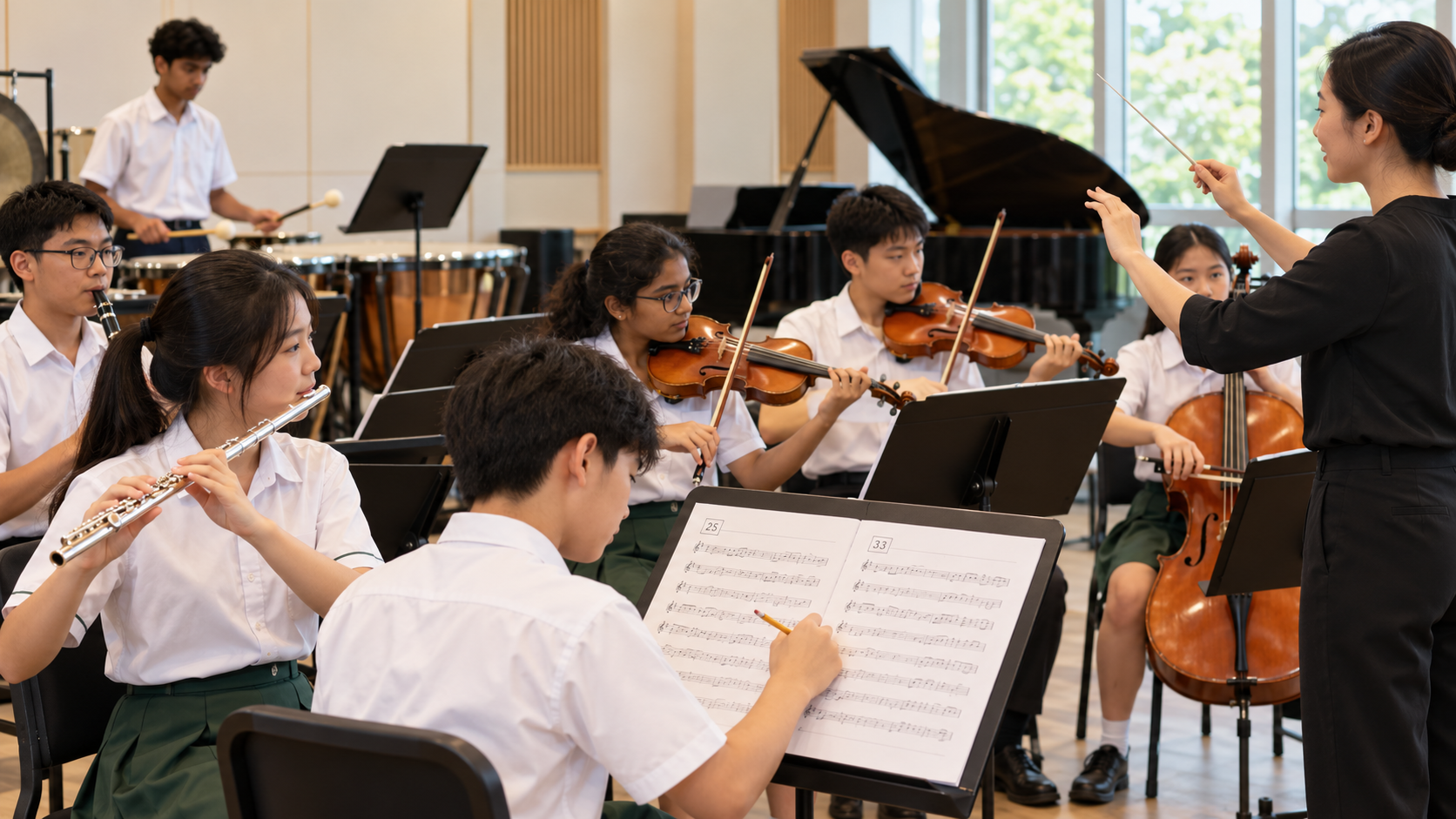
After receiving PSLE results, parents whose children enjoy singing, vocal harmony, choral performance or combining song and dance should first confirm which secondary schools accept the child’s eligible PG1, PG2 or PG3 Posting Group. Then compare what their actual Choir or Show Choir CCAs teach. Bedok View Secondary welcomes pupils with or without years of singing experience; Manjusri Secondary describes breath, projection, scales and part-singing training; Hua Yi Secondary’s Show Choir combines vocal rehearsals with dance; and Ang Mo Kio Secondary describes choral singing, school performances and occasional a cappella work. These programmes are not identical, and joining a school does not guarantee every choir or performance place.
Use MOE SchoolFinder and up-to-date school CCA notices to check audition or intake rules, the weekly schedule, performance expectations, voice guidance, transport and the child’s academic needs. St. Anthony’s Canossian Secondary, Westwood Secondary and Temasek Secondary publish different choir experiences and training commitments. A choir’s past Singapore Youth Festival recognition does not guarantee the newcomer a solo or award, and a Show Choir is not necessarily the same as an academic Music Elective Programme. Rank up to six eligible schools in genuine preference order, including two or three suitable historical cut-off-point alternatives.
- Read the official PSLE Score, S1 Option Form and eligible Posting Group before shortlisting schools.
- Distinguish traditional Choir, Show Choir, a cappella, music-production clubs and academic Music.
- Check beginner entry, vocal coaching, rehearsal days and actual Secondary 1 participation.
- Compare Manjusri, Bedok View, Ang Mo Kio, Hua Yi and other school-specific opportunities.
- Ask about choral technique, part-singing, listening, stagecraft and respectful teamwork.
- Verify competition, solo and overseas travel opportunities rather than assuming universal access.
- Plan a sustainable rehearsal and commute schedule with academic support and appropriate rest.
- Rank six eligible schools honestly and treat historical cut-off points as uncertain.
Definition lock: Choir and Show Choir are different performing experiences
A conventional school Choir often focuses on choral vocal music, blending different voice parts and communicating a musical work through sound. A Show Choir commonly combines singing with choreography and other theatrical elements. Hua Yi Secondary and Broadrick Secondary publish Show Choir descriptions that involve music, movement and performance, while many other schools describe seated or standing choral ensembles with varied repertoire.
Parents should ask whether the child enjoys vocal technique and harmony or would also welcome repeated dance rehearsals. A student who loves singing but dislikes choreography may prefer a traditional choir. A performer who enjoys both could find Show Choir meaningful. The exact activities depend on the school, not just the label.
Parent action: Ask what the child enjoys about singing and whether dancing is part of the desired experience.
Posting Group does not measure singing potential
PG1, PG2 and PG3 facilitate Secondary 1 admission under Full Subject-Based Banding. They reflect PSLE eligibility and do not measure musical sensitivity, voice range or enjoyment of ensemble work. G1, G2 and G3 describe academic subject demand. Pupils with different school-entry routes can develop vocal skills and participate meaningfully in music.
Read the official S1 Option Form before researching CCAs. A strong primary-school solo or certificate does not override ordinary school posting rules. If a pupil has a confirmed DSA-Sec allocation in a relevant talent area, that has its own commitment. Schools must still provide appropriate teaching in academic subjects alongside performing-arts experiences.
Parent action: Keep admission eligibility and musical interest in separate parts of the shortlist.
Bedok View describes a welcoming vocal-learning environment
Bedok View Secondary’s September 2026 Choir page emphasises that singers with different experience levels are welcome. It describes musical variety, teamwork and a willingness to grow. The published schedule lists Tuesday and Thursday sessions from 3.30 pm to 6 pm and a 2025 Singapore Youth Festival Certificate of Accomplishment.
Parents should confirm current 2027 intake and whether capacity, auditions or other arrangements apply. A welcoming philosophy is valuable, but it does not mean every new member is immediately selected for all competitions or solos. Ask how beginners receive training and build confidence alongside more experienced singers.
Parent action: Ask Bedok View how new Secondary 1 voices are introduced and supported.
Manjusri emphasises breathing, scales and part-singing
Manjusri Secondary’s July 2026 Choir page identifies breathing technique, projection, scale-singing, harmonic blending and music literacy as key skills. Its regular sessions are listed for Monday and Wednesday afternoons. This offers a concrete example of a programme focused on developing musical fundamentals rather than only memorising songs.
Ask how pupils practise each skill and how teachers adapt exercises to different starting points. A child who sings well in the shower may be unfamiliar with reading a score or holding a harmony line. Good coaching introduces these areas progressively and avoids humiliating new singers. The timetable should also suit the family’s travel and homework commitments.
Parent action: Ask how Manjusri teaches basic vocal and music-reading skills to beginners.
Ang Mo Kio develops community through choral performance
Ang Mo Kio Secondary’s August 2026 Choir page describes an ensemble performing in different voice formations, including SAB and sometimes SATB, alongside school events, exchanges and competitions. The page also records a student-executive a cappella tribute to teachers, showing that a cappella can be one selected performance format rather than the entire regular CCA.
Parents should not assume that every new choir member joins an a cappella group or that all choir pieces use the same arrangement. Ask which musical styles are taught and how pupils are guided into suitable voice parts. A child’s sense of belonging and the quality of everyday rehearsal may matter more than any one celebrated performance.
Parent action: Check the regular choir programme separately from selected a cappella or senior performances.
Hua Yi’s Show Choir includes separate vocal and dance sessions
Hua Yi Secondary’s August 2026 Show Choir page describes a combination of singing, dance and stage expression, similar to the performing energy of contemporary music videos. Its 2026 schedule separates Wednesday vocal training from Friday dance rehearsal. The programme also includes service activities and festival participation.
This is an important parent decision. A pupil who loves voices but finds movement stressful should understand the routine before joining. Another child may welcome the integration of physical performance and music. Ask how beginners learn choreography and how the club manages different experience levels rather than treating public award videos as the entire programme.
Parent action: Check whether the pupil enjoys a combined singing-and-dance weekly commitment.
Broadrick’s Show Choir emphasises theatrical performance
Broadrick Secondary’s August 2026 Show Choir page describes work across singing, dance and drama, with regular Monday and Wednesday training and additional Friday sessions when required. Its objectives include confidence, appreciation of different musical styles and teamwork. This shows that Show Choir can be an interdisciplinary performance experience rather than a conventional stationary choir.
Ask how much time the group devotes to vocal improvement, choreography and acting. A student may discover an unexpected strength through the combination. But it is important to know the physical and rehearsal commitments, particularly when the child is also adapting to secondary-school academics.
Parent action: Ask Broadrick about the relative time spent on vocals, dance and theatrical work.
St. Anthony’s Canossian offers a wide choral style range
St. Anthony’s Canossian Secondary’s August 2026 Choir page describes singing across classical and contemporary styles while developing technique, confidence and group identity. Its published schedule includes Wednesday and Friday rehearsals. This can suit a pupil who wants to experience musical repertoire beyond one genre.
Ask how the school teaches musical interpretation and whether the child can participate without previous external coaching. A school’s public performance photographs can be inspiring, but the regular learning and student support matter more. Confirm current rehearsal times and CCA entry requirements with staff.
Parent action: Ask what music styles the choir teaches and how beginners develop technique.
Westwood gives another example of a varied Choir CCA
Westwood Secondary’s July 2026 Choir page describes building singing confidence, teamwork and appreciation of music across cultures and genres. The published schedule lists Wednesday and Friday sessions. Its award history may help parents understand past activities, but not the exact future experience of an entering Secondary 1 pupil.
Ask about regular repertoire, how singers receive feedback and whether there are opportunities to collaborate with other groups. A pupil who enjoys learning songs from different cultures may value variety and the explanation of their context. The school still needs to suit the child’s academic and travel requirements.
Parent action: Compare ordinary rehearsal learning rather than relying only on recent choir awards.
Temasek Chorale trains twice weekly with performance seasons
Temasek Secondary’s May 2026 Choir page describes a large choral group, twice-weekly regular training, additional sessions near competitions or performances and opportunities for choir exchanges and concerts. This is a useful example of the difference between normal CCA time and the more intensive weeks leading to a show.
Parents should ask how extra rehearsals are communicated and whether new singers can manage the timetable. A child may enjoy performances but still need sufficient rest and study time. The capacity to participate consistently over several years matters more than the excitement of one concert.
Parent action: Ask about normal weekly training and additional pre-performance commitments.
Breathing instruction should be age-appropriate
Choral singing includes learning how posture, breath and phrasing support clear musical delivery. A beginner may breathe at inconvenient points or lose control during a long phrase. Good coaching helps the pupil listen and develop appropriate habits gradually without presenting strain as a badge of commitment.
Ask how instructors teach basic technique and respond when a young voice is tired or uncomfortable. Parents should not substitute aggressive home drills for trained vocal guidance. The goal is healthy and expressive participation, not forcing a child to imitate an adult singer’s sound.
Parent action: Ask how teachers help new singers learn comfortable phrasing and safe vocal habits.
Voice parts help singers learn to listen to one another
Choirs may organise singers into different lines or sections, depending on the music and the young voices available. The pupil may need to sustain a melody while hearing a different part nearby. This develops listening, concentration and awareness of how individual contributions fit into a shared sound.
Ask whether the school introduces harmony gradually and helps beginners practise without embarrassment. A child who finds their line unfamiliar should be given guidance rather than told they have no musical ability. Ensemble skill develops through repeated appropriate practice and cooperation.
Parent action: Ask what the student learns about holding a part while listening to the whole choir.
A cappella is a technique, not always a separate CCA
A cappella singing uses voices without instrumental accompaniment. It can involve several vocal parts and sometimes vocal percussion, but its exact form varies. A school Choir may perform one a cappella piece without offering a dedicated a cappella ensemble to every member.
Parents should check the actual repertoire and selection rules before assuming the child will sing in a specialised small group. The basic Choir CCA can still provide rich opportunities for harmony and musical understanding. A pupil may discover an interest in unaccompanied singing as confidence grows.
Parent action: Ask which a cappella experiences are regular, occasional or selected.
Show Choir combines two kinds of coordination
A Show Choir performance may require singing while moving through choreography, which can affect attention and the demands on a beginner. Students learn to remember musical and physical sequences while cooperating with the group. The performance can be exciting, but the regular training requires time and patience.
Ask how the school introduces singing and movement in stages. A pupil who is a strong dancer may still need vocal guidance, while a singer may find choreography new. A supportive programme treats both as learnable rather than expecting immediate perfection.
Parent action: Ask how first-year members practise singing and movement before combining them.
Music reading is valuable but not always a prerequisite
Reading notes and rhythmic notation can help a choir learn unfamiliar repertoire, but some pupils join with more practical singing experience than formal theory. A suitable school should explain what knowledge is expected at entry and how novices are supported. Families should not invent a requirement for expensive private music lessons.
Ask whether the school uses score reading, listening recordings or other appropriate learning methods. A pupil can develop confidence through a structured progression. Good instruction helps them understand musical ideas rather than merely copy an experienced section leader.
Parent action: Ask what music-literacy skills a beginner learns during the first term.
Choir involves language and cultural understanding
Choral repertoire can include music in different languages and from different traditions. Ngee Ann, Westwood and other school choir descriptions emphasise cultural variety. Singing unfamiliar words is more meaningful when pupils learn appropriate pronunciation and something about the text’s context.
Ask how teachers prepare students to communicate lyrics accurately and respectfully. A child can benefit from reading and language learning alongside the musical performance. The goal is not simply memorising sounds without understanding, but appreciating what the piece is trying to express.
Parent action: Ask the pupil what the song’s text means and how it shapes the performance.
A choir CCA is not an examinable Music subject
Normal Music, school Choir, the Music Elective Programme and later national examination subjects have different purposes and entry conditions. Singing in a CCA does not automatically place a student into an academic Music elective, and a school offering MEP does not mean every child admitted to that institution can enrol in the programme.
Ask what the pupil actually hopes to learn. A child who enjoys group singing may be happy without more demanding examined music theory, while another might want to pursue formal studies. Verify the particular school’s academic route and the timetable consequences before making promises about qualifications.
Parent action: Keep Choir membership, normal Music and MEP choices in different columns.
Choir entry and solo selection are separate decisions
Some choirs use voice checks, selection or allocation when places are limited, while others welcome singers who are new to formal training. Joining a school does not guarantee entry to a selected choir or a solo part. A Primary 6 singing certificate may show enthusiasm but does not override the receiving school’s CCA procedures.
Ask about auditions, beginner opportunities and how voice parts are assigned. A pupil should know that a role in a large ensemble is worthwhile even without an individual spotlight. Suitable coaching helps students gain confidence and musical understanding over time.
Parent action: Verify initial CCA entry and later solo or competition selection separately.
Group harmony depends on every singer listening
Choral music requires different voices to contribute to a shared performance. A student may need to sing one part while hearing another, follow a conductor and adjust expression without losing the line. These skills can develop attention and cooperation beyond the desire to sound impressive individually.
Ask how the school teaches young singers to listen to the whole group and receive feedback. A child whose part is not the melody can still be essential to a balanced arrangement. Parents should value reliable collaboration instead of treating every ensemble member as a potential soloist.
Parent action: Ask what the pupil did that helped the choir sound more unified.
Historical SYF awards are not future guarantees
Schools may list Singapore Youth Festival certificates or national and international choral festival recognition. These describe past cohorts and selected performances. They do not promise that an entering pupil will receive the same award, perform every piece or attend a particular festival.
Ask about ordinary rehearsal quality, beginner coaching and how instructors help singers recover from mistakes. A well-supported choir can provide valuable learning even when it has fewer public awards. The school should be chosen for the actual child’s development and whole-school fit.
Parent action: Separate competition achievements from regular learning opportunities.
Changing adolescent voices require suitable guidance
Secondary school pupils can experience changes in vocal range, comfort or confidence. A suitable choir instructor should help them participate with age-appropriate repertoire and sensible technique. A young singer should not be pressured to imitate an adult voice or force an uncomfortable register for a performance.
Ask how the school responds when a member’s voice is tired or changing. Persistent pain or concerning symptoms merit suitable adult attention and professional advice, not an instruction to push harder. Healthy musical development should be more important than one concert result.
Parent action: Ask how coaches support voice changes and teach comfortable singing habits.
A shy child can find belonging without a solo
Some students enjoy singing with classmates but feel nervous about speaking or performing alone. Choir may create a structured shared interest in which pupils gradually build friendships and confidence. That does not mean every shy student should be compelled to join or that singing will instantly change their personality.
Ask how the club welcomes new members and provides early practice opportunities without embarrassment. The child’s own enjoyment is central. A good choir helps students contribute respectfully whether they are naturally outspoken or prefer a quieter role in the group.
Parent action: Ask whether the pupil looks forward to ensemble practice, not only stage performance.
Different languages can enrich choral learning
Choirs may sing music from several cultures, historical periods and languages. The text matters because pronunciation and meaning influence expression. Schools that describe varied repertoire, such as Ngee Ann and Westwood, may offer opportunities to discover musical styles beyond the child’s usual listening preferences.
Ask how teachers explain the song text and its cultural context. A pupil can practise unfamiliar words respectfully without being expected to become fluent in a new language immediately. Understanding the lyrics can make the performance more meaningful than simply memorising syllables.
Parent action: Ask what the song communicates and how the choir expresses it.
Music production and Choir are not identical experiences
A choir may occasionally be recorded for a school event, but singing in harmony is different from writing songs, editing tracks or producing digital audio. Some schools also offer music technology through normal lessons or another CCA. A pupil attracted to software may not get enough of it through Choir alone.
Ask the child if they want to sing, arrange, record or manage sound equipment. Each involves different skills and possibly different clubs. The family’s school research should identify real opportunities rather than assume every programme carrying the word music teaches everything.
Parent action: Distinguish vocal performance from digital production and live sound duties.
Show Choir asks pupils to coordinate song and movement
Show Choir can combine harmonised singing with choreography and elements of theatre. Hua Yi separates singing and dance rehearsals in its current schedule; Broadrick describes group work spanning music, dance and drama. The pupil may find this exciting but also more demanding than a conventional choir.
Ask how the school teaches beginners to combine movement with vocal performance safely and gradually. A student who loves singing but not dancing might prefer a traditional ensemble, while another welcomes the integrated challenge. Match the child’s actual interests, not just an online festival video.
Parent action: Check both the vocal and physical commitments of Show Choir.
Performance seasons can add rehearsals
Choirs often take part in school ceremonies, concerts and selected competitions. Preparing for a major performance may require additional practice beyond the normal weekly timetable, while smaller events may involve only some members. A school website’s regular training days do not capture every possible late rehearsal.
Ask when extra commitments are expected and how families are informed. Pupils still need appropriate rest, homework time and safe transport. A choir should enrich school life rather than overwhelm the child’s whole week.
Parent action: Ask about normal sessions and the typical increase before shows.
Special choir exchanges may be selected or historical
Schools sometimes describe guest-conductor workshops, choir exchanges or festival trips. Such experiences can broaden musical learning but vary by year, organiser and capacity. A photo from a past festival is not a promise that every new Secondary 1 singer will attend the next one.
Ask what regular experiences remain available when a special event is not scheduled. The quality of weekly instruction and peer support matters more than rare opportunities. Families should not spend or plan travel based on a promotional description without confirmation.
Parent action: Label exchanges and special performances as confirmed, selected or past.
Performance attire and expenses need checking
Choir may require particular concert clothes, folders or other small supplies. Some schools provide approved items; others ask parents to purchase specified attire. Requirements can change between performances, so an older member’s list may be unreliable.
Ask about compulsory costs and financial assistance where relevant. Do not buy elaborate equipment or private coaching simply because a school choir has high-profile performances. A supportive group should help members learn through the resources actually available.
Parent action: Obtain the current choir materials and attire instructions before spending.
Choir can support musical confidence without guaranteeing grades
Listening, rhythm and sustained practice can be meaningful learning experiences. But participation in a choir is not a substitute for English, Mathematics, Science or formal Music teaching. A student may have strong vocal instincts while finding certain academic subjects difficult.
Ask how the school supports the learner at the appropriate G-level and how CCA expectations fit near assessment periods. A holistic school helps pupils grow musically and academically. Parents should not claim a high-performing choir guarantees examination improvements.
Parent action: Compare academic teaching and music opportunities as separate strengths.
The daily commute matters on rehearsal days
Several school choirs publish training twice weekly until late afternoon or early evening, and concerts may finish later. A long school journey can create substantial demands when combined with homework and other commitments. Current 2026 schedules may change for 2027.
Test the return journey after the expected choir end time, not only the morning trip. A nearer school with sound vocal teaching may offer a more sustainable experience than a distant institution selected for past recognition alone.
Parent action: Compare regular dismissal and late rehearsal journeys.
School COP and Choir allocation are separate uncertainties
Previous-year school cut-off points describe the final score admitted through a particular Posting Group in an earlier exercise. They can shift with demand and vacancies. A school’s choir reputation does not change the official academic posting rules, and admission does not guarantee every selected music role.
MOE advises six genuine preferences, including two or three appropriate schools whose previous COPs are less stringent than the child’s score. Each school should remain suitable if Choir is full or the student develops another interest.
Parent action: Track school entry and choir selection separately.
The school choice order should be real
Under normal S1 Posting, the ranked preference order matters within the standard tie-breaker sequence for equal-scoring candidates, after citizenship and before balloting. Ranking a school first should express true preference, not a rumour that a prestigious choir rewards eager applicants.
Discuss with the child where they would prefer to attend ordinary classes, make friends and participate in CCAs. Every option should be genuinely acceptable and feasible for the family’s transport and schedule. A strong list gives more than one positive possible outcome.
Parent action: Verify all six school codes and the actual order of preference.
The right Choir school helps a pupil belong and learn
Choral singing can develop communication through music, friendship, patient practice and teamwork. Some pupils may continue to advanced singing, while others will keep it as a meaningful hobby. Neither future requires a solo or an award in the first year.
Choose among eligible schools using the real beginner programme, rehearsal expectations, supportive culture, academics and daily logistics. After posting, help the child settle into study and enjoy contributing to the ensemble without turning one performance into a judgment of their worth.
Parent action: Choose a school where singing remains positive and educationally meaningful.
Frequently asked questions about Choir and Show Choir
Is Show Choir different from ordinary Choir?
Yes. It commonly includes choreographed movement or theatrical performance alongside singing.
Does Bedok View welcome beginners?
Its current choir description welcomes different levels of experience, subject to actual CCA entry.
Does Manjusri teach breathing and part-singing?
Its published programme includes breathing, projection, scales and blending.
Does Choir mean admission to MEP?
No. Formal academic Music programmes are separate.
Can a PG1 pupil be a strong singer?
Yes. Posting Group is not a vocal ranking.
Is every member given a solo?
No. Solo opportunities and selected performances depend on the actual programme.
Does Hua Yi Show Choir include dance?
Yes. Its published schedule separates vocals and dance practice.
Do all choir members participate in every festival?
Not necessarily. Availability and selection can differ.
Are choir schedules fixed year to year?
No. Confirm the incoming cohort’s regular and special rehearsals.
Are past COPs guaranteed?
No. They reflect past admission outcomes.
Does a SYF award guarantee a future one?
No. Past performance results cannot promise future results.
How should six schools be ranked?
In genuine eligible preference order with suitable historical alternatives.
Official school Choir pages and related parent guides
Broadrick Secondary Show Choir
eduKateSG Music Production and Songwriting
Reviewed 5 November 2026. Choir intake, rehearsal schedules, selected roles and festival participation can change for the incoming 2027 cohort. Verify current school arrangements. A choir’s past awards and the school’s previous COP are not guarantees.