
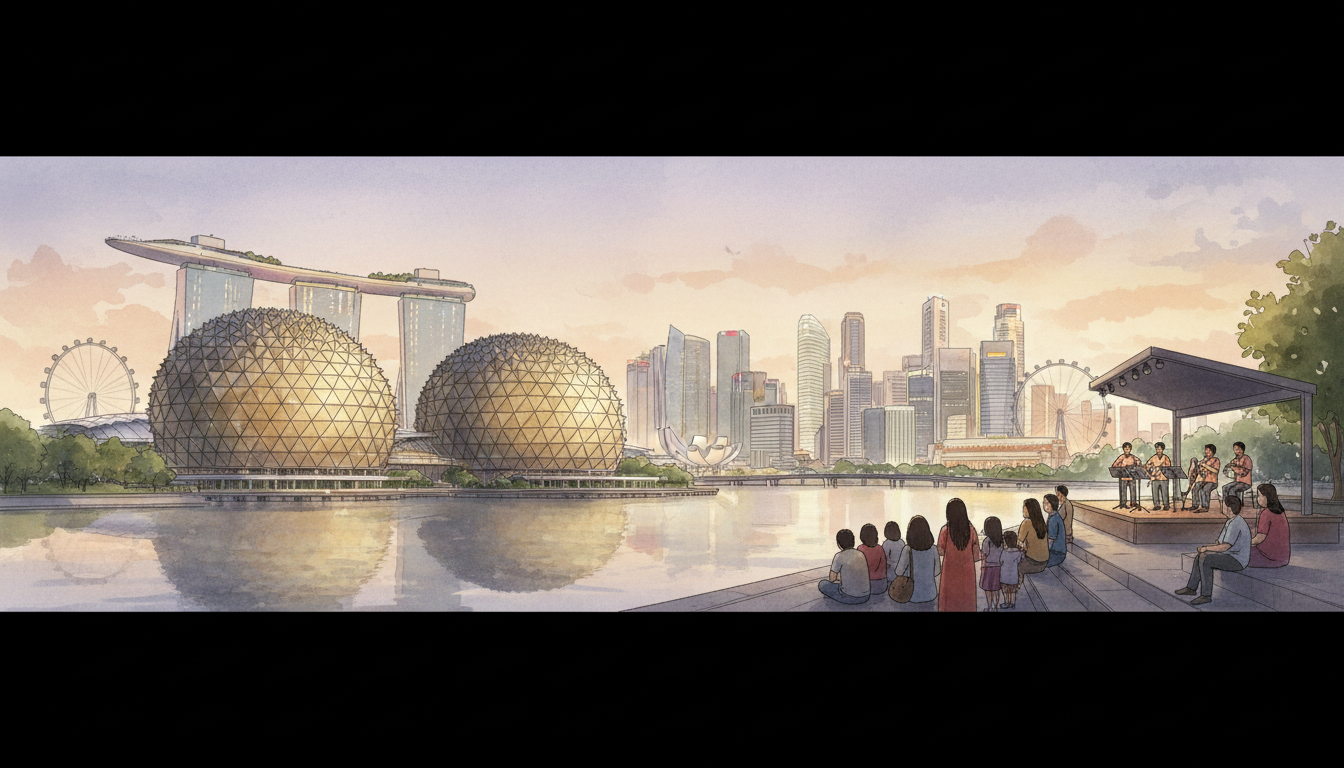
What to do in Singapore when you want to experience music, dance or theatre without needing to understand every artistic tradition in advance? Visit Esplanade – Theatres on the Bay and choose one live performance that makes you curious. Its public concourse and waterfront programme offer an approachable entry into the performing arts, while its concert halls, theatres and studios present more specialised ticketed experiences.
A good Esplanade outing is not a race to see the famous durian-shaped roofs. The deeper experience begins when performers and audiences share the same time and place. A voice, instrument, movement or silence may communicate something that a photograph cannot fully reproduce. The best way to learn is to listen attentively, ask what changed during the performance and respect the people making the work.
The official Esplanade programme directory lists current free and ticketed events, while the DBS Foundation Outdoor Theatre page explains that free waterfront performances normally occur Fridays, Saturdays, Sundays and public holidays. Esplanade’s ticketing guide lists the Box Office and Visitor Centre as open noon to 8 p.m. daily. Specific showtimes, tickets, age advisories and weather arrangements must be verified separately; no general article can guarantee that a particular act is performing on your day.
Quick answer: watch one live programme carefully
- Open the current Esplanade “What’s On” directory and filter for free or ticketed events.
- Choose one suitable music, dance or theatre performance based on the group’s interests and age.
- Read the exact date, venue, duration, admission terms and any sensory or language advisories.
- Arrive with enough time to find the correct entrance without rushing.
- Listen and observe without distracting the performers or other audience members.
- Record one element that changed during the work—rhythm, movement, mood, story or interaction.
- Afterward, ask what made the performance different from listening to a recording or watching a video.
- Use the waterfront or building architecture as an optional addition, not a substitute for the live arts experience.
Why live performance matters
A live performance unfolds in real time. Performers make choices and respond to one another while the audience experiences the event together. Even when the same composition or script is presented again, timing, interpretation and audience atmosphere may differ. That makes a concert or play different from a recording edited for repeated playback. You do not have to understand a genre fully to appreciate the experience. Begin with a simple question: what were the performers trying to communicate, and what visible or audible evidence helped you understand it? A thoughtful answer is more useful than claiming that every work must generate the same emotional response.
What Esplanade is
Esplanade is Singapore’s performing arts centre beside Marina Bay, with venues for music, theatre, dance and other creative activities. Its institutional history records the official opening on 12 October 2002. The site contains large halls, smaller studios, a waterfront theatre and free public performance areas. Different spaces suit different sizes and styles of work. A seated orchestral concert, intimate chamber performance, children’s activity and outdoor dance showcase require different conditions. The point is not that one venue is superior to another; each creates a particular relationship between performers and audience.
The famous roof is not actually a durian
Esplanade’s two rounded shells have been nicknamed the “durians” because their exterior cladding resembles the surface of the tropical fruit. The official architecture story explains that the early design proposals evolved through several forms and were not originally intended to imitate a durian. This is a useful reminder that public nicknames and architectural intentions are not necessarily identical. Look at the structure and describe its shapes before guessing what it represents. A building can acquire cultural meaning through the way people recognise it, even when that meaning was not the architect’s first concept.
The aluminium sunshades have a job
The Esplanade architecture account explains that the distinctive exterior cladding consists of aluminium sunshades attached to the double-glazed surfaces of the principal venues. They help admit light while limiting tropical solar heat. This is an example of form and function working together. The spikes may be visually memorable, but their purpose is not purely decorative. A student can ask how solar exposure influences building comfort and energy demand. Avoid inventing a numerical cooling benefit without measurements. The useful observation is the connection between architectural identity and a practical environmental challenge.
Maintenance is part of architecture
Esplanade says trained rope-access technicians clean its complex exterior cladding by hand, with the process for both shells taking approximately two months. That highlights the work required after a building opens. A striking structure must remain safe, clean and functional through years of public use. Do not assume design is complete when construction finishes. Material selection, inspection, access and maintenance costs affect real outcomes. Ask what kinds of equipment and expertise may be required to care for an unusual roof. This is a practical design lesson that applies to bridges, parks, transport stations and school buildings as well as cultural landmarks.
Concert Hall and Theatre serve different arts
The Concert Hall is designed for music performances where sound quality and orchestral or ensemble requirements matter. The Theatre supports staged productions with lighting, scenery, acting and other theatrical possibilities. The same building contains distinct technical spaces because different art forms require different conditions. Do not assume every concert takes place in the Concert Hall or every dance work must appear in the large Theatre; programmers choose from multiple venues. Read the actual event listing. A first-time visitor can learn about the building by asking what the selected work needs from its stage and audience arrangement.
How acoustics changes a performance
Acoustics concerns the behaviour of sound in a space. A concert hall’s geometry, surfaces and technical equipment affect how audiences hear voices and instruments. Esplanade’s architecture history identifies the late acoustician Russell Johnson of Artec Consultants as a key designer of its Concert Hall’s acoustic capabilities. Different ensembles may benefit from different sound conditions. A student can ask why an unamplified string performance might require a different acoustic approach from a heavily amplified music event. Avoid claiming exact reverberation values without official technical sources. Listening carefully is an accessible starting point for understanding the subject.
The meaning of a performance venue
A performance venue is not merely an empty room with seats. It contains backstage circulation, safety systems, audience access, technical equipment and spaces for artists to prepare. The visible stage is only one portion of a larger working environment. At Esplanade, the wide variety of spaces reflects the needs of different kinds of performances. A visitor should stay within authorised public areas rather than attempting to explore restricted backstage corridors. A useful question is what must happen before a musician walks on stage. That reveals a network of people and technical functions that an audience may otherwise take for granted.
The DBS Foundation Outdoor Theatre
The official Outdoor Theatre listing describes free live arts against the Marina Bay waterfront, with programmes normally staged on Fridays through Sundays and public holidays. Music, dance, theatre and other performances may appear, depending on the calendar. The stage is one of the most approachable ways to try a new art form without committing to a large ticket purchase. But “free performances every weekend” is not a promise of a particular artist or genre at a particular hour. Check the event page, weather advice and any special-event changes before planning the exact visit.
Free does not mean no planning
A free event may not require a ticket, but visitors still need to know the date, location, capacity arrangements and performance etiquette. A first-time family should check the show duration and whether its content is suitable for young children. Outdoor performances are also sensitive to rain, lightning and air quality. The Esplanade advisory warns that outdoor programmes may be cancelled under unsuitable haze conditions. Choose a suitable arrival time and keep a backup activity or flexible return. The arts can be accessible without becoming a guaranteed service that ignores safety and operational needs.
The Esplanade Concourse
The family programme guide highlights the Concourse as a setting for free indoor performances. Its relaxed format can help visitors encounter genres they may never have bought tickets to see. However, even an informal public venue benefits from attentive behaviour. Keep passageways clear, avoid talking loudly over performers and let others enjoy the shared space. A child may stay for a short song or movement piece before needing a break. The goal is a positive first connection with performance, not completing an entire programme regardless of individual attention span.
A first encounter with live music
Music can be explored through rhythm, melody, timbre, tempo and the interaction among performers. A beginner does not need to identify every chord or instrument to listen intelligently. Choose one thing to follow: perhaps the pulse of a drum, a singer’s phrasing or the way musicians hand a melodic idea to one another. After the performance, describe a specific moment without asserting that it meant the same thing to everyone. Personal response is valuable, but it is different from a factual claim about the composer or cultural history. Use the programme notes to verify context when available.
Rhythm: the pattern you can notice
Rhythm concerns the organisation of sounds and silences in time. A listener may notice repeated beats, unexpected pauses or changes in speed. During a performance, tap only if the event welcomes participation; otherwise observe without distracting the artists or nearby listeners. Children can describe whether the pattern felt regular or changing. Older students can ask which instruments contributed different rhythmic layers. Do not claim that a single rhythm represents an entire national culture. Music traditions are diverse, and specific interpretations require knowledge of the particular work. A concert offers the opportunity to become curious about those distinctions.
Melody and musical conversation
A melody may recur, change or be passed between performers. In an ensemble, one instrument may present a phrase while another answers or supports it. Try listening for repetition and contrast. What happens when the main sound disappears? How does the remaining group respond? This is not an exercise in guessing an artist’s private intention. It is a way to describe audible relationships. A listener who notices a change and can explain it has made a meaningful observation, even without formal music training. A performance may also involve sound textures that do not fit a conventional melody-first listening approach.
Timbre: why different instruments sound different
Timbre refers to the qualities that help us distinguish sounds beyond their basic pitch or loudness. A violin, trumpet and human voice can produce notes of similar pitch while sounding very different. A live ensemble gives listeners a chance to hear contrasting timbres in the same acoustic environment. Ask a child to describe the sound using ordinary words before introducing technical terms. Avoid reducing musical traditions to one stereotypical instrument. The important question is how performers use sound qualities to create contrast and meaning. This is useful vocabulary for Arts and Science learning alike.
A live dance performance
Dance communicates through human movement, timing, spatial relationships and sometimes music or spoken text. A viewer can notice changes in speed, direction, formation and gesture without knowing the style in advance. Ask what a group of dancers does together and what changes when one dancer moves differently. Do not assume every movement has one universal symbolic meaning. Contemporary and traditional dance can involve particular cultural histories that require research and respect. A programme note may explain the creator’s intention, but a viewer’s own response can still be discussed as an interpretation rather than an established fact.
Theatre asks us to follow action
A play brings together character, dialogue, movement, staging and audience attention. Some works use elaborate sets; others depend on a small cast and minimal objects. Choose one element to observe, such as how a performer changes tone or how the stage arrangement directs attention. Do not photograph or record a ticketed performance without permission. A child can talk about what a character wanted; a Secondary student can examine conflict, setting and the role of dialogue. The key is separating the fictional situation from historical claims unless the production provides documented context. A theatre experience can strengthen English comprehension and empathy.
Why silence can be meaningful
In live performance, silence is not always an absence of activity. A pause may create anticipation, focus attention or allow the audience to consider what has happened. The meaning depends on the work and context. A beginner can note where a silence occurs and what follows it. Do not fill every quiet moment with conversation or phone activity. Attentive listening is part of being a considerate audience member, especially in smaller venues where incidental noise can be noticeable. This habit also improves observation in classrooms, discussions and other situations where timing matters.
The stage and the audience are connected
Performers present a prepared work, but the audience’s attentiveness, laughter or responses can affect the shared atmosphere. The appropriate degree of participation varies by event. A children’s interactive show may invite movement and questions, while a chamber recital may require quiet attention until a section ends. Read the event description and follow instructions from artists or staff. Do not assume the behaviour appropriate for one genre is suitable for every performance. A useful lesson for children is that listening and participation are both skills: each requires understanding when the moment calls for it.
Why programme notes matter
An event listing or programme note may identify the artists, composer, creator, language, genre, duration and historical context. Reading these details can deepen understanding before a performance. But do not treat a promotional description as a complete academic account. Some materials emphasise themes rather than technical explanation. A learner can choose two facts to verify and one question to explore later. After the show, compare what the performance actually communicated with the pre-event expectations. This helps people appreciate both artistic intention and the possibility of different responses among audience members.
Kalaa Utsavam and cultural diversity
The Esplanade 2026 calendar includes Kalaa Utsavam – Indian Festival of Arts, with performances in music, theatre and other forms. It is a festival with its own schedule and mix of free and ticketed events, not an activity that runs unchanged every day of the year. Read the selected programme’s languages, age advisory and venue carefully. Indian arts contain many different traditions, so avoid using one performance to represent them all. A festival can introduce unfamiliar work while encouraging visitors to investigate the specific artists and cultural contexts involved rather than rely on broad labels.
A dated November 2026 example
For example, the Esplanade event page for *Bedok to Bollywood* lists performances from 26 to 28 November 2026 in the Recital Studio. It has an admission age of 16 and above and an advisory about coarse language. That makes it inappropriate to describe as a general all-ages family show merely because its title sounds accessible. Use this as a lesson in reading venue information precisely. A dated specific event can be useful when planning that exact week, but it must not become an evergreen claim about daily Esplanade programming.
Mosaic Music Series
The Esplanade programme directory includes a Mosaic Music Series featuring musicians and different genres. The events vary over time and may be ticketed. A visitor interested in discovering new music can select an artist whose background or instrumentation prompts curiosity. Avoid relying solely on labels such as jazz, classical or folk to predict exactly what the music will sound like. Read the specific programme and allow the performance to challenge expectations. The learning outcome is the ability to notice artistic choices rather than confirming that every genre follows one fixed formula.
Voices – A Festival of Song
Esplanade’s Voices festival explores singing across choral, pop, a cappella, theatre and other traditions. Its 2026 programme includes ticketed performances with different admission ages and access arrangements. A person fascinated by voices could use a festival event to compare solo and ensemble singing. Do not promise the same choir will appear every day. The specific event listing is the appropriate source for date, time, venue and price. The wider lesson concerns how people coordinate breath, pitch, timing and words to make music together.
What a choir teaches about cooperation
A choir depends on voices working together, but cooperation does not mean every person sings an identical part. Singers may have different ranges and musical lines. The resulting harmony or texture depends on listening, rehearsal and coordination. A school group can discuss the relationship between individual responsibility and ensemble achievement. Do not claim that singing well requires no training simply because a group appears effortless on stage. The polished performance is the visible result of substantial practice. That makes live music a useful analogy for teamwork in other settings, provided the artistic work itself is respected.
Stage design is visual communication
Set pieces, lighting and costumes influence how a theatrical or dance work is perceived. They may establish location, mood, time period or a conceptual idea. Some productions use very little physical scenery, while others are visually elaborate. Ask which design choice directs your attention and whether the programme provides context for it. Do not claim every colour has a fixed meaning or every costume is historically authentic. A production may deliberately use contemporary design for a historical story. The important skill is distinguishing the observed visual elements from the interpretive conclusion you draw about them.
Lighting changes the same stage
Theatre lighting can guide the eye, alter visible colour and create transitions during performance. It is controlled through technical systems and skilled operators, not simply by turning room lights on or off. A student can observe what changes when the stage becomes brighter or a different area is illuminated. Do not assume a particular lighting effect was achieved through equipment you cannot see. Read production information if the technical method matters. Stage lighting connects art with physics and engineering, while reminding us that an audience experience often depends on unseen technical work.
Sound engineering behind live events
Some performances depend on acoustic instruments in a carefully designed room; others use microphones, loudspeakers and mixing equipment. Sound engineers help manage levels, balance and clarity according to the venue and performance. A visitor may notice differences in loudness or spatial effect without knowing the technical settings. Do not infer decibel measurements or equipment specifications from experience alone. A useful question is how the same ensemble might sound in an outdoor theatre compared with an enclosed hall. The answer depends on acoustics, amplification and many practical conditions. Live arts offer a real setting for studying technical choices.
The many people who make a show possible
A production may involve performers, directors, composers, choreographers, stage managers, lighting and sound teams, ushers, ticketing staff and others. The audience sees only part of this work. Ask what must happen before the first performer enters and after the final bow. This is a lesson in coordinated professional roles. Avoid assuming a show is created only by the person most visible on stage. When reading credits, pay attention to the different functions acknowledged. The most useful interpretation recognises artistic leadership and the collective systems that make a live public event possible.
The Singtel Waterfront Theatre
Esplanade’s institutional history records the Singtel Waterfront Theatre, introduced in 2022 as a medium-sized venue. It complements the main halls and studios rather than simply replacing them. A work created for a more intimate audience can use space differently from one designed for a large concert hall. Check which theatre the ticket actually names; “Esplanade” alone is not a sufficiently precise room description. The building’s multiple venues are a reminder that scale influences how artists create and audiences experience a performance. Plan the correct entrance and allow time for wayfinding.
The Recital Studio and smaller performances
The Recital Studio supports more intimate performances than the main Concert Hall, depending on the event. A smaller venue can change the perceived distance between performer and audience and the way subtle details are heard or seen. Do not assume all events there have the same price, seating layout or admission age. Read the specific listing. A student might compare the use of silence or a small gesture with what could be noticed in a much larger theatre. The point is understanding the relationship between scale and experience, not ranking one venue’s artistic quality above another.
PIP’s PLAYbox for younger visitors
The Esplanade family guide describes PIP’s PLAYbox on Level 4 as a creative play space for young children, alongside books and activity opportunities. The October 2026 family programme information lists typical access 11 a.m. to 6 p.m. daily, with a 2–3 p.m. break, subject to current arrangements. This is distinct from an evening ticketed performance. A family should use the children’s space according to its actual rules and capacity. Do not assume play access includes every workshop or performance elsewhere in the building. A short creative visit can be complete even without a paid show.
What children learn through creative play
A child who draws, explores a story or experiments with movement may be developing observation, narrative and coordination skills. The activity should remain age-appropriate and enjoyable. Adults can ask simple questions about what the child created rather than imposing a model answer. A play area is not the same as an unsupervised childcare service; follow the actual family and supervision guidance. The objective is to help children see the arts as something they can participate in, not merely watch from a distant seat. The best result may be a new question or imaginative idea to try at home.
PIP’s Trail
Esplanade’s family activities page introduces PIP’s Trail, a free self-guided digital activity with puzzles and discoveries around public parts of the arts centre. It can be useful when children enjoy exploring a building but are not ready for a long formal performance. Check the current instructions, suitable device requirements and open areas. Do not interpret the trail as permission to enter backstage rooms or interfere with a rehearsal. It is a way to make public architecture and the venue’s purpose understandable through age-appropriate exploration rather than an unrestricted building tour.
Choose a performance suitable for the actual child
Event pages may have minimum admission ages, language information and content advisories. A six-year-old may enjoy one children’s show but be ineligible for another concert or theatre work. Never assume every performance at a public arts centre welcomes all ages. Check the selected event. Some works contain loud effects, flashing lights or emotionally intense subjects; an individual child may need additional preparation. The most important choice is a programme the family can experience comfortably. A shorter free event may offer a better first introduction than an expensive ticketed show beyond the child’s attention span.
The difference between art and entertainment
Art and entertainment can overlap, but they are not identical categories. A work may invite enjoyment while also exploring difficult ideas or unfamiliar forms. A visitor need not love every performance to learn from it. Ask what the artist attempted, how the form worked and what you found challenging. Avoid claiming that an unfamiliar tradition is bad simply because it differs from your habits. Equally, do not pressure anyone to pretend enthusiasm for a work they did not enjoy. A thoughtful response can acknowledge technique, cultural context and personal preference separately.
Learning from an unfamiliar tradition
If a programme includes a form you have never seen, begin by reading the artists’ own description. Identify the instruments, movement vocabulary or storytelling context that makes the work distinctive. Do not assign a single exotic label to an entire community or assume every member of a culture follows the same artistic practice. A performance may reflect historical conventions while also incorporating contemporary experimentation. The strongest cultural learning combines respectful observation with accurate sources. It asks what the specific artists made and why, rather than demanding that one work represent a complete national or ethnic identity.
How to use subtitles and surtitles
Some performances use a language unfamiliar to the audience and may provide subtitles or surtitles. The event listing normally specifies the performance language and any translation support. Check these details before booking. A surtitled performance can introduce the challenge of communicating timing, humour and cultural context across languages. But translation cannot preserve every nuance of a live performance perfectly. A visitor should not assume that a translation fully captures an original expression or that a performance without translation is unsuitable for everyone. Decide according to the people attending and the nature of the work.
What SG Culture Pass can cover
The Esplanade SG Culture Pass guide explains that eligible Singapore citizens aged 18 and above receive credits that can be used for participating arts and heritage programmes. The scheme runs from 1 September 2025 to 31 December 2028, subject to eligibility and rules. Not every Esplanade performance is automatically eligible. Check the actual event and its ticketing page; credits must be applied using the supported process. The presence of a national credit programme does not turn every paid show into a free one. Read the remaining balance, selected seat category and any payment required before purchasing.
Ticket concessions are event-specific
Esplanade’s ticketing guidance describes different concessions for eligible visitors, including students, seniors and persons with disabilities on selected programmes. Eligibility may be checked at entry, and failure to show suitable proof can require upgrading a ticket. Do not apply one concession rate to every concert. Read the specific event’s categories and conditions. The same is true for group-booking arrangements and membership discounts. A reliable budget uses the actual ticket type and fee instead of a general claim that all students receive the same discount.
The Box Office and Visitor Centre
The official ticketing page lists the Esplanade Box Office and Visitor Centre as open 12 p.m.–8 p.m. daily. This is useful for ticketing assistance and general visitor questions, but its hours should not be confused with the opening of every dining space, play area or outdoor theatre. A performance may occur outside that service window under separate arrangements. Check the event-specific timing and arrival guidance. If you need accessibility assistance or clarification about a concession, contact the relevant service before the show rather than assuming the issue can be resolved at the last minute.
Where Esplanade is and how to get there
Esplanade is in the Marina Bay and Civic District area, with routes from nearby MRT stations including Esplanade and City Hall through connected pedestrian approaches. The official getting-here guide contains venue maps and wayfinding resources. Choose the entrance for the actual performance room rather than relying on a generic destination pin. A waterfront show and a ticketed studio performance may require different approaches. Plan the complete route, especially when travelling with children or using mobility aids. A calm arrival gives you time to settle into the experience.
The CityLink tunnel has its own hours
Esplanade’s general advisory lists the CityLink tunnel connection as operating 6 a.m.–10 p.m. daily. Do not assume that every sheltered route remains available late at night after a performance. If leaving after a long show, check the actual exit and return journey. This is particularly useful for visitors who need step-free connections or want to avoid exposed outdoor conditions. A performance itinerary is incomplete without a practical way home. A venue’s main opening, ticket-office hours and connected pedestrian routes can all have different schedules.
Accessibility includes different senses and needs
Esplanade’s wayfinding and access information describes wheelchair-friendly public premises and support for assistance dogs. Specific performances can offer features such as assistive listening, surtitles or relaxed environments, depending on the event. No single accommodation automatically applies to all shows. Read the selected event’s Access Needs information and ask the venue for help when necessary. An inclusive arts visit depends on the complete experience: transport, venue entry, seating and the work’s particular sensory content. Choose what is suitable for the people attending, not simply the most prominent event in the calendar.
What a relaxed environment means
Some performances advertise a relaxed environment, designed to reduce certain barriers for people who may benefit from adjusted audience conventions or sensory conditions. The exact arrangements vary by programme, so the label should not be treated as a universal guarantee of a silent or stimulus-free show. Read the access details or contact the venue for specific needs. A family with a child sensitive to loud sounds may prefer a suitable shorter event rather than expecting every performance to make the same accommodations. The important lesson is that artistic access can be designed thoughtfully while respecting the different ways people engage with live work.
Audience etiquette in a concert
An audience helps create conditions for performance. In a formal concert, phones, loud conversation and unnecessary movement can interfere with listening. Follow the venue’s photography and recording restrictions and turn off audible notifications where requested. Different musical traditions have different conventions about applause or participation, so use the programme and performers’ cues instead of assuming one rule applies everywhere. A first-time visitor does not need to know every convention beforehand. Being attentive, considerate and willing to follow staff guidance is enough. The purpose is to support the shared experience, not to make newcomers afraid of attending.
Audience etiquette in outdoor free spaces
The Outdoor Theatre is more informal than many ticketed concert halls, but it remains a working performance environment. Keep pedestrian routes and emergency access clear, consider other viewers and do not obstruct the stage with large recording equipment. A child may need to leave for a rest; do so discreetly when possible. The performers are not obliged to repeat a song for someone who arrived late. If the show has an audience-participation segment, follow the artist’s instructions. Respectful behaviour helps free arts programmes remain welcoming without sacrificing the quality of the performance for others.
Photography, recording and copyright
An event being free to attend does not necessarily mean its music, staging or choreography may be recorded and reproduced without restriction. Follow Esplanade’s event-specific house rules and any instructions from performers or staff. Do not use flash or film full performances where prohibited. If you want a souvenir, a permitted photograph of the venue or a short written reflection may be enough. Public performance and commercial publication rights are different matters. The strongest memory of live arts is often a description of something you noticed, rather than an unauthorised recording of someone else’s creative work.
A family evening on the waterfront
A family interested in an affordable outing can check the current free events and choose one appropriate Friday-to-Sunday performance. Plan dinner, arrival, toilet access and the return journey before committing to a late show. A short performance may be a better first experience for a young child than an entire evening of unfamiliar music. Afterward, ask which instrument, movement or story element captured their attention. Do not demand a formal review. The goal is to make the arts feel accessible and enjoyable while demonstrating the importance of shared audience etiquette.
A first-time adult arts outing
Choose a genre you are interested in but do not know well. Read the artist’s short introduction, attend a suitable programme and note three moments: an opening impression, a change and the ending. After the performance, explain what you noticed without worrying about whether it matches a critic’s review. If a particular tradition is unfamiliar, investigate the context using the artist’s own information and reliable resources. The value of attendance is not proving expertise. It is learning to look and listen more precisely while encountering creative work outside your usual experience.
Primary-school music observation
A Primary child can begin with three questions: What sounds did you hear? Which sound changed? What did the musicians do together? Let the child use ordinary words such as fast, slow, quiet, loud or repeated before introducing technical vocabulary. Avoid asking them to identify a complex musical scale after one short performance. They can draw the shape or movement of an instrument they noticed, without touching stage equipment. The educational result is recognising that music is organised activity requiring listening and coordination. The child should leave more curious, not exhausted by questions.
Primary-school theatre observation
For an age-appropriate play, ask what a character wanted, what problem occurred and how the situation changed. Distinguish what happened in the fictional story from historical facts about the society in which it is set. A child may identify a costume or gesture that helped tell the story. Use the programme description for context rather than inventing what every visual detail meant. Keep the outing short enough for attention and comfort. Theatre can support English comprehension, empathy and conversation, but it should not be reduced to a worksheet that prevents the child enjoying the live performance.
Secondary student: a performance review
A Secondary learner can write a short evidence-based review with four parts: context, observation, interpretation and evaluation. Name the performance and its creators accurately. Describe at least two specific artistic decisions, such as a change in rhythm or staging, and explain their effect. State whether the response is personal or supported by programme notes. A useful evaluation includes reasons rather than simply calling a work excellent or boring. This process strengthens written argument and arts literacy. The review need not reach the same conclusion as a professional critic; its quality depends on clear evidence and thoughtful reasoning.
Secondary Science: the physics of sound
A live concert provides an entry into vibration, pitch, loudness, resonance and acoustics. The exact science depends on the instruments and venue. A student can observe how different instruments produce and project sound, then research the relevant mechanisms after the performance. Do not interrupt artists to perform experiments or attempt to measure sound levels without permission and suitable instruments. A concert hall’s acoustic design is an important technical subject, but attending one event does not establish all its measured properties. The visit can generate a sound-physics question that later classroom investigation explores safely.
Secondary Humanities: performance and society
Art can communicate histories, languages and perspectives that formal documents sometimes address differently. A song, dance or play may refer to migration, work, family or public change. The interpretation depends on the particular work rather than the visitor’s preconceptions. Read programme notes and ask whose story is represented and whose may be absent. Do not assume that a production’s fictional character speaks for every member of a community. A strong Humanities discussion can appreciate the artistic choices while recognising the difference between creative expression and documentary evidence. Live performance becomes a starting point for social inquiry.
What school groups should check
School organisers need to verify the event’s date, seating capacity, admission age, transport, accessibility and any booking conditions. The Esplanade ticketing page describes group-booking concessions for selected programmes, but those terms do not apply automatically to every show. Teachers should prepare students for audience etiquette and age-appropriate content. A meaningful school trip includes a question for discussion afterwards, while leaving space for students to enjoy the performance. Do not assume a free public programme reserves seating for a large group without separate arrangements. A reliable plan respects the venue’s capacity and operational needs.
An arts activity for grandparents and children
Different generations may enjoy different forms. An older relative might recognise a familiar song; a child may notice movement or costumes first. Invite those perspectives without assuming everyone of one age likes the same genre. Choose an appropriate programme and plan seating, travel and rest. If one person has limited mobility or sensory sensitivities, check the specific access arrangements. Afterward, ask each participant to describe one moment that mattered to them. A shared performance can create conversation without requiring identical interpretations. The goal is connection and curiosity, not agreement about which art form is best.
The public waterfront as cultural infrastructure
Esplanade’s waterfront setting is attractive, but its arts role goes beyond the view. Free performances allow members of the public to encounter artists without purchasing a conventional ticket, while larger venues support works requiring more complex facilities. The two approaches are complementary. A visitor can recognise how cultural infrastructure creates opportunities for participation, learning and creative livelihoods. Do not assume free events cost nothing to produce: artists, staff and technical services still require resources. Public support and programming choices influence access. The useful question is how a city makes artistic experiences available to diverse audiences.
Why the outdoor theatre is an interesting policy choice
The Esplanade origin story explains that the early leadership deliberately created smaller performance spaces, including an Outdoor Theatre, to support free and varied public programmes. That shows how a design decision can shape cultural access decades later. The theatre is not merely decorative landscaping beside a major hall. Its capacity to host performances without a conventional ticket creates a different relationship with passers-by. A student can ask what makes a public arts venue inviting and which resources are required to keep it operating responsibly.
The artists are not interchangeable
The calendar includes both local and international performers, established artists and emerging creators. Different programmes use different traditions, languages and production methods. Avoid referring to an entire festival or community as though every work has one style. If you see a Malay musical performance, for example, investigate its specific form rather than assuming it describes all Malay music. The same applies to Chinese, Indian, Western classical and contemporary genres. The first rule of cultural appreciation is to take the actual artwork seriously. An accurate name and a few careful observations are stronger than broad cultural labels.
An inexpensive day at Esplanade
A visitor can enjoy the public building, selected free arts programmes and permitted waterfront areas without buying a major concert ticket. However, free performances depend on the calendar and venue conditions. Meals, parking, workshops and ticketed shows may add expenses. The programme filter is the right place to check current free options. A low-cost outing is successful when it provides a meaningful experience rather than simply minimising price. Choose one event whose subject interests you and avoid forcing the group to stay until everyone becomes tired.
Buying a ticket responsibly
Before checkout, confirm the title, date, time, venue, seat, age advisory, language and concession eligibility. Read the refund or change conditions supplied by the ticketing partner. A cheaper seat may have a different view, while a limited concession may require verification. Do not assume the SG Culture Pass applies to every event; use the eligible-event and checkout guidance. When a show has a sensory advisory, consider its relevance to the people attending before buying. A little preparation helps avoid disappointment and allows the audience to focus on the creative work once inside.
Haze, rain and outdoor cancellations
The Esplanade general advisory says outdoor shows may be cancelled when air quality reaches unhealthy levels, and outdoor conditions may also be unsuitable during severe rain or lightning. Check current NEA weather and venue notices. Do not insist that a free show must proceed because it was advertised earlier. A waterfront stage is a working environment where performer and audience safety matter. If weather changes, choose an appropriate indoor alternative only when it is genuinely open or return another day. Flexibility is part of responsible event planning.
Wayfinding after an evening show
Performances can finish after shopping and pedestrian connections begin closing. The CityLink tunnel schedule is one reason to plan the return journey rather than assuming every approach remains open late. Check public transport options and the venue’s correct exit. A person using mobility aids may need a different route from the shortest pedestrian path. Leave enough time for children or older relatives to move without rushing. The best arts experience should not end in an avoidable navigation problem. Planning is part of making cultural life accessible.
Photography of architecture versus performance
The durian-like domes and waterfront views are well-known photographic subjects, but taking a picture of the building is different from recording a copyrighted show. Respect event instructions and the privacy of others. Do not climb barriers or obstruct the public path for a staged image. An accurate architectural caption can explain the sunshade function, while a performance reflection can describe the artists’ work without reproducing it. These are different kinds of documentation. A thoughtful visitor should understand both the practical purpose of the building and the rights and needs of the people performing within it.
Five useful performing-arts words
Learn venue, ensemble, acoustics, interpretation and stagecraft. A venue is a place hosting an activity. An ensemble is a group performing together. Acoustics concerns sound in an environment. Interpretation refers to how an artist or viewer gives form and meaning to a work. Stagecraft includes technical and practical methods used to create a theatrical presentation. Use the words in short sentences about a particular programme. A learner need not memorise every term in one visit. Accurate vocabulary helps people move beyond vague reactions toward clear explanations of what they heard and saw.
A simple post-performance notebook
Create five fields: event, what I noticed, what changed, what the programme establishes, and what I want to investigate. For example, a group of musicians may begin quietly and build toward a fuller sound. You can describe that change while checking the programme for the name of the composition. Do not claim to know the artist’s private intention unless they have described it. This method helps learners distinguish observable performance features from interpretation. It is useful for essays, conversations and personal cultural learning without turning every performance into a formal examination.
What not to do at Esplanade
Do not assume a free Friday-to-Sunday programme means your preferred artist performs on demand. Do not treat an age-restricted show as a family event because it takes place at a public venue. Do not record a full performance against the organiser’s rules or block other audience members. Do not assume every hall uses the same entrance or every linked tunnel remains open after 10 p.m. Do not rely on a 2025 festival brochure for a 2026 event. These mistakes are avoided by checking the exact listing, respecting performers and planning a suitable journey home.
The meaning of an arts centre for everyone
Access to the arts involves several parts: affordable opportunities, different genres, appropriate spaces and support for people with varied needs. Esplanade’s free programming and access initiatives show ways a performing arts centre can address those goals. However, not every event can be appropriate for every person, and practical barriers may remain. The right question is which experience meets the current visitor’s interest and circumstances. A short free performance can be valuable alongside a professionally staged ticketed production. Artistic engagement is not measured by ticket price alone; it grows through attention, repeated exposure and informed curiosity.
Frequently asked questions
Where is Esplanade – Theatres on the Bay?
Beside Marina Bay in central Singapore, with nearby Esplanade and City Hall MRT approaches. Check the correct entrance for your event.
Can I watch free performances?
Yes. The DBS Foundation Outdoor Theatre normally hosts free programmes Friday through Sunday and on public holidays, with indoor Concourse programmes also available subject to the calendar.
Does every free show run at the same time?
No. Artists, genres and times vary. Use the live Esplanade What’s On directory.
What are the Box Office hours?
The official ticketing guide lists the Box Office and Visitor Centre as open noon to 8 p.m. daily.
Is Esplanade suitable for young children?
Yes, with a suitable programme. PIP’s PLAYbox and family activities have separate access, ages and hours from ticketed theatre shows.
Why does the roof resemble a durian?
Its distinctive aluminium sunshades create the familiar silhouette; the official architectural history says the original design was not intended as a durian.
Are all ticketed shows eligible for SG Culture Pass?
No. Only eligible programmes can use the credits, subject to the scheme’s rules and actual checkout conditions.
Can audiences record performances?
Follow the specific event’s photography and recording rules. Free entry does not automatically grant rights to reproduce the performance.
Can I attend a show with accessibility needs?
Esplanade provides venue access and event-specific support. Check the access features of the particular programme and the full journey.
Do outdoor shows continue during storms?
Not necessarily. Weather and haze can cause cancellations or changes; follow the venue’s current notices.
Official references and further eduKate reading
Use Esplanade What’s On, current free performances, DBS Foundation Outdoor Theatre, visitor maps and accessibility, ticketing, general advisories, Esplanade architecture, family activities and SG Culture Pass information.
Continue with Touring Singapore | Things to Do and Places A–Z, What to do in Singapore | Learn to Read Art at National Gallery Singapore, What to do in Singapore | Enjoy the City After Sunset and What to do in Singapore | Enjoy a Low-Cost Learning Day.
What makes the visit worth remembering
A live performance asks us to pay attention to what people create together in real time. Esplanade makes that possible through free public programmes, specialised venues and opportunities for families and learners. Choose one event that suits you, listen or watch respectfully, and leave with a clearer understanding of how the artists used sound, movement or story. The most valuable result is a new way of experiencing creative work—not another photo of a famous roof.