
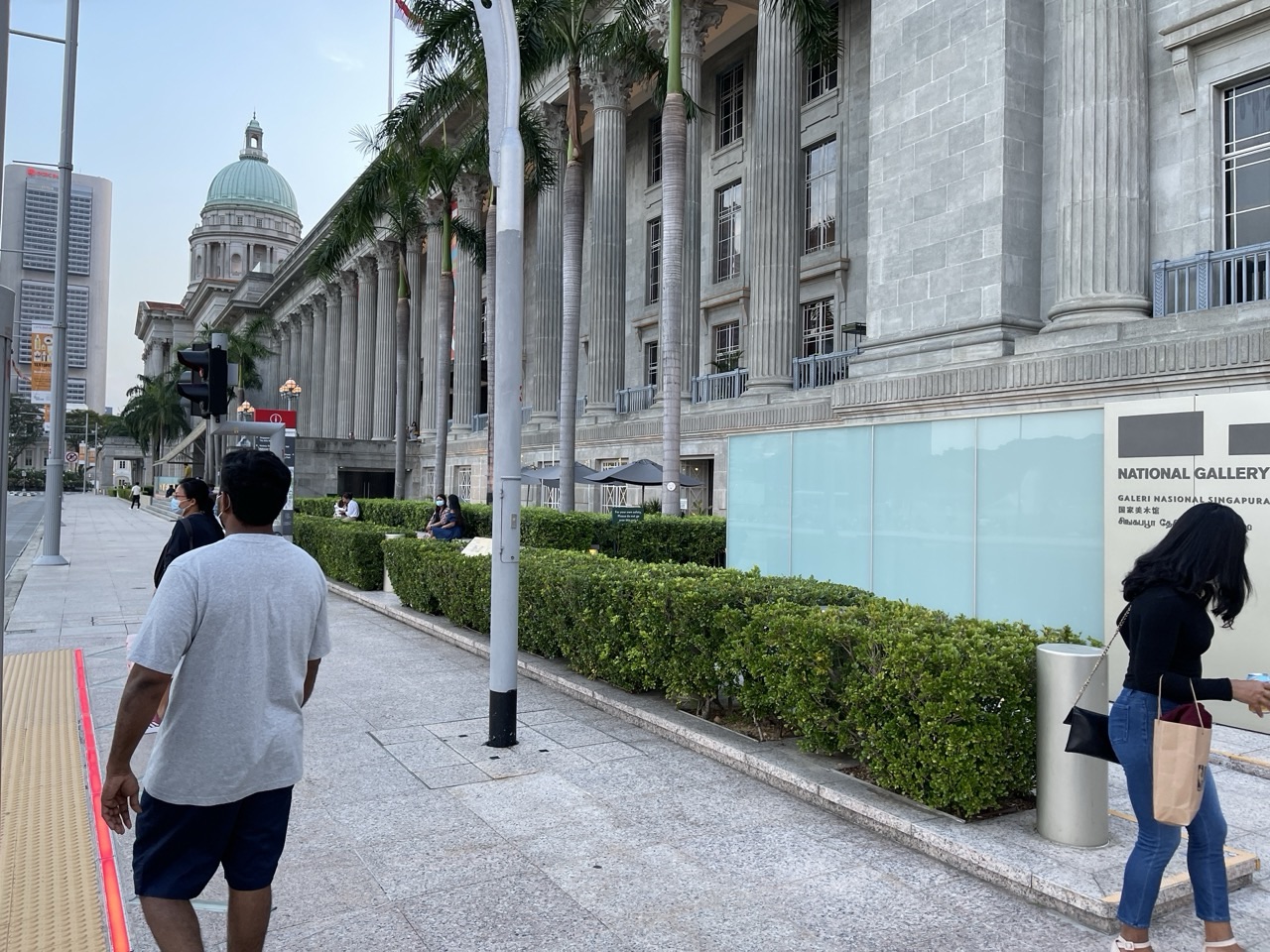
What to do in Singapore when you would like to understand art rather than simply stand in front of a painting and wonder what you are supposed to say? Visit National Gallery Singapore with a small question, a method for looking and the freedom to explore slowly. One carefully examined artwork can reveal far more about observation, imagination, society and history than a rushed attempt to see every gallery.
National Gallery Singapore occupies the former City Hall and Supreme Court buildings at 1 St Andrew’s Road. It focuses on modern and contemporary art from Singapore and Southeast Asia, with exhibitions, learning spaces and heritage architecture that can support a thoughtful half-day visit. You do not need to be an artist or an art historian to participate.
The most important October 2026 planning detail is that the UOB Southeast Asia Gallery is temporarily closed, with reopening expected in late 2027. The official visitor page confirms that works from the National Collection remain displayed elsewhere, and the reopened DBS Singapore Gallery offers a substantial alternative. A useful visit should follow what is actually open rather than an older tour that still promises the closed wing.
The quick answer: one artwork, three questions, one explanation
Choose the DBS Singapore Gallery or an accessible free space, take your time with a small number of artworks and use a reliable interpretation method.
- Notice first: what is physically visible—colour, line, materials, figures, arrangement and scale?
- Ask why: what question or situation might the artist be exploring?
- Check context: what does the artwork label, exhibition text or Gallery guide actually establish?
- Compare: how does a different artwork address a similar theme?
- Make room for uncertainty: personal interpretations can be valuable, but they are not automatically historical facts.
- Plan the visit: check current galleries, admission categories, tours, access needs and the journey home.
- Respect the art: follow photography rules, do not touch objects and keep other visitors’ views clear.
A satisfying art day ends when you can explain how you reached an interpretation—not when you have photographed every famous work.
What is National Gallery Singapore?
The Gallery is an art institution using the historic City Hall and former Supreme Court buildings to present and interpret visual art. Its collections and exhibitions connect artists with changes in Singapore and the wider Southeast Asian region.
The Gallery’s visitor information identifies the location, admission categories and general hours. The institution normally opens daily from 10 a.m. to 7 p.m., with last admission at 6.30 p.m.; some entrances and restaurants have separate hours.
An art museum is more than a storehouse of paintings. It chooses what to display, researches historical connections, conserves objects, writes interpretive labels and designs experiences for different audiences.
As a visitor, you are entering a conversation between artworks, the people who created them, curators and everyone who looks at them today.
Why art belongs in an education about Singapore
History books describe events through records. A painting or sculpture may communicate how someone interpreted the society around them, the changes they witnessed or the relationships they imagined.
Art is not a transparent photograph of history. An artist may simplify, exaggerate, symbolise or transform a scene. That makes artistic works valuable evidence of a viewpoint, but not automatic proof that every depicted detail occurred exactly as shown.
The Singapore Stories exhibition asks questions such as whose story is being told, where home is and what art is for. Those are useful questions for anyone learning about national identity, migration, social change and cultural memory.
The best education through art combines curiosity with careful distinction between what an object depicts and what historical sources verify.
Start with the exhibition that is actually open
The DBS Singapore Gallery’s Singapore Stories: Pathways and Detours in Art is a long-term exhibition spanning artistic developments from the nineteenth century to today.
Its approach is not simply a chronological parade of famous names. It asks how artistic communities engaged with colonialism, changing cities, class, labour, identity and the connections between Singapore and other places.
That is a good starting point because a visitor can select a topic and follow artworks representing different responses. A student might explore the representation of work; a parent might notice depictions of neighbourhoods; another visitor may be interested in how artists experiment with materials.
Choose one area within the exhibition and read slowly. There is no obligation to finish its complete historical narrative on one visit.
Why the UOB Southeast Asia Gallery closure matters
The visitor page states that the UOB Southeast Asia Gallery is temporarily closed and expected to reopen in late 2027.
This means an older article listing the entire UOB wing as a normal gallery stop should not be followed unchanged. Some older self-guided tour pages may still describe exhibits located in the closed area.
Do not enter barriers or assume that a named artwork is on public display just because a search engine shows an old gallery photograph. Use the current in-gallery guide and ask Visitor Services which collection works are available.
A well-planned museum visit distinguishes collection ownership from current display. An institution can hold an artwork without showing it in the space you expect.
How to use the current Gallery guide
The in-gallery guide lists exhibitions, visitor services, free areas, tours and audio guides.
Begin there rather than depending on a decade-old floor map. Check which gallery requires admission and which public space can be accessed without a ticket.
Some tours contain routes through spaces that may change during renovation. A current listing or staff advice is a better guide than a static social-media recommendation.
You can also choose a short self-guided visit. The Gallery has published a first-timer itinerary of roughly ninety minutes, but the actual visit should reflect current closure notices and your pace.
The purpose of the guide is to reduce logistical uncertainty so your attention can stay with the art.
The first skill: describe before you interpret
Stand at a suitable distance from one artwork. Before reading the label, ask yourself what you can directly see.
For a painting, notice colours, shapes, figures, gestures, objects and the distribution of light. For a sculpture, consider its material, size, surface and relationship with the space around it.
Write two sentences with no interpretive claims. “Several people occupy the foreground” is a description. “They are anxious about economic change” is an interpretation that would require reasons.
This separation helps you become a better observer. It prevents your mind from rushing toward a story before you have actually noticed what is present.
What is composition?
Composition means the arrangement of visual elements. An artist may place a figure in the centre, leave large empty spaces, repeat shapes or use lines that draw attention across the work.
Ask what you notice first and why. Is it size, contrast, position, colour or the direction that figures appear to face?
Then look at what is less prominent. A small detail near the edge may change your understanding of a scene.
Composition is a practical technology of attention. Advertising, photographs, scientific diagrams and mobile app interfaces also arrange elements to influence what people notice.
A museum gives you a chance to investigate that influence without the constant pressure to respond immediately.
Colour can communicate without one fixed meaning
A painting’s palette can affect mood, contrast and visual relationships. Strong warm colours may feel intense in one context, while muted colours may create a different effect.
But there is no universal dictionary in which each colour always means one emotion. The artwork’s context, artistic tradition and neighbouring elements matter.
Try describing a colour relationship precisely. “A bright red form contrasts with the grey background” explains an observable effect. “Red always represents anger” makes an unsupported general claim.
This is how vocabulary improves interpretation: it replaces vague reactions with evidence.
The goal is not to eliminate personal response, but to show why the work produced that response.
Line, shape and rhythm
Straight, curved, repeated or broken lines can influence how a viewer experiences movement and structure.
Look at whether forms create a pattern. Are repeated shapes calm and regular, or do changes in their spacing create tension? Do figures seem static or moving?
A child can trace the direction of shapes in the air without touching the artwork. An older learner can sketch a simple compositional diagram in a notebook where museum rules permit.
These practices develop visual literacy. A student becomes more capable of explaining how an image works instead of using only the word “beautiful.”
Materials are part of meaning
Paint, paper, ink, textile, metal, wood and contemporary mixed media have different physical qualities. A medium influences the surface, scale, durability and creative possibilities of an artwork.
Read the label and identify the actual medium rather than guessing from appearance. A printed image may resemble a painting, while a digital installation can produce a visual effect that has no stable physical canvas.
Ask why the artist might have chosen the material. What can it do easily? What limitations does it create? Does its texture influence how the subject is understood?
Do not claim an artist’s private intention without supporting sources. A useful interpretation can remain tentative while still grounded in what you see.
Context changes the experience
An artwork made during an era of major social change may be understood differently when you learn about that context.
In the Singapore Stories exhibition, artists are presented in relation to changing conditions, including colonialism and globalisation. That invites visitors to consider the society surrounding the work.
But context does not mean that every image is a direct political statement. Artists also experiment with form, technique, relationships and personal experience.
Ask what evidence connects the work with a particular historical situation. Then distinguish documented background from your interpretation of how that background shaped the image.
This produces a richer and more responsible discussion.
The artist’s identity matters, but should not determine everything
Knowing an artist’s place, era, training or cultural connections can help illuminate an artwork. However, it is a mistake to assume that all artists from one country produce identical styles or beliefs.
Singapore’s art history includes different aesthetic movements, communities and relationships with wider regional traditions.
The Gallery’s interpretation examines these differences instead of reducing national art to one uniform identity.
Ask how a particular artist approached their subject and whether other artists responded differently. Individual choices remain important within broader social context.
This is useful for learning about culture more generally: group membership can provide context without exhausting the complexity of an individual person’s work.
Georgette Chen and the question of belonging
The DBS Singapore Gallery introduces figures including Georgette Chen, whose life and art involved movement across places and artistic cultures.
Her work can be used as a starting point for asking how an artist’s sense of home may change over a lifetime. The answer must come from actual works, biographical records and curatorial explanation rather than a guess about the artist’s private feelings.
Choose a displayed work by Chen if one is available during your visit. Describe the subject, medium and composition before reading the label.
Then ask which features of the exhibition help you understand its place in Singapore’s art history.
An individual work becomes more interesting when viewed carefully rather than treated as one photograph in a famous-names collection.
Liu Kang and the study of artistic communities
The Gallery’s Singapore Stories account also references Liu Kang among artists who contributed to the changing visual arts landscape.
Artistic communities often form through learning, discussion, experimentation and shared projects. Their members may influence one another while making distinct choices.
If a relevant work is on display, look at how figures and settings are arranged. Ask whether the artwork presents daily life, relationships, labour or an imagined scene.
Do not assume it is a literal historical photograph. Artistic representation can transform its subject.
The deeper inquiry concerns how artists develop visual methods to explain what they find important in society.
Chen Wen Hsi and experiment
Chen Wen Hsi is another name associated with the Gallery’s presentation of Singapore art. His work can open questions about the relationships between different artistic traditions, forms and processes.
Rather than guessing a style from the artist’s name, look at the actual exhibited work, its label and the surrounding curatorial context.
Ask how the materials, colours or figures differ from another piece nearby. Which similarities might suggest shared influences, and which differences reveal individual exploration?
This is a method of comparison, not an attempt to classify an entire artist’s life through one canvas.
Art can tell stories about work
A painting showing labourers, craftspeople, markets or domestic activity can invite questions about whose work receives public attention.
Observe what the artist chooses to show. Are tools visible? Is a workplace depicted from the viewpoint of someone working or someone watching? How do size and position influence the subject’s importance?
Be careful not to infer exact wages, working conditions or historical policies from the image alone. Those claims require additional documentary sources.
Art can begin a question that history research later answers.
This is a useful connection to Economics and Social Studies because it encourages learners to consider how ordinary work is represented.
Art can question the meaning of home
Home can refer to a building, a neighbourhood, a family relationship, a place of belonging or a memory that has changed over time.
An artist may explore home through interiors, landscapes, maps, people or abstract forms. The viewer’s own experience will influence the response, but the object still deserves careful attention.
Ask how the work creates the impression of a place. What details suggest familiarity or distance? Are those observations supported by the label?
A museum gives people room to encounter another interpretation of belonging without being required to agree completely.
The purpose is thoughtful conversation, not forcing one definitive emotional response.
The building itself is part of the lesson
National Gallery Singapore occupies the former Supreme Court and City Hall buildings. Both had important civic functions before being adapted into an art institution.
The Gallery’s building history and visitor guide identify heritage spaces such as the Chief Justice’s Chamber and Office as publicly accessible interpretive areas.
Ask what it means to place art inside buildings associated with law and government. Does the historic setting change how a visitor understands public culture?
Notice how contemporary walkways and atria connect older architectural spaces. Conservation involves both retaining meaningful features and making a building usable for a new purpose.
The Art Connector: arrival as part of the experience
The Gallery identifies City Hall MRT, Exit B, as a convenient rail approach, with a roughly seven-minute walk via the Art Connector according to its current directions.
A traveller’s route is part of the visit. Notice the change from the surrounding Civic District to the historic Gallery architecture.
Do not assume that one walking time applies equally to families with strollers or visitors with mobility needs. Check the appropriate entrance, available lifts and weather.
A calm arrival lets you begin by observing architecture rather than rushing to a ticket counter.
The Padang Atrium and modern architectural intervention
The Padang Atrium connects the two historic wings, creating an experience that includes both restored buildings and contemporary design.
Look at the relationship between the old stone façades and newer surfaces or structures. How has the modern intervention made circulation easier? Which architectural contrasts are deliberate and visible?
Avoid asserting specific engineering calculations without technical documentation. The most useful observation is how design enables a new public purpose within older structures.
This is an accessible lesson in adaptive reuse, the practice of giving an existing building a new function while addressing its historical significance.
An art visit can begin without a ticket
The Gallery’s current visitor page identifies several non-ticketed spaces, including the Keppel Centre for Art Education, ArchiGallery, roof garden gallery and selected concourse or heritage areas.
These are useful when you want a low-cost introduction, a shorter visit or an experience with younger children.
But free public access does not guarantee that every event, installation or gallery is operating at your chosen time. Check the in-gallery guide and onsite signs.
A meaningful visitor experience does not depend on purchasing the most comprehensive ticket. Choose the space that fits your question.
General admission is not identical for all visitors
According to the current admission information, Singapore citizens and permanent residents receive free general admission, while the standard general-admission price for other nationalities is listed as S$20, subject to current terms.
Children aged six and under, locally based students and teachers, qualifying persons with disabilities and a caregiver, and certain other categories may be eligible for free entry.
Special exhibitions and All Access tickets may have different rates. Do not confuse free general admission with unrestricted access to every exhibition in the building.
Read the exact ticket type and verify eligibility at the time of purchase or redemption.
The UOB closure can affect older recommended routes
Some older art guides describe the UOB Southeast Asia Gallery as a central route stop. That does not match its present closure status.
If a self-guided route directs you there, check the current visitor map and choose a different open space or a currently available National Collection display.
Do not attempt to cross barriers or seek staff-only access to a closed gallery. The renovation is part of an institution’s changing exhibition programme.
A successful visitor adapts. The DBS Singapore Gallery and free interpretation spaces can support an excellent art outing without the closed wing.
A new exhibition is not automatically open today
The current visitor page includes an upcoming Level 4 exhibition titled Let’s Imagine the World Together: Art in Southeast Asia, scheduled to open on 5 November 2026.
That is a forward-looking date from the perspective of October 31. It should not be represented as already open.
Similarly, another special exhibition is scheduled later in December. The correct itinerary depends on the date actually chosen.
When researching attractions, learn to read “opening soon,” “ongoing,” “temporarily closed” and “permanent collection” as distinct status categories.
The Keppel Centre for Art Education
The Gallery’s in-gallery guide lists the Keppel Centre for Art Education among its public-access learning areas.
It can provide a useful place for children to encounter artistic concepts through activities designed for younger audiences, subject to current programme rules.
Do not assume every hands-on exhibit is available without limits or that children may run or touch everything. Follow the instructions and help them take turns.
Parents can ask one thoughtful question after an activity: “What did you change, and what difference did it make?”
That links creative play with observation and reasoning without turning the visit into formal tuition.
Slow looking: a useful museum technique
The Gallery offers Slow Art with Friends as a self-guided method.
Slow looking begins by spending meaningful time with one artwork rather than moving quickly to the next. You might look silently, record observations, share different interpretations and revisit the work after reading its context.
This is surprisingly useful because our everyday media habits often encourage rapid scrolling and instant judgment.
A museum provides the opposite environment: time to examine uncertainty and notice details that did not appear in the first few seconds.
A five-minute slow-looking routine
Begin with one quiet minute. Notice the overall form without reading the label. Then choose three details and describe them precisely.
Ask what they seem to have in common. Form one tentative interpretation, using the word “perhaps” if the evidence is uncertain.
Now read the label and note whether it confirms, challenges or complicates your idea. Finally, look again and identify something you had initially missed.
This routine trains the mind to revise judgments in response to information. It works for art, science images, advertising and data visualisations.
A family conversation with no single correct answer
A parent and child may see different things in the same painting. That is not necessarily a failure. One may notice the people; another notices the background colours.
Ask the child to explain what made a detail important. Then respond with an observation of your own. If a factual claim arises about the artist or historical context, check the museum label together.
This separates open interpretation from verifiable information. You can disagree about the mood of a painting while still agreeing about the materials and objects shown.
The result is a more thoughtful conversation than asking the child to guess the one sentence the adult already wants to hear.
Primary-school children: the three-detail challenge
Choose one accessible and age-appropriate artwork. Ask the child to find a shape, a colour contrast and a repeated pattern.
Let them describe these using their own vocabulary. You may introduce words such as foreground, background, texture and composition when useful.
Do not insist on sitting through several hours of formal art history. A short visit with an enjoyable activity can create a lasting willingness to engage with museums.
Supervise children and follow the Gallery’s no-touch instructions. The artwork is not a play object simply because its surface looks interesting.
Secondary students: build an evidence-based art paragraph
A Secondary student can choose an artwork and write a claim about its effect or subject.
The paragraph should identify the title and artist accurately, describe two visible details, explain how they support an interpretation and acknowledge relevant context from the museum.
For example, the student might explain how repeated figures draw attention to communal activity without claiming to know each figure’s identity or feelings.
This strengthens English and Humanities skills. The student is constructing an argument supported by evidence rather than replacing thought with fashionable art terminology.
A visual arts student: compare media
Choose two works in different media, such as a painting and a mixed-media installation, when currently available.
Describe how each uses material, scale, arrangement and space. Ask what expressive possibilities a particular medium offers and what limitations may matter.
Do not copy an artist’s technical process or claim knowledge of unobserved materials from appearance alone. Read the labels and any artist statements.
A good comparison explains how form and meaning interact, not simply which artwork you like more.
Adults who feel intimidated by art
You do not need a specialised vocabulary before entering. Start by saying what you see in plain language and what questions occur to you.
If a label contains an unfamiliar term, identify the part of the explanation that matters and look it up. Do not pretend you understand because the museum environment feels formal.
Curators, guides and educational resources can provide context. But your own observations also matter, as long as you distinguish them from factual claims.
The point is to participate in thought, not to perform expertise for other visitors.
The role of a guided tour
The Gallery’s current exhibition page lists guided tours for the DBS Singapore Gallery, subject to schedules and capacity.
A guide can introduce artists, interpretive themes and connections that you may not notice independently. But tour availability can change, and some routes may be affected by renovation.
Check the live listing, register where required and arrive early. Do not assume a free tour means free admission to ticketed galleries for visitors who otherwise need a ticket.
A self-guided visit remains worthwhile if the tour is full or unavailable.
Photography etiquette in an art museum
Check the Gallery’s rules and the signs beside individual artworks. Some works may be photographable while others have restrictions because of loans, rights or conservation needs.
Avoid flash where prohibited, keep equipment clear of other people and do not lean into artworks to obtain a close-up. A photograph of a gallery label is not a substitute for understanding the work.
Consider copyright and permissions before reproducing artwork images in commercial materials. Public display does not mean unlimited reproduction rights.
The best record of a visit may be a short written reflection paired with a permitted photograph rather than dozens of images with no context.
Accessibility is more than an entrance ramp
The Gallery’s visitor page lists wheelchair loan services, accessible restrooms, lifts and visitor support at major entrances.
Choose the entrance that fits the group and the exhibitions actually selected. A comfortable route may require more than the shortest distance from the MRT.
If someone has sensory or mobility needs, consult the specific exhibition’s access advisory and ask staff for current assistance.
Do not insist everyone move at one pace. An accessible art visit lets each person spend time engaging with works in a way that suits them.
A manageable 90-minute visit
Begin at a convenient Gallery entrance and review current exhibitions and tickets. Choose two or three works in the DBS Singapore Gallery and set aside time for slow looking.
Take a break. If the group remains interested, add one free heritage or architectural space, such as ArchiGallery, subject to current access.
Finish by discussing which artwork generated the strongest question and what the label clarified.
The time allocation is illustrative, not a requirement. Some visitors will want longer, while a younger child or someone with fatigue may be satisfied with a short encounter.
What if you want only the free areas?
Use the current free-space directory and choose one learning or architecture-focused area. You can examine the historic building itself, visit an available public education space or enjoy an authorised viewing area.
Do not assume that a free public route grants entry to the ticketed DBS galleries. Respect admission barriers and staff instructions.
A short free visit can be meaningful if your purpose is to understand the Gallery’s architecture or practise observation.
Another day, you can choose a paid or complimentary eligible admission according to your interest and circumstances.
The Gallery and Singapore’s colonial civic architecture
The former City Hall and Supreme Court buildings are a reminder that museums can occupy places with complicated political histories.
Ask what those buildings were used for before the Gallery opened. How does their present role invite the public to interact with spaces that once had specialised administrative or legal purposes?
Avoid assuming all historical events associated with a building occurred in the exact room you are viewing. Interpretive displays and official building histories can clarify which spaces were used for what.
This creates a connection between art history, civic education and architectural conservation.
Curators choose a narrative, not the entire truth of art
An exhibition cannot show every work ever made. Curators select objects and organise them into themes, periods and relationships.
The Singapore Stories exhibition explicitly asks whose stories are represented and how art history has been written.
That makes curatorial interpretation itself part of the learning. Ask why two works appear together and whether another arrangement would create a different understanding.
A mature visitor can appreciate the exhibition while recognising that it is a structured narrative open to further research.
Art, identity and the danger of stereotypes
A painting showing a cultural practice may be a valuable expression by a particular artist. It does not prove that all people belonging to that community experience the practice in one way.
Avoid using one visual image to make sweeping claims about gender, nationality, ethnicity or personal belief.
Use the work as an invitation to ask questions, then seek broader evidence where you need historical or social conclusions.
Art literacy includes ethical interpretation: looking closely without reducing the people depicted or the artist to simplistic categories.
How to use art to strengthen vocabulary
Choose five words: composition, medium, perspective, symbolism and interpretation.
Describe a work using each term only when it genuinely applies. A medium refers to material or process; perspective can refer to a visual technique or viewpoint; symbolism concerns elements carrying meanings beyond literal appearance.
An interpretation is a reasoned explanation, not an officially guaranteed secret message.
Vocabulary becomes a thinking tool when it helps you make distinctions you could not easily express before.
The final three-sentence reflection
After your visit, write: “I noticed… I interpreted… The exhibition helped me understand…”
The first sentence contains observable details. The second explains your personal response with reasons. The third states what a label or guide contributed.
If your interpretation changed, mention that. Revising an idea after new evidence is a valuable learning outcome.
This small reflection is portable. It works after any visual arts museum, public art installation or carefully observed building.
Common mistakes and useful repairs
Mistake: assuming the UOB Southeast Asia Gallery is open in October 2026. Repair: check the temporary closure notice and use open exhibitions.
Mistake: trying to see every work in one visit. Repair: choose a small number and look closely.
Mistake: declaring a personal interpretation to be the artist’s documented intention. Repair: distinguish observation, interpretation and verified context.
Mistake: assuming everyone pays the same ticket price. Repair: check current admission categories and special exhibition requirements.
Mistake: treating artwork photos as unrestricted commercial content. Repair: follow photography and reproduction rules.
Mistake: turning a family visit into a test. Repair: allow age-appropriate questions, play and conversation.
Frequently asked questions
What is the best thing to do at National Gallery Singapore?
For a first visit, explore a few works in the DBS Singapore Gallery’s Singapore Stories exhibition, or choose an accessible free education or heritage space. Look slowly and read the context.
Is National Gallery Singapore open every day?
The current official visitor page lists daily opening from 10 a.m. to 7 p.m., with last gallery admission at 6.30 p.m. Individual areas may have different arrangements.
Is the UOB Southeast Asia Gallery open?
No. It is temporarily closed, with reopening planned for late 2027. Works from the National Collection are still displayed in other areas.
Is admission free?
Singapore citizens and permanent residents generally receive free general admission, while other categories and special exhibitions have their own conditions. Some public spaces are free for everyone without a ticket.
Are children welcome?
Yes. The Gallery has family and education resources, including the Keppel Centre for Art Education. Choose age-appropriate activities and follow visitor rules.
Do I need to understand art before visiting?
No. Begin by observing visible details, offering a tentative interpretation and checking the label.
Can I photograph paintings?
It depends on the work and exhibition. Follow current signs and staff instructions, and check reproduction rights before commercial use.
Where is the Gallery?
At 1 St Andrew’s Road, Singapore 178957, with City Hall MRT among the convenient public transport approaches.
Official sources and connected eduKate reading
Check National Gallery Singapore visitor information, Singapore Stories: Pathways and Detours in Art, the current in-gallery guide, first-timer self-guided tour and Slow Art with Friends.
Continue with Touring Singapore | Things to Do and Places A–Z, What to do in Singapore | Discover Art Inside MRT Stations, What to do in Singapore | Sketch the City’s Buildings and What to do in Singapore | Investigate a Question at the National Library.
What you should take away
An artwork is not a puzzle with one secret answer that everyone else understands. It is something you can observe, interpret and investigate with evidence.
Visit the spaces that are actually open, give yourself time, respect the objects and leave with a clearer explanation of something that caught your attention. The strongest reason to visit National Gallery Singapore is that it can teach you a new way to look at the world.